
Paper Barrier Coatings Market Size and Share
Market Overview
| Study Period | 2022 - 2032 |
|---|---|
| Market Size (2027) | USD 2.19 Billion |
| Market Size (2032) | USD 2.99 Billion |
| Growth Rate (2027 - 2032) | 6.44 % |
| Fastest Growing Market | Asia-Pacific |
| Largest Market | Asia-Pacific |
| Market Concentration | Low |
Major Players *Disclaimer: Major Players sorted in no particular order Image © Mordor Intelligence. Reuse requires attribution under CC BY 4.0. | |
Paper Barrier Coatings Market Analysis by Mordor Intelligence
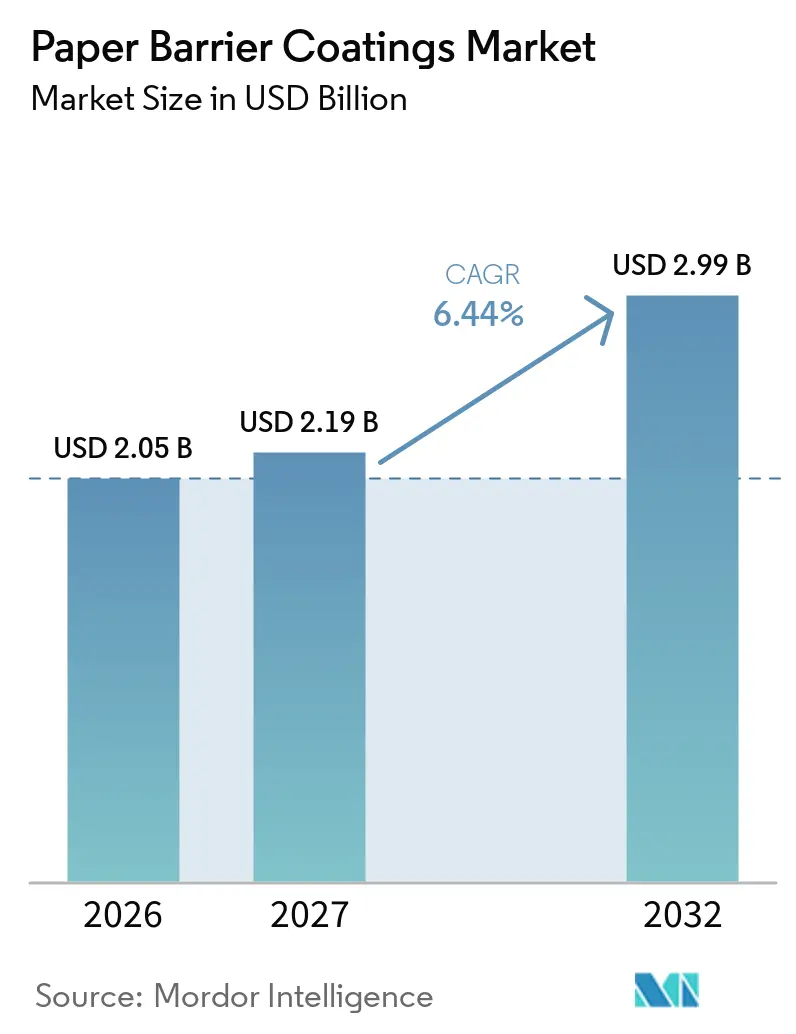
The Paper Barrier Coatings Market size was valued at USD 2.05 billion in 2026 and is estimated to grow from USD 2.19 billion in 2027 to reach USD 2.99 billion by 2032, at a CAGR of 6.44% during the forecast period (2027-2032). Regulatory restrictions on per- and polyfluoroalkyl substances (PFAS) are moving converters toward water-based and fluorine-free barriers for paper packaging. Regulation (EU) 2025/40 sets limits of 25 parts per billion for individual PFAS and 250 parts per billion for total targeted PFAS in food-contact packaging, strengthening the need for compliant alternatives in Europe. The paper barrier coatings market is also benefiting as brands replace polyethylene-laminated paper with fiber-based formats that can meet recycling requirements. Suppliers are responding with lower-coat-weight products, food-contact approvals, and materials that can run on existing paper-converting equipment. Cost premiums, testing requirements, and uneven recovery systems continue to slow adoption in price-sensitive applications.
Key Report Takeaways
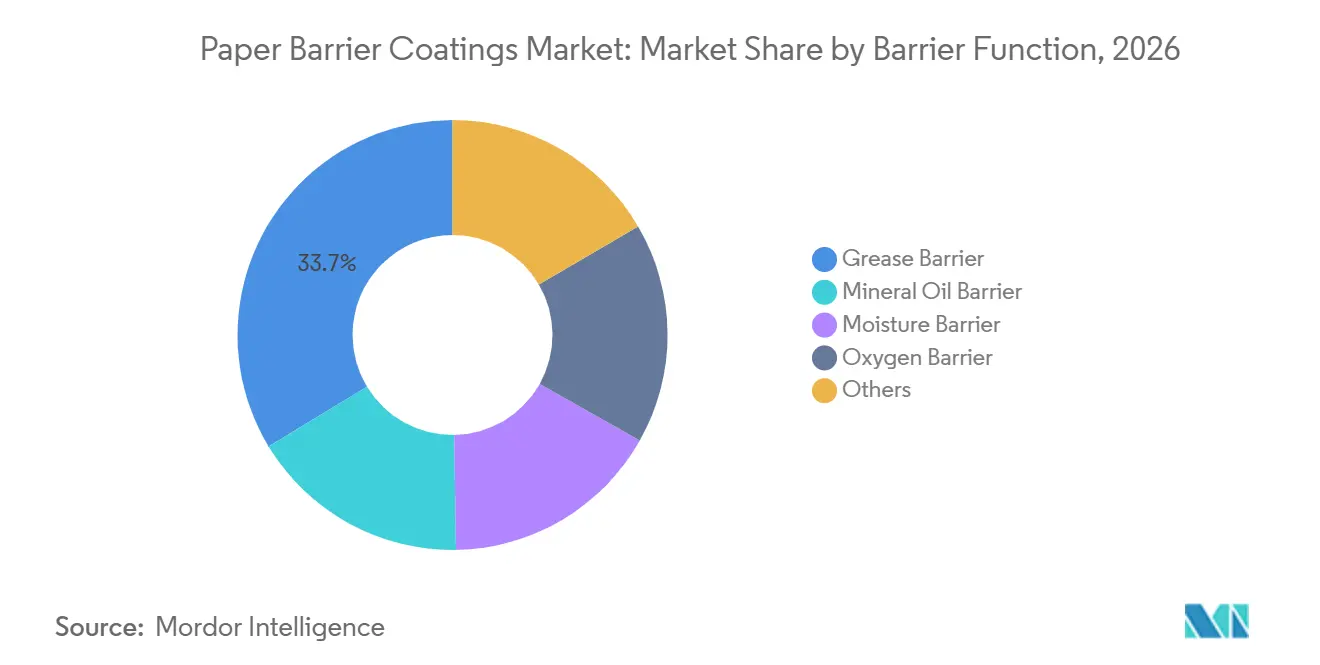
- By barrier function, grease barrier held 33.67% of the paper barrier coatings market share in 2026, while the oxygen barrier is projected to advance at a 7.12% CAGR through 2032.
- By chemistry, acrylic held 28.12% of the paper barrier coatings market share in 2026, while bio-based polymer is projected to advance at a 7.37% CAGR through 2032.
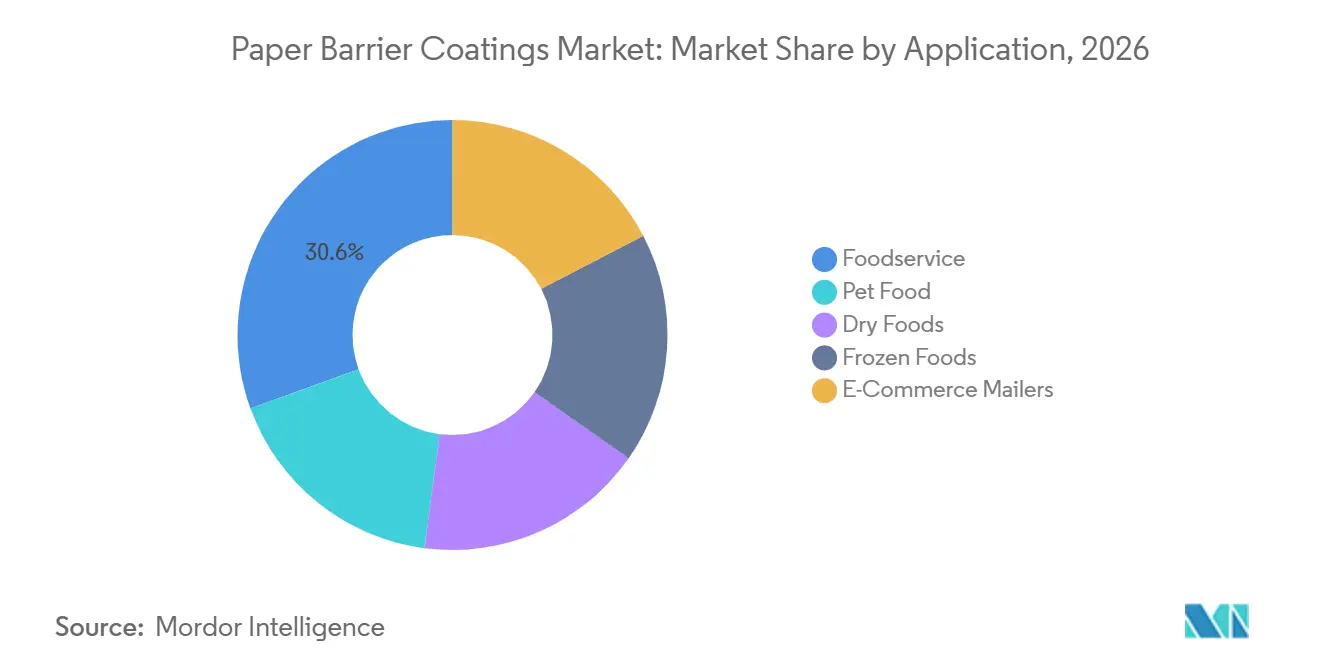
- By application, foodservice held 30.55% of the paper barrier coatings market share in 2026, while e-commerce mailers are projected to advance at a 7.58% CAGR through 2032.
- By geography, Asia-Pacific held 38.28% of the paper barrier coatings market share in 2026 and is projected to advance at a 7.45% CAGR through 2032.
Note: Market numbers in this report are based on Mordor Intelligence's proprietary estimation framework, which combines nine months of actuals with Q4 projections for base year 2026.
Global Paper Barrier Coatings Market Trends and Insights
Drivers Impact Analysis*
| Driver | (~) % Impact on CAGR Forecast | Geographic Relevance | Impact Timeline |
|---|---|---|---|
| Plastic-to-Fiber Packaging Conversion | +1.8% | Global | Short term (≤ 2 years) |
| PFAS Phase-Out and Compliance-Ready Alternatives | +1.5% | Europe, North America | Short term (≤ 2 years) |
| Recyclable and Repulpable Foodservice Formats | +1.0% | Global foodservice hubs | Medium term (2–4 years) |
| E-Commerce and Automated Fulfillment Packaging | +0.8% | Asia-Pacific, North America, Europe | Medium term (2–4 years) |
| Low-Coat-Weight and Existing-Line Compatibility | +0.4% | Global, early gains in APAC and Europe | Long term (≥ 4 years) |
| Source: Mordor Intelligence | |||
Plastic-to-Fiber Packaging Conversion
The replacement of single-use plastic and polyethylene-laminated paper is a durable driver for the paper barrier coatings market. Brand owners and converters are changing procurement specifications as regulations and packaging commitments favor fiber-based materials. The shift requires a barrier chemistry that matches each package's exposure to grease, moisture, or oxygen. This need favors suppliers with several coating options over suppliers that sell a single product. BASF and UPM Specialty Materials announced a May 2026 collaboration that paired Joncryl HPB waterborne barrier resins with different UPM papers for fatty food and dry food applications. The partnership shows that paper conversion depends on matching the coating and substrate rather than treating all paper packaging as one application.
PFAS Phase-Out and Compliance-Ready Alternatives
PFAS restrictions are creating an immediate reformulation requirement for food-contact paper packaging. Regulation (EU) 2025/40 established PFAS concentration limits that apply to food-contact packaging in the European Union[1]. The paper barrier coatings market, therefore, has a clear compliance role for converters that previously used fluorochemical grease barriers. Bio-based alternatives cost USD 0.015 to USD 0.98 per m², compared with USD 0.00012 per m² for PFAS treatments, which raises transition costs. Hybrid dispersion formulations can help converters balance fluorine-free requirements with cost and operating performance. Products with food-contact approvals can reduce the time between reformulation and commercial use.
Recyclable and Repulpable Foodservice Formats
Quick-service restaurants, coffee brands, and institutional food operators are increasingly specifying repulpable paper formats. Their choices are shaped by extended producer responsibility fees and recyclability classifications in several packaging systems. A coating must separate cleanly during repulping so mills can recover fiber without creating contaminants. This distinction matters because a package can carry a recycling claim but still cause operating problems in a paper mill. Kemira Oyj states that its FennoGuard barrier coatings performed comparably with uncoated material in standardized CEPI v2.0 recyclability testing. Mondi introduced its verified PFAS-free re/cycle FunctionalBarrier Paper range in September 2025, giving converters an already compliant paper substrate.
E-Commerce and Automated Fulfillment Packaging
E-commerce growth is broadening demand for moisture-resistant and grease-resistant paper mailers, liners, and overwraps. Food delivery is especially important where packages carry meals through humid or oily conditions. The paper barrier coatings market also must meet the handling requirements of automated filling and packaging lines. Inconsistent surface friction can interrupt vertical form-fill-seal and horizontal packaging equipment. Michelman, Inc. introduced Nuvita Life 4002 and Nuvita Life 4605 in April 2026 with a low coefficient of friction and crease resistance for these processes. Processing consistency is becoming as important as barrier performance for high-volume converters.
Restraints Impact Analysis*
| Restraint | (~) % Impact on CAGR Forecast | Geographic Relevance | Impact Timeline |
|---|---|---|---|
| Multi-Stage Qualification Across Coating, Printing, and Forming | -0.6% | Global | Medium term (2–4 years) |
| Drying-Energy and Line-Speed Constraints | -0.5% | Europe, North America | Medium term (2–4 years) |
| Inconsistent Collection and Recycling Infrastructure | -0.3% | South America, MEA | Long term (≥ 4 years) |
| Source: Mordor Intelligence | |||
Multi-Stage Qualification Across Coating, Printing, and Forming
New barrier formulations must satisfy several checks before converters adopt them at a commercial scale. Food-contact compliance, PFAS-free verification, repulpability tests, printing trials, and forming trials can each add time. The sequence can take 12 to 18 months when a converter must validate each application separately. Companies that secure multiple approvals before launch can reduce this delay. Michelman, Inc.'s Nuvita Life coatings carry TÜV Austria OK biobased Class 5 certification and were designed for recycling and packaging-line performance. Converters may postpone a switch when they manage many stock-keeping units and lack a clear testing path.
Inconsistent Collection and Recycling Infrastructure
Collection and recycling systems are uneven across South America and the Middle East and Africa. Paper packaging cannot deliver its full recycling value when organized recovery and repulping capacity are limited. This reduces the advantage of barrier-coated paper for applications that depend on local recycling outcomes. Foodservice wrappers, bakery papers, and trays can still be relevant because their use does not rely on complex recovery systems. Brazil's Decree No. 12,688/2025 established reverse-logistics requirements for plastic packaging, increasing attention to substitute packaging materials[2]. Exporters may also adopt compliant paper packaging to meet procurement requirements from customers in Europe and North America.
*Our forecasts treat driver/restraint impacts as directional, not additive. The impact forecasts reflect baseline growth, mix effects, and variable interactions.
Segment Analysis
By Barrier Function: Grease Barrier Anchors Revenue, While Oxygen Barrier Expands
Grease barrier held 33.67% of the market revenue in the paper barrier coatings market in 2026. Grease barriers are used in wrappers, food trays, and bakery papers where direct contact with oily foods is common. Moisture barrier coatings serve cold-chain and frozen-food formats where condensation can affect package strength and appearance. Mineral oil barrier coatings address concerns over mineral oil-saturated hydrocarbons and mineral oil aromatic hydrocarbons migrating from recycled fiber into food. These applications give the paper barrier coatings market a broad functional base beyond a single foodservice use case.
Oxygen barrier is projected to advance at a 7.12% CAGR through 2032. The segment supports dry foods, pet food, and modified-atmosphere packaging that need a longer shelf life. Paper formats in these categories seek to replace aluminum laminates and multilayer plastic structures. A 2025 paper in ACS Omega reported that polyvinyl alcohol and nanoclay composite coatings achieved an oxygen permeability coefficient of 0.875 cm³·mm/m²·day at 23 °C and 50% relative humidity. The result indicates that paper-based structures can reach higher barrier performance when the coating design is suited to the package. Oxygen protection remains important where food quality depends on limiting air exposure during storage.

By Chemistry: Acrylic Scale Persists and Bio-Based Polymer Targets Regulatory Demand
Acrylic held 28.12% of the market revenue in the paper barrier coatings market in 2026. Its position reflected formulation maturity, established line-speed compatibility, and lower cost than several alternative chemistries. Acrylic coatings continue to serve applications that need grease resistance, including hot food packaging. Some commercial acrylic systems now use renewable feedstock content through mass-balance methods. This can support partial bio-based claims without the cost of a fully bio-based formula. BASF described Joncryl HPB 1702 as an acrylic emulsion that maintained grease resistance at temperatures up to 60 °C.
Bio-based polymer is projected to advance at a 7.37% CAGR through 2032. Demand is linked to recycling requirements and brand-owner interest in circular packaging claims. Polyvinyl alcohol remains relevant in high-performance oxygen barrier applications. Kuraray Co., Ltd.'s PLANTIC EP resins have received recyclability certification that can shorten the qualification process for converters. Wax Dispersion chemistry faces pressure where paraffin-based materials are associated with poor repulpability. Hybrid Dispersion systems can provide water resistance while supporting paper recycling requirements. The 95/5 design-for-recycling criteria under the European packaging regulation may restrict access for chemistries with unresolved recycling performance.
By Application: Foodservice Anchors Demand and E-Commerce Mailers Reconfigure Specifications
Foodservice held 30.55% of the paper barrier coatings market size in 2026. Quick-service restaurants, institutional caterers, and coffee retailers are replacing PFAS-treated wrappers, trays, and bakery papers. These formats require grease resistance while remaining suitable for paper recycling systems. The segment benefits from repeated daily use and large procurement volumes. Foodservice providers also need materials that run consistently on packaging equipment. PFAS restrictions reinforce the move toward waterborne dispersion coatings for these uses.
E-commerce mailers are projected to advance at a 7.58% CAGR through 2032. Retail and fashion platforms are substituting plastic mailers with paper-based alternatives that need moisture and tear resistance. Dry food packaging is also adopting paper structures for sugar, flour, cereal, and confectionery. In May 2026, UPM, Michelman, Inc., and BOBST presented packaging concepts for tea bags, oatmeal, sugar stick-packs, cookies, and chocolate. Frozen foods require coatings that retain integrity through freeze-thaw cycles and condensation. Pet food creates a premium oxygen-barrier opportunity because shelf-life extension can reduce the need for refrigeration.
Geography Analysis
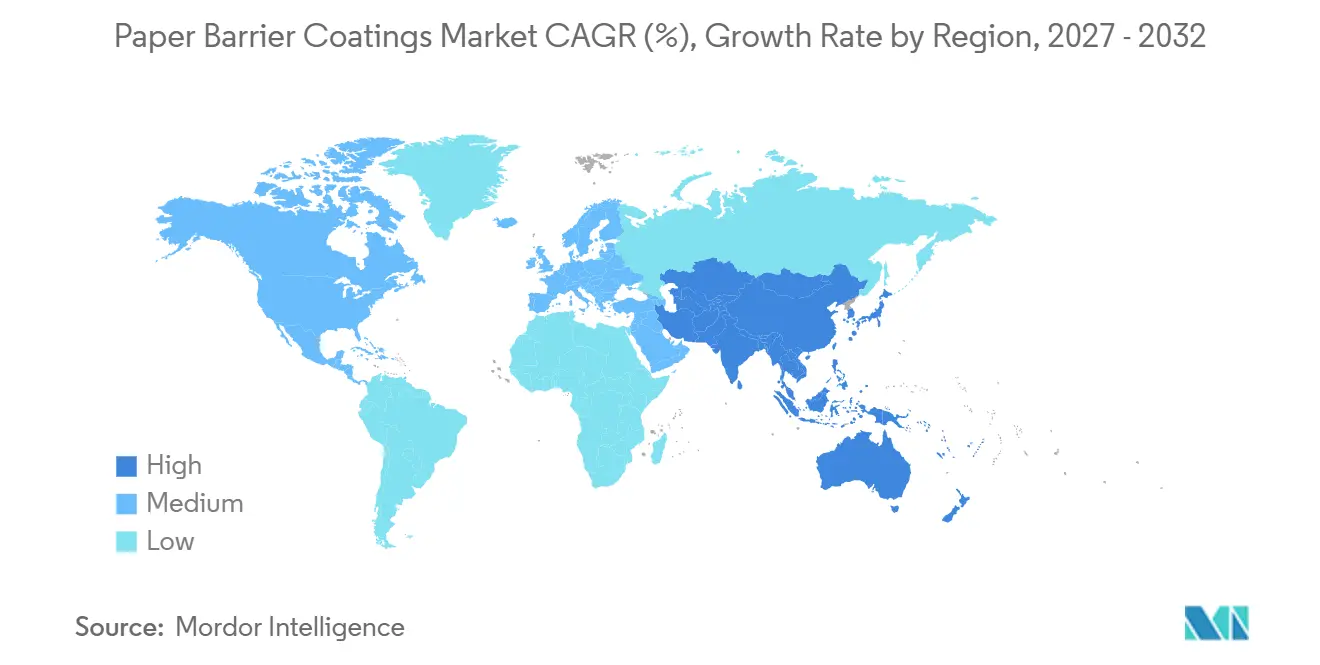
Asia-Pacific held 38.28% of revenue in the paper barrier coatings market in 2026 and is projected to advance at a 7.45% CAGR through 2032. China provides a large paper-converting base and high volumes of food delivery and e-commerce packaging. India's growing quick-service restaurant and e-commerce activity is adding demand for coated paper formats. Domestic paper mills are beginning to add inline dispersion-coating capabilities. South Korea and Japan are developing thin-coat technologies that seek to lower coat weight while protecting barrier performance.
North America is advancing through state-level PFAS rules and demand for paper mailers and shipping envelopes. California's AB 1200 restricts PFAS in plant-fiber food packaging and requires compliance documentation. More than 14 U.S. states have enacted PFAS restrictions for food-contact packaging. Europe remains a key regulatory center because its packaging rules set PFAS limits and design-for-recycling requirements. Germany's converting base is adopting waterborne dispersion systems, while Nordic markets offer stronger conditions for bio-based coatings because collection systems are more mature.
South America offers compliance-driven opportunities for food exporters serving Europe and North America. Brazil's reverse-logistics requirements for plastic packaging apply from 2026 and can raise interest in fiber-based alternatives. Argentina's meat, bakery, and dry-food exporters can face PFAS-free requirements from overseas retail customers. Saudi Arabia is adding domestic packaging manufacturing capacity through Vision 2030 programs. The Middle East and Africa have limited collection infrastructure in many locations. This makes immediate-use formats, including foodservice wrappers and bakery papers, more practical than applications that depend on organized recovery and repulping.
Competitive Landscape
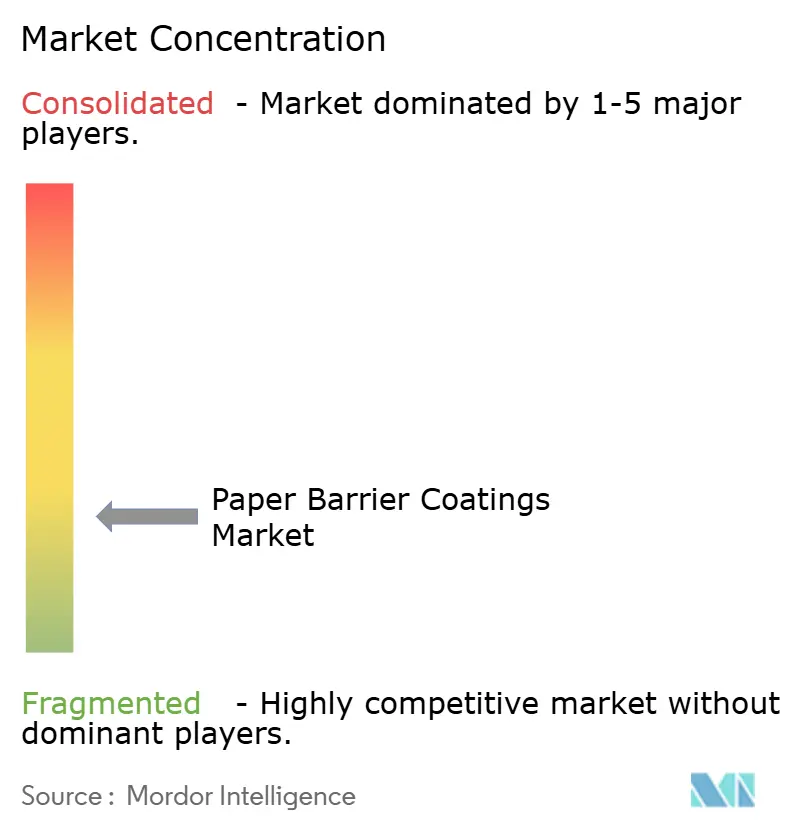
The paper barrier coatings market is highly fragmented, with the top five players including Solenis, Michelman, Inc., Dow, BASF, and Archroma. Multinational chemical suppliers hold broad waterborne dispersion portfolios, while integrated paper producers compete through barrier-coated paper and board. BASF, Henkel AG & Co. KGaA, and Kemira Oyj are active on the coating chemistry side. Stora Enso and Mondi compete through coated substrate portfolios. Suppliers are increasingly pursuing approvals under European and North American food-contact and recycling systems. This approach supports global procurement needs for brand owners.
BASF and UPM Specialty Materials announced a May 2026 collaboration that linked Joncryl HPB resins with UPM papers for recyclable fiber-based packaging. Michelman, Inc. introduced Nuvita Life 4002 and Nuvita Life 4605 in April 2026 for fiber-based retail food packaging. The products were designed for low surface friction, recyclability, and compostability pathways. Henkel AG & Co. KGaA expanded its water-based barrier and heat-seal portfolio for paper applications in April 2026. These moves show competition around materials, food-contact compliance, recyclability, and converting performance.
Opportunity areas include mineral oil barriers for recycled-fiber substrates, heat-sealable mono-material paper structures, and thin bio-based coatings for standard printing lines. ACTEGA presented water-based barrier coatings and thermoplastic elastomer dispersions for food trays, soap boxes, and fast-food packaging at Interpack 2026. Stahl launched its Repura portfolio for recyclable and repulpable paper-based packaging in May 2026. Solenis and HEIDELBERG also demonstrated inline flexographic coating integration in 2025. These strategies can reduce offline processing requirements for converters.
Paper Barrier Coatings Industry Leaders
-
Solenis
-
Michelman, Inc.
-
Dow
-
BASF
-
Archroma
- *Disclaimer: Major Players sorted in no particular order
Recent Industry Developments
- September 2026: Sun Chemical and Archipelago Technology Group announced a partnership to expand paper-based packaging using liquid barrier and resistant coatings. The collaboration supported the paper barrier coatings market by advancing recyclable barrier solutions for paper substrates and molded-fiber packaging.
- May 2026: Stahl launched its Repura barrier coatings portfolio for paper-based packaging, offering protection against oil, grease, water, water vapor, and oxygen while maintaining recyclability. The launch supported demand for high-performance coatings that enable paper to replace plastic-based packaging structures.
Global Paper Barrier Coatings Market Report Scope
Paper barrier coatings are functional coatings applied to paper and paperboard to improve resistance to substances such as grease, moisture, oxygen, and mineral oils. They enhance the protective performance of paper-based materials while supporting their use in packaging and other applications requiring barrier properties.
The Paper Barrier Coatings Market is segmented by barrier function, chemistry, application, and geography. By barrier function, the market is segmented into grease barrier, moisture barrier, oxygen barrier, mineral oil barrier, and others. By chemistry, the market is segmented into acrylic, PVOH (Polyvinyl Alcohol), bio-based polymer, wax dispersion, and hybrid dispersion. By application, the market is segmented into foodservice, dry foods, frozen foods, pet food, and e-commerce mailers. The report also covers the market size and forecasts for paper barrier coatings across 15 countries. For each segment, the market sizing and forecasts have been done on the basis of value (USD).
| Grease Barrier |
| Moisture Barrier |
| Oxygen Barrier |
| Mineral Oil Barrier |
| Others |
| Acrylic |
| PVOH (Polyvinyl Alcohol) |
| Bio-Based Polymer |
| Wax Dispersion |
| Hybrid Dispersion |
| Foodservice |
| Dry Foods |
| Frozen Foods |
| Pet Food |
| E-Commerce Mailers |
| Asia-Pacific | China |
| India | |
| Japan | |
| South Korea | |
| ASEAN Countries | |
| Rest of Asia-Pacific | |
| North America | United States |
| Canada | |
| Mexico | |
| Europe | Germany |
| United Kingdom | |
| France | |
| Italy | |
| NORDIC Countries | |
| Rest of Europe | |
| South America | Brazil |
| Argentina | |
| Rest of South America | |
| Middle East and Africa | Saudi Arabia |
| South Africa | |
| Rest of Middle East and Africa |
| By Barrier Function | Grease Barrier | |
| Moisture Barrier | ||
| Oxygen Barrier | ||
| Mineral Oil Barrier | ||
| Others | ||
| By Chemistry | Acrylic | |
| PVOH (Polyvinyl Alcohol) | ||
| Bio-Based Polymer | ||
| Wax Dispersion | ||
| Hybrid Dispersion | ||
| By Application | Foodservice | |
| Dry Foods | ||
| Frozen Foods | ||
| Pet Food | ||
| E-Commerce Mailers | ||
| By Geography | Asia-Pacific | China |
| India | ||
| Japan | ||
| South Korea | ||
| ASEAN Countries | ||
| Rest of Asia-Pacific | ||
| North America | United States | |
| Canada | ||
| Mexico | ||
| Europe | Germany | |
| United Kingdom | ||
| France | ||
| Italy | ||
| NORDIC Countries | ||
| Rest of Europe | ||
| South America | Brazil | |
| Argentina | ||
| Rest of South America | ||
| Middle East and Africa | Saudi Arabia | |
| South Africa | ||
| Rest of Middle East and Africa | ||
Key Questions Answered in the Report
What is the size of the paper barrier coatings market?
The Paper Barrier Coatings Market size was valued at USD 2.05 billion in 2026 and is estimated to grow from USD 2.19 billion in 2027 to reach USD 2.99 billion by 2032, at a CAGR of 6.44% during the forecast period (2027-2032).
What is driving demand for paper barrier coatings?
PFAS restrictions, fiber-based packaging conversion, and demand for recyclable foodservice and e-commerce packaging are supporting adoption.
Which barrier function held the largest share in 2026?
Grease barrier held 33.67% in 2026, supported by foodservice, bakery, and quick-service restaurant packaging.
Which chemistry is projected to advance fastest through 2032?
Bio-based polymer is projected to advance at a 7.37% CAGR through 2032 as packaging buyers seek recyclable and bio-based options.