
Packaging Tape Printing Market Size and Share
Market Overview
| Study Period | 2021 - 2031 |
|---|---|
| Market Size (2026) | USD 15.09 Billion |
| Market Size (2031) | USD 21.62 Billion |
| Growth Rate (2026 - 2031) | 7.46 % |
| Fastest Growing Market | Asia-Pacific |
| Largest Market | North America |
| Market Concentration | Low |
Major Players *Disclaimer: Major Players sorted in no particular order Image © Mordor Intelligence. Reuse requires attribution under CC BY 4.0. | |
Packaging Tape Printing Market Analysis by Mordor Intelligence
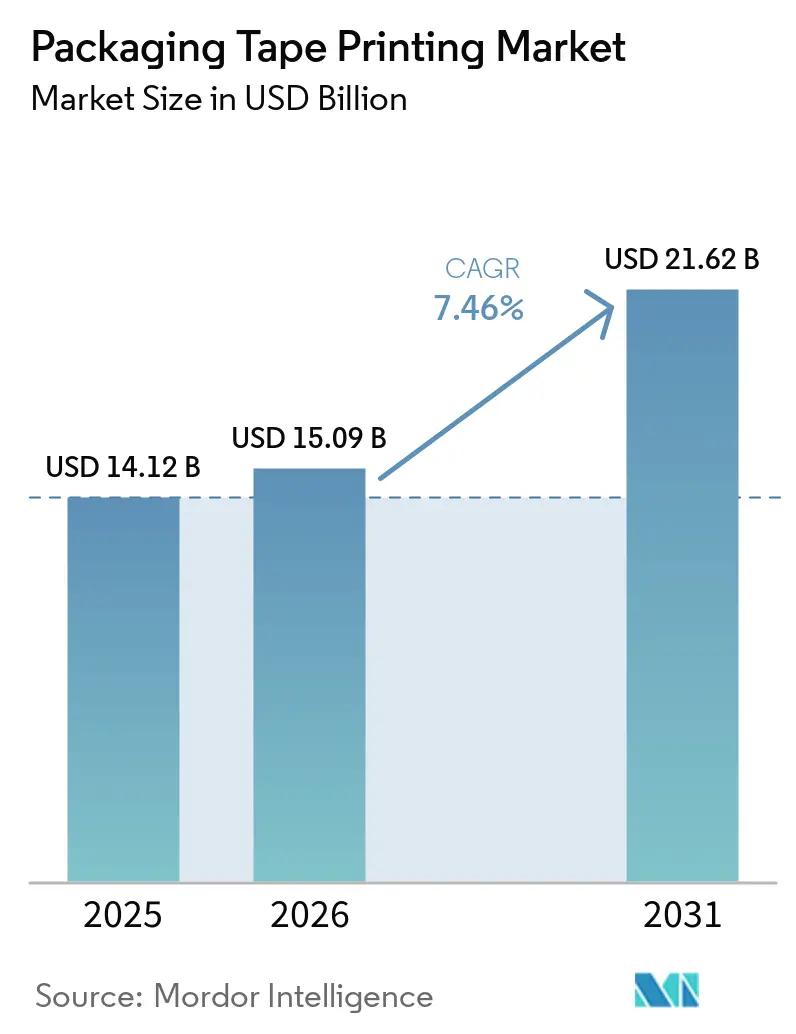
The packaging tape printing market size was valued at USD 14.12 billion in 2025 and is estimated to grow from USD 15.09 billion in 2026 to reach USD 21.62 billion by 2031, at a CAGR of 7.46% during the forecast period (2026-2031). The packaging tape printing market is transitioning from plain sealing tape to printed formats that combine carton closure with brand communication, handling instructions, security messages, and supply chain information. This shift makes tape a visible component of the shipment rather than an item used solely during the final packing stage. E-commerce-driven parcel activity supports recurring demand, while printed tape can replace separate labels and inserts for cost-sensitive brands. It can also reduce the number of packaging components required per shipment, particularly when companies use a common carton across multiple product lines or campaigns. The growing use of recycled corrugated packaging has increased the need for adhesives that perform reliably on variable surfaces with differing textures and fiber content. This trend is widening the gap between basic tape products and specification-grade printed tapes designed to provide consistent adhesion and print quality. Larger suppliers are responding by developing adhesives, improving sustainability credentials, and expanding digital printing capacity. Meanwhile, smaller converters must prioritize investments that address specific customer requirements and remain compatible with their existing production equipment. Regulatory requirements for tamper evidence and serialization are creating opportunities in pharmaceutical secondary packaging. In this application, printed tape can serve a defined functional role beyond standard carton closure, while print durability and security communication may provide additional value.
Key Report Takeaways
- By product type, hot-melt tape held 43.65% of the packaging tape market share in 2025, while acrylic tape is forecast to grow at a CAGR of 7.85% through 2031.
- By material, polypropylene accounted for 61.04% of the packaging tape market share in 2025, while polyethylene is forecast to grow at a CAGR of 8.07% through 2031.
- By printing ink, water-based ink held 45.17% of the packaging tape printing market share in 2025, while UV-curable ink is forecast to grow at a CAGR of 8.18% through 2031.
- By printing technology, flexography held 48.93% of the packaging tape printing market share in 2025, while digital and inkjet printing are forecast to grow at a CAGR of 8.32% through 2031.
- By end-user industry, logistics and e-commerce held 55.72% of the packaging tape printing market share in 2025, while pharmaceuticals are forecast to grow at a CAGR of 8.89% through 2031.
- By geography, North America held 32.21% of the packaging tape printing market share in 2025, while Asia-Pacific is forecast to grow at a CAGR of 8.77% through 2031.
Note: Market size and forecast figures in this report are generated using Mordor Intelligence’s proprietary estimation framework, updated with the latest available data and insights as of January 2026.
Market Trends and Insights
Drivers Impact Analysis of Packaging Tape Printing Market*
| Drivers | (~) % Impact on CAGR Forecast | Geographic Relevance | Impact Timeline |
|---|---|---|---|
| E-Commerce and Last-Mile Parcel Growth | +2.2% | Global, led by Asia-Pacific, North America, and Europe | Short term (≤ 2 years) |
| Printed Tape as a Low-Cost Brand and Unboxing Medium | +1.4% | North America, Europe, and the Asia-Pacific e-commerce hubs | Medium term (2-4 years) |
| Demand for Tamper Evidence, Handling Instructions, and Traceability | +1.2% | Global, with European Falsified Medicines Directive (FMD) and U.S. Drug Supply Chain Security Act (DSCSA) requirements central | Medium term (2-4 years) |
| Short-Run Customization and Variable-Data Printing | +0.9% | North America, Europe, and the Asia-Pacific small and medium enterprise clusters | Medium term (2-4 years) |
| Recycled-Corrugate Compatibility and Adhesive Formulation Innovation | +0.5% | Europe, North America, and the Asia-Pacific | Long term (≥ 4 years) |
| Source: Mordor Intelligence | |||
E-Commerce and Last-Mile Parcel Growth
E-commerce growth increases the number of parcels requiring secure closure, handling information, and visual identification. This trend supports tape consumption across fulfillment centers, third-party logistics providers, retailers, and direct-to-consumer brands that manage recurring shipments. It also supports businesses that need to maintain a consistent package appearance across varying order levels. Automated case-sealing lines require tape with consistent adhesion, as performance variations can disrupt packing processes and reduce the reliability required in high-throughput operations. As a result, buyers place greater importance on performance testing when changing tape formulations or substrates. Printed tapes add visible functionality without altering the core packaging workflow, enabling brands to display messaging or handling instructions at the point of carton sealing and throughout the delivery process. The packaging tape printing market is supported as buyers shift from commodity tape rolls to products with defined print, adhesive, and performance specifications suited to their operating conditions. This shift can increase value per roll, even when parcel shipments remain the primary demand driver, because printed tape can replace or complement other packaging elements without requiring a separate application step.
Printed Tape as a Low-Cost Brand and Unboxing Medium
Custom-printed tape can serve as a package seal, a branded surface, and an instruction carrier. In certain direct-to-consumer shipments, it can reduce the need for separate labels, inserts, or tissue paper. This approach simplifies packing operations for brands that use standardized cartons and seek a consistent presentation across their delivery networks. Printed tape is particularly relevant for subscription businesses and smaller brands that require visible branding without redesigning shipping cartons for every campaign or product line. Changing tape designs is easier to implement than undertaking a full carton redesign. Sun Chemical stated that its SunCure Advance ECO UV ink line provides color consistency and rub resistance and contains 25-30% bio-renewable content[1]. Packaging tape printing helps brand owners treat the outer shipment as part of the customer experience and keeps printed images clear throughout distribution. Suppliers that protect artwork during transport can compete based on performance, print quality, and application reliability rather than roll price alone.
Demand for Tamper Evidence, Handling Instructions, and Traceability
Pharmaceutical secondary packaging requires clear tamper-evidence and accurate handling information throughout packaging, transportation, and dispensing. The EU Falsified Medicines Directive requires covered medicinal products to include safety features, including an anti-tampering device. ISO 21976:2018 provides a technical reference for tamper-verification features used in medicinal product packaging. These requirements support demand for high-resolution printing and durable adhesion when tape carries security messages or machine-readable information that must remain legible after normal handling. The packaging tape printing market has applications when tape serves multiple functions on regulated packages, including closure, communication, and verification support. Pharmaceutical buyers may place greater value on dependable print and verification performance than buyers who use tape solely for carton closure, supporting the growth outlook for this application.
Short-Run Customization and Variable-Data Printing
Digital and inkjet systems reduce the order-size barriers associated with conventional printing plates. These systems support seasonal artwork, localized campaigns, and variable information without requiring the same production setup as long flexographic runs. As a result, customization becomes more accessible to smaller brands and regional logistics users. Durst Group AG presented the Tau G3 platform at Labelexpo Europe 2025 for label and packaging production with extended-gamut color capabilities. This development is relevant to printed tape, as film gauges, print designs, and the information carried on tape can vary significantly across customers and packaging applications. QR code and barcode requirements further support digital production, particularly where each printed unit requires different information that must be applied consistently. The packaging tape printing market can therefore serve smaller customers and accommodate diverse order requirements without displacing flexography’s role in longer production runs.
Restraints Impact Analysis of Packaging Tape Printing Market*
| Restraints | (~) % Impact on CAGR Forecast | Geographic Relevance | Impact Timeline |
|---|---|---|---|
| Petrochemical Feedstock and Adhesive Price Volatility | -1.1% | Global, most acute in European and Asia-Pacific import markets | Short term (≤ 2 years) |
| Print Quality and Adhesion Trade-Offs on Recycled Corrugate | -0.7% | North America and Europe | Medium term (2-4 years) |
| Capital Intensity of High-Speed Printing and Converting Lines | -0.5% | Emerging Asia-Pacific and South American markets | Long term (≥ 4 years) |
| Source: Mordor Intelligence | |||
Petrochemical Feedstock and Adhesive Price Volatility
Biaxially oriented polypropylene (BOPP) film is produced from polypropylene resin derived from crude oil and natural gas feedstocks. Fluctuations in resin prices can increase the costs of films, adhesives, ink-related inputs, and finished tape, creating pressure across the converting process. These fluctuations also complicate cost planning for suppliers that do not control upstream inputs. Converters often face a lag between rising input costs and price adjustments for downstream customers, particularly when customer contracts or purchasing cycles restrict immediate price revisions. Buyers may also resist rapid increases in packaging budgets. This lag can compress margins, especially for regional suppliers serving price-sensitive accounts with limited ability to absorb higher packaging costs. In the packaging tape printing market, smaller converters may delay investments in digital printing or converting equipment when input prices remain volatile and cash generation becomes less predictable. Larger integrated producers can manage these pressures by coordinating sourcing, compounding, printing, and converting across broader operations.
Print Quality and Adhesion Trade-Offs on Recycled Corrugate
Recycled corrugated board can vary in surface texture, fiber composition, and residual ink content. These variations can affect adhesive contact and the definition of fine printed areas, making it more difficult to achieve consistent results across boxes from different sources. They can also increase the need for testing before approving a tape for routine use. The EU Packaging and Packaging Waste Regulation establishes sustainability and waste management requirements for packaging that increase attention to recycled materials[2]. Tape producers may need reformulated adhesives or heavier substrates to maintain performance on recycled corrugate, particularly when packages also require clear printed instructions or security markings. These changes can increase costs in product categories where buyers continue to compare tape primarily by price and may not initially recognize the value of technical improvements. Consequently, the packaging tape printing market requires suppliers to have in-house adhesive capabilities and the technical capacity to qualify tapes for variable packaging surfaces.
*Our forecasts treat driver/restraint impacts as directional, not additive. The impact forecasts reflect baseline growth, mix effects, and variable interactions.
Packaging Tape Printing Market Segment Analysis
By Product Type:
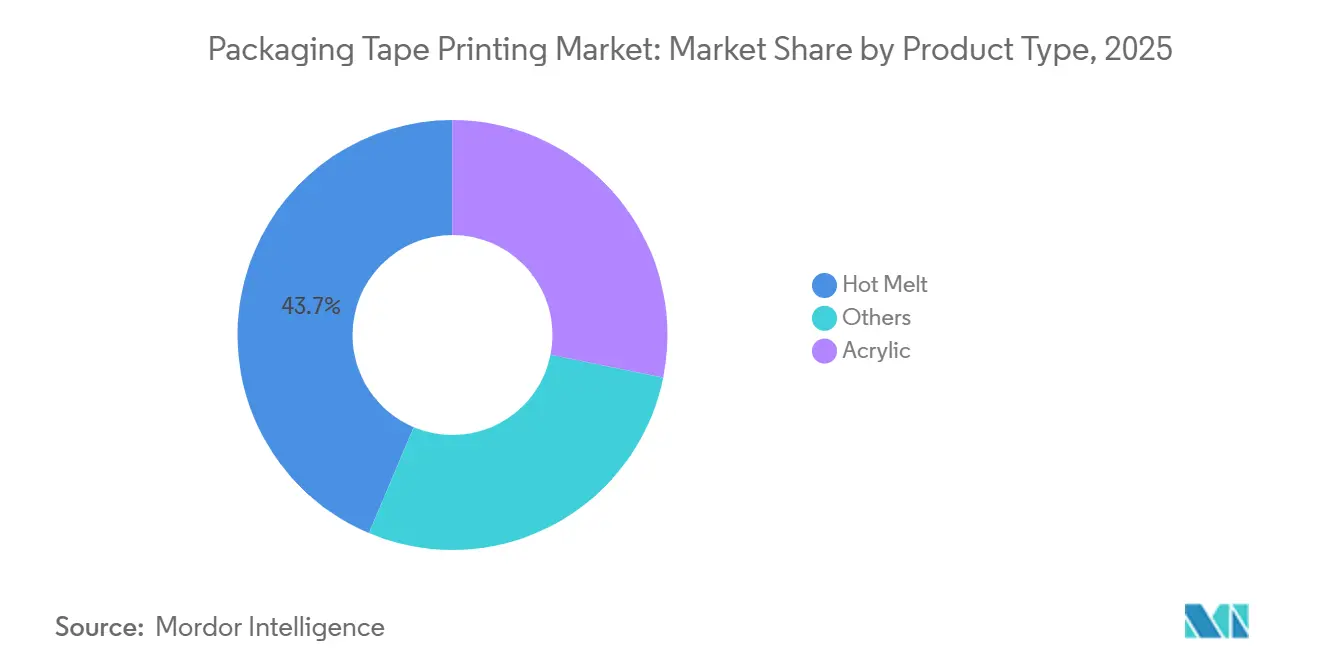
Hot-Melt Holds the Largest Share, While Acrylic Addresses Specification RequirementsHot-melt tape accounted for 43.65% of the packaging tape market share in 2025. Its position reflects instant tack, performance on automated case-sealing lines, and compatibility with virgin and recycled corrugated surfaces. These properties are relevant in fulfillment centers that process high parcel throughput and require seals to form without slowing packing lines. Tape failures at this stage can disrupt packing operations, increase rework, and affect shipment consistency. Hot-melt tape is used in applications where rapid adhesion is more important than resistance to sunlight or prolonged outdoor exposure. Its market position also reflects the established use of hot-melt tape among converters and logistics buyers for standard sealing applications.
Acrylic tape is forecast to expand at a CAGR of 7.85% through 2031. Growth in the acrylic tape segment is supported by demand for UV-stable, solvent-free, and food-contact-safe formulations. Acrylic tape is relevant when buyers require printed graphics to remain clear after handling, transport, and exposure to light. In January 2026, Shurtape launched AP 251 Custom-Printed Production-Grade Acrylic Packaging Tape, featuring Lock Print Technology designed to protect printed artwork from abrasion. The launch links adhesive performance with printed-image durability. In relevant applications, acrylic films accept water-based and UV-curable inks, supporting custom printing requirements. This compatibility supports orders involving short runs, multiple designs, or variable printed content. Other adhesive systems, including rubber-based products, retain a role in applications where adhesion to irregular industrial substrates is more important than detailed artwork.

By Material:
Polypropylene Dominates, Polyethylene Scales with Cold ChainPolypropylene accounted for 61.04% of the packaging tape printing market share in 2025. Biaxially oriented polypropylene (BOPP) film offers clarity, tensile strength, and thin-gauge performance for mainstream tape production. Its clear surface provides a base for printed messages, brand colors, handling instructions, and basic security markings. The material also supports high-output converting, which is relevant for parcel and logistics users who purchase tape regularly. Its availability and established converting base support its market position. Polypropylene is used in high-output printed tapes for parcel, retail, and logistics applications. However, recycled content and changing package surfaces require suppliers to maintain print quality and adhesion performance.
Polyethylene is projected to grow at a CAGR of 8.07% through 2031 as cold-chain and moisture-exposed logistics applications expand. Growth in the polyethylene segment is driven by applications requiring flexibility and environmental resistance, including pharmaceutical and temperature-sensitive food shipments. These applications require tape to remain functional despite moisture, temperature fluctuations, and varying handling conditions that can affect conventional packaging materials. Polyethylene, therefore, serves a distinct need from polypropylene’s high-output application base. Magis introduced a BOPP adhesive tape made with recycled polypropylene derived from used cooking oil, with International Sustainability and Carbon Certification (ISCC) PLUS certification. This example shows how recycled-content solutions are developing across the broader film category. Paper-backed tapes and other materials also receive attention where curbside recyclability influences purchasing decisions. In 2025, Shurtape presented its Recycled Series Packaging Tapes at Pack Expo Las Vegas, describing products made from 90% post-consumer recycled polyethylene terephthalate (PET). These material options expand the product range for buyers looking for packaging that meets recycling requirements.
By Printing Ink:
Water-Based Ink Holds the Largest Share, While UV-Curable Ink ExpandsWater-based ink accounted for 45.17% of the packaging tape printing market in 2025. It is established on flexographic lines and compatible with biaxially oriented polypropylene (BOPP). This ink category supports tape orders requiring consistent color application at conventional production speeds. Lower volatile organic compound (VOC) emissions and suitability for use near food-contact packaging applications support its continued use. Converters also use water-based systems when customers require established processes and broad substrate compatibility. The category is suited to applications with stable packaging messages and order sizes that support standard flexographic production. Its established position enables suppliers to address mainstream packaging tape demand, while other ink systems serve higher-durability or shorter-run requirements.
UV-curable ink is forecast to grow at a CAGR of 8.18% through 2031. Growth in the UV-curable ink segment reflects instant curing, rub resistance, and suitability for digital and hybrid printing systems. Instant curing enables faster handling of freshly printed materials, which benefits applications that require production speed and image durability. Rub resistance is also relevant when tape is subject to friction during packing, sorting, and transportation. In July 2025, Sun Chemical launched SunCure Advance ECO UV inks, describing a formulation containing 25% to 30% bio-renewable content and a production capability of more than 20,000 impressions per hour. Solvent-based inks face pressure as environmental requirements tighten across major markets. Water-based UV-curable approaches may be relevant where low odor, durability, and controlled migration are important. The growth of UV-curable products reflects demand for printed tapes that carry durable artwork while maintaining production flexibility.
By Printing Technology:
Flexography Commands Share, Digital Disrupts Mid-TierFlexography accounted for 48.93% of the packaging tape printing market share in 2025. The technology supports long production runs through high throughput, controlled ink consumption, and an extensive installed base. It is suited to repeat orders with stable graphics, consistent colors, and large shipment quantities. These conditions are common in logistics, retail packaging, and established consumer brands. Flexography also benefits from the operating experience of converters across Europe, North America, and East Asia. It remains an option for customers with stable artwork and large order quantities. Its position indicates that digital formats are adding production options rather than eliminating the need for established long-run equipment.
Digital and inkjet printing is projected to expand at a CAGR of 8.32% through 2031. Short production runs, variable data, and lower setup requirements support growth in the digital and inkjet printing segment. This technology is suitable for seasonal packaging, region-specific artwork, promotional runs, and shipments requiring changing machine-readable information. Plate costs of USD 300 to USD 800 per color plate and setup times of one to four hours are constraints for smaller flexographic orders. Digital printing reduces the impact of these constraints for jobs that do not justify conventional long runs. Durst’s Tau G3 supports extended-gamut CMYK plus spot colors and is relevant for tape film gauges ranging from 20 to 500 microns. Hybrid systems combine flexographic flood coating with digital variable-data modules, offering an option for mid-volume work. This production mix enables converters to maintain long-run efficiency while serving customers with varied printing requirements.
By End-User Industry:
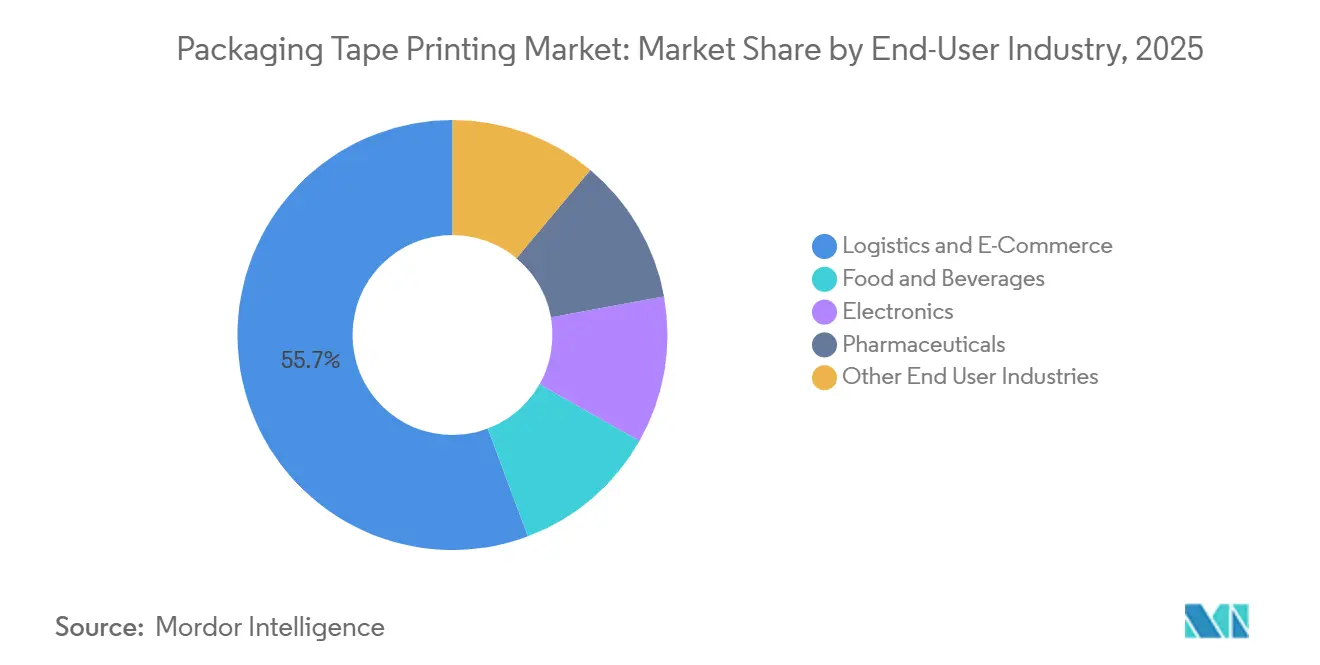
Logistics Leads on Share, Pharmaceuticals Lead on GrowthLogistics and e-commerce accounted for 55.72% of the packaging tape printing market share in 2025. The segment uses printed sealing tape for parcel closure, shipment identification, handling instructions, and brand visibility. High parcel throughput makes the segment relevant for standard printed tape and performance-grade formats. Printed tape can convey a visible message when a shipment enters the delivery network and when it reaches the recipient. Direct-to-consumer shippers can use branded tape without modifying the carton itself, simplifying packaging changes. This gives tape a role in packaging presentation and carton closure. The segment’s share reflects parcel applications across fulfillment centers, retailers, brands, and third-party logistics providers.
The pharmaceutical segment is forecast to grow at a CAGR of 8.89% through 2031. Serialization and tamper-evidence requirements under the EU Falsified Medicines Directive and the U.S. Drug Supply Chain Security Act support this growth. These applications require more than a basic carton seal, as printed tape can carry handling instructions, security messages, and traceability information. Regulatory requirements are the primary reason the pharmaceutical segment growth exceeds that of the logistics segment. Food and beverage applications require low-migration inks for packaging that comes into close contact with regulated products. Electronics applications use specialized tape where anti-static performance and cleanliness are critical. Temperature-indicating printed tape also integrates security, handling instructions, and traceability for pharmaceutical and food cold-chain applications. These end uses indicate that demand for printed tape is expanding as packaging requires defined functions beyond sealing.
Geography Analysis
North America Packaging Tape Printing Market
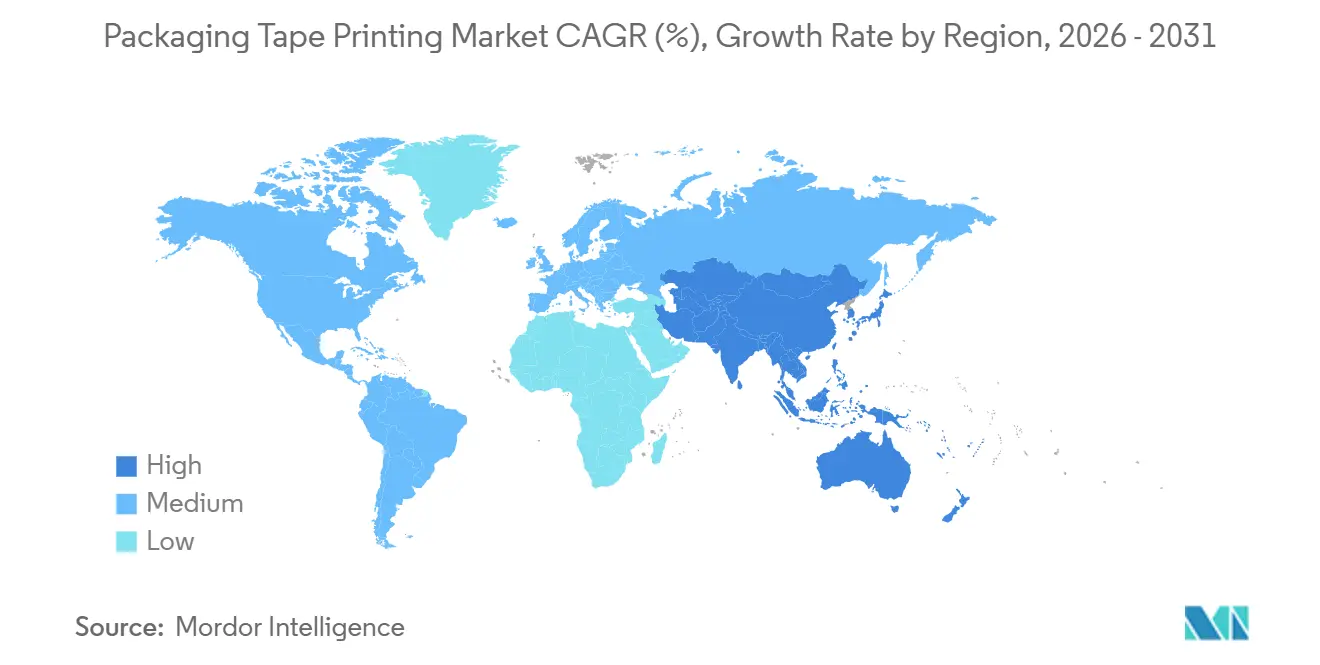
North America accounted for 32.21% of the packaging tape printing market in 2025. The region combines high parcel density, established fulfillment infrastructure, and the use of custom-branded tape by direct-to-consumer and subscription businesses. These users incorporate branding, handling instructions, and security messaging on tape while using a standardized carton format across multiple shipments. Demand from the U.S. pharmaceutical packaging industry also supports printed tape formats that carry tamper-evident or serialized information, for which closure performance and print clarity are requirements. Intertape Polymer Group (IPG) introduced its Packaging Diagnostics program in February 2026, combining the iTrack, AF2K, and Gear Up tools to improve packaging-line performance. Shurtape launched AP 251 in January 2026, reflecting demand for acrylic printed tape with protected artwork. These developments reflect the regional focus on operational reliability and product features for packaging teams managing more shipments.
APAC Packaging Tape Printing Market
Asia-Pacific is projected to grow at a CAGR of 8.77% through 2031. The regional packaging tape printing market size is driven by expanding fulfillment operations in China, India, and Southeast Asia, where e-commerce and third-party logistics networks continue to increase capacity. Demand is supported by the growing use of branded tape in the Yangtze River Delta, the Maharashtra logistics corridor, and regional third-party logistics networks. In these markets, shipment growth plays a larger role than mature unit-value patterns in North America. India’s official investment agency has set a target of USD 350 billion in e-commerce gross merchandise value by 2030. Nitto Denko expanded its manufacturing presence in Hung Yen, Vietnam, and adhesive production came online in May 2026. Expanded regional production capacity can shorten supply chains for large-scale tape demand and position producers closer to customers requiring recurring tape supplies. The region combines demand growth with an expanding manufacturing base for adhesive and tape products.
EMEA and South America Packaging Tape Printing Market
Europe is shaped by sustainability requirements and investments in recycled-substrate Biaxially Oriented Polypropylene (BOPP) tape and low-migration inks. The Packaging and Packaging Waste Regulation provides a policy framework that emphasizes recyclable packaging solutions, increasing the importance of material selection for tape producers. Tesa is expanding its Offenburg site with a new 4,500-square-meter production building, scheduled to begin production in 2027. Tesa also announced its participation in a hydrogen network in Hamburg in March 2026. These initiatives reflect the importance of production methods and verified material solutions for suppliers serving European customers. South America contributes to emerging demand from domestic e-commerce and food manufacturing, particularly in Brazil and Argentina. In the Middle East and Africa, demand is associated with investments in cold-chain logistics capacity, where moisture resistance, product-handling information, and adhesion performance support specialized tape applications.
Competitive Landscape
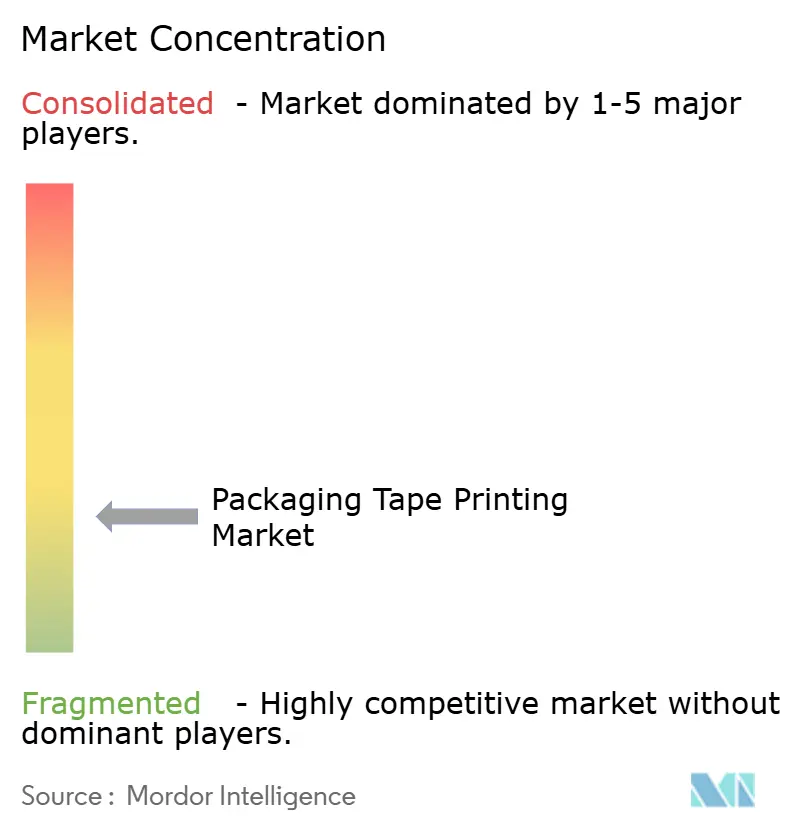
The packaging tape printing market is fragmented. Tesa, 3M, and IPG operate in premium product categories, while regional converters serve customers in Asia-Pacific and South America. Local suppliers benefit from proximity to fulfillment hubs, access to domestic resin supplies, and lower operating costs, particularly in applications with limited requirements for specialized printing or adhesive features. Competition extends beyond roll pricing to adhesive formulations, printing precision, certified recycled content, and the ability to meet packing-line operating requirements. Suppliers must also demonstrate that printed graphics, security messages, and handling instructions remain legible and functional throughout distribution. The patent activity focuses on recycled corrugate adhesive compatibility, UV-LED curing, and variable-data inkjet configurations. These areas indicate that technical capabilities increasingly differentiate suppliers beyond basic tape supply.
Vertical integration across adhesive compounding, printing, and converting is a competitive strategy. It enables suppliers to control product performance, product development, and response times when input costs or substrate requirements change. It also allows suppliers to align adhesive, film, ink, and converting processes for products designed to meet specific customer application requirements. Tesa’s Offenburg expansion involves a double-digit-million-euro investment in solvent-free production and supports its sustainability-focused supply strategy. IPG’s Packaging Diagnostics program extends its relationship with packaging-line customers beyond tape supply to operating support. Shurtape’s AP 251 product launch addresses demand for acrylic-printed tape designed to protect artwork during distribution. These examples reflect approaches to value creation through production investment, operational support, and differentiated product design.
Suppliers can differentiate their offerings through recycled-content substrates, low-migration inks, and variable-data capabilities for regulated or premium shipments. These features are relevant in pharmaceutical and direct-to-consumer packaging applications, where conventional commodity tape may not meet requirements for print durability, material credentials, or traceable information. Large suppliers can meet customer requirements for verified material content and consistent performance across multiple facilities, as these customers may require the same tape to perform consistently across different box types and shipment routes. Regional converters remain competitive where local service, lower operating costs, and straightforward applications drive purchasing decisions. Many packaging users require dependable printed tape without the specifications needed for regulated or premium applications.
Packaging Tape Printing Industry Leaders
-
3M
-
IPG
-
tesa SE
-
Shurtape Technologies, LLC
-
Avery Dennison Corporation
- *Disclaimer: Major Players sorted in no particular order
Packaging Tape Printing Market Companies Covered in this Report
- 3M
- Avery Dennison Corporation
- Berry Global Inc.
- Canon U.S.A., Inc.
- Cenveo
- DuPont
- Flexcon Company, Inc.
- Henkel AG & Co. KGaA
- IPG
- Nitto Denko Corporation
- RR Donnelley & Sons Company
- Scapa Industrial
- Shurtape Technologies, LLC
- SIAT S.P.A.
- tesa SE
Recent Industry Developments in Packaging Tape Printing Market
- August 2026: Avery Dennison Performance Tapes North America launched the Sustainable ADvantage portfolio, combining emulsion acrylic, pure emulsion acrylic, and UV acrylic adhesive technologies. The portfolio targets manufacturers seeking sustainable material options without compromising bonding performance. The launch strengthened Avery Dennison’s presence in the high-specification printed packaging tape segment.
- April 2026: Cantech, a subsidiary of Intertape Polymer Group (IPG), announced the strategic expansion of the Tuck Tape brand into the Canadian consumer retail market. The expansion introduced Utility Packing Tape, Advance Packaging Tape, and Premium Shipping Tape through paint, hardware, home improvement, and office supply channels.
Global Packaging Tape Printing Market Report Scope
Packaging tape printing involves customizing adhesive box-sealing tape with a company’s logo, brand name, handling instructions, or warning messages, rather than using plain, unbranded tape.
The packaging tape printing market is segmented by product type, material, printing ink, printing technology, end-user industry, and geography. By product type, the market is segmented into hot melt, acrylic, and others. By material, the market is segmented into polypropylene, polyvinyl chloride, polyethylene, and other materials. By printing ink, the market is segmented into water-based ink, UV-curable ink, and solvent-based ink. By printing technology, the market is segmented into flexography, digital and inkjet printing, gravure and lithography, and other technologies. By end-user industry, the market is segmented into food and beverages, electronics, logistics and e-commerce, pharmaceuticals, and other end-user industries. The report also covers market size and forecasts for packaging tape printing across 15 countries in major regions. The market sizes and forecasts are provided in terms of value (USD).
Segmentation Overview
| Hot Melt |
| Acrylic |
| Others |
| Polypropylene |
| Polyvinyl Chloride |
| Polyethylene |
| Other Materials |
| Water-Based Ink |
| UV-Curable Ink |
| Solvent-Based Ink |
| Flexography |
| Digital and Inkjet Printing |
| Gravure and Lithography |
| Other Technologies |
| Food and Beverages |
| Electronics |
| Logistics and E-Commerce |
| Pharmaceuticals |
| Other End-User Industries |
| Asia-Pacific | China |
| India | |
| Japan | |
| South Korea | |
| ASEAN Countries | |
| Rest of Asia-Pacific | |
| North America | United States |
| Canada | |
| Mexico | |
| Europe | Germany |
| United Kingdom | |
| France | |
| Italy | |
| NORDIC Countries | |
| Rest of Europe | |
| South America | Brazil |
| Argentina | |
| Rest of South America | |
| Middle East and Africa | Saudi Arabia |
| South Africa | |
| Rest of Middle East and Africa |
| By Product Type | Hot Melt | |
| Acrylic | ||
| Others | ||
| By Material | Polypropylene | |
| Polyvinyl Chloride | ||
| Polyethylene | ||
| Other Materials | ||
| By Printing Ink | Water-Based Ink | |
| UV-Curable Ink | ||
| Solvent-Based Ink | ||
| By Printing Technology | Flexography | |
| Digital and Inkjet Printing | ||
| Gravure and Lithography | ||
| Other Technologies | ||
| By End-User Industry | Food and Beverages | |
| Electronics | ||
| Logistics and E-Commerce | ||
| Pharmaceuticals | ||
| Other End-User Industries | ||
| By Geography | Asia-Pacific | China |
| India | ||
| Japan | ||
| South Korea | ||
| ASEAN Countries | ||
| Rest of Asia-Pacific | ||
| North America | United States | |
| Canada | ||
| Mexico | ||
| Europe | Germany | |
| United Kingdom | ||
| France | ||
| Italy | ||
| NORDIC Countries | ||
| Rest of Europe | ||
| South America | Brazil | |
| Argentina | ||
| Rest of South America | ||
| Middle East and Africa | Saudi Arabia | |
| South Africa | ||
| Rest of Middle East and Africa | ||
Key Questions Answered in the Report
What is current market size of Packaging Tape Printing Market?
The packaging tape printing market size was valued at USD 14.12 billion in 2025 and is estimated to grow from USD 15.09 billion in 2026 to reach USD 21.62 billion by 2031, at a CAGR of 7.46% during the forecast period (2026-2031).
Which packaging tape product type is growing fastest?
Acrylic tape is the fastest-growing product type, with a projected CAGR of 7.85% through 2031. Its outlook is tied to demand for UV-stable, solvent-free, and custom-printed formats that protect artwork through handling and can support applications requiring consistent print performance.
Which printing technology is growing fastest for packaging tape?
Digital and inkjet printing is the fastest-growing technology, with a projected CAGR of 8.32% through 2031. It supports shorter runs, variable data, localized designs, and changing print content without the same setup requirements as conventional long-run production, which broadens access to customization.
Which end-user sector is growing fastest?
Pharmaceuticals are the fastest-growing end-user sector, with a projected CAGR of 8.89% through 2031. Serialization and tamper-evidence needs increase the importance of durable, high-resolution printed tape for secondary packaging, where closure and communication requirements can be closely linked.