
Packaged and Rooftop Air Conditioner (AC) Market Size and Share
Market Overview
| Study Period | 2021 - 2031 |
|---|---|
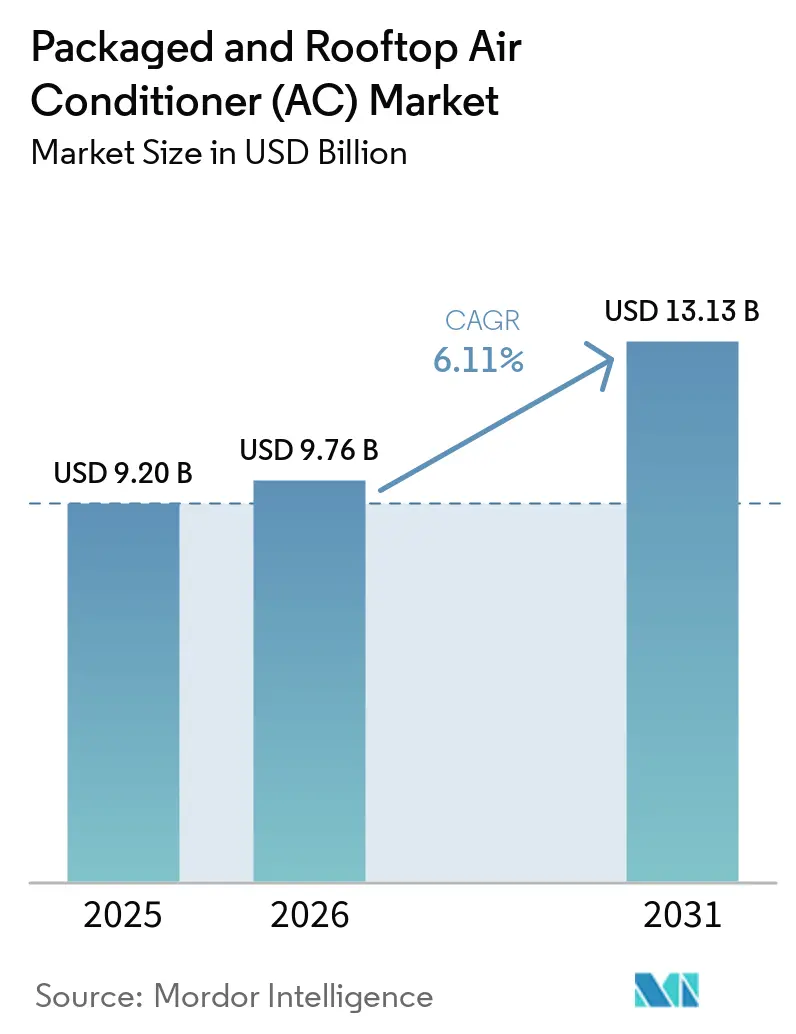
| Market Size (2026) | USD 9.76 Billion |
| Market Size (2031) | USD 13.13 Billion |
| Growth Rate (2026 - 2031) | 6.11 % |
| Fastest Growing Market | Asia-Pacific |
| Largest Market | Asia-Pacific |
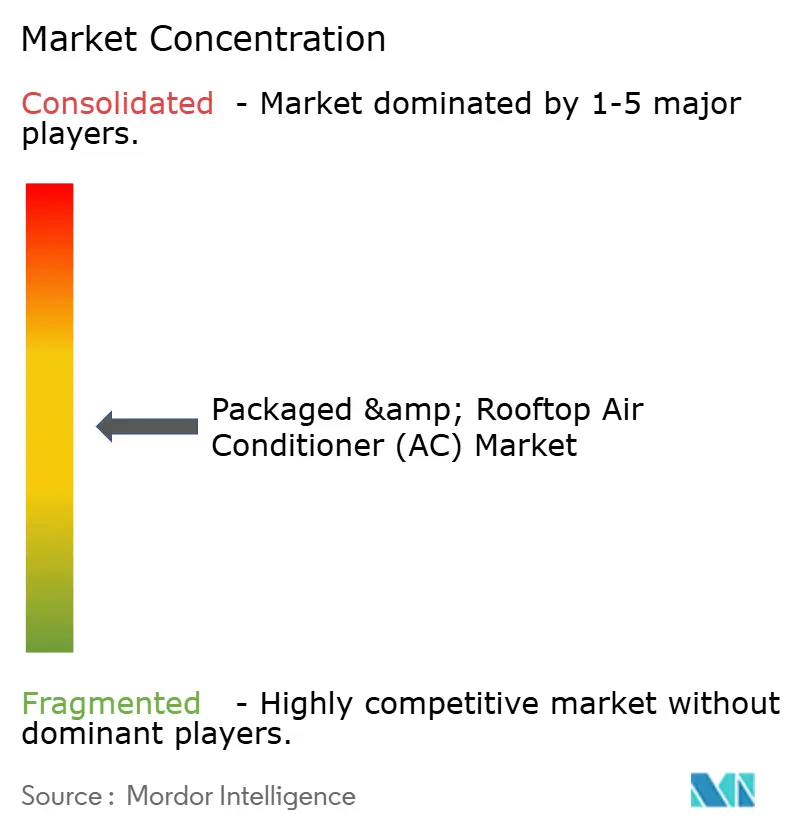
| Market Concentration | Medium |
Major Players *Disclaimer: Major Players sorted in no particular order Image © Mordor Intelligence. Reuse requires attribution under CC BY 4.0. | |
Packaged and Rooftop Air Conditioner (AC) Market Analysis by Mordor Intelligence
The packaged rooftop air conditioner market size is projected to expand from USD 9.2 billion in 2025 and USD 9.8 billion in 2026 to USD 13.1 billion by 2031, registering a CAGR of 6.1% between 2026 and 2031. Aging commercial units, tighter efficiency rules, and continued commercial construction support replacement and new-installation demand in the packaged rooftop air conditioner market. The United States Department of Energy will require higher integrated energy efficiency standards for covered commercial packaged equipment from January 1, 2029, which gives building owners a clearer reason to replace older systems[1]. Refrigerant rules in the United States and Europe are also changing equipment design and purchasing schedules, especially for light-commercial systems[2]. Manufacturers are responding with heat-pump models, low-GWP refrigerants, and controls that link equipment to building management systems. These changes create opportunities in retrofits, cold-climate applications, and sites that need more efficient cooling without major mechanical-room work.
Key Report Takeaways
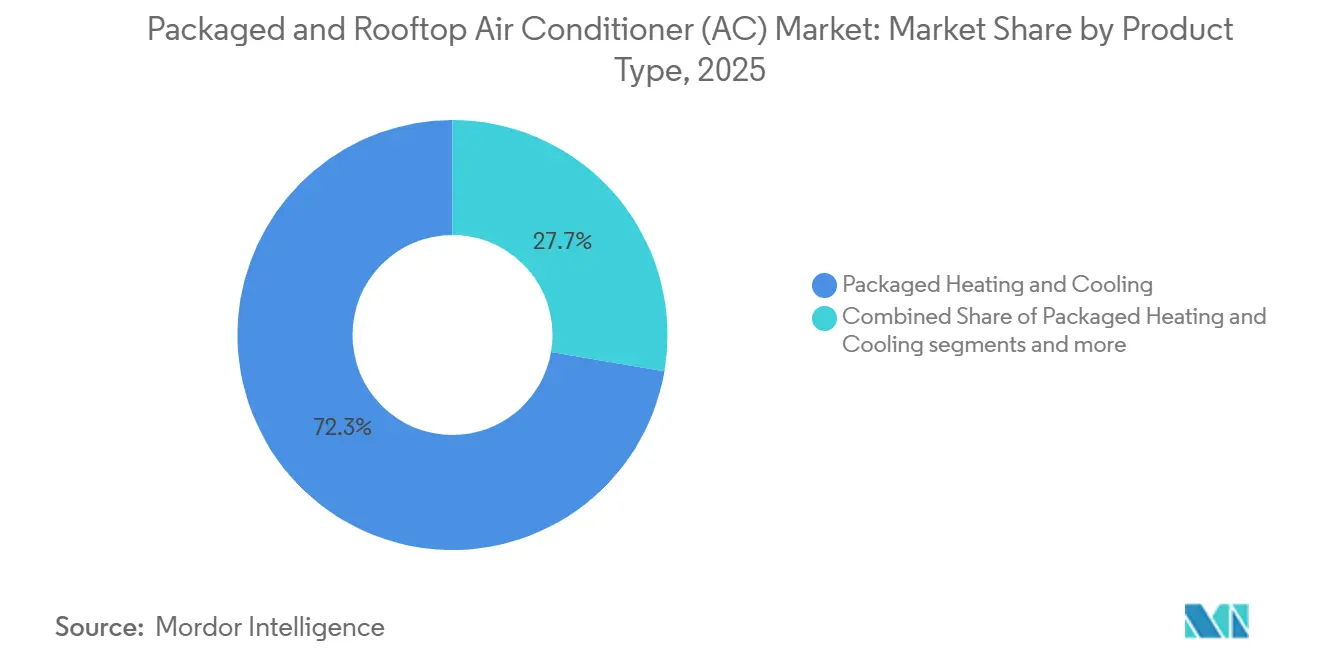
- By product type, packaged heating and cooling held 72.3% of the packaged rooftop air conditioner market share in 2025, while packaged cooling only is forecast to expand at an 8.9% CAGR through 2031.
- By cooling capacity, above 20 tons accounted for 47.4% of revenue in 2025, while below 10 tons is forecast to expand at an 8.5% CAGR through 2031.
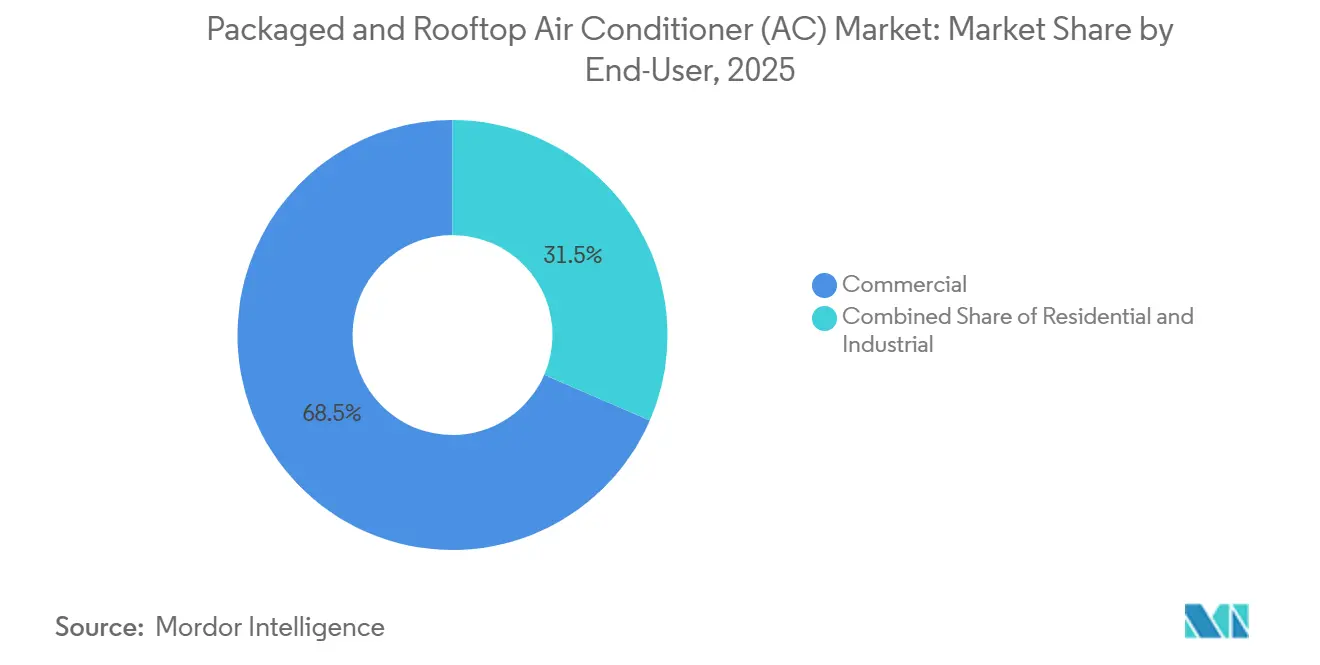
- By end-user, commercial buildings held 68.5% of revenue in 2025, while industrial end-users are forecast to expand at a 7.1% CAGR through 2031.
- By distribution channel, direct sales held 55.3% of revenue in 2025 and is forecast to expand at a 7.48% CAGR through 2031.
- By geography, Asia-Pacific held 41.3% of revenue in 2025 and is forecast to expand at an 8.2% CAGR through 2031.
Note: Market size and forecast figures in this report are generated using Mordor Intelligence’s proprietary estimation framework, updated with the latest available data and insights as of January 2026.
Global Packaged and Rooftop Air Conditioner (AC) Market Trends and Insights
Drivers Impact Analysis*
| Driver | (~) % Impact on CAGR Forecast | Geographic Relevance | Impact Timeline |
|---|---|---|---|
| Replacement of Aging Commercial Rooftop Units | +2.0% | North America and Europe, with spillover to Asia-Pacific and the Middle East and Africa | Short term (≤ 2 years) |
| Energy-Efficiency Upgrades and Building-Code Tightening | +1.5% | North America, Europe, China, India, and Australia | Medium term (2-4 years) |
| Commercial Construction in Retail, Logistics, Healthcare, and Education | +1.2% | Global, with early gains in Asia-Pacific, South America, and the Middle East and Africa | Medium term (2-4 years) |
| Demand for Space-Efficient Factory-Packaged HVAC Systems | +0.8% | Global, concentrated in North America, Europe, and industrial Asia-Pacific | Medium term (2-4 years) |
| Heat-Pump Electrification and Grid-Interactive Commercial Buildings | +1.0% | North America and Europe, with spillover to Asia-Pacific | Long term (≥ 4 years) |
| AI-Enabled Controls, Predictive Maintenance, and Indoor-Air-Quality Monitoring | +0.7% | Global, led by North America, Europe, and North Asia | Long term (≥ 4 years) |
| Source: Mordor Intelligence | |||
Replacement of Aging Commercial Rooftop Units Accelerates Retrofit Spend
Older rooftop equipment raises operating costs and can make replacement more attractive than continued repair. The United States Department of Energy states that high-efficiency next-generation rooftop units can reduce energy costs by up to 50% compared with conventional equipment in commercial buildings. This operating-cost case supports retrofit activity across retail, logistics, education, and healthcare properties in the packaged rooftop air conditioner market. A failed unit during a cooling season also gives facility managers little time to defer a purchase. That urgency makes replacement demand less dependent on the timing of new construction. It also favors suppliers that can offer product availability, technical support, and reliable installation coordination.
Mandatory Energy-Efficiency Upgrades and Building-Code Tightening Reshape the Product Mix
The Department of Energy’s 2024 direct final rule requires covered commercial air-cooled packaged air conditioners and heat pumps with a capacity of at least 65,000 Btu/h to meet new integrated value efficiency cooling standards from January 1, 2029. The rule sets standards from 12.1 to 14.3 IVEC, depending on equipment class. The Department estimates 5.5 quadrillion Btu in lifetime energy savings for equipment purchased from 2029 through 2058. California’s 2025 Energy Code took effect on January 1, 2026, and added heat-pump requirements for certain end-of-life rooftop replacements in existing retail, school, office, and library buildings[3]. These rules move some purchases from discretionary capital planning into compliance planning. The packaged rooftop air conditioner market, therefore, benefits from a clearer demand schedule for efficient and electrified equipment.
Commercial Construction Across Retail, Logistics, Healthcare, and Education Broadens the Install Base
Commercial floor-space additions create new demand for packaged rooftop equipment in regions with different building patterns. Logistics facilities and pharmaceutical cold-chain sites often use large, single-story formats that suit rooftop systems. Retail, healthcare, and education projects also need systems that can be installed quickly and serviced with limited impact on indoor space. This supports the Packaged rooftop air conditioner market where developers seek self-contained equipment that reduces mechanical-room requirements. In Asia-Pacific, commercial development is linked to logistics, retail, office campuses, and healthcare capacity. In the Gulf, large warehouses, malls, hotels, and other commercial facilities require cooling equipment that can operate in high outdoor temperatures.
Heat-Pump Electrification and Grid-Interactive Commercial Buildings Drive High-Efficiency Unit Uptake
Heat-pump rooftop units are becoming more relevant as building owners seek lower-emission heating and cooling options. AAON stated that its Alpha Class EXTREME SERIES can operate to -20°F and maintain 100% heating capacity at 5°F in a simultaneous dual-fuel configuration. A National Renewable Energy Laboratory analysis found that shifting the United States commercial rooftop-unit stock from gas-fired units to high-performance heat-pump units could save 130 TWh and reduce total site energy use by 10%. Modeling from NEEA and CEE found that cold-climate heat-pump packages paired with Tier 2 efficiency measures could reduce total HVAC energy use by up to 23% compared with the regulated baseline[4]. These performance results address a long-standing barrier in colder regions. The packaged rooftop air conditioner market can therefore gain from electrification, where owners need both cooling efficiency and dependable winter heating.
Restraints Impact Analysis*
| Restraint | (~) % Impact on CAGR Forecast | Geographic Relevance | Impact Timeline |
|---|---|---|---|
| High Capital Cost of High-Efficiency and Low-GWP Equipment | -0.6% | Global, most acute in price-sensitive Asia-Pacific, South America, and the Middle East and Africa | Medium term (2-4 years) |
| Rooftop Structural, Crane, Access, and Safety Constraints | -0.3% | North America and Europe, with high-density urban areas in the Middle East and Africa | Short term (≤ 2 years) |
| Skilled Technician Shortages and Commissioning Complexity | -0.5% | North America and Europe, with spillover to Asia-Pacific | Medium term (2-4 years) |
| Cold-Climate Heat-Pump Performance and Electrical-Infrastructure Limits | -0.4% | Nordics, northern North America, and northern China | Long term (≥ 4 years) |
| Source: Mordor Intelligence | |||
*Our forecasts treat driver/restraint impacts as directional, not additive. The impact forecasts reflect baseline growth, mix effects, and variable interactions.
Segment Analysis
By Product Type: Heating and Cooling Units Lead While Cooling-Only Systems Grow Faster
Packaged heating and cooling units held 72.3% of the packaged rooftop air conditioner market share in 2025. Their integrated design combines heating, cooling, and ventilation in one rooftop-mounted package for offices, retail sites, schools, and healthcare buildings. This suits North American commercial construction, where less mechanical-room space can simplify planning and installation. Familiar servicing arrangements and a large installed base also support replacement demand. These factors keep packaged heating and cooling units central to the packaged rooftop air conditioner market.
Packaged cooling-only systems are forecast to grow at an 8.9% CAGR through 2031 because tropical locations need cooling throughout the year without a heating load. Commercial and industrial construction in Asia-Pacific, the Gulf, and Sub-Saharan Africa supports this demand. Split-system rooftop configurations serve a smaller position and can help mid-rise buildings where refrigerant-line routing is useful, although zoning and service requirements can limit their use at larger sites. Daikin’s July 2026 NEXIO Max launch, an R-32 inverter-driven unit in 7.5-, 8.5-, and 10-ton capacities, shows the shift toward efficient rooftop heat pumps. AHRI Standard 1340, expected to take effect in 2029, also raises the focus on integrated heating performance.

By Cooling Capacity: Large Systems Anchor Revenue While Small Units Gain Volume
The above 20-ton tier accounted for 47.4% of the packaged rooftop air conditioner market size in 2025. It serves distribution centers, hypermarkets, manufacturing facilities, and institutional buildings that need substantial cooling capacity. A large rooftop unit can offer simpler maintenance and lifecycle economics than multiple smaller units at these sites. The 10-to-20-ton range serves offices, mid-scale retail, and community healthcare facilities, and much of the installed commercial base in North America is within this range. Large systems, therefore, remain a key value contributor to the packaged rooftop air conditioner market.
The below 10-ton tier is forecast to grow at an 8.5% CAGR through 2031. Small-format retail, clinics, and quick-service food outlets in Asia-Pacific and South America support volume in this range. The EPA’s GWP restrictions require a product refresh in light-commercial packaged equipment and increase the need for compliant installation practices. Carrier’s field trials for a 10-to-14-ton cold-climate rooftop heat pump show the wider push for efficient commercial equipment across common capacity ranges. Buyers in the packaged rooftop air conditioner market are increasingly assessing capacity, refrigerant choice, efficiency, and heating performance together.
By End-User: Commercial Buildings Lead While Industrial Uses Expand
Commercial buildings held 68.5% of revenue in 2025. Offices, retail properties, hospitality sites, healthcare facilities, and schools form the largest application base. Rooftop systems are selected because their self-contained design limits the space needed for indoor mechanical equipment and supports timely installation during shell-and-core construction. Retail, logistics, and healthcare projects remain recurring sources of specification activity. Commercial demand, therefore, provides the volume base for the packaged rooftop air conditioner market.
Industrial end-users are forecast to grow at a 7.1% CAGR through 2031. Cold-chain logistics, pharmaceutical nearshoring, food processing, semiconductor production, battery-material manufacturing, and edge data facilities need tighter cooling control. AAON reported that its BASX data-center backlog increased 185% in the period leading to the second quarter of 2026, pointing to stronger specialized-cooling demand. Connected controls support monitoring, maintenance planning, and system adjustment, creating opportunities for equipment and service contracts. The packaged rooftop air conditioner industry is adding digital capability alongside mechanical performance.
By Distribution Channel: Direct Sales Lead Complex Project Specifications
Direct sales through OEM relationships and large-project contracting held 55.3% of revenue in 2025. This channel is important when projects need custom engineering, large tonnage, and clear service accountability. Building owners and mechanical consultants often work directly with OEM technical teams, especially as heat-pump systems, A2L refrigerants, and connected controls add technical requirements. Direct engagement also helps customers manage commissioning and compliance requirements. The channel remains important in the packaged rooftop air conditioner market.
Indirect channels include distributors, dealers, and mechanical-equipment resellers. They are most relevant to replacements and smaller commercial projects where local coverage, installer relationships, product access, and field support matter. Digital specification platforms and building information modeling tools help them configure more complex systems without constant direct engineering support. This can extend indirect distribution into mid-tier work while retaining OEM involvement in specialized projects. The packaged rooftop air conditioner market, therefore, depends on both direct technical support and indirect local reach.
Geography Analysis
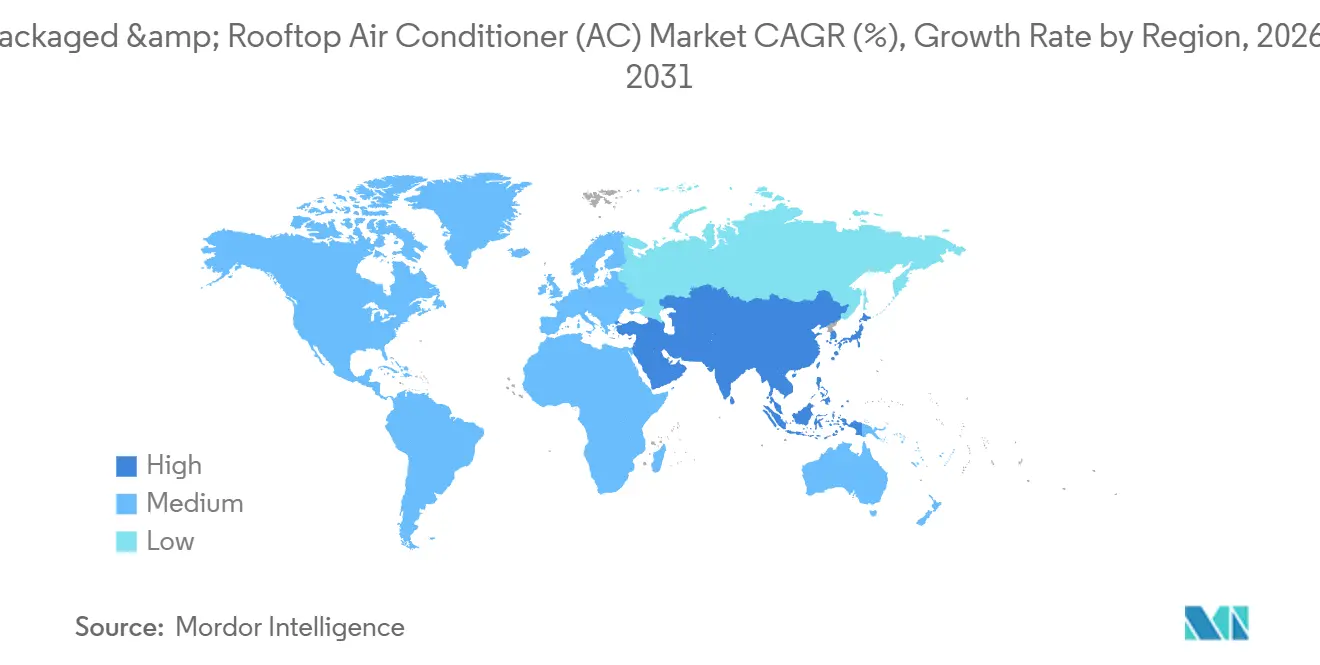
Asia-Pacific held 41.3% of revenue in 2025 and is forecast to grow at an 8.2% CAGR through 2031. China and India support demand through logistics, retail, IT office campuses, and healthcare construction. India’s Energy Conservation Building Code sets minimum performance requirements for new commercial buildings and supports more efficient HVAC choices. Japan and South Korea have technically sophisticated buyers and strong positions for domestic manufacturers such as Daikin, Mitsubishi Electric, and Samsung. Vietnam, Indonesia, and the Philippines are adding commercial space quickly. Australia’s rooftop segment is supported by large-format retail and healthcare projects.
North America is the second-largest regional revenue contributor in the packaged rooftop air conditioner market. Its large installed base supports replacement activity, while United States standards and California’s building code encourage efficient equipment. California’s requirements for some end-of-life rooftop replacements took effect in 2026. Canadian buyers have historically been more cautious about rooftop heat pumps because of winter conditions. Equipment certified for operation to -20°F is helping change specifications. Mexico adds demand through nearshoring-related industrial and logistics development.
Europe, the Middle East and Africa, and South America have different demand patterns within the Packaged rooftop air conditioner market. Europe is moving toward lower-GWP refrigerants and heat-pump replacements as building decarbonization rules become more important. Saudi Arabia and the United Arab Emirates need equipment that operates in high temperatures and coastal conditions. South Africa and Nigeria have potential in retail and healthcare construction, while Brazil is expanding through industrial activity and commercial development in tier-2 cities. Manufacturers must adapt capacity, refrigerants, controls, and service support to local conditions.
Competitive Landscape
The packaged rooftop air conditioner market is fragmented. Carrier, Trane Technologies, Daikin Industries, Mitsubishi Electric, LG Electronics, AAON, Midea, Gree, and Haier compete across efficiency, product breadth, price, and regional manufacturing reach. Global OEMs are well placed in high-efficiency commercial applications, while Chinese manufacturers compete strongly in price-sensitive segments. AAON expanded its manufacturing footprint by 25% in 2025 and invested USD 204.9 million in capital expenditures, including new capacity in Memphis, Tennessee. The company entered 2026 with a record backlog. Manufacturing capacity and the ability to support new heat-pump designs are increasingly important competitive factors.
Rheem completed its acquisition of Nortek Global HVAC in October 2024, adding packaged heating and cooling products to its Global Air Division. Daikin launched the NEXIO Max in July 2026, adding an R-32 rooftop heat pump for light-commercial electrification and retrofit work. Carrier’s cold-climate field trials show another strategic focus on equipment that can serve commercial buildings in colder locations. These moves show that acquisition, product development, and field validation shape competition. Suppliers also use certification and regulatory compliance to strengthen their position in institutional and government specifications.
Smart-service offerings are another area of differentiation. Predictive-maintenance platforms can connect rooftop equipment with existing BACnet and Modbus building-management infrastructure. This gives OEMs a way to support recurring service relationships after the equipment sale. Trane Technologies reported that its Trane Cloud work with Amazon Bedrock AgentCore produced building insights 60 times faster. Controls, monitoring, and service capability can influence customer choice alongside mechanical efficiency. The Packaged rooftop air conditioner market also rewards suppliers that can support equipment through its operating life.
Packaged and Rooftop Air Conditioner (AC) Industry Leaders
-
Carrier Global Corporation
-
Daikin Industries, Ltd.
-
Trane Technologies plc
-
Johnson Controls International plc
-
Lennox International Inc.
- *Disclaimer: Major Players sorted in no particular order
Recent Industry Developments
- September 2026: Industrial Analytics, an Infineon Technologies company, showcased OPTIFICIENT, a hybrid AI and physics-based HVAC optimization software solution that integrates with existing building automation environments and adjusts setpoints in real time for industrial, data-center, and office applications.
- July 2026: Daikin Comfort Technologies North America launched the NEXIO Max, an inverter-driven packaged rooftop heat pump in 7.5-, 8.5-, and 10-ton capacities using R-32 refrigerant with up to 22 IEER efficiency, native BACnet integration, and cold-climate heating to -13°F.
- March 2026: AAON announced that its Alpha Class EXTREME SERIES packaged rooftop unit, available from 3 to 40 tons with simultaneous dual-fuel capability to -20°F, completed the United States Department of Energy Commercial Building HVAC Technology Challenge laboratory evaluation phase.
- February 2026: Greenheck expanded air-source heat-pump availability to additional tonnages across RT-40 packaged rooftop units, covering 6.5 to 30 tons of air-source heat-pump or packaged DX capacity, and RV/RVE dedicated outdoor air system models.
Global Packaged and Rooftop Air Conditioner (AC) Market Report Scope
| Packaged Cooling Only |
| Packaged Heating & Cooling |
| Split-System Rooftop Configurations |
| Below 10 Tons |
| 10–20 Tons |
| Above 20 Tons |
| Residential |
| Commercial |
| Industrial |
| Direct Sales (OEM / Large Project Contracting) |
| Indirect Sales (Distributors, Dealers, Electronics Retailers, and MEP Resellers) |
| North America | Canada |
| United States | |
| Mexico | |
| South America | Brazil |
| Peru | |
| Chile | |
| Argentina | |
| Rest of South America | |
| Europe | United Kingdom |
| Germany | |
| France | |
| Spain | |
| Italy | |
| BENELUX (Belgium, Netherlands, and Luxembourg) | |
| NORDICS (Denmark, Finland, Iceland, Norway, and Sweden) | |
| Rest of Europe | |
| Asia-Pacific | India |
| China | |
| Japan | |
| Australia | |
| South Korea | |
| South East Asia (Singapore, Malaysia, Thailand, Indonesia, Vietnam, and the Philippines) | |
| Rest of Asia-Pacific | |
| Middle East and Africa | United Arab Emirates |
| Saudi Arabia | |
| South Africa | |
| Nigeria | |
| Rest of the Middle East and Africa |
| By Product Type | Packaged Cooling Only | |
| Packaged Heating & Cooling | ||
| Split-System Rooftop Configurations | ||
| By Cooling Capacity | Below 10 Tons | |
| 10–20 Tons | ||
| Above 20 Tons | ||
| By End-User | Residential | |
| Commercial | ||
| Industrial | ||
| By Distribution Channel | Direct Sales (OEM / Large Project Contracting) | |
| Indirect Sales (Distributors, Dealers, Electronics Retailers, and MEP Resellers) | ||
| By Region | North America | Canada |
| United States | ||
| Mexico | ||
| South America | Brazil | |
| Peru | ||
| Chile | ||
| Argentina | ||
| Rest of South America | ||
| Europe | United Kingdom | |
| Germany | ||
| France | ||
| Spain | ||
| Italy | ||
| BENELUX (Belgium, Netherlands, and Luxembourg) | ||
| NORDICS (Denmark, Finland, Iceland, Norway, and Sweden) | ||
| Rest of Europe | ||
| Asia-Pacific | India | |
| China | ||
| Japan | ||
| Australia | ||
| South Korea | ||
| South East Asia (Singapore, Malaysia, Thailand, Indonesia, Vietnam, and the Philippines) | ||
| Rest of Asia-Pacific | ||
| Middle East and Africa | United Arab Emirates | |
| Saudi Arabia | ||
| South Africa | ||
| Nigeria | ||
| Rest of the Middle East and Africa | ||
Key Questions Answered in the Report
What is the projected value of the packaged rooftop air conditioner market by 2031?
The sector is projected to reach USD 13.1 billion by 2031, growing from USD 9.8 billion in 2026 at a 6.1% CAGR.
Which product type led packaged rooftop air conditioner sales in 2025?
Packaged heating and cooling units led with 72.3% of revenue in 2025.
Which capacity category is growing fastest for packaged rooftop air conditioners?
The below 10-ton category is forecast to grow at an 8.5% CAGR through 2031.
Why are commercial rooftop air conditioner replacements increasing?
Aging equipment, rising operating costs, energy-efficiency standards, and refrigerant transition requirements are encouraging replacement decisions.
Which region is expanding fastest for packaged rooftop air conditioners?
Asia-Pacific is forecast to grow at an 8.2% CAGR through 2031 and held 41.3% of revenue in 2025.