
Over-Dimensional and Heavy-Lift Project Cargo Transportation Market Size and Share
Market Overview
| Study Period | 2021 - 2032 |
|---|---|
| Market Size (2027) | USD 172.73 Billion |
| Market Size (2032) | USD 220.74 Billion |
| Growth Rate (2027 - 2032) | 5.03 % |
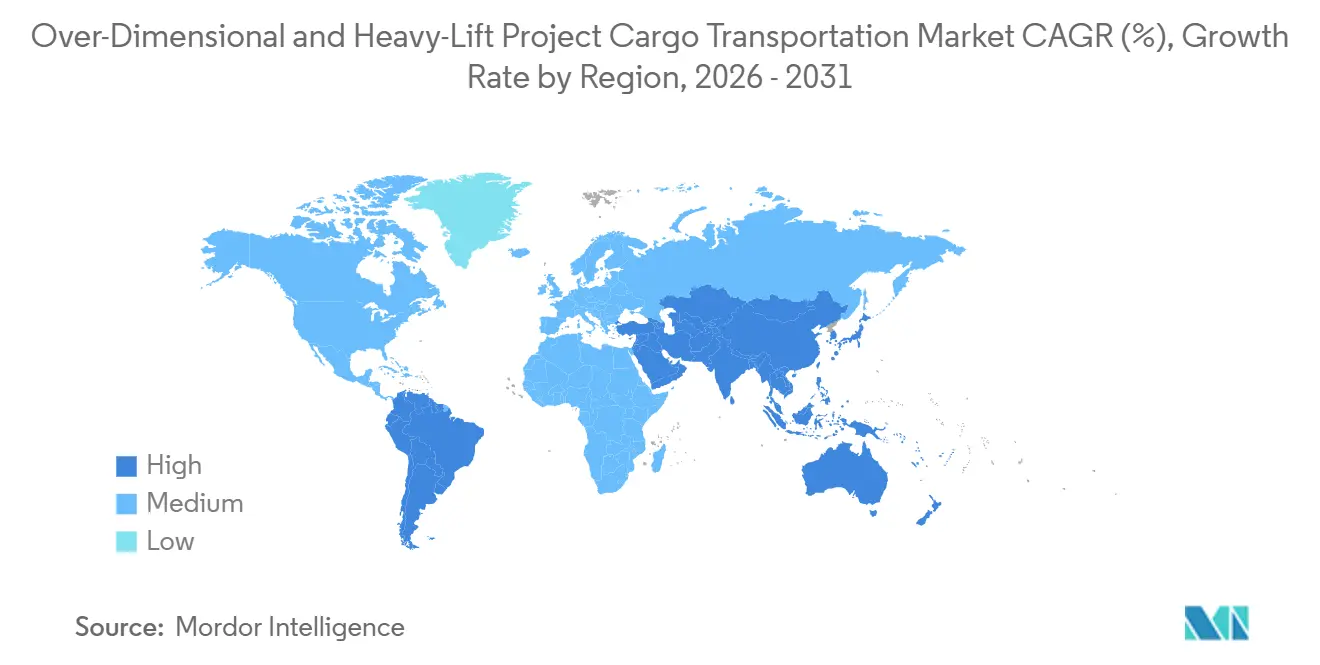
| Fastest Growing Market | Asia-Pacific |
| Largest Market | Asia-Pacific |
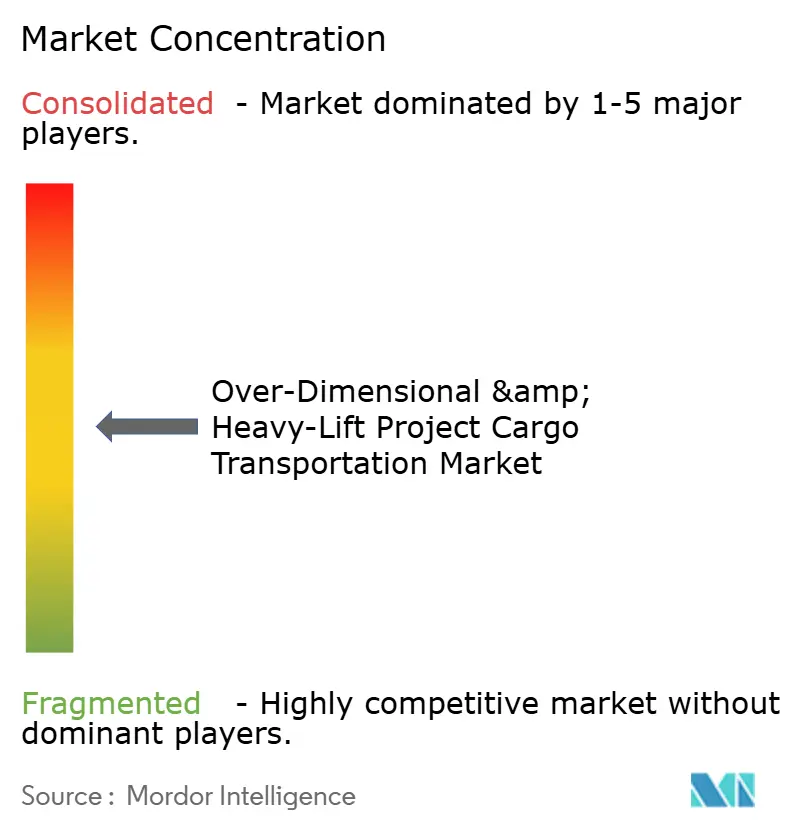
| Market Concentration | Medium |
Major Players *Disclaimer: Major Players sorted in no particular order Image © Mordor Intelligence. Reuse requires attribution under CC BY 4.0. | |
Over-Dimensional and Heavy-Lift Project Cargo Transportation Market Analysis by Mordor Intelligence
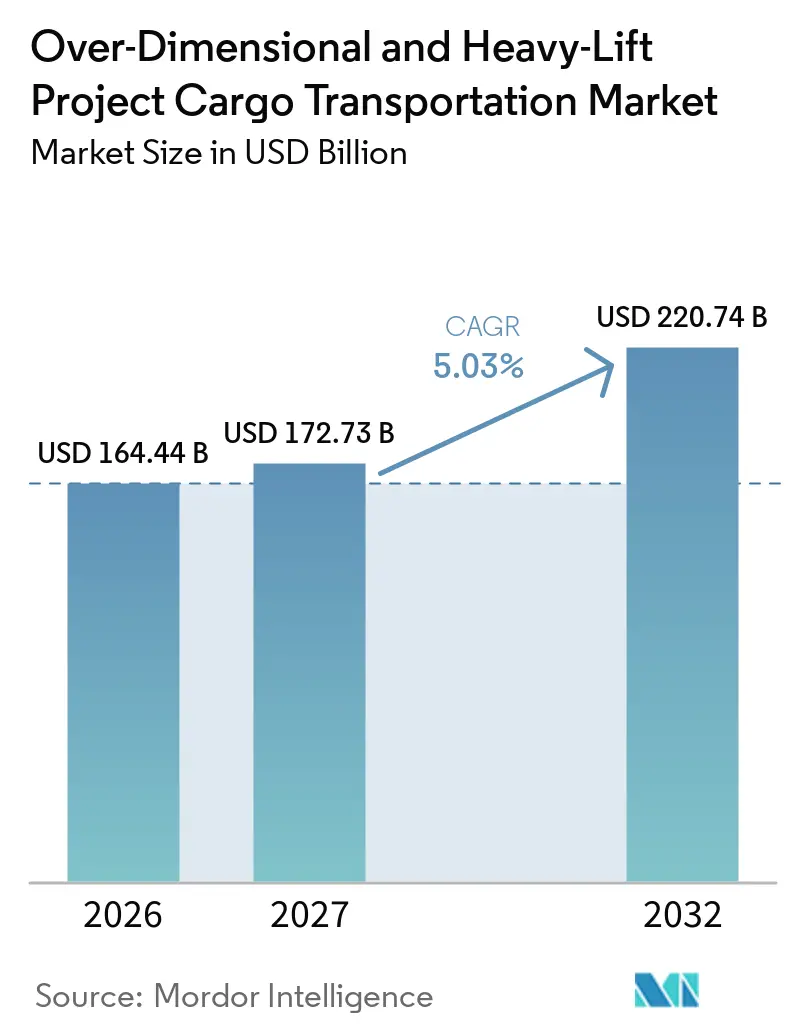
The over-dimensional and heavy-lift project cargo transportation market size is valued at USD 164.44 billion in 2026 and is estimated to grow from USD 172.73 billion in 2027 to reach USD 220.74 billion by 2032, at a CAGR of 5.03% during the forecast period (2027-2032).
The over-dimensional and heavy-lift project cargo transportation market is supported by energy, infrastructure, and advanced manufacturing projects that require equipment beyond the capability of conventional freight networks. Renewable capacity additions, industrial modularization, and construction of complex facilities are increasing the need for engineered road, rail, waterway, and vessel movements. Operators with cranes, self-propelled modular transporters, semi-submersible vessels, and route-engineering capabilities are better placed to manage fixed-price project scopes. The over-dimensional and heavy-lift project cargo transportation market also faces scheduling and cost pressure from permit coordination, infrastructure constraints, fuel costs, vessel availability, and maritime disruptions. The breadth of capital expenditure across energy, construction, and technology manufacturing gives demand a more resilient base than a single-industry project cycle.
Key Report Takeaways
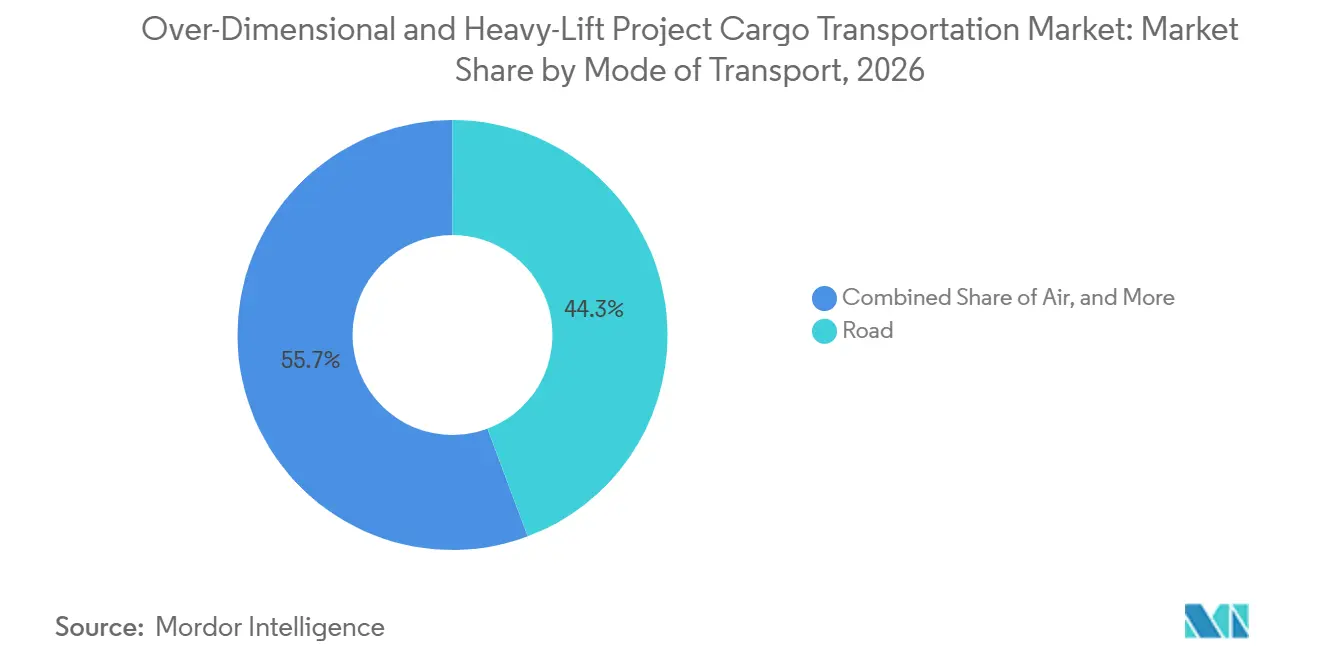
- By mode of transport, road held 44.30% of the over-dimensional and heavy-lift project cargo transportation market share in 2029, while air is projected to expand at a 6.59% CAGR through 2032.
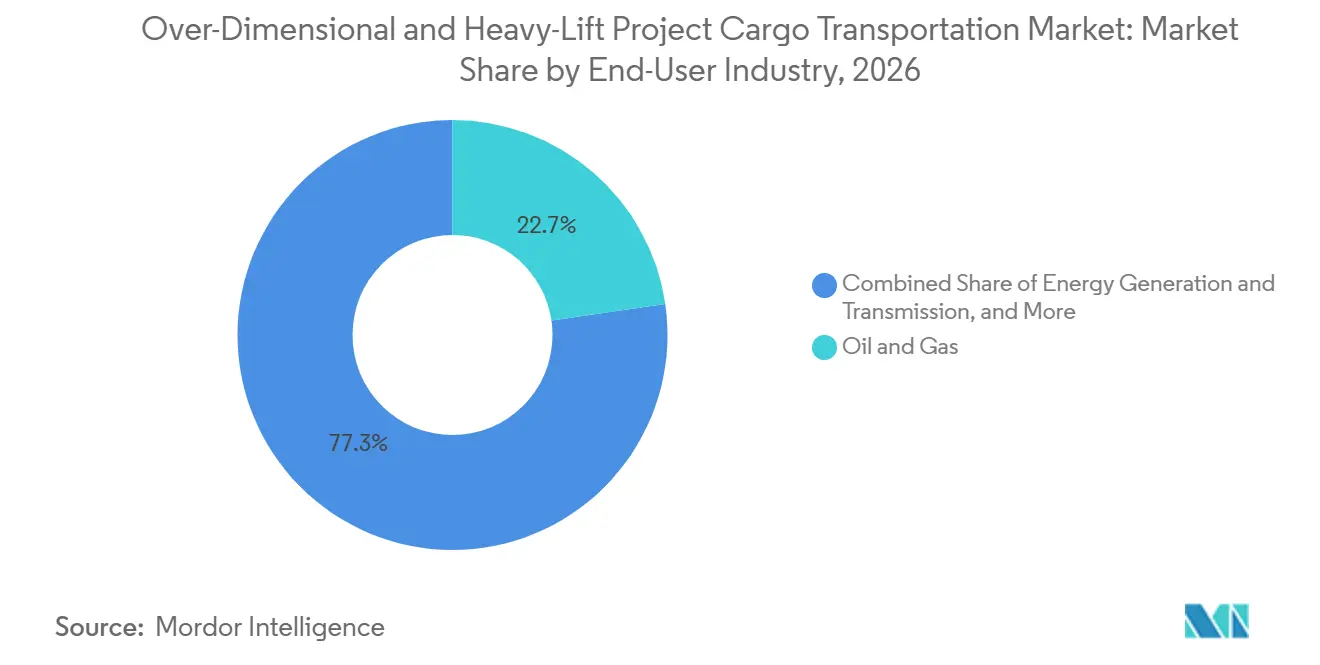
- By end-user industry, oil and gas held 22.70% of the over-dimensional and heavy-lift project cargo transportation market size in 2026, while energy generation and transmission, including renewable energy, is projected to register a 6.93% CAGR through 2032.
- By geography, Asia-Pacific held 31.80% of the over-dimensional and heavy-lift project cargo transportation market share in 2026 and is projected to register a 7.01% CAGR through 2032.
Note: Market numbers in this report are based on Mordor Intelligence's proprietary estimation framework, which combines nine months of actuals with Q4 projections for base year 2026.
Market Trends and Insights
Drivers Impact Analysis of Over-Dimensional and Heavy-Lift Project Cargo Transportation Market*
| Driver | (~) % Impact on CAGR Forecast | Geographic Relevance | Impact Timeline |
|---|---|---|---|
| Renewable-Energy Component Expansion | +2.1% | Global, with the highest intensity in Asia-Pacific, Europe, and North America | Medium term (2-4 years) |
| Mega Infrastructure and Modular Construction Projects | +1.5% | Global, with Asia-Pacific, the Middle East, North America, and Europe as primary capital expenditure centers | Long term (≥ 4 years) |
| LNG, Petrochemical, and Offshore Energy Development | +1.3% | North America, the Middle East, Southeast Asia, and West Africa | Medium term (2-4 years) |
| Semiconductor, Battery Plant, and Data-Center Build-Out | +1.0% | North America, Asia-Pacific, and Europe | Medium term (2-4 years) |
| Multimodal Corridor and Port-Rail Connectivity Investment | +0.7% | Asia-Pacific, South America, the Middle East, and Central Asia | Long term (≥ 4 years) |
| Engineered Heavy-Lift and Digital Route-Optimization Adoption | +0.5% | Global, with early adoption in Europe, North America, and developed Asia-Pacific markets | Short term (≤ 2 years) |
| Source: Mordor Intelligence | |||
Renewable-Energy Component Expansion
Global renewable energy additions set a record in 2025, with 692 GW of new capacity, including 158.7 GW of wind capacity. China added 119.4 GW of wind capacity in 2025, while India added 6.3 GW, concentrating transport demand in key Asian corridors.[1] The IEA expects onshore wind capacity additions to reach 732 GW in 2025 through 2030, 45% above the additions recorded in the preceding 5-year period. The over-dimensional and heavy-lift project cargo transportation market requires specialized movements for blades, nacelles, and tower sections that standard carriers cannot handle. Blades above 115 meters and nacelles above 650 metric tons need purpose-built trailers, semi-submersible vessels, and compatible installation assets. The resulting vessel and equipment constraint can narrow the pool of qualified providers as 15 MW turbine deployments expand during the forecast period.
Mega Infrastructure and Modular Construction Projects
Modular construction moves work from project sites to controlled fabrication shops before completed modules are transported by sea, river, road, or rail. Modules can exceed 1,000 metric tons and 70 meters in length, which increases the need for precise lifting plans, route surveys, and multimodal coordination. The over-dimensional and heavy-lift project cargo transportation market benefits when a single move replaces a large volume of field labor and requires a high-precision lift. Reuters reported in September 2025 that United States LNG builders used modular fabrication to reduce peak field labor from as many as 10,000 workers to fewer than 2,000 workers on comparable projects. INEOS Project One required deliveries from more than 20 countries over 5 years, including a 1,040-metric-ton substation delivered within 85,500 cubic meters of cargo in December 2025. Mining plants, offshore structures, data center infrastructure, and power facilities extend this need across industrial construction programs.
LNG, Petrochemical, and Offshore Energy Development
LNG export projects, petrochemical facilities, and offshore energy assets generate multi-year demand for complex project transport. Each project can require module load-outs, dedicated vessel charters, engineered barges, self-propelled modular transporter configurations, and tailored insurance arrangements. The over-dimensional and heavy-lift project cargo transportation market is, therefore, exposed to a project profile that differs from spot freight because engineering and execution risk are central to the contract. In September 2025, deugro Canada delivered a 1,334-metric-ton LNG module to a deck barge at the Port of Corpus Christi for a Canadian LNG project. The movement used custom-designed grillage engineering supplied by dteq Transport Engineering Solutions, illustrating the coordination required for a single module delivery. Calcasieu Pass 2 began site work in June 2025 and targets first LNG production in late 2027, while Middle Eastern offshore and West African deepwater programs add demand for dynamic-positioning crane vessels and semi-submersibles.
Semiconductor, Battery Plant, and Data-Center Build-Out
Semiconductor fabrication plants, battery facilities, and hyperscale data centers require large process and utility equipment that often exceeds road axle limits. Deposition chambers, lithography systems, utility modules, and transformer vaults can require specialized cranes, engineered lift studies, and self-propelled modular transporter configurations. Micron broke ground on its Clay, New York, semiconductor campus in January 2026, with an investment of up to USD 100 billion over more than 20 years, and Bechtel serving as engineering, procurement, and construction partner. The over-dimensional and heavy-lift project cargo transportation market gains a long-duration pipeline from fabrication projects that use modular construction and oversized equipment. This demand can extend through several phases of site construction and equipment installation. It also requires coordination between manufacturers, project contractors, and specialized transport operators.
Restraints Impact Analysis of Over-Dimensional and Heavy-Lift Project Cargo Transportation Market*
| Restraint | (~) % Impact on CAGR Forecast | Geographic Relevance | Impact Timeline |
|---|---|---|---|
| Multi-Jurisdictional Permit and Abnormal-Load Coordination | -0.8% | Global, with acute issues in the United States, Europe, and developing economies | Medium term (2-4 years) |
| Specialized Fleet, Skilled-Crew, and Equipment Capital Intensity | -0.7% | Global, with concentrated effect in offshore wind and LNG | Long term (≥ 4 years) |
| Port, Bridge, Draft, and First-/Last-Mile Infrastructure Bottlenecks | -0.6% | Global, with severe constraints in South and Southeast Asia, Sub-Saharan Africa, and inland North American and European corridors | Long term (≥ 4 years) |
| Fuel, Charter-Rate, Geopolitical, and Weather Volatility | -0.5% | Global, amplified at maritime chokepoints and under decarbonization compliance frameworks | Short term (≤ 2 years) |
| Source: Mordor Intelligence | |||
Multi-Jurisdictional Permit and Abnormal-Load Coordination
Abnormal-load road transport remains subject to fragmented rules that can add weeks to project schedules and increase direct costs. In the United States, states issue separate permits for oversized or overweight cargo and may require independent structural assessments. Indiana amended its overweight divisible-load permit regulations in June 2025 and introduced a formal fee schedule under 105 IAC 10-4-3.5.[2] The coordination burden rises when routes cross multiple states or countries with different escort, bridge-rating, and permit requirements. Operators must align permit timing with equipment availability and the planned movement window. These requirements can affect project budgets before cargo begins its route.
Port, Bridge, Draft, and First-/Last-Mile Infrastructure Bottlenecks
Port berths, inland waterways, road bridges, and last-mile routes can limit cargo throughput and raise project costs. These barriers require physical infrastructure investment and cannot be fully resolved through operating practices. Heavy-lift vessels operate under tight charter-rate structures, so port delays can increase carrying costs. The Federal Maritime Commission found that Suez Canal tonnage in early May 2025 remained 70% below 2023 averages because of Red Sea rerouting. The reduced traffic constrained vessel availability and raised positioning costs for specialized assets.
*Our forecasts treat driver/restraint impacts as directional, not additive. The impact forecasts reflect baseline growth, mix effects, and variable interactions.
Over-Dimensional and Heavy-Lift Project Cargo Transportation Market Segment Analysis
By Mode of Transport:
Road Commands Share, Air Registers the Fastest GrowthRoad transport held 44.30% of the over-dimensional and heavy-lift project cargo transportation market size in 2026 because it provides the required first- and last-mile connection to sites without direct waterway or rail access. The mode relies on self-propelled modular transporters, low-bed trailers, rotor-blade carriers, and multi-axle configurations. These assets can carry tower sections above 80 meters and modules above 1,000 metric tons when pre-move infrastructure preparation is completed. The over-dimensional and heavy-lift project cargo transportation industry depends on road transport where rail terminals and ports cannot reach the final site. Google Maps Platform made Large Vehicle Routing generally available in 2025 to support restriction-aware routing for commercial fleets. The system considers height, weight, length, and axle parameters, improving compliance planning for heavy-haul operations.
Air transportation is projected to register a 6.59% CAGR through 2032, reflecting its growing role in time-critical project cargo movements. Although air remains the smallest transportation mode by value, it serves semiconductor, aerospace, and time-critical energy projects where commissioning schedules cannot slip. Rail, sea, and inland-waterway transport support longer-distance project corridors, with rail linking deep-draft ports to inland industrial zones in Germany, India, and the United States Gulf Coast. Inland waterways remain cost-competitive for ultra-heavy modules where draft and lock-clearance conditions are sufficient. These modes reduce the road distance required for oversized cargo, although road-based delivery remains necessary at the origin or destination. The over-dimensional and heavy-lift project cargo transportation market, therefore, uses air selectively for cargo where delivery speed commands a premium.
By End-User Industry:
Oil and Gas Leads, Energy Generation and Transmission Grows FastestOil and gas held 22.70% of the over-dimensional and heavy-lift project cargo transportation market share in 2026. LNG liquefaction modules, floating production storage and offloading units, offshore platform topsides, and pipeline equipment create the sector’s heaviest individual lifts. These projects use specialized vessels, barge movements, crane operations, and route studies that can run over several years. Their large individual cargo pieces make execution capability as important as transport capacity. The segment also draws demand from petrochemical expansions and offshore infrastructure. Project schedules can, therefore, sustain demand even when conventional freight volumes are uncertain.
Energy generation and transmission, including renewable energy, is projected to register a 6.93% CAGR through 2032. The segment covers renewable generation, conventional power equipment, and high-voltage direct current transmission systems. Wind equipment is becoming larger, while solar projects and transmission programs require balance-of-system equipment and long-distance transport planning. IRENA confirmed that global wind additions reached 158.7 GW in 2025, including 119.4 GW in China. Construction and infrastructure, mining and metals, manufacturing and industrial plants, and aerospace and defense also support demand. The over-dimensional and heavy-lift project cargo transportation industry serves these sectors as national policies direct investment into fabs, chemical facilities, and other advanced production capacity.
Geography Analysis
APAC Over-Dimensional and Heavy-Lift Project Cargo Transportation Market
Asia-Pacific held 31.80% of the over-dimensional and heavy-lift project cargo transportation market size in 2026 and is projected to register a 7.01% CAGR through 2032. China’s wind and solar manufacturing and deployment activity creates the largest country-level volume of turbine transport movements in the region. According to its Renewables 2025 outlook, the IEA projected that China would contribute nearly 60% of global renewable energy capacity growth.[3] Indonesia, Vietnam, and the Philippines are also developing industrial facilities, LNG import terminals, and data center campuses. These projects create demand beyond wind equipment movements. Japan’s dedicated offshore wind construction vessel, under construction at Seatrium in Singapore, is targeted for delivery in late 2028.
North America Over-Dimensional and Heavy-Lift Project Cargo Transportation Market
North America had substantial demand in 2025, led by LNG export expansion, onshore wind development, and semiconductor construction in the United States. The Gulf Coast corridor in Texas and Louisiana required barge-based module transport, semi-submersible charters, and self-propelled modular transporter moves through 2025. Canadian LNG projects added cargo volumes, while industrial expansion in Mexico increased equipment movements across road and rail corridors. The over-dimensional and heavy-lift project cargo transportation market has an extended United States pipeline for semiconductor equipment transport. Facilities at Clay, Taylor, and Phoenix require continued movements of cleanroom systems, deposition equipment, and utility modules. These sites demonstrate how domestic manufacturing investment can produce demand beyond the normal delivery period of a single project.
EMEA and South America Over-Dimensional and Heavy-Lift Project Cargo Transportation Market
Europe, the Middle East and Africa, and South America have distinct demand patterns within the over-dimensional and heavy-lift project cargo transportation market. Europe’s North Sea, Baltic Sea, and Atlantic offshore wind programs support demand for installation vessels and deck carriers. DEME acquired Havfram for USD 900 million in 2025, reflecting the capital commitment to offshore installation capacity as turbine requirements grow. The Middle East is supported by Saudi Arabian and United Arab Emirates industrial programs, while AD Ports Group announced a rail-linked inland logistics network across the UAE in May 2026. South America’s mining activity in Brazil, Chile, and Peru supports movements of processing equipment. The World Bank’s USD 4.5 billion rail freight portfolio across 15 active projects in August 2025 also points to work intended to improve industrial cargo corridors.[4]
Competitive Landscape
The over-dimensional and heavy-lift project cargo transportation market has moderate concentration, with asset-backed specialists competing against diversified logistics groups. Mammoet, Sarens Group, Fagioli S.p.A., BigLift Shipping, SAL Heavy Lift, and Deugro are some of the major players in the market. Their cranes, self-propelled modular transporters, and semi-submersible vessels allow them to manage cargo engineering as well as transport. This capability supports fixed-price, turnkey project scopes where clients require schedule certainty. General freight forwarders can face greater spot-rate exposure and may lack the assets needed for load-outs or route engineering. The difference is becoming more important as turbine nacelles and blades exceed the limits of standard equipment.
COSCO Shipping Specialized Carriers entered a USD 310 million bareboat charter arrangement in June 2025 for 6 new multipurpose heavy-lift vessels to be built at Chengxi Shipyard. The contracts run for 189 to 195 months and show a preference for long-duration capacity arrangements. SAL Heavy Lift agreed to acquire MV Sun Shine and MV Sun Rise from Pan Ocean in September 2025. The acquisition doubled its semi-submersible deck carrier capacity and expanded the range of project scopes it could serve. A 2025 scientific analysis of multipurpose heavy-lift vessel fleets found methanol to be the most compatible transition fuel among the pathways it assessed under European Union emissions trading, FuelEU Maritime, and International Maritime Organization compliance costs. These fleet decisions support the over-dimensional and heavy-lift project cargo transportation market and align with demand from offshore wind, LNG, semiconductor, and industrial construction projects.
Open areas for the over-dimensional and heavy-lift project cargo transportation market include lower-emission vessel operations, digital-first and last-mile route engineering, and integrated turnkey services in South and Southeast Asia. Local heavy-lift infrastructure in these areas can be less developed than the project pipeline requires. Operators that combine route surveys, live load monitoring, and digital permit management can reduce coordination demands for engineering, procurement, and construction clients. The World Bank intends to expand its active rail freight investment portfolio from USD 4.5 billion to more than USD 6 billion over 5 years. Improved rail connections can reduce the need to use road corridors beyond their design capacity. The over-dimensional and heavy-lift project cargo transportation market remains shaped by the availability of specialized assets and the ability to coordinate complex multimodal moves.
Over-Dimensional and Heavy-Lift Project Cargo Transportation Industry Leaders
-
DHL Group
-
DSV A/S
-
Kuehne+Nagel
-
A.P. Moller - Maersk
-
GEODIS
- *Disclaimer: Major Players sorted in no particular order
Over-Dimensional and Heavy-Lift Project Cargo Transportation Market Companies Covered in this Report
- DHL Group
- DSV A/S
- Kuehne+Nagel
- A.P. Moller - Maersk
- CEVA Logistics AG
- GEODIS
- Rhenus Group
- Nippon Express Holdings, Inc.
- C.H. Robinson Worldwide, Inc.
- Trans Global Projects
- Mammoet
- Sarens Group
- Sinotrans Limited
- deugro group
- COSCO SHIPPING Specialized Carriers Co., Ltd.
- BigLift Shipping B.V.
- SAL Heavy Lift GmbH & Co. KG
- UNITED HEAVY LIFT GmbH
- Roll Group
- AAL Shipping
- Express Global Logistics
- Bahri Logistics
- Bertling Group
- Blue Water Shipping A/S
- Kerry Logistics Network Limited
Recent Industry Developments in Over-Dimensional and Heavy-Lift Project Cargo Transportation Market
- May 2026: AD Ports Group announced the establishment of a consolidated multimodal inland logistics network of rail-linked dry ports and cargo depots across the UAE, signing MoUs with Emirates Global Aluminum, EMSTEEL Group, Al Ghurair Iron and Steel, and Tenaris as anchor industrial cargo clients connecting Khalifa Port and Fujairah Terminals to UAE industrial zones.
- January 2026: DP World, Pakistan Railways, and the National Logistics Corporation broke ground on the Dedicated Freight Corridor and Multimodal Logistics Park at Pipri, integrating a 52-kilometer rail corridor from Karachi Port to Pipri Marshalling Yard with a multimodal logistics hub serving warehousing, cargo consolidation, and industrial distribution.
- September 2025: Deugro Canada and DTEQ Transport Engineering Solutions delivered a 1,334-metric-ton LNG module to a deck barge at the Port of Corpus Christi as part of a major Canadian LNG project, requiring custom-designed grillage engineering and coordinated barge preparation at Port Ingleside, demonstrating the multi-firm engineering complexity required for a single LNG module move.
- June 2025: ENERCON invested in a Liebherr LR 11000 crawler crane with 1,000-metric-ton capacity and a 200-meter maximum hook height for its E-175 EP5 E2 turbine installations, adding to an existing fleet that includes 22 heavy-duty transport trailers and a dedicated push barge for rotor blade transport on inland waterways.
Global Over-Dimensional and Heavy-Lift Project Cargo Transportation Market Report Scope
Segmentation Overview
| Road |
| Rail |
| Air |
| Sea and Inland-Waterway Transport |
| Oil and Gas |
| Mining and Metals |
| Energy Generation and Transmission (Including Renewable Energy) |
| Construction and Infrastructure |
| Manufacturing and Industrial Plants |
| Aerospace and Defense |
| Others (Maritime and Shipbuilding, Telecommunications, etc.) |
| North America | United States |
| Canada | |
| Mexico | |
| South America | Brazil |
| Argentina | |
| Peru | |
| Chile | |
| Rest of South America | |
| Europe | Germany |
| United Kingdom | |
| France | |
| Italy | |
| Spain | |
| Russia | |
| Nordics (Denmark, Finland, Iceland, Norway, and Sweden) | |
| Rest of Europe | |
| Asia-Pacific | China |
| India | |
| Japan | |
| South Korea | |
| Australia | |
| Southeast Asia (ASEAN) | |
| Rest of Asia-Pacific | |
| Middle East and Africa | Saudi Arabia |
| United Arab Emirates | |
| Qatar | |
| South Africa | |
| Nigeria | |
| Egypt | |
| Rest of Middle East and Africa |
| By Mode of Transport | Road | |
| Rail | ||
| Air | ||
| Sea and Inland-Waterway Transport | ||
| By End-User Industry | Oil and Gas | |
| Mining and Metals | ||
| Energy Generation and Transmission (Including Renewable Energy) | ||
| Construction and Infrastructure | ||
| Manufacturing and Industrial Plants | ||
| Aerospace and Defense | ||
| Others (Maritime and Shipbuilding, Telecommunications, etc.) | ||
| By Geography | North America | United States |
| Canada | ||
| Mexico | ||
| South America | Brazil | |
| Argentina | ||
| Peru | ||
| Chile | ||
| Rest of South America | ||
| Europe | Germany | |
| United Kingdom | ||
| France | ||
| Italy | ||
| Spain | ||
| Russia | ||
| Nordics (Denmark, Finland, Iceland, Norway, and Sweden) | ||
| Rest of Europe | ||
| Asia-Pacific | China | |
| India | ||
| Japan | ||
| South Korea | ||
| Australia | ||
| Southeast Asia (ASEAN) | ||
| Rest of Asia-Pacific | ||
| Middle East and Africa | Saudi Arabia | |
| United Arab Emirates | ||
| Qatar | ||
| South Africa | ||
| Nigeria | ||
| Egypt | ||
| Rest of Middle East and Africa | ||
Key Questions Answered in the Report
What is driving demand for over-dimensional and heavy-lift project cargo transportation?
Renewable energy additions, modular LNG and industrial construction, and semiconductor projects are increasing demand for engineered freight movements.
How large is the over-dimensional and heavy-lift project cargo transportation market?
The market is projected to grow from USD 164.44 billion in 2026 and USD 172.73 billion in 2027 to USD 220.74 billion by 2032, representing a 5.03% CAGR for 2027 through 2032.
Which transport mode leads project cargo transportation?
Road led with a 44.30% share in 2026 because it provides the final connection between ports or rail terminals and project sites. It is supported by specialized trailers, blade carriers, and self-propelled modular transporters.
Which end-user segment is growing fastest?
Energy generation and transmission, including renewable energy, is forecast to register a 6.93% CAGR through 2032. Larger wind equipment, solar balance-of-system equipment, and transmission projects support its logistics requirements. These projects also depend on the timely delivery of components to remote or grid-connected sites.
Which region is growing fastest for heavy-lift cargo services?
Asia-Pacific led with a 31.80% share in 2026 and is forecast to register a 7.01% CAGR through 2032. China’s renewable deployment and wider industrial construction in Southeast Asia support regional cargo demand.
What are the main operational barriers for heavy-lift operators?
Permit fragmentation, infrastructure bottlenecks, specialized asset costs, and fuel, charter-rate, geopolitical, and weather volatility can delay movements or raise costs. Port congestion and maritime rerouting can further tighten vessel capacity, while separate approval processes can complicate movements across state or national boundaries.