
OT Remote Access Security Market Size and Share
Market Overview
| Study Period | 2021 - 2032 |
|---|---|
| Market Size (2027) | USD 4.75 Billion |
| Market Size (2032) | USD 11.37 Billion |
| Growth Rate (2027 - 2032) | 19.05 % |
| Fastest Growing Market | Asia-Pacific |
| Largest Market | North America |
| Market Concentration | Low |
Major Players *Disclaimer: Major Players sorted in no particular order Image © Mordor Intelligence. Reuse requires attribution under CC BY 4.0. | |
OT Remote Access Security Market Analysis by Mordor Intelligence
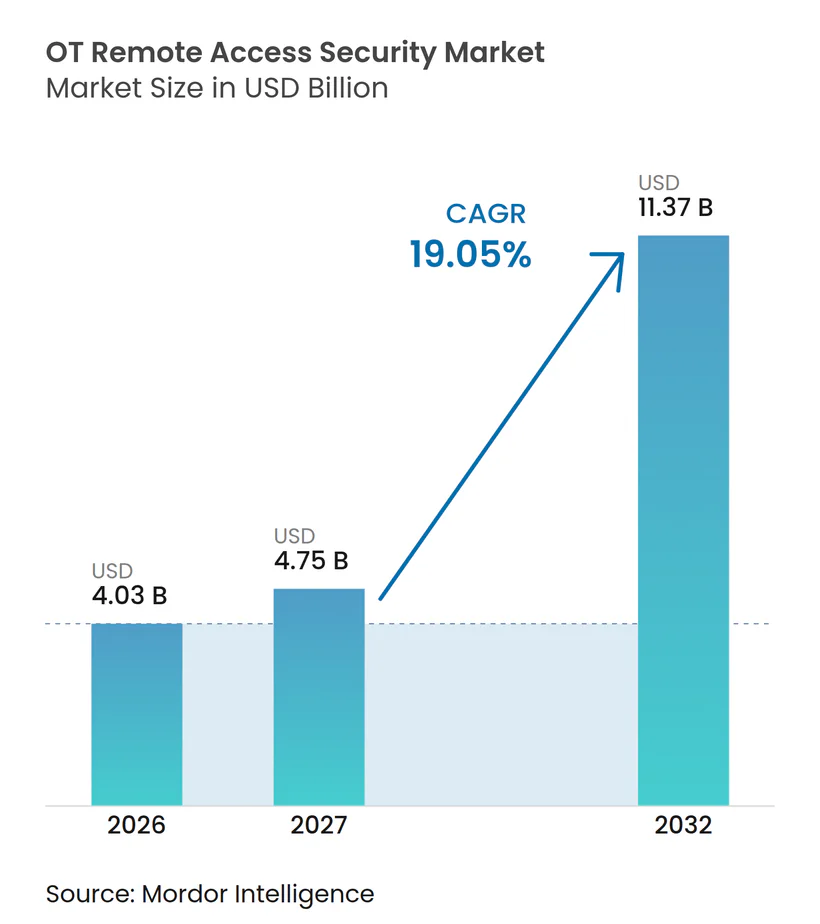
The OT remote access security market size is projected to expand from USD 4.03 billion in 2026 to USD 11.37 billion by 2032, registering a CAGR of 19.05% between 2027 and 2032. Industrial operators are giving greater priority to access controls as plant networks connect with enterprise systems, cloud services, and external maintenance teams. Malware was blocked on industrial automation systems during Q1 2026, and 19.6% of ICS computers registered threats, keeping remote access risk in focus for asset owners. Demand is shifting from basic connectivity to identity controls, session records, and policies suited to industrial equipment. Regulations are also making proof of access governance more important in purchasing decisions. The OT remote access security market is therefore creating opportunities for providers that can serve legacy sites without interrupting production.
Key Report Takeaways
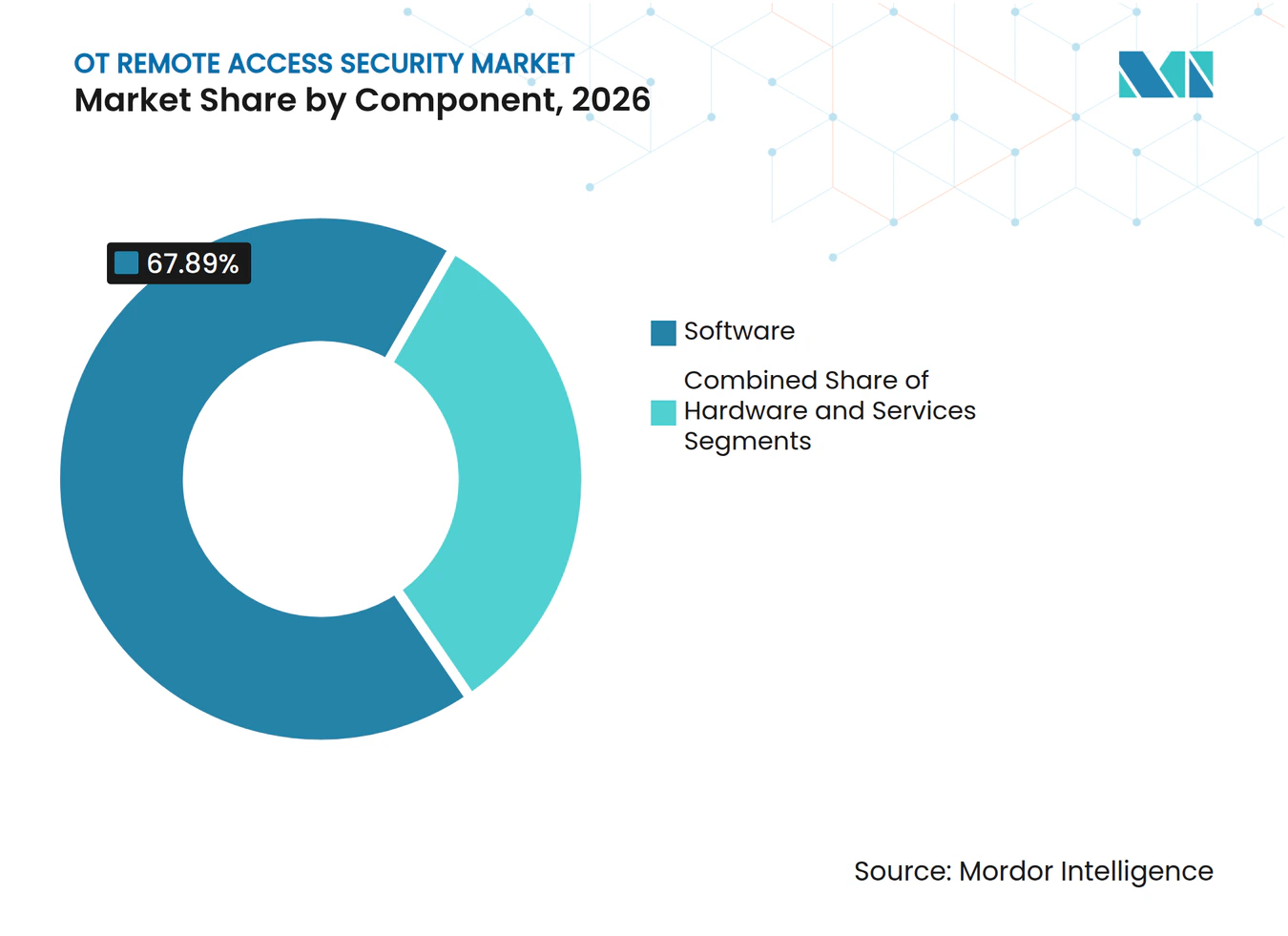
- By component, software held 67.89% of the OT remote access security market in 2026, while services are projected to expand at a 20.77% CAGR through 2032.
- By access architecture, VPN-based remote access held 65.20% of the OT remote access security market in 2026, while zero-trust network access is projected to expand at a 20.16% CAGR through 2032.
- By application, maintenance and support held 68.12% of the OT remote access security market in 2026, while incident response and emergency repair are projected to expand at a 20.51% CAGR through 2032.
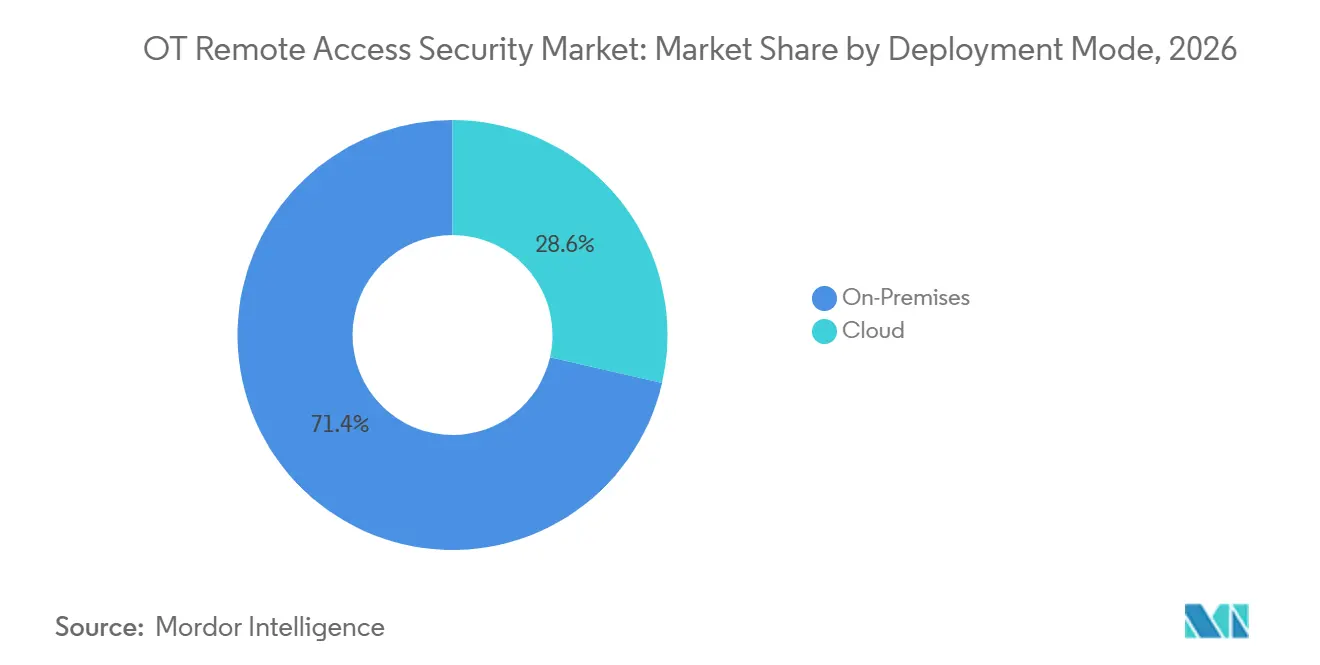
- By deployment mode, on-premises held 71.41% of the OT remote access security market in 2026, while cloud deployment is projected to expand at a 21.04% CAGR through 2032.
- By end user, industrial manufacturing held 27.19% of the OT remote access security market in 2026, while water and wastewater is projected to expand at a 19.45% CAGR through 2032.
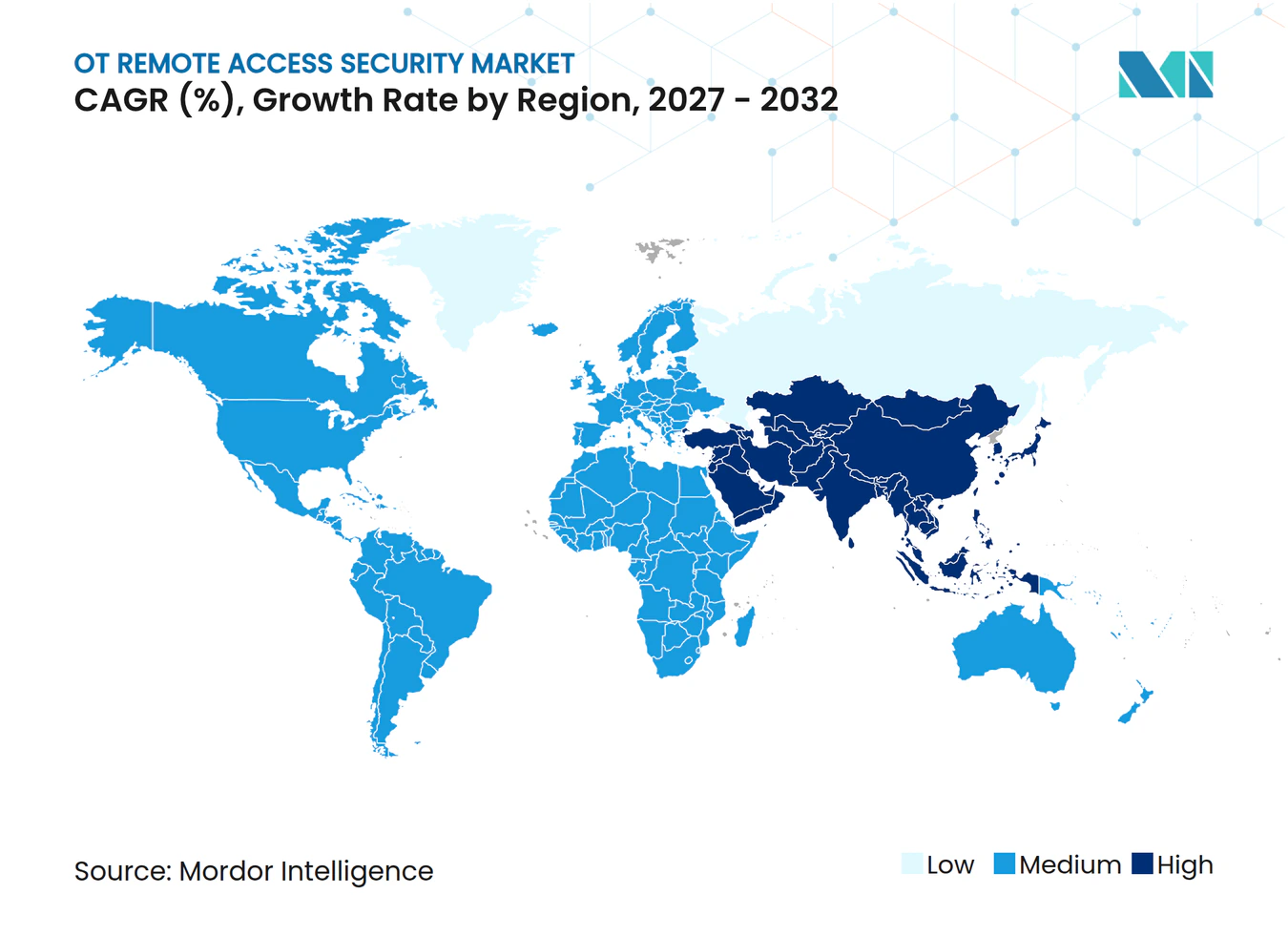
- By geography, North America held 38.10% of the OT remote access security market in 2026, while Asia-Pacific is projected to expand at a 19.81% CAGR through 2032.
Note: Market numbers in this report are based on Mordor Intelligence's proprietary estimation framework, which combines nine months of actuals with Q4 projections for base year 2026.
Market Trends and Insights
Drivers Impact Analysis of OT Remote Access Security Market*
| Driver | (~) % Impact on CAGR Forecast | Geographic Relevance | Impact Timeline |
|---|---|---|---|
| Industrial Cyberattacks on Connected Control Environments | +3.5% | Global | Short term (≤ 2 years) |
| Expansion of Remote Maintenance and Distributed Operations | +3.2% | Global | Short term (≤ 2 years) |
| Stricter Cybersecurity Regulation and Auditability Requirements | +2.8% | North America and Europe, with growing Asia-Pacific influence | Medium term (2-4 years) |
| Industry 4.0 and IIoT Connectivity | +2.1% | Asia-Pacific core, with spillover to North America and Europe | Medium term (2-4 years) |
| Vendor Ecosystem Identity and Credential Governance Gap | +1.8% | Global | Short term (≤ 2 years) |
| Protocol-Aware Access for Brownfield and Air-Gapped Assets | +1.4% | North America and Europe | Long term (≥ 4 years) |
| Source: Mordor Intelligence | |||
Industrial Cyberattacks on Connected Control Environments
Attacks on industrial control systems are increasing the need for access controls because exposed remote connections remain a direct route into plant networks. A joint April 2026 advisory described Iranian-affiliated actors targeting internet-connected PLCs at U.S. water, energy, and government facilities since March 2026. The advisory identified attempts to manipulate ladder logic and turn off shutdown alarms through exposed access ports. Kaspersky reported that threats affected 19.6% of ICS computers globally during Q1 2026, confirming that industrial exposure is broad rather than limited to a small group of high-profile targets. The OT remote access security market benefits when operators require multi-factor authentication, individual vendor identities, and session recordings for control environments. These requirements also affect insurance and compliance discussions because organizations need evidence that remote access is governed.
Expansion of Remote Maintenance and Distributed Operations
Remote maintenance has become a regular operating practice for organizations managing sites across wide geographic areas. Manufacturers and utilities rely on external specialists when skilled personnel cannot be present at every facility. The 2025 SANS survey identified secure remote access as a top investment priority and found that external connectivity and remote pathways accounted for a substantial share of reported ICS and OT cybersecurity incidents. This operating model can leave a company with VPNs, OEM tools, and specialized OT platforms running in parallel at different facilities. The resulting complexity reduces visibility when each tool creates its own accounts, approval process, and session record. The OT remote access security market is supported by demand for platforms that consolidate policy and audit evidence across a distributed asset base. This gives the OT remote access security market a role in standardizing governance across facilities.
Stricter Cybersecurity Regulation and Auditability Requirements
Regulatory requirements are shifting attention from the publication of new rules toward the ability to produce usable evidence during audits. NERC CIP-003-9 took effect on April 1, 2026, and brought documented vendor electronic remote access controls to low-impact Bulk Electric System assets. This change extends formal access expectations to assets that had previously received less attention under the framework. NIS2 requires multi-factor authentication and access controls for remote maintenance sessions, while its penalty provisions increase the importance of documented compliance for essential entities. IEC 62443-aligned procurement increasingly requires least-privilege access and individual accountability instead of a general statement that a VPN is available. Providers that generate session logs, recordings, and identity-linked records are better placed to address this requirement.
Industry 4.0 and IIoT Connectivity
Connected sensors, edge devices, and cloud analytics are widening the number of pathways between the plant floor and enterprise systems. This expansion is central to the OT remote access security market because every new connection requires clear rules on who can reach equipment and what they can do. A 2025 peer-reviewed review found that Industrial Internet of Things adoption can improve operations while creating data security and interoperability risks. Older industrial assets often use Modbus, DNP3, or proprietary protocols without built-in identity controls. NIST guidance recognizes the need to address IIoT and cloud environments alongside established operational technology systems.[1] Access controls must therefore operate at the network and session levels when the endpoint itself cannot authenticate a user.
Restraints Impact Analysis of OT Remote Access Security Market*
| Restraint | (~) % Impact on CAGR Forecast | Geographic Relevance | Impact Timeline |
|---|---|---|---|
| Legacy Protocol and Endpoint Compatibility Limits | -2.3% | North America and Europe, with brownfield concentration | Long term (≥ 4 years) |
| High Implementation and Lifecycle Cost | -1.9% | Global, with higher impact in emerging markets | Medium term (2-4 years) |
| Shortage of OT Cybersecurity Skills | -1.5% | Global | Medium term (2-4 years) |
| Operational Resistance to New Access Control Paths | -1.2% | Global | Short term (≤ 2 years) |
| Source: Mordor Intelligence | |||
Legacy Protocol and Endpoint Compatibility Limits
Long operating lives for industrial assets make compatibility a major limitation on adoption. Many brownfield sites use PLCs, RTUs, and HMIs that depend on Modbus, DNP3, or proprietary protocols that were not designed with authentication or encryption. A secure connection must protect access without affecting deterministic and time-sensitive operations. A 2025 peer-reviewed framework found that OT cybersecurity integration requires coordinated attention to people, processes, technology, and suppliers. Segmentation requirements can add difficulty because older facilities were not designed around modern zones and conduits. Agentless and protocol-aware tools can reduce deployment burden where endpoint updates or firmware changes are not practical.
High Implementation and Lifecycle Cost
Multi-site implementation costs can exceed initial expectations because each facility has its own equipment, network design, and maintenance procedures. The cost includes software, engineering work, integration, training, and configuration updates as access requirements change. Organizations may also need to address OT and IT network separation before remote access policies can be enforced effectively. Recurring audit preparation and evidence collection add to the post-deployment lifecycle burden. This restraint can favor cloud-delivered and managed service models because they can centralize updates and reduce the need for each site to maintain a full access management stack. The OT remote access security market can benefit when providers make the cost structure easier to manage. The cost remains a greater burden for smaller operators and organizations in emerging markets with limited security budgets.
*Our forecasts treat driver/restraint impacts as directional, not additive. The impact forecasts reflect baseline growth, mix effects, and variable interactions.
OT Remote Access Security Market Segment Analysis
By Component:
Software Dominance and the Services PivotSoftware accounted for 67.89% of the OT remote access security market in 2026. Its position reflects the importance of policy enforcement, identity federation, session recording, audit trails, and dashboards in modern industrial access programs. These functions are delivered primarily through software rather than through a gateway alone. Platforms can apply a policy to a named user, a device, a facility, or a specific session. They can also record activity and create evidence that supports operational reviews. Hardware remains relevant at air-gapped and brownfield facilities where agents cannot be added to legacy endpoints. Such locations often require a local gateway to mediate access without modifying production equipment. Hardware, therefore, remains necessary even though it represents the smallest component by revenue. The software position shows that buyers are prioritizing control and visibility alongside connection availability.
Services are projected to expand at a 20.77% CAGR through 2032, making it the fastest-growing component. Industrial organizations need help deploying platforms across multiple plants and managing access policies for external vendors. Managed services can also provide continuous monitoring, policy updates, and evidence collection. Dispel introduced Integrated Threat Monitoring in January 2026 as a 24/7 managed capability within its OT remote access platform. The development reflects demand for providers capable of combining remote access with active threat monitoring. Services are also relevant where internal teams have separate IT and OT responsibilities that do not easily align. This can make deployment support important during the initial rollout and later expansions to new sites. The OT remote access security industry, therefore, has room for professional and managed offerings in addition to standalone software licenses.



By Access Architecture:
Transition From VPN Incumbency to Zero Trust EnforcementVPN-based remote access held 65.20% of the OT remote access security market share in 2026. This position reflects the installed base of legacy deployments rather than a preference for unrestricted network-level access. VPNs can connect a remote user to a site, but they may not provide industrial protocol awareness or session-level control on their own. These limitations matter when a vendor requires access to only one asset or a narrow maintenance task. A critical authentication-bypass issue affecting remote-access VPN software was added to the CISA Known Exploited Vulnerabilities catalog in June 2026.[2] The event reinforced attention on the security of perimeter-facing remote access tools. Organizations are therefore reviewing how access can be limited by identity, asset, time, and role. Existing VPN deployments will remain important because replacing site connections can take time in sensitive environments.
Zero trust network access is projected to expand at a 20.16% CAGR through 2032. The approach gives organizations a way to verify identity and apply narrow policies before a connection is established. CISA and NSA guidance have extended zero-trust principles to operational technology, encouraging controls that reduce implicit trust in remote sessions. Industrial protocol-based access remains relevant at brownfield sites where a platform must understand plant communications before applying access rules. Cloud- and edge-based access supports distributed operators who cannot maintain large local hardware stacks at every site. Xage Security introduced a Visibility-to-Policy Studio that links asset discovery to enforceable zero-trust policies. The product direction seeks to reduce the effort required to move from broad VPN access to more specific controls. The OT remote access security industry is thus balancing the large installed VPN base with a transition toward policy-led access.
By Application:
Maintenance and Support Leads While Incident Response RisesMaintenance and support held 68.12% of the OT remote access security market share in 2026. Routine connections from technicians and equipment vendors generate a high volume of access activity across industrial facilities. This work can include troubleshooting, configuration changes, diagnostics, and routine support for production assets. The scale of routine access makes clear approval processes and records important for plant operators. Secomea reported in 2026 that only 43% of surveyed organizations maintained full audit trails of vendor sessions. This leaves a material governance gap in the largest application area. A unified platform can support recurring maintenance while providing security and operations teams with a common evidence trail. That need supports demand for more controlled vendor access rather than informal credentials or shared VPN accounts.
Incident response and emergency repair are projected to expand at a 20.51% CAGR through 2032. The segment requires a fast connection during an operational event without sacrificing records that can support later investigation. This differs from earlier approaches, in which secure remote access was primarily configured for planned maintenance. Organizations now need predefined roles, approvals, and emergency workflows before an incident occurs. Remote monitoring, real-time diagnostics, and asset management are smaller applications that also reduce the need for on-site physical presence. These applications can create separate access paths if they are managed through separate tools. NIS2 and NERC CIP requirements favor a unified evidence trail across remote access contexts. The OT remote access security market is therefore moving toward platforms that handle regular activity and crisis access under common policies.
By Deployment Mode:
On-Premises Dominates and Cloud InflectsOn-premises deployment held 71.41% of the OT remote access security market in 2026. Its lead reflects the requirements of the energy, defense, chemicals, and process industries, which favor separate networks and local control. Some organizations also have data residency or operational rules that limit where data can be processed. Existing plants often already operate local gateways and security systems. The 2025 SANS survey placed asset visibility and secure remote access among the leading investment priorities for ICS and OT programs. These programs frequently begin within the on-premises environments that operators already manage. Local deployment can also support sites where internet reliability and external cloud connections are operational concerns. The segment is therefore likely to remain important for sensitive single-site operations.
Cloud deployment is projected to expand at a 21.04% CAGR through 2032. Multi-site manufacturers and water utilities can use cloud control planes to manage policies across locations without installing a full management stack at every facility. This model can reduce the capital expense associated with individual site hardware. Tosi launched a unified platform in January 2026 that combined cloud-based monitoring with gateway-level access management. The design illustrates a hybrid approach in which policy management is centralized, while session enforcement remains close to the asset. Such models can preserve uptime needs while improving policy consistency across a large facility base. Pure on-premises use will remain relevant where external connections are not acceptable. The OT remote access security market is consequently moving toward hybrid deployment patterns rather than a complete replacement of local systems. This creates a distinct opportunity in the OT remote-access security market for flexible control architectures.

By End User:
Industrial Manufacturing Anchors the Market, Water and Wastewater AcceleratesIndustrial manufacturing held 27.19% of the 2026 total. The sector has dense populations of OT assets and recurring vendor access needs across automotive, food and beverage, chemicals, and discrete production. Production equipment often requires support from original equipment manufacturers and specialized integrators. Each connection can affect throughput, safety, and product quality when it reaches a control environment. Manufacturing organizations, therefore, need access policies that recognize plant schedules and asset criticality. The sector also has long-lived equipment, which can make direct replacement of older network practices difficult. Its scale and operating complexity keep it the largest end-user segment in the OT remote access security market. Demand is likely to remain tied to both digitalization initiatives and the need to protect established production lines. The OT remote access security market remains relevant, where manufacturers need to govern external support across complex facilities.
Water and wastewater are projected to expand at a 19.45% CAGR through 2032. Municipal utilities have received greater attention after attacks and warnings involving exposed operational technology. The EPA released cybersecurity planning resources for water systems in October 2025, increasing the availability of guidance for utility programs. A 2026 peer-reviewed analysis identified SCADA vulnerabilities and legacy OT infrastructure as important cyber-physical risks for U.S. water utilities. Energy and utilities also remain important, as electricity operators are subject to NERC CIP requirements. Oil and gas operators manage remote and critical assets under sector-specific security expectations. Transportation and logistics, chemicals and pharmaceuticals, and mining and metals are smaller end-user areas that are adding connected assets over time. Vendor identity governance remains a common requirement across these verticals, regardless of the asset type.
Geography Analysis
North America OT Remote Access Security Market
North America accounted for 38.10% of the OT remote access security market in 2026. The region combines a large base of regulated power, water, oil, and gas assets, as well as manufacturing assets. NERC CIP-003-9 introduced documented vendor electronic remote access requirements for low-impact Bulk Electric System assets in April 2026. This changed third-party access from an informal practice to an auditable obligation for electric utilities. The United States remains the main revenue pool in the region, while Canadian operators also align access programs with national guidance and NERC CIP requirements.
APAC OT Remote Access Security Market
Asia-Pacific is projected to expand at a 19.81% CAGR through 2032. Southeast Asia recorded 23.21% of ICS computers under attack in Q1 2026, linking the region's rapid manufacturing digitalization to a material security challenge. National rules are becoming more demanding across the region, including requirements for monitoring, risk assessment, and rapid incident reporting. In Japan, NTT Communications and IIJ began providing an integrated OT security management solution in 2025, which combined OT-specific intrusion detection with secure remote access. Yokogawa opened its Industrial Cyber Resilience Center in Singapore in September 2026 to provide regional training, threat simulation, and managed services.
EMEA and South America OT Remote Access Security Market
Europe has a material position in the OT remote access security market, supported by high manufacturing density in Germany, the United Kingdom, and France. NIS2- and IEC 62443-aligned procurement has increased the importance of remote-access auditability across industrial sectors. IXON introduced its IEC 62443-4-2 certified SecureEdge gateway in April 2026. Moxa gained dual IEC 62443-4-1 Maturity Level 3 certifications in June 2026.[3] South America is an emerging area where manufacturing and oil activity are increasing awareness of industrial security needs. The Middle East has concentrated demand from oil and gas operators, while Africa remains the smallest revenue area despite having the highest regional ICS attack rate at 27.4% in Q1 2026.
Competitive Landscape
Market Concentration
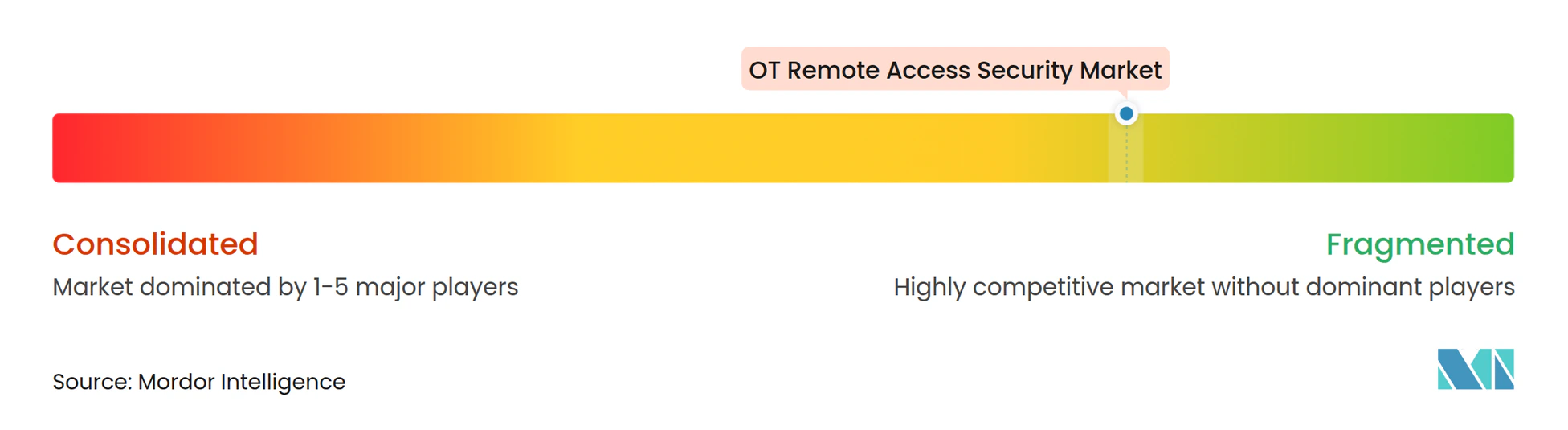
The OT remote access security market is fragmented, with no provider holding a dominant position across all segments and geographies. The field includes OT-native providers such as Cyolo, Dispel, Secomea, IXON, and XONA Systems. It also includes industrial networking suppliers such as HMS Networks, Moxa, and Westermo, which have expanded their connectivity portfolios to include secure remote access. OT-native platforms focus on identity-based access, protocol awareness, and session-level enforcement. Networking suppliers generally extend access management from their existing connectivity hardware. The difference is most visible in regulated evaluations where the buyer requires auditable sessions, individual vendor identities, and evidence of policy enforcement. These conditions favor purpose-built platforms when a general remote connection is not enough.
Providers are seeking to increase switching costs by embedding their platforms in partner ecosystems and adding adjacent capabilities. Dispel entered a multi-year global partnership with ABB in August 2025 to support secure remote services under ABB Care. The company also announced an integration with Armis from ServiceNow in August 2026 to bring asset-risk information into remote access decisions. Cyolo introduced CPS Segmentation in July 2026, extending its offering from human-to-machine access toward machine-to-machine communication control.[4] These moves broaden the role of access platforms beyond a basic remote connection. They also respond to buyers who need visibility of assets, users, and communication paths before granting access. Compliance requirements are shortening evaluations for vendors that can provide logs, identity records, and policy evidence without extensive customization.
The competitive environment also includes capabilities for managed monitoring, behavior analysis, and policy generation. Dispel launched a 24/7 Integrated Threat Monitoring service in January 2026. Cyolo released Live Risk Detection in September 2026 to flag risky operator actions during active OT remote sessions without disrupting the connection. These functions aim to reduce the gap between granting a connection and supervising what happens after access is approved. Companies with protocol-aware architecture can address brownfield requirements, while large networking vendors retain an advantage in established equipment relationships. The OT remote access security market remains open to different provider types because customer needs vary by regulation, deployment model, asset age, and internal operating capability. There is no disclosed combined share for the leading companies, which supports a fragmented competitive description.
OT Remote Access Security Industry Leaders
-
HMS Networks AB
-
IXON B.V.
-
Moxa Inc.
-
Secomea A/S
-
Tosibox Oy
- *Disclaimer: Major Players sorted in no particular order
OT Remote Access Security Market Companies Covered in this Report
- AhnLab, Inc.
- Alleantia S.L.
- Bayshore Networks, Inc.
- Cyolo Security Ltd.
- Dispel LLC
- HMS Networks AB
- IXON B.V.
- Moxa Inc.
- Otector B.V.
- ProSoft Technology, Inc.
- Radiflow Ltd.
- Remote Engineer B.V.
- Secomea A/S
- TDi Technologies, Inc.
- Tosibox Oy
- Trout Software, Inc.
- Waterfall Security Solutions Ltd.
- Westermo Network Technologies AB
- Xage Security, Inc.
- XONA Systems, Inc.
Recent Industry Developments in OT Remote Access Security Market
- September 2026: Cyolo released Live Risk Detection for its Cyolo PRO (Privileged Remote Operations) solution, introducing AI-powered, real-time anomaly flagging that flags risky operator actions during active OT remote sessions without disrupting the connection. The capability addresses the persistent gap in post-connection monitoring across vendor remote access channels in critical infrastructure environments.
- September 2026: Yokogawa Engineering Asia launched the Industrial Cyber Resilience Center (ICRC) in Singapore, establishing a regional hub for Southeast Asia, Oceania, and Taiwan, offering OT cybersecurity training, threat simulation, and managed services. The center reflects growing corporate investment in Asia-Pacific OT security capacity ahead of regional regulatory mandates intensifying through 2027.
- August 2026: Dispel announced an integration with Armis from ServiceNow at Black Hat USA 2026, combining Armis Centrix's AI-powered cyber exposure management platform with the Dispel Zero Trust Engine so that real-time asset risk intelligence informs every remote access decision at the point of authorization. The integration closes the operational gap between security-owned asset visibility and operations-owned access decisions in industrial environments.
- July 2026: Cyolo announced Cyolo CPS Segmentation, expanding its platform beyond human-to-machine secure remote access into machine-to-machine communication control for industrial and critical infrastructure organizations. The capability enables discovery, communication visualization, policy simulation, and connectivity enforcement to limit lateral movement and contain blast radius without disrupting operations.
Global OT Remote Access Security Market Report Scope
The OT Remote Access Security Market comprises revenues generated from hardware, software, and services that enable secure remote connectivity to operational technology systems and industrial environments. These solutions provide controlled access to industrial assets, engineering workstations, control systems, and field equipment through technologies such as zero-trust access, VPN-based access, industrial protocol-aware access, and cloud-based remote connectivity. The market helps organizations secure remote maintenance, monitoring, diagnostics, support, and emergency-response activities while maintaining operational safety and compliance. Solutions also provide authentication, authorization, session monitoring, and audit capabilities for third-party vendors and internal users. Growth is driven by the increasing adoption of remote operations, Industry 4.0 initiatives, and the need for secure access to distributed industrial assets.
The OT Remote Access Security Market Report is Segmented by Component (Hardware, Software, and Services), Access Architecture (VPN-Based Remote Access, Zero Trust Network Access, Industrial Protocol-Based Access, Cloud and Edge-Based Access, and Other Access Architectures), Application (Remote Monitoring, Real-Time Diagnostics, Asset Management, Maintenance and Support, and Incident Response and Emergency Repair), Deployment Mode (On-Premises, and Cloud), End User (Industrial Manufacturing, Energy and Utilities, Oil and Gas, Transportation and Logistics, Chemicals and Pharmaceuticals, Mining and Metals, Water and Wastewater, and Other End Users), and Geography (North America, South America, Europe, Asia-Pacific, Middle East, and Africa). The Market Forecasts are Provided in Terms of Value (USD).
Segmentation Overview
| Hardware |
| Software |
| Services |
| VPN-Based Remote Access |
| Zero Trust Network Access |
| Industrial Protocol-Based Access |
| Cloud and Edge-Based Access |
| Other Access Architectures |
| Remote Monitoring |
| Real-Time Diagnostics |
| Asset Management |
| Maintenance and Support |
| Incident Response and Emergency Repair |
| On-Premises |
| Cloud |
| Industrial Manufacturing |
| Energy and Utilities |
| Oil and Gas |
| Transportation and Logistics |
| Chemicals and Pharmaceuticals |
| Mining and Metals |
| Water and Wastewater |
| Other End Users |
| North America | United States |
| Canada | |
| South America | Brazil |
| Argentina | |
| Mexico | |
| Rest of South America | |
| Europe | Germany |
| United Kingdom | |
| France | |
| Italy | |
| Russia | |
| Rest of Europe | |
| Asia-Pacific | China |
| Japan | |
| India | |
| South Korea | |
| Rest of Asia-Pacific | |
| Middle East | Saudi Arabia |
| United Arab Emirates | |
| Rest of Middle East | |
| Africa | South Africa |
| Nigeria | |
| Rest of Africa |
| By Component | Hardware | |
| Software | ||
| Services | ||
| By Access Architecture | VPN-Based Remote Access | |
| Zero Trust Network Access | ||
| Industrial Protocol-Based Access | ||
| Cloud and Edge-Based Access | ||
| Other Access Architectures | ||
| By Application | Remote Monitoring | |
| Real-Time Diagnostics | ||
| Asset Management | ||
| Maintenance and Support | ||
| Incident Response and Emergency Repair | ||
| By Deployment Mode | On-Premises | |
| Cloud | ||
| By End User | Industrial Manufacturing | |
| Energy and Utilities | ||
| Oil and Gas | ||
| Transportation and Logistics | ||
| Chemicals and Pharmaceuticals | ||
| Mining and Metals | ||
| Water and Wastewater | ||
| Other End Users | ||
| By Geography | North America | United States |
| Canada | ||
| South America | Brazil | |
| Argentina | ||
| Mexico | ||
| Rest of South America | ||
| Europe | Germany | |
| United Kingdom | ||
| France | ||
| Italy | ||
| Russia | ||
| Rest of Europe | ||
| Asia-Pacific | China | |
| Japan | ||
| India | ||
| South Korea | ||
| Rest of Asia-Pacific | ||
| Middle East | Saudi Arabia | |
| United Arab Emirates | ||
| Rest of Middle East | ||
| Africa | South Africa | |
| Nigeria | ||
| Rest of Africa | ||
Key Questions Answered in the Report
What is the OT remote access security market size?
The OT remote access security market is valued at USD 4.03 billion in 2026 and is projected to reach USD 11.37 billion by 2032, at a 19.05% CAGR from 2027 to 2032.
What is driving demand for OT remote access security?
Cyberattacks, distributed maintenance, IIoT connectivity, and audit requirements are increasing demand for identity-based, recorded, and policy-controlled access.
Which component leads OT remote access security spending?
Software leads with 67.89% of the 2026 total because policy enforcement, session recording, identity management, and audit tools are software-led functions.
Which access architecture is growing fastest?
Zero trust network access is projected to grow at a 20.16% CAGR through 2032 as operators seek narrower access permissions and stronger identity verification.
Which end user is expanding fastest?
Water and wastewater is projected to grow at a 19.45% CAGR through 2032, supported by attention to municipal utility cyber risks and planning guidance.
Which region is expanding fastest?
Asia-Pacific is projected to grow at a 19.81% CAGR through 2032 as manufacturing digitalization, new rules, and increasing ICS threats raise security requirements.