
Orthopedic Imaging Equipment Market Size and Share
Market Overview
| Study Period | 2020 - 2031 |
|---|---|
| Market Size (2026) | USD 5.71 Billion |
| Market Size (2031) | USD 7.41 Billion |
| Growth Rate (2026 - 2031) | 5.35 % |
| Fastest Growing Market | Asia-Pacific |
| Largest Market | North America |
| Market Concentration | Medium |
Major Players *Disclaimer: Major Players sorted in no particular order Image © Mordor Intelligence. Reuse requires attribution under CC BY 4.0. | |
Orthopedic Imaging Equipment Market Analysis by Mordor Intelligence
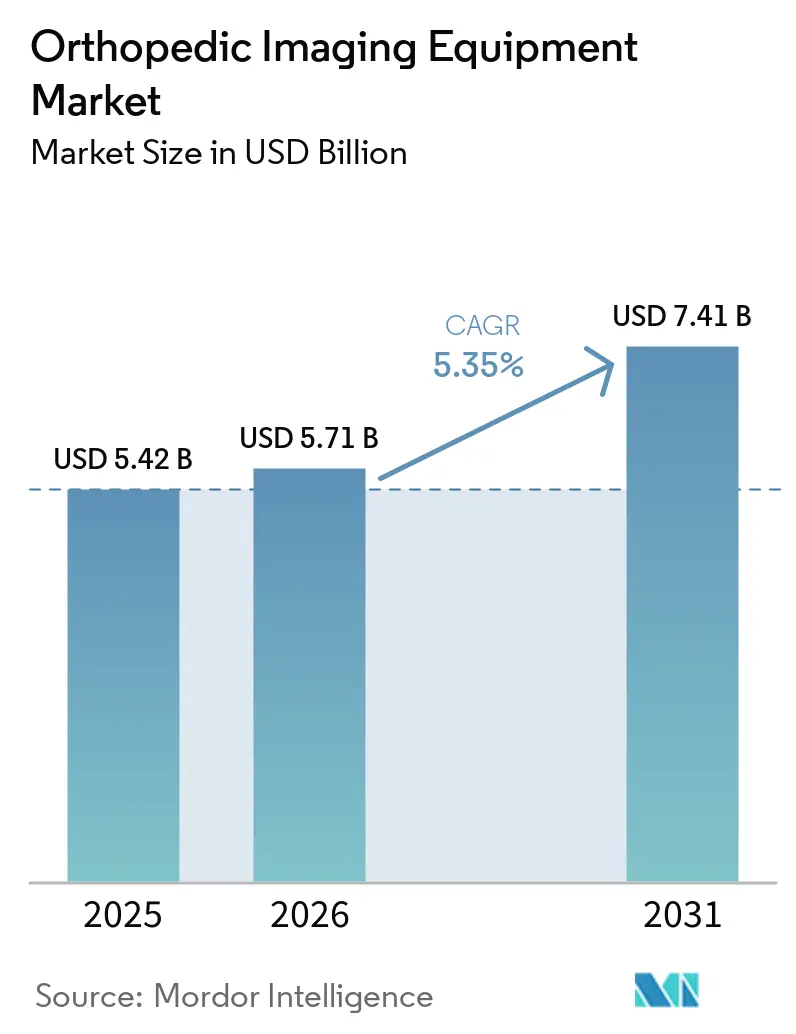
The Orthopedic Imaging Equipment Market size is projected to expand from USD 5.42 billion in 2025 and USD 5.71 billion in 2026 to USD 7.41 billion by 2031, registering a CAGR of 5.35% between 2026 and 2031.
The orthopedic imaging equipment market is supported by the growing clinical need for accurate musculoskeletal diagnosis, broader use of AI-assisted imaging, and the expansion of ambulatory orthopedic care. Demand covers digital X-ray for emergency departments, photon-counting CT, MRI, mobile C-arms, and weight-bearing cone-beam CT systems used in specialty settings across the orthopedic imaging equipment market. Capital investment by established imaging suppliers and a continuing pipeline of regulatory clearances in the United States, Europe, and Japan support equipment replacement and technology upgrades in the orthopedic imaging equipment market. The orthopedic imaging equipment market is also changing as ambulatory surgical centers and orthopedic clinics buy compact imaging systems outside traditional hospital purchasing cycles. Chronic conditions, including arthritis and degenerative joint disease, create repeat imaging needs within the orthopedic imaging equipment market that differ from episodic demand associated with acute trauma.
Key Report Takeaways
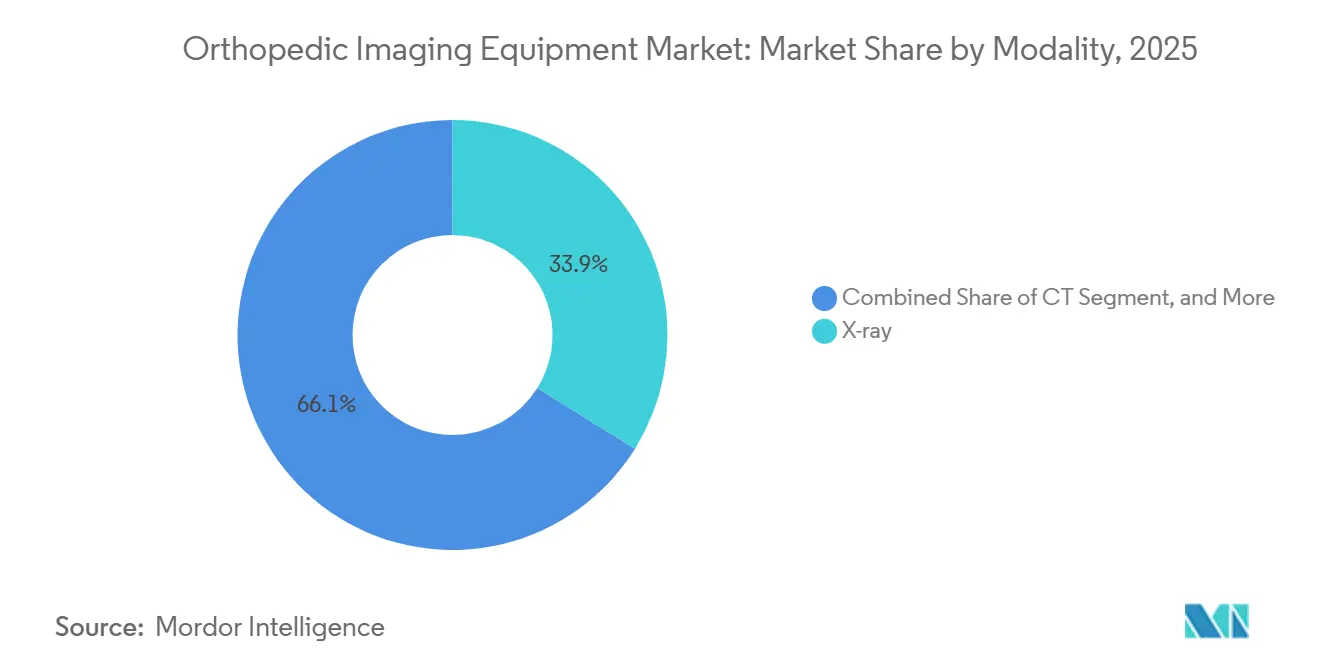
- By modality, X-ray held 33.87% revenue share in 2025, while CT recorded the highest forecast CAGR at 7.54% through 2031.
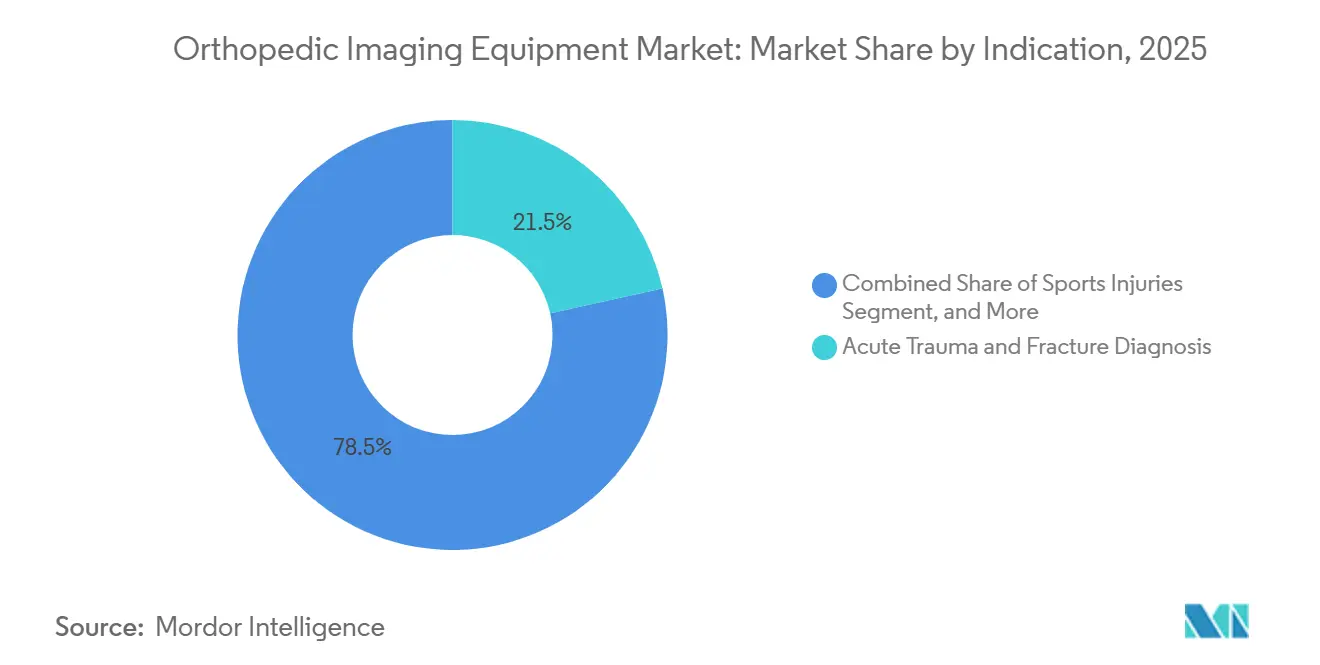
- By indication, acute trauma and fracture diagnosis accounted for 21.53% of revenue in 2025, while arthritis and degenerative joint disease recorded the highest forecast CAGR at 8.21% through 2031.
- By end user, hospitals and trauma centers held 42.80% of revenue in 2025, while diagnostic imaging centers recorded the highest forecast CAGR at 8.54% through 2031.
- By geography, North America held 42.43% of revenue in 2025, while Asia-Pacific recorded the highest forecast CAGR at 6.43% through 2031.
Note: Market size and forecast figures in this report are generated using Mordor Intelligence’s proprietary estimation framework, updated with the latest available data and insights as of January 2026.
Global Orthopedic Imaging Equipment Market Trends and Insights
Drivers Impact Analysis*
| Driver | (~) % Impact on CAGR Forecast | Geographic Relevance | Impact Timeline |
|---|---|---|---|
| Rising Prevalence of Musculoskeletal Disorders and Orthopedic Procedures | +1.80% | Global | Short term (≤ 2 years) |
| Aging Population and Higher Joint-Replacement Demand | +1.50% | Global, most pronounced in North America, Europe, and East Asia | Long term (≥ 4 years) |
| Growth in Sports, Trauma, and Road-Injury Imaging | +0.70% | Global, with accelerating road trauma volumes in Asia-Pacific and the Middle East and Africa | Short term (≤ 2 years) |
| AI-Enabled, 3D, and Low-Dose Imaging Workflows | +1.40% | Global, with North America and Europe leading adoption and Asia-Pacific scaling rapidly | Medium term (2-4 years) |
| Shift Toward Outpatient and Ambulatory Orthopedic Care | +0.90% | North America, Western Europe, and urban Asia-Pacific centers | Medium term (2-4 years) |
| Portable and Weight-Bearing Imaging for Underserved Care Pathways | +0.50% | Asia-Pacific emerging markets, the Middle East and Africa, South America, and North American ambulatory surgical centers | Medium term (2-4 years) |
| Source: Mordor Intelligence | |||
Rising Prevalence of Musculoskeletal Disorders and Orthopedic Procedures
Musculoskeletal disorders were the largest contributor to years lived with disability worldwide and represented 17% of all years lived with disability. A 2025 systematic analysis using Global Burden of Disease 2021 data reported 1.69 billion musculoskeletal disorder cases globally in 2021, which was 95% higher than in 1990. The same body of evidence showed that disability-adjusted life years associated with these disorders rose 88% during that period. Osteoarthritis is expected to become the leading contributor to the musculoskeletal disease burden by 2050, especially among women. The orthopedic imaging equipment market therefore has demand across diagnosis, treatment planning, guided interventions, and follow-up care. More than half of people with symptomatic knee osteoarthritis are younger than 65 years old, extending imaging use beyond older adult care pathways.
Aging Population and Higher Joint-Replacement Demand
Joint arthroplasty requires imaging before surgery, during planning, and after the procedure, which links procedure volumes to repeated equipment use. U.S. primary total knee arthroplasty volume rose from 603,704 procedures in 2013 to 1,013,533 procedures in 2022. The supplied research projects primary total knee arthroplasty volume at 2,793,919 procedures by 2040, with 5.9% annual growth, while total hip arthroplasty is projected to grow 7.6% annually through 2040. Hip and knee replacement volumes returned to, and exceeded, pre-pandemic levels across OECD countries in 2025. Germany, Switzerland, Poland, and Australia recorded leading increases in replacement volumes in the supplied research. The orthopedic imaging equipment market benefits when implant positioning, periprosthetic fracture assessment, and loosening detection require post-surgical surveillance.
AI-Enabled, 3D, and Low-Dose Imaging Workflows
The supplied research estimated that 30% to 40% of new orthopedic imaging tenders in 2025 and 2026 included AI capability specifications. GE HealthCare received FDA 510(k) clearance in March 2026 for Photonova Spectra, a photon-counting CT system designed to process up to 50 times more data than conventional CT. The system supports material separation and high-definition musculoskeletal tissue characterization in the supplied research. Canon Medical launched Ultimion in April 2026 as Japan’s first domestically manufactured photon-counting CT, with musculoskeletal scan protocols. The FDA issued final guidance for AI-enabled device software functions in 2025, covering performance validation and post-market monitoring[1]. The orthopedic imaging equipment market favors suppliers that build cleared AI functions into image acquisition and workflow systems, rather than relying only on later-stage image processing.
Shift Toward Outpatient and Ambulatory Orthopedic Care
The move of orthopedic procedures toward ambulatory surgical centers and free-standing imaging sites is changing the end-user base for equipment suppliers. Medicare-certified ambulatory surgical centers totaled 6,308 facilities in 2023 and grew 2.5%, according to the Medicare Payment Advisory Commission. New orthopedic centers increasingly combine advanced C-arms, MRI, and robotic technologies in one-visit care models. The supplied research cited an August 2026 opening by Mid-State Orthopaedic ASC in Alexandria, Louisiana, as an example of this configuration. Compact equipment has a stronger fit in locations with smaller footprints and procedure-led workflows. The orthopedic imaging equipment market therefore provides openings for suppliers with products and commercial models designed for outpatient orthopedic care.
Restraints Impact Analysis*
| Restraint | (~) % Impact on CAGR Forecast | Geographic Relevance | Impact Timeline |
|---|---|---|---|
| High Capital, Installation, and Lifecycle-Service Costs | -0.90% | Global, most acute in emerging markets and rural settings | Short term (≤ 2 years) |
| Shortage of Radiologists, Radiographers, and Musculoskeletal Specialists | -0.70% | Global, most pronounced in North America and Western Europe | Medium term (2-4 years) |
| Reimbursement Fragmentation and Site-of-Service Pressure | -0.50% | North America and Western Europe | Medium term (2-4 years) |
| Interoperability, Cybersecurity, and AI-Validation Burden | -0.40% | Global, with the strongest regulation in North America and the European Union | Medium term (2-4 years) |
| Source: Mordor Intelligence | |||
High Capital, Installation, and Lifecycle-Service Costs
Advanced orthopedic imaging systems in the supplied research carried procurement prices from USD 1 million to more than USD 3 million per unit. Shielded-room construction and commissioning added to the expenditure for systems that required fixed installations. Lifecycle service contracts represented 20% to 30% of new-system contract value in the supplied research, creating multi-year commitments for buyers. Community hospitals, rural health centers, and newer ambulatory surgical centers faced the greatest capital barriers. This leaves well-capitalized urban hospital systems better positioned to acquire AI-enabled premium platforms. The orthopedic imaging equipment market has room for leasing, shared-service, and consumption-based commercial models where facilities cannot fund large upfront purchases.
Shortage of Radiologists, Radiographers, and Musculoskeletal Specialists
A continuing radiologist shortage limits imaging capacity even when patient demand rises. A 2025 study projected that the U.S. radiologist workforce could increase from 37,482 in 2023 to 47,119-52,591 by 2055 without a material expansion in residency positions[2]. Another 2025 analysis reported a cumulative gap of 21,645 radiology jobs relative to graduating trainees between 2014 and 2023[3]. The U.S. population aged 65 years and older grew 38.6% from 2010 to 2020, while annual diagnostic radiology residency matches remained near 1,000-1,100 in the supplied research. Musculoskeletal reading backlogs can delay diagnosis and extend the interval before surgery. The orthopedic imaging equipment market consequently faces lower near-term scan throughput, even as staffing constraints make AI-assisted interpretation more important.
*Our forecasts treat driver/restraint impacts as directional, not additive. The impact forecasts reflect baseline growth, mix effects, and variable interactions.
Segment Analysis
By Modality: X-Ray Anchors Volume, CT Drives the Upgrade Cycle
X-ray held 33.9% of revenue in 2025 because it remained central to trauma assessment, fracture screening, and weight-bearing joint alignment analysis. Digital radiography continued to replace computed radiography, particularly where facilities were upgrading established X-ray rooms. Konica Minolta, Agfa-Gevaert, and Allengers Medical Systems competed in Asia-Pacific and Latin America, where the supplied research indicated lower digital radiography penetration than in Western markets. FUJIFILM launched the CALNEO CROSS Slim surgical C-arm in Japan in September 2026. Its tube head was 55% narrower than its predecessor, while ultrasound-supported tendon assessment and guided injections, and mobile C-arms supported ambulatory surgical center workflows.
CT was the fastest-growing modality, with the orthopedic imaging equipment market size for CT projected to expand at a 7.5% CAGR from 2026 to 2031. Photon-counting architectures and deep-learning reconstruction supported the shift toward higher-value CT systems. GE HealthCare’s Photonova Spectra, cleared in March 2026, was designed for material separation and high-definition musculoskeletal characterization. Canon Medical introduced CLEAR Motion and PIQE 1024 Matrix deep-learning reconstruction in July 2026 for its CT portfolio. MRI remained important for soft tissue, cartilage, and ligament assessment, and premium CT and MRI platforms raised revenue per unit faster than entry-level X-ray systems.

By Indication: Trauma Anchors Volume, Arthritis Reshapes Revenue Mix
Acute trauma and fracture diagnosis accounted for 21.5% of the orthopedic imaging equipment market share in 2025 and remained the largest indication segment. Emergency departments require rapid imaging for road injuries, sports injuries, and fall-related fractures. This produced a broad and steady volume base across hospitals, trauma centers, and urgent care pathways. Conventional X-ray remained the usual first imaging step for many fracture assessments. CT and MRI added clinical value in complex fractures and soft-tissue injuries, supporting a continuing role for mobile and fixed systems in the orthopedic imaging equipment market.
Arthritis and degenerative joint disease were the fastest-growing indication segments, with a forecast CAGR of 8.2% from 2026 to 2031. Osteoarthritis affected an estimated 595 million people globally in 2022 and is projected to be a leading contributor to musculoskeletal disease burden by 2050. Serial imaging is required throughout disease management, including baseline assessment, treatment planning, and follow-up. This repeated use pattern differed from the single-event imaging demand often associated with trauma. Spinal injuries and disorders required advanced imaging and intraoperative guidance, while sports injuries, osteoporosis, bone disorders, and musculoskeletal cancer required modality-specific pathways.
By End User: Hospitals Lead, Diagnostic Imaging Centers, and ASCs Surge
Hospitals and trauma centers held 42.8% of revenue in 2025, making them the largest end-user group in the orthopedic imaging equipment market. Their position reflected their role in trauma CT, intraoperative fluoroscopy, and MRI for complex joint and spine procedures. Hospital systems also had the infrastructure required for shielded rooms and specialist staffing. Large facilities, therefore, absorbed the highest-cost imaging platforms. Their purchasing often covered multiple modalities and service contracts, supporting established vendors with broad imaging portfolios.
Diagnostic imaging centers recorded the highest end-user CAGR at 8.5% from 2026 to 2031. Payers were directing elective musculoskeletal imaging toward lower-cost free-standing facilities in the supplied research. Ambulatory surgical centers were also becoming more important equipment customers as orthopedic procedures moved away from hospitals. CurveBeam AI’s HiRise CBCT received FDA clearance, Health Canada approval, and a CE mark under the EU Medical Device Regulation in 2025. The system was designed for orthopedic specialty clinics, and suppliers were responding with compact variants, separate channels, and consumption-based pricing.
Geography Analysis
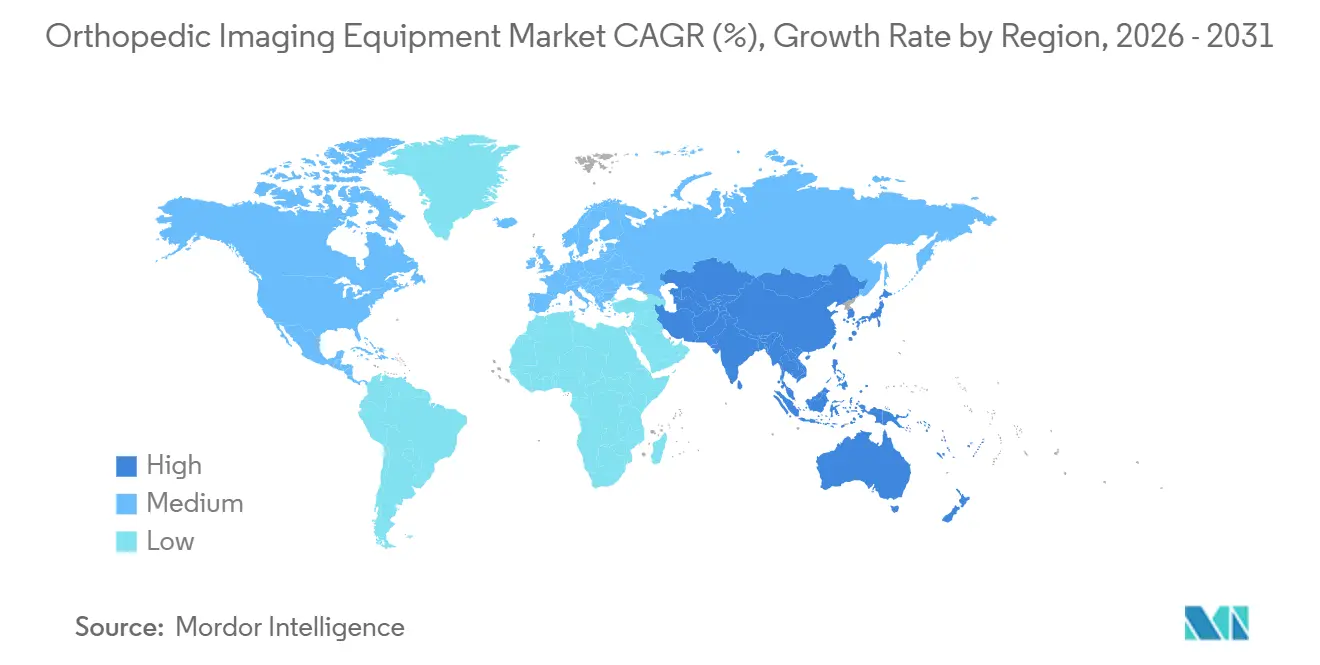
North America held 42.4% of the orthopedic imaging equipment market share in 2025. The region benefited from a large installed base, high joint procedure volumes, and early uptake of AI-augmented imaging. The United States remained a major setting for joint arthroplasty, spine surgery, and sports medicine imaging in the supplied research. Canada added demand through weight-bearing CBCT adoption in orthopedic specialty clinics, including CurveBeam AI’s Enhanced HiRise system, which received Health Canada clearance in July 2025. The FDA’s February 2026 cybersecurity guidance made device security an important procurement consideration for networked imaging systems.
Europe was the second-largest regional market in the supplied research, with Germany anchoring an advanced orthopedic imaging infrastructure. Germany’s orthopedic and trauma surgery settings provided stable, high-volume applications for diagnostic imaging equipment. The United Kingdom, France, and Italy formed the main demand base, while Spain and Portugal showed faster ambulatory orthopedic expansion. Siemens Healthineers presented Vuze 2 trackerless spinal guidance software in September 2026 for the Cios Spin C-arm, and the software achieved 95% median navigated pedicle screw placement accuracy in the supplied research. EU Medical Device Regulation 2017/745 continued to affect market-entry timing for suppliers entering Europe.
Asia-Pacific was the fastest-growing region, with the orthopedic imaging equipment market size projected to advance at a 6.4% CAGR through 2031. China’s medical imaging equipment sales reached CNY 75 billion, equivalent to USD 10.4 billion, in 2025 in the supplied research. The draft also expected 2,520 orthopedic CBCT units to ship in China during 2025. United Imaging Healthcare, Mindray, and Neusoft Medical competed through pricing and service responsiveness. Japan’s physician overtime rules increased interest in AI-enabled tools, while India, the Middle East, Africa, Brazil, and Argentina provided equipment-upgrade opportunities for the orthopedic imaging equipment market. These regional differences reflected varied care delivery settings, installed capacity, and local supplier presence in the supplied research.
Competitive Landscape
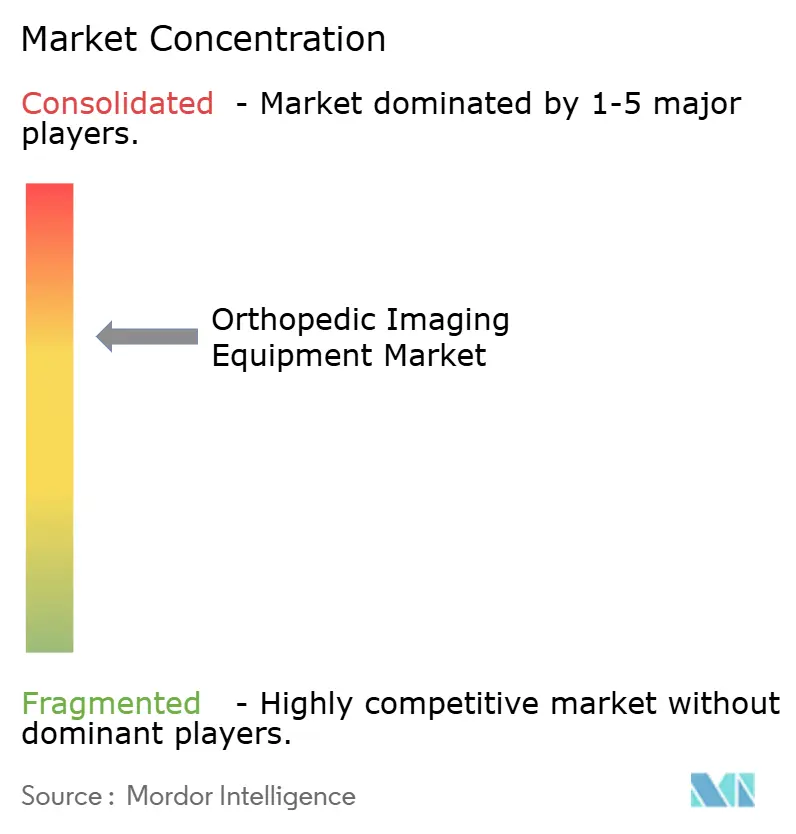
The orthopedic imaging equipment market was moderately consolidated around GE HealthCare, Siemens Healthineers, Koninklijke Philips, Canon Medical, and FUJIFILM Holdings. These companies used multi-modality portfolios and multi-year service agreements to retain institutional customers. Their large installed bases gave them an advantage when customers refreshed equipment or added software. GE HealthCare invested more than USD 3 billion in research and development since 2023 and received FDA 510(k) clearances for 3 SIGNA MRI innovations in February 2026 and Photonova Spectra in March 2026.
Siemens Healthineers acquired Vuze in 2025 to add trackerless navigation technology to its C-arm portfolio. Philips announced a 7-year preferred imaging vendor alliance with WellSpan Health in 2026 across 12 hospitals. The alliance covered CT, MR, digital X-ray, ultrasound, and image-guided therapy. The orthopedic imaging equipment market is increasingly being competed through AI-enabled workflow software, lower-dose imaging, and enterprise informatics integration. Cybersecurity requirements favored established regulatory processes and raised entry barriers for smaller companies.
United Imaging Healthcare, Mindray, and Neusoft Medical expanded competitive pressure through AI-oriented designs, pricing, and local service. Procedure-specific companies targeted clinical workflows that broad imaging suppliers had addressed less directly. Orthopedic Driven Imaging received FDA 510(k) clearance in May 2026 for HipGuide, an intraoperative measurement software for total hip replacement that worked with the ODI See-arm C-arm platform. CurveBeam AI built a position in weight-bearing orthopedic CBCT for specialty clinics. This orthopedic imaging equipment market remained concentrated enough for large suppliers to benefit from service scale, while specialized suppliers found procedure-focused openings.
Orthopedic Imaging Equipment Industry Leaders
-
GE HealthCare Technologies Inc.
-
Siemens Healthineers AG
-
Koninklijke Philips N.V.
-
Canon Medical Systems Corporation
-
FUJIFILM Holdings Corporation
- *Disclaimer: Major Players sorted in no particular order
Recent Industry Developments
- September 2026: Siemens Healthineers presented Vuze 2 trackerless spinal surgical guidance software for its Cios Spin C-arm. The system fuses preoperative CT with intraoperative X-ray for K-wire placement without external tracking hardware, achieving up to 96.7% screw placement accuracy and 95% median navigated accuracy versus 92% with conventional fluoroscopy. Siemens acquired Vuze in 2025 and plans integration across its full 2D, 3D, and robotic C-arm portfolio.
- September 2026: FUJIFILM launched the CALNEO CROSS Slim surgical C-arm X-ray system in Japan, with a 55% narrower tube head than its predecessor, improving intraoperative positioning freedom in orthopedic and trauma surgery suites while retaining wireless operation and lightweight design.
- July 2026: Canon Medical Systems introduced CLEAR Motion deep learning technology and PIQE 1024 Matrix high-resolution reconstruction across its Aquilion ONE CT portfolio, extending diagnostic-quality musculoskeletal CT to high-BMI and challenging patient populations through AI-driven motion compensation.
- May 2026: Orthopedic Driven Imaging received FDA 510(k) clearance for HipGuide, its intraoperative surgical imaging software for real-time measurements during total hip replacement, paired with the ODI See-arm C-arm platform cleared in September 2025. This represents the first FDA-cleared integrated orthopedic-specific intraoperative imaging solution from a pure-play new entrant.
Global Orthopedic Imaging Equipment Market Report Scope
According to the report’s scope, orthopedic imaging equipment helps doctors view bones, joints, and muscles. It includes X-ray, CT, MRI, and other imaging machines. These tools help diagnose injuries and plan treatment.
The Orthopedic imaging equipment market is segmented into modality, indication, end user, and geography. By modality, the market is segmented into X-ray, CT, MRI, ultrasound, EOS imaging systems, nuclear imaging systems, and intraoperative and fluoroscopy systems. By indication, the market is segmented into acute trauma and fracture diagnosis, sports injuries, spinal injuries and disorders, arthritis and degenerative joint diseases, osteoporosis and bone disorders, musculoskeletal cancer, and other indications. By end user, the market is segmented into hospitals and trauma centers, diagnostic imaging centers, ambulatory surgical centers, orthopedic specialty clinics, and other end users. By geography, the market is segmented into North America, Europe, Asia-Pacific, the Middle East and Africa, and South America. The report also covers the estimated market sizes and trends for 17 countries across major regions globally. The report offers values (USD) for all the above segments.
| X-ray |
| CT |
| MRI |
| Ultrasound |
| EOS Imaging Systems |
| Nuclear Imaging Systems |
| Intraoperative and Fluoroscopy Systems |
| Acute Trauma and Fracture Diagnosis |
| Sports Injuries |
| Spinal Injuries and Disorders |
| Arthritis and Degenerative Joint Diseases |
| Osteoporosis and Bone Disorders |
| Musculoskeletal Cancer |
| Other Indications |
| Hospitals and Trauma Centers |
| Diagnostic Imaging Centers |
| Ambulatory Surgical Centers |
| Orthopedic Specialty Clinics |
| Other End Users |
| North America | United States |
| Canada | |
| Mexico | |
| Europe | Germany |
| United Kingdom | |
| France | |
| Italy | |
| Spain | |
| Rest of Europe | |
| Asia-Pacific | China |
| Japan | |
| India | |
| Australia | |
| South Korea | |
| Rest of Asia-Pacific | |
| Middle East and Africa | GCC |
| South Africa | |
| Rest of Middle East and Africa | |
| South America | Brazil |
| Argentina | |
| Rest of South America |
| By Modality | X-ray | |
| CT | ||
| MRI | ||
| Ultrasound | ||
| EOS Imaging Systems | ||
| Nuclear Imaging Systems | ||
| Intraoperative and Fluoroscopy Systems | ||
| By Indication | Acute Trauma and Fracture Diagnosis | |
| Sports Injuries | ||
| Spinal Injuries and Disorders | ||
| Arthritis and Degenerative Joint Diseases | ||
| Osteoporosis and Bone Disorders | ||
| Musculoskeletal Cancer | ||
| Other Indications | ||
| By End User | Hospitals and Trauma Centers | |
| Diagnostic Imaging Centers | ||
| Ambulatory Surgical Centers | ||
| Orthopedic Specialty Clinics | ||
| Other End Users | ||
| Geography | North America | United States |
| Canada | ||
| Mexico | ||
| Europe | Germany | |
| United Kingdom | ||
| France | ||
| Italy | ||
| Spain | ||
| Rest of Europe | ||
| Asia-Pacific | China | |
| Japan | ||
| India | ||
| Australia | ||
| South Korea | ||
| Rest of Asia-Pacific | ||
| Middle East and Africa | GCC | |
| South Africa | ||
| Rest of Middle East and Africa | ||
| South America | Brazil | |
| Argentina | ||
| Rest of South America | ||
Key Questions Answered in the Report
What is the projected value of orthopedic imaging equipment in 2031?
The orthopedic imaging equipment market is forecast to reach USD 7.41 billion by 2031, from USD 5.71 billion in 2026, at a 5.35% CAGR. Demand is supported by precise musculoskeletal diagnosis, AI-assisted imaging, and outpatient orthopedic care.
Which imaging modality is growing fastest for orthopedic use?
CT is the fastest-growing modality, with a projected 7.5% CAGR through 2031. Photon-counting architecture and deep-learning reconstruction are supporting demand for higher-value CT systems.
Why do ambulatory surgical centers matter for orthopedic imaging suppliers?
These centers are adding advanced C-arms, MRI, and compact imaging systems as more orthopedic procedures move into outpatient care. Suppliers need smaller-footprint products and purchasing options that fit procedure-led facilities.
Which orthopedic clinical use has the strongest forecast growth?
Arthritis and degenerative joint disease is projected to grow at an 8.2% CAGR through 2031 because management often requires serial imaging. This pattern creates repeat demand across assessment, treatment planning, and follow-up.
Which end users account for the largest demand for orthopedic imaging systems?
Hospitals and trauma centers led end-user revenue with 42.8% in 2025, supported by trauma CT, fluoroscopy, and complex MRI procedures. Their installations also require the infrastructure and staff needed for high-cost modalities.
Which region is expanding fastest for orthopedic imaging equipment?
Asia-Pacific is forecast to grow at a 6.4% CAGR through 2031, supported by equipment upgrades and local supplier activity. China, Japan, India, and emerging healthcare systems form important demand settings in the supplied research.