
Orthopedic Consumables Market Size and Share
Market Overview
| Study Period | 2020 - 2031 |
|---|---|
| Market Size (2026) | USD 9.29 Billion |
| Market Size (2031) | USD 10.94 Billion |
| Growth Rate (2026 - 2031) | 3.31 % |
| Fastest Growing Market | Asia-Pacific |
| Largest Market | North America |
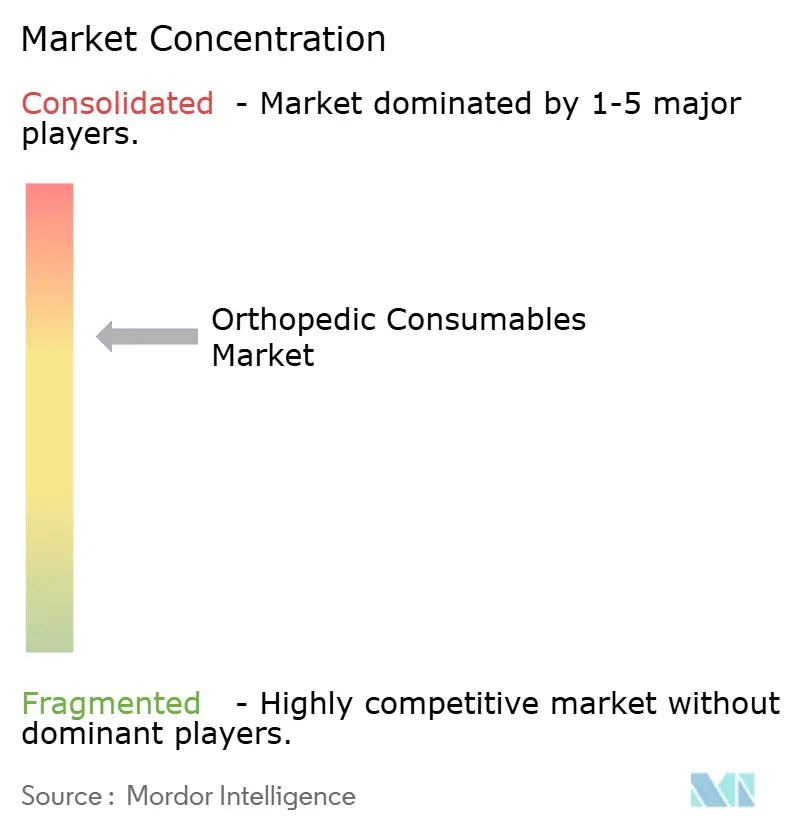
| Market Concentration | Medium |
Major Players *Disclaimer: Major Players sorted in no particular order Image © Mordor Intelligence. Reuse requires attribution under CC BY 4.0. | |
Orthopedic Consumables Market Analysis by Mordor Intelligence
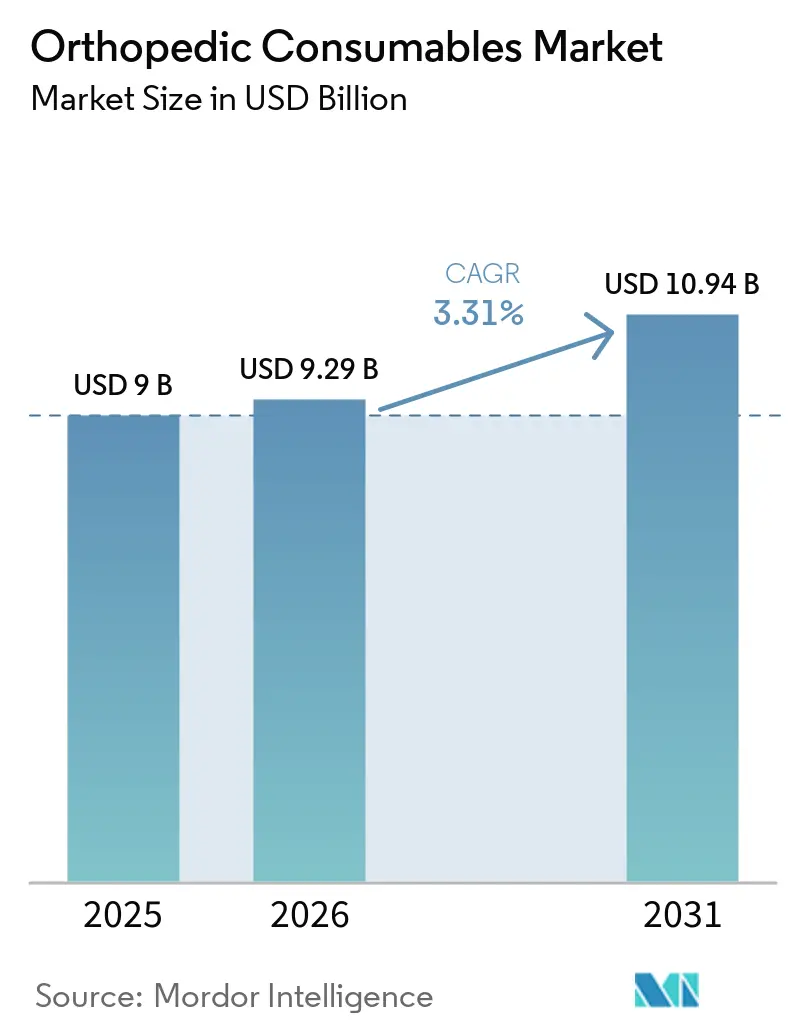
The Orthopedic Consumables Market size is projected to be USD 9 billion in 2025, USD 9.29 billion in 2026, and reach USD 10.94 billion by 2031, growing at a CAGR of 3.31% from 2026 to 2031.
The orthopedic consumables market is shaped by rising procedure demand, the movement of care into outpatient settings, and a clearer split between standard disposable supplies and specialized biologic or procedure-specific products. Demand is strongest where trauma, joint replacement, and sports medicine procedures are performed at scale, since each procedure requires consumables throughout preparation, surgery, and recovery. Procurement is also changing as health systems seek standardization, shorter operating-room setup times, and more reliable sterile workflows. In North America, ambulatory surgery centers are becoming a larger source of demand, while capacity additions in the Asia-Pacific region broaden the customer base. Competition increasingly depends on whether suppliers can support clinical workflows, produce outcome evidence, and offer products suited to the setting in which care is delivered.
Key Report Takeaways
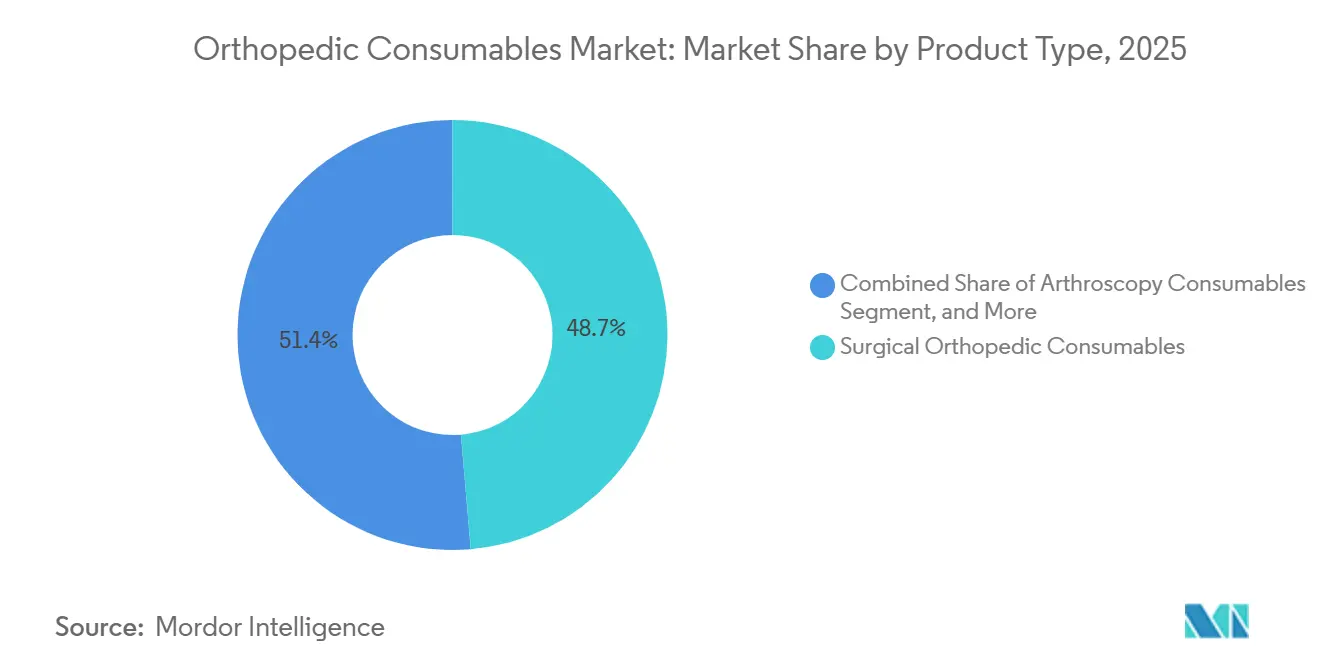
- By product type, Surgical Orthopedic Consumables led with 48.65% revenue share in 2025, while Wound-Management Orthopedic Consumables are forecast to expand at a 5.54% CAGR through 2031.
- By application, Trauma Surgery held 42.54% revenue share in 2025, while Sports Medicine and Soft-Tissue Repair recorded the highest projected CAGR at 5.76% through 2031.
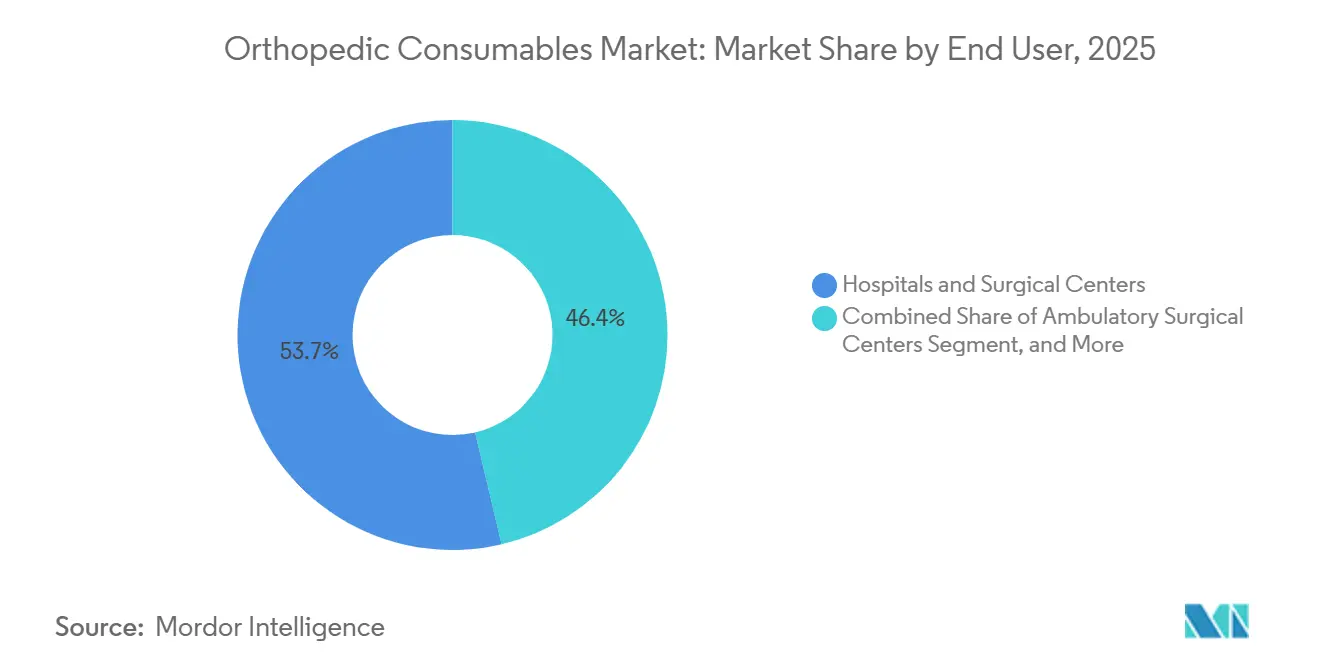
- By end user, Hospitals and Surgical Centers accounted for 53.65% revenue share in 2025, while Homecare Settings are forecast to advance at a 6.78% CAGR through 2031.
- By distribution channel, Distributor and Group Purchasing Organization Sales held 52.76% revenue share in 2025, while E-Commerce Platforms are forecast to grow at a 6.54% CAGR through 2031.
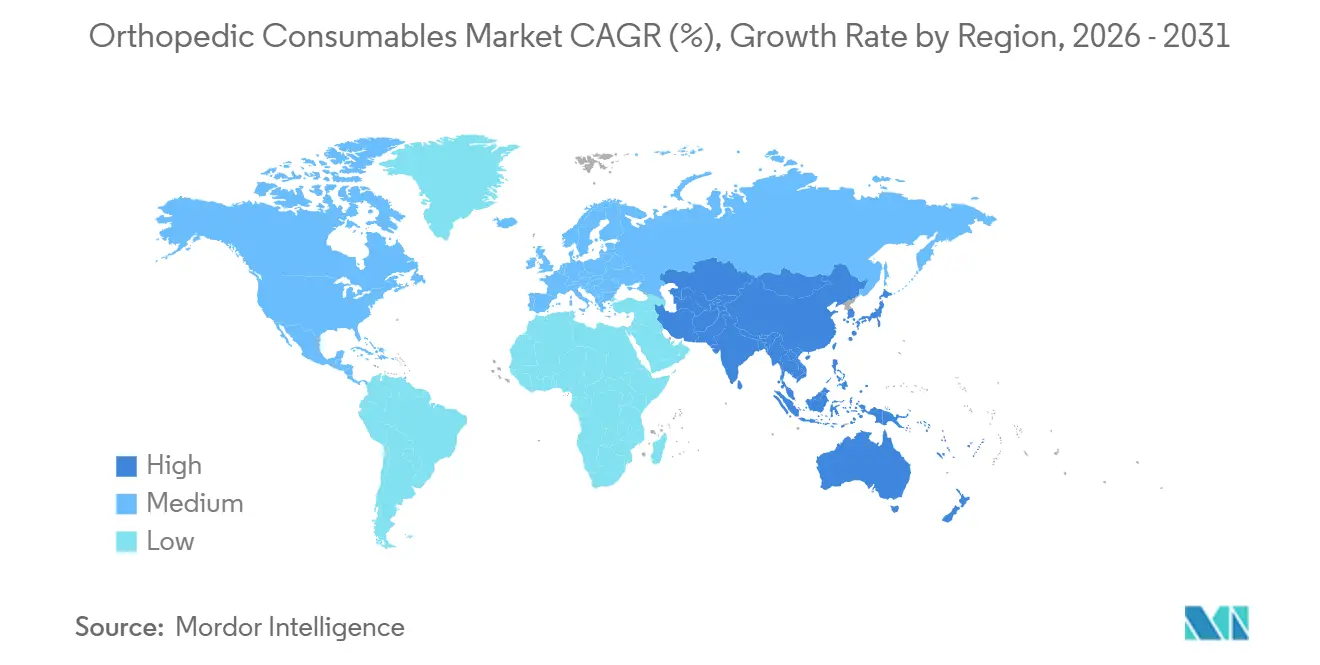
- By geography, North America held 41.54% revenue share in 2025, while Asia-Pacific is forecast to grow at a 4.53% CAGR through 2031.
Note: Market size and forecast figures in this report are generated using Mordor Intelligence’s proprietary estimation framework, updated with the latest available data and insights as of January 2026.
Market Trends and Insights
Drivers Impact Analysis of Orthopedic Consumables Market*
| Driver | (~) % Impact on CAGR Forecast | Geographic Relevance | Impact Timeline |
|---|---|---|---|
| Aging Population and Rising Osteoarthritis Burden | +1.10% | Global, with the highest concentration in East Asia, Western Europe, and high-income North America | Long term (≥ 4 years) |
| Increasing Orthopedic Procedure Volumes From Trauma and Sports Injuries | +0.80% | Global, with the highest concentration in North America, Europe, and Asia-Pacific urban centers | Medium term (2-4 years) |
| Shift Toward Minimally Invasive and Ambulatory Orthopedic Procedures | +0.60% | North America, with spillover to Europe and Australia | Medium term (2-4 years) |
| Expansion of Orthopedic Surgical Capacity in Asia-Pacific and Emerging Markets | +0.50% | Asia-Pacific core markets including China, India, South Korea, and Japan, with spillover to the Middle East, Africa, and South America | Long term (≥ 4 years) |
| Single-Use Conversion for Infection Prevention and Procedure Standardization | +0.40% | North America and the European Union, with early adoption in Asia-Pacific | Short term (≤ 2 years) |
| Procedure-Specific Biologics and Smart Consumables Enabling Premiumization | +0.30% | North America and the European Union, with spillover to high-income Asia-Pacific markets | Long term (≥ 4 years) |
| Source: Mordor Intelligence | |||
Aging Population and Rising Osteoarthritis Burden
Osteoarthritis creates sustained demand for the orthopedic consumables market because treatment needs are concentrated in older patient groups with high procedure use. A 2025 analysis in Arthritis Research & Therapy reported that 607 million people lived with osteoarthritis globally in 2021, compared with 256 million in 1990. The study also reported a 9.2% increase in age-standardized prevalence during that period and projected a further 14% increase by 2050. Knee osteoarthritis represented more than 56% of the global burden, while high body mass index accounted for 21% of osteoarthritis-related disability-adjusted life years. These patterns support demand for products used in joint reconstruction, trauma care, wound management, and postoperative recovery. The burden is particularly significant in high-income health systems, where access to surgery and spending per procedure are higher.
Increasing Orthopedic Procedure Volumes from Trauma and Sports Injuries
Trauma surgery held 42.54% of the orthopedic consumables market in 2025, reflecting the steady need for products used in fracture treatment and urgent surgery. Road accidents, falls, fragility fractures, and high-energy sports injuries sustain procedure demand across age groups. Sports medicine and soft-tissue repair are forecast to grow at a 5.76% CAGR through 2031 as surgical options broaden for active patients. The use of bioabsorbable fixation devices and biologic materials is extending from elective sports procedures into some trauma care pathways. This expands the role of specialized consumables in the largest application area without changing the importance of high-volume trauma supplies. Suppliers with products that fit both trauma and sports medicine workflows can address a broader clinical base.
Shift Toward Minimally Invasive and Ambulatory Orthopedic Procedures
The move toward ambulatory surgery changes demand conditions in the orthopedic consumables market because outpatient facilities use different packaging, stocking, and sterility practices than hospital operating rooms. The Centers for Medicare & Medicaid Services added 168 orthopedic codes to the ambulatory surgical center covered procedures list in the 2026 Hospital Outpatient Prospective Payment System final rule. More than 600 ambulatory surgery centers performed total joint replacements in the United States in 2026, according to the supplied source material. The Ambulatory Surgery Center Association reported projected Medicare fee-for-service savings of USD 13.5 billion from musculoskeletal surgeries in ambulatory surgery centers between 2025 and 2034[1]. These settings favor prepackaged sterile kits that reduce setup time and reduce the need for on-site sterile processing. Suppliers that make products for ambulatory workflows can benefit as orthopedic procedures continue to shift beyond hospital settings.
Expansion of Orthopedic Surgical Capacity in Asia-Pacific and Emerging Markets
Asia-Pacific is forecast to grow at a 4.53% CAGR through 2031, making it the fastest-growing regional part of the orthopedic consumables market. China and India are expanding orthopedic capacity as older urban populations require more treatment for osteoarthritis and fragility fractures. The supplied source material stated that China had more than 2,000 new orthopedic centers installed between 2020 and 2025. In India, technology adoption is visible in private hospitals, where Apollo Hospitals completed more than 2,000 robotic-assisted orthopedic surgeries in September 2026. New capacity supports demand for surgical kits, wound products, fixation-related supplies, and procedure support materials. International suppliers must also meet registration requirements set by agencies, including the CDSCO in India and the NMPA in China.
Restraints Impact Analysis of Orthopedic Consumables Market*
| Restraint | (~) % Impact on CAGR Forecast | Geographic Relevance | Impact Timeline |
|---|---|---|---|
| High Cost of Advanced Orthopedic Consumables and Procedures | -0.20% | Global, with the greatest effect in price-sensitive markets in the Middle East, Africa, South America, and Southeast Asia | Long term (≥ 4 years) |
| Stringent Regulatory Approval and Compliance Requirements | -0.10% | European Union, United States, and Asia-Pacific markets including China and India | Medium term (2-4 years) |
| Procurement Pressure From Volume-Based Tenders and Hospital Consolidation | -0.20% | North America and the European Union, with spillover to urban Asia-Pacific health systems | Medium term (2-4 years) |
| Limited Product Interoperability Across Robotic and Digital Surgical Ecosystems | -0.10% | North America and the European Union | Long term (≥ 4 years) |
| Source: Mordor Intelligence | |||
High Cost of Advanced Orthopedic Consumables and Procedures
High prices can limit adoption in the orthopedic consumables market when reimbursement does not cover the full cost of advanced procedure bundles. The constraint is most pronounced in health systems outside North America and Western Europe, where spending limits affect the use of biologic kits, specialized draping systems, and advanced wound materials. Volume-based purchasing can expand procedure access while placing pressure on the value captured by suppliers. This environment requires companies to support premium prices with evidence on complications, length of stay, and readmissions. Hospital formulary decisions increasingly depend on whether clinical advantages can be linked to economic value. Companies without this evidence risk being excluded when purchasing committees standardize product choices.
Procurement Pressure from Volume-Based Tenders and Hospital Consolidation
Hospital consolidation centralizes purchasing decisions and can limit product variety in the orthopedic consumables market. Large health systems commonly use preferred-vendor contracts, group purchasing organizations, and value analysis processes to manage spending. The supplied material noted that U.S. Orthopaedic Partners named Johnson & Johnson as its official vendor for total joint products in October 2025. Such agreements can reduce the number of available supplier positions across large outpatient networks. Product interoperability and alignment with approved workflows can therefore become as important as individual product features. Smaller suppliers face a narrower opportunity to show clinical differentiation before multi-year purchasing arrangements are established.
*Our forecasts treat driver/restraint impacts as directional, not additive. The impact forecasts reflect baseline growth, mix effects, and variable interactions.
Orthopedic Consumables Market Segment Analysis
By Product Type:
Surgical Consumables Lead as Wound Care Grows FastestSurgical orthopedic consumables held 48.65% of the orthopedic consumables market share in 2025, supported by frequent use in trauma and joint replacement procedures. This group includes disposable drapes, bone cement mixing systems, lavage devices, and sterile instrument kits. The leading position reflects the recurring need for these materials in each procedure rather than one-time capital equipment spending. Casting and splinting consumables serve high-volume trauma and sports injury pathways, although pricing is competitive. Synthetic casting materials are gradually replacing plaster of Paris in developed health systems. Arthroscopy consumables are also moving toward products that support robotic and navigation-assisted procedures in the orthopedic consumables market.
Wound-management orthopedic consumables are forecast to grow at a 5.54% CAGR through 2031. The expansion reflects the movement of recovery and wound treatment into outpatient and homecare settings. These settings need products that can be handled outside an acute-care hospital and purchased in smaller volumes. Other orthopedic consumables include bioabsorbable implants and intraoperative diagnostic materials, where several specialized categories are grouped together. The orthopedic consumables industry is therefore seeing demand for both established surgical supplies and more specialized products used after discharge.

By Application:
Trauma Surgery Maintains the Base While Sports Medicine Grows FasterTrauma surgery accounted for 42.54% of category revenue in 2025, making it the largest application segment. Its position is supported by the continuing need to treat road injuries, fall-related fractures, and other acute conditions. The supplied source material reported global trauma implant sales of USD 9.6 billion in 2025, with 5.8% year-over-year growth. Joint Replacement and Spine Surgery also creates material demand because procedures use multiple sterile and procedure-specific items. Spine care can require higher consumable use when navigation systems and expandable cage technologies are used. Wound Management and Postoperative Care remain important as payers encourage earlier discharge from acute settings in the orthopedic consumables market.
Sports medicine and soft-tissue repair are forecast to expand at a 5.76% CAGR through 2031. Arthrex released the TightRope SB All-Suture Implant in February 2026 for anterior cruciate ligament reconstruction. The supplied material described it as the first all-suture soft-button technology in an anterior cruciate ligament fixation device. New fixation and biologic options raise the clinical requirements for sports procedures and may increase the use of specialized materials. The orthopedic consumables industry is also linking sports medicine products more closely with the needs of patients receiving minimally invasive care. This makes the segment important for suppliers seeking growth beyond the large trauma base.
By End User:
Hospitals Lead Purchasing While Homecare Expands QuicklyHospitals and surgical centers accounted for 53.65% of category revenue in 2025. Their leading role reflects the concentration of high-acuity surgical volume and the influence of group purchasing organizations. Teaching hospitals and integrated delivery networks also use consumable kits that fit robotic surgical platforms. Stryker Mako, Zimmer Biomet ROSA Knee, and Smith+Nephew CORI XT are examples of systems that can shape related consumable requirements. These environments can create high switching costs when staff training and product specifications are linked to a platform. Hospitals will remain the main purchasing channel for many procedure-intensive products in the orthopedic consumables market.
Homecare settings are forecast to grow at a 6.78% CAGR through 2031, the highest rate among the listed segments. Wound management, casting removal, and rehabilitation support are moving closer to the patient’s home after discharge. Manufacturers can supply premeasured kits to home health agencies, reducing the role of hospital materials departments in some categories. Ambulatory surgery centers also need compact, preassembled sterile configurations that are suitable for outpatient procedures. Other end users include rehabilitation centers, orthotics clinics, and sports medicine facilities. The orthopedic consumables market is thus extending beyond the operating room into a wider recovery pathway.
By Distribution Channel:
Group Purchasing Organizations Lead While E-Commerce ExpandsDistributor and group purchasing organization sales held 52.76% of the distribution in 2025. The channel is supported by multi-year preferred-vendor agreements and volume rebate structures. These arrangements give large health systems a predictable supply route and help control procurement costs. They can also make it difficult for non-contracted suppliers to reach hospitals, even where products have differentiated clinical features. Direct Sales remains important for premium and specialized consumables that require surgeon training and clinical support. The main channel mix in the orthopedic consumables market continues to favor established vendors with broad service capabilities.
E-commerce platforms are forecast to grow at a 6.54% CAGR through 2031. Growth is linked to homecare products, wound care supplies, casting removal kits, and braces that can be purchased outside traditional hospital procurement systems. Smaller surgery centers and outpatient clinics can also use digital platforms to access greater product choice. Retail Pharmacies and Medical Supply Stores serve lower-complexity categories such as bandages, casting supplies, and over-the-counter supports. Those channels face pressure from online sellers and private-label health system purchasing. This shift gives the orthopedic consumables market more routes to serve lower-acuity and home-based needs.
Geography Analysis
North America Orthopedic Consumables Market
North America accounted for 41.54% of the orthopedic consumables market share in 2025. The region benefits from high procedure volumes, established reimbursement, and demand for products used in complex elective and trauma cases. The 2026 expansion of the ambulatory surgery center covered procedures list adds 168 orthopedic codes in the United States. This broadens the number of care settings that can purchase orthopedic products. Suppliers that were previously dependent on hospital group purchasing channels can address a more varied institutional base. Canada and Mexico provide additional regional demand, including some cross-border care flows near the U.S.-Mexico border.
Europe Orthopedic Consumables Market
Europe has a split between high-volume, well-reimbursed countries and more price-sensitive systems in the orthopedic consumables market. Germany held the largest national share of the European orthopedic devices market in 2025 at 23.15%, according to the supplied Mordor Intelligence material. Strong statutory insurance coverage, a high surgeon base, and domestic manufacturing support its role in regional demand. The European Union Medical Device Regulation continues to affect product decisions by raising conformity assessment requirements for reusable Class I devices[2]. Some manufacturers face a choice between recertifying reusable lines and focusing more on disposable alternatives. The United Kingdom is forecast to record a 5.92% CAGR through 2031 as elective surgery activity recovers.
APAC, MEA and South America Orthopedic Consumables Market
Asia-Pacific is forecast to grow at a 4.53% CAGR through 2031, the fastest pace among the listed regions. The orthopedic consumables market size in the region is supported by healthcare capacity expansion in China and India, where demand is growing with aging urban populations. Johnson & Johnson’s DePuy Synthes established a Global Capability Center in Bangalore in 2026 and planned a 500-person technical team, according to the supplied material. Apollo Hospitals completed more than 2,000 robotic-assisted orthopedic surgeries in September 2026. The Middle East and Africa demand is supported by the Gulf Cooperation Council's infrastructure spending and medical tourism. In South America, demand is concentrated in Brazil and Argentina, where public budgets and imported product dependence create both opportunity and entry barriers.
Competitive Landscape
The orthopedic consumables market is moderately concentrated in its major surgical categories, although wound care, casting, and arthroscopy contain many specialized and regional suppliers. The supplied material reported that the top 5 companies held 80% of trauma consumables revenue in 2025. Stryker, Johnson & Johnson MedTech, Zimmer Biomet, Smith+Nephew, and B. Braun are central suppliers across major orthopedic procedure settings. Their position reflects broad portfolios, customer relationships, and the ability to supply procedure-specific materials. However, the broader category remains more fragmented because clinical needs differ across product niches. Competitive success increasingly depends on whether suppliers fit into the surgical workflow rather than sell products as standalone items.
Platform strategies are becoming more important as companies connect consumables to robotic and digital surgical systems in the orthopedic consumables market. Stryker uses the Mako platform to support workflows that can increase demand for procedure-specific consumable bundles[3]. Zimmer Biomet received FDA clearance in 2025 for an updated ROSA Knee system with Optimize, with commercial availability targeted for the first quarter of 2026. Johnson & Johnson announced in October 2025 that it planned to separate DePuy Synthes into a standalone publicly traded orthopedic company within 18-24 months. The supplied material stated that the business generated USD 9.2 billion in sales during 2024. A more focused company could change how portfolio resources are directed between implants and consumables.
Specialized companies are targeting biologics, ambulatory surgery, and data-enabled workflow support in the orthopedic consumables market. Isto Biologics acquired NovaBone Products from Halma plc in August 2026, adding bioactive glass synthetic bone graft technologies and broader distribution reach. Kuros Biosciences reported 77% year-over-year revenue growth for the first 9 months of 2025, linked in the supplied material to the MagnetOs MIS Delivery System. Globus Medical acquired Higgs Boson Health in August 2026 to add artificial intelligence-based patient and provider experience capabilities to its surgical ecosystem. These moves show how suppliers are seeking differentiated positions around biologics, outpatient care, and digital support. Regulatory planning remains important because product review timing can affect the speed of new product availability.
Orthopedic Consumables Industry Leaders
-
Stryker Corporation
-
Johnson & Johnson MedTech
-
Zimmer Biomet Holdings, Inc.
-
Smith+Nephew plc
-
Medtronic plc
- *Disclaimer: Major Players sorted in no particular order
Orthopedic Consumables Market Companies Covered in this Report
- ATEC, Inc.
- Anika Therapeutics
- Arthrex
- B. Braun
- BONESUPPORT AB
- Conmed
- DJO Global
- Enovis Corporation
- Exactech
- Globus Medical
- Integra LifeSciences
- Johnson & Johnson MedTech
- Limacorporate S.p.A.
- Medartis Holding AG
- Medtronic
- MicroPort
- Orthofix
- OrthoPediatrics Corp.
- Paragon 28, Inc.
- SI-BONE, Inc.
- Smith+Nephew plc
- Stryker
- Zimmer Biomet
Recent Industry Developments in Orthopedic Consumables Market
- September 2026: Globus Medical obtained CE Mark for its Excelsius3D intelligent 3-in-1 imaging system for commercial sale across the EU and UK, expanding the Excelsius GPS robotic navigation ecosystem into European markets. The approval positions the company to compete for robotic-assisted spine and trauma procedure share in Germany, France, and the UK, where digital surgical infrastructure investment is accelerating. Excelsius3D had previously received FDA 510(k) clearance in 2021.
- August 2026: Stryker signed a definitive agreement to acquire ZuriMED, developer of the FiberLocker System for rotator cuff augmentation, to strengthen its shoulder sports medicine and arthroplasty portfolio. Rotator cuff augmentation is described by Stryker as one of the fastest-growing areas in sports medicine, addressing a key clinical failure mode in rotator cuff repair. No deal value was disclosed, and the transaction is subject to customary closing conditions.
- August 2026: Globus Medical acquired Higgs Boson Health, a digital healthcare experience company incubated from Duke University, to integrate artificial intelligence-driven patient and provider experience capabilities into its Excelsius surgical ecosystem. The acquisition adds artificial intelligence-based outcomes analytics to Globus’s spine and trauma consumable portfolio strategy, enabling closed-loop performance monitoring across the full episode of care.
- August 2026: Isto Biologics acquired NovaBone Products from Halma plc, adding a differentiated portfolio of bioactive glass synthetic bone graft technologies to its bone healing consumable platform. The acquisition expands Isto’s international footprint into Europe, Asia-Pacific, and Latin America through NovaBone’s established distribution presence.
Global Orthopedic Consumables Market Report Scope
According to the report’s scope, orthopedic consumables are single-use or frequently replaced medical products used in bone, joint, and musculoskeletal care. The orthopedic consumables market is segmented into product type, application, distribution channel, end user, and geography. By product type, the market is segmented into surgical orthopedic consumables, wound-management orthopedic consumables, casting and splinting consumables, arthroscopy consumables, and other orthopedic consumables. By application, the market is segmented into trauma surgery, joint replacement, spine surgery, sports medicine and soft-tissue repair, wound management and postoperative care, and other applications. By distribution channel, the market is segmented into direct sales, distributor and group purchasing organization sales, retail pharmacies and medical supply stores, and e-commerce platforms. By end user, the market is segmented into hospitals and surgical centers, ambulatory surgical centers, homecare settings, and other end users. By geography, the market is segmented into North America, Europe, Asia-Pacific, the Middle East and Africa, and South America. The report also covers the estimated market sizes and trends for 17 countries across major regions globally. The report offers values (USD) for all the above segments.
Segmentation Overview
| Surgical Orthopedic Consumables |
| Wound-Management Orthopedic Consumables |
| Casting and Splinting Consumables |
| Arthroscopy Consumables |
| Other Orthopedic Consumables |
| Trauma Surgery |
| Joint Replacement |
| Spine Surgery |
| Sports Medicine and Soft-Tissue Repair |
| Wound Management and Postoperative Care |
| Other Applications |
| Direct Sales |
| Distributor and Group Purchasing Organization Sales |
| Retail Pharmacies and Medical Supply Stores |
| E-Commerce Platforms |
| Hospitals and Surgical Centers |
| Ambulatory Surgical Centers |
| Homecare Settings |
| Other End Users |
| North America | United States |
| Canada | |
| Mexico | |
| Europe | Germany |
| United Kingdom | |
| France | |
| Italy | |
| Spain | |
| Rest of Europe | |
| Asia-Pacific | China |
| Japan | |
| India | |
| Australia | |
| South Korea | |
| Rest of Asia-Pacific | |
| Middle East and Africa | GCC |
| South Africa | |
| Rest of Middle East and Africa | |
| South America | Brazil |
| Argentina | |
| Rest of South America |
| By Product Type | Surgical Orthopedic Consumables | |
| Wound-Management Orthopedic Consumables | ||
| Casting and Splinting Consumables | ||
| Arthroscopy Consumables | ||
| Other Orthopedic Consumables | ||
| By Application | Trauma Surgery | |
| Joint Replacement | ||
| Spine Surgery | ||
| Sports Medicine and Soft-Tissue Repair | ||
| Wound Management and Postoperative Care | ||
| Other Applications | ||
| By Distribution Channel | Direct Sales | |
| Distributor and Group Purchasing Organization Sales | ||
| Retail Pharmacies and Medical Supply Stores | ||
| E-Commerce Platforms | ||
| By End User | Hospitals and Surgical Centers | |
| Ambulatory Surgical Centers | ||
| Homecare Settings | ||
| Other End Users | ||
| Geography | North America | United States |
| Canada | ||
| Mexico | ||
| Europe | Germany | |
| United Kingdom | ||
| France | ||
| Italy | ||
| Spain | ||
| Rest of Europe | ||
| Asia-Pacific | China | |
| Japan | ||
| India | ||
| Australia | ||
| South Korea | ||
| Rest of Asia-Pacific | ||
| Middle East and Africa | GCC | |
| South Africa | ||
| Rest of Middle East and Africa | ||
| South America | Brazil | |
| Argentina | ||
| Rest of South America | ||
Key Questions Answered in the Report
What is the projected value of the orthopedic consumables market by 2031?
The category is forecast to reach USD 10.94 billion by 2031, growing at a 3.31% CAGR from 2026 to 2031.
Which product category leads the orthopedic consumables market?
Surgical orthopedic consumables led with 48.65% revenue share in 2025, supported by repeated use in trauma and joint replacement procedures.
Which application is expected to grow the fastest through 2031?
Sports medicine and soft-tissue repair is forecast to grow at a 5.76% CAGR through 2031, supported by evolving fixation and biologic options.
Why are ambulatory surgery centers important for orthopedic suppliers?
CMS added 168 orthopedic codes to the ambulatory surgical center covered procedures list in 2026, increasing the need for compact and sterile outpatient procedure kits.
Which end-user setting is growing fastest?
Homecare settings are forecast to grow at a 6.78% CAGR through 2031 as wound management and rehabilitation support move beyond hospitals.
Which region will record the strongest growth through 2031?
Asia-Pacific is forecast to grow at a 4.53% CAGR through 2031 as orthopedic capacity expands in China and India.