
Organosheet Market Size and Share
Market Overview
| Study Period | 2022 - 2032 |
|---|---|
| Market Size (2027) | USD 501.81 Million |
| Market Size (2032) | USD 886.74 Million |
| Growth Rate (2027 - 2032) | 12.06 % |
| Fastest Growing Market | Asia-Pacific |
| Largest Market | Europe |
| Market Concentration | Low |
Major Players *Disclaimer: Major Players sorted in no particular order Image © Mordor Intelligence. Reuse requires attribution under CC BY 4.0. | |
Organosheet Market Analysis by Mordor Intelligence
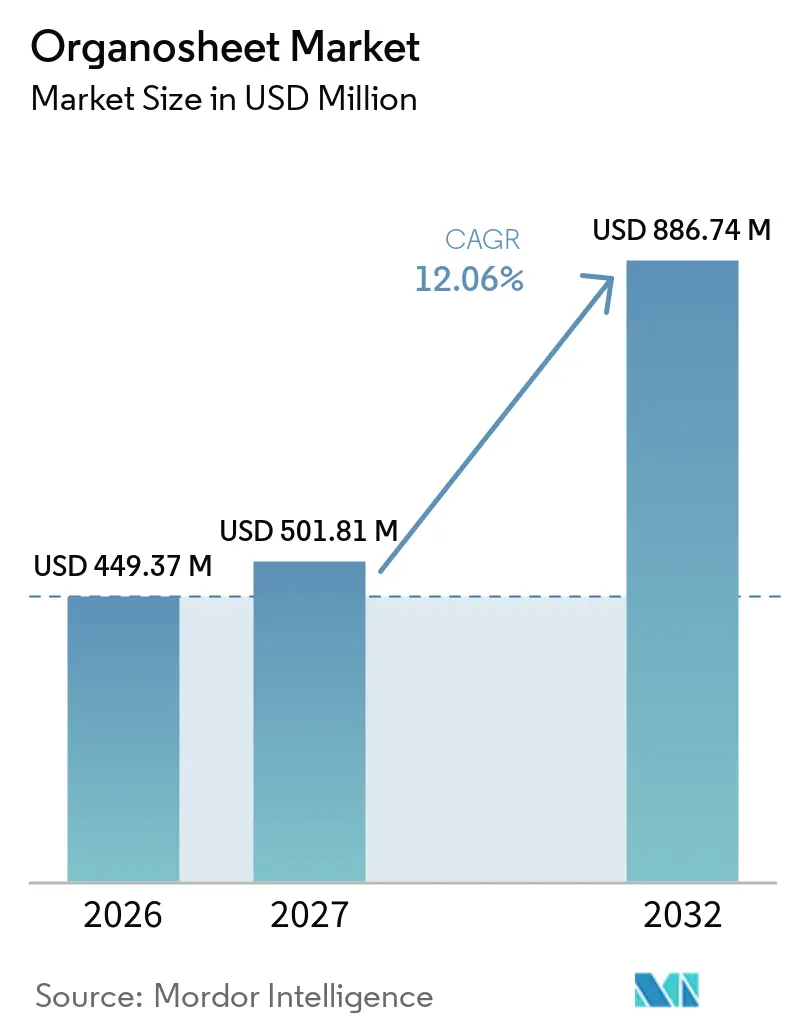
The Organosheet Market size was valued at USD 449.37 million in 2026 and is estimated to grow from USD 501.81 million in 2027 to reach USD 886.74 million by 2032, at a CAGR of 12.06% during the forecast period (2027-2032). The organosheet market is moving beyond specialized automotive use as electric vehicle battery enclosures and structural parts create higher demand. One-shot overmolding is shortening production cycles and helping suppliers compete with metal component production. Emission rules, vehicle carbon-footprint reporting, and recycling requirements are increasing the value of lightweight thermoplastic composites in procurement decisions. Aerospace programs are also expanding the use of qualified thermoplastic laminates in interiors and structural components. Competition centers on resin integration, certified production capability, process know-how, and documented recyclability.
Key Report Takeaways
- By fiber type, glass fiber held 49.53% of the organosheet market share in 2026, while carbon fiber is forecast to advance at a 12.89% CAGR through 2032.
- By resin type, polyamide (PA) held 38.12% of the organosheet market share in 2026, while polyether ether ketone (PEEK) is forecast to advance at a 13.12% CAGR through 2032.
- By application, automotive held 42.67% of the organosheet market share in 2026, while aerospace and defense are forecast to advance at a 13.64% CAGR through 2032.
- By geography, Europe held 35.91% of the organosheet market share in 2026, while Asia-Pacific is forecast to advance at a 13.31% CAGR through 2032.
Note: Market numbers in this report are based on Mordor Intelligence's proprietary estimation framework, which combines nine months of actuals with Q4 projections for base year 2026.
Market Trends and Insights
Drivers Impact Analysis of Organosheet Market*
| Driver | (~) % Impact on CAGR Forecast | Geographic Relevance | Impact Timeline |
|---|---|---|---|
| Electric-Vehicle Battery Enclosure and Structural-Part Adoption | +3.2% | Global, with greatest intensity in China, Germany, South Korea, and the United States | Short term (≤ 2 years) |
| Vehicle Lightweighting and Emission-Reduction Requirements | +2.8% | North America and EU (Euro 7 compliance); APAC via China MIIT standards | Short term (≤ 2 years) |
| Rapid Thermoforming and High-Volume Overmolding Economics | +2.1% | Global, strongest in Germany, Japan, and South Korea | Medium term (2-4 years) |
| Aerospace Fleet Expansion and Fuel-Efficiency Requirements | +1.8% | Global (Airbus and Boeing supply chains in Europe and North America; APAC spillover) | Medium term (2-4 years) |
| Recyclability and Circularity Advantages of Thermoplastic Matrices | +1.5% | EU (NZIA and ELV-driven), with spillover to North America and APAC core | Long term (≥ 4 years) |
| Source: Mordor Intelligence | |||
Electric-Vehicle Battery Enclosure and Structural-Part Adoption
Battery enclosure demand is creating a new source of demand for the organosheet market. A fully automated process presented at the Society for the Advancement of Material and Process Engineering (SAMPE) North America 2025 combined 2 carbon-fiber-reinforced thermoplastic inserts with long-fiber thermoplastic resin to make a 1.3 m by 1.8 m battery cover in under 90 seconds. The process reduced system cost by up to 28% against multi-piece metal designs and approached metal-stamping throughput. SABIC reported that its STAMAX FR materials withstood internal pressure of up to 250 kPa and 420 °C in module-level thermal-runaway testing. That performance can support flame, smoke, and toxicity requirements that previously favored heavier metal covers. The organosheet market can therefore benefit where battery safety and weight reduction must be achieved in one component system.
Vehicle Lightweighting and Emission-Reduction Requirements
Vehicle standards are connecting emissions compliance with a broader material accounting requirement for the organosheet market. Regulation (EU) 2024/1257 introduced Euro 7 type-approval requirements and an environmental vehicle passport for new M1 and N1 vehicle approvals from November 2026[1]. European manufacturers are also preparing for component-level carbon-footprint information in supply-chain transactions. China’s 2025 Automotive Standardization Work Program called for work on vehicle carbon footprints, product life cycles, and green-material standards. Thermoplastic laminates can be reheated and reshaped, which gives them an advantage in recycling discussions over thermoset alternatives. This makes lifecycle documentation increasingly relevant to material selection, not only to corporate sustainability reporting.
Rapid Thermoforming and High-Volume Overmolding Economics
Production economics are becoming as important as material performance in the organosheet market. Preconsolidated sheets can be thermoformed in under 60 seconds, followed by overmolding in a press-to-part sequence. This approach reduces assembly steps by combining brackets, ribs, and load paths into a single component. Ensinger produces thermoplastic composites on double-belt presses with widths up to 1,300 mm and configurations that include unidirectional, cross-ply, and sandwich structures. The production model can lower total component cost even where the raw material cost per kilogram exceeds that of metal. This makes the process useful for automotive suppliers seeking shorter cycle times and fewer joining operations.
Aerospace Fleet Expansion and Fuel-Efficiency Requirements
Aerospace qualification is opening additional demand for the organosheet market. The European Union Aviation Safety Agency updated CS-25 certification specifications for large airplanes in November 2025, including guidance relevant to thermoplastic composite structures and joining techniques. PORCHER INDUSTRIES received National Aerospace and Defense Contractors Accreditation Program (NADCAP) accreditation for thermoplastic composite manufacturing in July 2025. It also presented a glass-fiber-reinforced thermoplastic cockpit panel with Airbus in March 2025. Teijin Limited’s Tenax TPCL carbon fiber and PEEK laminates are used in Airbus A350 brackets and clips, showing series use in load-bearing aerospace parts. These qualification steps reduce uncertainty for suppliers considering thermoplastic parts in future aircraft programs.
Restraints Impact Analysis of Organosheet Market*
| Restraint | (~) % Impact on CAGR Forecast | Geographic Relevance | Impact Timeline |
|---|---|---|---|
| High Fiber, Resin, and Processing Costs | -2.1% | Global; most acute in North America and EU where energy and labor costs are highest | Short to Medium term (1-3 years) |
| Complex Heat Management and Forming-Window Control | -1.5% | Global; highest in APAC where specialized tooling and press expertise is still developing | Medium term (2-4 years) |
| Limited Design, Simulation, and Skilled-Workforce Capability | -0.9% | North America, EU (rural regions), and South America where composites engineering talent is thin | Long term (≥ 4 years) |
| Source: Mordor Intelligence | |||
High Fiber, Resin, and Processing Costs
Material and processing costs continue to limit wider adoption in the organosheet market. PEEK resin costs remain 20 to 50 times higher than polypropylene on a per-kilogram basis, restricting its use to aerospace and premium vehicle applications with a clear performance need. China introduced export controls for T800-grade and higher carbon fiber in January 2025, which added licensing requirements and increased sourcing uncertainty for fabricators outside China. SGL Carbon cited declining demand, global overcapacity, and uncompetitive prices as the basis for closing carbon-fiber sites in Portugal and the United States. These conditions favor glass-fiber and polypropylene grades in cost-sensitive vehicles. They also narrow the near-term opportunity for premium grades outside higher-value vehicle and aerospace applications.
Complex Heat Management and Forming-Window Control
Thermoplastic processing requires carefully controlled heating, transfer, and stamping. Polyamide 6 systems typically have a 10- to 30-second forming window before recrystallization reduces ductility. PEEK systems have an even narrower usable window because they require elevated processing temperatures. The European Union Aviation Safety Agency classifies thermoplastic overmolding and welding as novel technologies that need structured qualification programs. A 2025 peer-reviewed study found that turbulent resin flow remains a critical forming variable in needle-punched carbon-fiber-reinforced thermoplastic materials. Suppliers without simulation tools, thermal controls, and experienced engineers face longer development cycles and higher scrap risk.
*Our forecasts treat driver/restraint impacts as directional, not additive. The impact forecasts reflect baseline growth, mix effects, and variable interactions.
Organosheet Market Segment Analysis
By Fiber Type:
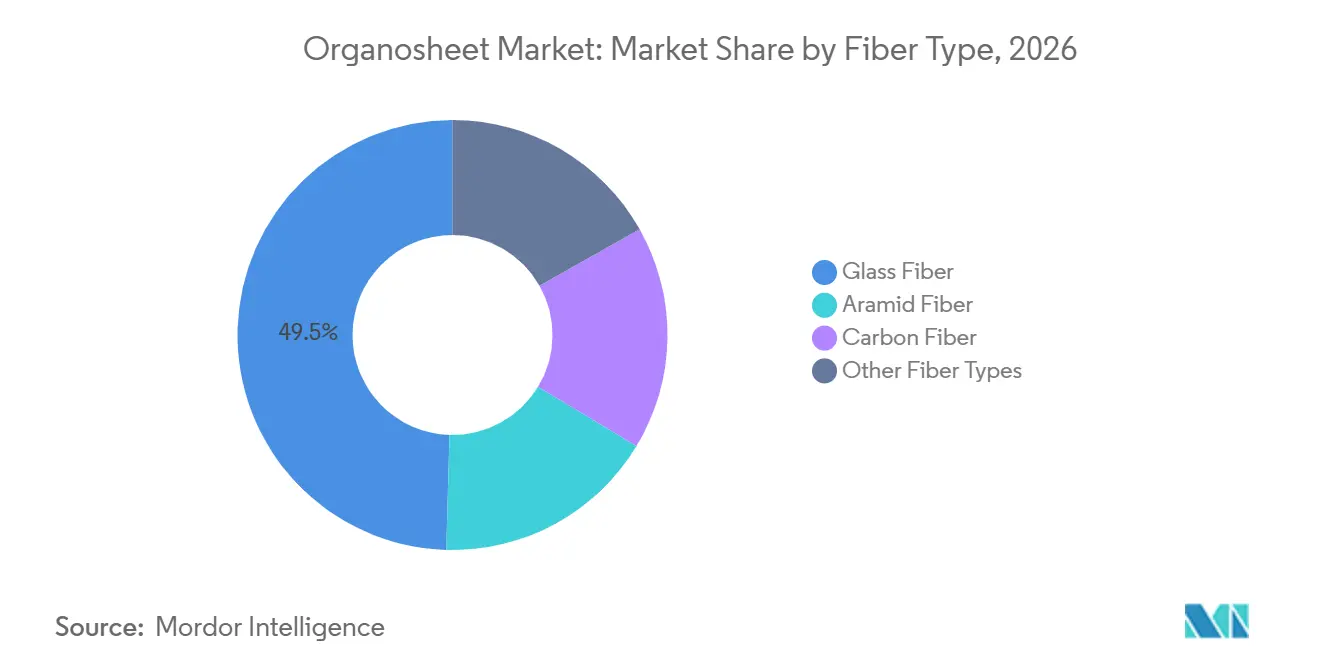
Glass Fiber Supports Revenue While Carbon Fiber Advances in Structural ApplicationsGlass fiber held 49.53% of the organosheet market in 2026 because it offers a practical balance between cost and structural performance. It is widely used with polypropylene and polyamide matrices in high-volume automotive programs. VALEO has produced an organosheet bumper beam for series production at 300,000 units per year. The component has a rated tensile strength of 400 to 500 MPa and fire resistance above 1,000 °C for more than 5 minutes. Aramid fiber serves applications that need high impact resistance at low areal weight, including ballistic equipment and aerospace interiors.
Carbon fiber is projected to advance at a 12.89% CAGR through 2032 as electric vehicle and aerospace users value its larger weight-saving potential. Mitsubishi Chemical Group Corporation uses a dry-impregnation process in its KyronTEX platform that combines polymer fibers with carbon reinforcement before consolidation. This method improves drapability during layup and can reduce the cost difference with conventional wet-impregnation routes. China’s export controls on higher-grade carbon fiber have prompted aerospace and defense buyers outside China to diversify supply. Other fiber types include natural and hybrid materials, including flax and polypropylene products being developed for European sustainability programs.

By Resin Type:
Polyamide Supports Revenue While PEEK Serves High-Specification ApplicationsPolyamide (PA) held 38.12% of the organosheet market in 2026, supported by PA6 and PA66 systems that combine mechanical strength, moisture resistance, and compatibility with established overmolding lines. PA6-based glass-fiber materials are used where a validated aerospace certification route is needed. Polypropylene serves the cost-sensitive end of the resin mix and supports fully recyclable glass-fiber composite designs. VALEO, Profol GmbH, and PORCHER INDUSTRIES have offered polypropylene and glass-fiber solutions for lightweight automotive components.
PEEK is projected to advance at a 13.12% CAGR through 2032 as aircraft programs require heat resistance, chemical resistance, and certified structural performance. Haufler Composites GmbH & Co. KG, Ensinger, and PORCHER INDUSTRIES supply high-temperature thermoplastic composite materials for technical applications. Teijin Limited’s Tenax TPCL carbon fiber and PEEK laminates are qualified through the National Center for Advanced Materials Performance and are used on Airbus A350 aircraft. PEEK and Polyether Ether Ketone (PEKK) grades remain specialized because they require tool temperatures above 380 °C and press systems capable of 100 to 200 bar.
By Application:
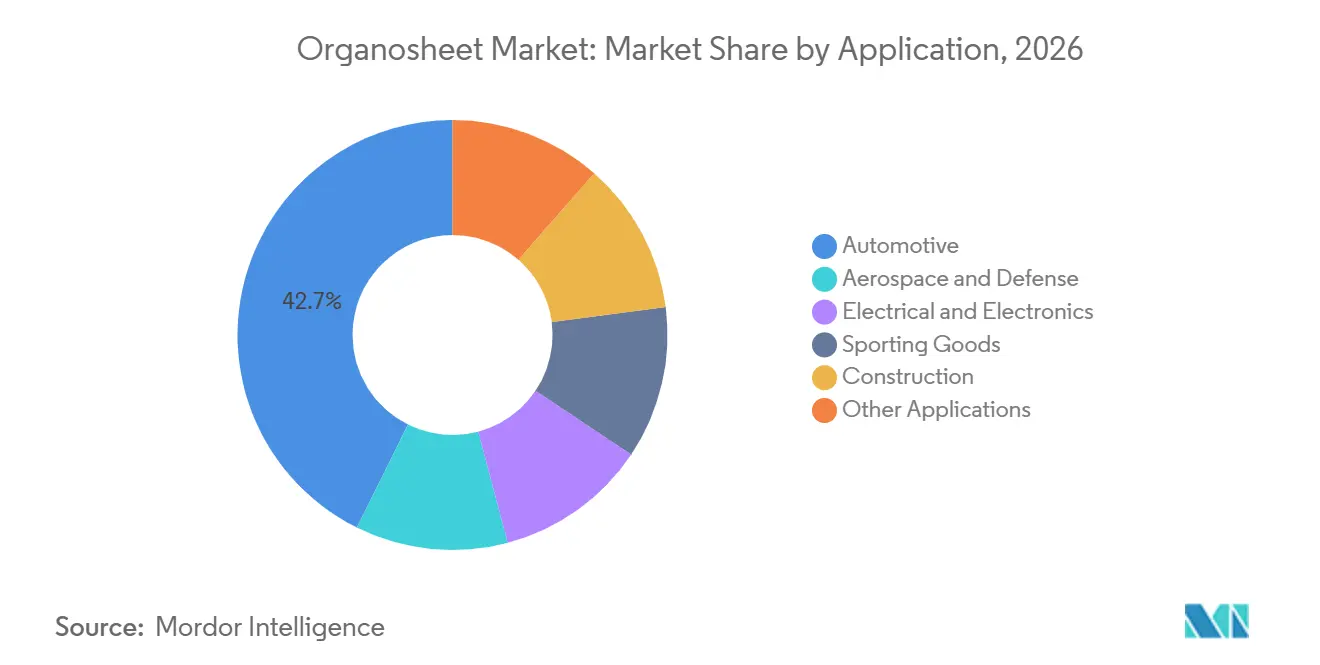
Automotive Leads Demand While Aerospace and Defense Have the Fastest GrowthAutomotive held 42.67% of the organosheet market in 2026, based on established use in front-end modules, crossmembers, battery enclosures, and bumper beams. VALEO has produced thermoplastic composite structural crossmembers since 2018 and offers battery casings for plug-in hybrid electric vehicles. Its battery casing can be up to 20% lighter than a steel baseline and has a reported carbon footprint of 1.4 to 3.1 kg CO2eq per kilogram. Electrical and electronics also use thermoplastic carbon-fiber laminates in thin device housings, including Teijin Limited materials used in the Vaio Vision+ portable monitor.
Aerospace and defense are projected to advance at a 13.64% CAGR through 2032, driven by aircraft interiors, structural parts, and thermoplastic welding programs. The organosheet market benefits as aircraft manufacturers seek lighter parts that can also support end-of-life recovery. The European Union Aviation Safety Agency has provided clearer certification treatment for composite structures and novel thermoplastic processes. Construction uses glass fiber and polypropylene sheets in products such as scaffolding boards and drainage covers. Sporting goods use carbon fiber grades in frames and protective equipment.
Geography Analysis
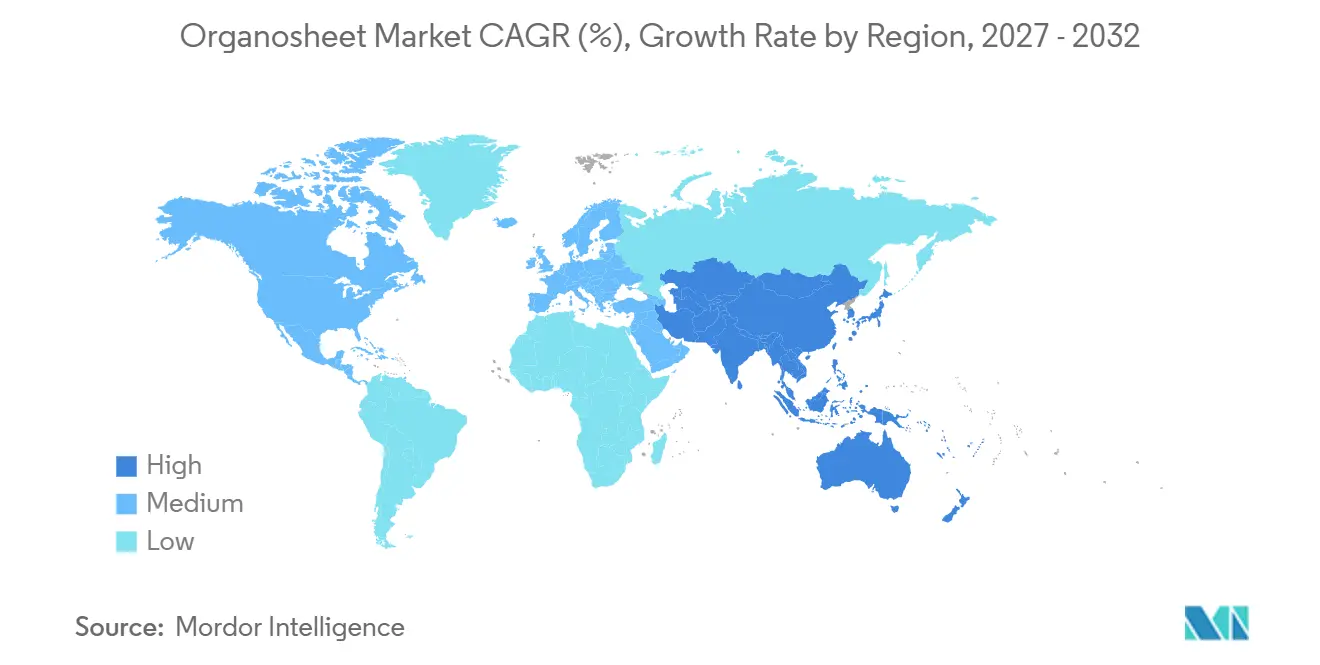
Europe held 35.91% of the organosheet market in 2026, supported by producers in Germany, France, and Austria and by direct exposure to Euro 7 and vehicle end-of-life rules. European composites suppliers provide local material production and application support for automotive programs. The European composites sector is advancing repair, reuse, and remanufacturing approaches for end-of-use products. European aerospace suppliers face a higher certification threshold after PORCHER INDUSTRIES received NADCAP accreditation and after the European Union Aviation Safety Agency updated CS-25. These conditions favor suppliers that can provide certified material, process control, and recycling documentation.
Asia-Pacific is projected to advance at a 13.31% CAGR through 2032, supported by electric vehicle production in China, South Korea, and Japan. China had 39 published national carbon-fiber standards in 2025 covering production, performance testing, and application requirements[2]. Kingfa Sci.&Tech. Co.,Ltd. announced a CNY 1.702 billion investment (approximately USD 236 million) in February 2025 for 10,000 metric tons per year of carbon-fiber-reinforced thermoplastic organosheet capacity and 3,500 metric tons per year of prepreg capacity. TORAY INDUSTRIES, INC. introduced Cetex TC1130 PESU for aircraft interiors and Cetex TC915 PA+ for urban air mobility applications in June 2025. Regional battery supply chains and government investment in mass-production technology support broad demand across automotive and aerospace uses.
North America drives demand through aerospace qualification infrastructure and activity among automotive Tier-1 suppliers. The National Center for Advanced Materials Performance supports material data accepted by the Federal Aviation Administration and the European Union Aviation Safety Agency, while Avient Corporation reported USD 3.3 billion in 2025 revenue across specialty materials and advanced composites. Johns Manville supplies glass-fiber reinforcements formulated for thermoplastic composite processes. South America and the Middle East and Africa remain smaller markets, with Brazil providing an automotive base and Middle East aerospace maintenance and defense programs generating selected demand for PEEK and carbon fiber grades.
Competitive Landscape
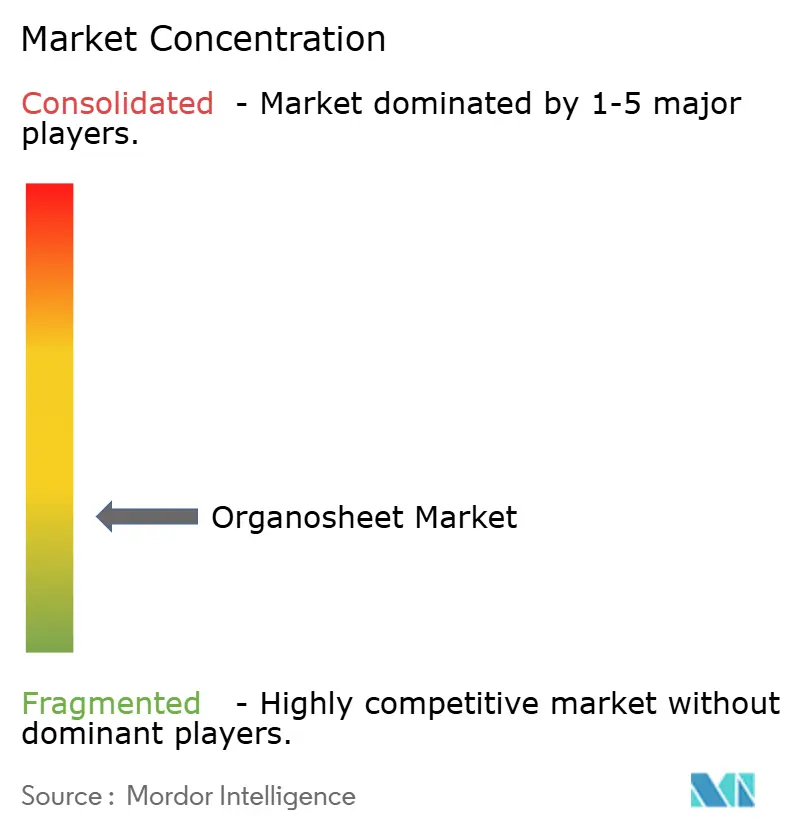
The organosheet market is highly fragmented, with the top five players including Ensinger, TORAY INDUSTRIES, INC., LANXESS, Teijin Limited, and Johns Manville. Vertical integration is a central competitive approach because it gives suppliers more control over material properties, production capacity, and customer support. This structure favors companies that can help customers move from material selection through component validation.
Companies are investing in production, products, and asset integration. Kingfa Sci.&Tech. Co.,Ltd. committed CNY 1.702 billion to dedicated composite capacity. TORAY INDUSTRIES, INC. used the 2025 Paris Air Show to introduce new Cetex products for aircraft interiors and urban air mobility. SABIC collaborated with Engel, Siebenwurst, Forward Engineering, Ensinger, and Envalior on a hybrid electric vehicle battery cover that uses carbon-fiber-reinforced thermoplastic inserts with STAMAX resin. These moves show that scale, processing partnerships, and large-component validation are important routes to commercial adoption.
Bio-based and recycled reinforcement grades are an additional area of competition in the organosheet market. PORCHER INDUSTRIES and Terre de Lin announced a June 2025 cooperation to develop flax and polypropylene reinforcement products for thermocompression, while Mitsubishi Chemical Group Corporation is developing recycled carbon-fiber options through its KyronTEX platform. The European end-of-life vehicle framework supports continued use of carbon fiber after the June 2025 draft removed a proposed blanket restriction. Suppliers that can combine traceable recycled content, qualification support, and reliable high-volume production are better positioned for future programs, while BUFA GmbH & Co. KG remains relevant as a distributor of thermoplastic composite materials in Europe.
Organosheet Industry Leaders
-
Ensinger
-
TORAY INDUSTRIES, INC.
-
LANXESS
-
Teijin Limited
-
Johns Manville
- *Disclaimer: Major Players sorted in no particular order
Organosheet Market Companies Covered in this Report
- Avient Corporation
- BUFA GmbH & Co. KG
- Ensinger
- Haufler Composites GmbH & Co. KG
- Johns Manville
- Kingfa Sci.&Tech. Co.,Ltd.
- LANXESS
- Mitsubishi Chemical Group Corporation
- PORCHER INDUSTRIES
- Profol GmbH
- SABIC
- SGL Carbon
- Teijin Limited
- TORAY INDUSTRIES, INC.
- VALEO
Recent Industry Developments in Organosheet Market
- September 2026: Envalior and Röchling Automotive developed a structural front trunk (frunk) for a fully electric high-performance sports car using Envalior’s Tepex multiaxially reinforced organosheets. The component combines storage functionality with chassis reinforcement and is manufactured through a single-step hybrid molding process, supporting the organosheet market through demand for lightweight, high-strength thermoplastic composites in automotive structural applications.
- January 2026: POLYTEC GROUP acquired the composites business of Profol, expanding its capabilities in unidirectional (UD) tapes and organosheet technology. The acquisition supports the organosheet market by strengthening the supply of continuous-fiber-reinforced thermoplastic semi-finished products for lightweight automotive components and other structural applications.
Global Organosheet Market Report Scope
Organosheets are continuous fiber-reinforced thermoplastic composite sheets designed to provide high strength, stiffness, and low weight. They can be thermoformed and integrated into structural components, supporting efficient manufacturing and improved mechanical performance in demanding applications.
The Organosheet Market is segmented by fiber type, resin type, application, and geography. By fiber type, the market is segmented into glass fiber, carbon fiber, aramid fiber, and other fiber types. By resin type, the market is segmented into polyamide (PA), polypropylene (PP), polycarbonate (PC), polyether ether ketone (PEEK), and other resin types. By application, the market is segmented into automotive, aerospace and defense, electrical and electronics, construction, sporting goods, and other applications. The report also covers the market size and forecasts for organosheets across 15 countries. For each segment, the market sizing and forecasts have been done on the basis of value (USD).
Segmentation Overview
| Glass Fiber |
| Carbon Fiber |
| Aramid Fiber |
| Other Fiber Types |
| Polyamide (PA) |
| Polypropylene (PP) |
| Polycarbonate (PC) |
| Polyether Ether Ketone (PEEK) |
| Other Resin Types |
| Automotive |
| Aerospace and Defense |
| Electrical and Electronics |
| Construction |
| Sporting Goods |
| Other Applications |
| Asia-Pacific | China |
| India | |
| Japan | |
| South Korea | |
| ASEAN Countries | |
| Rest of Asia-Pacific | |
| North America | United States |
| Canada | |
| Mexico | |
| Europe | Germany |
| United Kingdom | |
| France | |
| Italy | |
| NORDIC Countries | |
| Rest of Europe | |
| South America | Brazil |
| Argentina | |
| Rest of South America | |
| Middle East and Africa | Saudi Arabia |
| South Africa | |
| Rest of Middle East and Africa |
| By Fiber Type | Glass Fiber | |
| Carbon Fiber | ||
| Aramid Fiber | ||
| Other Fiber Types | ||
| By Resin Type | Polyamide (PA) | |
| Polypropylene (PP) | ||
| Polycarbonate (PC) | ||
| Polyether Ether Ketone (PEEK) | ||
| Other Resin Types | ||
| By Application | Automotive | |
| Aerospace and Defense | ||
| Electrical and Electronics | ||
| Construction | ||
| Sporting Goods | ||
| Other Applications | ||
| By Geography | Asia-Pacific | China |
| India | ||
| Japan | ||
| South Korea | ||
| ASEAN Countries | ||
| Rest of Asia-Pacific | ||
| North America | United States | |
| Canada | ||
| Mexico | ||
| Europe | Germany | |
| United Kingdom | ||
| France | ||
| Italy | ||
| NORDIC Countries | ||
| Rest of Europe | ||
| South America | Brazil | |
| Argentina | ||
| Rest of South America | ||
| Middle East and Africa | Saudi Arabia | |
| South Africa | ||
| Rest of Middle East and Africa | ||
Key Questions Answered in the Report
What is the size of the organosheet market?
The organosheet market size was valued at USD 449.37 million in 2026 and is estimated to grow from USD 501.81 million in 2027 to reach USD 886.74 million by 2032, at a CAGR of 12.06% during the forecast period (2027-2032).
What is driving demand for organosheets?
Battery enclosures, vehicle lightweighting, faster thermoforming, and aerospace qualification programs are supporting demand.
Which fiber type held the largest share in 2026?
Glass fiber leads with 49.53% share in 2026 because it balances cost and structural performance for high-volume components.
Which resin type is projected to grow fastest through 2032?
Polyether Ether Ketone (PEEK) is projected to advance at a 13.12% CAGR through 2032 because aerospace programs require high-temperature and chemical resistance.