
Optical Ground Wire (OPGW) Market Size and Share
Market Overview
| Study Period | 2022 - 2032 |
|---|---|
| Market Size (2027) | USD 0.86 Billion |
| Market Size (2032) | USD 1.32 Billion |
| Growth Rate (2027 - 2032) | 8.95 % |
| Fastest Growing Market | Asia-Pacific |
| Largest Market | Asia-Pacific |
| Market Concentration | High |
Major Players *Disclaimer: Major Players sorted in no particular order Image © Mordor Intelligence. Reuse requires attribution under CC BY 4.0. | |
Optical Ground Wire (OPGW) Market Analysis by Mordor Intelligence
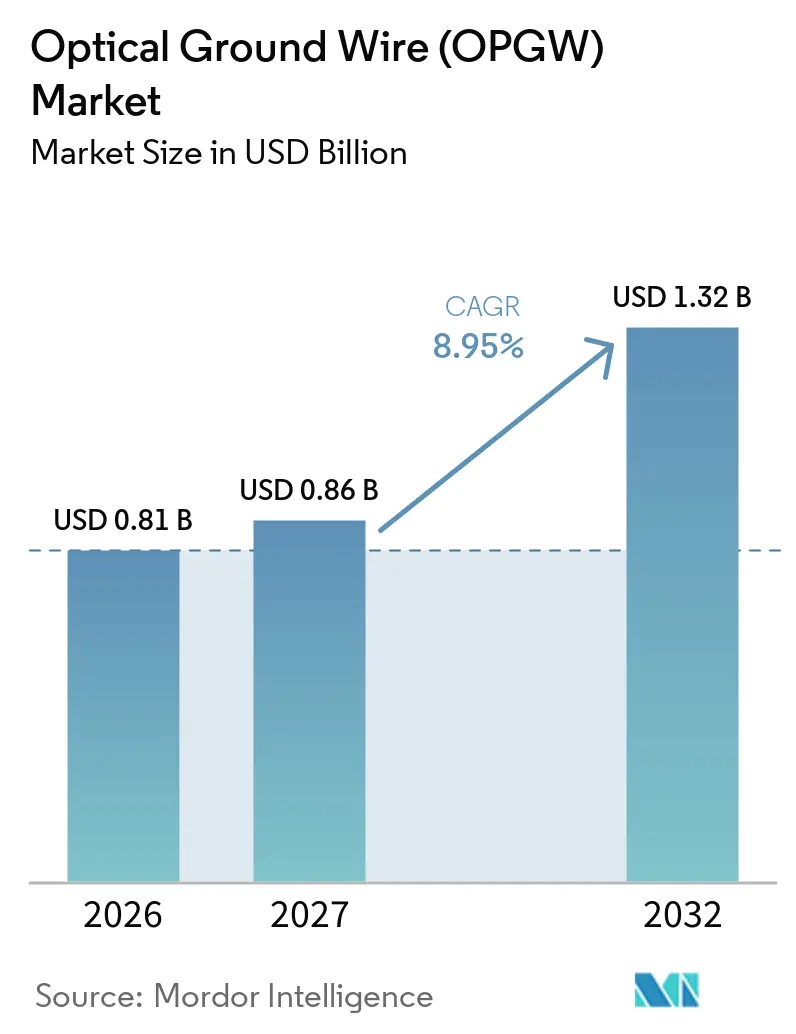
The Optical Ground Wire Market size was valued at USD 0.81 billion in 2026 and is estimated to grow from USD 0.86 billion in 2027 to reach USD 1.32 billion by 2032, at a CAGR of 8.95% during the forecast period (2027-2032). Optical ground wire combines grounding, lightning protection, and optical communications in a single overhead cable, which lets utilities add communications capacity while working within existing transmission corridors. The optical ground wire market is supported by grid modernization, renewable energy evacuation, and the need for secure utility communications. India’s Green Energy Corridor Phase III targets 51,126 circuit km of transmission lines and 229 GVA of transformation capacity by 2032 to 2033, which provides a long planning horizon for transmission-connected equipment[1]. Utilities are increasingly selecting higher fiber counts at the initial design stage because retrofitting an energized route is costly and operationally difficult. This supports higher-value installations in new high-voltage corridors, even where project approvals and installation capacity can slow near-term orders.
Key Report Takeaways
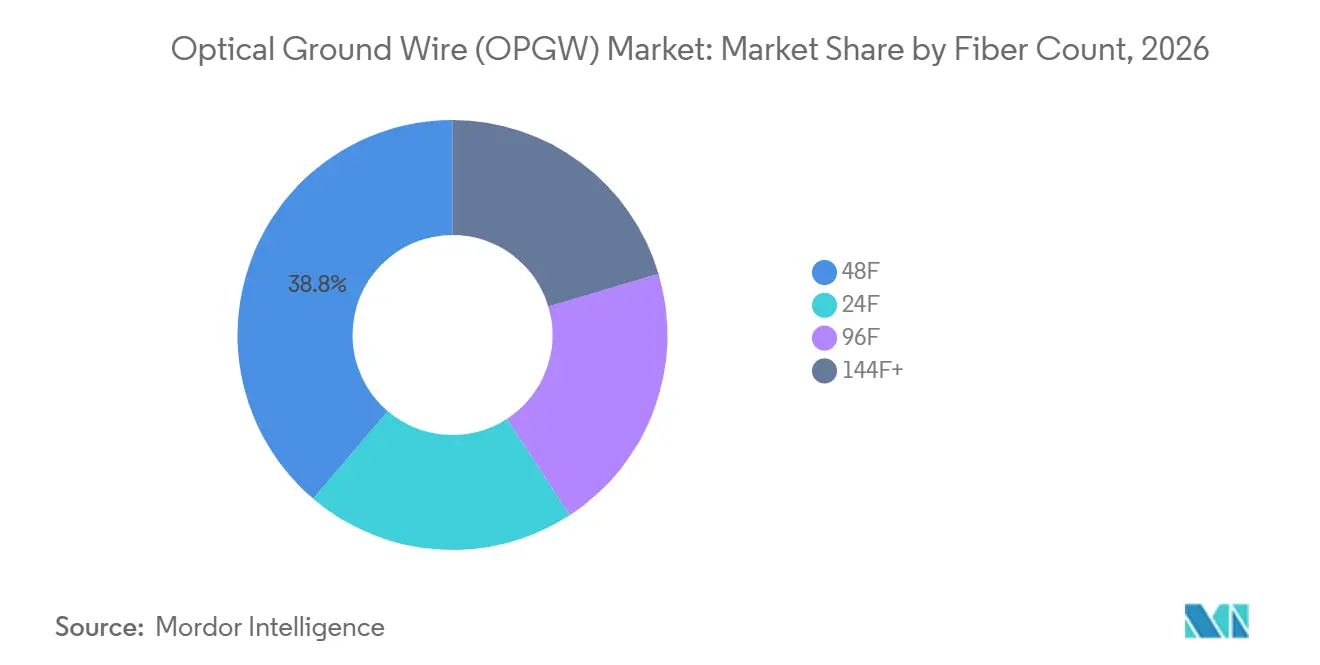
- By fiber count, 48F held 38.78% of the optical ground wire market share in 2026, while 96F is forecast to expand at a 12.21% CAGR through 2032.
- By cable design type, Design A held 38.05% of the optical ground wire market share in 2026, while Design B is forecast to expand at a 9.46% CAGR through 2032.
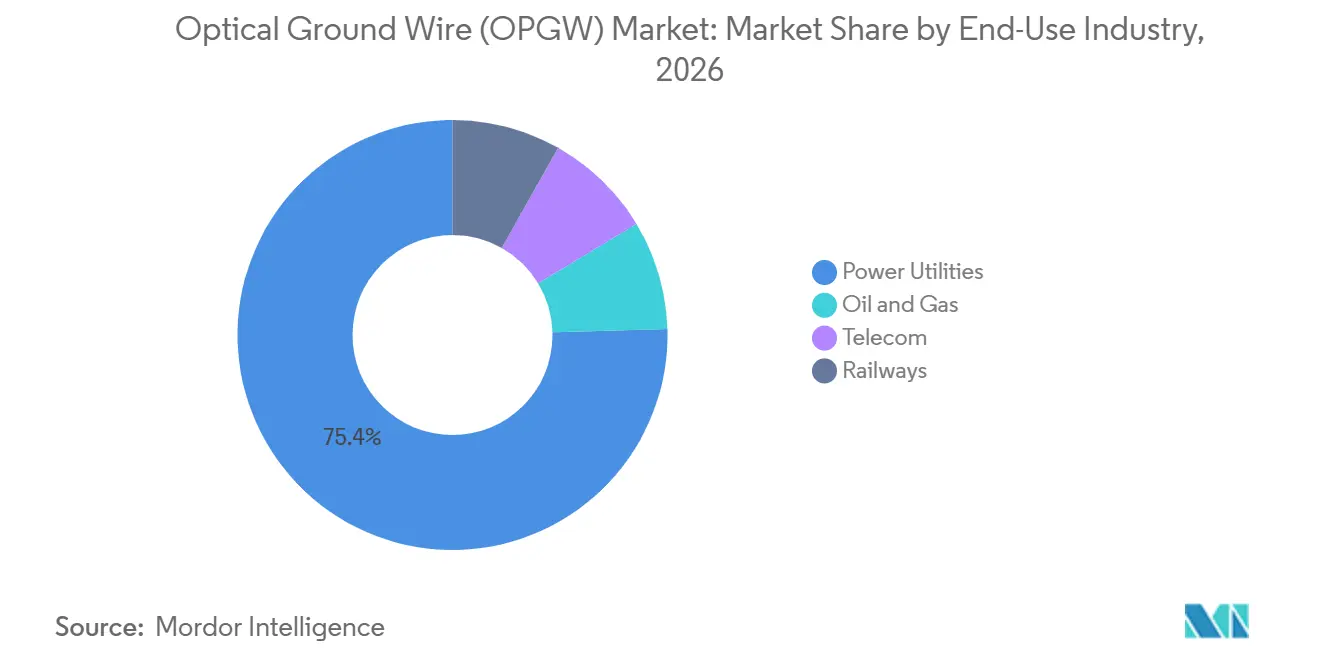
- By end-use industry, power utilities held 75.44% of the optical ground wire market share in 2026 and are forecast to expand at a 9.25% CAGR through 2032.
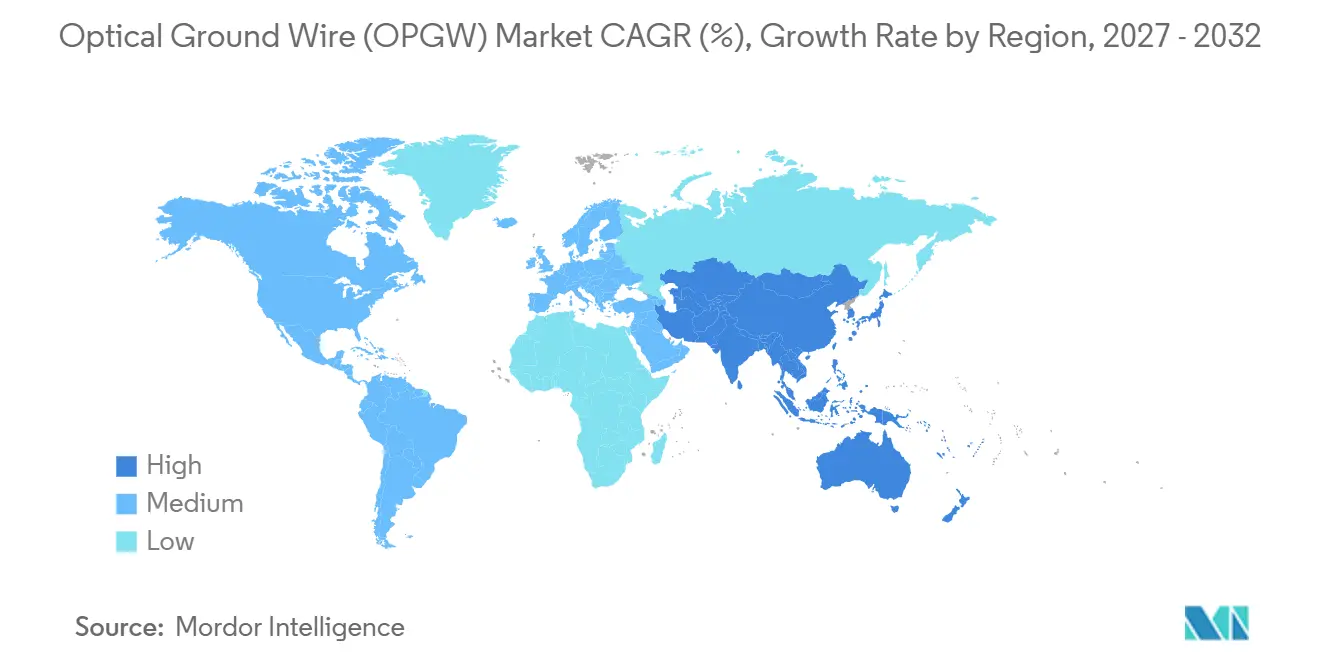
- By geography, Asia-Pacific held 44.39% of the optical ground wire market share in 2026 and is forecast to expand at a 9.66% CAGR through 2032.
Note: Market numbers in this report are based on Mordor Intelligence's proprietary estimation framework, which combines nine months of actuals with Q4 projections for base year 2026.
Market Trends and Insights
Drivers Impact Analysis of Optical Ground Wire (OPGW) Market*
| Driver | (~) % Impact on CAGR Forecast | Geographic Relevance | Impact Timeline |
|---|---|---|---|
| Grid Modernization and Smart-Grid Communications | +3.20% | Global, led by North America, Europe, and APAC | Medium term (2–4 years) |
| Renewable-Energy Evacuation and Long-Distance Transmission Expansion | +2.10% | APAC core (India, China); spill-over to South America and MEA | Long term (≥ 4 years) |
| Higher Fiber Capacity for Utility-Owned Backhaul and Grid Automation | +1.30% | Global, particularly North America and APAC | Medium term (2–4 years) |
| Resilience Upgrades for Extreme Weather and Wildfire Exposure | +0.80% | North America (wildfire corridors), Europe (storm), APAC (seismic) | Short term (≤ 2 years) |
| AI-Enabled Grid Monitoring and Predictive Maintenance | +0.60% | North America and Europe (early adopters), APAC (fast follower) | Medium term (2–4 years) |
| Utility Demand for Dual-Function Grounding and Communications Infrastructure | +0.50% | Global, acute in MEA and South America | Long term (≥ 4 years) |
| Source: Mordor Intelligence | |||
Grid Modernization and Smart-Grid Communications
Utilities are replacing aging shield wires with OPGW where they need a private fiber backbone without acquiring new rights-of-way. The U.S. Department of Energy has set a goal to upgrade 100,000 miles of transmission lines over 5 years, while its fiscal year 2026 request includes funding for transmission capacity and grid security infrastructure. This investment direction gives the optical ground wire market a role in both replacement programs and new line construction. National Grid’s Bryncir connection project in Wales includes earthwire replacement with OPGW, showing how communications requirements are entering reconductoring plans[1]. North American compliance requirements also support dedicated protection channels in critical corridors. OPGW is useful in these settings because its optical fibers are protected from the electromagnetic conditions surrounding high-voltage transmission equipment.
Renewable-Energy Evacuation and Long-Distance Transmission Expansion
New transmission towers for renewable power evacuation create a direct need for a ground wire and an opportunity to specify optical fiber at the same time. India approved Green Energy Corridor Phase III in 2025, with a planned 51,126 circuit km of intrastate transmission lines and 229 GVA of transformation capacity through 2032 to 2033. The same national plan outlines a 500 GW non-fossil capacity target by 2030, linking renewable capacity additions with new transmission requirements. The optical ground wire market benefits when cable specifications are fixed during the engineering phase rather than after a route becomes operational. Developers are also more likely to select 96F or 144F+ designs in long-distance corridors because an upgrade under energized conditions can be disruptive. This makes fiber capacity an early design decision rather than a minor later addition.
Resilience Upgrades for Extreme Weather and Wildfire Exposure
Wildfire exposure is making grid hardening a capital priority for several U.S. utilities. Southern California Edison committed USD 6.2 billion over 3 years in its 2025 wildfire mitigation plan for resilience measures and high-definition fire camera monitoring[3]. PG&E’s 2025 plan includes 570 circuit miles of transmission overhead upgrades for 2026 to 2028 and nearly 1,100 miles of undergrounding. The U.S. Department of Energy also requested USD 4 million for wildfire risk research, including advanced sensors and AI applications. In exposed transmission corridors, OPGW can support communications and sensing while retaining the grounding function of a conventional overhead shield wire. That dual role makes its use more relevant where utilities are improving situational awareness and infrastructure resilience at the same time.
AI-Enabled Grid Monitoring and Predictive Maintenance
OPGW can provide the fiber path used by distributed acoustic, temperature, strain, and vibration monitoring systems. A 2025 U.S. patent application describes a system that combines distributed fiber sensing with generative AI and large language model capabilities for anomaly detection, fault localization, and maintenance scheduling[4]. This application does not establish broad deployment, but it shows how fiber-based sensing is being linked with more automated grid analysis. The optical ground wire market can therefore benefit when utilities procure monitoring capabilities alongside cable hardware. Suppliers with sensing and analytics offerings may have an advantage in projects that include ongoing condition monitoring. The shift also increases the practical value of spare fiber pairs in high-capacity OPGW designs. It favors designs that can carry communications, monitor traffic, and future expansion requirements without adding another physical cable route.
Restraints Impact Analysis of Optical Ground Wire (OPGW) Market*
| Restraint | (~) % Impact on CAGR Forecast | Geographic Relevance | Impact Timeline |
|---|---|---|---|
| High Retrofit and Specialized Installation Costs | -1.80% | Global, acute in MEA and South America | Short term (≤ 2 years) |
| Procurement and Permitting Delays for Transmission Projects | -1.20% | North America, Europe | Medium term (2–4 years) |
| Engineering Trade-Offs Between Electrical Performance and Fiber Capacity | -0.60% | Global, critical in high-voltage APAC segments | Long term (≥ 4 years) |
| Competition from Underground Fiber and Wireless Communications | -0.40% | North America, Europe (dense urban corridors) | Long term (≥ 4 years) |
| Source: Mordor Intelligence | |||
High Retrofit and Specialized Installation Costs
Installing OPGW on an energized transmission line requires specialized live-line practices and careful control of grounding sequences. The work can involve aerial access, precision threading through tower hardware, and safety procedures that raise labor and mobilization costs. Consolidated Power Projects completed live OPGW stringing over 500 kV circuits in Australia in 2026, which demonstrates that this work needs specialized technical capability. The optical ground wire market can see uneven retrofit demand when utilities defer projects that require scarce, qualified crews. This issue is important in the Middle East, Africa, and South America, where the availability of certified live-line teams can be more limited. As a result, demand can be tied more closely to installation capacity and project timing than to the underlying need for digital grid communications.
Procurement and Permitting Delays for Transmission Projects
OPGW orders are often part of wider transmission packages, so project approvals directly affect cable demand. In January 2025, four Japanese utilities attached withdrawal conditions to the JPY 1.5 trillion to JPY 1.8 trillion Hokkaido-Honshu Sea Route project because of cost inflation. Such conditions show how large grid plans can be delayed even after substantial development work. Environmental assessments and route approvals in the United States and Europe can take several years before equipment procurement begins. The U.S. Department of Energy has identified a 2-year authorization target for transmission and distribution permitting, but historic permitting backlogs still limit deployment speed. The optical ground wire market remains exposed to this timing gap because communications cable purchases generally follow final transmission construction decisions.
*Our forecasts treat driver/restraint impacts as directional, not additive. The impact forecasts reflect baseline growth, mix effects, and variable interactions.
Optical Ground Wire (OPGW) Market Segment Analysis
By Fiber Count:
High-Count Architectures Outpacing Workhorse ConfigurationsThe 48F configuration held 38.78% of the optical ground wire market share in 2026, making it the leading fiber-count option. It supports common utility needs such as SCADA backhaul, protection relay signaling, and administrative communications without requiring unusually large cable dimensions. The 24F option continues to serve legacy replacement projects and lower-voltage circuits with limited bandwidth needs. The 144F+ category is more common in ultra-high-voltage interstate routes, where operators plan for long asset lives and may lease spare fiber pairs to mobile operators. In Southeast Asia and Latin America, 48F remains a reference design where procurement specifications are based on current utility communication requirements. This maintains a large installed base for medium-capacity OPGW even as requirements become more demanding.
The 96F optical ground wire market size is projected to expand at a 12.21% CAGR through 2032, the fastest rate among fiber-count categories. Its demand is linked to distributed acoustic sensing, 5G backhaul on transmission towers, and high-capacity communications requirements in new corridors. Utilities prefer to install more fiber at the start of a project because a mid-life splice on an energized line can be expensive and disruptive. Optics11 launched OptiFinder in June 2025, a fiber-optic partial discharge monitoring system that localizes faults within 15 cm, illustrating the type of monitoring application that uses dedicated fiber capacity. Higher fiber counts can also enable a utility to reserve pairs for internal systems while retaining flexibility for later use. The result is a clear separation between established replacement specifications and new-build designs intended to support digital grid functions over a long operating life.

By Cable Design Type:
Design A Retains a Broad Installed Base While Design B Gains in New CorridorsDesign A held 38.05% of the optical ground wire market share in 2026. Its position reflects compatibility with a broad range of accessories, tower fittings, and splicing equipment already used in mature transmission networks. This compatibility matters in North America, Europe, and developed Asia-Pacific systems, where replacement work must fit existing infrastructure. Designs B through F address more specialized installation conditions such as high-altitude spans, wide-river crossings, coastal salt exposure, and extreme ice loads. Several of these designs use added water blocking, corrosion-resistant armoring, or high-tensile wires to meet route-specific requirements. The cable design type, therefore, depends on the mechanical and environmental demands of the transmission corridor, not only on fiber capacity.
Design B is projected to grow at a 9.46% CAGR through 2032, the highest rate among cable design types. It can accommodate 96F and higher fiber counts without a proportionate increase in cable diameter that could complicate aerodynamic loading or tower attachment design. This is relevant in India’s renewable transmission buildout and in China’s UHV projects, where new circuits require higher communications capacity. Procurement decisions also consider mechanical strength, fiber strain, short-circuit capability, and weather endurance under IEC 60794-4 requirements. Design B does not replace Design A across the full market because standardized replacement needs continue to favor familiar, compatible hardware. Instead, the optical ground wire industry is separating into a replacement segment led by proven designs and a new-build segment that places greater value on fiber density and structural capability.
By End-Use Industry:
Power Utilities Remain the Core Demand CenterPower utilities accounted for 75.44% of the optical ground wire market share in 2026 and are forecast to grow at a 9.25% CAGR through 2032. Each addition to renewable generation requires transmission access, while each transmission circuit needs grounding and communications decisions. POWERGRID approved INR 584.13 crore for grid expansion and digital communications in 2025, including 2 large-scale OPGW communication network schemes in its western and eastern interstate transmission regions. Railways provide a stable secondary source of demand in Europe and India, where electrification requires signaling and remote monitoring. OPGW can support these needs where overhead power infrastructure provides a practical route for optical communications. The concentration of demand within utilities reflects the cable’s central role in power transmission operations.
Telecom operators can lease spare fiber pairs in utility-owned OPGW networks, helping utilities offset some communications infrastructure costs. This can encourage utilities to choose higher fiber-count configurations where future capacity has commercial value. Oil and gas users deploy OPGW along pipeline corridors where excavation constraints and hazardous conditions make overhead monitoring routes attractive. APAR Industries secured the L1 position on an INR 981.56 crore KPTCL tender in 2025 for a statewide OPGW and IP-MPLS network in Karnataka that covers supply, installation, testing, and network integration. This illustrates how grid digitalization projects can combine cable hardware with network-layer work. These adjacent end uses add demand, but the optical ground wire market remains primarily shaped by utility investment cycles and transmission infrastructure planning.
Geography Analysis
APAC Optical Ground Wire (OPGW) Market
Asia-Pacific held 44.39% of the optical ground wire market share in 2026 and is forecast to grow at a 9.66% CAGR through 2032. The region combines China’s UHV development, India’s renewable evacuation program, and rising transmission investment across other Asian economies. India’s Green Energy Corridor Phase III calls for 51,126 circuit km of intrastate transmission lines by 2032 to 2033, with communications-ready infrastructure required across new evacuation routes. China’s UHV routes create comparable long-distance applications because each high-voltage circuit requires a full route of overhead grounding and communications infrastructure. Japan’s longer-term renewable integration needs remain positive, although cost inflation has complicated the Hokkaido-Honshu Sea Route project. Australia’s 2026 live 500 kV OPGW stringing milestone also demonstrates the installation capability needed for high-voltage retrofit activity in the region.
North America and Europe Optical Ground Wire (OPGW) Market
North America and Europe are important for replacement, resilience, and regulated grid modernization programs. The U.S. Department of Energy’s 100,000-mile transmission upgrade goal supports a multi-year pipeline for transmission equipment and associated communications systems. Southern California Edison’s USD 6.2 billion wildfire mitigation plan and PG&E’s planned 570 circuit miles of overhead upgrades both demonstrate the scale of resilience spending in exposed U.S. regions. In Europe, reconductoring and substation connection projects are major routes for deployment. National Grid’s planned earthwire-to-OPGW replacement at Bryncir is one current example. These regions can deliver high-value projects, but permitting and environmental approvals can delay the point at which orders are released.
MEA and South America Optical Ground Wire (OPGW) Market
South America and the Middle East and Africa are emerging areas for the optical ground wire market as renewable ambitions outpace grid capacity. Brazil’s transmission expansion and Chile’s long-distance renewable export routes support greenfield circuits where higher fiber counts can be selected from the start. Saudi Arabia’s goal of 50% clean energy by 2030 points to new transmission corridors that require smart-grid-ready infrastructure. Morocco’s renewable development and planned European interconnectors also create potential demand beyond the Gulf states. The main execution constraint is the availability and cost of certified live-line installation crews. This makes project delivery less predictable in markets that may otherwise have strong transmission investment pipelines. New lines can favor OPGW, while retrofit activity can remain limited until specialized local installation capacity expands.
Competitive Landscape
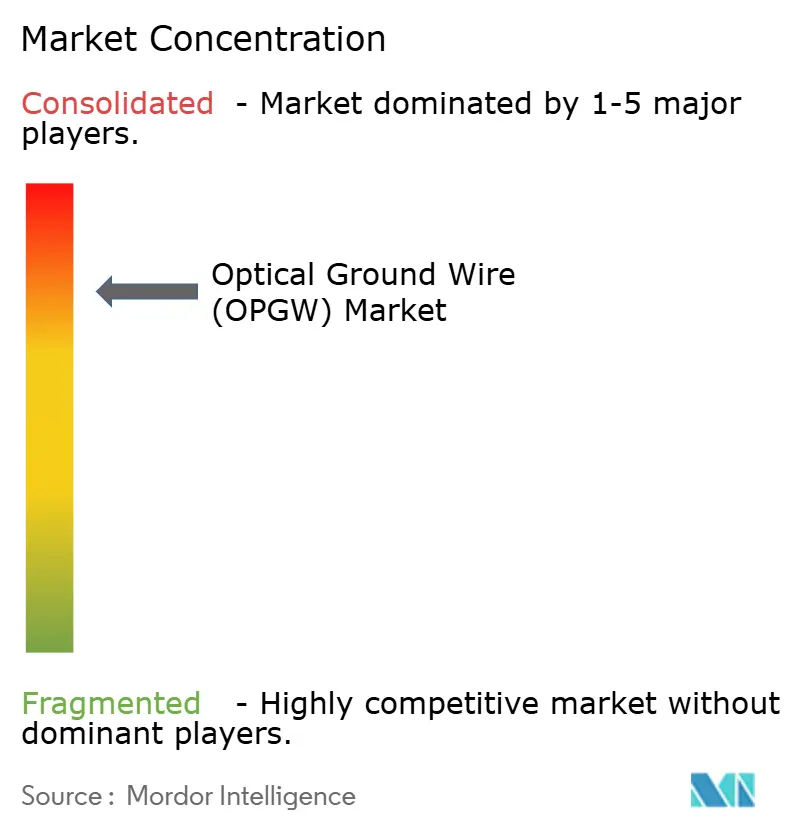
The optical ground wire market has high concentration, with ZTT Group, Fujikura, Hengtong Optic-Electric, Prysmian, and Furukawa Electric holding a meaningful share of procurement volumes. Chinese suppliers, including ZTT, Hengtong, Jiangsu Hongtu, Shenzhen SDG, Sichuan Huiyuan, and Tongguang Cable, compete through integrated fiber supply and cable production. This structure can support cost control when fiber availability is constrained. Japanese suppliers such as Fujikura, Furukawa, Sumitomo Electric, and J-Power Systems compete through engineering precision and compliance with IEC and JEC requirements. Prysmian, Nexans, AFL Global, and Tratos can also offer OPGW within larger transmission infrastructure packages. Competition is therefore shaped by cable engineering, manufacturing integration, tender pricing, and the ability to work within broader utility project requirements.
Suppliers are seeking positions beyond the sale of cable hardware. OPGW can serve as a fiber substrate for distributed acoustic sensing, distributed temperature sensing, and vibration monitoring. The 2025 U.S. patent application covering fiber sensing with AI-based analysis reflects the development of this monitoring direction. Companies that can combine cable supply with sensing systems and analytics may compete for longer-term monitoring contracts. This approach is relevant where utilities are investing in grid automation, predictive maintenance, and wildfire detection. It also raises the value of higher fiber-count designs, which can reserve capacity for monitoring applications. A supplier’s ability to support installation, integration, and post-installation services can therefore become as important as the cable itself.
Pricing pressure remains a competitive risk, particularly when suppliers with large domestic capacity bid for international tenders. Hengtong Optic-Electric was awarded a EUR 9.8 million REN contract in Portugal in February 2026 for ACSR cable supply, demonstrating its presence in the European transmission cable sector. Major grid projects can also be won by suppliers offering a wider package of power cables, project execution, and supporting equipment. The optical ground wire market remains open to specialist suppliers because route-specific design, installation experience, and utility qualification requirements matter in procurement. However, established companies can benefit from existing relationships and proof of performance in high-voltage environments. The result is active competition across both global and regional tenders rather than a market controlled by a single supplier group.
Optical Ground Wire (OPGW) Industry Leaders
-
ZTT International Limited
-
Fujikura Ltd.
-
Tongguang Cable Co., Ltd.
-
Shenzhen SDG Information Co., Ltd.
-
Hengtong Optic-Electric Co., Ltd.
- *Disclaimer: Major Players sorted in no particular order
Optical Ground Wire (OPGW) Market Companies Covered in this Report
- AFL Global
- APAR Industries Limited
- Elsewedy Electric S.A.E.
- Fujikura Ltd.
- Furukawa Electric Co., Ltd.
- Hengtong Optic-Electric Co., Ltd.
- Jiangsu Hongtu Optical Fiber Cable Co., Ltd.
- J-Power Systems Corporation
- LS Cable & System Ltd.
- Nexans S.A.
- NKT A/S
- Prysmian S.p.A.
- PT Voksel Electric Tbk
- Shenzhen SDG Information Co., Ltd.
- Sichuan Huiyuan Optical Communications Co., Ltd.
- Southwire Company, LLC
- Sterlite Technologies Limited
- Sumitomo Electric Industries, Ltd.
- Taihan Cable & Solution Co., Ltd.
- Tongguang Cable Co., Ltd.
- Tratos Group
- Yangtze Optical Fibre and Cable Joint Stock Limited Company
- ZTT International Limited
Recent Industry Developments in Optical Ground Wire (OPGW) Market
- September 2026: APAR Industries Limited secured the L1 position on a USD 117 million, KPTCL tender for Karnataka’s statewide OPGW and IP-MPLS communication network, covering supply, installation, testing, and network integration across KPTCL’s transmission network.
- September 2026: Systematic Industries Limited received a USD 9.9 million Notification of Award from POWERGRID for the OPGW-06 package, covering OPGW supply, execution, and erection across pan-India high-voltage transmission lines. Formally signed September 9, 2026, it signals continued momentum in India’s national transmission digitalization program.
- September 2026: India’s Union Cabinet approved Green Energy Corridor Phase III, valued at USD 22.4 billion, and targeting 51,126 circuit km of new transmission lines and 50 GWh of battery storage by 2032 to 2033, creating a multi-year demand pipeline for OPGW and grid communications infrastructure.
- August 2026: Prime Minister Modi laid the foundation stone for POWERGRID’s USD 663 million transmission system for the Kurnool-IV Renewable Energy Zone in Andhra Pradesh, designed to evacuate 4.5 GW of solar and wind capacity. This is one of several dedicated evacuation transmission systems under India’s Renewable Energy Zones framework, each requiring full-circuit OPGW deployment.
Global Optical Ground Wire (OPGW) Market Report Scope
Optical Ground Wire (OPGW) is a specialized overhead ground wire installed on electric power transmission lines that combines lightning protection and fault-current grounding with optical fiber communication capabilities. It consists of optical fibers housed within a protective metallic structure and is used by utilities for high-speed data transmission, substation communication, grid monitoring, protection, and control. OPGW serves a dual function by protecting transmission lines against lightning strikes while enabling reliable communication between power system facilities.
The global optical ground wire (OPGW) market is segmented by fiber count, cable design type, end-use industry, and geography. By fiber count, the market is segmented into 24F, 48F, 96F, and 144F and above. By cable design type, the market is segmented into Design A, Design B, Design C, Design D, Design E, and Design F. By end-use industry, the market is segmented into power utilities, telecommunications, railways, and oil and gas. The report also covers the market size and forecasts for the global optical ground wire (OPGW) market across 26 countries in key regions. For each segment, the market sizing and forecasts are provided on the basis of value (USD).
Segmentation Overview
| 24F |
| 48F |
| 96F |
| 144F+ |
| Design A |
| Design B |
| Design C |
| Design D |
| Design E |
| Design F |
| Power Utilities |
| Telecom |
| Railways |
| Oil and Gas |
| North America | United States |
| Canada | |
| Mexico | |
| Europe | Germany |
| France | |
| Italy | |
| Spain | |
| United Kingdom | |
| Poland | |
| Russia | |
| Rest of Europe | |
| Asia-Pacific | China |
| India | |
| Japan | |
| South Korea | |
| Australia | |
| Indonesia | |
| Vietnam | |
| Thailand | |
| Rest of Asia-Pacific | |
| South America | Brazil |
| Argentina | |
| Chile | |
| Rest of South America | |
| Middle East and Africa | Saudi Arabia |
| United Arab Emirates | |
| Egypt | |
| South Africa | |
| Morocco | |
| Rest of Middle East and Africa |
| By Fiber Count | 24F | |
| 48F | ||
| 96F | ||
| 144F+ | ||
| By Cable Design Type | Design A | |
| Design B | ||
| Design C | ||
| Design D | ||
| Design E | ||
| Design F | ||
| By End-Use Industry | Power Utilities | |
| Telecom | ||
| Railways | ||
| Oil and Gas | ||
| By Geography | North America | United States |
| Canada | ||
| Mexico | ||
| Europe | Germany | |
| France | ||
| Italy | ||
| Spain | ||
| United Kingdom | ||
| Poland | ||
| Russia | ||
| Rest of Europe | ||
| Asia-Pacific | China | |
| India | ||
| Japan | ||
| South Korea | ||
| Australia | ||
| Indonesia | ||
| Vietnam | ||
| Thailand | ||
| Rest of Asia-Pacific | ||
| South America | Brazil | |
| Argentina | ||
| Chile | ||
| Rest of South America | ||
| Middle East and Africa | Saudi Arabia | |
| United Arab Emirates | ||
| Egypt | ||
| South Africa | ||
| Morocco | ||
| Rest of Middle East and Africa | ||
Key Questions Answered in the Report
What is driving growth in optical ground wire demand?
Grid modernization, renewable energy evacuation, resilience spending, and secure utility communications are the main demand drivers. The report projects an 8.95% CAGR from 2027 to 2032 as utilities build and upgrade transmission corridors.
Which fiber count is growing fastest in OPGW applications?
The 96F configuration is projected to grow at a 12.21% CAGR through 2032. Sensing systems, 5G backhaul, and the need to avoid later retrofit work support its use in new transmission corridors.
Why do power utilities use OPGW cable?
OPGW combines overhead grounding and lightning protection with optical communications in a single cable. Power utilities held 75.44% of demand in 2026 because they use the cable for protection, control, and communications functions.
Which region leads OPGW demand?
Asia-Pacific held 44.39% share in 2026 and is projected to grow at a 9.66% CAGR through 2032. Transmission construction in India and China is the main reason for the region’s leading position.
What limits deployment on existing power lines?
Live-line retrofit work requires specialized crews, aerial techniques, and strict safety controls. Permitting delays, route approvals, and the availability of qualified installers can postpone orders even when utilities have clear communications needs.
How does fiber sensing affect OPGW use?
Distributed sensing can use OPGW fibers to monitor temperature, vibration, strain, and other grid conditions. These uses make spare fiber pairs more valuable and strengthen the case for higher-capacity designs at the project design stage.
How large is Optical Ground Wire (OPGW) Market?
The Optical Ground Wire Market size was valued at USD 0.81 billion in 2026 and is estimated to grow from USD 0.86 billion in 2027 to reach USD 1.32 billion by 2032, at a CAGR of 8.95% during the forecast period (2027-2032).