
Optical Current Transformer Market Size and Share
Market Overview
| Study Period | 2022 - 2032 |
|---|---|
| Market Size (2027) | USD 98.26 Million |
| Market Size (2032) | USD 145.15 Million |
| Growth Rate (2027 - 2032) | 8.12 % |
| Fastest Growing Market | Asia-Pacific |
| Largest Market | Asia-Pacific |
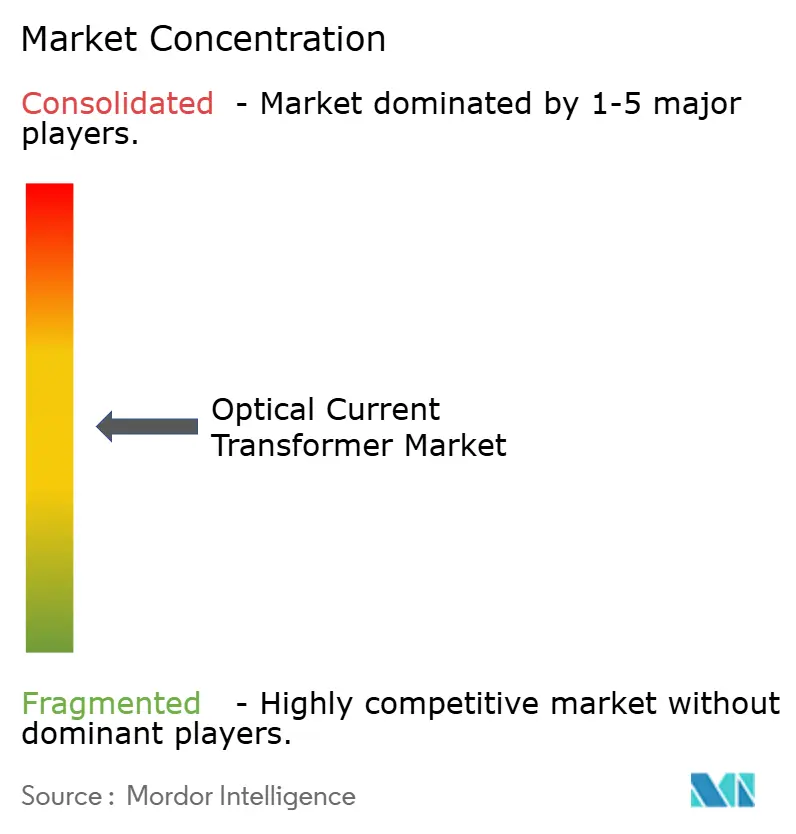
| Market Concentration | Medium |
Major Players *Disclaimer: Major Players sorted in no particular order Image © Mordor Intelligence. Reuse requires attribution under CC BY 4.0. | |
Optical Current Transformer Market Analysis by Mordor Intelligence
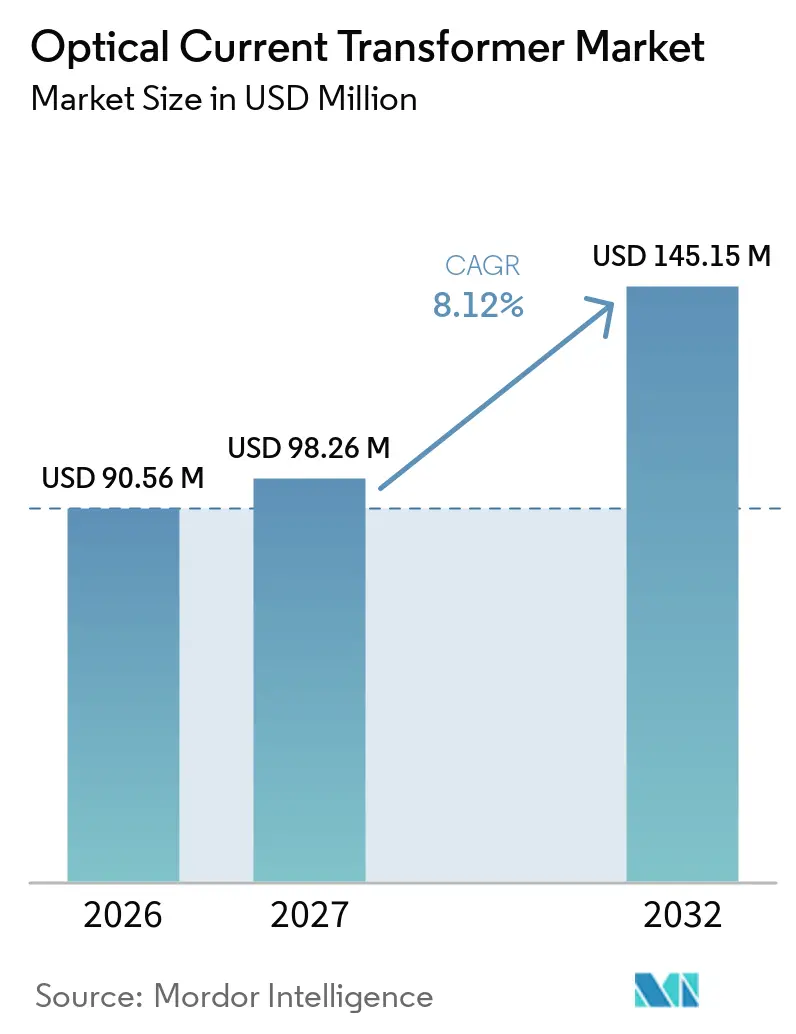
The optical current transformer market size is projected to expand from USD 90.6 million in 2026 to USD 145.2 million by 2032, registering a CAGR of 8.1% between 2027 and 2032. The optical current transformer market is moving with the shift toward digital substations and fiber-based process-bus designs. High-Voltage Direct Current (HVDC) corridors and renewable power evacuation projects also favor saturation-free measurement at converter stations. Environmental rules that restrict SF6 equipment are widening the case for passive, gas-free designs in selected substation projects.[1] Suppliers are combining sensing hardware with interoperability, cybersecurity, and protection interfaces, which makes qualification capability as important as the sensor itself. The opportunity is strongest where space, fault performance, and digital communication requirements outweigh the higher purchase cost of an optical alternative.
Key Report Takeaways
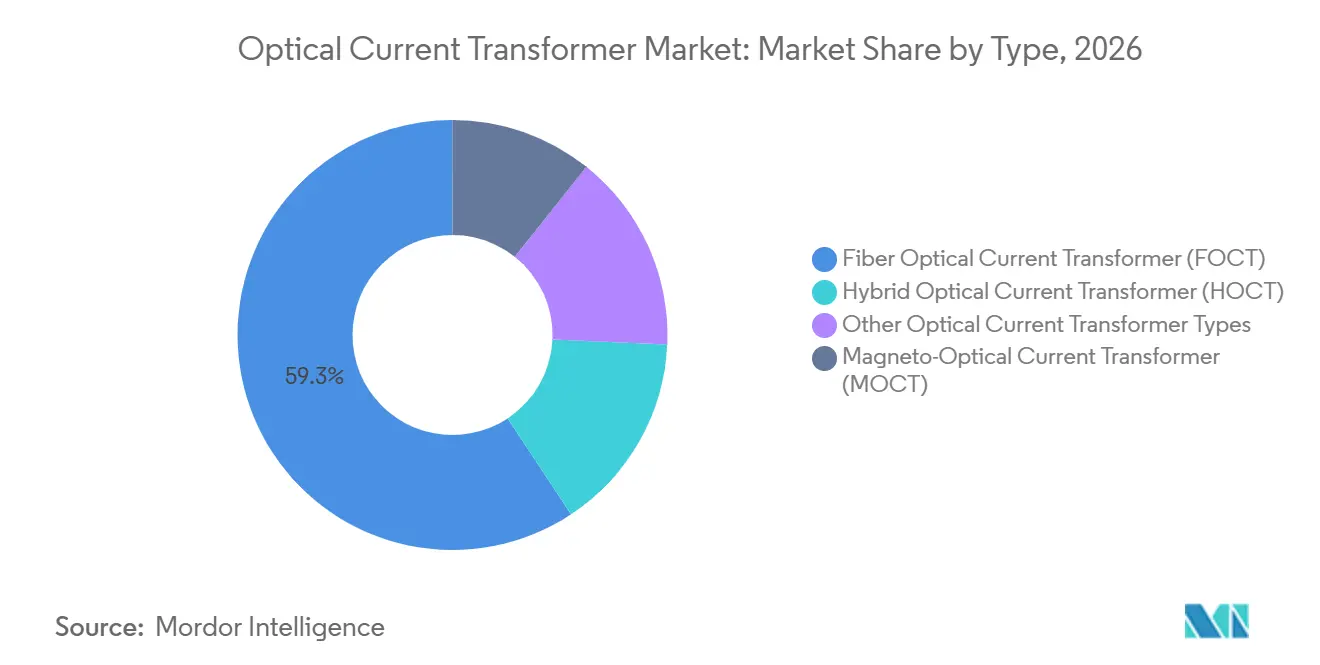
- By type, Fiber Optic Current Transformer (FOCT) held 59.3% of the demand in the optical current transformer market in 2026, while Fiber Optic Current Transformer (FOCT) is forecast to grow at a 9.3% CAGR through 2032.
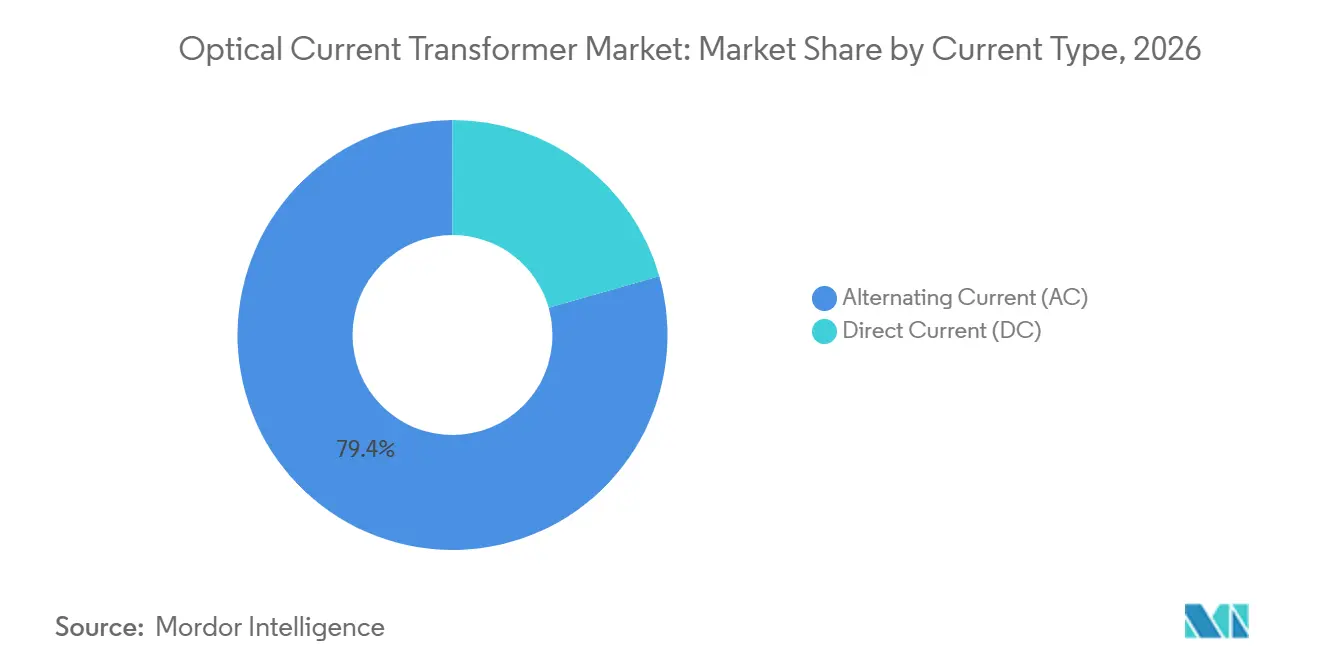
- By current type, AC accounted for 79.4% of the demand in the optical current transformer market in 2026, while DC is forecast to grow at a 9.7% CAGR through 2032.
- By voltage level, extra-high voltage held 36.7% of the demand in the optical current transformer market in 2026, while ultra-high voltage is forecast to grow at a 9.8% CAGR through 2032.
- By end user, electric power transmission and distribution utilities held 61.3% of the demand in the optical current transformer market in 2026 and are forecast to grow at an 8.6% CAGR through 2032.
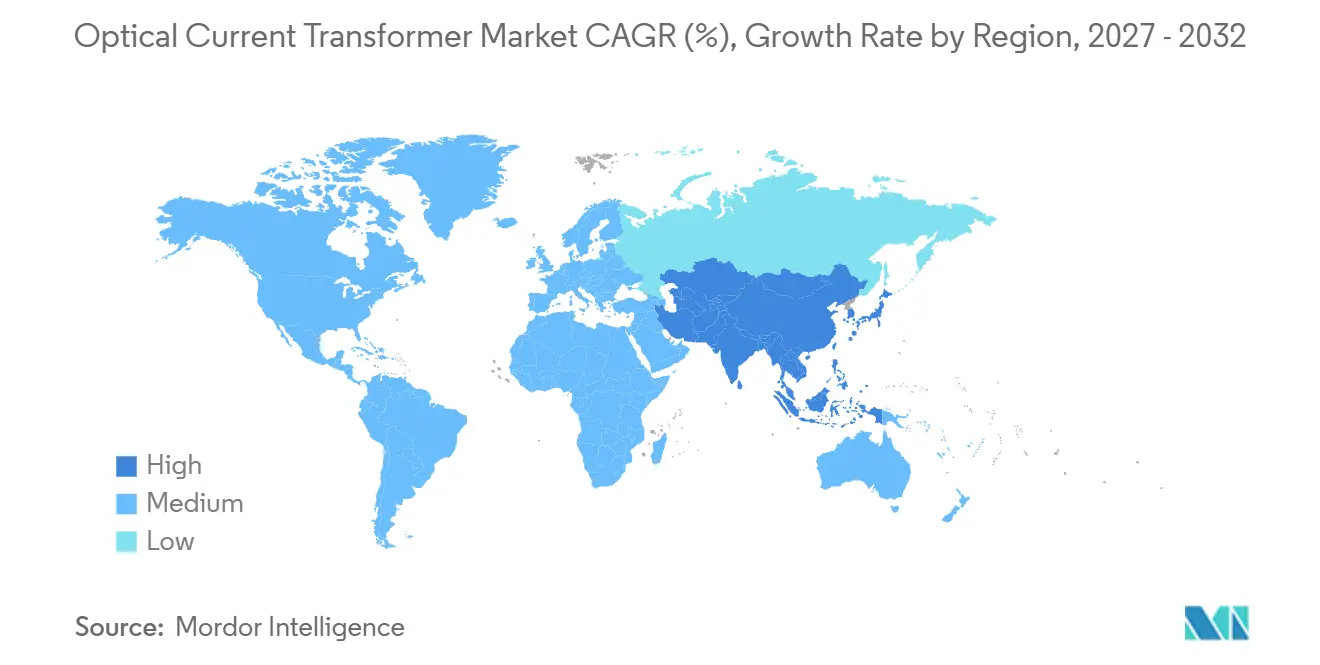
- By geography, Asia-Pacific held 41.5% of the demand in the optical current transformer market in 2026 and is forecast to grow at an 8.9% CAGR through 2032.
Note: Market numbers in this report are based on Mordor Intelligence's proprietary estimation framework, which combines nine months of actuals with Q4 projections for base year 2026.
Market Trends and Insights
Drivers Impact Analysis of Optical Current Transformer Market*
| Driver | (~) % Impact on CAGR Forecast | Geographic Relevance | Impact Timeline |
|---|---|---|---|
| Digital Substation and IEC 61850 Process-Bus Adoption | +1.8% | Global | Short term (≤ 2 years) |
| High-Voltage Renewable-Energy Evacuation and High-Voltage Direct Current (HVDC) Expansion | +2.1% | Asia-Pacific (APAC), Europe, Middle East | Medium term (2-4 years) |
| Gas Insulated Switchgear (GIS) Deployment in Space-Constrained and Offshore Substations | +0.9% | Europe, Asia-Pacific (APAC) | Medium term (2-4 years) |
| Saturation-Free Measurement for Faults and DC Offset | +0.7% | Global | Short term (≤ 2 years) |
| Optical Current Transformer (CT) Integration with Merging Units and Protection Relays | +0.6% | Global | Short term (≤ 2 years) |
| Replacement of Oil and SF6-Dependent Measurement Architectures | +1.0% | Europe, North America | Medium term (2-4 years) |
| Source: Mordor Intelligence | |||
Digital Substation and IEC 61850 Process-Bus Adoption Accelerating Specification Change
The optical current transformer market benefits when a new substation uses a fiber-optic process bus instead of copper secondary wiring. IEC 61850-9-2 supports digital sampled values at 4,000 to 14,400 samples per second, while magnetic transformers require merging units and conversion equipment to provide that format. Optical designs can supply sampled-value data directly to compatible protection systems. This changes the procurement decision early, because equipment configured around sampled-value communication is difficult to change back to analog outputs during construction. The optical current transformer market, therefore, gains from greenfield digital substations as well as from upgrades that replace conventional relay-room arrangements. The technical effect is especially clear where protection, control, and measurement are designed together rather than acquired as separate packages.
High-Voltage Renewable-Energy Evacuation and High-Voltage Direct Current (HVDC) Expansion Creating Dedicated Demand
High-Voltage Direct Current (HVDC) converter stations create a distinct application for optical current transformers because iron-core designs cannot measure true DC current. Conventional units can also saturate during asymmetric faults, which can distort the information available to protection equipment. NR Electric supported the June 2025 commissioning of the 2,290 km, 8 GW Hami-Chongqing ±800 kV project with control, protection, measurement, and optical current measurement equipment. The project supplies more than 36 billion kWh each year, illustrating the scale of transmission assets that require high-performance measurement. The optical current transformer market gains demand across converter yards, DC yards, and harmonic filter banks, rather than only at one measurement point. This makes renewable evacuation and long-distance transmission projects a more durable source of demand than isolated equipment replacements.
Saturation-Free Measurement for Faults and DC Offset Underpinning Protection Reliability
Optical designs have no magnetic core, so they do not saturate under the large short-circuit currents that affect conventional current transformers. A 2025 Graz University of Technology study at a 110 kV substation found that a fiber-optic sensor measured quasi-DC fault current without saturation, while inductive transducers did not resolve the DC-offset component.[2] A 2025 IEEE Sensors Journal study also reported a DC optical transformer prototype with 0.2% accuracy at 1,200 Hz harmonic current.[3] State Grid researchers reported cross-fringe measurement capability above 500 kA without accuracy loss in 2025[4]. These attributes matter at High-Voltage Direct Current (HVDC) facilities and substations with inverter-based generation, where distorted and offset fault currents place greater demands on protective measurement. The optical current transformer market is therefore supported by performance needs that are not solved through incremental changes to a standard iron-core unit.
Replacement of Oil and SF6-Dependent Measurement Architectures Driven by Regulatory and Environmental Pressure
Passive optical current transformers do not use oil or pressurized insulating gas in the sensing element. Regulation (EU) 2024/573 restricts new SF6 medium-voltage switchgear up to 24 kV from January 2026, which strengthens the case for gas-free alternatives in applicable projects. Statnett is building 4 new 420 kV stations without SF6 and identifies the reduction of this greenhouse gas as a design objective. TransnetBW has stated that it is replacing around 120 aging oil-insulated instrument transformers with alternatives that do not use fluorinated gas. Optical sensors can fit these architectures because they are passive and compact within gas-insulated switchgear arrangements. The optical current transformer market can benefit when environmental compliance is considered alongside space requirements and relay modernization.
Restraints Impact Analysis of Optical Current Transformer Market*
| Restraint | (~) % Impact on CAGR Forecast | Geographic Relevance | Impact Timeline |
|---|---|---|---|
| Higher Upfront Cost Versus Conventional Magnetic CTs | -0.8% | Global, particularly price-sensitive markets | Short term (≤ 2 years) |
| Utility Qualification Cycles and Limited Long-Term Reference Base | -0.5% | Global | Medium term (2-4 years) |
| Fiber and Photonic Component Supply-Chain Specialization | -0.4% | Asia-Pacific (APAC), North America | Medium term (2-4 years) |
| Interoperability and Cybersecurity Burden in Digital Substations | -0.3% | Europe, North America | Long term (≥ 4 years) |
| Source: Mordor Intelligence | |||
Higher Upfront Cost Versus Conventional Magnetic CTs Slowing Mid-Voltage Penetration
Optical current transformers carry a higher purchase cost than comparable magnetic units. The difference is most difficult to justify at medium and high voltage, where the full performance advantage of an optical sensor may not be required. The 2025 Indonesian digital-substation research found that lower wiring, fire-risk, and maintenance needs support the lifecycle case at transmission voltage, but the comparison is harder at distribution voltage. Specialized photonic components and lower manufacturing scale remain part of this cost position. Budget pressure is strongest in price-sensitive grid programs, where a substation requires many units and the direct equipment cost is closely reviewed. The optical current transformer market will therefore penetrate first where high-voltage performance and digital architecture create a clear operational benefit.
Utility Qualification Cycles and Limited Long-Term Reference Base Extending Procurement Lead Times
Regulated utilities often seek 5 to 10 years of operational evidence before approving a new measurement technology across a network. The installed base of optical units remains much smaller than the installed base of magnetic current transformers. This leaves fewer long-term field references for procurement engineers assessing reliability. PT PLN deployment research also identifies strict fiber installation protocols and factory and site acceptance procedures as material commissioning needs. A limited reference base can lengthen approval cycles, which in turn slows the production of further operating data. The optical current transformer market consequently faces a practical adoption constraint even when a design meets the technical requirements of a project.
*Our forecasts treat driver/restraint impacts as directional, not additive. The impact forecasts reflect baseline growth, mix effects, and variable interactions.
Optical Current Transformer Market Segment Analysis
By Type:
Fiber Optic Current Transformer (FOCT) Dominance Reinforced by High-Voltage Direct Current (HVDC) and Gas Insulated Switchgear (GIS) FitFiber Optic Current Transformer (FOCT) held 59.3% of the optical current transformer market share in 2026 and is forecast to expand at a 9.3% CAGR through 2032. Its all-fiber configuration avoids the bulky magneto-optical crystal components used in some competing designs. This is valuable in High-Voltage Direct Current (HVDC) converter environments, offshore substations, and compact Gas Insulated Switchgear (GIS) layouts where electromagnetic immunity is important. Fiber Optic Current Transformer (FOCT) technology uses a Sagnac interferometer and Faraday rotation principles to measure current. The 2025 cross-fringe research reported measurement above 500 kA after optical-path error compensation, extending the relevant range for high-current applications. The technology is therefore aligned with busbar protection and converter-valve hall measurement duties.
MOCT is the second-largest type and uses magneto-optical glass rods rather than fiber loops. It can retain a cost advantage at medium and high voltage, where an all-fiber arrangement is more capable than the operating conditions require. HOCT fills retrofit applications that need partial compatibility with existing secondary systems. Other optical CT designs include Rogowski-coil-based electronic products used in medium-voltage digital switchgear. A 2025 review of all-fiber current transformers identified temperature compensation and vibration tolerance as active reliability challenges for Ultra High Voltage Direct Current (UHVDC) deployments. China Electrical Equipment Group reported that its POCT-800-III all-fiber DC current transformer is operating at the Jinsu High-Voltage Direct Current (HVDC) converter station, showing that domestic Fiber Optic Current Transformer (FOCT) products are active at the highest voltage tiers.

By Current Type:
DC Segment Outpacing the Market Despite Small BaseAC applications accounted for 79.4% of the demand in the optical current transformer market in 2026 because AC substations remain the larger part of installed electrical infrastructure. The AC segment remains the volume base through 2032 as utilities replace aging magnetic units and build new digital transmission substations. It also includes the AC yards of High-Voltage Direct Current (HVDC) converter stations. In those yards, sensors may need to resolve DC offset during fault conditions. Saturation-free optical designs address that requirement without a magnetic-core limitation. This preserves the relevance of optical sensing even where the normal system current is alternating current.
DC is projected to grow at a 9.7% CAGR through 2032, the fastest rate among current types. Each HVDC bipole requires multiple devices at converter stations, harmonic filter banks, and electrode connections. The Hami-Chongqing project provides a current example of optical measurement supplied as part of an integrated HVDC package. Railway traction systems using rectified DC supply add a smaller source of demand. Growing metro systems in Asian cities can require DC current monitoring at traction substations. This niche is defensible because conventional magnetic current transformers do not provide true DC measurement.
By Voltage Level:
UHV Fastest-Growing as HVDC Projects ProliferateExtra-high voltage, covering 300 to 800 kV, commanded 36.7% of the demand in the optical current transformer market in 2026. This tier serves backbone transmission, renewable evacuation routes, interregional interconnectors, and large HVDC schemes. Projects at this level have high consequences for fault performance and outage avoidance. They also need measurement equipment that can work within demanding insulation and space constraints. The extra-high-voltage tier, therefore, provides a substantial installed base for suppliers. Its position reflects where digital transmission investment and large project budgets converge.
Ultra-high voltage above 800 kV is forecast to advance at a 9.8% CAGR through 2032. China Southern Grid issued a public tender in October 2025 for all-fiber CT reliability improvements for the Tibet-Guangdong Ultra High Voltage Direct Current (UHVDC) project. The research scope included vibration tolerance, fiber-loop integration, and electromagnetic interference resilience. High voltage, from 110 to 300 kV, remains a major mass-adoption tier because digital-substation rollouts are active at this range. Medium voltage, from 11 to 110 kV, still favors conventional magnetic designs on cost, although process-bus adoption can gradually extend optical specifications downward. The optical current transformer industry benefits most where the voltage level makes its performance and compactness commercially relevant.
By End User:
Utilities Lead but Renewable Operators Are a Structural Growth DriverElectric power transmission and distribution utilities accounted for 61.3% of the demand in the optical current transformer market in 2026 and are projected to grow at an 8.6% CAGR through 2032. Utilities specify and purchase instrument transformers for greenfield digital substations and for the modernization of installed networks. Their role puts them at the center of the procurement process. State Grid Corporation of China and PowerGrid operate large transmission networks that require high-voltage measurement equipment. State Grid research in 2025 covered cross-fringe Fiber Optic Current Transformer (FOCT) measurement and quantum sensing, as well as conventional optical systems. Utility demand will remain linked to the pace of transmission investment and technology qualification.
Power generation companies form the second-largest end-user group, especially large nuclear and thermal facilities that need high-precision generator-terminal measurement. Renewable operators are an additional growth source because offshore wind farms and large solar facilities require measurement at substation interconnection points. Their power flows can include harmonics and DC injection components that are difficult for conventional equipment to reproduce accurately. Railway and metro operators also need compact measurement in high-reliability traction environments. ABB's AdvaSense sensors were installed in a 25 kV Czech railway substation in September 2025, the first application of that family in the country. Industrial and commercial users complete the demand base through precision metering at large energy-intensive facilities.
Geography Analysis
Asia-Pacific held 41.5% of the optical current transformer market share in 2026 and is projected to grow at an 8.9% CAGR through 2032. China drives demand through its ±800 kV HVDC corridors and domestic Fiber Optic Current Transformer (FOCT) manufacturing base. Chinese suppliers including NR Electric, Yangtze Optical Electronic, and Comcore compete for domestic Ultra High Voltage Direct Current (UHVDC) work. NR Electric's support for Hami-Chongqing demonstrates the role of integrated control, protection, measurement, and optical current measurement in regional projects. India is another growth node because it continues to expand high-voltage transmission and renewable integration. Japan and South Korea also maintain high-specification digital-substation programs that use process-bus architectures.
Europe is the second-largest regional market and has growing demand from SF6 phase-out decisions and offshore-grid investment. The EU restrictions on new SF6 medium-voltage switchgear apply from January 2026 and reinforce interest in gas-free measurement architectures. Statnett's 4 SF6-free 420 kV stations provide a current reference for high-voltage alternatives. TransnetBW's planned replacement of aging oil-insulated equipment supports the same direction of travel. The optical current transformer market in Europe also benefits from North Sea offshore HVDC connections. GE Vernova and Seatrium secured the BalWin5 contract from TenneT in December 2025 for a 2.2 GW offshore HVDC connection scheduled for commissioning in 2032.
North America, South America, and the Middle East and Africa have smaller but distinct demand profiles. North America has concentrated HVDC demand from transmission corridors, although digital-substation adoption is less advanced than in Asia-Pacific and Europe. South America is building a pipeline around Brazil and Chile. Conexión Kimal-Lo Aguirre completed technical verification visits to NR Electric's facility in January 2025 for the 1,346 km, 3,000 MW Kimal-Lo Aguirre line in Chile. The Middle East and Africa have early digital-substation activity and major grid-expansion programs. Saudi Arabia and the UAE provide potential high-value opportunities through grid and offshore HVDC development.
Competitive Landscape
The optical current transformer market is moderately consolidated in technology leadership, with ABB, Siemens Energy, Hitachi Energy, GE Vernova, and Trench Group holding established positions in certified high-voltage applications. These companies compete through fiber-optic sensing platforms, high-voltage reference projects, and their ability to integrate equipment with protection and control systems. Their product strategies increasingly combine sensing hardware with interoperability, cybersecurity, and predictive-maintenance functions. This makes certification and system knowledge important barriers for new suppliers. Arteche secured a EUR 29 million loan from ICO in 2025 for research, digitization, and productive investment in its electrical equipment portfolio. The financing supports its effort to compete in HVDC and digital-substation applications.
Trench Group acquired H Nu in September 2025, adding fiber-optic instrument-transformer technology with rapid response suitable for HVDC measurement. The company stated that it is working with system suppliers to qualify the technology for high-voltage use. ABB's Czech railway installation shows another competitive route, where compact sensors address space and safety constraints rather than only UHV transmission demand. GE Vernova's BalWin5 award is an example of a large offshore HVDC program that supports the need for converter-station measurement packages. Suppliers can find room in offshore substations below 500 kV and in Gas Insulated Switchgear (GIS)-integrated digital substations, where passive compact designs are less widely supplied. Established vendors remain favored in projects that require extensive testing, documentation, and long operating references.
Chinese companies are becoming a stronger competitive group through domestic Ultra High Voltage Direct Current (UHVDC) experience and integrated system delivery. NR Electric has supported the Hami-Chongqing project and is linked to technical verification for Chile's Kimal-Lo Aguirre line. Yangtze Optical Electronic and Comcore compete with cost-advantaged Fiber Optic Current Transformer (FOCT) products in China's domestic procurement environment. Profotech maintains a specialist MOCT position for utilities in the CIS region. IEC 61869-10 and IEC 61869-11 requirements, together with cybersecurity expectations in North America and Europe, can limit rapid entry into those regions. A quantum current transformer developed by University of Science and Technology of China (USTC) and State Grid Anhui achieved 0.05% accuracy at a Hefei 110 kV substation in 2025, creating a longer-term technical development that established suppliers must follow
Optical Current Transformer Industry Leaders
-
ABB Ltd.
-
Siemens Energy AG
-
GE Vernova Inc.
-
Arteche Lantegi Elkartea, S.A.
-
Nissin Electric Co., Ltd.
- *Disclaimer: Major Players sorted in no particular order
Optical Current Transformer Market Companies Covered in this Report
- ABB Ltd.
- Arteche Lantegi Elkartea, S.A.
- Beijing Daelim Green EP Technology Co., Ltd.
- Comcore Optical Intelligence Technologies Co., Ltd.
- GE Vernova Inc.
- Hitachi Energy Ltd.
- KONČAR – Electrical Engineering Institute, Inc.
- Mitsubishi Electric Corporation
- Nissin Electric Co., Ltd.
- NR Electric Co., Ltd.
- NxtPhase T&D Corporation
- Profotech LLC
- RITZ Instrument Transformers GmbH
- Schweitzer Engineering Laboratories, Inc.
- Siemens Energy AG
- T&D Products Ltd.
- Toshiba Energy Systems & Solutions Corporation
- Trench Group GmbH
- Yangtze Optical Electronic Co., Ltd.
- Yokogawa Electric Corporation
Recent Industry Developments in Optical Current Transformer Market
- December 2025: GE Vernova and Seatrium were awarded a contract by TenneT to deliver BalWin5, a 2.2 GW offshore HVDC grid connection in the German North Sea with commissioning planned for 2032. The project involves an offshore converter station, onshore converter station at Bremen-Werderland, and a 325 km cable system.
- September 2025: Trench Group acquired Australian firm H Nu, gaining access to fiber-optic instrument transformer technology with ultra-fast response times suited to HVDC measurement. Trench stated it is collaborating with leading system suppliers to qualify the technology as a future standard for high-voltage measurement.
- September 2025: ABB's AdvaSense compact current and voltage sensors were integrated into a 25 kV AC railway substation in the Czech Republic by EPC contractor EŽ, marking the first railway application of the AdvaSense family in the country.
- January 2025: Chile's Conexión Kimal-Lo Aguirre completed technical verification visits to NR Electric's Nanjing facility for HVDC control protection and optical Current Transformer (CT) equipment for the 1,346 km, 3,000 MW Kimal-Lo Aguirre DC transmission line.
Global Optical Current Transformer Market Report Scope
An Optical Current Transformer (OCT) is an electrical instrument that measures alternating or direct current in high-voltage power systems. It uses optical technology, such as the Faraday effect, to detect the magnetic field generated by current flowing through a conductor. The measured current is converted into an optical signal, which is then processed and converted into data for protection, monitoring, and control systems.
The global optical current transformer market is segmented by type, current type, voltage level, end user, and geography. By type, the market is segmented into fiber optical current transformers (FOCT), magneto-optical current transformers (MOCT), hybrid optical current transformers (HOCT), and other optical current transformer types. By current type, the market is segmented into alternating current (AC) and direct current (DC). By voltage level, the market is segmented into low voltage (below 11 kV), medium voltage (11–110 kV), high voltage (110–300 kV), extra-high voltage (300–800 kV), and ultra-high voltage (above 800 kV). By end user, the market is segmented into electric power transmission and distribution utilities, power generation companies, industrial sector, renewable energy operators, railway and metro operators, commercial and infrastructure operators, and other end users. The report also covers the market size and forecasts for the global optical current transformer market across 26 countries in key regions. For each segment, the market sizing and forecasts are provided on the basis of value (USD).
Segmentation Overview
| Fiber Optical Current Transformer (FOCT) |
| Magneto-Optical Current Transformer (MOCT) |
| Hybrid Optical Current Transformer (HOCT) |
| Other Optical Current Transformer Types |
| Alternating Current (AC) |
| Direct Current (DC) |
| Low Voltage (Below 11 kV) |
| Medium Voltage (11-110 kV) |
| High Voltage (110-300 kV) |
| Extra-High Voltage (300-800 kV) |
| Ultra-High Voltage (Above 800 kV) |
| Electric Power Transmission and Distribution Utilities |
| Power Generation Companies |
| Industrial Sector |
| Renewable Energy Operators |
| Railway and Metro Operators |
| Commercial and Infrastructure Operators |
| Other End Users |
| North America | United States |
| Canada | |
| Mexico | |
| Europe | Germany |
| France | |
| Italy | |
| Spain | |
| United Kingdom | |
| Poland | |
| Russia | |
| Rest of Europe | |
| Asia-Pacific | China |
| India | |
| Japan | |
| South Korea | |
| Australia | |
| Indonesia | |
| Vietnam | |
| Thailand | |
| Rest of Asia-Pacific | |
| South America | Brazil |
| Argentina | |
| Chile | |
| Rest of South America | |
| Middle East and Africa | Saudi Arabia |
| United Arab Emirates | |
| Egypt | |
| South Africa | |
| Morocco | |
| Rest of Middle East and Africa |
| By Type | Fiber Optical Current Transformer (FOCT) | |
| Magneto-Optical Current Transformer (MOCT) | ||
| Hybrid Optical Current Transformer (HOCT) | ||
| Other Optical Current Transformer Types | ||
| By Current Type | Alternating Current (AC) | |
| Direct Current (DC) | ||
| By Voltage Level | Low Voltage (Below 11 kV) | |
| Medium Voltage (11-110 kV) | ||
| High Voltage (110-300 kV) | ||
| Extra-High Voltage (300-800 kV) | ||
| Ultra-High Voltage (Above 800 kV) | ||
| By End User | Electric Power Transmission and Distribution Utilities | |
| Power Generation Companies | ||
| Industrial Sector | ||
| Renewable Energy Operators | ||
| Railway and Metro Operators | ||
| Commercial and Infrastructure Operators | ||
| Other End Users | ||
| By Geography | North America | United States |
| Canada | ||
| Mexico | ||
| Europe | Germany | |
| France | ||
| Italy | ||
| Spain | ||
| United Kingdom | ||
| Poland | ||
| Russia | ||
| Rest of Europe | ||
| Asia-Pacific | China | |
| India | ||
| Japan | ||
| South Korea | ||
| Australia | ||
| Indonesia | ||
| Vietnam | ||
| Thailand | ||
| Rest of Asia-Pacific | ||
| South America | Brazil | |
| Argentina | ||
| Chile | ||
| Rest of South America | ||
| Middle East and Africa | Saudi Arabia | |
| United Arab Emirates | ||
| Egypt | ||
| South Africa | ||
| Morocco | ||
| Rest of Middle East and Africa | ||
Key Questions Answered in the Report
What is the optical current transformer market size?
The optical current transformer market size is projected to rise from USD 90.56 million in 2026 to USD 145.15 million by 2032, at an 8.12% CAGR.
Which product type leads optical current transformer demand?
Fiber Optic Current Transformer (FOCT) leads with 59.3% share in 2026 and is projected to grow at a 9.3% CAGR through 2032.
Why are High-Voltage Direct Current (HVDC) projects important for optical current transformers?
High-Voltage Direct Current (HVDC) systems require true DC measurement and must handle asymmetric faults, conditions where magnetic current transformers can saturate.
Which current type is growing fastest through 2032?
DC is forecast to grow at a 9.7% CAGR, supported by converter stations, filter banks, and electrode connections in High-Voltage Direct Current (HVDC) systems.
Which region leads demand for optical current transformers?
Asia-Pacific leads with 41.5% share in 2026 and is forecast to expand at an 8.9% CAGR through 2032.
What limits the adoption of optical current transformers?
Higher upfront cost, specialist photonic supply chains, and utility qualification cycles can slow adoption, especially at lower voltage levels.