
Optic Adhesives Market Size and Share
Market Overview
| Study Period | 2022 - 2032 |
|---|---|
| Market Size (2027) | USD 1.16 Billion |
| Market Size (2032) | USD 1.59 Billion |
| Growth Rate (2027 - 2032) | 6.47 % |
| Fastest Growing Market | Asia-Pacific |
| Largest Market | Asia-Pacific |
| Market Concentration | Medium |
Major Players *Disclaimer: Major Players sorted in no particular order Image © Mordor Intelligence. Reuse requires attribution under CC BY 4.0. | |
Optic Adhesives Market Analysis by Mordor Intelligence
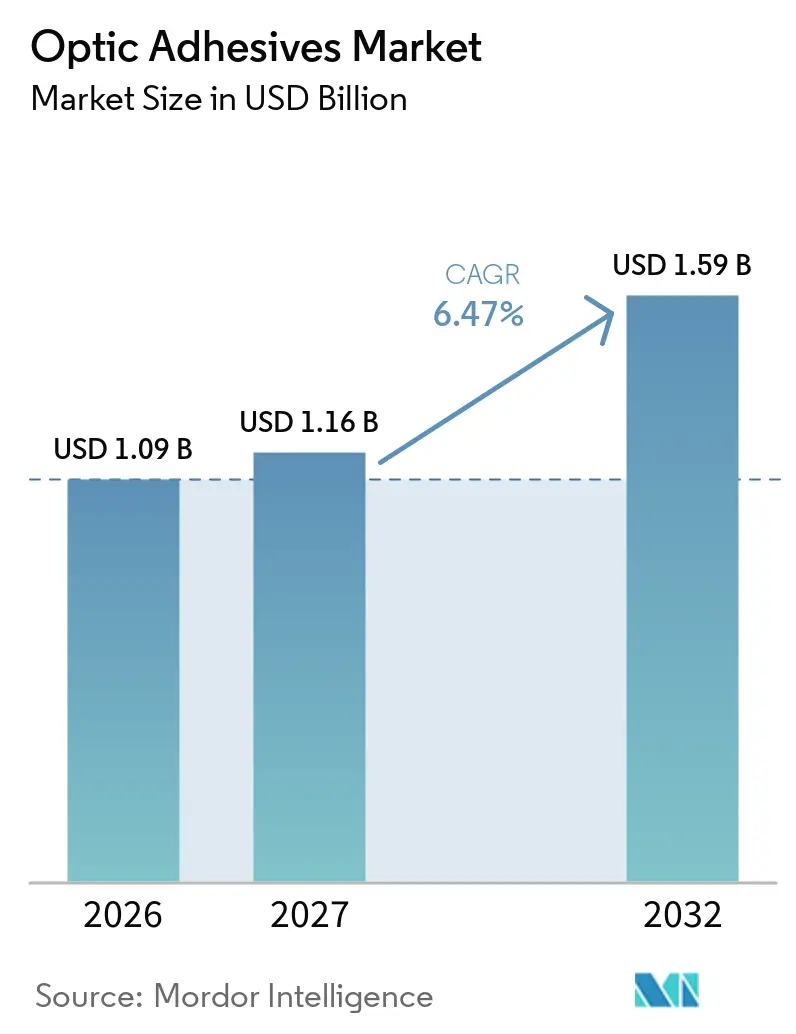
The Optic Adhesives Market size was valued at USD 1.09 billion in 2026 and is estimated to grow from USD 1.16 billion in 2027 to USD 1.59 billion by 2032, at a CAGR of 6.47% during the forecast period (2027-2032). Growth is driven by the expansion of high-speed optical networks and AI data centers, which require reliable bonding in optical assemblies. The increasing use of optics in electronics, vehicles, and telecommunications hardware is also driving demand for materials that maintain clarity and adhesion under heat and humidity. Suppliers are responding with index-matched, thermally stable, and lower-emission formulations suited to more demanding assembly processes. Competitive advantage increasingly depends on qualification data and application knowledge rather than a broad product catalog alone. Feedstock volatility and incomplete testing methods for electro-photonic packages can slow adoption, even as requirements for precision bonding increase.
Key Report Takeaways
- By resin type, cyanoacrylate held 36.12% of the Optic Adhesives Market share in 2026, while silicone is forecast to expand at a CAGR of 7.12% through 2032.
- By application, optical bonding and assembly accounted for 40.45% of the Optic Adhesives Market Share in 2026, while fiber optics is forecast to expand at a 7.34% CAGR through 2032.
- By end-user industry, electrical and electronics accounted for 39.78% of the Optic Adhesives Market Share in 2026, while telecommunications is forecast to expand at a CAGR of 7.81% through 2032.
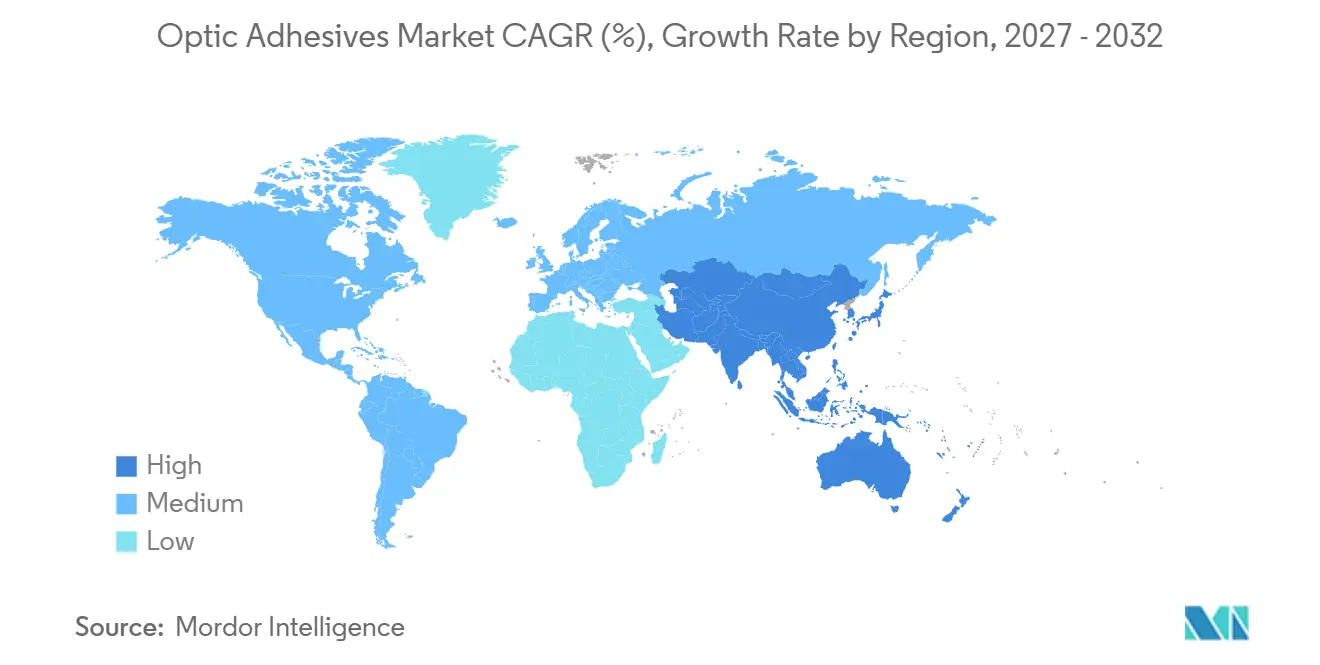
- By geography, Asia-Pacific accounted for 34.23% of the Optic Adhesives Market Share in 2026 and is forecast to expand at a 7.66% CAGR through 2032.
Note: Market numbers in this report are based on Mordor Intelligence's proprietary estimation framework, which combines nine months of actuals with Q4 projections for base year 2026.
Market Trends and Insights
Drivers Impact Analysis of Optic Adhesives Market*
| Drivers | (~) % Impact on CAGR Forecast | Geographic Relevance | Impact Timeline |
|---|---|---|---|
| Optical Communications, Data-Center Interconnects, and Co-Packaged Optics (CPO) | +2.0% | Global, with core impact in Asia-Pacific and North America | Short term (≤ 2 years) |
| Displays, Cameras, Sensors, and Smart Devices | +1.5% | Asia-Pacific core, with spillover to North America and Europe | Short term (≤ 2 years) |
| Automotive Advanced Driver-Assistance Systems (ADAS) and Head-Up Display Integration | +0.8% | North America, Europe, and Asia-Pacific | Medium term (2-4 years) |
| Miniaturized Photonics and High-Throughput Assembly | +0.6% | Asia-Pacific and North America | Medium term (2-4 years) |
| Co-Packaged Optics and AI-Data-Center Deployment | +1.0% | Global, initially concentrated in North America and APAC | Short to medium term (≤ 3 years) |
| Source: Mordor Intelligence | |||
Expansion of Optical Communications, Data-Center Interconnects, and Co-Packaged Optics
The expansion of optical communications is increasing demand for materials used in fiber arrays, photonic integrated circuits, and optical housing. Co-packaged optics places photonic and electronic integrated circuits within a single package, making adhesive selection more demanding. These assemblies require index-matching materials with refractive indices ranging from 1.42 to 1.52, stability during reflow cycles up to 260°C, and low outgassing near optical interfaces. A 2025 scientific paper identified controlled viscosity, low cure shrinkage, and resistance to UV exposure and humidity as important properties for photonic packaging adhesives. An 800G optical transceiver can require 10 to 20 separate bonding operations for fiber arrays, photonic integrated circuits, and housings. Suppliers with silicone and index-matched epoxy capabilities are better positioned than those focused on commodity formulations.
Growth of Displays, Cameras, Sensors, and Smart Devices
Camera modules are becoming more important across consumer, automotive, and industrial products. Henkel identified camera modules as a fast-growing electronics subsegment in its 2025 earnings discussion, and its portfolio covers lens bonding, active alignment, underfill, and lens barrel attachment. The company also stated that its one-step UV lens bonding technology removes a process step compared with a two-step process, reducing manufacturing CO2 emissions. Demand is shifting from display panel bonding to compact rolling-shutter and time-of-flight sensors used in smartphones, vehicles, and wearables. H.B. Fuller introduced isobornyl acrylate (IBOA)-free UV adhesives for wearable headsets and medical devices in June 2025, indicating that formulation compliance is becoming part of product selection. REACH Regulation (EC) No 1907/2006 increases scrutiny of acrylate monomers, which supports demand for compliant alternatives in the optic adhesives market.
Automotive ADAS and Head-Up Display Integration
ADAS cameras and head-up displays require adhesives that meet automotive reliability standards. Relevant tests include exposure to 85°C at 85% relative humidity for 1,000 hours, as well as thermal shock resistance down to -40°C. Dymax developed its OP-81-LS adhesive for ADAS and LiDAR applications; the product meets ASTM E595 outgassing requirements while supporting UV and LED curing[1]. Sika states that its headlamp bonding systems bond more than 70 million headlamps for over 35 million vehicles each year. Similar bonding methods are extending into head-up display combiners and in-cabin LiDAR pods. Full-windshield head-up displays with ambient-light sensors require thin optical films with a controlled refractive index and low birefringence, bringing their requirements closer to photonic packaging than to conventional structural bonding.
Miniaturized Photonics and High-Throughput Assembly
Wafer-level optics manufacturing requires materials that support sub-micron replication and fast UV curing in high-output tools. These adhesives must bond to glass and optical-grade PET, PC, and COP substrates used in new optical designs. Hoenle Adhesives presented optical resins for wafer-level optics fabrication at SPIE Photonics West 2025, including products intended to improve yellowing resistance and optical shading. The company highlighted adhesion to COP substrates, a prior technical gap in optical assembly. High-throughput assembly requires both precision and repeatable cure performance. Material qualification commonly takes 12 to 18 months, so validated materials on established imprint tools can create a lasting advantage for early suppliers.
Restraints Impact Analysis of Optic Adhesives Market*
| Restraints | (~) % Impact on CAGR Forecast | Geographic Relevance | Impact Timeline |
|---|---|---|---|
| Petrochemical Feedstock Volatility and Supply Disruption | -0.7% | Global, most acute in regions with limited upstream integration | Short term (≤ 2 years) |
| Optical Reliability, Environmental Qualification, and Test-Method Gaps | -0.5% | Global, with the highest compliance burden in North America and Europe | Medium term (2-4 years) |
| Shortage of Industry-Standard Optical-Packaging Test Methods | -0.4% | Global, specifically APAC and North America Co-Packaged Optics (CPO) supply chains | Medium term (2-4 years) |
| Source: Mordor Intelligence | |||
Petrochemical Feedstock Volatility and Supply Disruption
Cyanoacrylate, acrylic, and epoxy optical adhesives in the optical adhesives market rely on petrochemical monomers such as ethyl acrylate, bisphenol A diglycidyl ether, and cyanoacrylate derivatives. Changes in crude oil pricing and refinery disruptions can affect the availability and cost of these inputs. The effect is more pronounced for specialty formulators, as moderate batch sizes and long qualification cycles limit their ability to pass on higher input costs quickly. Registration, Evaluation, Authorization and Restriction of Chemicals (REACH) Regulation (EC) 1907/2006 and reviews of substances of very high concern can also require European producers to assess alternative monomers. Alternative inputs may not have established validation data for optical performance. Limited access to fine-chemical intermediates and pressure on specialty-chemical trade routes remain purchasing concerns for original equipment manufacturers.
Stringent Optical Reliability, Environmental Qualification, and Test-Method Gaps
Optical adhesives used in fiber connectors, photonic integrated circuits, and precision instruments must meet several reliability requirements in the optical adhesives market. These include Telcordia GR-326 for fiber hardware, ISO/TC 172 standards for optics and photonics, and customer-specific automotive or defense protocols[2]. Qualification can take 12 to 24 months before a new formulation enters production, increasing the cost and time required for adoption. The EU Restriction of Hazardous Substances (RoHS) Directive 2011/65/EU and REACH authorization can limit the availability of curing agents and photoinitiators in European electronics supply chains. Dymax, Norland Products, and H.B. Fuller identify RoHS compliance for relevant product families, underscoring the importance of maintaining qualification status. The International Electronics Manufacturing Initiative (iNEMI) is developing standardized test vehicles and characterization methods for adhesives in electromechanical packages, leaving buyers with additional qualification uncertainty.
*Our forecasts treat driver/restraint impacts as directional, not additive. The impact forecasts reflect baseline growth, mix effects, and variable interactions.
Optic Adhesives Market Segment Analysis
By Resin Type:
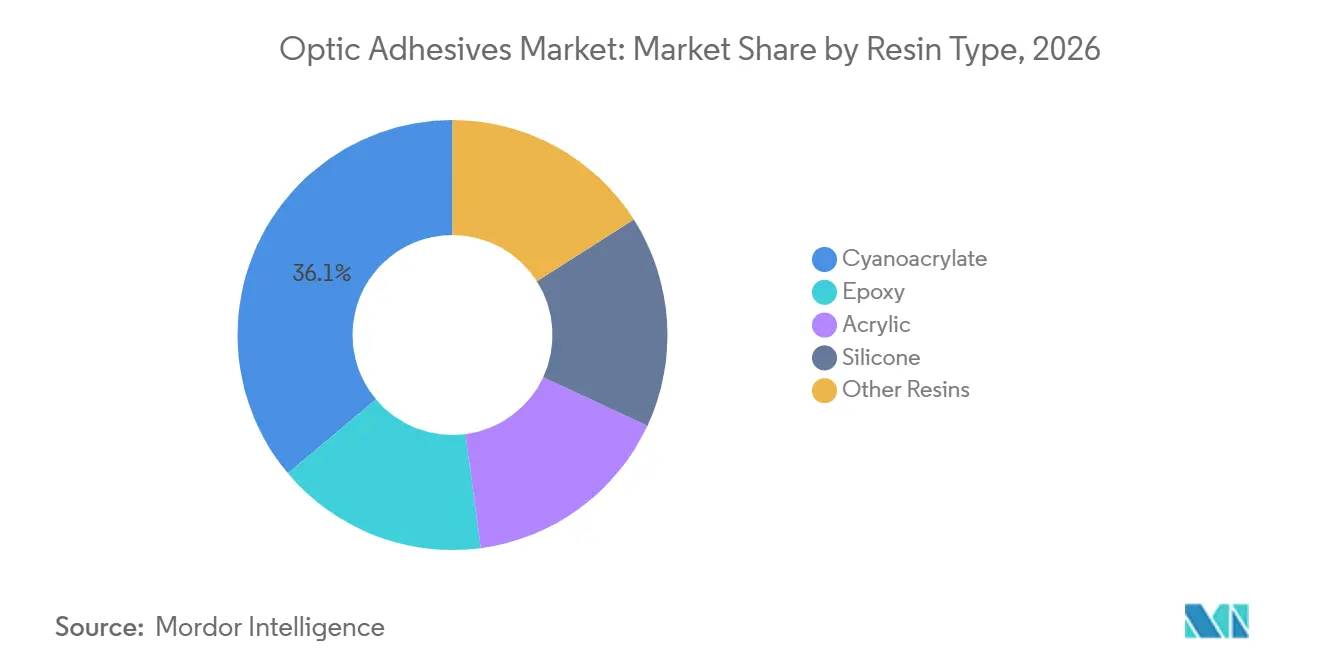
Silicone Gains Relevance in High-Temperature Optical AssembliesCyanoacrylate held 36.12% of the optic adhesives market share in 2026 because it cures quickly as a single-component material and bonds well to glass, ceramic, and metal. Its low viscosity also supports precise dispensing in compact assemblies. Acrylic and epoxy resins held the next-largest positions in the assessment. Acrylic materials serve display lamination and fiber alignment, while epoxies support precision photonic packaging where high glass-transition temperatures are needed for reflow-compatible assembly. Other materials, including enethiol-based optical adhesives, serve smaller but demanding applications. Denka's HARDLOC OP series is a UV-curing enethiol adhesive with optical properties close to glass and without oxygen-related cure inhibition, making it suitable for lens and prism bonding in camera modules.
Silicone is the fastest-growing resin type, with the optic adhesives market size for this segment projected to grow at a CAGR of 7.12% between 2027 and 2032. It tolerates thermal cycling from -50°C to above 200°C and resists UV-induced yellowing. These characteristics support its use in automotive LED headlamps, Advanced Driver Assistance Systems (ADAS) sensors, outdoor display panels, and co-packaged optics. This shift is driven by operating requirements rather than material preference alone. Per- and polyfluoroalkyl substances (PFAS)-free and low-molecular-siloxane-gas-free formulations are becoming procurement requirements in automotive and consumer electronics supply chains, favoring suppliers with advanced silicone chemistry and established product qualification.

By Application:
Fiber Optics Expands with Higher-Density Data-Center LinksOptical bonding and assembly accounted for 40.45% of revenue in 2026, supported by consumer electronics display lamination, touchscreen bonding, and industrial human-machine interface panels. These applications require optically clear materials with compatible refractive indices, low haze, and resistance to UV exposure and humidity cycling. Lens bonding cement is used for camera module cementing, microscope objective assembly, and laser collimator bonding. Norland Products' NOA 61 meets Federal Specification MIL-A-3920 and United States Pharmacopeia (USP) Class VI biocompatibility requirements, supporting its use in military and commercial precision optics. These applications remain important to the optic adhesives market because assembly quality directly affects optical clarity and alignment, and they create demand for materials with stable performance across varied substrates and geometries.
Fiber optics is the fastest-growing application, with the optic adhesives market size for this segment forecast to grow at a CAGR of 7.34% through 2032. AI data centers and 5G fronthaul networks require more bonded fiber arrays, V-groove fixtures, and index-matching joints than conventional transceiver designs. Namics provides adhesive systems for index matching, fiber fixing, fiber-array attachment, and strain relief in silicon photonics applications. The company states that these systems are PFAS-free and reflow-resistant to 260°C. The transition to 400G and 800G platforms increases fiber counts per port, raising adhesive consumption per assembly rather than solely with the number of installed transceivers.
By End-User Industry:
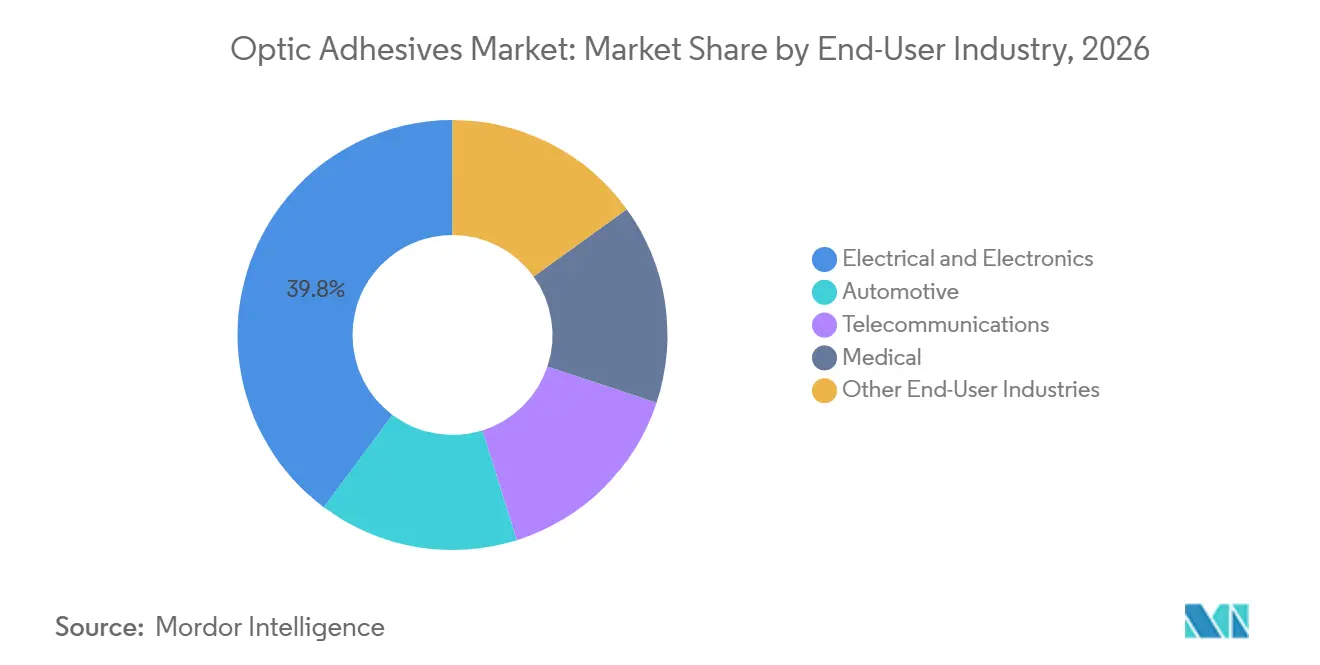
Telecommunications Leads Growth as Fiber Deployment ContinuesElectrical and electronics accounted for 39.78% of revenue in 2026, driven by high quantities of camera modules, display panels, optical sensors, and printed circuit board assemblies. This segment requires bonding materials that can be dispensed accurately at production scale. Automotive was the next-largest end-user segment, supported by headlamp bonding, ADAS camera modules, and head-up display combiners. Sika's automotive bonding systems serve more than 35 million vehicles annually. Medical applications are smaller but more technically demanding, as endoscopes, ophthalmic instruments, and wearable health sensors require ISO 10993 biocompatibility testing. H.B. Fuller's electronics materials catalog identifies solutions for medical and wearable electronics applications.
Telecommunications is the fastest-growing end-user segment, projected to grow at a CAGR of 7.81% from 2027 to 2032. Fiber-to-the-home and fiber-to-the-building projects across Asia-Pacific, Europe, and North America are increasing demand for reliable optical assemblies in the optical adhesives market. AI data center links are also raising requirements for fiber attachment and precise optical alignment. Outdoor transceiver assemblies at 5G cell sites require materials with strong humidity and UV resistance per Telcordia GR-326. Isobornyl Acrylate (IBOA)-free and PFAS-free materials are becoming relevant in telecommunications procurement as chemical restrictions receive greater attention, driven by buyer policies and anticipated Registration, Evaluation, Authorization and Restriction of Chemicals (REACH) compliance requirements.
Geography Analysis
Asia-Pacific
Asia-Pacific held a 34.23% revenue share in 2026 and is forecast to grow at a CAGR of 7.66% through 2032. The region has a concentrated base of smartphone, display panel, optical transceiver, and fiber cable manufacturing that supports the optic adhesives market. China's fiber broadband expansion and semiconductor self-sufficiency programs drive demand from telecommunications and electronics applications. Japan remains an important source of optical adhesive chemistry through Shin-Etsu Chemical, Nitto Denko, and Denka, which supply silicone encapsulants, optical clear adhesive films, and UV-curing thiol-ene materials. Nitto Denko received recognition for its LUCIACS transparent adhesive sheet for automotive displays under its fiscal 2025 ESG framework. In February 2025, Henkel opened an Application Engineering Center in Chennai with five specialized laboratories for electronics adhesive development. This investment places development work closer to regional customers and may reduce qualification time.
North America
North America is a key qualification base for co-packaged optics and defense precision optics in the optic adhesives market. Regional hyperscale data center operators are early adopters of index-matching and fiber attachment materials for co-packaged optics, which creates an advantage for local formulators with validated materials. In September 2025, SENKO and GlobalFoundries announced a wafer-level detachable fiber interface for co-packaged optics. The system used optical bonding to attach a SEAT receptacle to photonic integrated circuit die surfaces at GlobalFoundries' New York facilities. Norland Products' NOA 61 remains relevant in military and aerospace optical assemblies due to its compliance with MIL-A-3920 requirements. The U.S. Environmental Protection Agency issued Significant New Use Rules for certain chemical substances in July and November 2025, adding regulatory monitoring requirements for new adhesive chemistries. Suppliers therefore need to combine technical qualification with ongoing Toxic Substances Control Act (TSCA) compliance review.
Europe, South America, and Middle East and Africa
Europe's optic adhesives market is shaped by REACH and RoHS requirements and by its automotive, display, and precision optics production base. These compliance requirements can restrict the use of certain acrylate monomers, photoinitiators, and hazardous substances in adhesive formulations. DELO presented dual-cure adhesive solutions for laser system assembly at the China International Optoelectronic Exposition (CIOE) 2025 in Shenzhen, demonstrating that European specialists are competing in Asian equipment supply chains. South America remains a smaller market, with Brazil supporting consumer electronics assembly and industrial automation demand. Growth in the region is limited by reliance on imported specialty raw materials and a smaller optical manufacturing base. The Middle East and Africa present an emerging opportunity as 5G deployment advances in Saudi Arabia and South Africa, where aerial and underground fiber installation supports demand for termination and connector materials. However, import lead times and limited local technical support continue to slow qualification in these markets.
Competitive Landscape
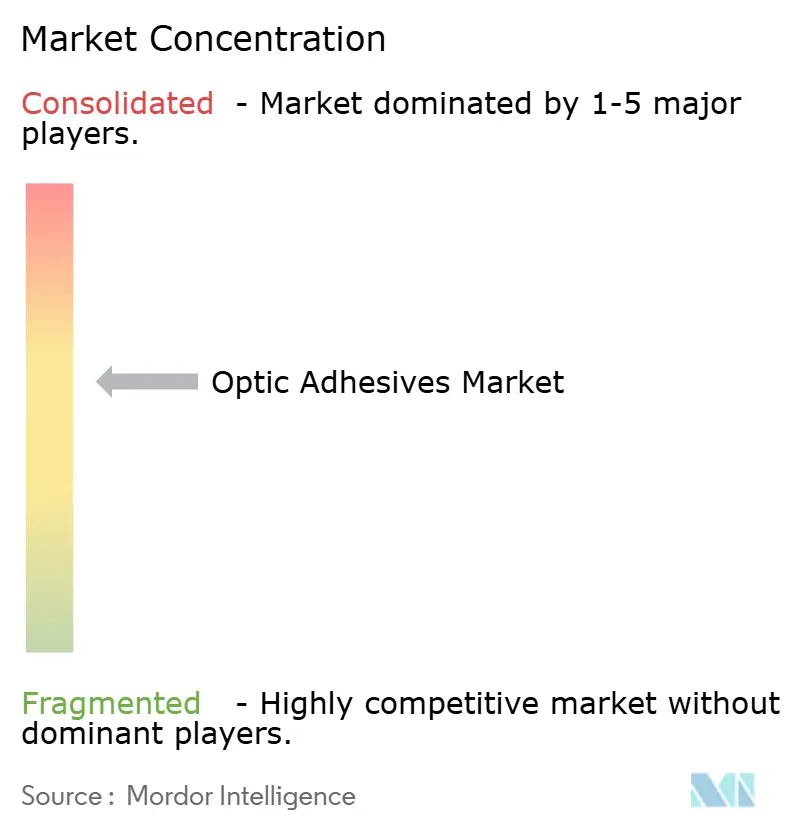
The optic adhesives market is moderately consolidated, with large specialty chemical suppliers active across several resin types and applications. Henkel reported EUR 2.7 billion (~USD 3.01 billion) in Adhesive Technologies sales for Q3 2025, and its Loctite ECCOBOND LUX portfolio addresses optical transceiver and fiber-optic assembly. 3M provides more than 120 optically clear adhesive formulations for display applications. Dow focuses on silicone materials for advanced semiconductor interconnects and co-packaged optics. Shin-Etsu Chemical supplies silicone materials for LED packaging. These companies compete with regional and specialized suppliers that hold focused qualification positions.
Competitive outcomes increasingly depend on how quickly suppliers can deliver reliable results in co-packaged optics, AR and VR waveguide bonding, and automotive LiDAR. ISO/TC 172 standards and customer-specific photonic test protocols reinforce the value of early qualification work. DELO has worked with EV Group on transparent polymer systems for wafer-level optics and nanoimprint lithography, where application-specific validation is important. This provides a route for specialists to compete against larger adhesive platforms. Dymax and Norland Products maintain detailed technical documentation and approvals for demanding optical applications. Norland's NOA 61 holds MIL-A-3920 and United States Pharmacopeia (USP) Class VI credentials, which are relevant to defense and precision applications.
Henkel expanded its regional electronics development capacity with the February 2025 opening of its Chennai engineering center, placing five laboratories near Asian electronics customers. In September 2025, SENKO and GlobalFoundries demonstrated optical bonding at the wafer level for a detachable fiber interface for co-packaged optics. DELO's laser-assembly solutions presented in 2025 reflect continued specialization in application-matched bonding. White space remains in PFAS-free and low-siloxane-gas silicone materials for co-packaged optics and precision photonics. Suppliers entering this area need to meet both optical performance requirements and environmental compliance standards in Asia-Pacific and Europe. As a result, differentiation remains possible in this market despite the broad capabilities of major suppliers.
Optic Adhesives Industry Leaders
-
Henkel AG & Co. KGaA
-
DELO Industrial Adhesives
-
Dymax
-
3M
-
H.B. Fuller Company
- *Disclaimer: Major Players sorted in no particular order
Optic Adhesives Market Companies Covered in this Report
- 3M
- DELO Industrial Adhesives
- Denka Company Limited
- DIC Corporation
- Dow
- Dymax
- H.B. Fuller Company
- Henkel AG & Co. KGaA
- Master Bond
- Momentive
- Nitto Denko Corporation
- NORLAND PRODUCTS INCORPORATED
- Panacol-Elosol GmbH
- Permabond
- Shin-Etsu Chemical Co., Ltd.
- Sika AG
Recent Industry Developments in Optic Adhesives Market
- September 2025: SENKO Advanced Components and GlobalFoundries announced a wafer-level detachable fiber connector system for co-packaged optics. The system used precision optical adhesive bonding to attach a SEAT receptacle directly onto photonic integrated circuit (PIC) die surfaces at GlobalFoundries' New York fabs. It enabled repeatable passive alignment in high-radix CPO switch architectures, validating the use of commercial-scale precision optical adhesive in silicon photonics manufacturing.
- September 2025: Panacol-Elosol GmbH was renamed Hoenle Adhesives GmbH as Hoenle Group unified all subsidiaries under a single corporate brand. The renamed entity retained full optical adhesive manufacturing operations at its Steinbach/Taunus site in Germany and continued to produce the Vitralit UV, structural, and conductive adhesive lines for optical bonding applications.
Global Optic Adhesives Market Report Scope
Optical adhesive is a specialized bonding material used to join optical components or display layers while maintaining high light transmission, refractive index control, and mechanical stability. These adhesives are formulated to minimize optical losses such as reflection, scattering, and absorption at the interface between bonded surfaces. They are widely used in applications including displays, cameras, lenses, and medical imaging devices, where optical clarity and precision are critical.
The optic adhesives market is segmented by resin type, application, end-user industry, and geography. By resin type, the market is segmented into epoxy, acrylic, cyanoacrylate, silicone, and other resins. By application, the market is segmented into optical bonding and assembly, lens bonding cement, fiber optics, and other applications. By end-user industry, the market is segmented into electrical and electronics, automotive, telecommunications, medical, and other end-user industries. The report also covers market sizes and forecasts for optic adhesives across 15 countries in major regions. The market sizes and forecasts are provided in terms of value (USD).
Segmentation Overview
| Epoxy |
| Acrylic |
| Cyanoacrylate |
| Silicone |
| Other Resins |
| Optical Bonding and Assembly |
| Lens Bonding Cement |
| Fiber Optics |
| Other Applications |
| Electrical and Electronics |
| Automotive |
| Telecommunications |
| Medical |
| Other End-User Industries |
| Asia-Pacific | China |
| India | |
| Japan | |
| South Korea | |
| ASEAN Countries | |
| Rest of Asia-Pacific | |
| North America | United States |
| Canada | |
| Mexico | |
| Europe | Germany |
| United Kingdom | |
| France | |
| Italy | |
| NORDIC Countries | |
| Rest of Europe | |
| South America | Brazil |
| Argentina | |
| Rest of South America | |
| Middle East and Africa | Saudi Arabia |
| South Africa | |
| Rest of Middle East and Africa |
| By Resin Type | Epoxy | |
| Acrylic | ||
| Cyanoacrylate | ||
| Silicone | ||
| Other Resins | ||
| By Application | Optical Bonding and Assembly | |
| Lens Bonding Cement | ||
| Fiber Optics | ||
| Other Applications | ||
| By End-User Industry | Electrical and Electronics | |
| Automotive | ||
| Telecommunications | ||
| Medical | ||
| Other End-User Industries | ||
| By Geography | Asia-Pacific | China |
| India | ||
| Japan | ||
| South Korea | ||
| ASEAN Countries | ||
| Rest of Asia-Pacific | ||
| North America | United States | |
| Canada | ||
| Mexico | ||
| Europe | Germany | |
| United Kingdom | ||
| France | ||
| Italy | ||
| NORDIC Countries | ||
| Rest of Europe | ||
| South America | Brazil | |
| Argentina | ||
| Rest of South America | ||
| Middle East and Africa | Saudi Arabia | |
| South Africa | ||
| Rest of Middle East and Africa | ||
Key Questions Answered in the Report
What is current market size of Optic Adhesives Market?
The Optic Adhesives Market size was valued at USD 1.09 billion in 2026 and is estimated to grow from USD 1.16 billion in 2027 to USD 1.59 billion by 2032, at a CAGR of 6.47% during the forecast period (2027-2032).
Which application is growing fastest for optic adhesives?
Fiber optics are projected to grow at a 7.34% CAGR through 2032 as data centers and 5G networks need higher-density optical links.
Which end-user segment is expanding fastest?
Telecommunications is forecast to grow at a 7.81% CAGR through 2032, supported by fiber deployment and AI data center interconnects.
Which region leads demand for optic adhesives?
Asia-Pacific holds a 34.23% share in 2026 and is expected to grow at a 7.66% CAGR through 2032.