
Open RAN System Integrator Market Size and Share
Market Overview
| Study Period | 2020 - 2031 |
|---|---|
| Market Size (2026) | USD 2.06 Billion |
| Market Size (2031) | USD 7.18 Billion |
| Growth Rate (2026 - 2031) | 28.37 % |
| Fastest Growing Market | Africa |
| Largest Market | North America |
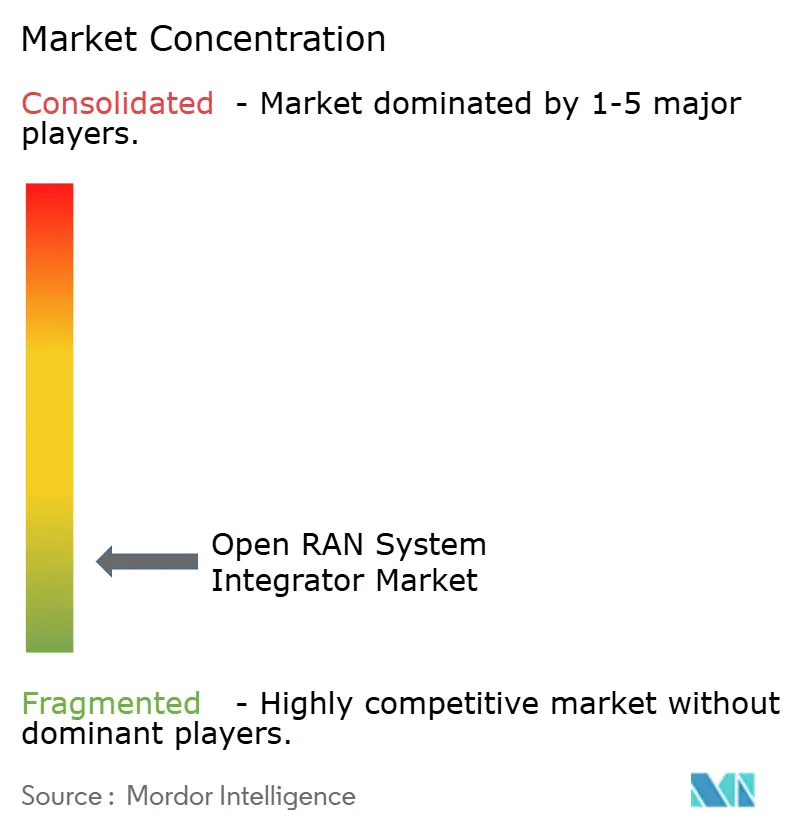
| Market Concentration | Low |
Major Players *Disclaimer: Major Players sorted in no particular order Image © Mordor Intelligence. Reuse requires attribution under CC BY 4.0. | |
Open RAN System Integrator Market Analysis by Mordor Intelligence
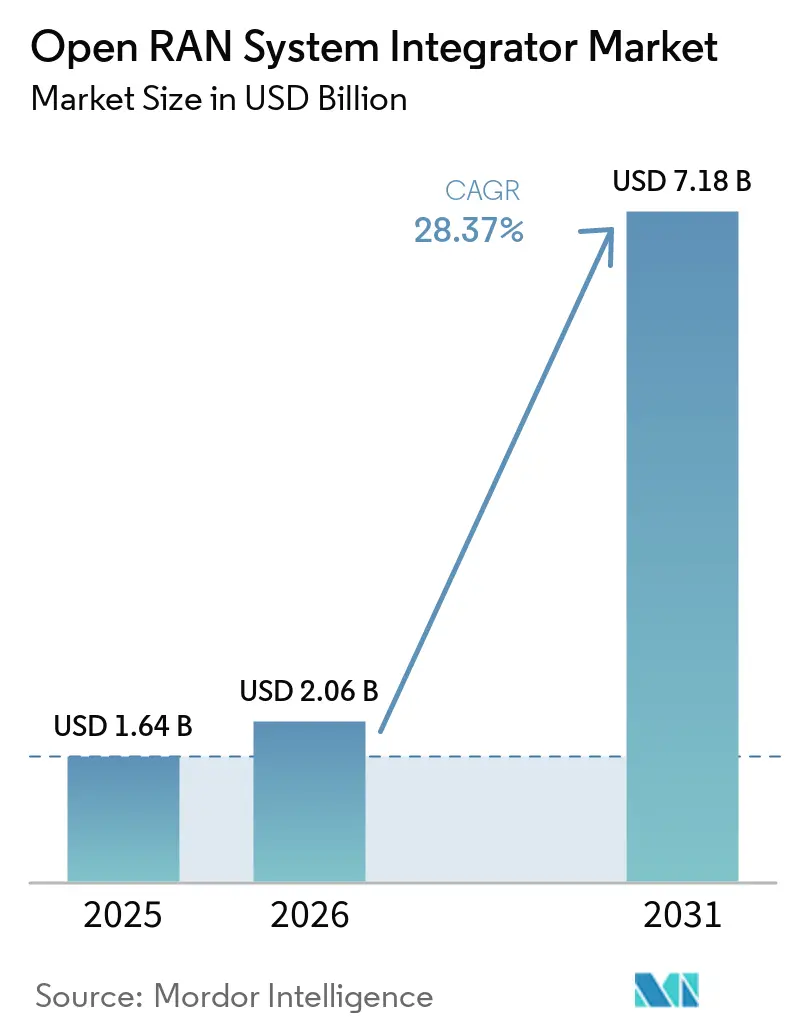
The Open RAN System Integrator Market size is projected to be USD 1.64 billion in 2025, USD 2.06 billion in 2026, and reach USD 7.18 billion by 2031, growing at a CAGR of 28.37% from 2026 to 2031. The Open RAN system integrator market is moving from pilots toward commercial 5G standalone networks, where operators must coordinate radio, cloud, timing, and orchestration systems from several suppliers. This change shifts work from equipment supply toward integration, validation, testing, and managed operations. Government programs, testing standards, and pre-validated solution stacks are reducing some procurement risk while making documented interoperability more important. The Open RAN system integrator market also faces longer deployment cycles, unclear accountability across suppliers, and a shortage of engineers with both RAN and cloud skills.
Key Report Takeaways
- By component, services held 68.91% of the Open RAN system integrator market share in 2025, while software is projected to expand at a CAGR of 30.46% through 2031.
- By network generation, 5G accounted for 78.26% of revenue in 2025 and is projected to record a CAGR of 31.63% through 2031.
- By deployment, public macrocell deployments held 58.13% of revenue in 2025, while private and enterprise networks are projected to grow at a CAGR of 30.76% through 2031.
- By end user, mobile network operators held 62.41% of revenue in 2025, while enterprises and industry verticals are projected to expand at a CAGR of 29.65% through 2031.
- By geography, North America held 41.03% market share in the Open RAN system integrator market in 2025, while Africa is projected to expand at a 31.28% CAGR through 2031.
Note: Market size and forecast figures in this report are generated using Mordor Intelligence’s proprietary estimation framework, updated with the latest available data and insights as of January 2026.
Global Open RAN System Integrator Market Trends and Insights
Drivers Impact Analysis*
| Driver | (~) % Impact on CAGR Forecast | Geographic Relevance | Impact Timeline |
|---|---|---|---|
| 5G Standalone and Cloud-Native RAN Rollouts | +7.5% | Global, with highest intensity in North America, Japan, and South Korea | Short term (≤ 2 years) |
| Multi-Vendor Interoperability Requirements | +5.8% | Global, particularly North America and Europe | Medium term (2-4 years) |
| Government Funding for Open and Secure Telecom Supply Chains | +4.2% | North America and Europe, with spillover to Asia-Pacific | Short term (≤ 2 years) |
| Operator Demand for Vendor-Independent SMO and Automation | +3.1% | Global, with early gains in North America and Japan | Medium term (2-4 years) |
| Private 5G and Neutral-Host Network Expansion | +2.5% | Asia-Pacific, with spillover to Europe and North America | Medium term (2-4 years) |
| Open RAN Lab-to-Field Validation as a Procurement Gate | +1.8% | North America and Europe | Short term (≤ 2 years) |
| Source: Mordor Intelligence | |||
5G Standalone and Cloud-Native RAN Rollouts
5G standalone architecture is creating the main commercial setting for the Open RAN system integrator market. It allows operators to separate the centralized, distributed, and radio units using cloud-native orchestration. Integration, therefore, extends beyond radio commissioning to fronthaul timing, O-Cloud lifecycle management, and automated network slice configuration. These tasks are harder to manage through closed, single-vendor tools. The 5G segment held 78.26% of 2025 revenue and is projected to grow at 31.63% through 2031. Rakuten Mobile operates a fully virtualized, cloud-native Open RAN network in Japan, showing that the approach can support national-scale deployment.
Multi-Vendor Interoperability Requirements
Multi-vendor interoperability is now a practical requirement before operators make commercial purchasing decisions in the Open RAN system integrator market. The O-RAN Alliance released 60 new or updated technical documents between March and August 2025, increasing the number of current-version titles to 134.[1]O-RAN Alliance, “60 New or Updated O-RAN Technical Documents Released Since March 2025,” O-RAN Alliance, o-ran.org. These documents cover conformance areas for the O-RU, O-DU, and Near-RT RIC. ATIS expanded its Open RAN Minimum Viable Profile in February 2025 to include fronthaul control, user, synchronization, and management-plane interface requirements. Integrators that can provide pre-validated combinations can reduce operator testing work and take on more delivery responsibility. The Open Testing and Integration Centre framework is becoming relevant in procurement because it provides a formal route for component and interoperability validation.
Government Funding for Open and Secure Telecom Supply Chains
Public programs are shaping demand in the Open RAN system integrator market by supporting testing, product development, and early deployments. The U.S. Public Wireless Supply Chain Innovation Fund had obligated USD 550 million across 35 projects by mid-2025. In 2026, NTIA is seeking feedback on a funding direction of up to USD 53 million for AI-native RAN architecture. The UK Open Networks Research and Development Fund totaled GBP 250 million (USD 317 million) at the 2024 average rate, as stated in the source material. The SONIC Labs program was completed in April 2026, and 72% of participating vendors had secured commercial partnerships, while 85% had begun developing new Open RAN products. Supply chain security requirements in Europe also favor projects that can demonstrate vendor diversity and integration controls.
Operator Demand for Vendor-Independent SMO and Automation
Operators are seeking vendor-independent service management and orchestration platforms to avoid lock-in at the control layer. This creates work for the Open RAN system integrator market, as production deployment requires integration between standards-based software and live network processes. Nokia licensed RAN Intelligent Controller technology from HPE in October 2025 and combined it with MantaRay SMO to support Level 4 autonomous networking. The arrangement strengthens the role of automation, rApps, and non-real-time RIC capabilities in operator network plans. An IEEE Vehicular Technology Magazine article published in December 2025 described O-RAN SMO frameworks as a foundation for AI-native management and orchestration on the path to 6G. Integrators that can connect telemetry, policy controls, and lifecycle management can provide a broader range of services than conventional radio deployment alone.
Restraints Impact Analysis*
| Restraint | (~) % Impact on CAGR Forecast | Geographic Relevance | Impact Timeline |
|---|---|---|---|
| Integration Complexity and Extended Deployment Timelines | -3.8% | Global, with highest friction in Asia-Pacific outside Japan and South America | Medium term (2-4 years) |
| Shortage of Carrier-Grade Open RAN Integration Skills | -2.4% | Global, most acute in Africa, South America, and parts of Europe | Long term (≥ 4 years) |
| Uneven Multi-Vendor Performance and Accountability Boundaries | -1.6% | Global, particularly in greenfield multi-vendor deployments | Medium term (2-4 years) |
| Fragmented Commercial Support and Certification Responsibilities | -1.2% | Global, with higher severity in markets without OTIC facilities | Long term (≥ 4 years) |
| Source: Mordor Intelligence | |||
Integration Complexity and Extended Deployment Timelines
Integration complexity is a material constraint on the Open RAN system integrator market. Multi-vendor systems must coordinate the open fronthaul link between the O-RU and O-DU, the F1 and E1 interfaces, and the O2 cloud infrastructure interface. Each interface can introduce a failure mode that is not present in a single-vendor RAN. NTIA's Institute for Telecommunication Sciences integrated 3 commercial Open RAN systems into its CRAIN Laboratory in 2025 and reported interoperability issues involving timer configuration, message handling, and standards-version mismatches. The source material noted that projects can face 10% to 20% higher 5-year costs after integration and support overhead. When operators have strong internal technical teams, they may retain more integration work, while unclear supplier accountability can further delay deployment.
Shortage of Carrier-Grade Open RAN Integration Skills
The limited supply of carrier-grade engineers is another constraint for the Open RAN system integrator market. Effective delivery combines knowledge of 3GPP protocols, cloud-native operations skills, and familiarity with O-RAN Alliance specifications. This combination takes time to build and is not available evenly across regions. The constraint is particularly relevant in Africa and South America, where growth prospects are strong but local carrier-grade RAN talent is limited. Integrators that cannot staff projects at scale can face delivery risk or lose work to larger service firms that can fund training. The shortage may also concentrate contracts among better-resourced firms, even where smaller specialists have strong technical capabilities.
*Our forecasts treat driver/restraint impacts as directional, not additive. The impact forecasts reflect baseline growth, mix effects, and variable interactions.
Segment Analysis
By Component: Services Support Current Revenue While Software Expands Future Value
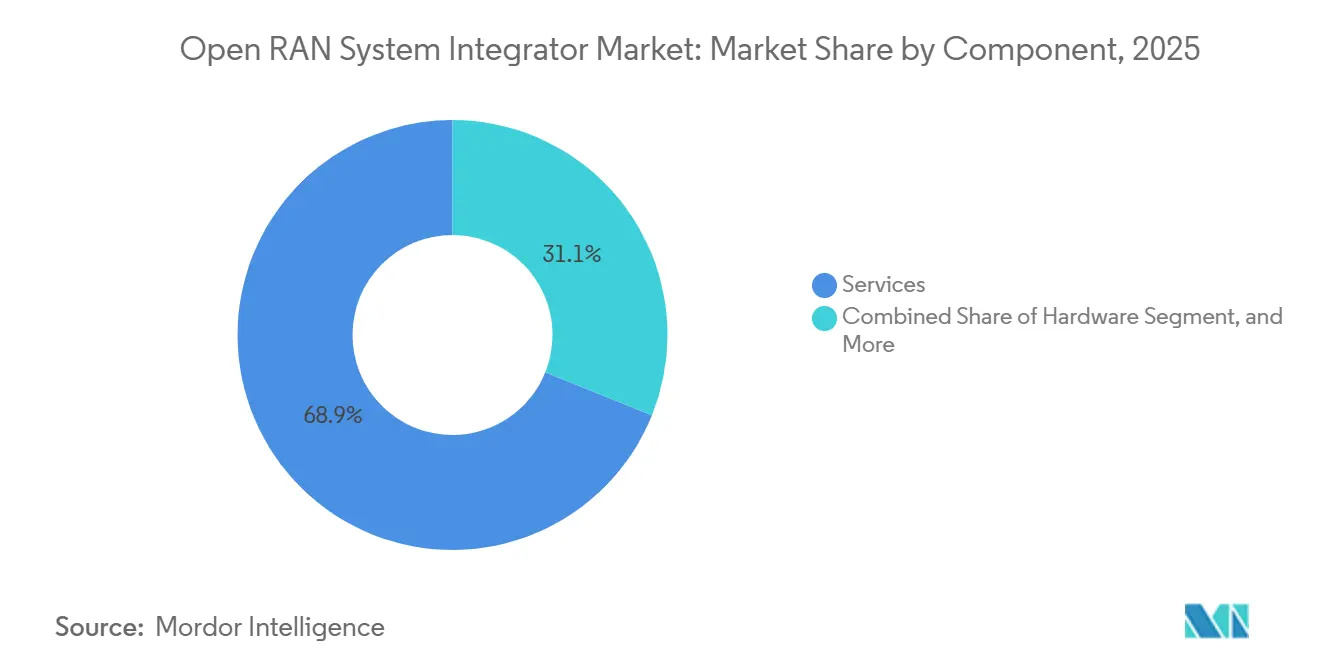
Services accounted for 68.91% of 2025 revenue, giving them the largest position in the Open RAN system integrator market. Multi-vendor networks require integration, testing, optimization, and managed operations across the full project lifecycle. Digital Catapult reported that 70% to 80% of activity at its Spring 2026 Plugfest related to multi-vendor integration and validation before formal testing began. This workload supports extended service engagements rather than a short commissioning phase. Hardware is under pressure as cloud-native designs place more RAN workloads on commercial off-the-shelf server infrastructure. Integrators are therefore likely to place more emphasis on hardware-agnostic automation and lifecycle services.
Software is projected to grow at a CAGR of 30.46% through 2031, the fastest rate within the component structure. AI-native SMO platforms, Near-RT RIC xApps, and rApp libraries require specialized integration before they can operate in commercial networks. Software has a smaller current revenue base than services, but it can support recurring license revenue when platforms are deployed at scale. This is encouraging integrators to develop proprietary automation libraries rather than solely deploying third-party tools. The O-RAN Software Community released its L version in July 2025 with an integrated blueprint for non-real-time RIC and SMO deployment. The release lowered entry barriers for firms building software-layer capabilities in the Open RAN system integrator industry.



By Network Generation: 5G Leads Volume While Multi-Generation Work Adds Contract Scope
5G represented 78.26% of 2025 revenue and accounted for the leading position in the Open RAN system integrator market. Standalone 5G requires coordinated work across the O-RU, O-DU, O-CU, Near-RT RIC, SMO, and O-Cloud. Each layer needs testing, certification, and lifecycle management. Rakuten Mobile recently announced plans to deploy a large number of advanced massive MIMO O-RAN radios in Japan. The deployment aims to improve throughput in high-density urban areas. Such multi-node deployments require systems integration at each stage of rollout.
The LTE segment remains relevant for brownfield overlay projects, especially in emerging markets with large LTE subscriber bases. Other network generations account for a smaller share and are associated with legacy overlay use cases in sub-Saharan Africa and parts of South America. Work that combines LTE and next-generation standalone systems can have a greater contract scope than a single-generation project. Mavenir and Parallel Wireless recently completed interoperability testing for a multi-generation GreenRAN stack with Mavenir's Converged Packet Core.
By Deployment: Public Macrocells Lead Revenue While Private Networks Gain Weight
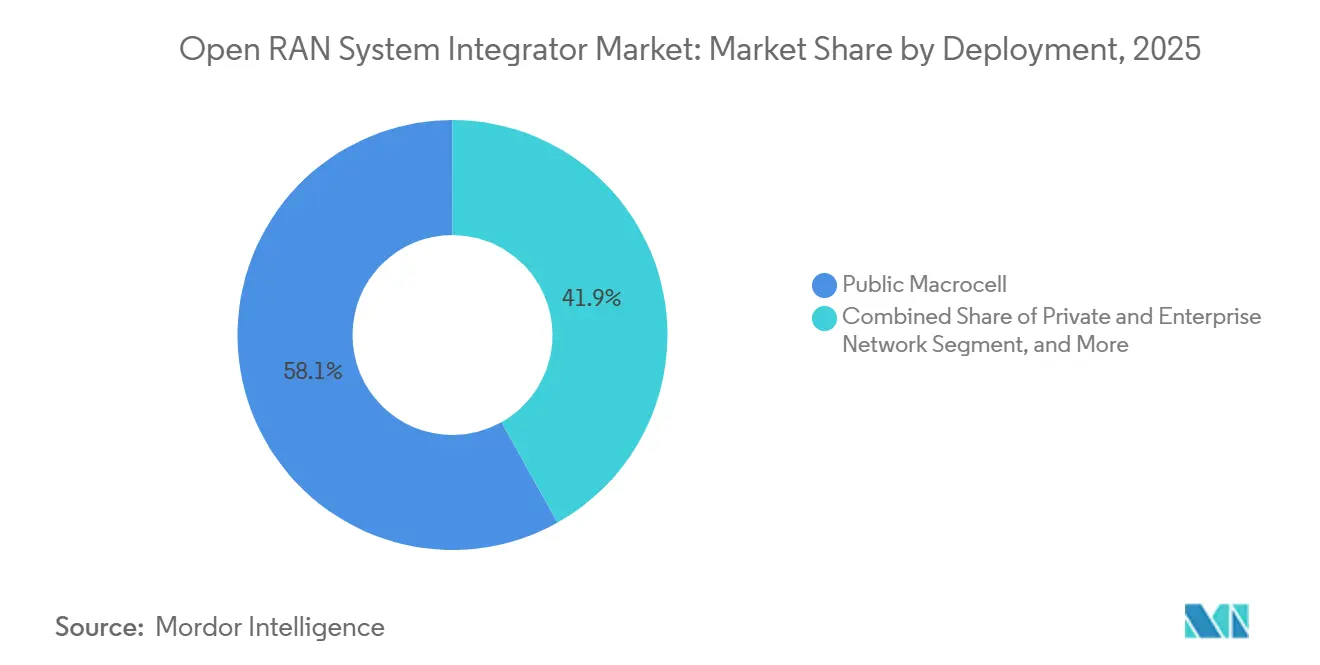
Public macrocell deployments held 58.13% of 2025 revenue, the largest deployment share in the Open RAN system integrator market. Large operator networks require integration across many sites and retain the highest deployment volume. Private and enterprise networks are projected to grow at a CAGR of 30.76% through 2031. Enterprise customers often require end-to-end support, from site survey and design through commissioning and optimization. In August 2025, Boldyn Networks launched the UK's first Open RAN neutral-host 5G system at Sunderland's Stadium of Light using Airspan and Mavenir hardware. The project showed how a shared network can serve multiple operators on an open infrastructure footprint.
The UK SNPN 5G Assured Integration program provides a certified assurance framework for private-network components. This raises the delivery standard for firms serving private networks. Indoor small cells and distributed antenna systems serve stadiums, airports, and enterprise campuses where dense coverage is needed. Mavenir was selected by MagtiCom in May 2026 for a nationwide 4G and 5G small-cell project in Georgia, covering residential, enterprise, and rural settings.[2]Mavenir, “MagtiCom Selects Mavenir for Next-Generation Small Cell Technology Roll-Out Across Georgia,” Mavenir, mavenir.com. The contract includes hardware, software, management, and orchestration.
By End User: MNOs Lead Volume While Enterprises Broaden Demand
Mobile network operators accounted for 62.41% of 2025 revenue, representing the leading end-user position in the Open RAN system integrator market. They manage the largest capital programs and must commission complex macrocell networks across extensive site footprints. TELUS had passed the halfway point of its radio network replacement with Open RAN by 2025, with completion targeted by end-2027 and all sites expected to convert by 2029. Neutral-host providers also create complex work because they must coordinate multiple operators and vendors in a shared infrastructure model. This can create more demanding engagements than a standard single-operator greenfield project. RAN and fiber-sharing agreements in Uganda and Nigeria illustrate how shared-network models can broaden the scope for third-party integration in the Open RAN system integrator market.
Enterprises and industry verticals are projected to grow at a CAGR of 29.65% through 2031, making them the fastest-growing end-user category. Demand extends to defense and government users who need security-certified stacks, air-gapped deployment, and supply chain documentation. The U.S. Department of Defense sought open-source software for 5G and 6G tactical networks in April 2025. These requirements can limit the number of qualified suppliers while increasing the value of specialist integration work. Korea's National Intelligence and Information Agency announced parallel domestic and overseas Open RAN demonstrations in 2025 using LG Electronics software-based O-DU equipment and domestic O-RU vendors. This adds government-led demand for integration services across Asia-Pacific.
Geography Analysis
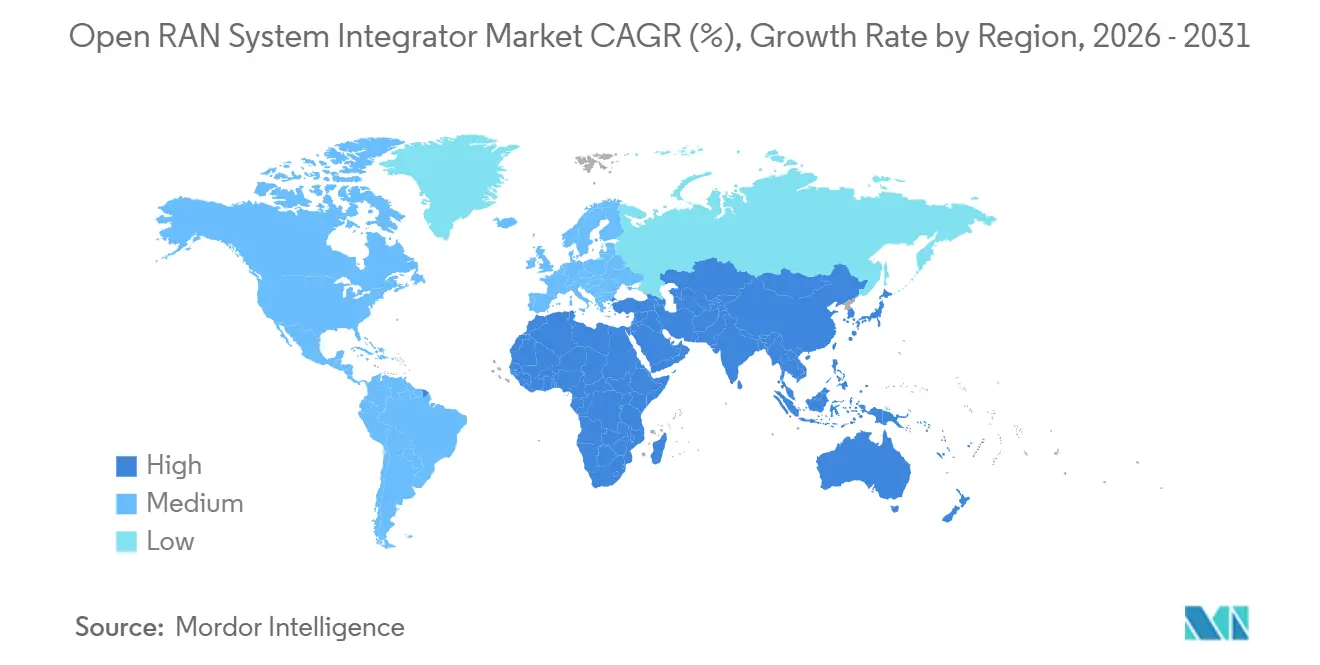
North America accounted for 41.03% of global revenue in 2025, the largest share among Open RAN system integrators. The region has an active policy and standards environment shaped by the U.S. Public Wireless Supply Chain Innovation Fund and ATIS Minimum Viable Profile requirements. ATIS expanded its profile in 2025 to define fronthaul interface requirements for North American MNOs. AT&T's brownfield, non-real-time RIC deployment and TELUS's national radio transition represent opportunities for software automation and network replacement. NTIA is seeking feedback in 2026 on a direction of up to USD 53 million for AI-native RAN architecture. Mexico's 5G spectrum rollout and Canada's transition to 5G provide additional regional pipeline opportunities.
Europe has a commercial ecosystem of validated suppliers, while Asia-Pacific remains central to the Open RAN system integrator market, with Japan as a leading example. The SONIC Labs program ended in April 2026, with 72% of 27 participating vendors securing commercial partnerships and 85% initiating new product development.[3]Digital Catapult, “SONIC Labs End of Programme Impact Report 2026,” Digital Catapult, digicatapult.org.uk. Germany, the UK, and France are active European locations for operator trials. Rakuten Mobile continues to operate a virtualized cloud-native Open RAN network and expanded capacity in Japan during 2026. Rakuten Symphony is running a JPY 8 billion (USD 50.2 million), METI-backed trial across 7 Global South countries from May 2026 to March 2029. India remains a long-term opportunity because no operator circle has committed to Open RAN at scale.
Africa is projected to grow at a CAGR of 31.28% through 2031, the fastest rate among geographic areas. Infrastructure cost pressure, RAN-sharing agreements, and international funding support the Open RAN system integrator market in the region. MTN Group and Airtel Africa formalized RAN and fiber-sharing agreements in Uganda and Nigeria in March 2025, with expansion considered for Congo-Brazzaville, Rwanda, and Zambia. Telkom Kenya, Rakuten Symphony, and Airspan Networks signed a January 2025 memorandum for an Open RAN laboratory and field trials, backed by a USD 4.4 million U.S. and Japanese government grant. South America is supported by Brazil's 5G standalone activity and trial locations in Bolivia and Paraguay. The Middle East has early activity through Zain Kuwait's pilot with Rakuten Symphony.

Competitive Landscape
The Open RAN system integrator market is fragmented because no provider has a dominant position across service types, deployment settings, and regions. Mavenir, Parallel Wireless, Radisys, ASOCS, JMA Wireless, and Amarisoft compete in cloud-native, multi-vendor assignments. Cisco and Dell Technologies use broader telecom transformation portfolios to compete for integration work. Dell Technologies launched its Open Telecom Transformation Program and AI for Telecom Certification Program in February 2025.[4]Dell Technologies, “Dell Technologies Accelerates Telecom Transformation with Comprehensive Program, Expanded Partnerships,” Dell Technologies, dell.com. The programs emphasize pre-validated stacks on commercial off-the-shelf infrastructure. Ericsson also validated its Service Orchestration and Assurance platform on Dell Telecom Infrastructure Blocks during 2025, supporting more ready-to-use reference architectures.
Rakuten Symphony introduced its Real Open RAN Licensing Program in February 2025 with Cisco, Airspan, and Tech Mahindra as inaugural partners. The program lets partners commercialize pre-qualified carrier-grade stacks and can shorten time to market. AI-RAN specialists such as DeepSig, Rimedo Labs, and Cohere Technologies are positioning their software as automation layers within broader integration stacks. Neutral-host deployments remain an open area of inquiry because no integrator has established a repeatable, multi-operator model at scale. Digital Catapult reported that 70% to 80% of Spring 2026 Plugfest preparation related to multi-vendor validation. Providers with testing capability and validated component combinations can therefore reduce on-site discovery work.
Regional suppliers with government backing can compete effectively in Africa and South Korea, where local partnerships and domestic technology programs matter. OTIC accreditation is becoming a useful procurement differentiator in the Open RAN system integrator market because it offers a recognized environment for testing and integration. The Open RAN system integrator market favors firms that can combine design, validation, deployment, and operations rather than provide a narrow product alone. Software-led service models can add recurring revenue through automation libraries, while larger providers can absorb training and delivery costs. The supplied material does not provide combined market shares for leading companies, so a share-based concentration score cannot be assigned without creating unsupported data. The competitive picture remains consistent with a fragmented market in which several specialists and larger infrastructure providers compete across distinct deployment needs.
Open RAN System Integrator Industry Leaders
Mavenir Systems, Inc.
Parallel Wireless, Inc.
Airspan Networks Holdings Inc.
Radisys Corporation
JMA Wireless, Inc.
- *Disclaimer: Major Players sorted in no particular order

Recent Industry Developments
- July 2026: Rakuten Mobile expanded its Open RAN network through the commercial deployment of 1Finity radio units from Fujitsu's 1Finity in Japan, targeting 5G Sub6, 3.7 GHz, capacity enhancement in high-traffic urban areas as part of a broader multi-phase expansion. The deployment followed Rakuten Mobile's earlier announcement of a 3,000-radio first-phase rollout and represented a repeatable commercial Open RAN radio procurement and integration cycle in a national carrier context.
- February 2026: Rakuten Mobile announced the deployment of 3,000 32T32R massive MIMO O-RAN-compliant radios in Japan as the first phase of a wider rollout. The deployment targeted a 7% gain in throughput in high-density urban areas and supported ongoing 5G Sub6 network expansion.
- February 2026: Dell Technologies, Intel, and Samsung demonstrated an integrated virtualized RAN system at Mobile World Congress 2026, combining Dell telecom infrastructure with Samsung vRAN software in a validated Cloud RAN solution for service provider requirements.
- October 2025: Nokia announced a global technology licensing agreement with HPE for HPE RAN Intelligent Controller assets and advanced its MantaRay SMO platform. The platform achieved TM Forum autonomous networks Level 4 certification and is O-RAN Alliance-compliant with open R1 support for rApps.


Global Open RAN System Integrator Market Report Scope
The Open RAN System Integrator Market covers services that enable the design, integration, deployment, testing, and management of Open Radio Access Network (Open RAN) solutions. The report analyzes market trends, growth drivers, challenges, competitive landscape, and opportunities across system integration services, deployment models, end-user industries, and geographic regions.
The Open RAN System Integrator Market Report is Segmented by Component (Hardware, Software, and Services), Network Generation (4G/LTE, 5G, and Other Network Generations), Deployment (Public Macrocell, Private and Enterprise Network, and Indoor Small Cell and DAS), End User (Mobile Network Operators, Neutral-Host Providers, Enterprises and Industry Verticals, and Government and Defense), and Geography (North America, South America, Europe, Asia-Pacific, Middle East, and Africa). The Market Forecasts are Provided in Terms of Value (USD).
| Hardware |
| Software |
| Services |
| 4G/LTE |
| 5G |
| Other Network Generations |
| Public Macrocell |
| Private and Enterprise Network |
| Indoor Small Cell and DAS |
| Mobile Network Operators |
| Neutral-Host Providers |
| Enterprises and Industry Verticals |
| Government and Defense |
| North America | United States |
| Canada | |
| Mexico | |
| South America | Brazil |
| Argentina | |
| Rest of South America | |
| Europe | Germany |
| United Kingdom | |
| France | |
| Italy | |
| Spain | |
| Russia | |
| Rest of Europe | |
| Asia-Pacific | China |
| Japan | |
| India | |
| South Korea | |
| Rest of Asia-Pacific | |
| Middle East | Saudi Arabia |
| United Arab Emirates | |
| Turkey | |
| Rest of Middle East | |
| Africa | South Africa |
| Nigeria | |
| Egypt | |
| Rest of Africa |
| By Component | Hardware | |
| Software | ||
| Services | ||
| By Network Generation | 4G/LTE | |
| 5G | ||
| Other Network Generations | ||
| By Deployment | Public Macrocell | |
| Private and Enterprise Network | ||
| Indoor Small Cell and DAS | ||
| By End User | Mobile Network Operators | |
| Neutral-Host Providers | ||
| Enterprises and Industry Verticals | ||
| Government and Defense | ||
| By Geography | North America | United States |
| Canada | ||
| Mexico | ||
| South America | Brazil | |
| Argentina | ||
| Rest of South America | ||
| Europe | Germany | |
| United Kingdom | ||
| France | ||
| Italy | ||
| Spain | ||
| Russia | ||
| Rest of Europe | ||
| Asia-Pacific | China | |
| Japan | ||
| India | ||
| South Korea | ||
| Rest of Asia-Pacific | ||
| Middle East | Saudi Arabia | |
| United Arab Emirates | ||
| Turkey | ||
| Rest of Middle East | ||
| Africa | South Africa | |
| Nigeria | ||
| Egypt | ||
| Rest of Africa | ||


Key Questions Answered in the Report
What is the size of the Open RAN system integrator market?
The Open RAN System Integrator Market size is projected to be USD 1.64 billion in 2025, USD 2.06 billion in 2026, and reach USD 7.18 billion by 2031, growing at a CAGR of 28.37% from 2026 to 2031.
What is driving demand for Open RAN system integration services?
5G standalone deployments, multi-vendor interoperability requirements, public supply-chain programs, and demand for vendor-independent orchestration are driving demand.
Which component has the largest revenue position?
Services held 68.91% of 2025 revenue because operators need integration, testing, optimization, and managed operations across the project lifecycle.
Which deployment type is growing fastest?
Private and enterprise networks are projected to grow at a CAGR of 30.76% through 2031 as buyers require full design, deployment, and optimization support.
Which region is expanding fastest for these services?
Africa is projected to record a CAGR of 31.28% through 2031, supported by cost pressures, shared-network agreements, and field trial activity.
What are the main barriers to Open RAN integration?
Multi-vendor technical complexity, longer deployment timelines, uncertain supplier accountability, and limited carrier-grade engineering talent are the principal barriers.
Page last updated on:





