
Open Network Deployment Readiness Market Size and Share
Market Overview
| Study Period | 2020 - 2031 |
|---|---|
| Market Size (2026) | USD 6.36 Billion |
| Market Size (2031) | USD 16.54 Billion |
| Growth Rate (2026 - 2031) | 21.06 % |
| Fastest Growing Market | Asia-Pacific |
| Largest Market | North America |
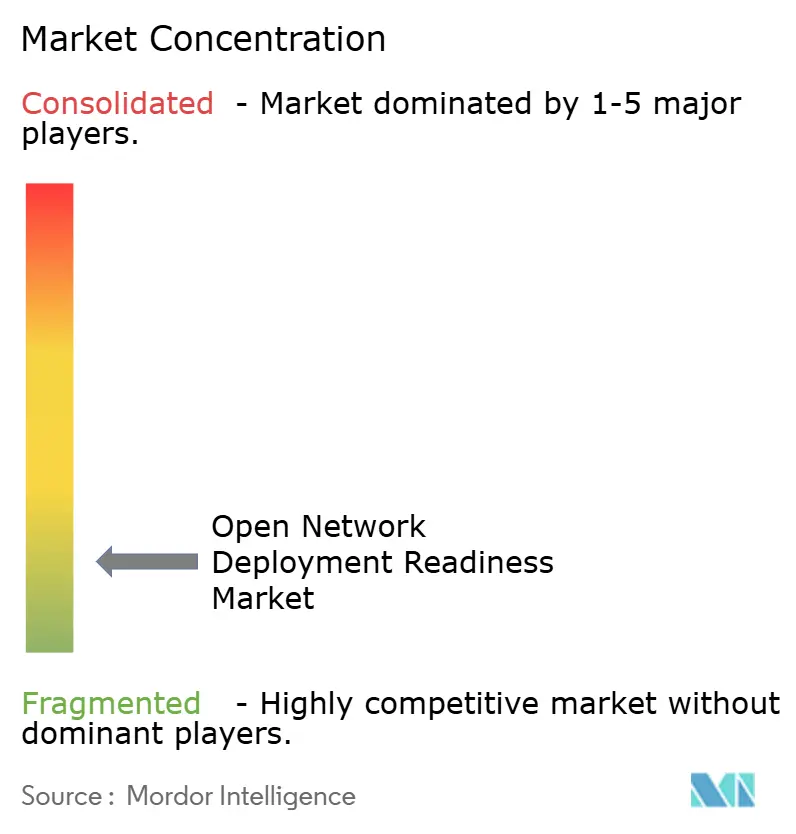
| Market Concentration | Low |
Major Players *Disclaimer: Major Players sorted in no particular order Image © Mordor Intelligence. Reuse requires attribution under CC BY 4.0. | |
Open Network Deployment Readiness Market Analysis by Mordor Intelligence
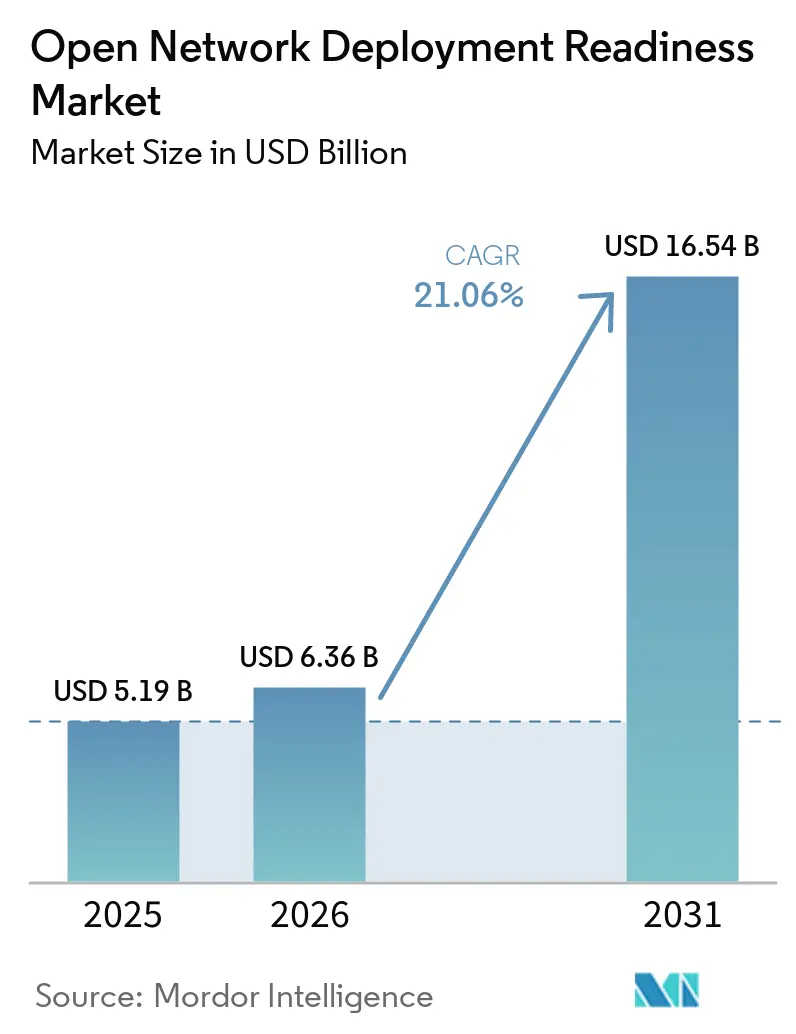
The open network deployment readiness market size is expected to grow from USD 5.19 billion in 2025 to USD 6.36 billion in 2026 and is forecast to reach USD 16.54 billion by 2031 at 21.06% CAGR over 2026-2031. Growth reflects operators moving from proof-of-concept work toward awarded contracts and broader network modernization programs. Disaggregated radio networks, cloud-native software, and O-RAN Alliance specifications are changing how operators procure radio infrastructure. Government programs that seek more diverse and secure telecom supply chains also support vendor testing, certification, and commercialization. AI-enabled RAN controllers create an added opportunity because they support automated network control in programmable environments. The open network deployment readiness market also faces slower adoption where operators must prove interoperability, performance, and lifecycle costs across several suppliers.
Key Report Takeaways
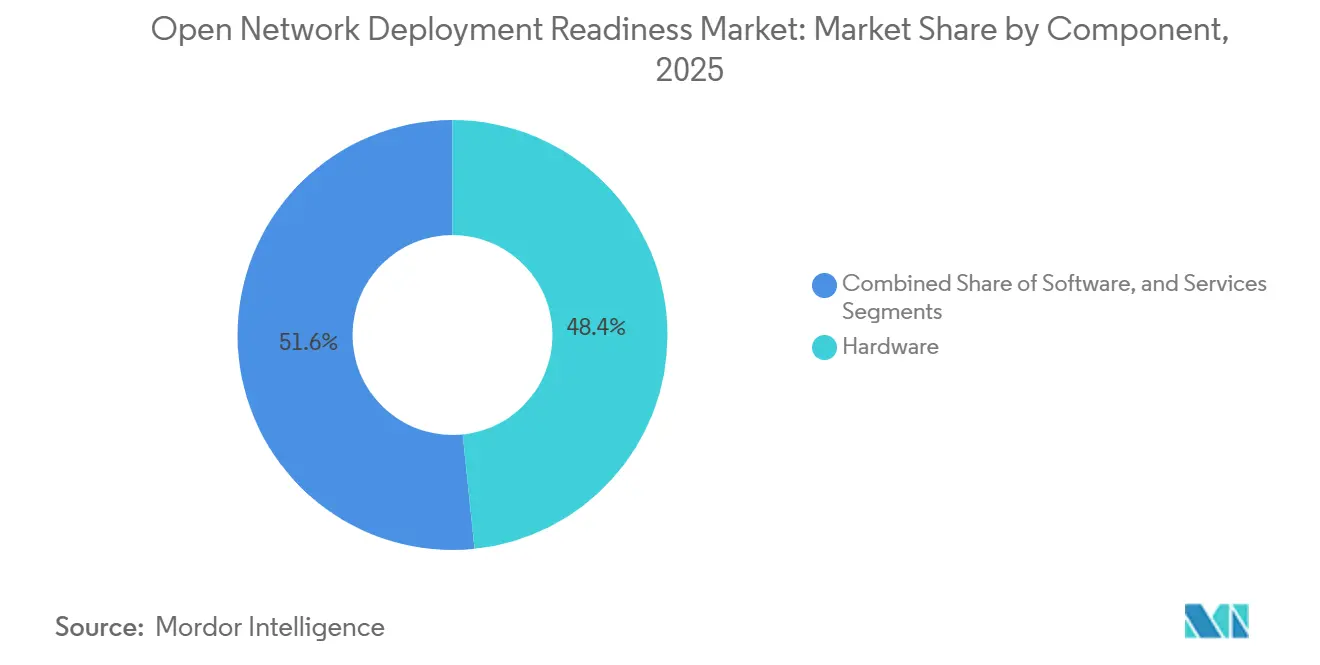
- By component, hardware held 48.37% of the open network deployment readiness market share in 2025, while services are projected to expand at a 22.32% CAGR through 2031.
- By architecture layer, the radio unit held 38.65% revenue share in 2025, while the distributed unit is expected to grow at a 21.84% CAGR through 2031.
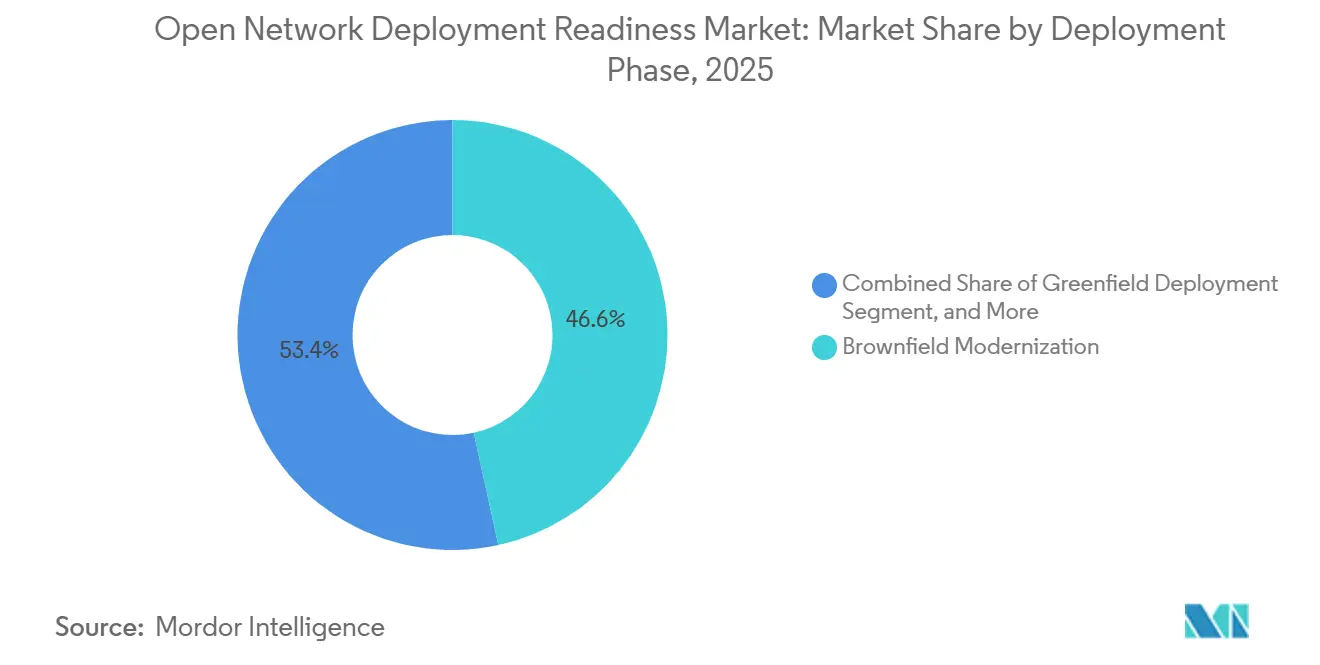
- By deployment phase, brownfield modernization accounted for 46.58% share in 2025, while greenfield deployment is projected to grow at a 21.91% CAGR through 2031.
- By end user, mobile network operators held 57.63% share in 2025, while enterprises and industry verticals are expected to expand at a 22.36% CAGR through 2031.
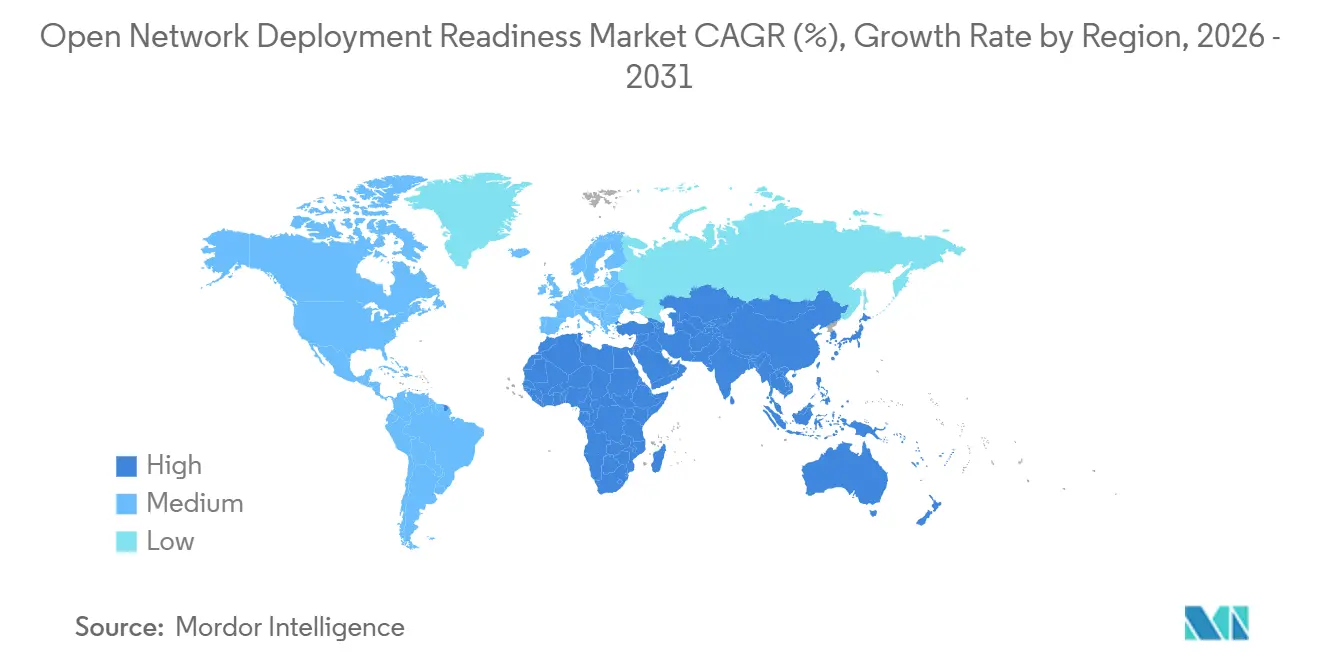
- By geography, North America held 42.19% of the market in 2025, while the Asia-Pacific is projected to grow at a 22.48% CAGR through 2031.
Note: Market size and forecast figures in this report are generated using Mordor Intelligence’s proprietary estimation framework, updated with the latest available data and insights as of January 2026.
Global Open Network Deployment Readiness Market Trends and Insights
Drivers Impact Analysis*
| Driver | (~) % Impact on CAGR Forecast | Geographic Relevance | Impact Timeline |
|---|---|---|---|
| 5G and Cloud-Native Network Modernization | +4.8% | Global | Short term (≤ 2 years) |
| Government Funding for Open and Secure Telecom Supply Chains | +3.5% | North America and Europe, with spillover to Asia-Pacific | Medium term (2-4 years) |
| Demand for Vendor Diversity and Network Resilience | +3.2% | Global | Medium term (2-4 years) |
| Expansion of Private and Enterprise 5G Networks | +2.8% | Asia-Pacific, North America, and Europe | Short term (≤ 2 years) |
| Reusable Test Automation Reducing Readiness Cycle Time | +2.0% | Global | Medium term (2-4 years) |
| Open RAN Reference Platforms for Rapid Field Replication | +1.7% | Asia-Pacific and North America | Long term (≥ 4 years) |
| Source: Mordor Intelligence | |||
5G and Cloud-Native Network Modernization
Cloud-native 5G networks allow software-defined base stations to receive configuration changes without physical site visits, reducing the time required to test and prepare multi-vendor deployments. AT&T reported that more than 50% of its radio replacement program had been completed by 2026, and open-capable hardware carried more than half of its network traffic. The company also progressed Cloud RAN live operations in 2 cities, which shows that the technology is moving into operational networks. O2 Telefónica deployed Ericsson Cloud RAN in a commercial 5G standalone network in Offenbach, Germany, in 2025. NTT DOCOMO launched commercial 5G Core services in a hybrid on-premises and cloud environment in March 2026 and reported an 80% reduction in deployment time through agentic AI automation.[1]NTT DOCOMO, “NTT DOCOMO Launches Commercial 5G Core Network on AWS,” AWS Press Center, press.aboutamazon.com These programs raise the value of automation, orchestration, and integration capabilities in the open network deployment readiness market.
Government Funding for Open and Secure Telecom Supply Chains
Public funding has moved from policy commitments toward grants that support testing, product development, and system integration. The US National Telecommunications and Information Administration awarded more than USD 550 million across 35 projects through the first 2 rounds of its Public Wireless Supply Chain Innovation Fund. A third round made up to USD 450 million available for software and integration automation for multi-vendor Open RAN deployments. The UK Open Networks Research and Development Fund provided GBP 250 million (USD 320 million) at the 2025 average exchange rate, through March 2026, for test infrastructure, product development, and commercial readiness activities. In April 2026, Japan’s METI selected Rakuten Symphony for a grant of up to JPY 8 billion (USD 50.2 million) for Open RAN and RAN Intelligent Controller deployments across 7 countries. These measures support the open network deployment readiness market by favoring suppliers with verified interoperability.
Demand for Vendor Diversity and Network Resilience
Telecom operators are placing greater value on supplier diversity when they plan radio network upgrades. This approach can reduce dependence on a single proprietary technology stack and support network resilience objectives. Vodafone started its first large-scale Open RAN deployment with Samsung in Germany in October 2025, beginning with a site in Hannover and planning a 5-year rollout across thousands of European sites. The program covers virtualized RAN software, O-RAN radios, and automation tools across 2G, 4G, and 5G. This creates demand beyond radio equipment, as operators in the open network deployment readiness market need software and managed services to coordinate with multiple suppliers. Early operator adoption can also improve procurement leverage by giving operators alternatives when they negotiate with traditional equipment providers.
Expansion of Private and Enterprise 5G Networks
Private 5G sites provide a practical setting for open architecture deployments because they do not carry the same legacy constraints as large public networks. The O-RAN Alliance stated in 2025 that open interface specifications can help private network users tailor radio control and security policies without vendor lock-in. Rakuten Symphony and Celona announced a collaboration in April 2026 for pre-integrated, end-to-end open RAN private 5G solutions for manufacturing, logistics, agriculture, ports, and mining. NTT East reported a March 2026 demonstration involving 26 companies that tested private 5G multi-vendor connectivity with an O-RAN Alliance-specified RAN Intelligent Controller. These projects allow vendors to build integration experience before pursuing larger operator contracts. The open network deployment readiness market gains from this activity because enterprise buyers often have faster procurement cycles than Tier-1 mobile operators.
Restraints Impact Analysis*
| Restraint | (~) % Impact on CAGR Forecast | Geographic Relevance | Impact Timeline |
|---|---|---|---|
| Multi-Vendor Interoperability and Integration Complexity | -4.5% | Global | Medium term (2-4 years) |
| Immature Commercial Scale and Performance Evidence | -3.2% | Global, with concentration in Europe and South America | Medium term (2-4 years) |
| Timing, Synchronization, and Energy-Efficiency Gaps | -2.5% | Global | Short term (≤ 2 years) |
| Shortage of Open Network Integration Skills | -2.0% | South America, Middle East, and Africa | Long term (≥ 4 years) |
| Source: Mordor Intelligence | |||
Multi-Vendor Interoperability and Integration Complexity
Multi-vendor integration remains a central constraint to commercial adoption, even when suppliers adhere to published standards. The Institute for Telecommunication Sciences found in 2025 that equipment compliant with 3GPP and O-RAN Alliance specifications could still produce interoperability events. The issues included timer configuration, message handling, bitrate compatibility, and differences between standard versions. The ATIS Open RAN Minimum Viable Profile Version 2 noted that differing interpretations, configurations, and optional features make interoperability difficult. Operators and system integrators must coordinate debugging work among suppliers that may compete with one another. Each update to an individual component can also restart elements of the qualification process and add continuing cost to the open network deployment readiness market.
Immature Commercial Scale and Performance Evidence
Commercial deployments remain concentrated among a limited group of operators and geographies. Airspan reported full-year 2025 revenue above USD 115 million and 20% year-over-year growth, while its outdoor Open RAN networks grew 118% year over year in the first half of 2026. These results show commercial progress, but many vendors still rely on a small number of anchor operators. Performance results from large US brownfield programs or Japanese greenfield networks may not transfer directly to operators with different spectrum, building density, and legacy equipment. Prospective buyers, therefore, need peer references that match their own conditions. A shortage of comparable evidence can extend procurement cycles and slow the market for open network deployment readiness.
*Our forecasts treat driver/restraint impacts as directional, not additive. The impact forecasts reflect baseline growth, mix effects, and variable interactions.
Segment Analysis
By Component: Hardware Leads While Services Grow Fastest
Hardware held 48.37% of the open network deployment readiness market share in 2025. Radio unit procurement is normally the starting point for an operator moving to an open network architecture. Radio equipment also represents a large share of capital spending during a RAN upgrade cycle. The 2025 procurement cycle aligned 4G equipment replacement with planned 5G coverage expansion across Europe and North America. Software provides containerized network functions and cloud-native orchestration tools. These products are increasingly sold through recurring license arrangements rather than single purchases.
Services are projected to expand at a 22.32% CAGR from 2026 to 2031. System integration, multi-vendor testing, and managed orchestration can exceed the internal engineering capacity available to many mobile operators. NTT DOCOMO completed a commercial deployment of Ericsson’s O-RAN Alliance-compliant RAN Processor 6672 in July 2026, reporting up to 4 times higher capacity efficiency and more than 50% lower energy use than the prior generation. The processor also supported interoperability among multi-vendor radio units. In June 2026, Mavenir introduced an Integrated AI Platform with Red Hat that used token-based consumption for operator AI services. Within the open network deployment readiness market, radio-unit specialists, including Airspan, Benetel, and Baicells, compete separately from software and service providers.



By Architecture Layer: Radio Units Lead and Distributed Units Expand
The radio unit held the largest share of the architecture layer at 38.65% in 2025. It is the physical interface that connects the network to the spectrum, so operators must upgrade or replace it early in an open network program. Multiple suppliers now offer O-RAN-compliant radio units across frequency bands. Radio units are also capital-intensive and highly visible in daily network operations. Centralized units and RAN Intelligent Controllers are gaining commercial use as software layers. The RAN Intelligent Controller hosts xApps and rApps for AI-enabled network optimization.
Distributed unit is projected to grow at a 21.84% CAGR from 2026 to 2031. Operators use this layer to disaggregate baseband processing into software-deployable functions that can run on commercial off-the-shelf servers. This can reduce per-site compute costs and support cloud-native lifecycle management. Rakuten Mobile completed a nationwide deployment of RAN Intelligent Controller applications in February 2026, including third-party rApps from AirHop Communications and Future Connections. Rakuten Symphony also received O-RAN conformance and Interoperability Badge certifications from Japan OTIC in January 2026. Certification can shape supplier selection in the open network deployment readiness market.
By Deployment Phase: Brownfield Programs Provide the Largest Near-Term Base
Brownfield modernization accounted for 46.58% of the open network deployment readiness market size in 2025. Legacy base station refresh programs at Tier-1 operators provide the largest immediate source of revenue. Equipment replacement often follows a 5- to 7-year depreciation cycle. Operators used the 2025 cycle to replace 4G equipment while expanding 5G coverage. In 2026, AT&T reported that its radio swap was more than 50% complete and that open-capable hardware carried more than half of its traffic. Pilot and field trial projects remain smaller, but they help operators assess live spectrum performance before signing larger rollout contracts.
Greenfield deployment is expected to grow at a 21.91% CAGR from 2026 to 2031. New entrants and private network operators can adopt open architectures without having to adapt to installed legacy equipment. Rakuten Mobile in Japan and Dish Network in the United States used Open RAN as their default architecture for greenfield networks built between 2016 and 2026. Rakuten Mobile began deploying 1Finity 32T32R massive MIMO Open RAN radios across its nationwide 5G network in February 2026.[2]Rakuten Mobile, “Rakuten Mobile to Deploy 1Finity Open RAN Massive MIMO Radios at Scale,” Rakuten Mobile Press Releases, corp.mobile.rakuten.co.jp The radios use Qualcomm Dragonwing QRU100 platforms and interoperate with Rakuten Symphony centralized and distributed units through the open fronthaul interface.
By End User: Mobile Operators Lead as Enterprise Demand Broadens
Mobile network operators held 57.63% share in 2025. Their radio infrastructure procurement cycles produce the largest individual contract values in the open network deployment readiness market. Their decisions also establish multi-vendor interoperability requirements that smaller buyers often use as a reference. Mobile operators drive demand for radio, centralized, and distributed units. Government and defense organizations are also adopting supplier-diverse infrastructure for tactical and fixed communications. Neutral-host providers serve a smaller but important role in dense urban and indoor settings where several operators use shared infrastructure.
Enterprises and industry verticals are projected to expand at a 22.36% CAGR from 2026 to 2031. Private 5G campuses in manufacturing, logistics, ports, and mining are adopting open RAN to gain deployment flexibility and control costs. The Rakuten Symphony and Celona collaboration announced in April 2026 targeted large and medium-sized enterprises across these sectors. NTT East’s 26-company demonstration showed multi-vendor RAN Intelligent Controller connectivity in a private 5G setting. O-RAN Alliance addresses enterprise spectrum, security, and latency requirements, supporting adoption beyond the industrial sectors that currently lead deployments.
Geography Analysis
North America held 42.19% share in 2025. AT&T’s radio swap program supported the region’s commercial position, while the NTIA funded more than USD 550 million across 35 testing and commercialization projects through the first 2 funding rounds. The rescission of USD 850 million in unallocated US Wireless Innovation Fund commitments reduced near-term public co-investment available to hardware and software developers. NTIA also planned a new opportunity using USD 50 million to explore AI-native 6G architecture. Canada is broadening the use of open technologies for rural and remote connectivity. Mavenir deployed Terrestar’s hybrid satellite IoT service over a cloud-native virtualized RAN and packet core in February 2026.[3]Mavenir, “Terrestar Launches Canada-Wide Hybrid Satellite IoT Service Powered by Mavenir’s Cloud-Native Virtualized RAN and Core,” Mavenir Press Releases, mavenir.com South America remains early stage, though the METI-backed Rakuten Symphony initiative supports the open network deployment readiness market in Bolivia and Paraguay from May 2026 through March 2029.
Europe is moving from trials toward commercial-scale activity in the open network deployment readiness market. Operators face pressure to diversify their supplier base and manage the coexistence of legacy and open radio systems. Vodafone’s 2025 program with Samsung began in Germany and is scheduled to extend across thousands of sites over 5 years. The rollout includes virtualized RAN software supporting 2G, 4G, and 5G, O-RAN radios, and AI-based automation tools. A wider group of operators, including Deutsche Telekom, Orange, Telefónica, and Vodafone, has committed to Open RAN adoption. Russia’s contribution remains limited because sanctions and geopolitical constraints isolate it from the wider European open network ecosystem. For the open network deployment readiness market, the region’s next stage depends on turning multi-vendor trials into repeatable programs across national markets.
Asia-Pacific is projected to be the fastest-growing region at a 22.48% CAGR from 2026 to 2031. Japan’s operational open virtualized RAN activity and India’s domestic telecom equipment manufacturing program support this growth. NTT DOCOMO, KDDI, SoftBank, and Rakuten Mobile are advancing Open RAN and virtualized RAN programs at different stages. Rakuten Mobile provides a large operational reference for other regional operators. NTT DOCOMO’s July 2026 processor deployment reported up to 4 times higher capacity efficiency and more than 50% lower energy consumption than the prior generation. India approved 136 telecom equipment manufacturing projects under its production-linked incentive scheme. The Middle East and Africa are growth-stage areas in the open network deployment readiness market, with Saudi Arabia, the UAE, Turkey, South Africa, Nigeria, and Egypt evaluating or piloting open network approaches.

Competitive Landscape
The open network deployment readiness market is moderately fragmented because no supplier controls hardware, software, and services across the full value chain. Competitive differentiation depends on verified O-RAN Alliance interoperability and the ability to integrate systems for large mobile operator programs. Mavenir, Rakuten Symphony, Airspan Networks, and Radisys compete as specialist vendors with different software, radio, and integration capabilities. Picocom addresses specific silicon needs, while VVDN Technologies serves equipment design and manufacturing requirements. Rakuten Symphony received all 3 certification classes in the O-RAN Alliance certification and badging process through Japan OTIC in January 2026.[4]Rakuten Symphony, “Rakuten Symphony Awarded O-RAN Conformance and Interoperability Badge Certifications From Japan OTIC,” Rakuten Symphony Newsroom, symphony.rakuten.com These credentials can become an important procurement requirement for vendors seeking to serve multi-vendor deployments.
The open network deployment readiness market creates openings in multi-vendor orchestration, RAN Intelligent Controller applications, and test automation. Operators need tools that manage both legacy and open networks because modernization often happens in stages. AI-focused rApps and xApps can improve RAN control for operators that have adopted a programmable architecture. Test automation remains important because frequent software updates may require re-qualification across component combinations. Mavenir’s June 2026 Integrated AI Platform, developed with Red Hat, demonstrates a move toward recurring platform-based revenue models for operator AI services. Its April 2026 cloud-native packet core deployment in Rakuten Mobile’s nationwide network also illustrates the company’s software-centered position.
Smaller suppliers are building traction in private enterprise and neutral-host deployments. Amarisoft, Druid Software, and ASOCS can build integration records in projects that have fewer qualification requirements than Tier-1 mobile operator networks. This experience may help them compete for larger contracts as enterprise deployments mature. Hardware-focused suppliers face pressure to pair radio products with validated software and services. Software providers must demonstrate that their platforms work across supplier combinations and real operating conditions. The open network deployment readiness market therefore rewards companies that combine proof of interoperability with repeatable deployment support. Strategic moves by Rakuten Symphony, Mavenir, and Airspan show that certification, software platforms, and targeted radio deployments remain the main paths to build that position.
Open Network Deployment Readiness Industry Leaders
Mavenir Systems, Inc.
Parallel Wireless, Inc.
Airspan Networks Holdings Inc.
Radisys Corporation
Rakuten Symphony, Inc.
- *Disclaimer: Major Players sorted in no particular order

Recent Industry Developments
- July 2026: Airspan Networks reported H1 2026 business performance with outdoor Open RAN networks growing 118% year over year, driven by key deployments in Europe and Asia. The company also announced a defense-sector alliance with Atika Ventures in Spain to deploy tactical 5G communications for defense and security environments.
- July 2026: NTT DOCOMO completed Japan’s first commercial deployment of Ericsson’s O-RAN Alliance-compliant RAN Processor 6672, achieving up to 4 times higher capacity efficiency and more than 50% energy consumption reduction versus the prior generation, while establishing a foundation for multi-vendor O-RAN radio unit interoperability and advancing DOCOMO’s network evolution toward 6G.
- June 2026: Mavenir launched an Integrated AI Platform co-developed with Red Hat, enabling mobile operators to monetize AI through token-based consumption plans delivered on their own networks. The platform supported operator-branded AI services, an AI infrastructure layer, and enterprise AI capability provision.
- April 2026: Rakuten Symphony and Celona announced a collaboration to deliver pre-integrated end-to-end open RAN private 5G solutions for large and medium-sized enterprises across manufacturing, logistics, agriculture, ports, and mining sectors globally.


Global Open Network Deployment Readiness Market Report Scope
The open network deployment readiness market encompasses solutions and services that help organizations assess, prepare, deploy, and manage open network architectures. These offerings support the adoption of interoperable, vendor-neutral network technologies, including Open RAN, software-defined networking (SDN), network function virtualization (NFV), cloud-native network functions, and open-source networking platforms. The report also examines the competitive landscape, key market drivers, restraints, opportunities, and technological developments influencing the adoption of open network deployment readiness solutions.
The Open Network Deployment Readiness Market Report is Segmented by Component (Hardware, Software, and Services), Architecture Layer (Radio Unit, Distributed Unit, Centralized Unit, RAN Intelligent Controller, and Other Architecture Layers), Deployment Phase (Greenfield Deployment, Brownfield Modernization, Pilot and Field Trial, and Other Deployment Phases), End User (Mobile Network Operators, Neutral-Host Providers, Enterprises and Industry Verticals, and Government and Defense Organizations), and Geography (North America, South America, Europe, Asia-Pacific, Middle East, and Africa). The Market Forecasts are Provided in Terms of Value (USD).
| Hardware |
| Software |
| Services |
| Radio Unit |
| Distributed Unit |
| Centralized Unit |
| RAN Intelligent Controller |
| Other Architecture Layers |
| Greenfield Deployment |
| Brownfield Modernization |
| Pilot and Field Trial |
| Other Deployment Phases |
| Mobile Network Operators |
| Neutral-Host Providers |
| Enterprises and Industry Verticals |
| Government and Defense Organizations |
| North America | United States |
| Canada | |
| Mexico | |
| South America | Brazil |
| Argentina | |
| Rest of South America | |
| Europe | Germany |
| United Kingdom | |
| France | |
| Italy | |
| Spain | |
| Russia | |
| Rest of Europe | |
| Asia-Pacific | China |
| Japan | |
| India | |
| South Korea | |
| Australia and New Zealand | |
| Rest of Asia-Pacific | |
| Middle East | Saudi Arabia |
| United Arab Emirates | |
| Turkey | |
| Rest of Middle East | |
| Africa | South Africa |
| Nigeria | |
| Egypt | |
| Rest of Africa |
| By Component | Hardware | |
| Software | ||
| Services | ||
| By Architecture Layer | Radio Unit | |
| Distributed Unit | ||
| Centralized Unit | ||
| RAN Intelligent Controller | ||
| Other Architecture Layers | ||
| By Deployment Phase | Greenfield Deployment | |
| Brownfield Modernization | ||
| Pilot and Field Trial | ||
| Other Deployment Phases | ||
| By End User | Mobile Network Operators | |
| Neutral-Host Providers | ||
| Enterprises and Industry Verticals | ||
| Government and Defense Organizations | ||
| By Geography | North America | United States |
| Canada | ||
| Mexico | ||
| South America | Brazil | |
| Argentina | ||
| Rest of South America | ||
| Europe | Germany | |
| United Kingdom | ||
| France | ||
| Italy | ||
| Spain | ||
| Russia | ||
| Rest of Europe | ||
| Asia-Pacific | China | |
| Japan | ||
| India | ||
| South Korea | ||
| Australia and New Zealand | ||
| Rest of Asia-Pacific | ||
| Middle East | Saudi Arabia | |
| United Arab Emirates | ||
| Turkey | ||
| Rest of Middle East | ||
| Africa | South Africa | |
| Nigeria | ||
| Egypt | ||
| Rest of Africa | ||


Key Questions Answered in the Report
What is the size of the open network deployment readiness market?
The open network deployment readiness market is forecast to increase from USD 6.36 billion in 2026 to USD 16.54 billion by 2031, at a 21.06% CAGR.
What is driving demand for open network deployment readiness solutions?
Cloud-native 5G modernization, supplier diversity requirements, public funding, and private 5G deployment are supporting demand for open architectures, testing, and orchestration.
Which component leads spending in open network deployments?
Hardware led with 48.37% share in 2025 because radio equipment is a core requirement when operators upgrade their RAN infrastructure.
Which deployment phase is growing fastest?
Greenfield deployment is expected to grow at a 21.91% CAGR through 2031 because new networks can use open architecture without adapting legacy equipment.
Which end users are adopting these solutions most quickly?
Enterprises and industry verticals are projected to grow at a 22.36% CAGR as private 5G use expands in manufacturing, logistics, ports, and mining.
What limits wider adoption of open network architecture?
Interoperability, continuing software qualification, and limited comparable performance evidence can increase cost, extend deployment schedules, and delay procurement decisions.
Page last updated on:


 Your data is secure and never sold or shared.


