
Size and Share of Online Coated Glass Market For Building Application
Market Overview
| Study Period | 2022 - 2032 |
|---|---|
| Market Volume (2027) | 320.62 Million square meters |
| Market Volume (2032) | 442.79 Million square meters |
| Growth Rate (2027 - 2032) | 6.67 % |
| Fastest Growing Market | Asia-Pacific |
| Largest Market | Asia-Pacific |
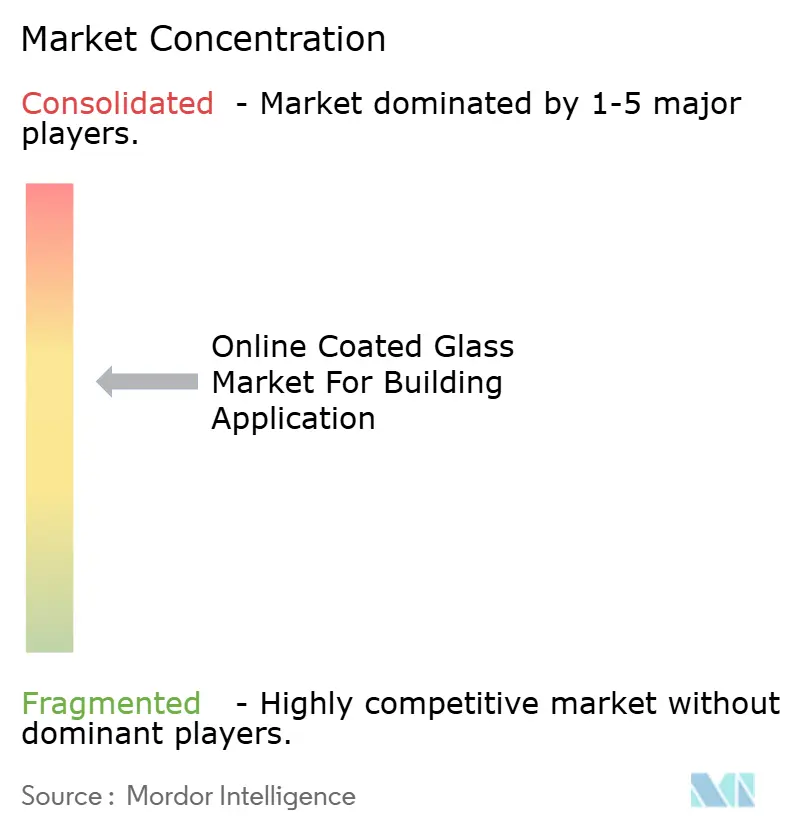
| Market Concentration | Medium |
Major Players *Disclaimer: Major Players sorted in no particular order Image © Mordor Intelligence. Reuse requires attribution under CC BY 4.0. | |
Analysis of Online Coated Glass Market For Building Application by Mordor Intelligence
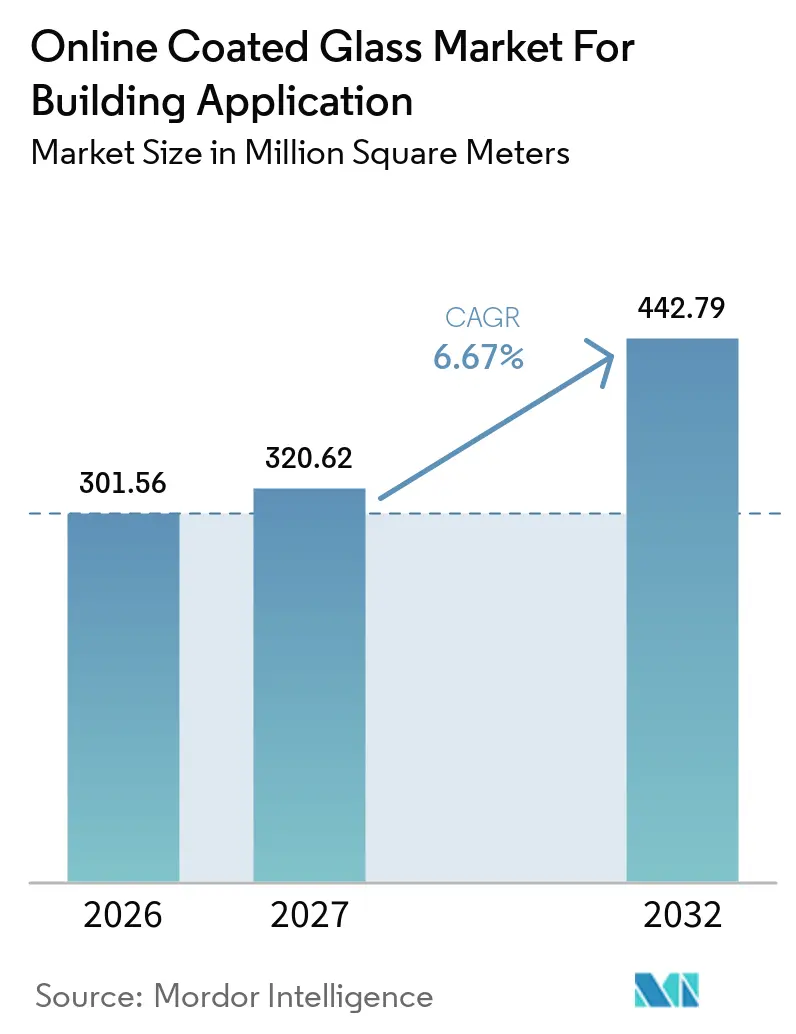
The Online coated glass for building application market size was estimated at 301.56 million square meters in 2026 and is projected to grow from 320.62 million square meters in 2027 to 442.79 million square meters by 2032, at a CAGR of 6.67% during the forecast period (2027-2032). The online coated glass market for building applications supplies commercial facades and glazed building envelopes with coatings applied during float glass production, a process commonly referred to as pyrolytic or hard-coat production. This inline process produces a durable surface that withstands heat treatment and fabrication, supports high-volume output, and generally has a lower unit cost than offline-sputtered products. Energy performance regulations in major construction markets are increasing demand for glazing with documented thermal insulation and solar control properties, while building efficiency spending is projected to exceed USD 5.9 trillion by 2030 to support a net-zero pathway. The online coated glass market for building applications also benefits from retrofit activity, as existing building stock often requires improved window performance, particularly where building codes, certification programs, portfolio energy targets, and the age of installed fenestration influence renovation decisions. Higher-performing offline low-E products remain a substitution risk in applications subject to stringent U-value requirements. Yet, durable hard-coat glazing retains a practical role in commercial envelopes and many cost-sensitive replacement applications where fabricators value the coating's handling resilience.
Key Report Takeaways
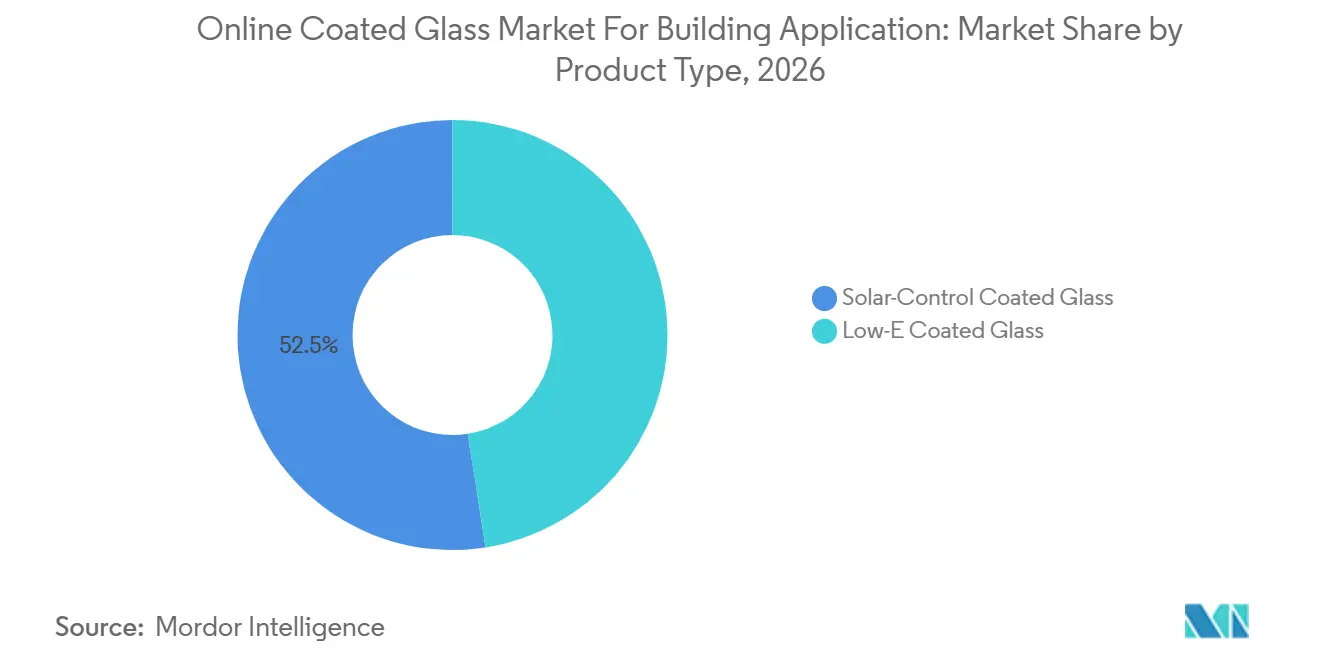
- By product type, Solar-Control Coated Glass held 52.45% of the Online coated glass for building application market share in 2026, while Low-E Coated Glass is projected to grow at a 7.75% CAGR through 2032.
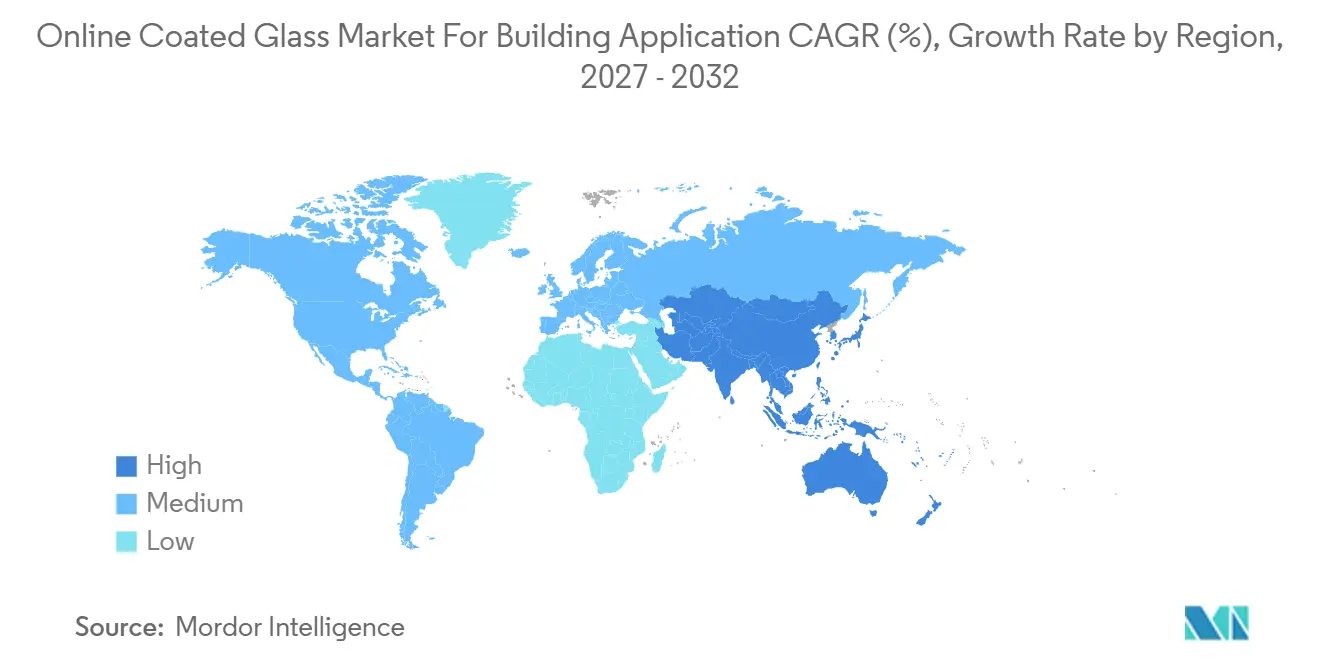
- By geography, Asia-Pacific accounted for 44.11% of the Online coated glass for building applications market share in 2026 and is forecast to expand at a 7.84% CAGR through 2032.
Note: Market numbers in this report are based on Mordor Intelligence's proprietary estimation framework, which combines nine months of actuals with Q4 projections for base year 2026.
Insights and Trends of Online Coated Glass Market For Building Application
Drivers Impact Analysis*
| Drivers | (~) % Impact on CAGR Forecast | Geographic Relevance | Impact Timeline |
|---|---|---|---|
| Tightening Building Energy-Performance Codes | +2.1% | Global, with primary uplift in the EU, North America, South Korea, and China | Short term (≤ 2 years) |
| Green-Building Certification and Net-Zero Construction | +1.8% | Global, concentrated in Mainland China, India, the US, and the UAE | Medium term (2-4 years) |
| Commercial Building Construction and Façade Expansion | +1.4% | Asia-Pacific, with spillover to the Middle East and South America | Medium term (2-4 years) |
| Building Retrofit and Aging Fenestration Replacement | +1.2% | North America and Europe, extending into mature Asia-Pacific urban centers | Long term (≥ 4 years) |
| Performance Documentation, Environmental Product Declarations (EPDs), and Procurement Compliance | +0.7% | Global, with the strongest regulatory influence in the EU and North America | Medium term (2-4 years) |
| Source: Mordor Intelligence | |||
Tightening Building Energy-Performance Codes
Mandatory building energy codes are a direct driver of demand for online coated glass in building applications because they make glazing performance a formal specification requirement rather than an optional product upgrade. New York City began enforcing the 2025 New York City Energy Conservation Code (NYCECC) for new project filings on March 30, 2026, with more stringent fenestration U-factor and solar heat gain coefficient requirements per ASHRAE 90.1[1]. Commission Delegated Regulation (EU) 2025/1511 requires EU Member States to calculate cost-optimal energy performance levels for new and existing buildings using life-cycle calculation periods of at least 30 years, making window performance part of a longer-term building cost assessment rather than a narrow up-front material choice. The regulation provides illustrative reference window U-values from 1.9 W/m²K to 5.7 W/m²K and requires remediation plans when national requirements depart by more than 15% from cost-optimal levels. Shandong's DB37/T5155-2025 public-building standard took effect in May 2025, while Xiong'an New Area requires energy-saving glass in new projects, indicating that performance requirements are also being applied through regional construction rules in China. For the online coated glass market, hard-coat glass can be tempered in-line without edge-deletion requirements, supporting monolithic applications in climate zones where code-compliant single-pane configurations are suitable and where installation simplicity carries practical value.
Green-Building Certification and Net-Zero Construction
Green-building certification supports the online coated glass market for building applications by increasing demand for documented material performance, lower operational energy use, and product information that can be reviewed during project certification. More than 7,500 commercial projects received LEED certification globally in 2025, covering more than 147 million gross square meters. Mainland China led markets outside the US with 1,939 certified projects totaling 26.6 million gross square meters, while India had 611 projects totaling 16.1 million gross square meters, underscoring the importance of these countries in certified commercial construction. India recorded more certifications for existing buildings than for new ones, pointing to a larger retrofit role in certified construction and creating conditions in which replacement glazing can be considered alongside broader envelope improvements. Vietnam entered the LEED Top 10 in 2025, indicating broader adoption of green-building requirements in Southeast Asian manufacturing centers. For the online coated glass market, environmental product declarations can strengthen the suitability of pyrolytic glass because LEED material pathways consider verified product documentation, and hard-coat surfaces can reduce damage during installation on large curtain-wall assemblies.
Commercial Building Construction and Façade Expansion
Commercial construction in Asia-Pacific and the Middle East creates demand for online coated glass in building applications, particularly where developers use extensive glazed areas in buildings with high occupancy or long operating hours. High-rise mixed-use towers, airports, and integrated transit facilities use extensive glazed areas and require solar-control performance to manage solar heat exposure and support more predictable indoor comfort conditions. In South Korea, Low-E glass accounted for 40% of the domestic architectural glass market in 2025 as commercial specifications and the Zero Energy Building program affected purchasing requirements. This shift shows how building performance standards can influence glazing selection within a short planning cycle when compliance rules are applied to public and commercial projects. In January 2026, Xinyi Glass signed a cooperation agreement with Saudi Arabia's MODON for a USD 386 million production base that includes float glass and high-performance Low-E glass, indicating that Saudi localization policy is attracting regional supply capacity. Commercial tenants increasingly require verified solar-control performance for energy-cost models and Environmental, Social, and Governance (ESG) disclosures, placing more weight on performance documentation during product selection and reducing the role of purely commodity-based buying decisions.
Building Retrofit and Aging Fenestration Replacement
Window replacement in existing buildings offers a longer-term source of demand for the online coated glass market because the installed stock often performs below current envelope requirements. Lawrence Berkeley National Laboratory found that commercial window upgrades in the US could produce median site-energy savings of 4% to 6% per building, with savings of up to 26% in the highest-savings quartile. The same work estimated annual US commercial-building site-energy savings of 0.2 to 0.25 quads from nationwide window upgrades, linking glazing improvement to measurable reductions in energy consumption at a building-stock level. The US Department of Energy estimates that 40% of commercial and multifamily buildings, or 2.4 million structures, still have single-pane, non-thermally broken windows, leaving a large stock of buildings for which replacement may be technically feasible. Hard-coat products can better accommodate field measurement, cutting, and fabrication variation in occupied-building replacement projects than soft-coat alternatives, while simplifying handling during renovation. EU renovation requirements are also supporting orders for Pilkington K Glass and comparable pyrolytic products in residential and light-commercial replacement work.
Restraints Impact Analysis*
| Restraints | (~) % Impact on CAGR Forecast | Geographic Relevance | Impact Timeline |
|---|---|---|---|
| Higher Upfront Cost Than Conventional Float Glass | -1.2% | Global, most pronounced in South and Southeast Asia and South America | Short term (≤ 2 years) |
| Capital Intensity and Coating-Line Yield Challenges | -0.9% | Global, with particular weight in markets with new-entrant activity | Medium term (2-4 years) |
| Requalification Risk After Coating-Stack or Substrate Changes | -0.7% | Global, particularly in the EU and North America, where Environmental Product Declaration (EPD) and compliance documentation are required | Medium term (2-4 years) |
| Source: Mordor Intelligence | |||
Higher Upfront Cost Than Conventional Float Glass
The price premium over standard float glass remains a restraint for the online coated glass market for building applications, particularly in price-sensitive housing and commercial developments in India, Southeast Asia, and South America. Pyrolytic Chemical Vapor Deposition (CVD) coatings add 25% to 60% to the cost of uncoated float glass, depending on coating complexity and substrate thickness. This cost increase makes performance upgrades difficult to approve when project budgets are constrained, and the glazing package competes with other construction costs. Developers may prioritize initial procurement costs over life-cycle energy savings, as energy savings are realized after the initial spending decision and may not be directly captured by the project sponsor. The Fenestration and Glazing Industry Alliance reported that prime window demand in the US declined 5% in 2025, while replacement demand also fell. This decline illustrates how weaker construction conditions can limit the uptake of coated glass despite favorable energy regulations and a large base of potential retrofit buildings. In insulating glass units, hard-coat products can reduce fabrication complexity because they do not require edge deletion, although the related savings typically accrue to fabricators rather than developers.
Capital Intensity and Coating-Line Yield Challenges
Capital requirements limit the pace at which producers can add online coating capacity for the online coated glass market for building applications. The pyrolytic process runs on the float glass ribbon, so a new or converted coating line is tied to the float furnace's investment cycle and cannot be easily separated from broader furnace planning, maintenance schedules, or output decisions. A typical new float furnace requires USD 100 million to USD 300 million, while CVD equipment adds to this capital requirement and raises the financial threshold for new entrants, particularly when a producer must simultaneously establish local fabrication, quality control, and technical support capabilities. NSG Group announced a PLN 160 million (~USD 40.77 million) investment in a sputtering coating line at Pilkington Polska's Sandomierz facility in September 2025, with production scheduled for the first quarter of 2027. Coating uniformity, precursor delivery, and ribbon temperature must be closely controlled, as deviations can result in the downgrading or scrapping of an entire production run, adding operational risk to an already capital-intensive process. These requirements concentrate production among established float glass manufacturers and make rapid geographic expansion of capacity more difficult, even as commercial demand increases.
*Our forecasts treat driver/restraint impacts as directional, not additive. The impact forecasts reflect baseline growth, mix effects, and variable interactions.
Segment Analysis
By Product Type: Solar-Control Glass Leads While Low-E Glass Grows Faster
Solar-control-coated glass accounted for 52.45% of the total volume in 2026, making it the largest product category. It is widely specified for commercial curtain walls in tropical and subtropical regions, where solar heat rejection is a primary requirement for the building envelope. The hard-coat surface is compatible with structural glazing assemblies used in large commercial developments, and its thermal durability is relevant in applications exposed to ultraviolet radiation and humidity cycling over long service periods. Southeast Asia, the Middle East, and coastal China remain important demand areas, as commercial buildings in these regions frequently require solar-control glazing. China's GB/T 35604-2025 green-product assessment standard, effective from November 2025, establishes a formal performance framework for certified solar-control coated glass in public procurement.
Low-emissivity (Low-E) coated glass is forecast to grow at a 7.75% CAGR through 2032, the highest rate among product categories in the online coated glass for building applications market. Its growth is supported by heating-season energy codes in continental and northern climates, where thermal insulation is a more prominent requirement in the building envelope, and window U-values are closely scrutinized. In South Korea, Low-E glass accounted for 40% of the domestic architectural glass market in 2025, as zero-energy building requirements influenced specifications for public and commercial buildings. Online Low-E glass has a somewhat higher emissivity than offline triple-silver alternatives, but it offers a cost-effective route to code-compliant glazing performance for projects that require a practical balance of thermal performance, product durability, and fabrication flexibility. This positioning is relevant for retrofits where budgets and installation conditions favor durable monolithic configurations over more complex insulating glass units, broadening the range of applications that the online coated glass for building applications market can serve.

Geography Analysis
Asia-Pacific accounted for 44.11% of global volume in 2026 and is projected to record a 7.84% CAGR through 2032. The region combines a large commercial construction pipeline with extensive float-glass and online-coating capacity in China, India, and South Korea. It serves as the primary demand center and a major production base for the online coated glass for building applications market, connecting regional construction activity to global supply availability. NSG Group announced an upgrade to its Chiba plant in Japan, adding a sputtering coating line for Low-E glass, with mass production scheduled for the third quarter of 2026. The investment aligns with Japan's Zero Energy Building programs and reflects the region's focus on energy-efficient glazing. Asia-Pacific's role in both supply and demand also creates procurement exposure when production and consumption are concentrated in the same region.
Europe and North America present a retrofit opportunity for the online coated glass for building applications market. The EU Energy Performance of Buildings Directive required Member States to transpose it by May 2026 and will require cost-optimal fenestration benchmarks in Member State reporting by June 2028. This framework supports demand that is less dependent on new construction cycles and places greater emphasis on documented window performance, a setting in which the online coated glass for building applications market can serve renovation work. The International Energy Agency identifies glass among building materials competing for investment in near-zero-emission production as the sector pursues carbon-neutrality objectives[2]. In the US, commercial window upgrades can contribute substantial annual site-energy savings, encouraging building owners to consider envelope improvements in their portfolio spending.
The Middle East, Africa, and South America are at earlier stages of adoption of coated glass in the online coated glass for building applications market. Saudi Vision 2030, Oman's Integrated Tourism Complex development, and ongoing commercial activity in the UAE support project-based demand for solar-control products, particularly in areas with high solar exposure, where façade design and cooling performance are important considerations. Localized supply investment is being evaluated to meet regional demand, as developers and governments place greater emphasis on domestic industrial capacity, shorter supply lines, and access to higher-performance glass products. South Africa's construction sector and Brazil's LEED-certified commercial real estate pipeline create additional opportunities in premium commercial and institutional projects. However, these regions have less comprehensive regulatory frameworks than those in Europe and Northeast Asia. Their adoption pattern, therefore, remains more connected to major developments, commercial developer standards, and the availability of localized technical support than to a single region-wide energy code.
Competitive Landscape
The online coated glass market for building applications is moderately consolidated at the production level. Saint-Gobain, AGC Inc., and NSG Group hold significant pyrolytic coating capacity because they operate integrated float-to-coating assets that integrate glass supply, coating operations, and product qualification. Chinese companies, including Xinyi Glass, CSG Holding, and Jinjing Group, compete on cost in the Asia-Pacific and are expanding into the Middle East and Africa. This structure favors established producers in demanding applications that require consistent technical documentation, while lower-cost suppliers find opportunities in regions where commercial customers prioritize installed cost. As a result, the market faces both premium-performance competition and cost-led regional competition.
AGC and Saint-Gobain inaugurated the Volta hybrid furnace pilot in Teplice, Czech Republic, in February 2025. The companies positioned this work as part of the FURnace HYbrid (FURHY) project planned for Avilés, Spain. The project addresses the need to reduce furnace emissions while preparing for more detailed embodied-carbon declarations under the EU Construction Products Regulation. NSG Group is investing across Poland, Italy, and Japan, signaling a focus on capacity expansion and higher-value applications ahead of the European compliance cycle. These developments indicate that both manufacturing modernization and regional capacity planning are shaping the online coated glass market for building applications.
There's still an opportunity for mid-performance online coated glass to narrow the performance gap with offline soft-coat Low-E glass at a lower price. Cardinal Glass, Şişecam, and CSG Holding compete through lead times, technical support, and the depth of their environmental product documentation, which can be important where public procurement teams must compare verified product information. Asahi India Glass is positioned to benefit from India's growing demand for commercial glazing as larger producers expand local float-to-coating capacity and raise expectations for integrated manufacturing. Electrochromic and thermochromic smart glazing can cost 5 to 10 times more than pyrolytic coated glass, which limits their displacement potential to smaller, higher-value applications during the forecast period. These conditions preserve a role for online coated glass in building projects that require durable performance and more manageable upfront glazing costs.
Leaders of Online Coated Glass Market For Building Application
-
Saint-Gobain
-
AGC Inc.
-
Xinyi Glass Holdings Limited
-
Nippon Sheet Glass Co., Ltd.
-
Şişecam
- *Disclaimer: Major Players sorted in no particular order
Recent Industry Developments
- April 2026: AGC Glass Europe's FINEO vacuum insulating glass production line at Lodelinsart, Belgium, came online in H2 2026, quadrupling capacity with lead times reduced to two weeks and a Ug value of up to 0.44 W/m²K. The expansion targets the renovation of heritage buildings that cannot accommodate thicker IGUs.
- January 2026: Xinyi Glass signed a project cooperation agreement with Saudi Arabia's MODON for a USD 386 million production base covering float glass, automotive glass, and Low-E energy-saving glass. The facility spans over 350,000 square meters and serves Saudi and regional MEA markets, supporting Saudi Vision 2030's advanced manufacturing and industrial localization objectives.
Scope of Report on Online Coated Glass Market For Building Application
Online coated glass, also known as hard-coated or pyrolytic glass, is a type of architectural glass where a thin layer of metal oxide is applied directly to the glass ribbon during the float manufacturing process. This coating is permanently bonded to the glass surface at high temperatures, resulting in a durable and scratch-resistant finish.
The online coated glass market for building applications is segmented by product type and geography. By product type, the market is segmented into solar-controlled coated glass and low-E coated glass. The report also covers the market size and forecasts for online coated glass for building applications in 15 countries across major regions. The market sizes and forecasts are provided in terms of Volume (Square Meters).
| Solar-Control Coated Glass |
| Low-E Coated Glass |
| Asia-Pacific | China |
| India | |
| Japan | |
| South Korea | |
| ASEAN Countries | |
| Rest of Asia-Pacific | |
| North America | United States |
| Canada | |
| Mexico | |
| Europe | Germany |
| United Kingdom | |
| France | |
| Italy | |
| NORDIC Countries | |
| Rest of Europe | |
| South America | Brazil |
| Argentina | |
| Rest of South America | |
| Middle East and Africa | Saudi Arabia |
| South Africa | |
| Rest of Middle East and Africa |
| By Product Type | Solar-Control Coated Glass | |
| Low-E Coated Glass | ||
| By Geography | Asia-Pacific | China |
| India | ||
| Japan | ||
| South Korea | ||
| ASEAN Countries | ||
| Rest of Asia-Pacific | ||
| North America | United States | |
| Canada | ||
| Mexico | ||
| Europe | Germany | |
| United Kingdom | ||
| France | ||
| Italy | ||
| NORDIC Countries | ||
| Rest of Europe | ||
| South America | Brazil | |
| Argentina | ||
| Rest of South America | ||
| Middle East and Africa | Saudi Arabia | |
| South Africa | ||
| Rest of Middle East and Africa | ||
Key Questions Answered in the Report
What is current market size of Online Coated Glass for Building Application Market?
The Online coated glass for building application market size was estimated at 301.56 million square meters in 2026 and is projected to grow from 320.62 million square meters in 2027 to 442.79 million square meters by 2032, at a CAGR of 6.67% during the forecast period (2027-2032).
Which product type has the largest share of demand?
Solar-Control Coated Glass leads with 52.45% share in 2026, supported by commercial façade demand in warmer climates.
Which product type is growing fastest?
Low-E Coated Glass is forecast to grow at a 7.75% CAGR through 2032 as heating-season energy rules become more stringent.
Which region leads global demand?
Asia-Pacific held a 44.11% share in 2026 and is expected to grow at a 7.84% CAGR through 2032.