
On-Demand Insurance Market Size and Share
Market Overview
| Study Period | 2021 - 2032 |
|---|---|
| Market Size (2027) | USD 2.70 Billion |
| Market Size (2032) | USD 4 Billion |
| Growth Rate (2027 - 2032) | 8.20 % |
| Fastest Growing Market | Asia-Pacific |
| Largest Market | North America |
| Market Concentration | Low |
Major Players *Disclaimer: Major Players sorted in no particular order Image © Mordor Intelligence. Reuse requires attribution under CC BY 4.0. | |
On-Demand Insurance Market Analysis by Mordor Intelligence
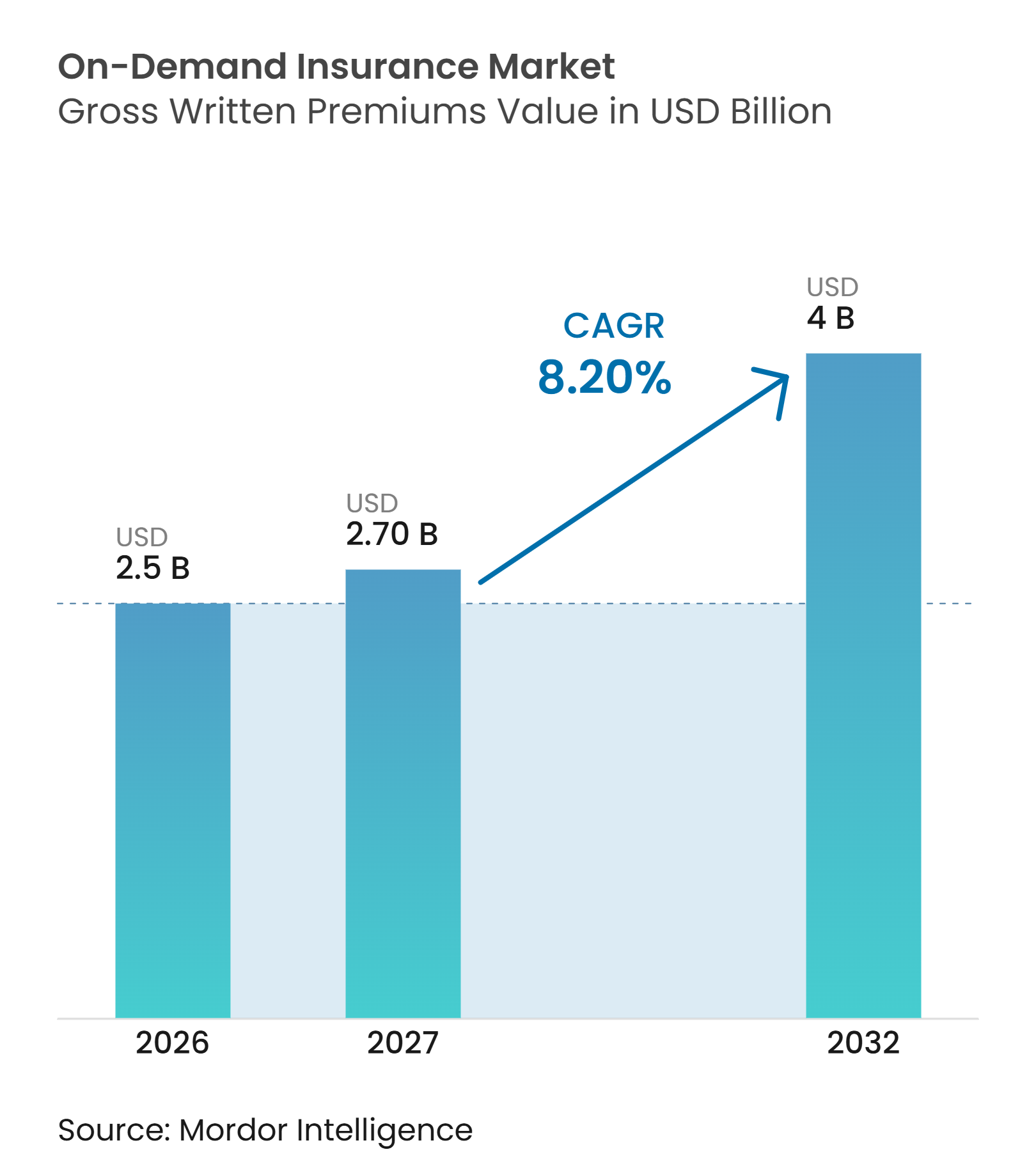
The On-Demand Insurance Market size in terms of gross written premiums was valued at USD 2.5 billion in 2026 and is estimated to grow from USD 2.70 billion in 2027 to reach USD 4 billion by 2032, at a CAGR of 8.20% during the forecast period (2027-2032).
This model provides coverage that activates for a verified risk event, such as a vehicle trip, drone flight, or equipment purchase, instead of relying only on annual policies. Growth is supported by platform-based work, the wider use of valuable assets that are not used continuously, and application programming interface-based distribution. Digital distribution can place cover within a transaction and reduce the cost of reaching customers. It can also make the insurance decision part of a broader purchase journey, where customers are already considering the asset, service, or activity that creates the exposure. Insurers with telematics data and strong platform relationships can build positions that are difficult for later entrants to match. This advantage comes from knowing how exposure begins, how it changes, and when a policy should activate, rather than simply reaching customers through a conventional sales channel. The on-demand insurance market also faces pressure from adverse selection, fragmented rules, and the need for dependable consent and data governance across jurisdictions.
Key Report Takeaways
- By coverage type, motor captured 42.3% of the on-demand insurance market share in 2026, while personal belongings, gadgets, and equipment are projected to grow at an 11.5% CAGR through 2032.
- By pricing and activation basis, time-based, single-purchase policies captured 34.6% of the on-demand insurance market share in 2026, while usage-metered policies are projected to grow at a 12.5% CAGR through 2032.
- By end user, individuals for personal use captured 48.4% of the on-demand insurance market share in 2026, while individuals for work use are projected to grow at a 13.5% CAGR through 2032.
- By distribution channel, direct digital captured 30.1% of the on-demand insurance market share in 2026, while embedded and partner platforms are projected to grow at a 14.2% CAGR through 2032.
- By geography, North America captured 31.8% of the on-demand insurance market share in 2026, while Asia-Pacific is projected to grow at a 11.6% CAGR through 2032.
Note: Market numbers in this report are based on Mordor Intelligence's proprietary estimation framework, which combines nine months of actuals with Q4 projections for base year 2026.
Market Trends and Insights
Drivers Impact Analysis of On-Demand Insurance Market*
| Driver | (~) % Impact on CAGR Forecast | Geographic Relevance | Impact Timeline |
|---|---|---|---|
| Embedded, Transaction-Triggered Insurance Distribution | +2.5% | Global, concentrated in North America, Europe, and Asia-Pacific digital commerce hubs | Medium term (2-4 years) |
| Pay-Per-Use and Short-Duration Coverage Demand | +1.5% | North America, United Kingdom, Germany, Australia | Medium term (2-4 years) |
| Gig Economy, Shared Mobility, and On-Demand Work | +1.3% | Asia-Pacific, Europe, and North America | Short term (≤ 2 years) |
| Specialized and Intermittently Used Assets | +0.8% | North America and Europe | Medium term (2-4 years) |
| Telematics and Connected-Device Risk Assessment | +1.0% | Global, strongest in Europe and North America | Long term (≥ 4 years) |
| Application Programming Interface Integration and Digital Servicing | +0.7% | Global, with early gains in Singapore, India, the United Kingdom, and the Netherlands | Medium term (2-4 years) |
| Source: Mordor Intelligence | |||
Expansion of Embedded, Transaction-Triggered Insurance Distribution
Embedding insurance at the point of customer intent turns protection into a contextual addition to a purchase or service. This approach reduces the awareness barrier that can limit standalone policy sales. It also places the on-demand insurance market within travel, retail, ticketing, logistics, banking, and mobility journeys. The model is most useful when the purchase flow can identify a clear exposure, present suitable terms, record consent, and confirm activation without forcing the customer into a separate insurance journey. bolttech expanded this model through a June 2026 partnership with ING Bank across the Netherlands, Italy, Poland, and Belgium. The company also became BYD’s embedded insurance partner in the United Kingdom, Italy, France, Germany, and Spain in April 2026[1]. These arrangements show how partner distribution can widen access without requiring insurers to build every customer relationship directly.
Rising Demand for Pay-Per-Use and Short-Duration Coverage
Pay-per-use cover responds to customers who need protection for a specific activity rather than for a full year. Short-duration products can suit a borrowed vehicle, a delivery shift, a photography assignment, or a one-day event. They can therefore offer a practical choice where annual coverage would include long periods with little or no relevant exposure. Lemonade launched Autonomous Car insurance in January 2026 to price Tesla Full Self-Driving miles at 50% below its standard per-mile rate in Arizona[2]. The product tied pricing to live driving information rather than relying only on broad demographic factors. In October 2026, Lemonade added support for Tesla FSD V14 Lite and offered 30% per-mile savings for eligible HW3 vehicles in Arizona, Colorado, and Tennessee.
Growth of Gig Economy, Shared Mobility, and On-Demand Work
Gig workers, ride-hail drivers, delivery workers, and freelancers often face exposure that changes during the day. Their work creates demand for policies that activate during a delivery, trip, or assignment. These needs can differ from standard personal cover because the worker’s risk is linked to the time spent completing a paid task and may be connected to more than one platform. China expanded its pilot occupational injury insurance program nationwide in July 2026, covering 29.902 million workers across 14 major platform companies by the end of June 2026[3]. Premiums under the program are calculated per order, while coverage activates daily and follows the worker across platforms. Singapore’s Platform Workers Act took effect on January 1, 2025, and requires operators to provide Work Injury Compensation insurance for ride-hail and delivery workers. These obligations create a source of demand that is less dependent on voluntary consumer awareness.
Proliferation of Specialized and Intermittently Used Assets
Intermittently used assets create insurance needs that are not always well served by annual contracts. Cameras, drones, specialist equipment, rented items, and event assets can have distinct periods of exposure. Protection can be more relevant when it is offered at the purchase moment or immediately before an asset is used for a defined task. Sony and bolttech launched My Sony Care+ in Hong Kong in January 2026 for accidental and liquid damage to selected cameras and lenses[4]. The offering uses post-purchase enrollment and was planned to expand to smartphones, televisions, and audio hardware during 2026. This structure allows protection to be offered closer to the moment when customers acquire an asset. It also supports product design that can reflect the use pattern of individual assets.
Restraints Impact Analysis of On-Demand Insurance Market*
| Restraint | (~) % Impact on CAGR Forecast | Geographic Relevance | Impact Timeline |
|---|---|---|---|
| Adverse Selection and Short-Duration Risk Pricing | -1.2% | Global, most acute where micro-duration actuarial history is limited | Short term (≤ 2 years) |
| Coverage Gaps, Activation Failures, and Disputed Effective Times | -0.8% | Global, heightened where platform data-sharing agreements are absent | Short term (≤ 2 years) |
| Fragmented Product Approval, Distribution, and Data Privacy Rules | -0.7% | Multi-jurisdiction operators, especially North American and European cross-border entrants | Medium term (2-4 years) |
| Digital Integration Costs and Limited Unit Economics | -0.6% | Emerging markets and smaller insurtechs with limited automation scale | Medium term (2-4 years) |
| Source: Mordor Intelligence | |||
Adverse Selection and Uncertain Short-Duration Risk Pricing
Short-duration policies allow customers to buy protection when they expect risk to be highest. That pattern can create an information imbalance when insurers cannot observe behavior across a broader period. Accurate pricing therefore requires sufficient policy activity and reliable behavioral information. A 2025 peer-reviewed study found that adverse selection persisted in China’s online auto insurance setting even when algorithmic underwriting was used. The study also found that machine-learning preprocessing reduced measured severity but did not eliminate the issue. New entrants may need data-sharing partnerships or early investment to develop sufficient experience for sound short-duration pricing.
Coverage Gaps, Activation Failures, and Disputed Effective Times
On-demand policies depend on the quality of the connection between an insurer and the event that activates coverage. A platform application, vehicle connection, device, or user action may all form part of that connection. A failure at any stage can leave a customer uncertain about whether coverage was active. This issue is especially important when a platform, intermediary, and carrier each contribute to the customer journey. Clear contract terms and visible confirmation of activation can reduce disputes over a policy’s effective time. The need for reliable activation can favor providers with direct, well-tested integrations with distribution partners.
*Our forecasts treat driver/restraint impacts as directional, not additive. The impact forecasts reflect baseline growth, mix effects, and variable interactions.
On-Demand Insurance Market Segment Analysis
By Coverage Type:
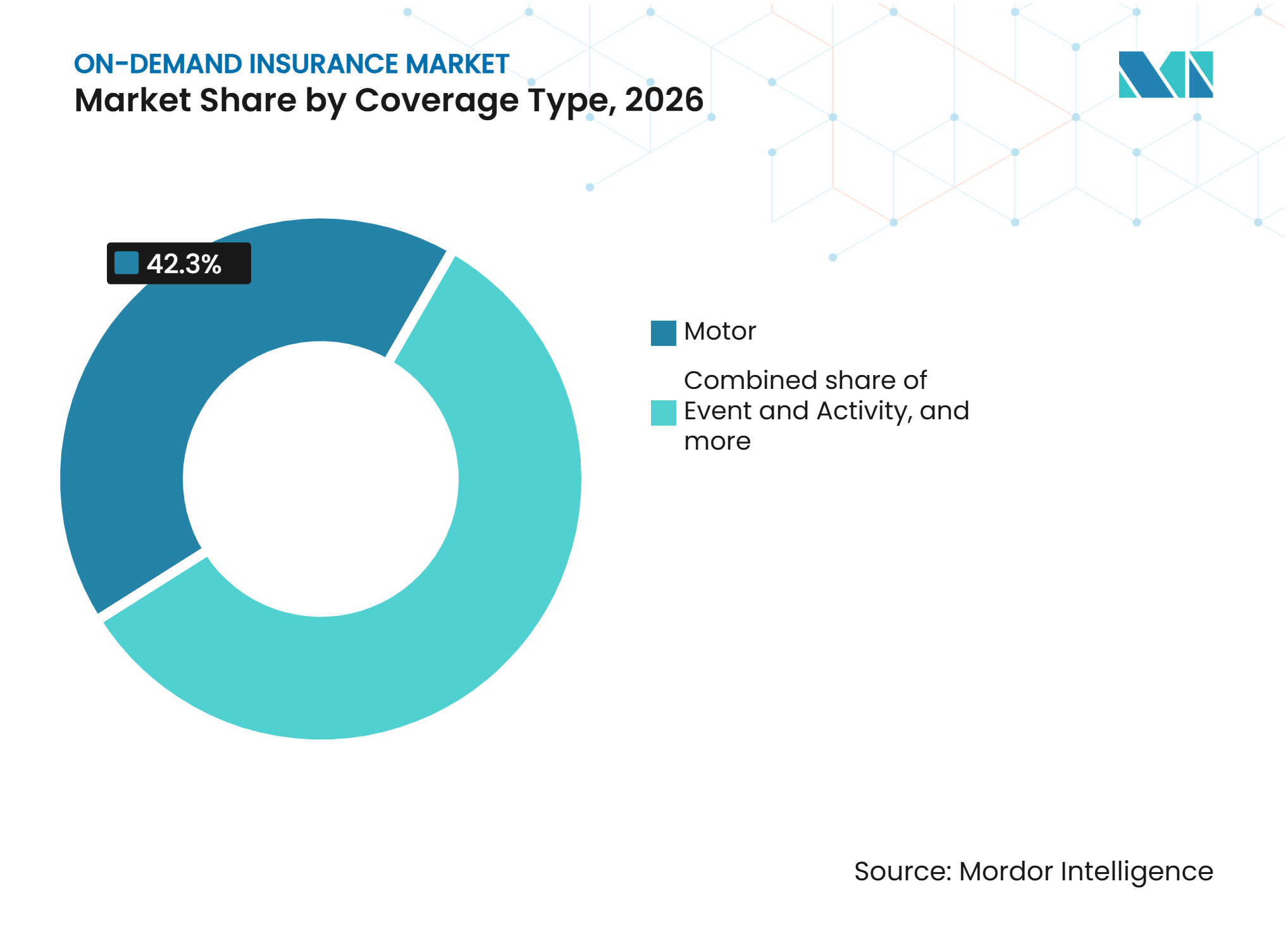
Motor Maintains Scale While Gadgets Gain MomentumMotor held 42.3% of the on-demand insurance market share in 2026, making it the leading coverage category. A vehicle trip is a measurable risk event, and established telematics investment has supported motor product development in advanced insurance markets. App-based activation is used for commercial motor, short-term personal motor, and hourly cover for borrowed vehicles. These products can address ride-hail work, delivery activity, and personal borrowing without requiring an annual policy. Motor also provides a clear setting for testing the link between recorded behavior, exposure, activation, and price. Personal belongings, gadgets, and equipment are forecast to grow at an 11.5% CAGR through 2032, making it the fastest-growing coverage category. Rising ownership of consumer electronics supports demand for protection offered when a device is purchased.
Sony and bolttech’s My Sony Care+ launch in Hong Kong provides an example of embedded device cover for selected cameras and lenses. The product covered accidental and liquid damage through post-purchase enrollment. Event and activity cover addresses intermittent exposure related to sports and hosted gatherings. Personal accident cover can support earnings protection for independent workers with irregular schedules. Liability cover can address the needs of freelancers and small businesses that take on temporary assignments. Together, these categories show that the on-demand insurance market can respond to asset, activity, and income exposures that do not occur continuously. The breadth of these uses allows the on-demand insurance market to serve a range of exposures beyond motor insurance.


By Pricing / Activation Basis:
Time-Based Models Lead While Usage-Metered Pricing ExpandsTime-based, single-purchase accounted for 34.6% of the on-demand insurance market share in 2026. The structure remains widely used because it needs limited data infrastructure and clearly defines the insured time window. It can fit a vehicle borrowed for an afternoon, a single photography job, or one-day event liability. Customers can understand when the policy starts and ends without needing continuous telemetry. This straightforward design can be important where a customer needs immediate cover but does not expect to buy it frequently. Time-based activations under a standing account can deduct covered minutes from a wallet or preloaded account. This format can suit frequent users who require repeated, short coverage periods.
Usage-metered pricing is forecast to grow at 12.5% CAGR through 2032. It charges according to a measured unit such as a mile, kilometer, delivery, or flight hour. Its purpose is to align premium revenue more closely with recorded exposure rather than elapsed time. The model needs a dependable way to define the unit, capture it, and explain its effect on the premium to the policyholder. Lemonade’s pricing for Tesla Full Self-Driving miles is an example of a per-mile structure tied to vehicle information. Per-transaction and per-trip products can serve a distinct event, including a trip or purchase.
By End User:
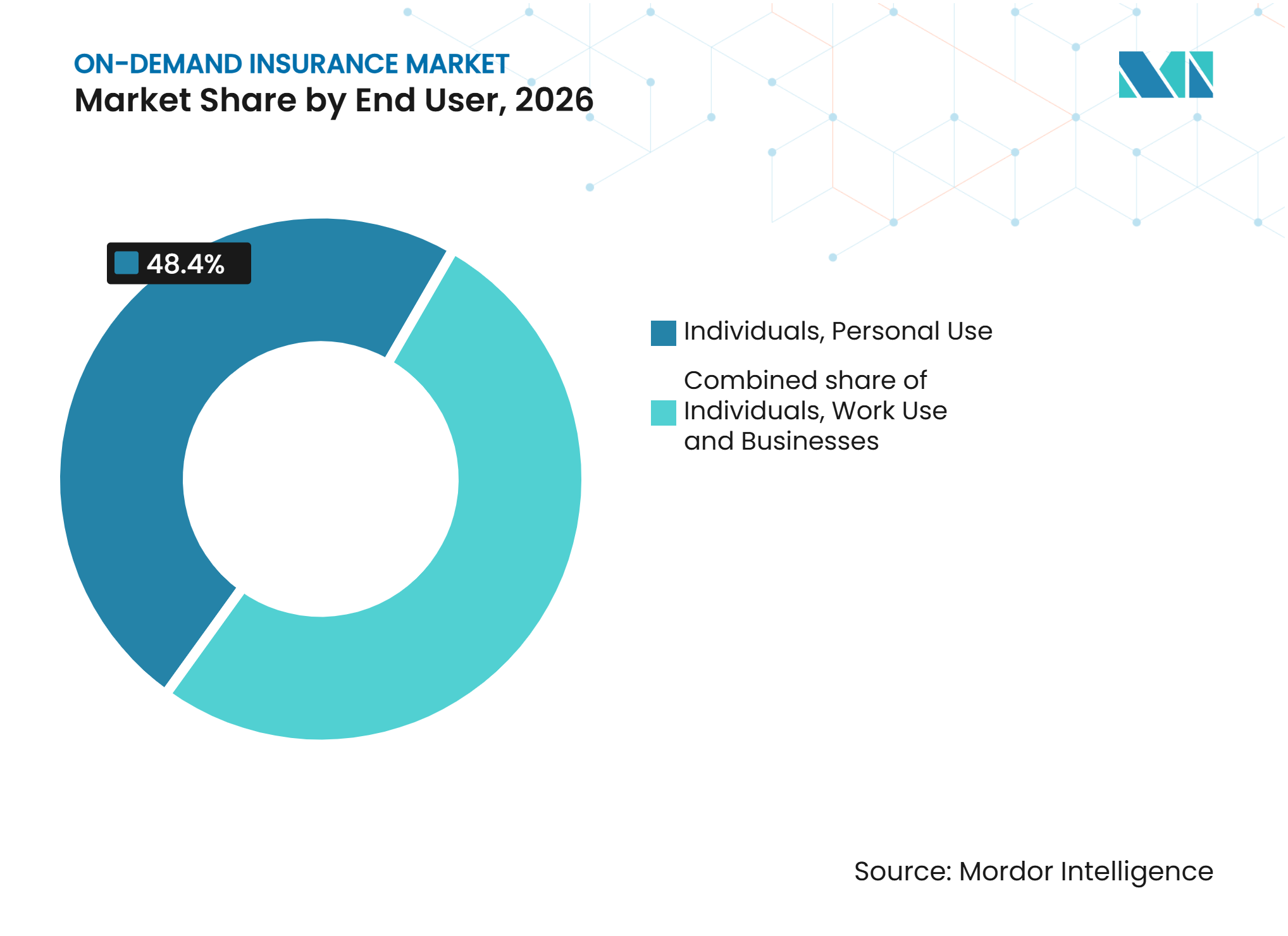
Personal-Use Individuals Lead While Work-Use Individuals Grow FastestIndividuals purchasing cover for personal purposes held 48.4% of the on-demand insurance market share in 2026. This position reflects the early development of consumer digital insurance channels in North America and Europe. Personal users may purchase short-term motor cover, gadget protection, event liability, or travel-related protection. Their requirements often center on ease of purchase, transparent terms, and immediate confirmation. The product must be easy to understand because the customer may make a decision close to the activity that creates the exposure. Businesses also use flexible liability or equipment policies when their operational exposure varies. However, lower coverage frequency per business customer can limit the relative size of this group.
Individuals in work settings are forecast to grow at 13.5% CAGR through 2032. This group includes gig-platform delivery workers, ride-hail drivers, and freelance professionals. Regulation and platform obligations can extend minimum injury cover to workers who previously lacked consistent protection. Coverage that follows a worker across platforms can be especially relevant when work is divided between different applications or clients. China’s nationwide occupational injury program uses per-order premiums and daily portable cover for platform workers. Singapore requires Work Injury Compensation insurance for ride-hail and delivery workers under the Platform Workers Act. These arrangements can expand coverage adoption beyond voluntary consumer demand.

By Distribution Channel:
Direct Digital Leads While Embedded Platforms Grow FastestDirect digital accounted for a 30.1% share in 2026. Insurer-owned applications, websites, and portals fit simple, time-bound products where customers have a clear purchase need. The channel supports self-service activation and can give insurers direct access to customer experience data. It also gives customers a direct point of contact when they need to confirm cover, change a policy, or initiate a claim. Aggregators and comparison sites remain relevant for short-term motor insurance in the United Kingdom. Brokers retain a role for commercial buyers who need customized terms. Gig worker distribution can combine a platform interface with an insurer-to-individual policy relationship.
Embedded and partner platforms are forecast to grow at a 14.2% CAGR through 2032. This channel places protection inside a banking, vehicle, retail, travel, or mobility journey. Its effectiveness depends on presenting relevant terms at the right moment without making the customer journey harder to complete. bolttech’s June 2026 agreement with ING Bank brought embedded insurance to the Netherlands, Italy, Poland, and Belgium. Its April 2026 partnership with BYD covered the United Kingdom, Italy, France, Germany, and Spain. These partnerships demonstrate how distributors can connect policy capacity with a relevant customer transaction. The approach can be effective when data sharing, consent, and servicing responsibilities are clearly defined.
Geography Analysis
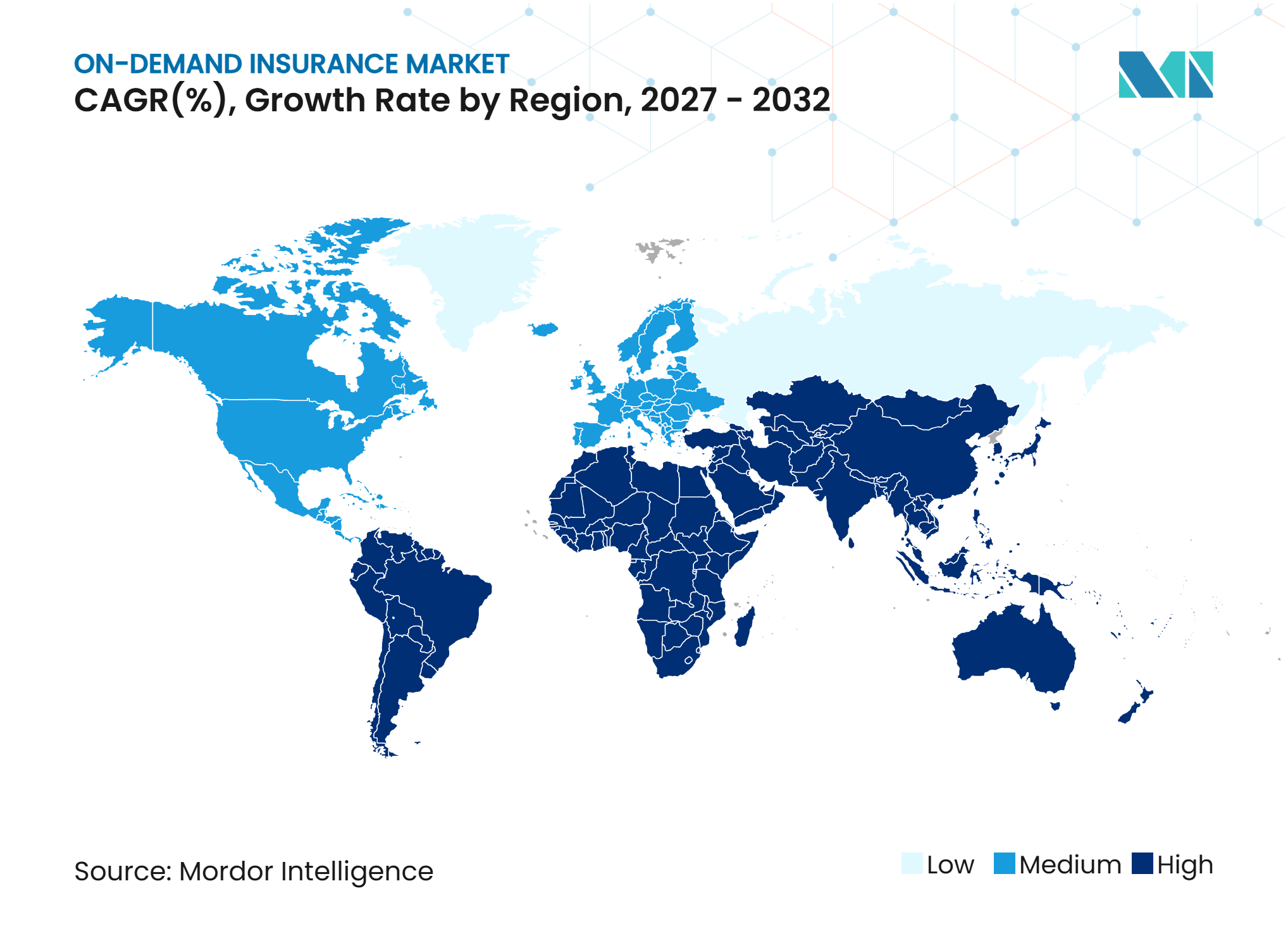
North America held a 31.8% share in 2026. The region benefits from established insurtech infrastructure, high smartphone use, and a large base of motor policies able to use usage-based features. The on-demand insurance market in the United States has a broad set of consumer and small-business providers, which supports experimentation across motor, liability, and personal cover. United States companies, including Lemonade, Thimble, Root Insurance, and Sure, have developed consumer and small-business product approaches across motor, liability, and personal lines. Lemonade launched Autonomous Car insurance in Arizona in January 2026 and later expanded it to Colorado and Tennessee. Colorado’s regulation on external consumer data and predictive models raises governance expectations for data-driven underwriting.
Europe combines United Kingdom category specialists with incumbent-supported digital challengers across the continent. The United Kingdom has produced Cuvva in hourly motor, Zego in commercial motor, INSHUR in platform-worker cover, and Tempcover in short-term motor. The on-demand insurance market benefits from the country’s developed digital motor insurance ecosystem, where short-duration cover has practical relevance for drivers and platform workers. bolttech’s BYD agreement covered the United Kingdom and four other European countries during 2026. The Financial Conduct Authority’s Consumer Duty sets standards for fair value and good customer outcomes in United Kingdom general insurance. South America remains earlier in adoption, while Brazil’s sandbox activity supports confidence in usage-based insurance pilots.
Asia-Pacific is forecast to grow at an 11.6% CAGR through 2032, the fastest regional rate. Super-app usage, mobile payments, and digital financial-inclusion initiatives support the adoption of transaction-triggered products. The on-demand insurance market can use these digital ecosystems to connect a policy with payments, customer identity, and the event that triggers cover. China’s expanded occupational-injury program illustrates the role that policy can play in creating coverage for platform workers. India is developing embedded and microinsurance products within its regulatory sandbox framework. The Middle East and Africa remain earlier-stage markets, but bolttech’s July 2026 partnership with Jubilee Health Insurance shows the use of API-based embedded health cover in East Africa.
Competitive Landscape
Market Concentration
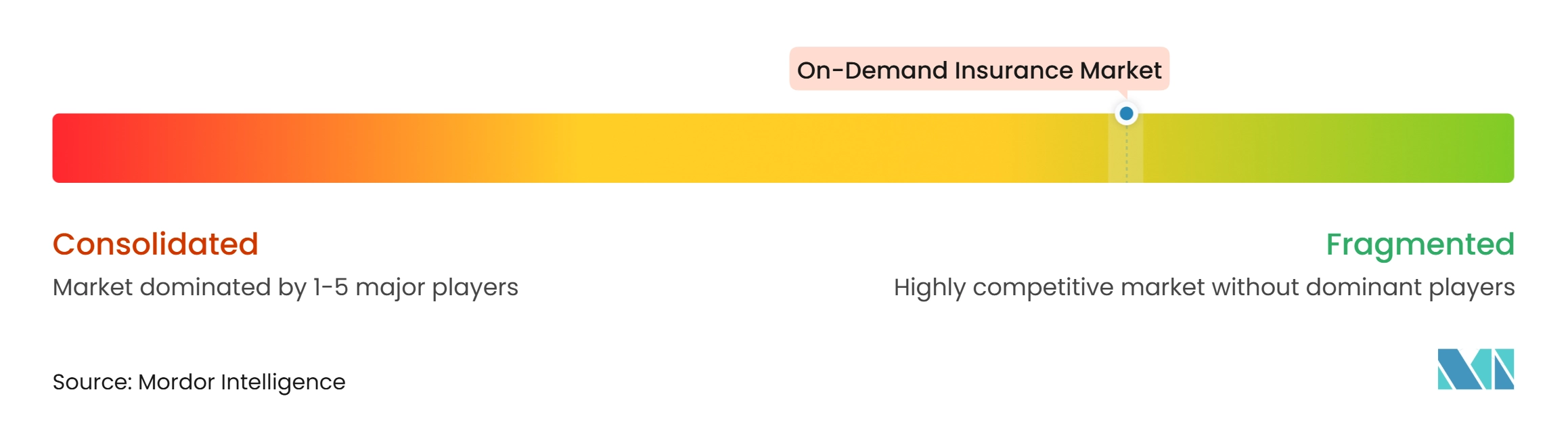
The on-demand insurance market is fragmented, with competition driven by product design, data capabilities, underwriting capacity, and distribution access. Digitally native providers, including Zego, Cuvva, Acko, ZhongAn, Lemonade, and Getsafe, compete by offering rapid policy activation, digital customer experiences, and flexible coverage. Embedded insurance platforms, such as Cover Genius, bolttech, Sure, and Qover, prioritize partner integrations and broad distribution reach. These business models vary in their control over policy design, customer relationships, servicing, and claims management. As a result, operational reliability and clear accountability remain important competitive differentiators.
Strategic partnerships are strengthening the link between insurance distribution and product design. In April 2026, bolttech partnered with BYD to distribute embedded insurance across the United Kingdom, Italy, France, Germany, and Spain, using vehicle-related data to support electric vehicle underwriting. In June 2026, bolttech expanded its European banking distribution through ING Bank, while its partnership with Sony introduced consumer device protection in Hong Kong. Lemonade also introduceed a Tesla-focused insurance product in January 2026, offering lower rates based on miles driven using Full Self-Driving technology. These developments underscore the growing role of manufacturer, banking, and technology partnerships in linking insurance coverage with customer transactions and relevant asset data.
Key opportunities include small-business professional liability insurance, parametric travel and weather coverage, and protection for shared or rented assets. Explainable pricing models, robust data governance, and efficient policy administration can help providers balance product flexibility with regulatory requirements. Colorado’s Regulation 10-1-1 establishes governance and risk management requirements for insurers’ use of external data and predictive models, while the United Kingdom Financial Conduct Authority’s Consumer Duty emphasizes fair value and positive customer outcomes. Compliance costs may challenge smaller insurtech companies and contribute to consolidation among managing general agents and platform specialists. Ultimately, competitive advantage will depend on combining accessible distribution with transparent policy activation, clearly defined responsibilities, and reliable claims handling.
On-Demand Insurance Industry Leaders
-
Lemonade, Inc.
-
Cover Genius Pty Ltd
-
Zego Ltd
-
Root Insurance Company
-
Slice Insurance Technologies, Inc.
- *Disclaimer: Major Players sorted in no particular order
On-Demand Insurance Market Companies Covered in this Report
- Lemonade, Inc.
- Cover Genius Pty Ltd.
- Zego Ltd.
- Root Insurance Company
- Slice Insurance Technologies, Inc.
- Cuvva Ltd.
- Thimble
- Tapoly Ltd.
- SkyWatch Insurance Services, Inc.
- INSHUR
- Sure, Inc.
- ZhongAn Online P&C Insurance Co., Ltd.
- Getsafe GmbH
- Tempcover
- bolttech
- Qover
- Acko General Insurance Limited
- Laka
- SafetyWing
- Urban Jungle
Recent Industry Developments in On-Demand Insurance Market
- October 2026: Lemonade extended its Autonomous Car insurance to support Tesla FSD V14 Lite (HW3), offering 30% per-mile savings in Arizona, Colorado, and Tennessee. HW4 drivers retain the original 50% discount. The update expands the sensor-verified pricing model to a broader base of FSD-enrolled Tesla vehicles for the first time.
- September 2026: Thimble and Bold Penguin launched an agentic AI integration enabling autonomous quote-and-bind in small commercial lines, allowing Bold Penguin brokers to originate Thimble policies through natural-language AI workflows without leaving existing systems.
- July 2026: China’s Ministry of Human Resources and Social Security expanded its pilot occupational-injury insurance program nationwide, covering 29.902 million gig-economy workers at 14 major platform companies, with per-order premiums and daily portable coverage following workers across platforms.
- June 2026: ING Bank selected bolttech as its strategic partner for embedded insurance across the Netherlands, Italy, Poland, and Belgium, with additional European markets in the pipeline, scaling embedded insurance through a major multinational bank’s customer base.
Global On-Demand Insurance Market Report Scope
Segmentation Overview
| Motor |
| Personal Belongings, Gadgets and Equipment |
| Event and Activity |
| Personal Accident |
| Liability |
| Other On-Demand Cover |
| Time-Based, Single Purchase |
| Time-Based, Activations Under a Standing Account |
| Usage-Metered |
| Per-Transaction / Per-Trip |
| Individuals, Personal Use |
| Individuals, Work Use |
| Businesses |
| Direct Digital |
| Aggregators and Comparison Sites |
| Embedded / Partner Platforms |
| Brokers, Agents and Other |
| Gig Workers and Freelancers |
| North America | United States |
| Canada | |
| Mexico | |
| South America | Brazil |
| Argentina | |
| Rest of South America | |
| Europe | United Kingdom |
| Germany | |
| France | |
| Italy | |
| Spain | |
| Rest of Europe | |
| Asia-Pacific | China |
| India | |
| Japan | |
| Australia | |
| Rest of Asia-Pacific | |
| Middle East & Africa | United Arab Emirates |
| Saudi Arabia | |
| South Africa | |
| Rest of Middle East & Africa |
| By Coverage Type | Motor | |
| Personal Belongings, Gadgets and Equipment | ||
| Event and Activity | ||
| Personal Accident | ||
| Liability | ||
| Other On-Demand Cover | ||
| By Pricing / Activation Basis | Time-Based, Single Purchase | |
| Time-Based, Activations Under a Standing Account | ||
| Usage-Metered | ||
| Per-Transaction / Per-Trip | ||
| By End User | Individuals, Personal Use | |
| Individuals, Work Use | ||
| Businesses | ||
| By Distribution Channel | Direct Digital | |
| Aggregators and Comparison Sites | ||
| Embedded / Partner Platforms | ||
| Brokers, Agents and Other | ||
| Gig Workers and Freelancers | ||
| By Geography | North America | United States |
| Canada | ||
| Mexico | ||
| South America | Brazil | |
| Argentina | ||
| Rest of South America | ||
| Europe | United Kingdom | |
| Germany | ||
| France | ||
| Italy | ||
| Spain | ||
| Rest of Europe | ||
| Asia-Pacific | China | |
| India | ||
| Japan | ||
| Australia | ||
| Rest of Asia-Pacific | ||
| Middle East & Africa | United Arab Emirates | |
| Saudi Arabia | ||
| South Africa | ||
| Rest of Middle East & Africa | ||
Key Questions Answered in the Report
What is on-demand insurance?
It is insurance that activates for a specific verified risk event, such as a vehicle trip, delivery shift, drone flight, or equipment purchase, rather than only through an annual contract. The on-demand insurance market uses this model to align cover more closely with a defined exposure.
How large is the on-demand insurance market?
The on-demand insurance market is projected to grow from USD 2.5 billion in 2026 to USD 4.0 billion by 2032 at an 8.2% CAGR.
Which coverage type leads on-demand insurance?
Motor is the largest coverage type, with a 42.3% share in 2026, supported by measurable trip-based risk and telematics capability.
Which on-demand insurance channel is growing fastest?
Embedded and Partner Platforms is forecast to grow at 14.2% CAGR through 2032 as cover is placed within banking, retail, vehicle, and mobility journeys.
Why is Asia-Pacific important for on-demand insurance?
Asia-Pacific is forecast to grow at 11.6% CAGR through 2032, supported by super-app ecosystems, mobile payments, and digital financial-inclusion initiatives.
What limits the adoption of on-demand insurance?
Adverse selection, activation failures, fragmented data rules, and high integration costs can constrain adoption and affect product economics.