
Oman Real Estate Market Size and Share
Market Overview
| Study Period | 2020 - 2031 |
|---|---|
| Forecast Data Period | 2026 - 2031 |
| Base Year Market Size (2025) | USD 7.06 Billion |
| Market Size (2026) | USD 7.51 Billion |
| Market Size (2031) | USD 10.20 Billion |
| Growth Rate (2026 - 2031) | 6.31 % |
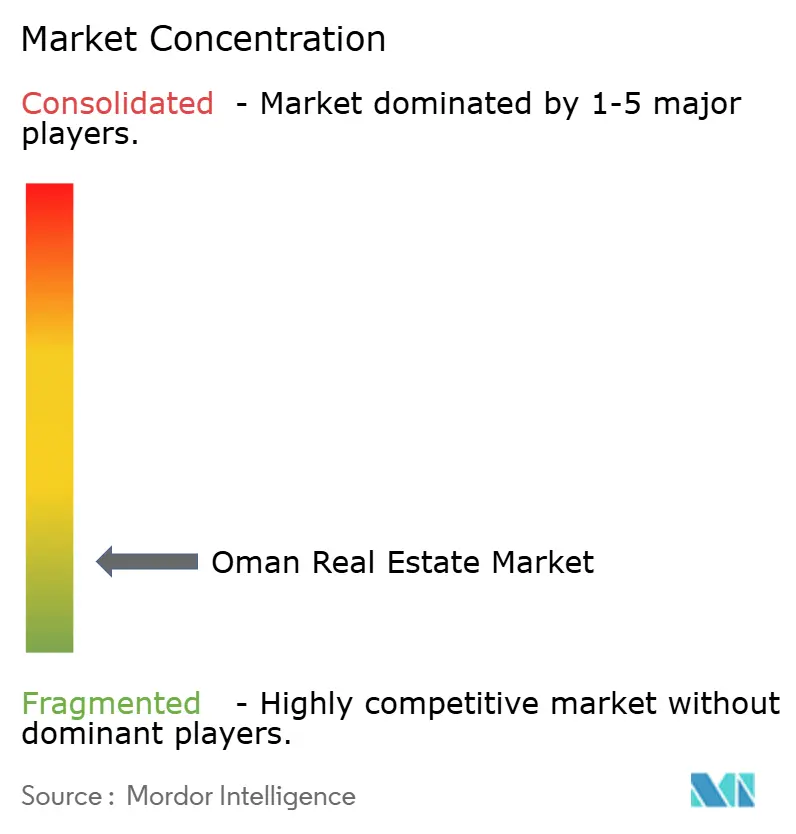
| Market Concentration | Low |
Major Players *Disclaimer: Major Players sorted in no particular order Image © Mordor Intelligence. Reuse requires attribution under CC BY 4.0. | |
Oman Real Estate Market Analysis by Mordor Intelligence
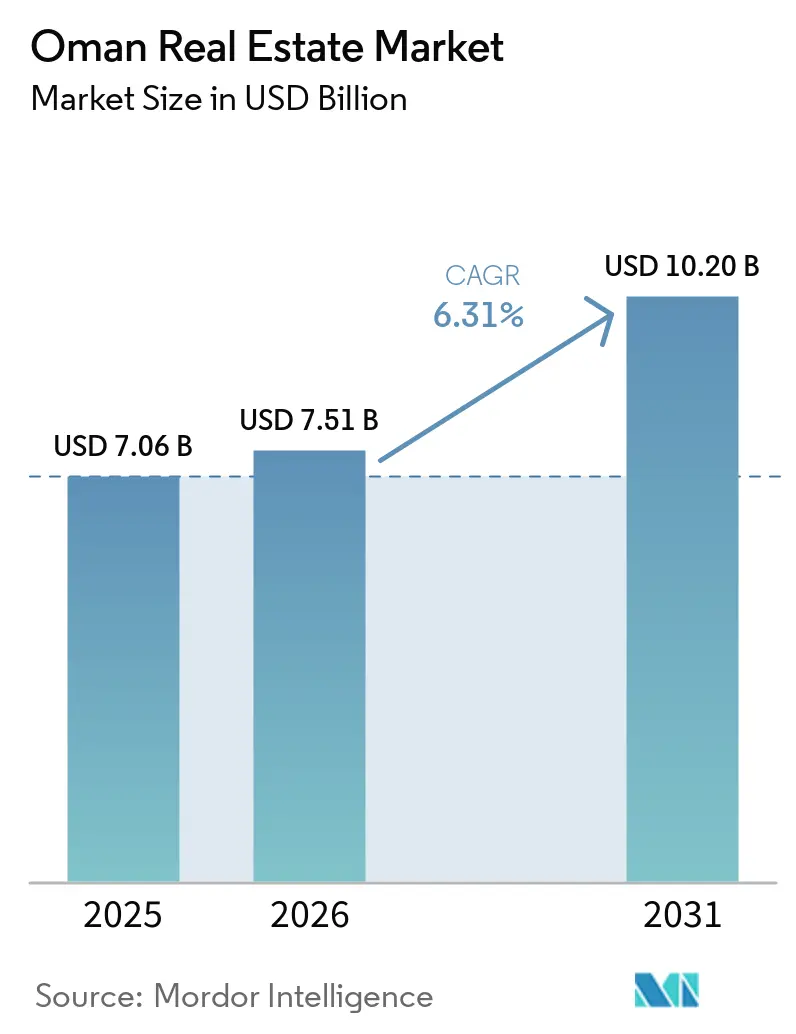
The Oman Real Estate Market size is expected to grow from USD 7.06 billion in 2025 to USD 7.51 billion in 2026 and is forecast to reach USD 10.20 billion by 2031 at 6.31% CAGR over 2026-2031.
Oman Vision 2040 continues to direct investment toward non-oil activity, tourism, logistics, and planned urban communities. The Real Estate Price Index rose 15.9% year over year in the first quarter of 2026, which points to firmer demand across property categories and locations. Royal Decree No. 79/2025 introduced a unified regulatory framework, including off-plan escrow accounts and licensing requirements for brokers and appraisers. Royal Decree No. 56/2026 established a digital property register and gave electronic title deeds the same legal status as paper documents. These changes improve transaction visibility, although new supply in integrated tourism complexes raises the importance of delivery quality, established brands, and complete community services.
Key Report Takeaways
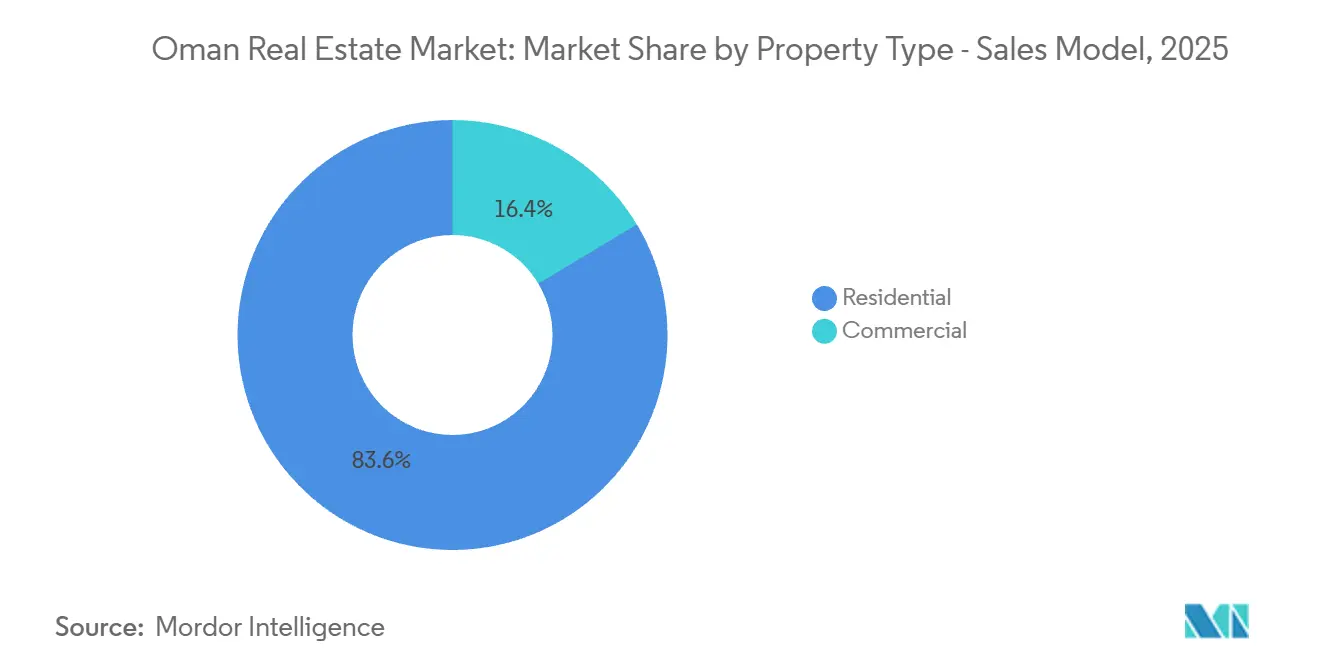
- By sales property type, residential property held 83.6% of the Oman real estate market share in 2025 and recorded the highest projected CAGR at 7.03% through 2031.
- By sales city, Muscat held 50.4% of the Oman real estate market share in 2025, while Dhofar is forecast to grow at 7.22% CAGR through 2031.
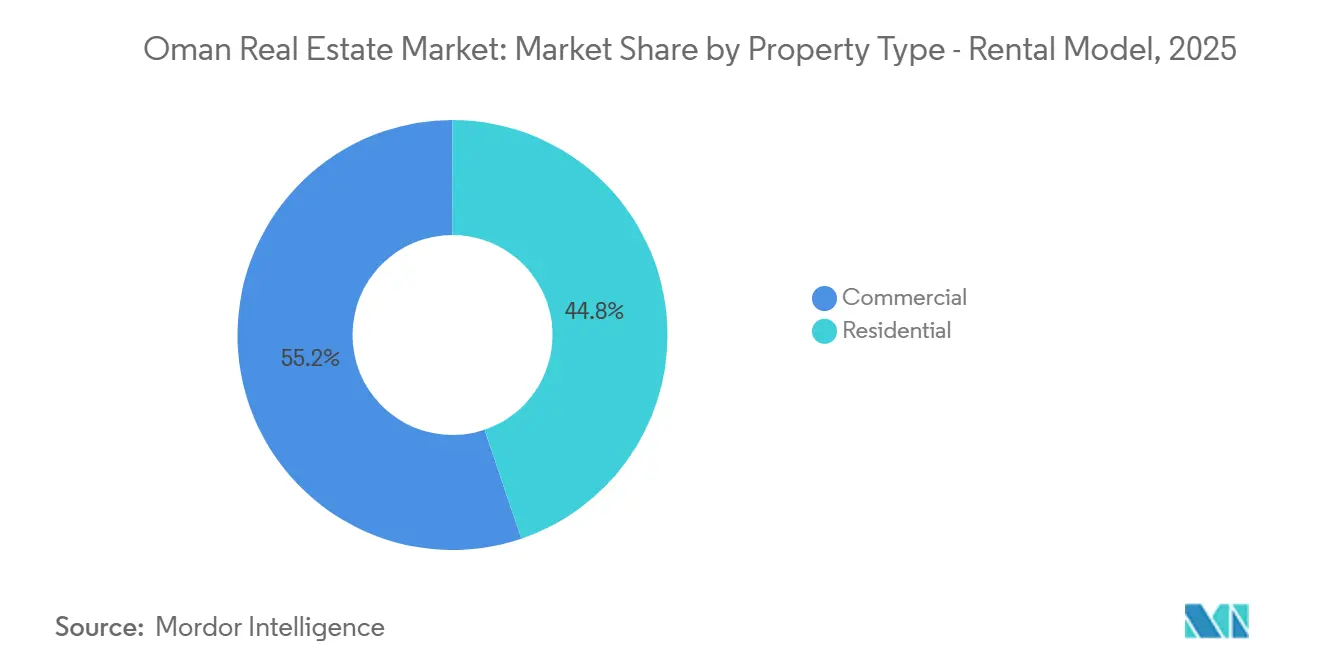
- By rental property type, commercial property accounted for 55.2% of the Oman real estate market size in 2025, while residential rental property is forecast to grow at 6.91% CAGR through 2031.
- By rental city, Muscat accounted for 58.3% of the Oman real estate market size in 2025, while Dhofar is forecast to grow at 7.43% CAGR through 2031.
Note: Market size and forecast figures in this report are generated using Mordor Intelligence’s proprietary estimation framework, updated with the latest available data and insights as of January 2026.
Oman Real Estate Market Trends and Insights
Drivers Impact Analysis*
| Drivers | (~) % Impact on CAGR Forecast | Geographic Relevance | Impact Timeline |
|---|---|---|---|
| Integrated tourism complexes are expanding the premium residential and mixed-use supply | +1.8% | National, concentrated in Muscat, Dhofar, and coastal corridors | Medium term (2-4 years) |
| Foreign ownership and residency-linked investment frameworks | +1.0% | Global buyers, mainly from the Gulf Cooperation Council, Europe, and South Asia | Medium term (2-4 years) |
| Sultan Haitham City and planned urban communities | +0.9% | Greater Muscat, with effects in Seeb and Al Batinah | Medium term (2-4 years) |
| Tourism expansion supporting hospitality property | +0.7% | Dhofar, Muscat Governorate, Musandam, and other coastal areas | Long term (≥ 4 years) |
| Industrial diversification increasing logistics and warehouse demand | +0.5% | Sohar, Duqm, and Salalah | Long term (≥ 4 years) |
| Demand for modern Grade A workplaces | +0.3% | Muscat business districts, Madinat Al Irfan, and emerging hubs | Long term (≥ 4 years) |
| Source: Mordor Intelligence | |||
Integrated Tourism Complexes and Foreign Ownership Expanding the Buyer Base
Integrated Tourism Complexes, or ITCs, are increasing the supply of premium homes and mixed-use projects in the Oman real estate market. Active projects include Al Mouj, The Sustainable City Yiti, AIDA, Jebel Sifah, Muscat Hills, and Hawana Salalah, while Al Qurum and Al Bustan were announced as further ITC developments[1]. The breadth of this pipeline gives buyers more choice across waterfront, urban, resort, and sustainability-focused settings, while placing greater weight on the ability of each project to establish a clear position. The investor residency program offers a 5-year visa for a qualifying investment of USD 650,000 and a 10-year visa for a qualifying investment of USD 1.3 million, with ITC purchases serving as a principal route[2]. The Owner Visa, introduced in June 2026, added a residency route without a minimum property value. The newer registry and title framework reduces legal and transaction-related concerns for overseas buyers. Projects therefore compete more directly on completion records, operator brands, amenities, and buyer confidence than on price alone.
Sultan Haitham City Creating a Broader Urban Demand Base
Sultan Haitham City adds residential supply while also creating demand for services, offices, and community facilities in Greater Muscat. The master plan covers 14.8 million square meters and is designed for 100,000 residents across 19 neighborhoods. Investment had exceeded USD 6.2 billion by April 2026, with 70% of the first 2 tender phases under execution and more than 1,700 homes sold. Three substations with 160 megavolt-amperes of combined capacity were commissioned in September 2026, and the first Hay Al Wafaa residents are expected by the end of 2026. The city includes schools, hospitals, a university, and commercial areas within its neighborhoods. This structure supports the Oman real estate market because housing demand and commercial activity can develop together rather than in separate phases.
Tourism and Industrial Investment Supporting Multiple Property Types
Tourism is supporting hotels, resorts, branded residences, and workforce housing across Oman. TUI Group and OMRAN Group formed a joint venture for 5 hotels in Dhofar, which target a winter 2028 opening and connect hotel development with international distribution[3]. Muriya Tourism Development plans to add 1,000 hotel rooms at Hawana Salalah and Jebel Sifah over 3-5 years, supported by cumulative investment above USD 750 million. This approach spans luxury, branded mid-market, and eco-tourism accommodation, so it broadens the types of lodging and residential demand being developed. Industrial diversification also supports warehouses and logistics facilities in Sohar, Duqm, and Salalah. SOHAR Port and Freezone reported a 19% year-over-year rise in leased warehouse space during the first half of 2026. The Oman real estate market is therefore gaining demand sources beyond premium residential development, even though hospitality and logistics projects have different tenant and investment cycles.
Modern Workplaces Raising the Standard for Commercial Assets
Demand for efficient Grade A offices is reshaping commercial development in Muscat. Office occupiers are placing more value on location, energy performance, building quality, and flexible space. Premium offices at Al Mouj Business Park and Madinat Al Irfan achieved rents of USD 18 to USD 31 per square meter per month, with occupancy above 85%. This supports selective new workplace development in established and emerging business districts. It also creates pressure on older buildings that cannot meet the requirements of multinational tenants. Flexible workspace formats add another source of leasing demand as small and international businesses expand their presence. The Oman real estate market benefits from this upgrade cycle, but returns remain tied to asset quality and effective building management.
Restraints Impact Analysis*
| Restraints | (~) % Impact on CAGR Forecast | Geographic Relevance | Impact Timeline |
|---|---|---|---|
| Foreign ownership restrictions outside designated areas | -0.7% | National, especially Musandam, Al Buraimi, and areas outside ITCs | Long term (≥ 4 years) |
| Secondary-grade properties facing weaker occupier demand | -0.5% | Muscat secondary districts and other areas of Oman | Medium term (2-4 years) |
| Regional geopolitical uncertainty affecting sentiment | -0.5% | National, with greater exposure in hospitality locations | Short term (≤ 2 years) |
| Limited liquidity in selected property segments | -0.3% | Musandam, other areas of Oman, and secondary commercial stock | Medium term (2-4 years) |
| Source: Mordor Intelligence | |||
Ownership Limits and Market Liquidity Constraining Foreign Participation
Foreign freehold ownership remains concentrated in ITCs and selected special economic zones, which narrows the range of assets available to international buyers. This leaves many residential areas outside the foreign ownership framework. Al Batinah North recorded USD 2.3 billion in real estate trading in 2024, but much of the broader provincial housing stock is not open to foreign freehold investment. The Ministry of Housing and Urban Planning retains significant influence over the locations and project types that qualify for ITC designation. Compliance obligations for developers, including licensing and escrow requirements, strengthen buyer protection but can increase approval time and development costs for smaller firms. Lower transaction activity in some provincial and secondary commercial segments also makes price discovery more difficult. The Oman real estate market may therefore see foreign capital remain concentrated in premium, designated projects while domestic and regional buyers carry more of the demand elsewhere.
Secondary Stock and Regional Uncertainty Limiting Near-Term Demand
Older properties are facing weaker demand as tenants and buyers favor new integrated communities and better-performing buildings. Premium Muscat office locations achieved rents of USD 18 to USD 31 per square meter per month, while secondary districts achieved USD 10 to USD 13 per square meter per month and often relied on incentives. Secondary residential assets in suburban locations also face competition from newly delivered communities. Properties with higher environmental credentials can achieve rental premiums, which widens the divide between modern stock and assets that need reinvestment. Regional geopolitical uncertainty can affect tourism bookings, investment sentiment, and transaction timing, especially for hospitality-linked assets. Owners of aging buildings may need material reinvestment to stay competitive. These factors do not remove demand from the Oman real estate market, but they make asset selection and location more important.
*Our forecasts treat driver/restraint impacts as directional, not additive. The impact forecasts reflect baseline growth, mix effects, and variable interactions.
Segment Analysis
By Property Type, Sales Model, Residential Property Leads Through ITC and Planned-City Delivery
Residential property held 83.6% of sales value in 2025, making it the largest sales segment in the Oman real estate market. It is also forecast to be the fastest-growing sales segment, with a 7.03% CAGR through 2031. ITC developments, planned communities, and the availability of qualifying property for investor residency support this position. Sultan Haitham City adds a substantial source of new residential supply and is designed around an integrated community model. Apartments and condominiums remain important in ITC areas, while villas and landed homes appeal to households seeking more space and buyers using high-value residency pathways.
Commercial property accounted for the remaining sales activity, including offices, retail, logistics, industrial, and hospitality assets. Warehouse demand strengthened in the first half of 2026 as SOHAR Port and Freezone reported a 19% increase in leased warehouse space. New ITCs at Al Qurum and Al Bustan add further residential and mixed-use supply. The sales market also benefits from clearer rules for off-plan projects under Royal Decree No. 79/2025. Industrial property has a different demand base, tied to free zones and economic activity in logistics corridors. This mix limits the Oman real estate industry’s reliance on a single type of end user, even as residential property remains the main source of sales value.

By City, Sales Model, Muscat Holds the Largest Base While Dhofar Grows Faster
Muscat held 50.4% of sales value in 2025, giving it the leading position in the Oman real estate market. The capital benefits from its large urban base, more established ITCs, government-backed urban development, and concentration of freehold stock. Residential land prices in Muscat rose 43.6% year over year in the first quarter of 2026. Sultan Haitham City, Al Qurum, and Al Bustan reinforce the city’s project pipeline. Grade A offices and established mixed-use districts also support its broad investor base. Muscat, therefore, combines residential depth with commercial demand that other locations are still building.
Dhofar is forecast to grow at 7.22% CAGR through 2031, making it the fastest-growing sales geography. The governorate’s tourism and urban investment pipeline is large relative to its current base. TUI’s planned 5 hotels and Muriya’s planned 1,000-room expansion add accommodation capacity and support related residential demand. Musandam has also attracted early developer and lender participation through Palm Hills. Other areas of Oman gain support from Sohar’s industrial activity and domestic housing demand in cities such as Nizwa.
By Property Type, Rental Model, Commercial Property Leads, While Residential Rents Grow Faster
Commercial property held 55.2% of the rental value in 2025, making it the largest rental segment in the Oman real estate market. Grade A offices in Muscat and logistics facilities in major industrial corridors provide the core rental base. Warehouses and logistics assets achieved gross yields of 9.4%, compared with 8.5% for Grade A offices and 8.8% for retail property. This reflects industrial tenant demand in Sohar and Duqm, together with selective demand for high-quality offices. Offices, retail space, warehouses, industrial buildings, and hospitality properties all contribute to commercial rental income.
Residential property is forecast to be the fastest-growing rental segment, with a 6.91% CAGR through 2031: tourism, logistics, and other non-oil employment support workforce housing demand. ITC locations serve corporate tenants and senior expatriates seeking managed communities and lifestyle facilities. Conventional urban neighborhoods continue to provide value-oriented options for the wider workforce. The different price points across ITC and non-ITC areas show that rental demand is not limited to luxury housing. This creates room for operators that can provide reliable mid-income supply near employment locations while maintaining practical access to transport and services.
Geography Analysis
Muscat held 50.4% of sales value and 58.3% of rental value in 2025, making it the largest geography in both models of the Oman real estate market. Its position rests on government-backed planning, ITC freehold inventory, commercial activity, and its role as the country’s principal urban center. Total real estate trading in Muscat reached USD 3.3 billion in 2024. The first half of 2026 recorded around 34,000 sales contracts nationwide, with transaction value reaching USD 3.7 billion. Sultan Haitham City, Al Qurum, and Al Bustan reinforce Muscat’s development pipeline. Higher-quality offices also draw multinational occupiers toward the city’s established business areas.
Dhofar is the fastest-growing city in the Oman real estate market, with sales forecast to grow at 7.22% CAGR and rentals at 7.43% CAGR through 2031. The governorate is building a wider base of tourism, hospitality, housing, and logistics activity. TUI and OMRAN are developing 5 hotels for a winter 2028 opening, while Muriya plans 1,000 additional hotel rooms at Hawana Salalah and Jebel Sifah. This pipeline can support accommodation demand beyond the traditional seasonal tourism period. Salalah’s logistics position also provides a separate source of property demand. The development path depends on project execution and on maintaining visitor and investor confidence.
Musandam remains a smaller and earlier-stage location, but residential land prices rose 17.6% in the first quarter of 2026. The Palm Hills project secured financing agreements with 8 lenders for around 650 units. Its coastal location and marine tourism potential provide a focused growth case. Other areas of Oman broaden the geographic base through Al Batinah North, Sohar, Duqm, Salalah, and domestic centers such as Nizwa. Al Batinah North recorded USD 2.3 billion in property trading in 2024. Sohar and Duqm are especially relevant for logistics, industrial premises, and workforce housing. The Oman real estate market, therefore, remains centered on Muscat but has increasingly distinct demand bases across the country.
Competitive Landscape
The Oman real estate market is moderately fragmented, with no developer shown to hold a dominant share across all property categories and locations. Government-linked developers such as OMRAN Group, Al Mouj Muscat, and Muriya Tourism Development have access to major tourism and mixed-use projects. Private domestic and regional developers compete for mandates in Sultan Haitham City and emerging ITCs. Compliance with escrow, licensing, and owners’ association rules favors firms with stronger financial resources and project controls. This framework can reduce buyer risk, but it can also make it harder for undercapitalized entrants to compete. Market concentration score: 3 out of 10, because the source material identifies no disclosed combined share for leading developers and describes competition as moderately fragmented rather than concentrated.
OMRAN Group has a prominent position because it participates in tourism development, land projects, and hotel partnerships. In September 2025, OMRAN Group and TUI Group agreed to form a joint venture for 5 hotels in Dhofar, while OMRAN acquired a 1.4% interest in TUI Group. In March 2026, OMRAN signed a USD 390 million agreement for the Al Bustan ITC, which includes a Four Seasons hotel, branded homes, a marina, and a yacht club. OMRAN has also partnered with Diamond Developers on The Sustainable City Yiti. These moves link residential development with hotel operations, tourism demand, and long-term place management.
Regional entrants are increasing competitive pressure for premium sites and urban development contracts. Retal Urban Development signed a USD 800 million agreement in July 2026 to act as lead developer for areas in Sultan Haitham City, covering more than 2,000 homes. LEO Development and Rove Hotels also agreed to work on projects in ITCs, free zones, and special economic areas in June 2026. Al Mouj Muscat, Muscat Hills Development, Orascom Development Holding, and Saraya Bandar Jissah continue to deepen their coastal and ITC portfolios. Smaller developers, including WUJHA Real Estate, Bayan Investment and Development, and Malik Developments, address non-ITC and mid-market demand. The Oman real estate industry is likely to reward developers that combine credible delivery, clear buyer protections, and an operating model suited to each local demand base.
Oman Real Estate Industry Leaders
-
Al Mouj Muscat
-
Al Raid Group
-
WUJHA Real Estate
-
Al-Taher Group
-
Maysan Properties SAOC
- *Disclaimer: Major Players sorted in no particular order
Recent Industry Developments
- September 2026: OPEC Fund approved up to USD 40 million for The Sustainable City Yiti, Plaza District. Financing supports the OMRAN Group and Diamond Developers joint venture, and the first residential unit handover is planned for December 2027.
- September 2026: VA Group secured long-term land rights for Muttrah Waterfront, covering 18.5 hectares, in partnership with OMRAN Group. The project combines residential, leisure, cultural, and retail components.
- July 2026: Retal Urban Development Company signed a USD 800 million agreement with the Ministry of Housing and Urban Planning. Retal acts as lead developer for areas 3, 15, and 17 in Sultan Haitham City, covering 1.3 million square meters and more than 2,000 residential units.
Oman Real Estate Market Report Scope
| Residential | Apartments and Condominiums |
| Villas and Landed Houses | |
| Commercial | Office |
| Retail | |
| Logistics | |
| Other Commercial Property, Including Industrial and Hospitality |
| Muscat |
| Dhofar |
| Musandam |
| Rest of Oman |
| By Property Type (Rental Model) | Residential | Apartments and Condominiums |
| Villas and Landed Houses | ||
| Commercial | Office | |
| Retail | ||
| Logistics | ||
| Other Commercial Property, Including Industrial and Hospitality | ||
| By City | Muscat | |
| Dhofar | ||
| Musandam | ||
| Rest of Oman | ||
Key Questions Answered in the Report
What is the forecast for the Oman real estate market?
The Oman real estate market is projected to increase from USD 7.51 billion in 2026 to USD 10.2 billion by 2031, at a 6.31% CAGR.
Which property type leads sales in Oman?
Residential property led sales with an 83.6% share in 2025 and is forecast to grow at 7.03% CAGR through 2031.
Which city has the largest real estate base in Oman?
Muscat led both models in 2025, holding 50.4% of sales value and 58.3% of rental value.
Why is Dhofar growing faster than other locations?
Dhofar is supported by hotel, tourism, housing, and logistics investment, with sales forecast to grow at 7.22% CAGR and rentals at 7.43% CAGR.
What changes did the Real Estate Register Law make?
Royal Decree No. 56/2026 established a digital property register and recognized electronic title deeds.
What rental property type is growing fastest in Oman?
Residential rental property is forecast to grow at 6.91% CAGR through 2031, supported by workforce housing demand.