
Oil Storage Terminal Market Size and Share
Market Overview
| Study Period | 2022 - 2032 |
|---|---|
| Market Size (2027) | USD 40.18 Billion |
| Market Size (2032) | USD 51.67 Billion |
| Growth Rate (2027 - 2032) | 5.16 % |
| Fastest Growing Market | Asia-Pacific |
| Largest Market | Asia-Pacific |
| Market Concentration | Low |
Major Players *Disclaimer: Major Players sorted in no particular order Image © Mordor Intelligence. Reuse requires attribution under CC BY 4.0. | |
Oil Storage Terminal Market Analysis by Mordor Intelligence
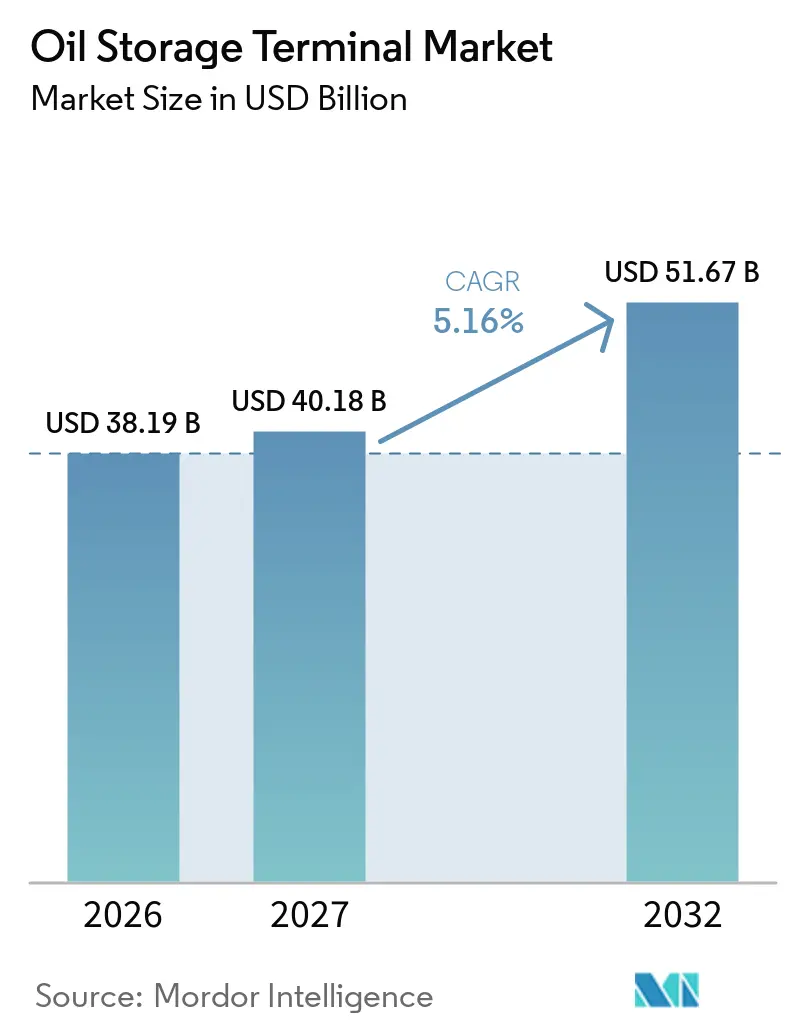
The Oil Storage Terminal Market size is expected to grow from USD 38.19 billion in 2026 to USD 40.18 billion in 2027 and is forecast to reach USD 51.67 billion by 2032 at 5.16% CAGR over 2027-2032. Government reserve programs, new trade routes, and investment around refining and export sites support demand for the oil storage terminal market. Storage located near deepwater ports, major refinery clusters, and trading centers remains valuable because it can serve several petroleum flows. Operators are also adapting selected assets for biofuels, sustainable aviation fuel, and other lower-carbon liquids, where local regulations and customer commitments support investment. Higher costs, long approval processes, and falling petroleum demand in mature economies limit new projects, especially where terminals rely on refinery throughput. The oil storage terminal market therefore favors operators with established marine access, contracted capacity, and the ability to direct capital toward Asia, the Middle East, Africa, and South American export corridors.
Key Report Takeaways
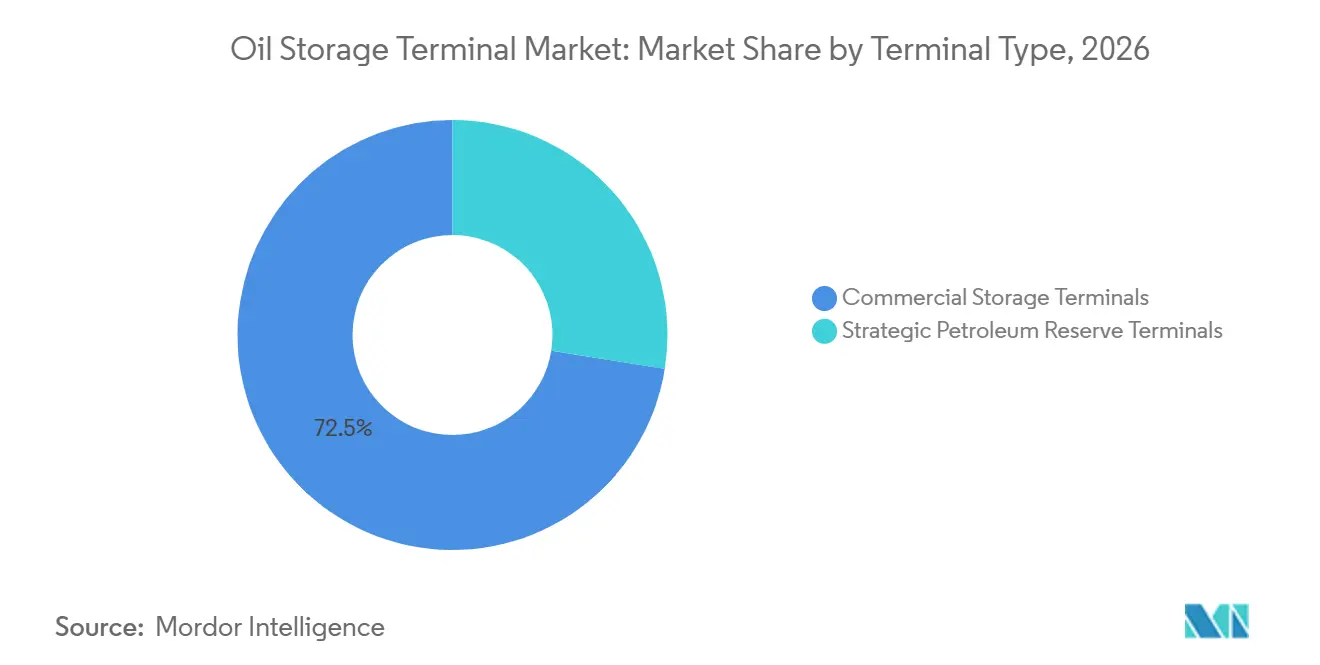
- By terminal type, commercial storage held a 72.5% revenue share in 2026, while strategic petroleum reserve terminals are forecast to grow at a 6.3% CAGR through 2032.
- By capacity, very large terminals held a 33.6% revenue share in 2026, while small terminals are forecast to grow at a 7.2% CAGR through 2032.
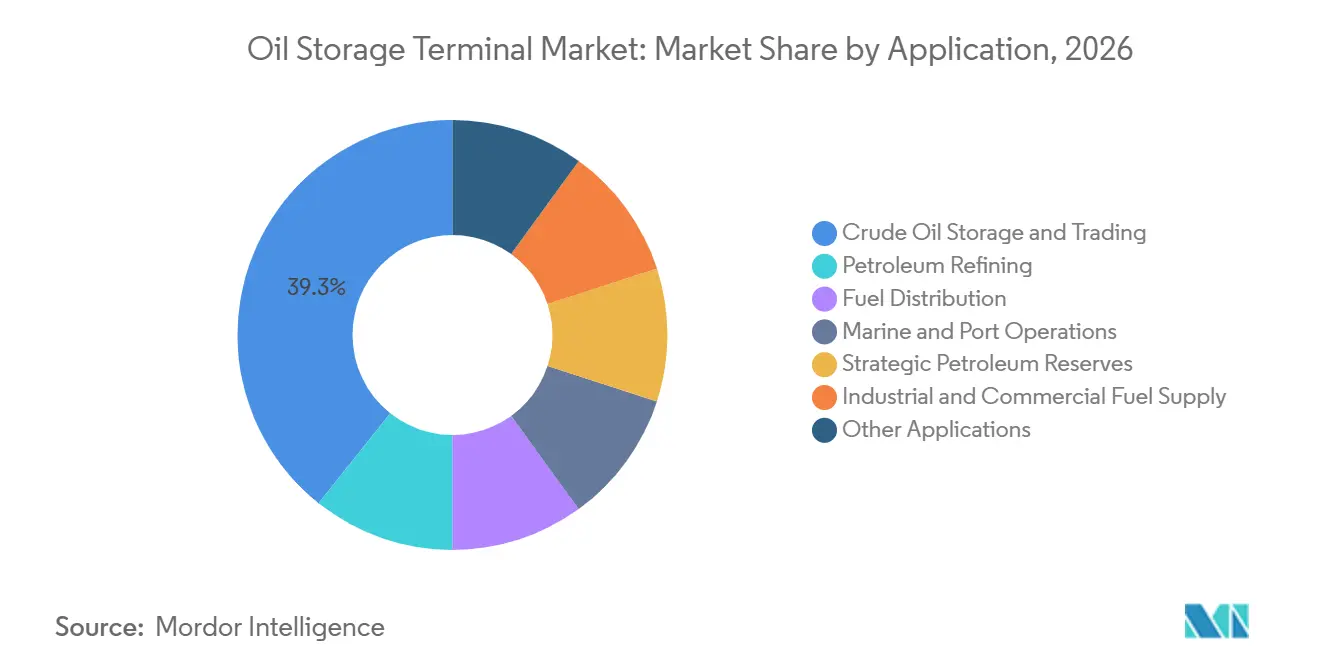
- By application, crude oil storage and trading held a 39.3% revenue share in 2026, while strategic petroleum reserves are forecast to grow at a 6.1% CAGR through 2032.
- By geography, Asia-Pacific held a 35.1% revenue share in 2026 and is forecast to grow at a 5.7% CAGR through 2032.
Note: Market numbers in this report are based on Mordor Intelligence's proprietary estimation framework, which combines nine months of actuals with Q4 projections for base year 2026.
Market Trends and Insights
Drivers Impact Analysis of Oil Storage Terminal Market*
| Driver | (~) % Impact on CAGR Forecast | Geographic Relevance | Impact Timeline |
|---|---|---|---|
| Energy Security and Strategic Petroleum Reserve Expansion | +1.3% | Global, concentrated in China, India, UAE, and Southeast Asia | Medium term (2-4 years) |
| Growth in Cross-Regional Crude and Refined-Product Trade | +1% | Global, centered on Singapore, Fujairah, Rotterdam, and emerging South American hubs | Short term (≤ 2 years) |
| Refinery, Petrochemical, and Export Infrastructure Expansion | +1% | Asia-Pacific and Middle East primary, Africa and South America secondary | Medium term (2-4 years) |
| Aviation-Fuel and Sustainable Aviation Fuel Storage Requirements | +0.4% | Europe, Asia-Pacific, and North America | Medium term (2-4 years) |
| Repurposing Underused Oil Hubs for Low-Carbon Liquids | +0.3% | Europe, North America, and selected Asia-Pacific ports | Long term (≥ 4 years) |
| Flexible Segregated Capacity During Trade-Route Shifts | +0.5% | Southeast Asia, Middle East outside Hormuz, and East Africa corridors | Short term (≤ 2 years) |
| Source: Mordor Intelligence | |||
Energy Security and Strategic Petroleum Reserve Expansion
China is adding 11 oil reserve sites during 2025 and 2026. Sinopec and China National Offshore Oil Corporation (CNOOC) are building at least 169 million barrels across these sites, equal to nearly 2 weeks of China’s net crude imports.[1] This work supports demand for large tank farms and long-term storage arrangements in the oil storage terminal market. India’s parliamentary committee recommended a 90-day crude storage target, compared with the national level of 74 days reported in 2025.[2] India also awarded a contract for a 2.5-million-metric-ton private-sector strategic reserve at Padur and is developing a further 4-million-metric-ton reserve at Chandikhol. These projects give the oil storage terminal market clearer demand than storage tied only to short-term commodity pricing, because public reserve requirements are linked to supply security and planned coverage targets rather than to immediate changes in petroleum prices or individual refinery operating rates.
Growth in Cross-Regional Crude and Refined-Product Trade
Sanctions and changes in refinery locations are changing crude and refined-product trade routes. A 2025 study using Automatic Identification System (AIS) shipping data found that global crude shipping centrality was shifting from Rotterdam and Antwerp toward Singapore, Fujairah, and other Asian hubs. For the oil storage terminal market, this change increases the value of terminals that can receive, segregate, blend, and transfer cargoes for different buyers, because a terminal can serve as a practical point between a producer, a vessel operator, a trader, and a final regional buyer. Indonesia’s Karimun terminal became a transshipment point for rebranded Russian oil products moving to Asian buyers in 2025.[3] Oman and Iraq also signed a memorandum in 2025 for Iraqi crude storage at Ras Markaz outside the Strait of Hormuz. The oil storage terminal market benefits when trade flows require additional storage between production, shipping, and final delivery.
Refinery, Petrochemical, and Export Infrastructure Expansion
New refinery, petrochemical, and export projects create demand for crude intake tanks and product storage before operations begin. India and China are contributing to global refining capacity additions in 2026, including Indian Oil Corporation expansions and the Saudi Aramco-backed Panjin complex. In the oil storage terminal market, these facilities need reliable buffer capacity for feedstock and finished products, since processing sites must manage deliveries, production schedules, product movements, and cargo loading without disrupting the wider supply chain that connects refineries, ports, and downstream customers. In Argentina, YPF and its partners are investing USD 1.8 billion in the Punta Colorada terminal, which will provide 630,000 m³ of capacity.[4] The project creates a new export storage point on the South Atlantic coast. In Europe, refinery closures reduce throughput-related demand, which directs oil storage terminal market investment toward regions with new processing and export infrastructure.
Aviation-Fuel and Sustainable Aviation Fuel Storage Requirements
Fuel storage at airports is changing as sustainable aviation fuel mandates take effect. The ReFuelEU Aviation framework requires a 6% sustainable aviation fuel share by 2030 and requires airport arrangements that support fuel availability. For the oil storage terminal market, these rules support specialized storage and logistics investment at aviation fuel hubs, because airport fuel systems must preserve product quality, manage separate fuel streams before blending, and maintain reliable supply for scheduled airline operations. Exolum received a contract in August 2025 to build a sustainable aviation fuel-ready terminal at Düsseldorf Airport with capacity of 9,000 m³. The terminal will have rail links to sustainable aviation fuel production plants in Rotterdam. Research published in 2025 found that fuel certification requirements can require segregated storage before blending, even where sustainable aviation fuel is compatible with conventional jet fuel. This requirement creates a defined retrofit opportunity for the oil storage terminal market.
Restraints Impact Analysis of Oil Storage Terminal Market*
| Restraint | (~) % Impact on CAGR Forecast | Geographic Relevance | Impact Timeline |
|---|---|---|---|
| Declining Petroleum Demand in Mature Markets | -0.4% | OECD Europe and North America, with an emerging headwind in China from 2027 | Long term (≥ 4 years) |
| High Capital Intensity and Long Payback Periods | -0.4% | Global, most acute in North American and EU coastal jurisdictions | Medium term (2-4 years) |
| Permitting, Land, and Community-Approval Delays | -0.3% | North America, EU, and selected Asia-Pacific port authorities | Medium term (2-4 years) |
| Tank Compatibility and Safety Barriers to Multi-Product Repurposing | -0.2% | Europe and North America | Long term (≥ 4 years) |
| Source: Mordor Intelligence | |||
Declining Petroleum Demand in Mature Markets
The IEA projected OECD oil demand to fall by 120 kb/d in 2025 and 240 kb/d in 2026. Transport electrification, improved vehicle efficiency, and demographic trends in Western Europe and Japan are contributing to the decline. The effects are not uniform across the oil storage terminal market. Terminals at Asian and Middle Eastern trading hubs can still serve cargo movements and reserve programs. Tank farms dependent on refinery throughput in mature markets face a greater risk of lower utilization. European operators are responding by considering biofuel configurations and other transition-related uses where asset design and regulation permit.
High Capital Intensity and Long Payback Periods
Large storage projects need substantial capital and extended approval periods before they earn revenue. A 500,000 m³ terminal typically costs USD 150 million and takes more than 3 years to permit, which limits the speed of new supply. Enterprise Products Partners LP reported that its Sea Port of Texas (SPOT) deepwater export terminal had no secured long-term customers in early 2025. The project cost had risen to USD 3 billion from USD 1.85 billion, while shifting trade flows and regulatory delays complicated development. High construction and financing costs favor established terminal operators with existing permits, customer relationships, and coastal land. The same conditions can support pricing power in the oil storage terminal market where capacity is scarce and contracts are long term, since customers often need permitted coastal locations, established marine infrastructure, operating records, and a credible ability to receive products on the required schedule.
*Our forecasts treat driver/restraint impacts as directional, not additive. The impact forecasts reflect baseline growth, mix effects, and variable interactions.
Oil Storage Terminal Market Segment Analysis
By Terminal Type:
Commercial Storage Remains the Largest FormatCommercial storage held 72.5% of the oil storage terminal market share in 2026, supported by its role in crude trading, refined-product logistics, petrochemical feedstock staging, fuel distribution, and marine bunkering. Facilities near active ports can move between these activities as regional trade patterns, refinery supply, and customer requirements change. That flexibility helps commercial operators protect utilization when a single product flow weakens or a cargo route is disrupted. Trading hubs usually require the largest capacities because they manage multiple suppliers, buyers, storage grades, vessel schedules, and customer contracts at the same location. Industrially integrated and regional distribution sites have different operating profiles, but each depends on predictable throughput, safe product handling, and access to nearby transport networks.
Strategic petroleum reserve terminals are forecast to grow at 6.3% CAGR from 2027 to 2032, faster than the overall oil storage terminal market. The projection reflects national efforts to improve reserve coverage following disruptions that began in 2022 and continued to influence energy-security policy. The International Energy Agency’s 90-day benchmark remains an important reference for countries that depend on imported crude and want greater protection against supply interruptions. Governments can contract capacity over longer periods than commercial customers, giving project developers better visibility of expected utilization and cash flow. The oil storage terminal industry therefore draws support from both commercial logistics needs and public spending on energy security.

By Terminal Capacity:
Large Hubs Lead While Smaller Assets Grow FasterVery large terminals accounted for 33.6% of the oil storage terminal market size in 2026, with the largest sites concentrated at deepwater export locations and strategic reserve hubs. Their location near shipping lanes and refinery clusters allows operators to combine spot-cargo arbitrage, government reserve filling, and petrochemical feedstock staging in a single asset. This breadth of use can improve utilization and reduce the unit cost of handling large product volumes. China’s coastal mega-sites, including Zhoushan V, demonstrate the investment logic around locations that can handle large and varied cargo flows. These projects nevertheless require extensive land, permitting, marine infrastructure, financing, and customer commitments before construction can proceed.
Small terminals are forecast to expand to 7.2% CAGR through 2032, the fastest rate among capacity bands. Distributed facilities are useful in landlocked markets and secondary ports where very large tank farms are not viable or are not needed. They can also support biofuel blending, local fuel distribution, and modular strategic reserve programs without relying on a single large coastal hub. Medium and large terminals in Southeast Asia, West Africa, and Southern Europe can gain demand as operators work to ease congestion at major hubs and shorten supply chains for regional customers. Dialog Group Berhad’s 614,000 m³ Pengerang expansion under a long-term agreement with BP Singapore illustrates continued demand for additional capacity near important Asian shipping routes.
By Application:
Crude Trading Holds the Largest ShareCrude oil storage and trading represented 39.3% of the oil storage terminal market size in 2026. Major facilities in Fujairah, Singapore, and the Amsterdam-Rotterdam-Antwerp region retain this position because they support price discovery, cargo aggregation, blending, and redistribution. Fujairah had 18 million m³ of storage capacity in 2026 and remained the Middle East’s largest commercial refined-product hub. Storage at these hubs lets traders hold cargoes while they arrange sales, match vessel availability, respond to changes in regional supply, and meet customer specifications. These operating functions keep crude trading central to the oil storage terminal market.
Strategic petroleum reserve applications are projected to grow at 6.1% CAGR through 2032. Programs in Asia and Africa require additional infrastructure rather than only filling spare capacity at facilities built for commercial trading. Refining applications follow capacity additions in India and the Middle East, while fuel distribution storage supports demand in Southeast Asia and Sub-Saharan Africa. Marine and port operations are adjusting to liquefied natural gas (LNG) and methanol, although conventional fuel volumes remain important during the forecast period. Industrial and commercial fuel supply is stable in developing economies but faces more pressure in Organization for Economic Co-operation and Development (OECD) markets where refinery closures reduce throughput-linked storage needs.
Geography Analysis
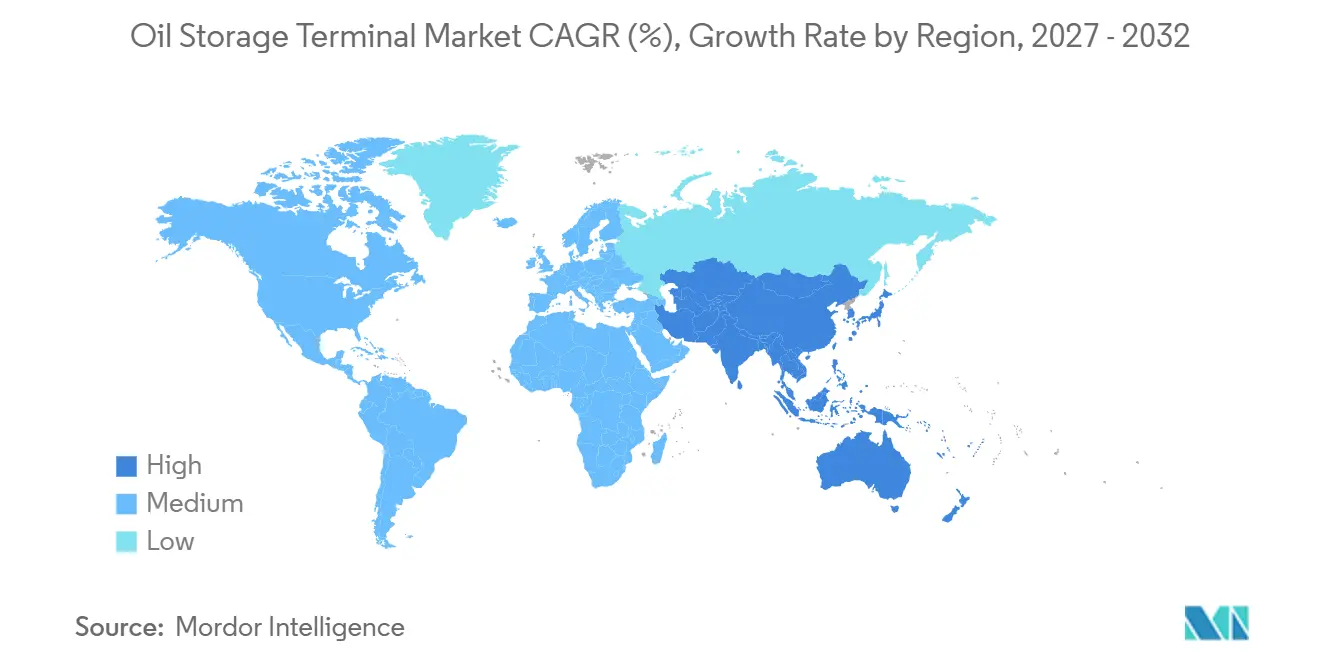
Asia-Pacific held 35.1% of the oil storage terminal market share in 2026 and is forecast to grow at 5.7% CAGR through 2032. China’s reserve construction, India’s strategic reserve projects, and transshipment investment in Singapore, Malaysia, and Indonesia support the region’s outlook. China is adding 11 oil reserve sites with 169 million barrels of combined capacity during 2025 and 2026. India is developing the Chandikhol reserve and has examined overseas storage in Oman. Dialog Group’s planned Pengerang expansion and ADNOC Global Trading’s 160,000 m³ lease at Singapore’s Jurong Port show how operators and suppliers are building access near Asian shipping lanes.
North America remains important for strategic and commercial crude storage, although greenfield development has slowed. The Sea Port Oil Terminal (SPOT) project illustrates how customer commitments, costs, permits, and changed trade routes can affect deepwater export developments. Europe has a divided outlook, with North Sea and Amsterdam-Rotterdam-Antwerp terminals facing weaker petroleum demand while selected operators invest in transition-related infrastructure. Stanlow Terminals began an investment program in 2025 for biofuels, hydrogen, and carbon dioxide logistics at its Cheshire site, while Jadranski naftovod (JANAF) received permits for 4 new tanks at Omišalj.
Middle East and Africa combine sovereign-backed infrastructure spending with cross-border crude routing. AD Ports Group and Oylz Terminals signed a 50-year agreement in March 2025 for a 600,000 m³ facility at Khalifa Port. Oman Tank Terminal Company (OTTCO) and Royal Vopak also signed an agreement for storage development in Duqm, where Iraqi crude storage provides a route outside the Strait of Hormuz. South America is adding export capacity from a smaller base. YPF’s Punta Colorada project will establish a new export node on Argentina’s South Atlantic coast.
Competitive Landscape
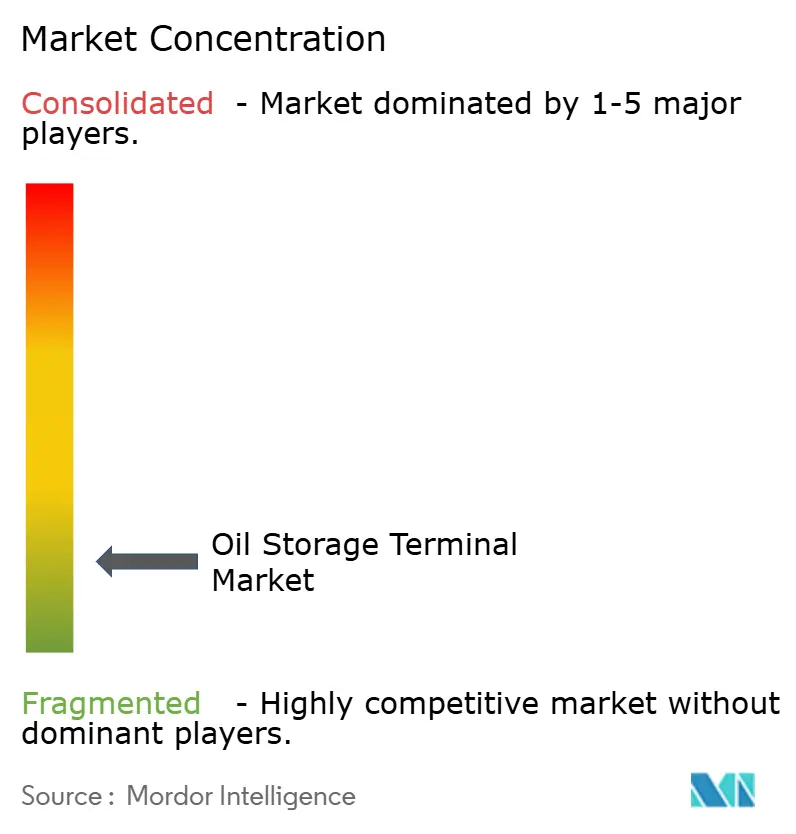
The oil storage terminal market is fragmented. State-owned enterprises and integrated oil companies supply much of their own storage, which limits the share served by independent terminals. This structure reduces direct tariff competition and favors incumbents with deepwater access, dependable service records, and long-term customer contracts. Company filings showed occupancy above 90% at leading operators in 2025. High utilization supports revenue stability when petroleum prices change and helps operators prioritize returns on existing assets.
Portfolio concentration is shaping the competitive position of the oil storage terminal market. Oiltanking completed the sale of its South African terminal interest to Aquarius Energy in July 2025, finalizing a restructuring that created Advario and OTAMERICA as focused operating entities. Mitsui O.S.K. Lines completed its acquisition of LBC Tank Terminals in 2025 and integrated the business into its chemical logistics strategy. Gulf Navigation’s acquisition of Brooge Energy assets also shows interest from companies expanding into terminal ownership through acquisitions. These moves concentrate capital around selected locations and customer groups while allowing operators to exit less suitable geographies.
Technology and compliance influence competition in this asset-heavy sector. Vopak and Falcker agreed in October 2025 to deploy tank inspection technology using digital twinning, condition monitoring, and lifecycle planning. These tools can support maintenance planning and reduce unplanned interruptions. Smaller operators can find it harder to absorb safety, security, and technology spending, while larger portfolios can spread those costs across more assets and customers.
Oil Storage Terminal Industry Leaders
-
Koninklijke Vopak N.V.
-
Oiltanking GmbH
-
Marathon Petroleum Corporation
-
Kinder Morgan, Inc.
-
ONEOK, Inc.
- *Disclaimer: Major Players sorted in no particular order
Oil Storage Terminal Market Companies Covered in this Report
- Advario
- Buckeye Partners, L.P.
- China National Petroleum Corporation
- Enbridge Inc.
- Gibson Energy Inc.
- Horizon Terminals Limited
- Intercontinental Terminals Company LLC
- Kinder Morgan, Inc.
- Koninklijke Vopak N.V.
- Marathon Petroleum Corporation
- Oiltanking GmbH
- ONEOK, Inc.
- PetroChina Company Limited
- Plains All American Pipeline, L.P.
- Rubis Terminal
- Saudi Arabian Oil Company (Saudi Aramco)
- Stolthaven Terminals
- Sunoco LP
- Vitol Tank Terminals International B.V. (VTTI)
- Zenith Energy
Recent Industry Developments in Oil Storage Terminal Market
- September 2026: Aster launched Aster Ports & Terminals as an integrated storage and logistics business, combining marine, terminal, and storage infrastructure with up to 4.3 million cubic metres of tank capacity. It awarded contracts to DIALOG Group subsidiary Overseas Technical Engineering and Construction and PEC to add more than 1.3 million barrels of crude storage capacity.
- October 2025: The Saudi Ports Authority (Mawani) signed a contract with Arabian Chemical Terminals Ltd. (ACT) for an investment exceeding USD 133.33 million (SAR 500 million) to develop chemical and petrochemical storage facilities at Jubail Commercial Port, Saudi Arabia. The project covers 49,000 m² and will provide 70,000 m³ of storage capacity, supporting chemical handling, storage, distribution, and exports, while strengthening the Kingdom's chemical logistics infrastructure and supply chains.
- September 2025: Exolum announced an energy transition terminal at A Coruña’s Outer Port in Spain, with investment exceeding EUR 100 million for a 165,000 m³ multi-product facility handling biofuels, sustainable aviation fuel, ammonia, and captured carbon dioxide.
- August 2025: Stanlow Terminals launched an investment program to develop a biofuels storage hub, a hydrogen transport hub, and carbon dioxide transport and storage facilities at its Cheshire terminal site.
Global Oil Storage Terminal Market Report Scope
An oil storage terminal (also known as a tank farm, oil depot, or oil installation) is an industrial facility used to store crude oil, petroleum, and petrochemical products before distribution to end-users, refineries, or other storage locations. These facilities operate within the midstream segment of the oil and gas industry and serve as logistical hubs for receiving, blending, and transporting liquid energy resources.
The oil storage terminal market is segmented into terminal type, terminal capacity, application, and geography. By terminal type, the market is segmented into commercial storage terminals and strategic petroleum reserve terminals. By terminal capacity, the market is divided into small-capacity terminals, medium-capacity terminals, large-capacity terminals, and very large-capacity terminals. By application, the market is segmented into crude oil storage and trading, petroleum refining, fuel distribution, marine and port operations, strategic petroleum reserves, industrial and commercial fuel supply, and other applications. The report also covers the market size and forecasts for the global oil storage terminal market across 26 countries in key regions. For each segment, the market sizing and forecasts have been provided on the basis of value (USD).
Segmentation Overview
| Commercial Storage Terminals |
| Strategic Petroleum Reserve Terminals |
| Small-Capacity Terminals |
| Medium-Capacity Terminals |
| Large-Capacity Terminals |
| Very Large-Capacity Terminals |
| Crude Oil Storage and Trading |
| Petroleum Refining |
| Fuel Distribution |
| Marine and Port Operations |
| Strategic Petroleum Reserves |
| Industrial and Commercial Fuel Supply |
| Other Applications |
| North America | United States |
| Canada | |
| Mexico | |
| Europe | Germany |
| France | |
| Italy | |
| Spain | |
| United Kingdom | |
| Poland | |
| Russia | |
| Rest of Europe | |
| Asia-Pacific | China |
| India | |
| Japan | |
| South Korea | |
| Australia | |
| Indonesia | |
| Vietnam | |
| Thailand | |
| Rest of Asia-Pacific | |
| South America | Brazil |
| Argentina | |
| Chile | |
| Rest of South America | |
| Middle East and Africa | Saudi Arabia |
| United Arab Emirates | |
| Egypt | |
| South Africa | |
| Morocco | |
| Rest of Middle East and Africa |
| By Terminal Type | Commercial Storage Terminals | |
| Strategic Petroleum Reserve Terminals | ||
| By Terminal Capacity | Small-Capacity Terminals | |
| Medium-Capacity Terminals | ||
| Large-Capacity Terminals | ||
| Very Large-Capacity Terminals | ||
| By Application | Crude Oil Storage and Trading | |
| Petroleum Refining | ||
| Fuel Distribution | ||
| Marine and Port Operations | ||
| Strategic Petroleum Reserves | ||
| Industrial and Commercial Fuel Supply | ||
| Other Applications | ||
| By Geography | North America | United States |
| Canada | ||
| Mexico | ||
| Europe | Germany | |
| France | ||
| Italy | ||
| Spain | ||
| United Kingdom | ||
| Poland | ||
| Russia | ||
| Rest of Europe | ||
| Asia-Pacific | China | |
| India | ||
| Japan | ||
| South Korea | ||
| Australia | ||
| Indonesia | ||
| Vietnam | ||
| Thailand | ||
| Rest of Asia-Pacific | ||
| South America | Brazil | |
| Argentina | ||
| Chile | ||
| Rest of South America | ||
| Middle East and Africa | Saudi Arabia | |
| United Arab Emirates | ||
| Egypt | ||
| South Africa | ||
| Morocco | ||
| Rest of Middle East and Africa | ||
Key Questions Answered in the Report
What is the projected size of the oil storage terminal market by 2032?
The oil storage terminal market is forecast to reach USD 51.67 billion by 2032, rising from USD 40.18 billion in 2027 at a 5.16% CAGR.
Which terminal type has the largest share?
Commercial storage held 72.5% of revenue in 2026 because it serves trading, product logistics, and marine supply requirements.
Which capacity band is growing the fastest?
Small terminals are forecast to grow at 7.2% CAGR through 2032, supported by distributed storage, secondary ports, and modular reserve development.
Which application leads demand for oil storage terminals?
Crude oil storage and trading held a 39.3% share in 2026, supported by major trading centers such as Fujairah, Singapore, and the Amsterdam-Rotterdam-Antwerp region.
Which region is expected to grow the fastest?
Asia-Pacific is forecast to grow at 5.7% CAGR through 2032, supported by strategic reserves, refinery expansion, and transshipment investment.
Why do strategic petroleum reserves matter to terminal operators?
Strategic petroleum reserve terminals are forecast to grow at 6.3% CAGR because governments are building reserve coverage and contract storage over longer periods.