
Offshore Energy Storage Market Size and Share
Market Overview
| Study Period | 2021 - 2031 |
|---|---|
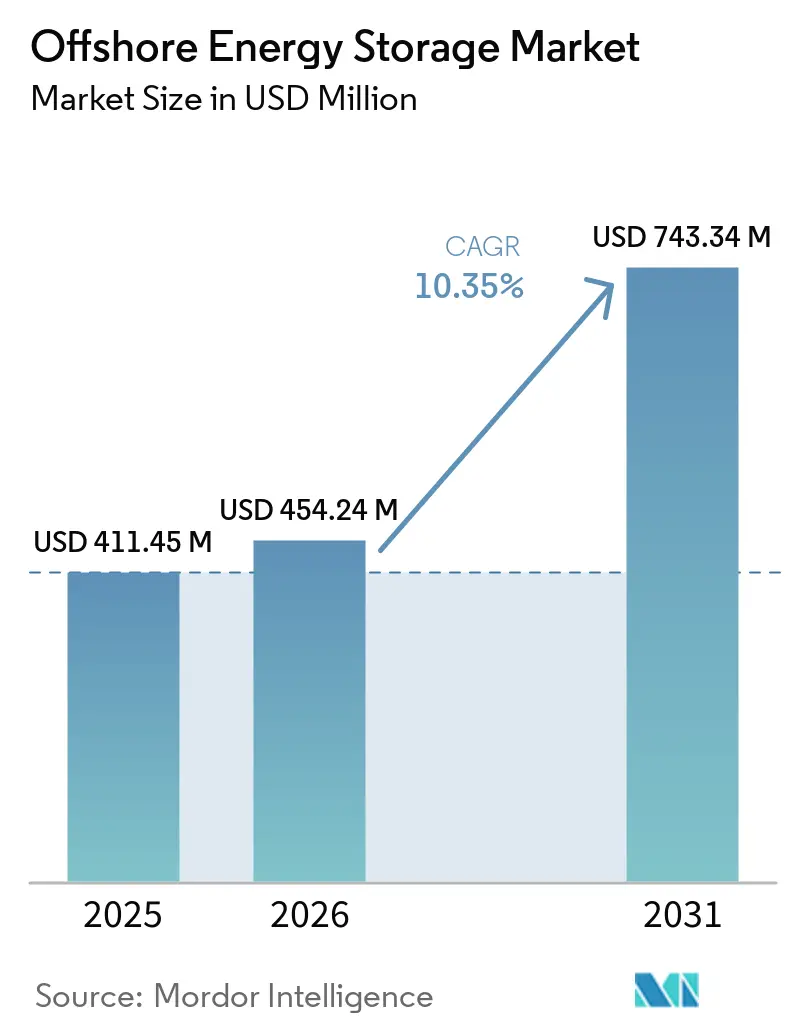
| Market Size (2026) | USD 454.24 Million |
| Market Size (2031) | USD 743.34 Million |
| Growth Rate (2026 - 2031) | 10.35 % |
| Fastest Growing Market | Asia-Pacific |
| Largest Market | Europe |
| Market Concentration | Medium |
Major Players *Disclaimer: Major Players sorted in no particular order Image © Mordor Intelligence. Reuse requires attribution under CC BY 4.0. | |
Offshore Energy Storage Market Analysis by Mordor Intelligence
The Offshore Energy Storage Market size is expected to grow from USD 411.45 million in 2025 to USD 454.24 million in 2026 and is forecast to reach USD 743.34 million by 2031 at 10.35% CAGR over 2026-2031. The Offshore energy storage market is being shaped by the gap between offshore renewable generation and available transmission capacity. Storage can retain electricity that would otherwise be curtailed, then release it when grid conditions and prices improve. This role is becoming more important as offshore wind projects are built faster than related network upgrades. The Offshore energy storage market also benefits from demand for cleaner vessel operations, hybrid power for offshore platforms, and resilient electricity systems on remote islands. Project developers are increasingly treating storage as part of the power system design rather than as equipment added after construction.
Key Report Takeaways
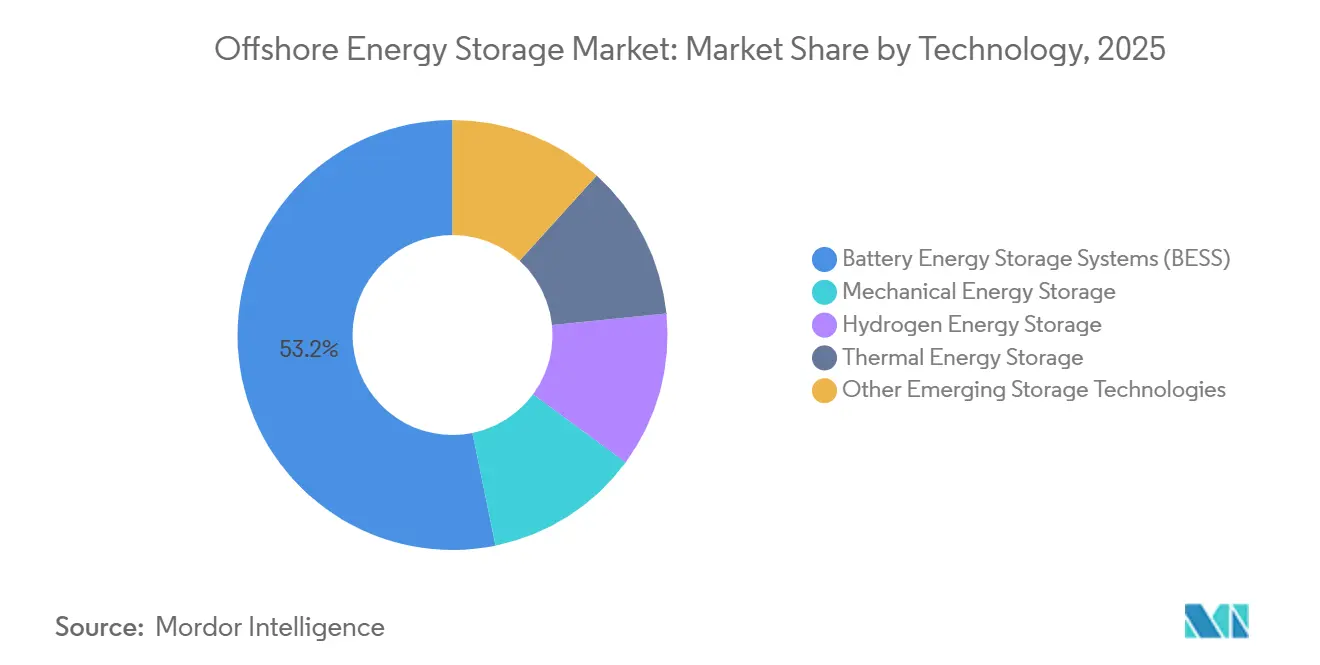
- By technology, Battery Energy Storage Systems held 53.2% of the Offshore energy storage market share in 2025, while hydrogen energy storage is forecast to grow at a 15.4% CAGR through 2031.
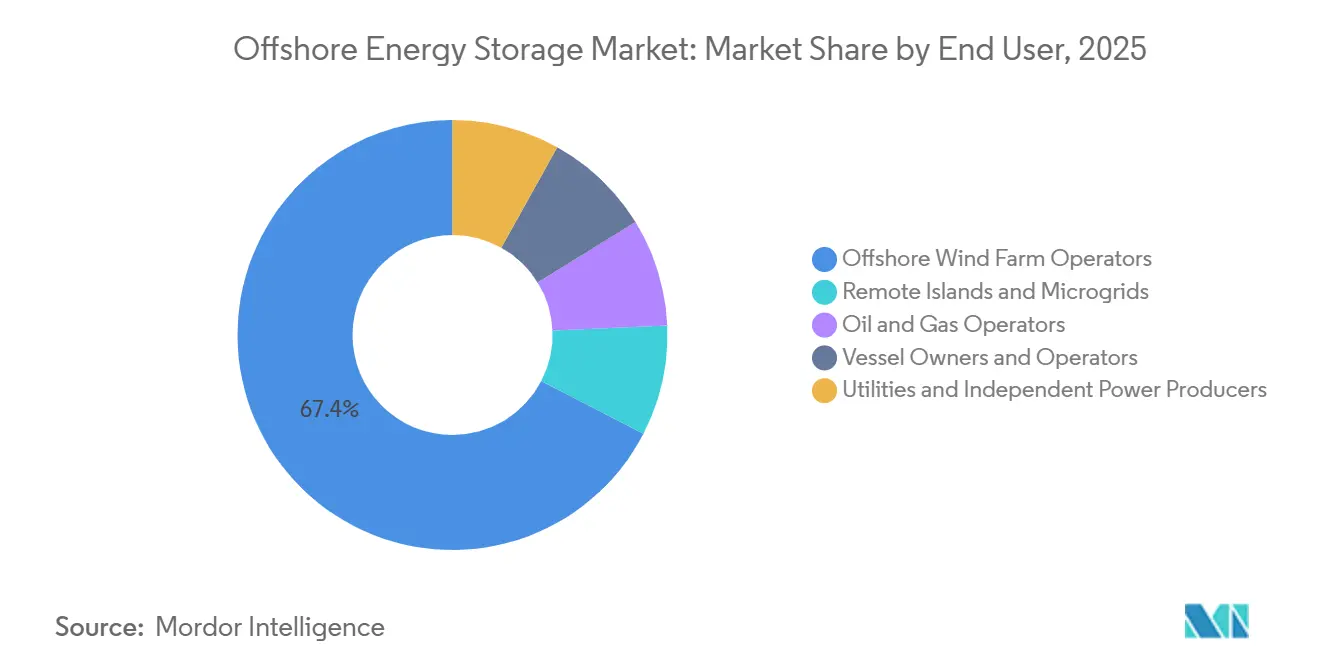
- By end user, Offshore Wind Farm Operators accounted for 67.4% of demand in 2025, while Remote Islands and Microgrids are projected to record the highest CAGR of 17.3% through 2031.
- By geography, Europe held 56.4% of the Offshore energy storage market share in 2025, while Asia-Pacific is forecast to expand at a 16.4% CAGR through 2031.
Note: Market size and forecast figures in this report are generated using Mordor Intelligence’s proprietary estimation framework, updated with the latest available data and insights as of January 2026.
Global Offshore Energy Storage Market Trends and Insights
Drivers Impact Analysis*
| Driver | % Impact on CAGR Forecast | Geographic Relevance | Impact Timeline |
|---|---|---|---|
| Offshore Wind Curtailment and Grid-Connection Congestion | +2.50% | UK, Germany, Denmark, Netherlands; spill-over to Baltic Sea markets | Short term (≤ 2 years) |
| Co-Location of Storage With Offshore Wind Transmission Assets | +2.00% | North Sea core; APAC emerging | Short term (≤ 2 years) |
| Maritime Decarbonization and Zero-Emission Vessel Adoption | +1.50% | Global, early gains in Northern Europe and China | Medium term (2-4 years) |
| Offshore Platform Electrification and Hybrid-Power Demand | +1.20% | Norway, UK North Sea, Gulf of Mexico | Medium term (2-4 years) |
| Subsea Long-Duration Storage Cost Advantages | +1.00% | North Sea, North Atlantic, APAC deep-water sites | Long term (≥ 4 years) |
| Shared Offshore Infrastructure and Digital Energy Management | +0.80% | Global, with early gains in UK, Netherlands, and Germany | Medium term (2-4 years) |
| Source: Mordor Intelligence | |||
Offshore Wind Curtailment and Grid-Connection Congestion
The Offshore energy storage market is gaining urgency as wind generation is curtailed when transmission networks cannot carry available output. Xodus Group projected that annual European curtailment could exceed 300 TWh by 2040 as offshore wind capacity expands toward the European Union target. The same analysis reported EUR 8.9 billion in congestion-management costs during 2024. Storage located alongside wind assets can absorb output during constrained periods and support more controlled dispatch. A 2025 IEE conference study found that co-located BESS using ensemble-based stochastic dispatch reduced curtailment by up to 15% against deterministic dispatch approaches. The study also found that improved dispatch raised market revenue by 0.1% to 5%, depending on intraday price volatility. These conditions favor projects that can enter service before transmission reinforcement reduces the value of curtailment management.
Co-Location of Storage With Offshore Wind Transmission Assets
The Offshore energy storage market is also supported by designs that share grid connections and transmission assets with offshore wind projects. Ørsted began construction of the 300 MW, 600 MWh Iceni BESS in March 2025 beside the Hornsea 3 onshore substation in Norfolk[1]Ørsted, “Ørsted Breaks Ground on Innovative UK Battery Energy Storage System,” Ørsted, orsted.co.uk. The project shares infrastructure associated with the offshore wind development instead of requiring a separate connection. This arrangement can reduce duplicated infrastructure and give a single project access to curtailment management, ancillary services, and capacity payments. Northland Power stated that it is developing 300 MW, 1.2 GWh of co-located BESS with Poland’s Baltic Power offshore wind project. Baltic Power delivered its first offshore wind electricity to Poland’s grid in 2026. Shared infrastructure gives lenders an operational reference for assessing integrated project structures.
Maritime Decarbonization and Zero-Emission Vessel Adoption
The Offshore energy storage market serves a maritime fleet that is moving toward battery and hybrid-electric propulsion. Corvus Energy stated in February 2025 that it would supply a near-25 MWh lithium iron phosphate battery system for BW Group’s fully electric offshore construction support vessel. The order showed that offshore vessel battery systems are moving beyond small auxiliary installations. ABB selected Corvus Dolphin NxtGen energy storage systems for 2 new hybrid-electric Washington State Ferries in February 2026. The replacement program could cover up to 16 vessels and has an indicated value of USD 4 billion. Marine-certified systems, vessel integration, and long-term service support are therefore important capabilities within the Offshore energy storage market. The use of batteries across vessels and ports can also link marine demand with shore-side charging infrastructure.
Offshore Platform Electrification and Hybrid-Power Demand
The Offshore energy storage market has a further role in supplying hybrid power to offshore oil and gas platforms. Offshore Norway reported that the country’s offshore sector consumed 10 TWh of electricity from shore-connected and partly electrified fields in 2025. Full electrification can be difficult where projects require long subsea cables and high marine construction spending. Equinor discontinued electrification plans for Snorre A&B, Heidrun, and Aasgard B in October 2025 because abatement costs had risen to NOK 5,000 per tonne of carbon dioxide. Hybrid wind, battery, and hydrogen systems can offer another route for lowering platform emissions. A 2025 SPE conference paper found that such systems could reduce carbon dioxide emissions by more than 77% against diesel-only baselines in its modeled cases[2]Society of Petroleum Engineers, “Decarbonising Offshore Production Platforms Using Hybrid Renewable Energy Systems,” SPE Conference Proceedings, spe.org. The same work reported a 6% rise in levelized energy costs in medium-cost scenarios.
Restraints Impact Analysis*
| Restraint | % Impact on CAGR Forecast | Geographic Relevance | Impact Timeline |
|---|---|---|---|
| High Marine Installation and Maintenance Costs | -2.00% | Global; most acute in APAC and North America | Short term (≤ 2 years) |
| Corrosion, Biofouling, and Extreme-Weather Exposure | -0.80% | Tropical MEA; North Sea; Pacific typhoon zones | Medium term (2-4 years) |
| Fragmented Permitting and Revenue-Stack Uncertainty | -1.00% | EU national markets; US offshore; APAC emerging markets | Short term (≤ 2 years) |
| Limited Offshore Storage Bankability and Insurance History | -0.70% | Global; most acute in APAC and Middle East | Long term (≥ 4 years) |
| Source: Mordor Intelligence | |||
High Marine Installation and Maintenance Costs
The Offshore energy storage market faces higher installation and maintenance costs than comparable land-based projects. Offshore systems require marine-certified equipment, specialized vessels, qualified crews, and work completed within limited weather windows. FLASC stated that marinized offshore lithium-ion systems can exceed EUR 1,100 per kWh for short-duration use. Its comparison placed comparable onshore systems near EUR 500 per kWh. These costs favor assets that can earn revenue from several services, including congestion management, balancing services, and capacity mechanisms. FLASC also indicated that hydro-pneumatic systems may have a cost advantage at storage durations of 16 to 24 hours, although commercial-scale validation remains necessary.
Fragmented Permitting and Revenue-Stack Uncertainty
The Offshore energy storage market is constrained when regulations do not clearly classify storage as generation, network infrastructure, or a separate asset class. ENTSO-E identified double charging and weak locational price signals as barriers to utility-scale storage in its December 2025 policy paper. Uncertain rules can make developers less certain about access to grid revenues and project permits. ENTSO-E also identified limited long-term revenue visibility as a structural deployment barrier. Regulation EU 2024/1735 recognizes energy storage as eligible Trans-European Energy Network infrastructure. The regulation allows dedicated infrastructure zones for storage that is co-located with offshore renewable capacity. Clearer permitting and tariff rules would improve the financing case for projects across the Offshore energy storage market.
*Our forecasts treat driver/restraint impacts as directional, not additive. The impact forecasts reflect baseline growth, mix effects, and variable interactions.
Segment Analysis
By Technology: BESS Leads Current Deployment, While Hydrogen Gains Momentum
Battery Energy Storage Systems held 53.2% of the Offshore energy storage market share in 2025. BESS has established operating experience, recognized safety pathways, and familiar procurement structures. The technology is particularly suited to short-duration balancing, curtailment management, and vessel electrification. Ørsted’s 300 MW, 600 MWh Iceni project demonstrates how BESS can be connected to offshore wind-related transmission infrastructure. Its design gives the project a direct operating reference for future integrated developments. Offshore deployment still requires humidity control, corrosion protection, safety systems, and equipment that can tolerate vibration. These requirements raise costs against standard land-based units. The Offshore energy storage industry, therefore, depends on suppliers that combine battery expertise with marine engineering and digital dispatch capabilities.
Hydrogen energy storage is forecast to grow at a 15.4% CAGR through 2031. The technology can support longer storage periods than a battery system designed primarily for hourly balancing. The CrossWind Base Load Power Hub at the Hollandse Kust Noord wind farm combined a 2.5 MW PEM electrolyzer, a 1 MW fuel cell, and a 5 MWh battery buffer[3]Ballard Power Systems, “CrossWind Project Base Load Power Hub Arrives in Netherlands,” Ballard Power Systems, ballard.com. The system was handed over to operator DOT in October 2025 and was renamed Phynix. FLASC is also developing hydro-pneumatic energy storage for 4 to 100 hours of duration, with a stated round-trip efficiency near 70%. Its grid-connected pilot at Plant One Rotterdam was in progress during 2025 and 2026. These technologies broaden the Offshore energy storage market beyond battery-led applications.



By End User: Wind Operators Provide Scale, While Remote Microgrids Grow Faster
Offshore Wind Farm Operators accounted for 67.4% of demand in 2025. Their demand is tied to the commercial need to manage constrained renewable output and improve the use of shared connections. The Offshore energy storage market size for this group is supported by projects that integrate storage during wind-farm planning. Iceni is expected to create a practical reference for developers weighing shared infrastructure against separate grid connections. Oil and gas operators are another relevant group where shore power is costly or technically difficult. SLB OneSubsea received an EPC award in August 2025 for Equinor’s Fram Sør all-electric subsea production system. The 12-well system will be hosted on Troll C, which receives power from shore. Vessel owners and utilities add further demand through hybrid propulsion and renewable-power agreements.
Remote Islands and Microgrids are projected to expand at a 17.3% CAGR through 2031. This part of the Offshore energy storage market is driven by the high cost and supply risk of diesel-based electricity. The British Virgin Islands Electricity Corporation commissioned the Anegada hybrid renewable energy and battery system in December 2025. The system combined 1.252 MW of solar photovoltaic capacity with 4,078 kWh of BESS. It is intended to reduce diesel-generated electricity by 90% to 95%. Cornell University is developing a green-hydrogen fuel-cell system for Vieques, Puerto Rico, with installation planned for early 2027[4]Cornell University, “On Storm-Ravaged Vieques, a Microgrid Builds Resilience,” Cornell Chronicle, news.cornell.edu. The project adds multi-day energy storage to a solar-plus-battery microgrid.
Geography Analysis
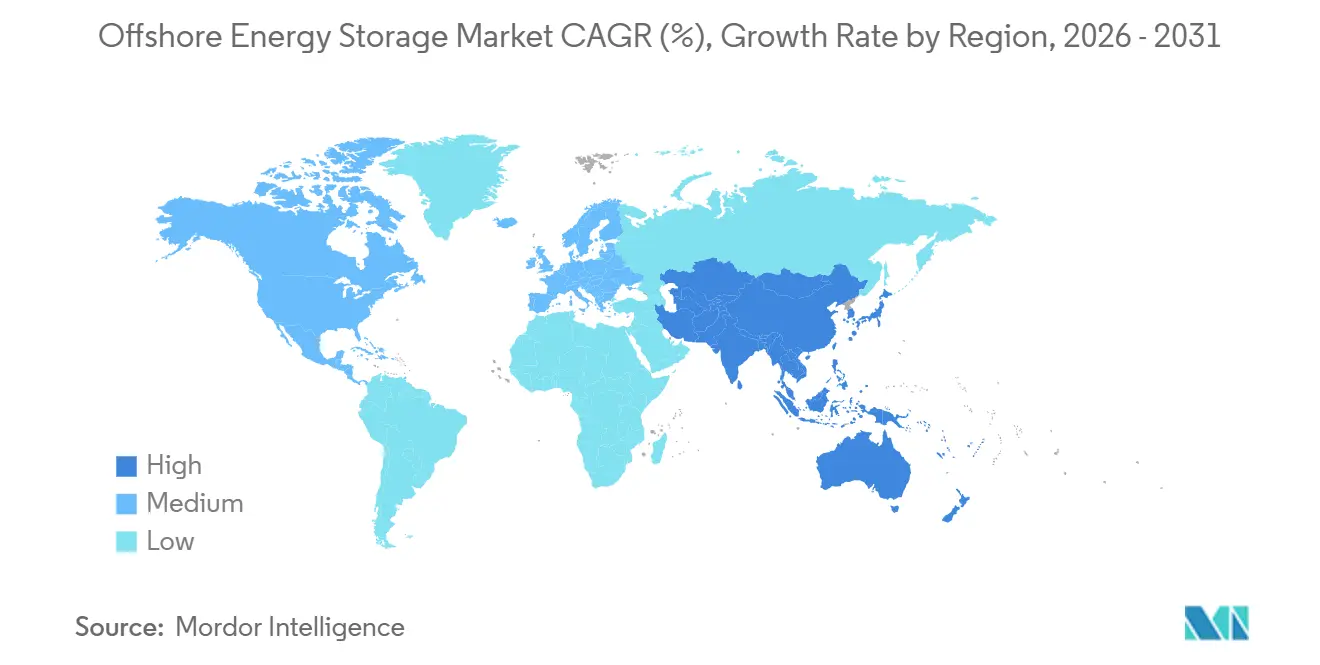
Europe held 56.4% of the Offshore energy storage market share in 2025. The region combines a large offshore wind fleet, significant grid congestion, and established project-development experience. The UK, Germany, Denmark, and the Netherlands remain central locations for co-located storage activity. ENTSO-E's Offshore Roadmap identified regulatory adaptation, locational price signals, and cross-border coordination as priorities for offshore development. The roadmap supports the European Union's objective of 365 GW of offshore renewable capacity by 2050. Poland is adding an important new reference through Baltic Power and its planned 300 MW, 1.2 GWh storage system.
Asia-Pacific is forecast to grow at a 16.4% CAGR through 2031. China's offshore deployment scale and national investment in transmission are important factors in the region's expansion. South Korea's Offshore Wind Promotion Act, enacted in 2024, provides a clearer route for project development. The government plans to designate 25 GW of offshore wind zones by 2031. The Shinan Uii 390 MW offshore wind complex began construction in July 2026. Its reported investment was KRW 3.4 trillion, equivalent to USD 2.5 billion. The Offshore energy storage market in the region will be affected by the pace of grid deployment, storage safety rules, and domestic supply chains.
North America represented a smaller share of the Offshore energy storage market in 2025, but vessel electrification and long-duration storage are developing important project references. ABB's selection of Corvus systems for Washington State Ferries demonstrates the scale of public ferry electrification procurement. Hydrostor stated that its Quinte Energy Storage Centre in Ontario is planned with an initial 4 GWh phase for the early 2030s. South America, the Middle East, and Africa remain early-stage areas. Their island systems offer a comparable use case where diesel exposure makes renewable generation and storage more valuable. The geographic opportunity depends on bankable procurement structures and reliable local maintenance capacity.

Competitive Landscape
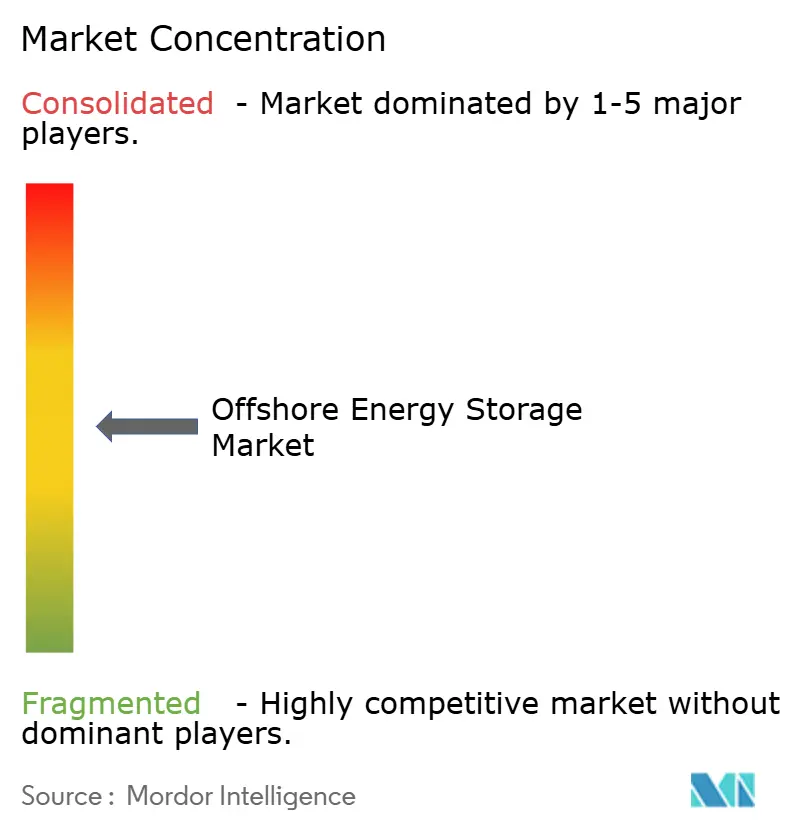
The Offshore energy storage market is moderately concentrated in system integration and more fragmented across individual technologies. ABB, Siemens Energy, Hitachi Energy, and Schneider Electric compete through electrical engineering, grid connection experience, and global service capabilities. Corvus Energy, Fluence Energy, and Leclanché compete through marine-focused battery design and operating data. Technology specialists remain important because offshore installations require equipment proven against corrosion, vibration, humidity, and demanding maintenance conditions. Subsea7 contributes marine engineering capability through its technology partnership with FLASC. This division of roles means that developers often need partnerships rather than a single supplier. Suppliers that can link power equipment, control systems, and operating services are better placed to support integrated projects.
Co-location is a central strategic move in the Offshore energy storage market. Ørsted’s Iceni project combines a wind-related transmission connection with a 300 MW, 600 MWh BESS. Northland Power is applying a comparable approach at Baltic Power in Poland. Long-duration storage suppliers are also forming partnerships to combine specialized technology with industrial delivery resources. Baker Hughes and Hydrostor agreed to collaborate on compression and power-generation equipment for Hydrostor projects in January 2026. The agreement covers up to 1.4 GW of equipment orders.
Digital energy management is becoming more relevant as storage assets use several revenue streams. Operators need systems that can coordinate curtailment reduction, balancing participation, capacity arrangements, and vessel or platform power requirements. This need creates room for software providers that specialize in dispatch and asset management. Long-duration technologies such as hydrogen, advanced compressed air, and hydro-pneumatic storage can compete where storage duration matters more than compact footprint. Hydrostor raised USD 230 million in August 2026 to advance its advanced compressed-air project portfolio. The funding included strategic participation from Baker Hughes, Hatch, and Canada Growth Fund. The Offshore energy storage market will continue to reward proven marine performance, practical financing structures, and the ability to integrate multiple technologies.
Offshore Energy Storage Industry Leaders
Siemens Energy AG
Wärtsilä Oyj Abp
ABB Ltd.
Saft Groupe S.A.
Corvus Energy
- *Disclaimer: Major Players sorted in no particular order

Recent Industry Developments
- September 2026: Hydrostor secured grid connection approval for the 200 MW, 1,600 MWh Silver City Energy Storage Centre in New South Wales, Australia.
- August 2026: Hydrostor secured USD 230 million to advance its advanced compressed-air energy storage projects and its 7 GW global pipeline.
- July 2026: The 390 MW Shinan Uii offshore wind complex began construction in South Korea.
- May 2026: Northland Power’s Baltic Power delivered Poland’s first offshore wind electricity to the national grid and confirmed the planned 300 MW, 1.2 GWh co-located BESS.


Global Offshore Energy Storage Market Report Scope
Offshore energy storage refers to technologies and systems designed to store energy at or near offshore locations and release it when required. These systems support the integration and reliable operation of offshore renewable energy and other marine energy infrastructure. They can store electricity generated by offshore wind farms, floating solar plants, tidal and wave energy projects, or electricity supplied from the onshore grid. Key technologies include battery energy storage systems (BESS), mechanical energy storage, hydrogen energy storage, thermal energy storage, and other emerging storage technologies.
The Offshore Energy Storage Market is segmented by technology, end user, and geography. By technology, the market is segmented into Battery Energy Storage Systems (BESS), mechanical energy storage, hydrogen energy storage, thermal energy storage, and other emerging storage technologies. By end user, the market is segmented into offshore wind farm operators, oil & gas operators, vessel owners and operators, utilities & independent power producers (IPPs), and remote islands & microgrids. The report also covers the market size and forecasts for the global offshore energy storage market across key regions, including North America, Europe, Asia-Pacific, South America, and the Middle East & Africa. For each segment, the market sizing and forecasts have been provided on the basis of value (USD).
| Battery Energy Storage Systems (BESS) |
| Mechanical Energy Storage |
| Hydrogen Energy Storage |
| Thermal Energy Storage |
| Other Emerging Storage Technologies |
| Offshore Wind Farm Operators |
| Oil and Gas Operators |
| Vessel Owners and Operators |
| Utilities and Independent Power Producers |
| Remote Islands and Microgrids |
| North America | United States |
| Canada | |
| Mexico | |
| Europe | Germany |
| France | |
| Italy | |
| Spain | |
| United Kingdom | |
| Poland | |
| Russia | |
| Rest of Europe | |
| Asia-Pacific | China |
| India | |
| Japan | |
| South Korea | |
| Australia | |
| Indonesia | |
| Vietnam | |
| Thailand | |
| Rest of Asia-Pacific | |
| South America | Brazil |
| Argentina | |
| Chile | |
| Rest of South America | |
| Middle East and Africa | Saudi Arabia |
| United Arab Emirates | |
| Egypt | |
| South Africa | |
| Morocco | |
| Rest of Middle East and Africa |
| By Technology | Battery Energy Storage Systems (BESS) | |
| Mechanical Energy Storage | ||
| Hydrogen Energy Storage | ||
| Thermal Energy Storage | ||
| Other Emerging Storage Technologies | ||
| By End User | Offshore Wind Farm Operators | |
| Oil and Gas Operators | ||
| Vessel Owners and Operators | ||
| Utilities and Independent Power Producers | ||
| Remote Islands and Microgrids | ||
| By Geography | North America | United States |
| Canada | ||
| Mexico | ||
| Europe | Germany | |
| France | ||
| Italy | ||
| Spain | ||
| United Kingdom | ||
| Poland | ||
| Russia | ||
| Rest of Europe | ||
| Asia-Pacific | China | |
| India | ||
| Japan | ||
| South Korea | ||
| Australia | ||
| Indonesia | ||
| Vietnam | ||
| Thailand | ||
| Rest of Asia-Pacific | ||
| South America | Brazil | |
| Argentina | ||
| Chile | ||
| Rest of South America | ||
| Middle East and Africa | Saudi Arabia | |
| United Arab Emirates | ||
| Egypt | ||
| South Africa | ||
| Morocco | ||
| Rest of Middle East and Africa | ||


Key Questions Answered in the Report
What is the forecast growth rate for offshore energy storage?
The sector is forecast to grow at a 10.35% CAGR from 2026 to 2031, reaching USD 743.34 million by 2031.
Which technology leads offshore energy storage deployment?
BESS led with 53.2% of revenue in 2025, supported by established operating experience and suitability for grid balancing.
Why is storage needed alongside offshore wind farms?
Storage can retain wind power during grid constraints and dispatch it later, helping reduce curtailment and improve asset use.
Which end user is expected to grow fastest?
Remote Islands and Microgrids are forecast to grow at a 17.3% CAGR through 2031, supported by diesel displacement needs.
Which region is growing fastest?
Asia-Pacific is forecast to grow at a 16.4% CAGR through 2031 as offshore wind and related transmission investment increase.
Page last updated on:





