
Off-Highway Plastics Market Size and Share
Market Overview
| Study Period | 2022 - 2032 |
|---|---|
| Market Size (2027) | USD 11.52 Billion |
| Market Size (2032) | USD 16.07 Billion |
| Growth Rate (2027 - 2032) | 6.87 % |
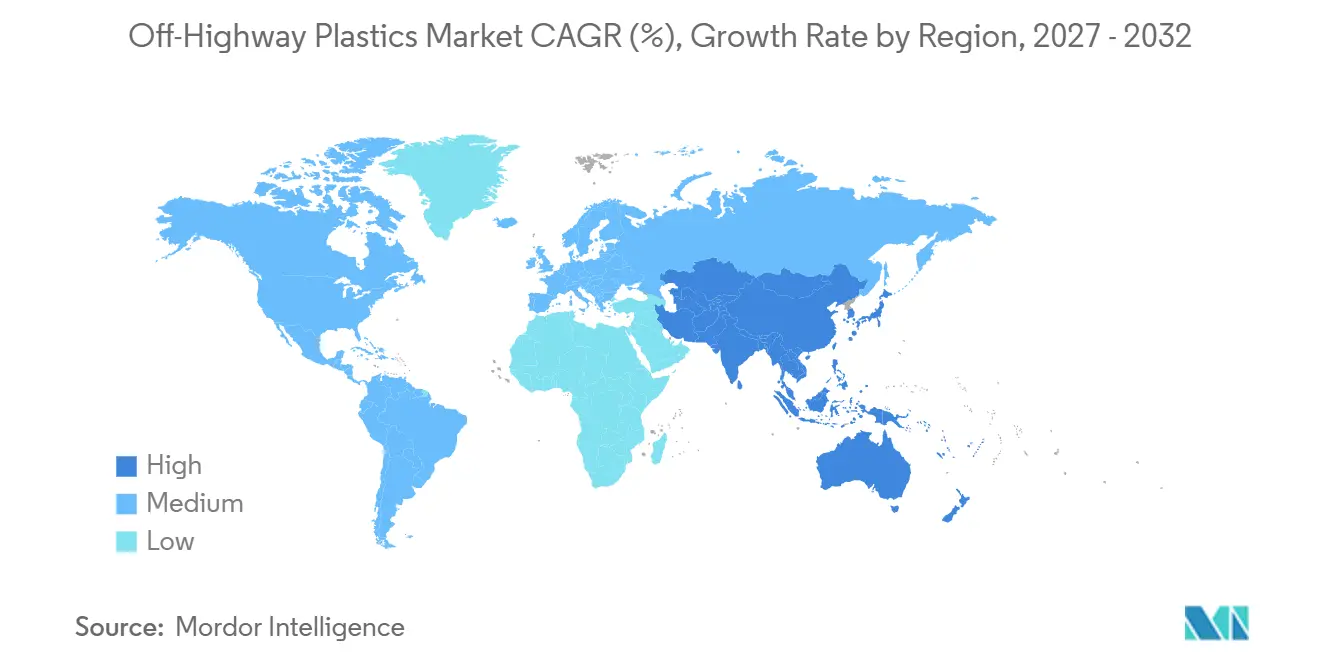
| Fastest Growing Market | Asia-Pacific |
| Largest Market | Asia-Pacific |
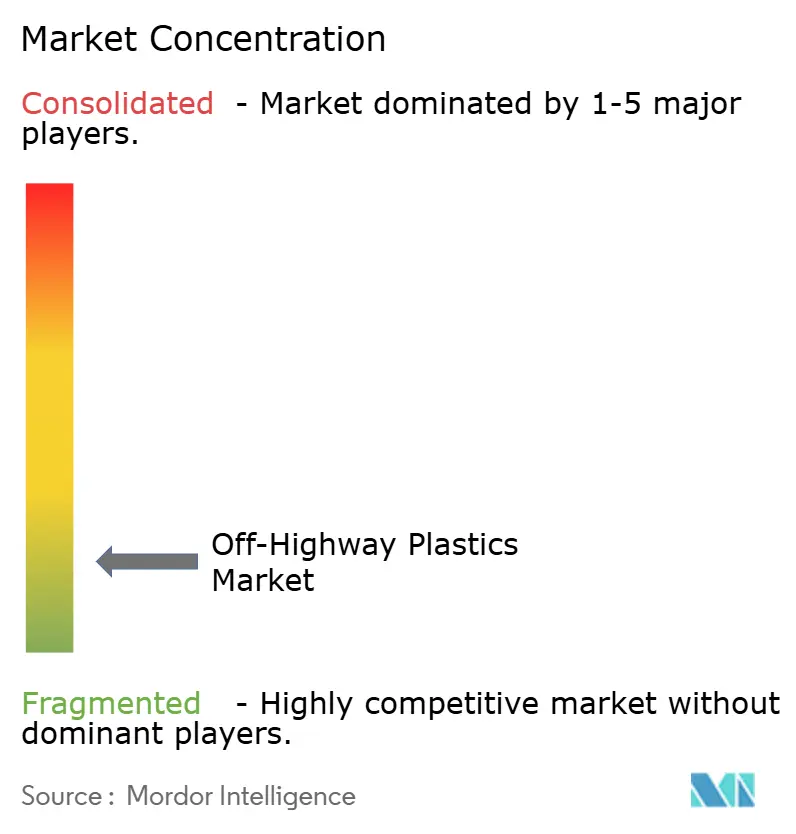
| Market Concentration | Low |
Major Players *Disclaimer: Major Players sorted in no particular order Image © Mordor Intelligence. Reuse requires attribution under CC BY 4.0. | |
Off-Highway Plastics Market Analysis by Mordor Intelligence
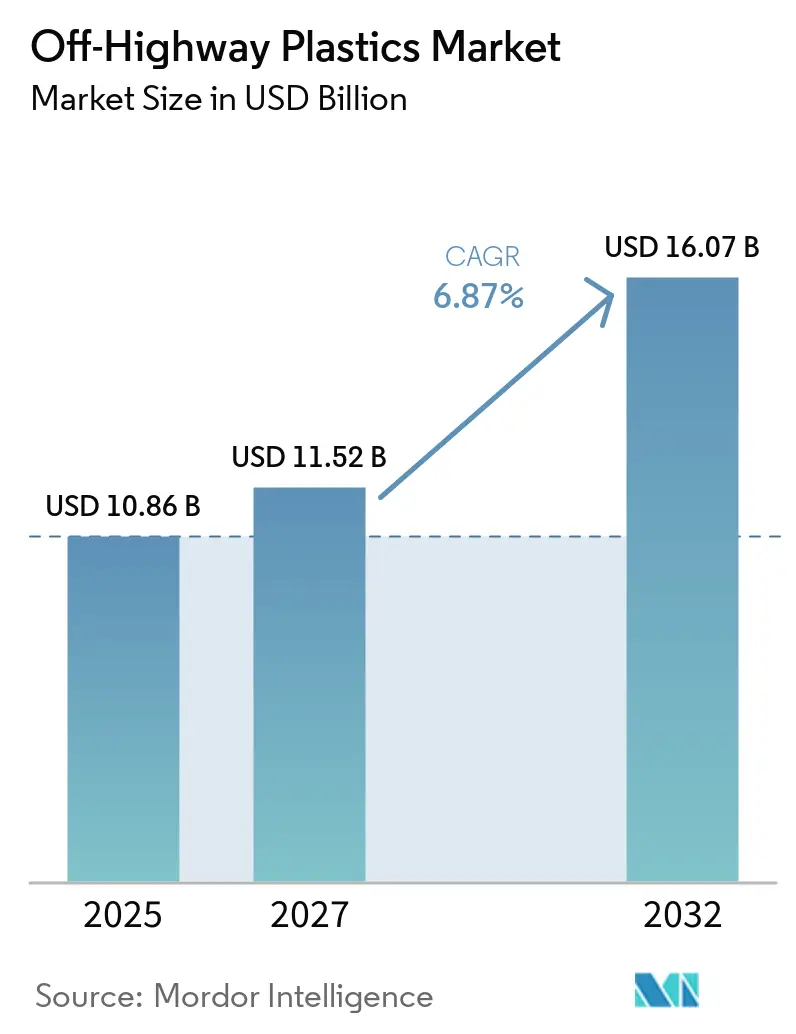
The off-highway plastics market size was valued at USD 10.86 billion in 2026 and is estimated to grow from USD 11.52 billion in 2027 to USD 16.07 billion by 2032, at a CAGR of 6.87% during the forecast period (2027-2032). The off-highway plastics market is supported by emissions regulations that make weight reduction an engineering requirement. Electrification is changing the mix of polymers used in powertrain, battery, and electrical applications. Infrastructure spending and agricultural mechanization are also supporting demand for equipment and increasing the plastic content per machine. These factors interact because original equipment manufacturers (OEMs) must meet efficiency, durability, and digital-system requirements within the same equipment platforms while managing maintenance needs and component reliability. The off-highway plastics market, therefore, presents opportunities in higher-value compounds, qualified components, and replacement parts for long-life fleets operating across construction, farming, mining, and material-handling environments worldwide.
Key Report Takeaways
- By material type, polypropylene held 33.54% of the off-highway plastics market share in 2026, while polyamide is forecast to grow at a 7.45% CAGR through 2032.
- By process type, injection molding accounted for 45.73% of the off-highway plastics market share in 2026, while additive manufacturing and 3D printing are forecast to expand at a 7.68% CAGR through 2032.
- By end-user industry, construction accounted for 40.17% of the off-highway plastics market share in 2026, while agriculture is forecast to grow at an 8.13% CAGR through 2032.
- By geography, Asia-Pacific held 41.68% of the off-highway plastics market share in 2026 and is forecast to grow at a 7.71% CAGR through 2032.
Note: Market numbers in this report are based on Mordor Intelligence's proprietary estimation framework, which combines nine months of actuals with Q4 projections for base year 2026.
Market Trends and Insights
Drivers Impact Analysis of Off-Highway Plastics Market*
| Drivers | (~) % Impact on CAGR Forecast | Geographic Relevance | Impact Timeline |
|---|---|---|---|
| Infrastructure and Construction Equipment Expansion | +2.1% | Global, led by Asia-Pacific and the Middle East | Medium term (2-4 years) |
| Agricultural Mechanization and Precision Farming Adoption | +1.7% | Asia-Pacific core, spillover to South America and Middle East and Africa (MEA) | Medium term (2-4 years) |
| Lightweighting for Fuel Efficiency and Emissions Compliance | +1.4% | Global | Short term (≤ 2 years) |
| Electrification of Off-Highway Equipment | +0.8% | Europe and North America, emerging in the Asia-Pacific | Long term (≥ 4 years) |
| Additive Manufacturing for Legacy Fleet Replacement Parts | +0.5% | North America and Europe | Short term (≤ 2 years) |
| Source: Mordor Intelligence | |||
Infrastructure and Construction Equipment Expansion
Long-cycle infrastructure programs support demand for construction equipment and related components across regional project pipelines. Construction machines use plastics for covers, cab interiors, fluid reservoirs, electrical housings, and hydraulic system parts. The off-highway plastics market benefits when a new generation of excavators, loaders, graders, or dump trucks enters service with a higher polymer-to-metal ratio. Digital construction sites create additional demand for sensor housings, cable conduits, and electronic enclosures. Autonomous operations, connected job-site management, and remote monitoring increase polymer requirements even when equipment fleet numbers remain stable. This makes per-machine content growth an important driver for the off-highway plastics market beyond normal equipment shipment cycles, reducing dependence on a single construction cycle or replacement period.
Agricultural Mechanization and Precision Farming Adoption
India's Sub-Mission on Agricultural Mechanization (SMAM) program has supported 21.61 lakh individual farm machines with INR 9,404.47 crore in central assistance since 2014-15. The number of individual beneficiaries increased from 2.07 lakh in 2020-21 to 2.32 lakh in 2024-25. Revised Pradhan Mantri Rashtriya Krishi Vikas Yojana (PM-RKVY) guidance issued in May 2025 expanded coverage to drone-based mechanization and post-harvest equipment[1]. China's 72% crop mechanization rate encourages OEMs to use lighter components that reduce soil compaction. Precision farming systems also require thermoplastic housings, connectors, and protective enclosures for guidance, application, and autonomous driving functions. Equipment content increases in complexity with each machinery generation, supporting the off-highway plastics market even when tractor production is stable and farm operators delay purchases of large mechanical platforms.
Lightweighting for Fuel Efficiency and Emissions Compliance
Weight reduction helps off-highway OEMs meet Stage V and Tier 4 Final non-road emissions requirements without redesigning every powertrain element. BASF and WAL Low Carbon Technology presented a commercial-vehicle air tank at CHINAPLAS 2025 that reduced weight by 10%-20% compared with aluminum and by more than 50% compared with steel. Comparable changes across a machine's plastic architecture can reduce mass over the equipment's life, which routinely exceeds 10,000 operating hours. Reinforced polypropylene grades are used for exterior panels, while PA, PC, and POM compounds are used where parts must carry a load or manage heat. Equipment electrification does not eliminate this need because battery packs absorb a substantial portion of the mass saved by simpler engine layouts. The off-highway plastics market therefore continues to benefit from lightweighting in both diesel and electric equipment designs, as efficiency targets apply across the full equipment fleet.
Electrification of Off-Highway Equipment
Battery-pack prices declined from USD 210/kWh in 2021 to USD 110/kWh in 2025, reducing the cost gap between electric and diesel equipment. Electrified platforms require dimensionally stable polyamide in high-voltage wiring systems and battery-management housings. They also use PPA compounds in coolant manifolds and pump housings exposed to glycol-water mixtures. Japan has identified electric construction machinery certified as GX Construction Machines as a national priority and allocated JPY 1.8 billion (USD 0.01 billion) for adoption incentives. Röchling Automotive's 2026 thermoplastic composite intrusion-protection plates demonstrate that battery-electric platforms can support structural applications that previously relied on aluminum alloys. These applications increase material value per kilogram and provide the off-highway plastics market with a route into more demanding load-bearing applications that require thermal stability, impact resistance, and reliable dimensional control.
Restraints Impact Analysis of Off-Highway Plastics Market*
| Restraints | (~) % Impact on CAGR Forecast | Geographic Relevance | Impact Timeline |
|---|---|---|---|
| Petrochemical Feedstock Price Volatility | -0.8% | Global | Short term (≤ 2 years) |
| Environmental Regulation and End-of-Life Plastic Requirements | -0.6% | Europe, expanding to North America | Medium term (2-4 years) |
| Long Qualification Cycles for Safety-Critical Plastic Components | -0.4% | Global | Long term (≥ 4 years) |
| Source: Mordor Intelligence | |||
Petrochemical Feedstock Price Volatility
Ethylene and propylene prices declined by 12-60% between January and December 2025, reflecting weak downstream demand, persistent oversupply, lower crude oil prices, and trade-policy uncertainty. For procurement teams, price volatility is more challenging than price direction, as it makes multi-year material contracts harder to negotiate. U.S. Gulf Coast propylene pricing also faced seasonal pressure, as greater use of ethane-based feedstocks reduced byproduct propylene output from steam crackers[2]. As a result, polymer-grade propylene became more sensitive to the output of dedicated propane dehydrogenation units. Ongoing shifts in resin supply and demand have extended uncertainty for polypropylene and polyethylene resins used in high-output components. When resin cost expectations change sharply, material qualification and supply diversification slow down in the off-highway plastics market, as suppliers and Original Equipment Manufacturers (OEMs) must reassess commercial terms before committing to new grades.
Environmental Regulation and End-of-Life Plastic Requirements
End-of-life plastic regulations for passenger vehicles are establishing a policy precedent that may extend to industrial and off-highway machinery. The proposed EU End-of-Life Vehicles Regulation targets 25% recycled plastic content in new passenger cars by 2030, including a closed-loop requirement within that target. A 2025 Global Impact Coalition pilot involving BASF, Covestro, LyondellBasell, Mitsubishi Chemical Group, and SABIC recovered nearly 8 metric tons of plastic from 100 end-of-life vehicles. The trial demonstrated that high-purity sorting by polymer type can work at scale. Construction and agricultural machines have operating lives of 15-25 years, considerably longer than the 8-12-year vehicle cycle that much of the existing recycling infrastructure is designed around. Producers that established recovery and traceability systems during 2026 are better positioned as end-of-life obligations reach the off-highway plastics market, and customers begin requesting verified recycled-content documentation.
*Our forecasts treat driver/restraint impacts as directional, not additive. The impact forecasts reflect baseline growth, mix effects, and variable interactions.
Off-Highway Plastics Market Segment Analysis
By Material Type:
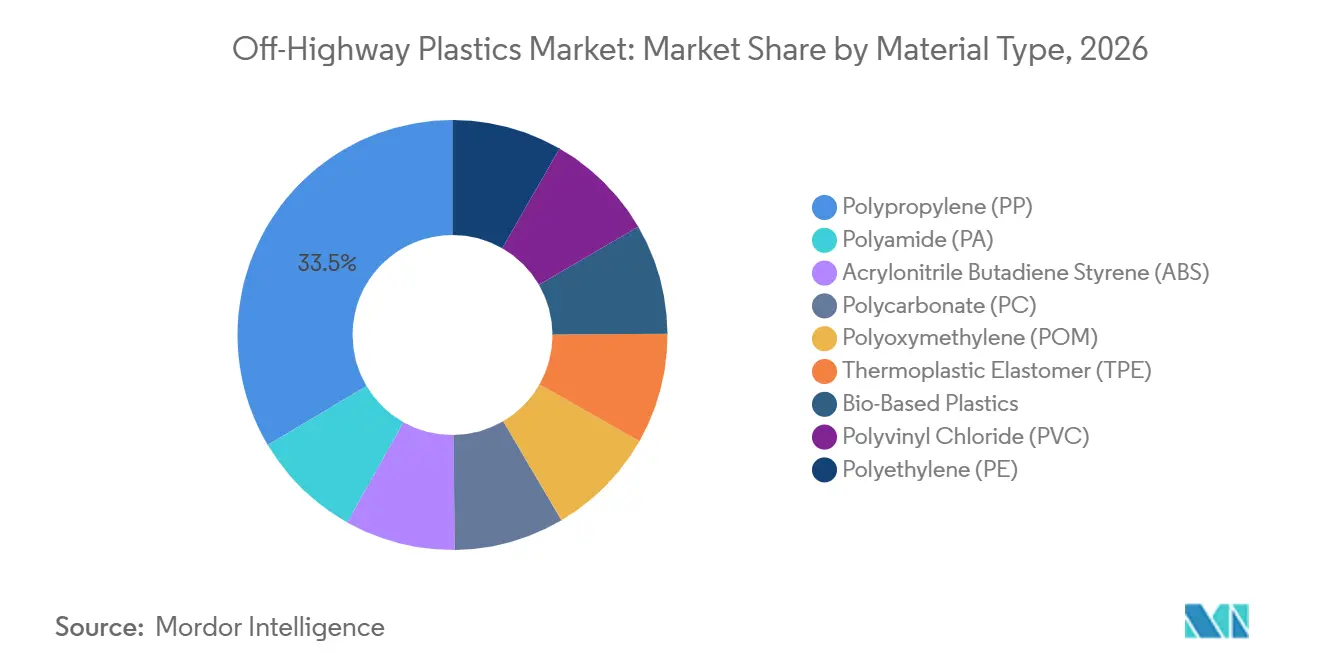
Engineering-Grade Substitution Broadens Beyond PP DominancePolypropylene held 33.54% of the off-highway plastics market share in 2026, making it the leading material by value. It is used in exterior cab panels, fuel tanks, fluid reservoirs, and under-hood covers across construction and agricultural equipment. Its performance and processing profile support injection molding and blow molding applications. Chemical resistance to hydrocarbons and cooling media also makes it suitable for large nonstructural parts. High-cavitation tools support the output required for many OEM platforms. PVC and PE remain cost-competitive choices for hoses, cable protection, and tank linings, with their role strongest where chemical resistance is more important than structural performance. ABS remains relevant for cab interiors and instrument panels. PC is increasingly used in sensor enclosures and protective lighting covers, while POM continues to be used in gears, valves, and hydraulic actuators.
Polyamide is the fastest-growing material category, with the off-highway plastics market size for PA projected to advance at a 7.45% CAGR from 2027 to 2032. Electrification and precision engineering are increasing the demand for materials that retain performance under heat and stress. In March 2025, BASF expanded its Ultramid Advanced T1000 polyphthalamide (PPA) range with hydrolysis-resistant grades designed for glycol-water environments up to 130°C. These grades are intended for pump housings, thermostat housings, and valve bodies in construction-equipment cooling systems. Thermoplastic elastomer (TPE) materials continue to serve vibration-damping, sealing, and flexible-boot applications. Bio-based plastics remain a small share of material demand, but OEMs are evaluating them as recycled-content and bio-content expectations broaden. Worldwide installed bioplastics capacity reached 2.31 million tons in 2025, with agriculture and transport among the application areas. Material substitution is therefore extending beyond low-cost polymers to grades that meet defined engineering requirements for thermal management, electrical protection, fluid control, and operator-facing equipment surfaces.

By Process Type:
Additive Manufacturing Redefines the AftermarketInjection molding accounted for 45.73% of the off-highway plastics market share by process type in 2026. It is used for high-output cab panels, fuel-system parts, structural brackets, and electrical housings. Its per-part economics remain attractive when OEMs source 50,000 or more units of a component each year, and tooling investment can be justified within a normal vehicle-model lifecycle. Injection molding also supports repeatable quality for components that must meet established fit and durability requirements. Extrusion is the second-largest process by scale and is essential for continuous profiles, hydraulic hoses, cable conduits, and weatherstrips. Compression molding plays a stable role in structural panels and thick-section guards, while blow molding remains important for hollow components such as reservoirs and tanks. Together, these established processes form the production base for the off-highway plastics market, allowing suppliers to match part geometry, production scale, and service requirements to the appropriate manufacturing method.
Additive manufacturing and 3D printing are forecast to record a 7.68% CAGR from 2027 to 2032, the fastest process growth rate in the off-highway plastics market. The opportunity is centered on spare parts rather than primary production. Legacy fleets are geographically dispersed and often require parts that are not economical to stock at every depot. Digitally produced parts can reduce the time and inventory required to support those machines. Caterpillar's range of nearly 80 printed composite and plastic aftermarket parts demonstrates this approach. The collaboration between 3D Systems, Daimler Trucks, and Daimler Buses also illustrates how decentralized production can improve fleet uptime. The economics of printed replacement components can be attractive where the alternative involves low inventory, long transport distances, and extended equipment downtime. Material suppliers that provide validated grades for maintenance-critical applications can build a service-based position beyond bulk resin supply.
By End-User Industry:
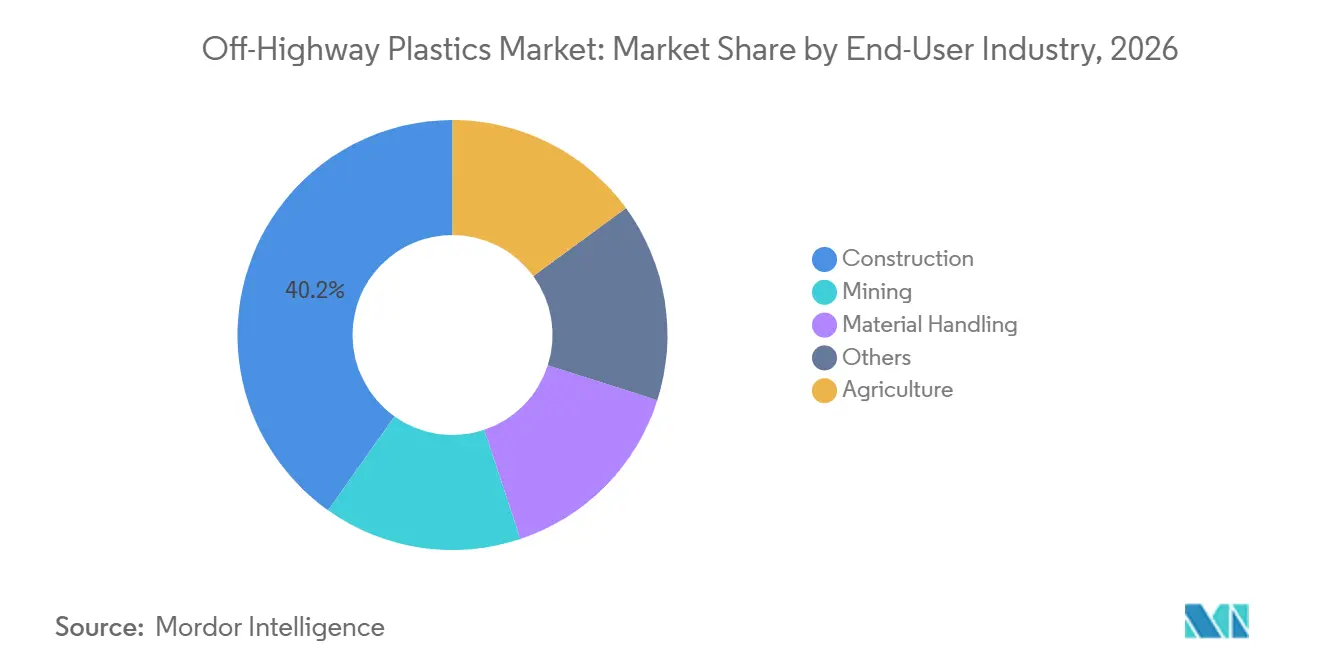
Agriculture Accelerates as Construction ConsolidatesConstruction accounted for 40.17% of the off-highway plastics market in 2026. Civil infrastructure activity and urban expansion support demand for excavators, loaders, and motor graders. These machines use plastics in cab interiors, engine covers, fluid systems, and electrical-protection parts. The installed fleet base gives construction a consistent role even when individual project cycles vary. Equipment redesigns can also raise polymer performance requirements. Caterpillar introduced its next-generation Cat 775 off-highway truck at bauma Munich in 2025, with a commercial launch planned for 2026. The redesigned frame was optimized for payload weight, which increases the importance of component-level mass management. Construction therefore remains the structural base of demand across the off-highway plastics market, with material selection shaped by durability, maintenance access, and operating conditions as much as by upfront part cost, particularly where equipment is exposed to dust, vibration, heat, fluid contact, and repeated field repairs.
Agriculture is expected to record an 8.13% CAGR from 2027 to 2032, the highest end-user growth rate in the off-highway plastics market. Precision agriculture platforms use GPS guidance, variable-rate systems, and autonomous sensors, each of which requires housings, connectors, and enclosures to protect electronic components from dust, vibration, moisture, and temperature fluctuations. This raises plastic content per machine independently of overall tractor production. India's Sub-Mission on Agricultural Mechanization (SMAM) program supported 2.32 lakh individual machinery purchases in 2024-25, compared with 2.07 lakh in 2020-21. Mining also supports demand through the need to reduce haul-truck tare weight, where a 5-10% reduction in machine weight can improve payload efficiency during long-haul cycles. Material handling provides a consistent demand base through forklifts, reach stackers, and automated guided vehicles, while CE marking requirements influence polymer choices in operator-facing components.
Geography Analysis
APAC Off-Highway Plastics Market
Asia-Pacific held 41.68% of the off-highway plastics market share in 2026 and is forecast to grow at a 7.71% CAGR through 2032. China combines large-scale production of construction and agricultural machinery with domestic component localization and green-machinery priorities. India's updated mechanization program is expanding the addressable base for precision farming, drones, and post-harvest equipment. Japan and South Korea contribute to specialized applications in electrified equipment and to the development of advanced polyamide (PA) and polycarbonate (PC). At the same time, ASEAN countries drive demand through regional infrastructure programs and integrated supply chains. The Asia-Pacific off-highway plastics market thus combines equipment scale with a shift toward higher-value materials, offering suppliers demand from both high-output machines and specialized electrified or digitally enabled platforms.
North America Off-Highway Plastics Market
North America remains significant due to equipment upgrades in the US Midwest, mining activity in Canada and Mexico, and a mature precision agriculture technology base that increases plastic content per machine. In January 2025, Covestro announced a USD 100 million-plus expansion of its polycarbonate compounding facility in Hebron, Ohio, with operations planned for late 2026, 24 new jobs expected, and 145 positions retained. Agricultural, construction, and mining equipment activity supports regional demand. At the same time, US EPA non-road engine emissions requirements continue to drive component-level weight reduction and the use of higher-performance polymer compounds. Both established equipment fleets and local investment in engineering plastics production support the regional market.
MEA and South America Off-Highway Plastics Market
South America, the Middle East, and Africa represent growth opportunities from a smaller base. Brazil's soybean and sugarcane economy drives demand for mechanized agricultural equipment, and Argentina retains substantial farm equipment activity despite macroeconomic volatility. Gulf infrastructure programs in Saudi Arabia and the UAE support construction equipment procurement, while South African mining activity in platinum-group metals and copper supports industrial plastic demand. Relying on compounded resins increases costs and lead-time exposure in both regions, creating an opportunity for suppliers that establish local compounding capacity and provide faster application support. Regional manufacturing can benefit the off-highway plastics market by lowering delivery risk for OEMs and component suppliers.
Competitive Landscape
The off-highway plastics market is fragmented, with large chemical producers competing alongside specialized component manufacturers. BASF, LyondellBasell, and Covestro compete on material breadth, research capabilities, and supply reliability, while Röchling and Trelleborg compete on application engineering, precision manufacturing, and proximity to OEM design cycles. The market structure reflects a division across commodity resins, engineering thermoplastics, compounds, molded components, seals, and application-specific technical services, with global resin suppliers and specialized processors rather than a single dominant participant. SABIC completed the divestiture of its Americas and Europe engineering thermoplastics business to Mutares in August 2026. The USD 450 million transaction covered polycarbonate (PC), acrylonitrile butadiene styrene (ABS), and polybutylene terephthalate (PBT) operations across eight plants in the Americas and Europe, creating potential space for regional compounders in value-added off-highway applications.
LyondellBasell selected Nexeo Plastics in March 2025 to distribute its engineered polymer portfolio across 40 European countries. The agreement expanded customer access without requiring direct-sales investment in every country, allowing the producer to maintain its focus on materials, product availability, and application development. At the same time, the distributor manages broader regional customer coverage. Trelleborg reported 2025 sales of SEK 34 billion and continued to develop engineered polymer sealing solutions for off-highway equipment. Its per- and polyfluoroalkyl substances (PFAS)-free product range, including Turcon polytetrafluoroethylene (PTFE) dual-layer technology, addresses potential restrictions on fluoropolymers in hydraulic sealing applications. These strategies indicate that the off-highway plastics market rewards distribution reach, compliance readiness, qualified performance, technical support, and resin availability.
Additive manufacturing and digital inventory management are competitive tools for material suppliers and OEMs. Companies that supply validated materials for printed spare parts can generate revenue beyond conventional resin quantities. At the same time, Caterpillar's 2025 patent activity around a 3D-printed filter center tube links OEM product development with material qualification. Compliance with the EU Machinery Regulation and ISO 11228 benefits suppliers with testing, traceability, and engineering depth in applications where generic materials are insufficient, especially when OEM teams require documented performance, repeatable processing, and a clear record of material selection through design validation.
Off-Highway Plastics Industry Leaders
-
Röchling SE & Co. KG
-
Mack Molding Co.
-
Trelleborg AB
-
EVCO Plastics
-
Mitsubishi Chemical Group
- *Disclaimer: Major Players sorted in no particular order
Off-Highway Plastics Market Companies Covered in this Report
- BASF
- Bemis Manufacturing Company
- Covestro AG
- EVCO Plastics
- Evonik Industries AG
- Gemini Group, Inc.
- Lippert
- LyondellBasell Industries Holdings B.V.
- Mack Molding Co.
- MacLean-Fogg
- Mitsubishi Chemical Group
- Röchling SE & Co. KG
- SABIC
- Trelleborg AB
- Varroc Group
Recent Industry Developments in Off-Highway Plastics Market
- September 2026: Röchling Automotive presented thermoplastic structural components, plastic-metal hybrid solutions, and composite high-voltage battery housings at IAA Transportation 2026. The presentation covered integrated development processes for commercial vehicle OEMs transitioning to lower-emission platforms and battery structural components that partially replace conventional metal solutions while reducing weight and material usage.
- August 2026: SABIC completed the divestiture of its engineering thermoplastics business in the Americas and Europe to Mutares for an enterprise value of USD 450 million. The business manufactures PC, ABS, and PBT at eight plants across the United States, Canada, Mexico, Brazil, Spain, and the Netherlands, and reported an operating loss of approximately USD 498 million for the full-year 2025. The transaction reflects SABIC's shift toward core Saudi Arabian polymer production and is expected to reshape supply dynamics in ABS and PC compounds used in off-highway cab components.
Global Off-Highway Plastics Market Report Scope
Off-highway plastics are specialized polymer materials and components used in vehicles and heavy equipment operating off public roadways. These materials are used across a range of applications, including agricultural machinery, construction equipment, mining vehicles, and forestry equipment. Off-highway plastics are selected for their ability to reduce weight, resist corrosion, and withstand demanding operating conditions.
The off-highway plastics market is segmented by material type, process type, end-user industry, and geography. By material type, the market is segmented into polypropylene (PP), polyvinyl chloride (PVC), polyethylene (PE), polyamide (PA), acrylonitrile butadiene styrene (ABS), polycarbonate (PC), polyoxymethylene (POM), thermoplastic elastomers (TPEs), and bio-based plastics. By process type, the market is segmented into injection molding, extrusion, compression molding, blow molding, additive manufacturing/3D printing, and other process types. By end-user industry, the market is segmented into construction, agriculture, mining, material handling, and others. The report also covers market sizes and forecasts for the off-highway plastics across 15 countries in major regions. The market sizes and forecasts are provided in terms of value (USD).
Segmentation Overview
| Polypropylene (PP) |
| Polyvinyl Chloride (PVC) |
| Polyethylene (PE) |
| Polyamide (PA) |
| Acrylonitrile Butadiene Styrene (ABS) |
| Polycarbonate (PC) |
| Polyoxymethylene (POM) |
| Thermoplastic Elastomer (TPE) |
| Bio-Based Plastics |
| Injection Molding |
| Extrusion |
| Compression Molding |
| Blow Molding |
| Additive Manufacturing/3D Printing |
| Other Process Types |
| Construction |
| Agriculture |
| Mining |
| Material Handling |
| Others |
| Asia-Pacific | China |
| India | |
| Japan | |
| South Korea | |
| ASEAN Countries | |
| Rest of Asia-Pacific | |
| North America | United States |
| Canada | |
| Mexico | |
| Europe | Germany |
| United Kingdom | |
| France | |
| Italy | |
| NORDIC Countries | |
| Rest of Europe | |
| South America | Brazil |
| Argentina | |
| Rest of South America | |
| Middle East and Africa | Saudi Arabia |
| South Africa | |
| Rest of Middle East and Africa |
| By Material Type | Polypropylene (PP) | |
| Polyvinyl Chloride (PVC) | ||
| Polyethylene (PE) | ||
| Polyamide (PA) | ||
| Acrylonitrile Butadiene Styrene (ABS) | ||
| Polycarbonate (PC) | ||
| Polyoxymethylene (POM) | ||
| Thermoplastic Elastomer (TPE) | ||
| Bio-Based Plastics | ||
| By Process Type | Injection Molding | |
| Extrusion | ||
| Compression Molding | ||
| Blow Molding | ||
| Additive Manufacturing/3D Printing | ||
| Other Process Types | ||
| By End-User Industry | Construction | |
| Agriculture | ||
| Mining | ||
| Material Handling | ||
| Others | ||
| By Geography | Asia-Pacific | China |
| India | ||
| Japan | ||
| South Korea | ||
| ASEAN Countries | ||
| Rest of Asia-Pacific | ||
| North America | United States | |
| Canada | ||
| Mexico | ||
| Europe | Germany | |
| United Kingdom | ||
| France | ||
| Italy | ||
| NORDIC Countries | ||
| Rest of Europe | ||
| South America | Brazil | |
| Argentina | ||
| Rest of South America | ||
| Middle East and Africa | Saudi Arabia | |
| South Africa | ||
| Rest of Middle East and Africa | ||
Key Questions Answered in the Report
What is current market size of Off-Highway Plastics Market?
The off-highway plastics market size was valued at USD 10.86 billion in 2026 and is estimated to grow from USD 11.52 billion in 2027 to USD 16.07 billion by 2032, at a CAGR of 6.87% during the forecast period (2027-2032).
Which manufacturing process is growing fastest for off-highway plastic parts?
Additive manufacturing and 3D printing are the fastest-growing processes, with a 7.68% CAGR through 2032, because they can reduce spare-part lead times for remote legacy fleets.
Why is agriculture growing faster than other end-user applications?
Agriculture is forecast to grow at an 8.13% CAGR through 2032 as precision farming adds housing,because OEMs must meet efficiency connectors, and electronic enclosures to machinery.
Which region has the largest opportunity for off-highway plastic suppliers?
Asia-Pacific holds a 41.68% market share in 2026 and is projected to register the fastest regional CAGR of 7.71% through 2032, driven by equipment manufacturing growth and increasing mechanization.