
OEM Insulation Market Size and Share
Market Overview
| Study Period | 2022 - 2032 |
|---|---|
| Market Size (2027) | USD 24.63 Billion |
| Market Size (2032) | USD 32.63 Billion |
| Growth Rate (2027 - 2032) | 5.78 % |
| Fastest Growing Market | Asia-Pacific |
| Largest Market | North America |
| Market Concentration | Medium |
Major Players *Disclaimer: Major Players sorted in no particular order Image © Mordor Intelligence. Reuse requires attribution under CC BY 4.0. | |
OEM Insulation Market Analysis by Mordor Intelligence
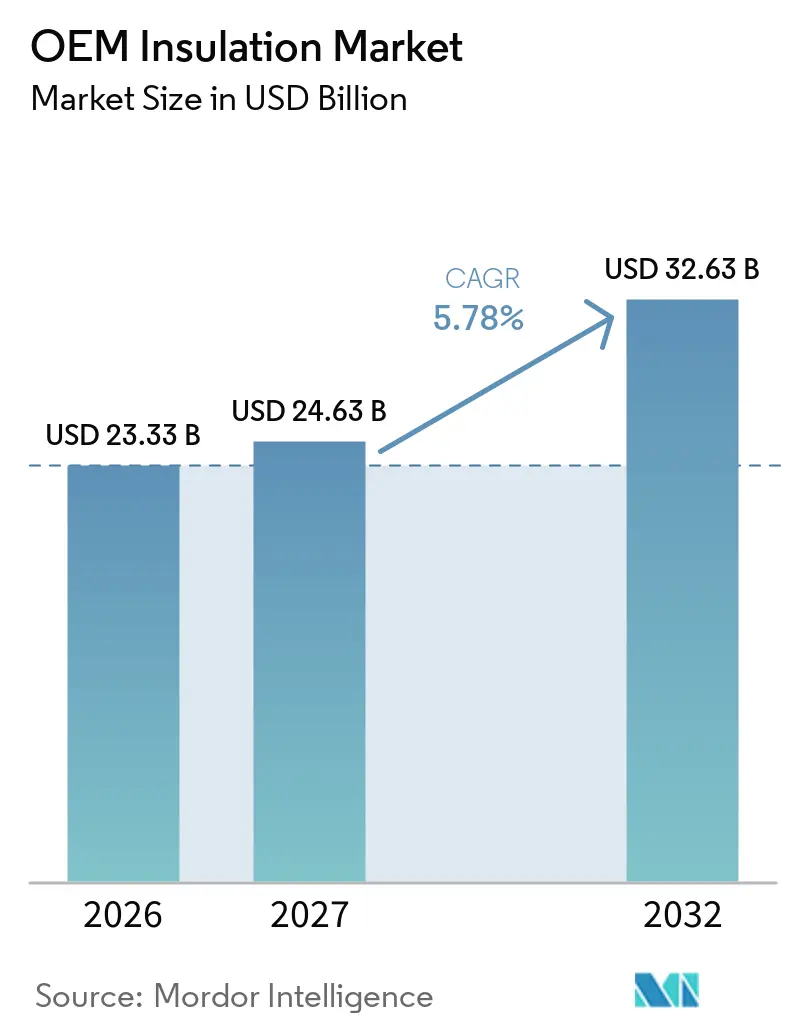
The OEM insulation market size was valued at USD 23.33 billion in 2026 and is estimated to grow from USD 24.63 billion in 2027 to USD 32.63 billion by 2032, at a CAGR of 5.78% during the forecast period (2027-2032). The OEM insulation market is supported by vehicle electrification and tighter energy-efficiency requirements for Heating, Ventilation, and Air Conditioning (HVAC), refrigeration, industrial equipment, and factory-built products. Battery-electric vehicles require materials that manage heat, fire propagation, vibration, and cabin noise within limited installation space. This requirement is directing product development toward material systems that combine thermal, acoustic, and structural functions. The OEM insulation market also benefits when manufacturers adopt higher-performing materials across global production lines rather than tailoring products to the least demanding local requirements. Suppliers with validated performance data, broad portfolios, and the capacity to support design work early in an OEM program are better positioned to compete.
Key Report Takeaways
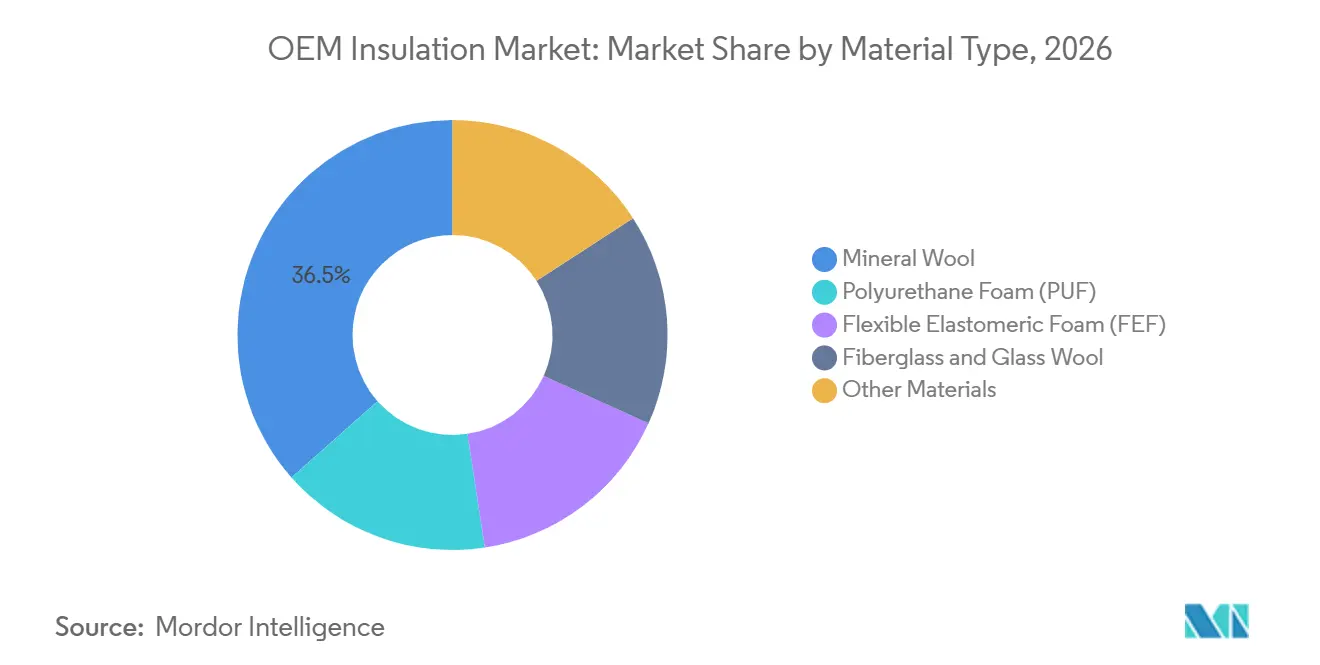
- By material type, Mineral Wool led with 36.52% market share in 2026, while Flexible Elastomeric Foam is forecast to expand at a 6.96% CAGR through 2032.
- By insulation type, Thermal Insulation held 55.17% market share in 2026, while Acoustic Insulation is forecast to expand at a 6.13% CAGR through 2032.
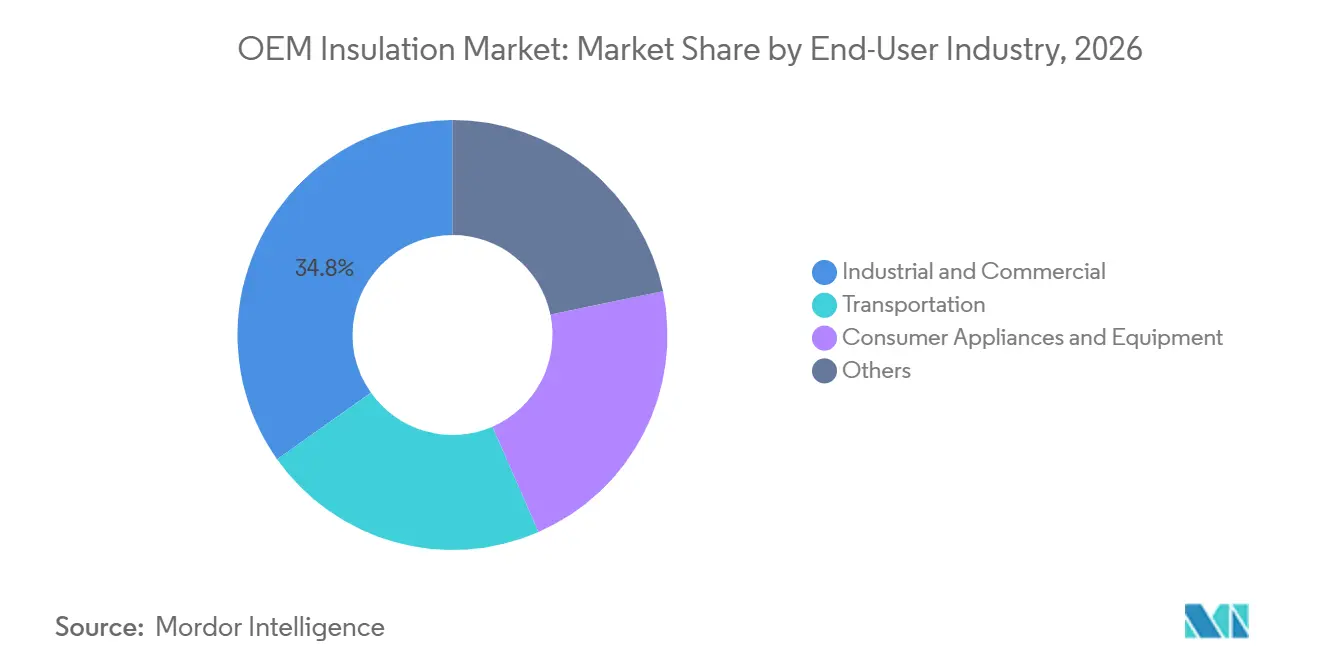
- By end-user industry, Industrial and Commercial accounted for 34.81% market share in 2026, while Transportation is forecast to advance at a 6.48% CAGR through 2032.
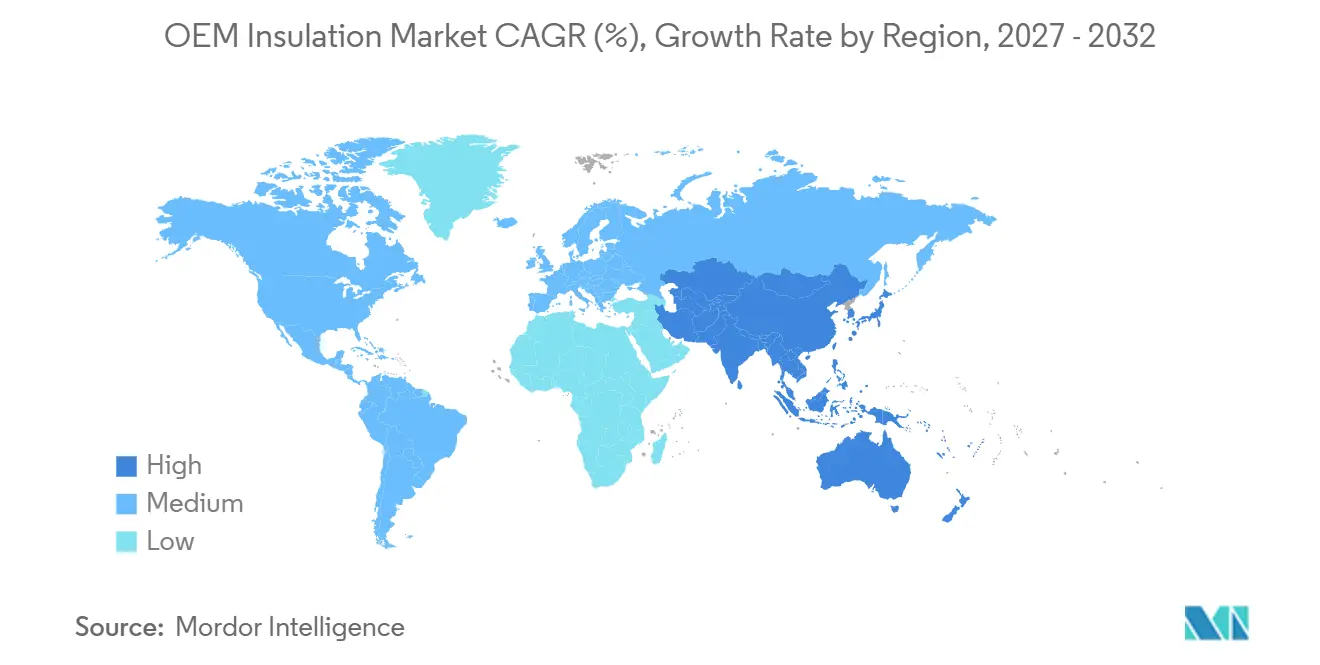
- By geography, North America held 33.39% of the OEM insulation market share in 2026, while Asia-Pacific is projected to grow at a 6.39% CAGR through 2032.
Note: Market numbers in this report are based on Mordor Intelligence's proprietary estimation framework, which combines nine months of actuals with Q4 projections for base year 2026.
Market Trends and Insights
Drivers Impact Analysis of OEM Insulation Market*
| Drivers | (~) % Impact on CAGR Forecast | Geographic Relevance | Impact Timeline |
|---|---|---|---|
| Tightening Energy-Efficiency and Emissions Standards | +1.20% | Global, with early gains in North America, Europe, and China | Medium term (2-4 years) |
| Vehicle Electrification and Battery Thermal Safety | +1.00% | Asia-Pacific, North America, and Europe | Long term (≥ 4 years) |
| Rising Acoustic Comfort Needs in Quieter Vehicles | +0.80% | Global, with concentration in Germany, Japan, South Korea, and the United States | Long term (≥ 4 years) |
| Original Equipment Manufacturer (OEM) Lightweighting and Space-Constrained Design | +0.70% | North America, Europe, Japan, and South Korea | Long term (≥ 4 years) |
| HVAC, Refrigeration, and Efficient Equipment Expansion | +0.90% | Asia-Pacific, with spillover to the Middle East, Africa, and South America | Medium term (2-4 years) |
| Source: Mordor Intelligence | |||
Tightening Energy-Efficiency and Emissions Standards
Regulatory requirements are a central driver of demand in the OEM insulation market across equipment categories. The European Union Construction Products Regulation, EU 2024/3110, requires performance declarations covering thermal conductivity, fire classification, and embodied carbon for products entering European value chains. In the United States, the Department of Energy published energy conservation standards for manufactured housing in July 2025, based on the 2021 International Energy Conservation Code's thermal-envelope provisions. EN 17956 provides energy-efficiency classes for industrial insulation systems across temperatures from -30°C to 650°C, giving equipment specifiers a way to set minimum installed performance levels. These regulations encourage OEM manufacturers to select higher-performing insulation grades across multiple production locations. The OEM insulation market benefits from compliance programs that affect both new equipment design and replacement-related upgrades.
Electrification of Vehicles and Battery Thermal Safety
Vehicle electrification is broadening the range of thermal safety functions expected from OEM insulation materials. China's GB 38031-2025 standard took effect in July 2026 and requires battery packs to resist fire or explosion during thermal runaway. Covestro introduced Baysafe BEF flame-retardant polyurethane encapsulation foam in July 2025 to limit thermal propagation between cylindrical cells[1]. Aspen Aerogels reported USD 168.9 million in 2025 Thermal Barrier revenue from PyroThin aerogel barriers supplied under production agreements with vehicle makers and battery-cell customers. Autoneum launched a long-fiber thermoplastic composite protection plate for electric vehicle batteries in May 2025, combining impact protection with thermal insulation. The OEM insulation market has an opportunity in designs that address cell-to-cell protection, underbody heat, and limited battery-pack space without adding excessive weight.
Rising Acoustic Comfort Requirements in Quieter Vehicles
Quieter electric vehicles make road and structure-borne noise more noticeable inside the cabin. A 2025 peer-reviewed study found that battery-electric vehicles expose noise paths at 500-2,000 Hz that combustion-engine noise had previously masked. The same research noted that European vehicle exterior noise limits fell from 82 dB to 68 dB under Regulation R51-03 for new production vehicles as of 2024. Technical research reported a sound absorption coefficient of 0.925 for optimized polyurethane foam at 2,000-4,000 Hz and vibration reduction of up to 25 dB for metamaterial-enhanced dash panels. Lightweight acoustic concepts can reduce sound-package weight by 35% while maintaining acoustic performance. These developments are influencing supplier selection in the OEM insulation market, as simulation-ready acoustic data is increasingly required during digital vehicle development.
Expansion of HVAC, Refrigeration, and Energy-Efficient Equipment Manufacturing
The transition from R-410A to A2L refrigerants, including R-32 and R-454B, is changing insulation requirements for HVAC and refrigeration assemblies. Higher-pressure systems can increase thermal gradients across insulation walls and support demand for thicker materials with lower water-vapor permeability. Flexible elastomeric foam is beneficial where manufacturers need conformable pipe insulation in compact assemblies. Munters announced a USD 29.95 million expansion of its Virginia HVAC manufacturing facility in March 2025, adding 200,000 square feet and 270 jobs to support data-center cooling demand. The OEM insulation market also benefits from new capacity in cold-chain equipment in developing economies, where food logistics and pharmaceutical distribution require pre-insulated systems. These conditions broaden demand beyond building construction and toward factory-made equipment.
Restraints Impact Analysis of OEM Insulation Market*
| Restraints | (~) % Impact on CAGR Forecast | Geographic Relevance | Impact Timeline |
|---|---|---|---|
| Volatile Polymer, Mineral Fiber, and Specialty Chemical Costs | -0.80% | Global, with high exposure in Europe, the Middle East, Africa, India, and North America | Medium term (2-4 years) |
| Long Qualification Cycles for New Materials and Formulations | -0.60% | North America, Europe, Japan, and South Korea | Long term (≥ 4 years) |
| Fire, Smoke, Toxicity, and Environmental Compliance Burden | -0.50% | Europe and North America, with supplier requirements extending to Asia | Medium term (2-4 years) |
| Source: Mordor Intelligence | |||
Volatile Polymer, Mineral Fiber, and Specialty Chemical Input Costs
Raw material volatility is a persistent constraint for the OEM insulation market. Methylene Diphenyl Diisocyanate (MDI), Toluene Diisocyanate (TDI), mineral fiber, and specialty additives affect the cost base of foam and fiber products. Supply disruptions and higher energy, logistics, and compliance costs can raise converter costs faster than contract prices can be revised. This is particularly challenging for suppliers operating under multi-year fixed-price agreements with equipment manufacturers. Margins can contract immediately, while the benefit of lower input costs takes longer to pass through the supply chain. Suppliers with diversified procurement, material flexibility, and contract protections are better positioned to manage this pressure.
Long Qualification Cycles for New Materials and Formulations
Long validation cycles limit the speed at which new insulation products can reach serial production. Automotive OEM programs can require 24 to 36 months of testing, from material sampling through production authorization[2]. Testing can cover thermal cycling, flame performance, vibration fatigue, and compatibility with vehicle fluids and electrolytes. High-voltage and thermal-runaway requirements add to the evidence needed for electric vehicle applications. Material specifications are also being finalized earlier in digital mock-up stages, which can disadvantage suppliers without verified simulation data. The OEM insulation market, therefore, tends to favor established suppliers with validation resources and existing OEM relationships.
*Our forecasts treat driver/restraint impacts as directional, not additive. The impact forecasts reflect baseline growth, mix effects, and variable interactions.
OEM Insulation Market Segment Analysis
By Material Type:
Mineral Wool Leads by Share, While Flexible Elastomeric Foam Records Faster GrowthMineral wool held 36.52% of the OEM insulation market share in 2026, supported by its non-combustibility, wide operating temperature range, and established use in piping and equipment housings. The material remains important for industrial piping, commercial equipment, and process-plant applications where fire performance is a basic requirement. ROCKWOOL introduced its FirePro range ahead of the 2029 update to the United Kingdom fire-resistance requirements, reflecting the continued focus on tested fire-safety products. Polyurethane foam remains relevant where thermal resistance per unit thickness and molding flexibility are required, while fiberglass and glass wool serve common HVAC and appliance applications. Aerogels and ceramic-fiber composites address specialized needs for thin, high-temperature designs.
Flexible elastomeric foam is the fastest-growing material category, with the OEM insulation market size for this material projected to grow at a 6.96% CAGR through 2032. The shift toward A2L refrigerants and the increasing use of flexible materials in electric-vehicle battery modules and underbody systems support growth. Ethylene Propylene Diene Monomer (EPDM)-based formulations can help manufacturers reduce dependence on butadiene and neoprene supply chains while meeting low-smoke and halogen-free material requirements. ISO 4898:2025 for rigid cellular plastics and ASTM C1728 requirements for aerogel insulation increase the importance of certification in foam and advanced-material applications. In May 2025, E-Van introduced an electric-vehicle liner using vacuum insulation panels with a microporous core and an R-60 rating in a 2.5-inch wall to preserve cargo space and reduce HVAC energy demand, demonstrating that installation space and material performance are linked purchasing criteria.

By Insulation Type:
Thermal Insulation Leads While Acoustic Insulation AdvancesThermal insulation accounted for 55.17% of revenue in 2026, as heat management is required across nearly every equipment category. HVAC duct wrap, refrigerated equipment linings, industrial pipe systems, and battery enclosures all depend on thermal control. The category has a broad base because temperature management is typically required regardless of economic conditions or end-use location. In battery applications, insulation also serves a safety function by helping slow thermal propagation following a cell failure, while keeping material selection tied to fire, moisture, and temperature performance. This wide range of uses gives thermal products a stable role in the OEM insulation market.
Acoustic insulation is forecast to grow at a 6.13% CAGR through 2032 in the OEM insulation market. Electric vehicles are increasing demand for acoustic treatments in dash panels, floor carpets, and pillar cavities, as noise paths previously masked by combustion engines are now more apparent. Vehicle programs increasingly specify insertion-loss targets and noise-reduction coefficients before physical prototypes are built, favoring suppliers that can provide both samples and verified digital performance data. In June 2025, Owens Corning announced a 50% capacity increase at its FOAMGLAS cellular-glass plant in Klášterec, Czech Republic, with the expanded line planned for the second quarter of 2026. Thermal and acoustic demand can grow in parallel as equipment manufacturers improve energy performance and vehicle manufacturers improve cabin comfort.
By End-User Industry:
Industrial and Commercial Demand Remains Stable While Transportation ExpandsThe industrial and commercial segment accounted for 34.81% of revenue in 2026, driven by process-plant piping, commercial refrigeration, and large HVAC systems. This position reflects the sustained need for insulation in logistics facilities, manufacturing plants, and equipment with long operating lives. Replacement cycles for industrial insulation can extend 15 to 20 years, creating a durable baseline of demand. Energy-efficiency programs can accelerate upgrades when existing assets no longer meet applicable performance requirements. The OEM insulation market benefits when equipment suppliers integrate insulation directly into the product rather than relying on separate field installation, supporting consistent quality and compliance with thermal and fire specifications.
Transportation is expected to be the fastest-growing end-user segment, with the OEM insulation market size projected to advance at a 6.48% CAGR through 2032. Multi-function panels are required to address battery thermal runaway, underbody heat, impact exposure, and cabin noise within a single vehicle platform. Autoneum's composite battery protection plate, introduced in May 2025, illustrates this combination of structural and thermal functions. Researchers at the University of Birmingham reported a nanofiber heat-shield material that was 10 times less thermally conductive than current advanced automotive materials and 100 times less dense than a ceramic fire blanket. Consumer appliances remain material-intensive, as refrigerators and freezers rely on foam insulation, while marine, aerospace, and medical equipment can support premium products due to demanding qualification requirements.
Geography Analysis
North America OEM Insulation Market
North America accounted for 33.39% of regional revenue in 2026, supported by its concentration of HVAC producers, automotive assembly plants, and industrial equipment manufacturers. The United States is the primary regional demand center, where federal and state energy standards influence factory-built products and commercial equipment. Wisconsin adopted the 2021 International Energy Conservation Code, including updated commercial thermal envelope requirements, in September 2025. ROCKWOOL broke ground on a facility in Wallula, Washington, in 2025 to serve regional industrial and OEM customers. Danfoss began production of GBC shutoff ball valves at its Monterrey facility in June 2025, reflecting Mexico's role in North American HVAC manufacturing supply chains.
APAC OEM Insulation Market
Asia-Pacific is forecast to grow at a 6.39% CAGR through 2032, making it the fastest-growing region in the OEM insulation market. China combines large-scale electric vehicle production with battery safety regulations that support the use of high-performance thermal materials. India and Southeast Asia contribute to demand through HVAC adoption, appliance manufacturing, cold-chain development, and data center construction. Armacell opened an aerogel insulation plant in Pune in June 2025, doubling its global aerogel manufacturing capacity. The region's expanding equipment manufacturing base supports demand for factory-installed insulation across a broad range of products.
EMEA and South America OEM Insulation Market
Europe remains a closely regulated OEM insulation market, as the Construction Products Regulation, Industrial Emissions Directive, and Energy Efficiency Directive set minimum standards for thermal performance. Germany remains important for automotive applications as premium vehicle programs shift toward electrification. Saint-Gobain continued construction of a stone wool production line at its Vidalengo facility in Italy during 2025 to serve regional demand. South America is centered on Brazil and Argentina, where cold-chain logistics and commercial HVAC adoption are the key drivers of demand. The Middle East and Africa show gradual growth in industrial and commercial demand, led by Saudi Arabia and South Africa.
Competitive Landscape
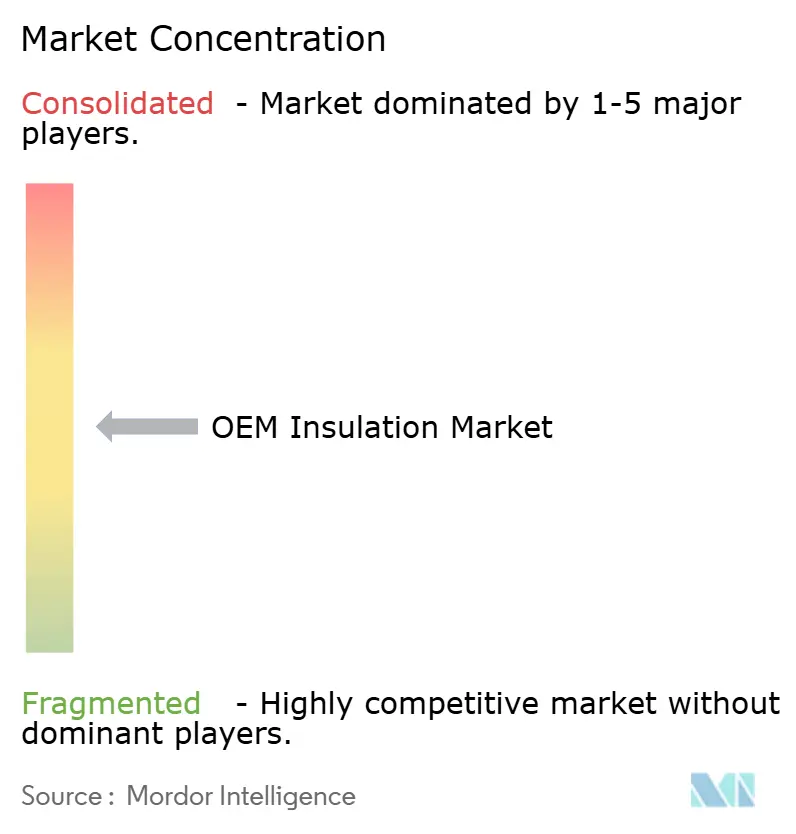
The OEM insulation market is moderately fragmented. ROCKWOOL A/S, Saint-Gobain, Owens Corning, and Knauf Insulation are vertically integrated mineral-fiber suppliers with broad manufacturing footprints. Their scale supports high-output industrial and transportation customers that require reliable availability and a wide range of tested products. Armacell operates in flexible foam and performance materials, while Covestro supplies polyurethane material technologies. ROCKWOOL reported EUR 473 million (~USD 531.04 million) in capital investment in 2025 and budgeted EUR 650 million (~USD 729.76 million) for 2026, supporting new capacity in markets where mineral-wool projects can take three to four years to develop.
Specialized suppliers compete in areas where vehicle and battery applications require thinner or more heat-resistant materials. Aspen Aerogels has established multi-year production relationships with GM, Toyota, Scania, Audi, Volvo Cars, and Automotive Cells Company (ACC) for thermal-barrier products. These relationships create switching costs because thermal-barrier materials require qualification within a vehicle program. Covestro launched CQ-Configurator in January 2026 to help polyurethane-foam partners assess carbon dioxide impact and attribute sustainable material content. Such digital tools are becoming relevant as tier-1 suppliers increasingly request product-level environmental information during qualification. Emerging materials, including electrospun nanofiber insulation, may expand options for lightweight battery thermal barriers.
The OEM insulation market presents opportunities in aerogel composites for electric vehicles and halogen-free acoustic foams for premium platforms. Smaller suppliers can compete by addressing a specific thermal, acoustic, safety, or space constraint that larger portfolios do not fully address. However, lengthy qualification cycles and the need for global production support can limit smaller firms' ability to scale quickly. Large suppliers continue to invest in capacity as regulation, equipment efficiency, and vehicle electrification drive demand across several end uses. Suppliers gain competitive advantage through verified performance, broad manufacturing reach, material expertise, and early engagement in OEM design programs.
OEM Insulation Industry Leaders
-
Owens Corning
-
ROCKWOOL A/S
-
Saint-Gobain
-
Knauf Insulation
-
Covestro AG
- *Disclaimer: Major Players sorted in no particular order
OEM Insulation Market Companies Covered in this Report
- 3M
- Armacell
- Aspen Aerogels, Inc.
- Auria Solutions
- Autoneum
- BASF
- Covestro AG
- Johns Manville
- Kingspan Group
- Knauf Insulation
- Morgan Advanced Materials
- Owens Corning
- Recticel Insulation
- ROCKWOOL A/S
- Saint-Gobain
Recent Industry Developments in OEM Insulation Market
- January 2026: Covestro launched the CQ-Configurator, a digital platform that enables polyurethane (PU) foam value-chain partners to assess and optimize CO₂ impact and attributed sustainable material content for flexible and rigid PU foam applications in real time. The platform uses third-party verified Life Cycle Assessment (LCA) data for Scope 3 reporting and does not require LCA expertise.
- August 2025: Saint-Gobain completed construction of its 5th mineral wool insulation line at the Oragadam complex near Chennai, India, with a planned capacity of 50,000 tons/year, expected to create over 1,100 direct and indirect jobs. This expansion supports demand for OEM insulation in the Asia-Pacific region.
Global OEM Insulation Market Report Scope
OEM insulation refers to custom-fabricated thermal, acoustic, or fire-protective materials built directly into manufactured goods and equipment, rather than installed in buildings. These components are designed by or for original equipment manufacturers (OEMs) to fit inside specific products, such as cars, HVAC systems, or appliances.
The OEM insulation market is segmented by material type, insulation type, end-user industry, and geography. By material type, the market is segmented into mineral wool, polyurethane foam (PUF), flexible elastomeric foam (FEF), fiberglass and glass wool, and other materials. By insulation type, the market is segmented into thermal insulation and acoustic insulation. By end-user industry, the market is segmented into industrial and commercial, transportation, consumer appliances and equipment, and others. The report also covers market sizes and forecasts for OEM insulation across 16 countries in major regions. The market sizes and forecasts are provided in terms of value (USD).
Segmentation Overview
| Mineral Wool |
| Polyurethane Foam (PUF) |
| Flexible Elastomeric Foam (FEF) |
| Fiberglass and Glass Wool |
| Other Materials |
| Thermal Insulation |
| Acoustic Insulation |
| Industrial and Commercial |
| Transportation |
| Consumer Appliances and Equipment |
| Others |
| Asia-Pacific | China |
| India | |
| Japan | |
| South Korea | |
| ASEAN Countries | |
| Rest of Asia-Pacific | |
| North America | United States |
| Canada | |
| Mexico | |
| Europe | Germany |
| United Kingdom | |
| France | |
| Italy | |
| NORDIC Countries | |
| Russia | |
| Rest of Europe | |
| South America | Brazil |
| Argentina | |
| Rest of South America | |
| Middle East and Africa | Saudi Arabia |
| South Africa | |
| Rest of Middle East and Africa |
| By Material Type | Mineral Wool | |
| Polyurethane Foam (PUF) | ||
| Flexible Elastomeric Foam (FEF) | ||
| Fiberglass and Glass Wool | ||
| Other Materials | ||
| By Insulation Type | Thermal Insulation | |
| Acoustic Insulation | ||
| By End-User Industry | Industrial and Commercial | |
| Transportation | ||
| Consumer Appliances and Equipment | ||
| Others | ||
| By Geography | Asia-Pacific | China |
| India | ||
| Japan | ||
| South Korea | ||
| ASEAN Countries | ||
| Rest of Asia-Pacific | ||
| North America | United States | |
| Canada | ||
| Mexico | ||
| Europe | Germany | |
| United Kingdom | ||
| France | ||
| Italy | ||
| NORDIC Countries | ||
| Russia | ||
| Rest of Europe | ||
| South America | Brazil | |
| Argentina | ||
| Rest of South America | ||
| Middle East and Africa | Saudi Arabia | |
| South Africa | ||
| Rest of Middle East and Africa | ||
Key Questions Answered in the Report
What is current market size of OEM Insulation Market?
The OEM insulation market size was valued at USD 23.33 billion in 2026 and is estimated to grow from USD 24.63 billion in 2027 to USD 32.63 billion by 2032, at a CAGR of 5.78% during the forecast period (2027-2032).
Which OEM insulation material is growing fast?
Flexible elastomeric foam is forecast to grow at 6.96% CAGR through 2032, supported by HVAC refrigerant changes and electric-vehicle applications. Its conformability and moisture-control properties suit compact pipe systems, battery modules, and underbody applications. These needs are important because equipment makers must maintain performance without increasing installation space.
Which end-use area has the strongest growth outlook?
Transportation has the highest projected CAGR at 6.48% through 2032 as vehicle makers need thermal, acoustic, and safety solutions for electric platforms. The segment uses multi-function panels that can manage battery heat, underbody exposure, and cabin noise. Long validation processes mean qualified suppliers can be important partners throughout the life of a vehicle program.
Which region is expanding fastest?
Asia-Pacific is expected to grow at a 6.39% CAGR through 2032, driven by electric-vehicle production, Heating, Ventilation, and Air Conditioning (HVAC) demand, and cold-chain infrastructure. China’s battery-safety rules and broader manufacturing investment also support demand for higher-performance materials. India and Southeast Asia contribute through appliance production, refrigeration equipment, data centers, and new factory capacity.