
Octreotide Market Size and Share
Market Overview
| Study Period | 2021 - 2032 |
|---|---|
| Market Size (2027) | USD 3.01 Billion |
| Market Size (2032) | USD 5.01 Billion |
| Growth Rate (2027 - 2032) | 10.78 % |
| Fastest Growing Market | Asia-Pacific |
| Largest Market | North America |
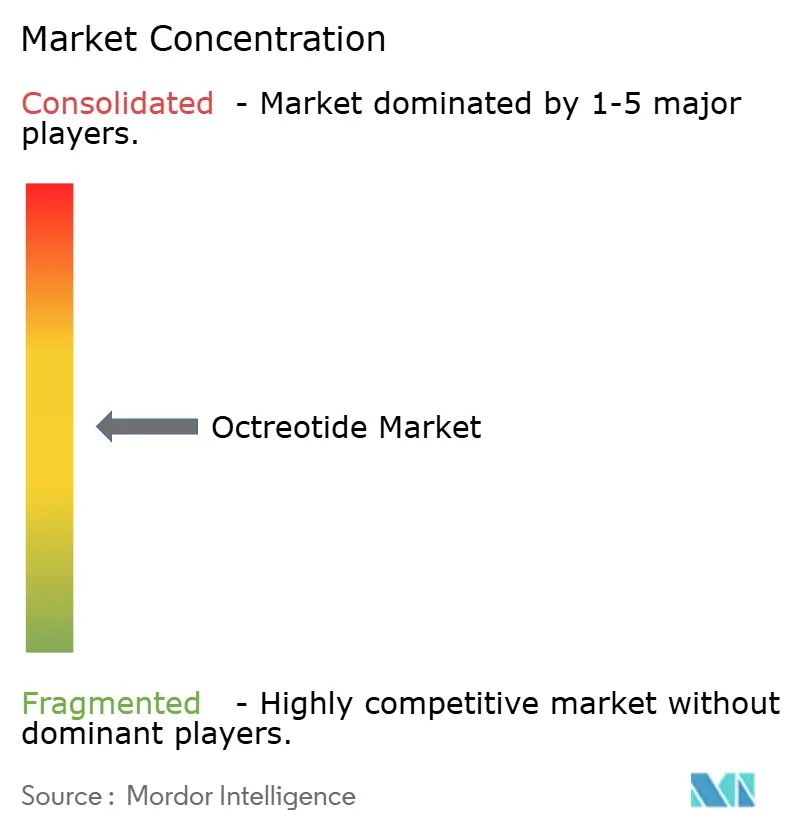
| Market Concentration | Medium |
Major Players *Disclaimer: Major Players sorted in no particular order Image © Mordor Intelligence. Reuse requires attribution under CC BY 4.0. | |
Octreotide Market Analysis by Mordor Intelligence
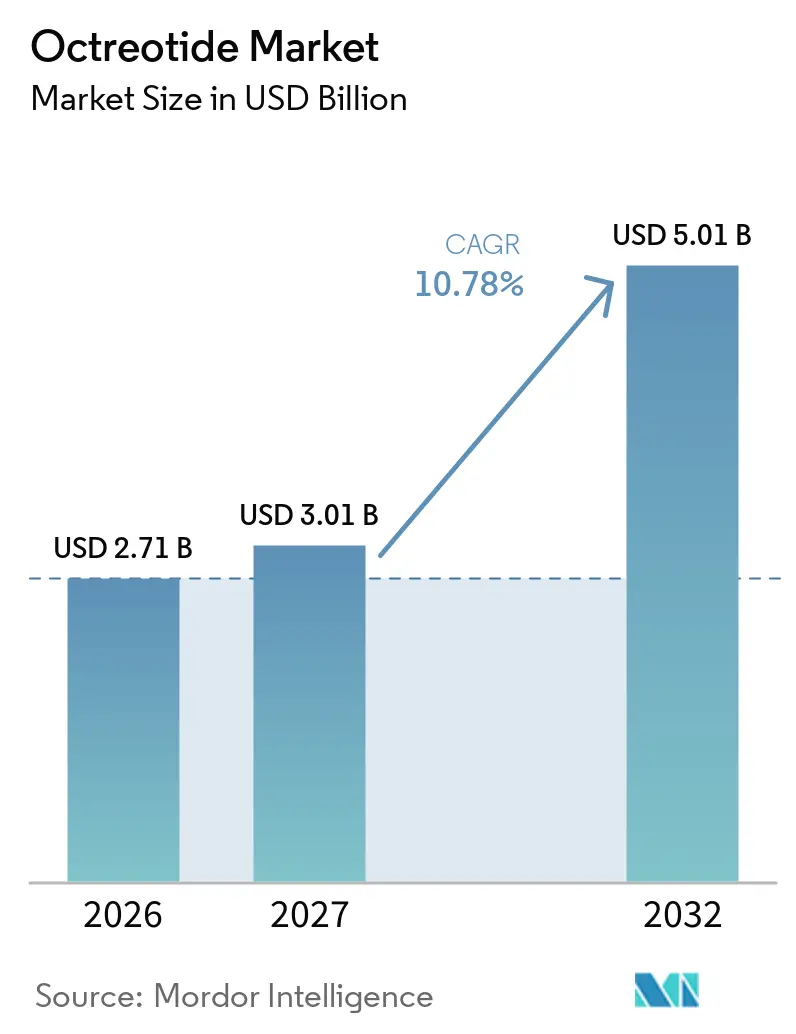
The Octreotide Market size was valued at USD 2.71 billion in 2026 and is estimated to grow from USD 3.01 billion in 2027 to reach USD 5.01 billion by 2032, at a CAGR of 10.78% during the forecast period (2027-2032).
Demand is supported by the established use of somatostatin analogs for gastroenteropancreatic neuroendocrine tumors and the need for ongoing treatment in acromegaly. The European Society for Medical Oncology’s 2024 guidance retains somatostatin analog therapy as a Category IA first-line option for eligible neuroendocrine tumor patients, supporting its continued use in specialist care. The octreotide market is also adapting to the entry of generic long-acting release formulations, which improve patient access but place downward pressure on branded product pricing.[1] New delivery approaches may change treatment settings, particularly as self-administered and oral formulations advance through clinical development. Consequently, competition is shifting beyond price toward reliable supply, ease of administration, and clinically relevant dosing schedules.
Key Report Takeaways
- By product type, branded octreotide held 53.45% of octreotide market share in 2026, while generic octreotide is forecast to grow at a 12.67% CAGR through 2032.
- By formulation, long-acting-release injectable suspension held 58.56% of octreotide market share in 2026, while depot microsphere injection is projected to grow at an 11.68% CAGR through 2032.
- By route of administration, intramuscular administration held 54.89% of revenue in 2026, while oral and other investigational routes are projected to grow at a 13.34% CAGR through 2032.
- By indication, gastroenteropancreatic neuroendocrine tumors accounted for 58.23% of the octreotide market size in 2026, while acromegaly is projected to grow at a 12.45% CAGR through 2032.
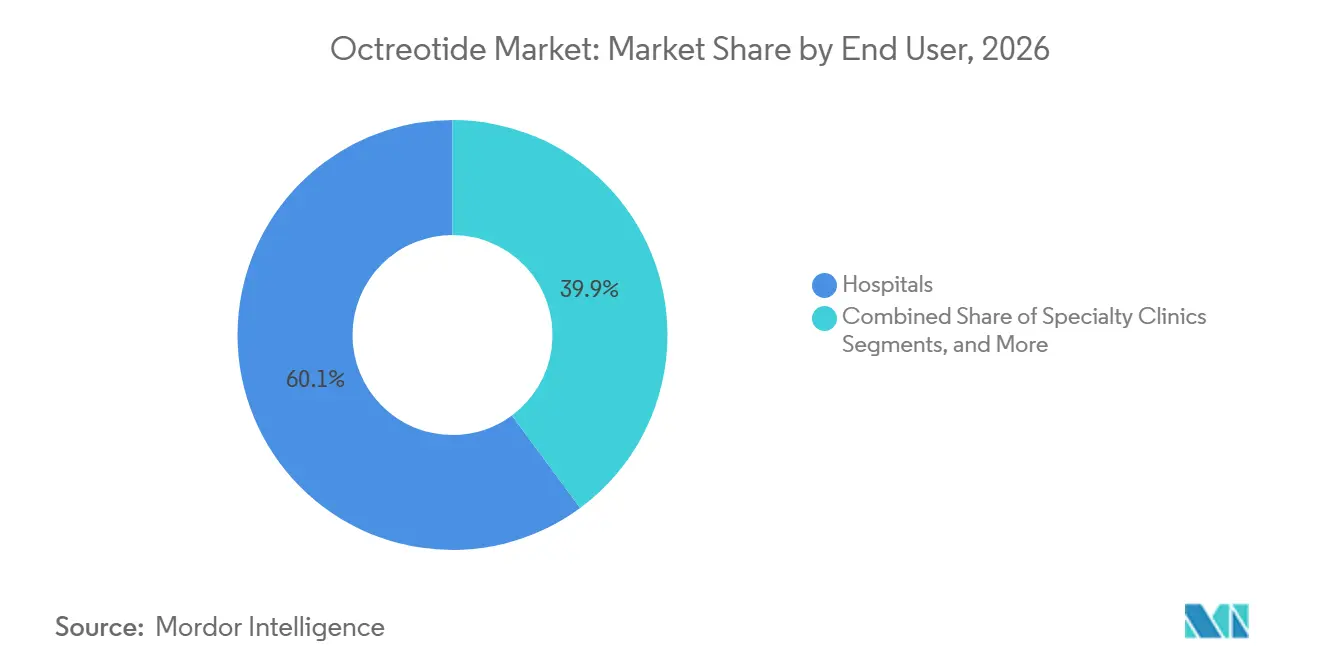
- By end user, hospitals held 60.12% of octreotide market share in 2026, while specialty clinics are projected to grow at an 11.85% CAGR through 2032.
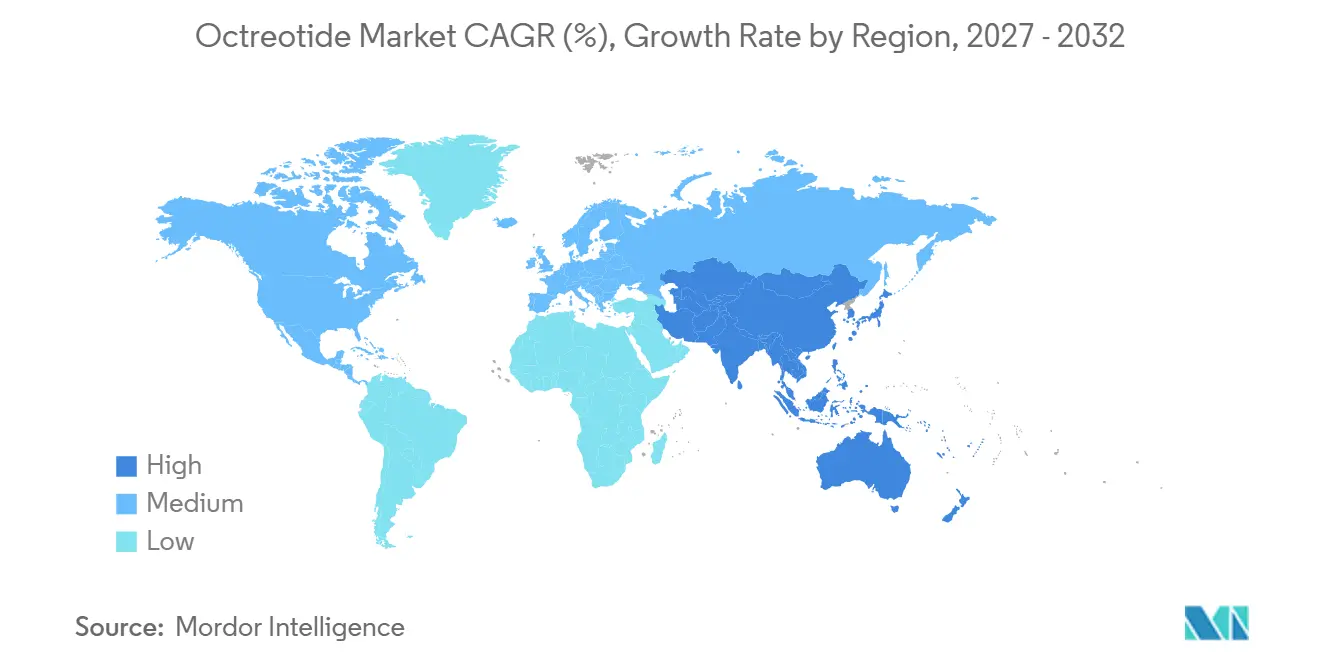
- By geography, North America held 39.88% of revenue in 2026, while Asia-Pacific is projected to grow at a 13.77% CAGR through 2032.
Note: Market numbers in this report are based on Mordor Intelligence's proprietary estimation framework, which combines nine months of actuals with Q4 projections for base year 2026.
Market Trends and Insights
Drivers Impact Analysis of Octreotide Market*
| DRIVER | (~) % IMPACT ON CAGR FORECAST | GEOGRAPHIC RELEVANCE | IMPACT TIMELINE |
|---|---|---|---|
| Expanding use in neuroendocrine tumors | +3.2% | Global, concentrated in North America and Europe | Long term (≥ 4 years) |
| Persistent demand for acromegaly maintenance therapy | +2.1% | Global, strongest in North America, Germany, and Japan | Medium term (2-4 years) |
| Generic long-acting-release entry expanding treatment access | +2.5% | North America, with expansion in Europe and Asia-Pacific | Short term (≤ 2 years) |
| Oral and self-administered somatostatin-pathway innovation | +1.3% | North America, with early spillover to Asia-Pacific and Europe | Long term (≥ 4 years) |
| Monthly depot supply-chain resilience as a formulary differentiator | +0.8% | Global, with emphasis on North America | Short term (≤ 2 years) |
| Improved conversion from short-acting to depot therapy | +0.9% | Asia-Pacific, South America, and Middle East and Africa | Medium term (2-4 years) |
| Source: Mordor Intelligence | |||
Expanding Use in Neuroendocrine Tumors: Octreotide as the Backbone of Combination Regimens
Gastroenteropancreatic neuroendocrine tumor incidence in the United States reached 6.1 cases per 100,000 people, while the 20-year limited-duration prevalence totaled 248,546 cases as of January 1, 2021. This expanding patient base supports recurring demand in the octreotide market, as treatment often continues over extended periods. The PROMID study reported median progression-free survival of 14.3 months with octreotide long-acting release (LAR), compared with 6.0 months with placebo, supporting its antiproliferative use in appropriate patients.[2] The European Society for Medical Oncology continues to recognize somatostatin analog therapy in its guidance for neuroendocrine and endocrine tumors. Octreotide also supports radioligand therapy regimens, with NETTER-2 reporting progression-free survival of 23.0 months for lutetium-177 dotatate plus octreotide, compared with 8.5 months for octreotide alone. Wider radioligand therapy availability at specialist centers may further support demand among patients with higher disease burden. Coordinated oncology and endocrinology care, including imaging, biochemical assessment, and treatment reviews, reinforces demand for established therapies and continuity of treatment.
Persistent Demand for Acromegaly Maintenance Therapy: Injectable SSAs Retain the Hardest-to-Treat Cohort
Acromegaly requires long-term biochemical monitoring and continued treatment for many patients. Debiopharm reported that up to 77% of patients receiving standard monthly somatostatin analog regimens experienced injection-site adverse events. However, the need to maintain biochemical control makes treatment interruption difficult despite the burden of regular injections. This supports demand for established injectable therapies among responsive patients and creates opportunities for formulations that reduce administration frequency. Paltusotine received Food and Drug Administration (FDA) approval in September 2025 as a once-daily oral, non-peptide somatostatin receptor subtype 2 agonist for adults with acromegaly.[3] Injectable somatostatin analogs remain relevant for patients requiring established maintenance approaches, particularly those with incomplete insulin-like growth factor 1 control who may need treatment escalation. Improved diagnosis in emerging health systems can expand the treated patient pool and support the projected 12.45% growth rate for acromegaly within the octreotide market.
Generic Long-Acting-Release Entry Expanding Treatment Access: The Access-Erosion Paradox
Teva launched the first generic version of Sandostatin LAR Depot in the United States in October 2024. Generic long-acting-release products improve access to complex depot therapies for payers and providers while increasing pressure on branded pricing and formulary positioning. The key market benefit is wider treatment availability in cost-sensitive settings; however, lower revenue per unit offsets commercial gains for manufacturers. This dynamic drives volume growth without comparable revenue growth for the originator brand. Manufacturing remains complex because these products require controlled microsphere performance and proven sterility, release characteristics, and bioequivalence. Limited qualified manufacturing capacity can restrict the number of competing suppliers. Consequently, health plans and providers assess generic products based on pricing and supply continuity, particularly when delayed dosing could disrupt established maintenance schedules.
Oral and Self-Administered Somatostatin-Pathway Innovation: Formulation Pipeline More Active Than at Any Prior Period
Triastek received FDA investigational new drug clearance for T25, an oral octreotide acetate tablet, in April 2026. The product uses a three-dimensional printed tablet design intended to protect the peptide through the digestive tract and enables clinical evaluation in the United States. An oral formulation could reduce dependence on clinic-based intramuscular administration and expand options for patients who find injections difficult. Camurus presented Phase III ACROINNOVA 2 results showing stable insulin-like growth factor 1 control through 52 weeks with its subcutaneous program. The company’s June 2026 presentation stated that the SORENTO study enrolled 332 participants across 103 sites in 12 countries. Self-administered options could shift suitable maintenance patients toward lower-cost care settings and reduce pressure on hospital injection capacity. However, clinic-based therapies remain necessary for complex cases, as these patients require close specialist supervision and regular clinical assessment.
Restraints Impact Analysis of Octreotide Market*
| RESTRAINT | (~) % IMPACT ON CAGR FORECAST | GEOGRAPHIC RELEVANCE | IMPACT TIMELINE |
|---|---|---|---|
| Generic price erosion in long-acting-release products | -1.8% | North America and Europe | Short term (≤ 2 years) |
| Complex depot manufacturing and bioequivalence requirements | -0.9% | Global | Long term (≥ 4 years) |
| Limited patient pool for rare endocrine disorders | -0.7% | Global, pronounced in emerging markets | Long term (≥ 4 years) |
| Buy-and-bill and site-of-care reimbursement friction | -0.6% | North America | Medium term (2-4 years) |
| Source: Mordor Intelligence | |||
Generic Price Erosion in Long-Acting-Release Products: Revenue Compression Beneath Volume Expansion
Novartis reported USD 1,213 million in 2025 sales for the Sandostatin LAR (long-acting release) group, reflecting a 5% decline at constant currency. Generic entry in the United States remains a key driver of lower realized prices for branded long-acting-release products. This pressure can continue even as patient treatment volumes increase, as payers favor lower-cost alternatives that meet coverage requirements. Consequently, branded revenue can decline despite stable or expanding treatment volumes. Although Sandostatin LAR benefits from established prescribing patterns and specialist familiarity, price differentials can affect hospital purchasing and payer coverage decisions. Manufacturers must strengthen their value proposition through competitive contracting, supply reliability, and clinical administration support.
Buy-and-Bill and Site-of-Care Reimbursement Friction: A Structural Barrier to Clinic-Level Adoption
The buy-and-bill model requires providers to purchase treatment before receiving reimbursement, creating financial pressure for smaller oncology and endocrinology practices when acquisition costs and reimbursement timelines do not align. Larger hospital systems have established billing processes and stronger purchasing capabilities, contributing to their 60.12% share of octreotide market revenue in 2025. These reimbursement dynamics can slow the adoption of newer depot products in smaller care settings and influence treatment administration sites. Specialty clinics remain a growth opportunity, with the segment projected to grow by 11.85% through 2032. Self-administered delivery can reduce practice-based drug purchasing requirements for certain patients, while complex cases continue to require monitoring and coordinated treatment. Clinic growth depends on providers’ ability to manage administration without excessive financial risk.
*Our forecasts treat driver/restraint impacts as directional, not additive. The impact forecasts reflect baseline growth, mix effects, and variable interactions.
Octreotide Market Segment Analysis
By Product Type:
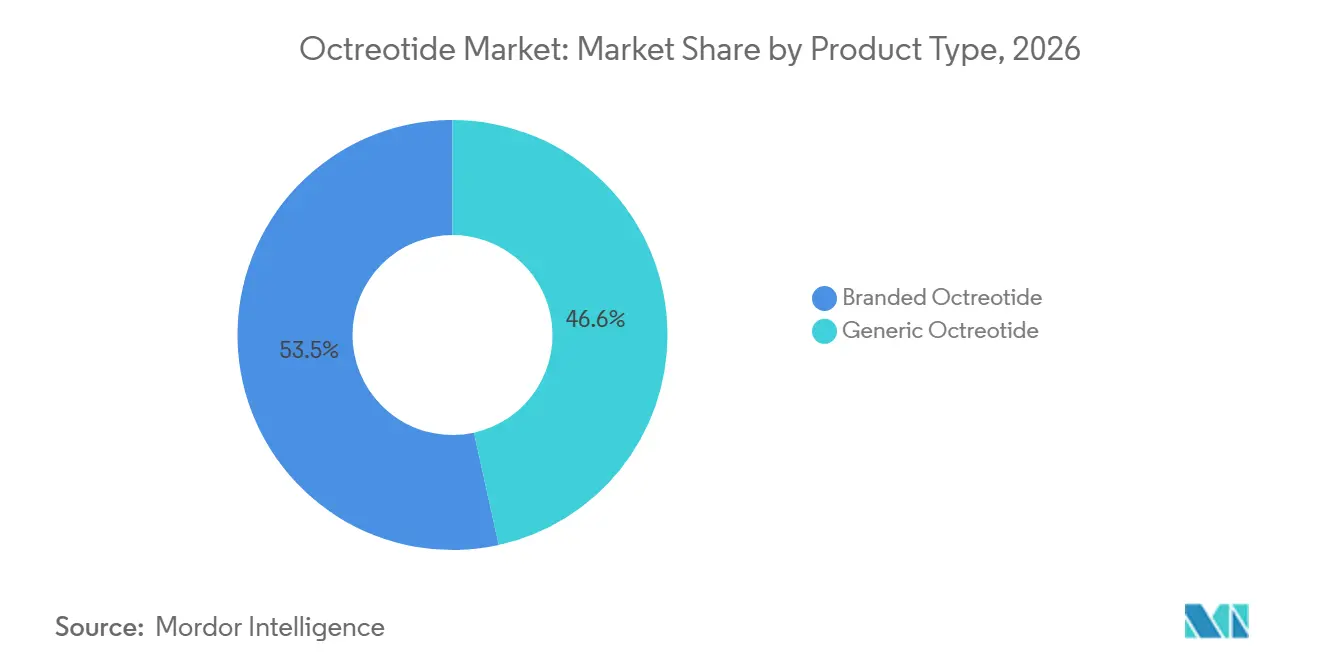
Generic Entry Expands Access While Branded Products Face Formulary PressureGeneric octreotide is projected to grow at a compound annual growth rate (CAGR) of 12.67% through 2032. Teva’s October 2024 United States launch introduced a generic long-acting release (LAR) option in a category historically led by the originator brand. Generic products can expand treatment access where pricing influences prescribing decisions and coverage. They can also prompt purchasing groups and health plans to reassess preferred-product designations.
Branded octreotide held a 53.45% share of the octreotide market in 2026. Branded products retain advantages through clinical familiarity, established distribution arrangements, and existing treatment protocols. Novartis reported Sandostatin LAR group sales of USD 1,213 million in 2025, confirming the franchise’s continued commercial scale. Generic competition will continue to pressure brand pricing and formulary placement, while suppliers compete on access, pricing, and supply reliability.
By Formulation:
Long-Acting-Release Suspension Remains the Core FormatLong-acting-release injectable suspension captured 58.56% of formulation revenue in 2026. The format supports regular maintenance treatment for neuroendocrine tumors and acromegaly. Monthly dosing provides clinicians with a familiar approach to monitoring disease control and managing treatment schedules. Established hospital workflows and trained providers continue to support its market position.
Depot microsphere injection is projected to grow at a 11.68% CAGR from 2027 to 2032. The technology requires precise control of polymer properties, drug loading, and release behavior, which can limit new competitor entry. Immediate-release injections continue to address acute-care needs, including esophageal variceal bleeding. Oral candidates, such as T25, represent a separate development pathway, subject to further clinical and regulatory progress.
By Route of Administration:
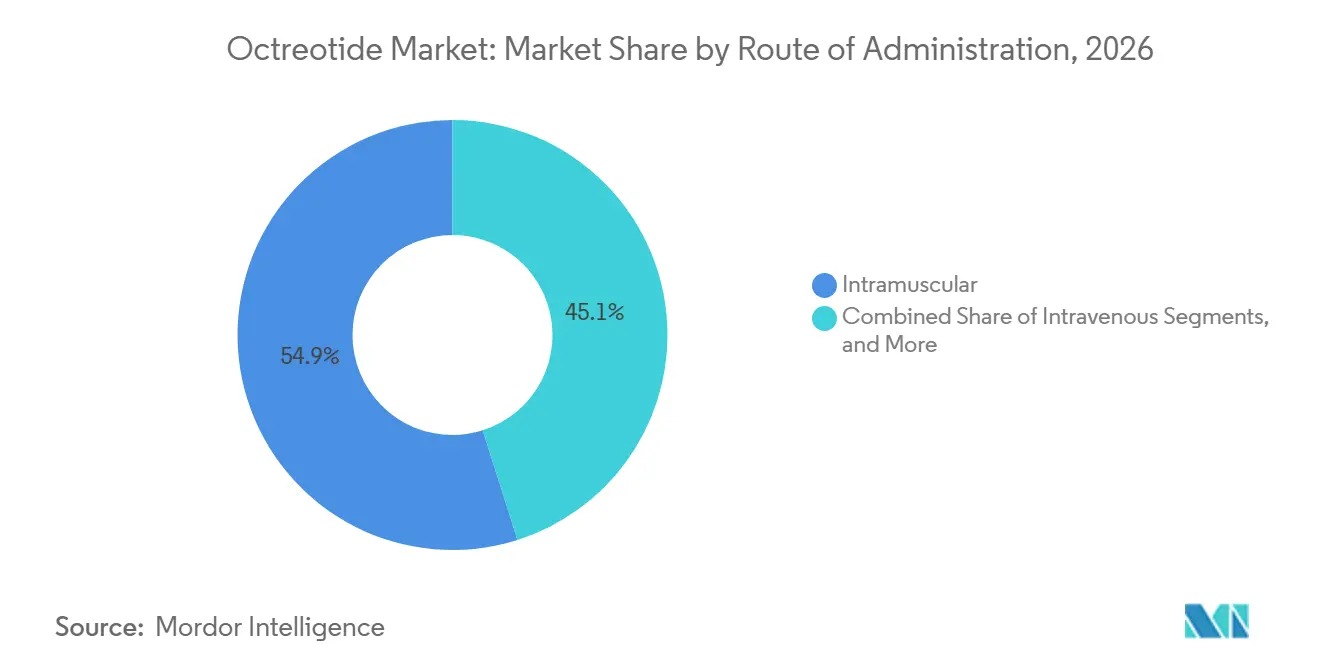
Intramuscular Administration Leads While New Routes Expand Treatment OptionsIntramuscular administration held 54.89% of revenue in 2026. Sandostatin LAR Depot uses an established gluteal intramuscular administration protocol. This route supports scheduled maintenance therapy and remains integrated into current clinical care pathways. Provider familiarity will continue to support its use across hospitals and specialty practices.
Oral and other investigational routes are projected to grow at a 13.34% CAGR through 2032. Subcutaneous approaches may reduce dependence on intramuscular clinic visits for suitable patients, while Camurus reported Phase III evidence of ongoing biochemical control with its subcutaneous program. Triastek’s T25 could further expand oral treatment options. Intravenous and short-acting subcutaneous products will continue to serve acute and outpatient-care needs.

By Indication:
Gastroenteropancreatic Neuroendocrine Tumors Lead While Acromegaly Gains MomentumGastroenteropancreatic neuroendocrine tumors accounted for 58.23% of the octreotide market size in 2026. The indication benefits from established clinical guidance and continued specialist use of somatostatin analogs. United States epidemiology data recorded a 20-year limited-duration prevalence of 248,546 neuroendocrine neoplasm cases in 2021. Combination approaches can further support use in selected advanced cases.
Acromegaly is projected to grow at a 12.45% CAGR through 2032. The indication requires long-term management to maintain biochemical control, supporting demand for injectable somatostatin analogs. The September 2025 approval of paltusotine introduced an oral option for adults with acromegaly. Acute uses, including esophageal variceal bleeding and secretory diarrhea, will continue to support demand for immediate-release products.
By End User:
Hospitals Retain Scale While Specialty Clinics Grow FasterHospitals held 60.12% of the octreotide market share in 2026. They administer acute-use octreotide and long-acting products for patients with complex neuroendocrine and endocrine conditions. Hospitals also maintain the staffing, cold-chain infrastructure, and purchasing systems required for depot injections. Their role remains particularly important in complex oncology care.
Specialty clinics are projected to grow at an 11.85% CAGR through 2032. These settings provide regular care for stable patients with endocrine and oncology conditions, supported by generic availability and lower-burden delivery systems. Self-administered treatment may allow some patients to transition from hospital-centered administration. Endocrinology clinics and oncology centers will continue to play a key role in monitoring symptoms, biochemical response, and patient follow-up.
Geography Analysis
North America
North America is projected to account for a 39.88% share of the octreotide market in 2026. The region benefits from established specialty care infrastructure, broad access to endocrinology and oncology providers, and the long-standing Sandostatin franchise. Teva’s 2024 launch of a generic long-acting release option in the United States is expected to influence purchasing decisions among payers and providers managing high-cost specialty medicines. Hospitals and specialist practices will continue to influence the pace of product switching, while new self-administered approaches may expand the range of care settings over time.
Asia-Pacific
Asia-Pacific is forecast to grow at a compound annual growth rate (CAGR) of 13.77% during 2027-2032. Expanding specialty care capacity and broader treatment access across major health systems will support this growth. Triastek is expected to receive U.S. Food and Drug Administration (FDA) investigational new drug clearance for T25 in April 2026, introducing an oral development pathway that supports the region’s innovation base. Funding levels and diagnostic capacities vary across Asia-Pacific countries; therefore, adoption is unlikely to be uniform. However, improved access to endocrinology and oncology care can support demand over time.
Europe, South America, Middle East, and Africa
Europe remains a major geographic cluster in the octreotide market, with Germany, France, and the United Kingdom serving as key contributors. The region has experienced generic competition in long-acting release products and maintains an established network of specialist centers. Novartis is expected to report continued pressure on Sandostatin long-acting release (LAR) from generic competition in its 2025 annual report. Europe also plays an important role in developing longer-interval products, with Debiopharm expected to initiate the Phase III OXTEND-03 trial across 75 sites in 21 countries in December 2025. South America and the Middle East and Africa offer opportunities to improve patient access as diagnostic capabilities and specialist care expand. Progress in these regions will depend on referral pathways, specialist availability, and reimbursement support.
Competitive Landscape
The octreotide market comprises a leading branded franchise and a growing group of generic suppliers. Novartis remains the largest branded participant through Sandostatin long-acting release (LAR) and reported USD 1,213 million in sales for the Sandostatin LAR group in 2025. Teva launched a lower-cost generic long-acting release option in the United States in October 2024. Immediate-release products are supplied by Aurobindo, Dr. Reddy’s, Fresenius Kabi, Gland Pharma, Hikma, Sagent, Sun Pharma, and Zydus Lifesciences. These suppliers create a more diverse competitive landscape outside the branded long-acting release segment. Manufacturers also compete based on supply reliability, manufacturing capabilities, and payer access.
Product development focuses on improving patient convenience and reducing the administration burden. Triastek received Food and Drug Administration (FDA) investigational new drug clearance in April 2026 for T25, an oral octreotide acetate tablet. If clinical development and regulatory review are successful, the program could offer a new route of administration. Camurus is advancing a self-administered subcutaneous program and presented Phase III evidence demonstrating continued biochemical control. As of June 2026, its SORENTO study had enrolled 332 patients across 103 sites in 12 countries. These programs demonstrate competitors’ efforts to reduce the need for monthly intramuscular treatment.
Debiopharm is pursuing a quarterly treatment strategy. The first patient entered the Phase III OXTEND-03 study of Debio 4126 in December 2025. The study plans to evaluate a regimen of four injections per year, compared with 12 injections annually, for eligible patients with acromegaly. The competitive landscape will remain divided among established injectables, generic products, and new delivery approaches. Companies that combine clear product positioning, reliable treatment delivery, and improved convenience will be better positioned in the market. Practical improvements in dosing intervals or care settings can be as important as product price.
Octreotide Industry Leaders
-
Viatris Inc.
-
Fresenius Kabi AG
-
Teva Pharmaceutical Industries Ltd.
-
Hikma Pharmaceuticals PLC
-
Novartis AG
- *Disclaimer: Major Players sorted in no particular order
Octreotide Market Companies Covered in this Report
- Amneal Pharmaceuticals
- Aurobindo Pharma
- Bachem Holding
- BCN Peptides, S.A.
- Cipla
- Dr. Reddy’s Laboratories
- Fresenius
- GLAND PHARMA
- Hikma Pharmaceuticals
- Lupin
- Novartis
- PolyPeptide Group AG
- Sagent Pharmaceuticals, Inc.
- Sun Pharmaceuticals Industries
- Teva Pharmaceutical Industries
- USV Private Limited
- Viatris
- Zydus Lifesciences Limited
Recent Industry Developments in Octreotide Market
- April 2026: Triastek received FDA IND clearance for T25, a 3D-printed oral octreotide acetate tablet, to assess relative bioavailability and food effects in a Phase I study.
- December 2025: Debiopharm randomized the first patient in the Phase III OXTEND-03 study of Debio 4126, evaluating four annual injections versus 12 in 120 acromegaly patients.
- September 2025: The FDA approved paltusotine for adults with acromegaly; the PATHFNDR-2 trial maintained IGF-1 control in 83% of treated patients versus 4% with placebo.
Global Octreotide Market Report Scope
As per the scope of the report, Octreotide is a synthetic (artificial) somatostatin analog, an octapeptide that mimics the natural hormone somatostatin. It is a more potent inhibitor of growth hormone, insulin, and glucagon than the natural hormone.
The octreotide market is segmented by product type, formulation, route of administration, indication, end user, and geography. By product type, the market includes branded octreotide and generic octreotide. By formulation, the market is segmented into immediate-release injection, long-acting release injectable suspension, depot microsphere injection, and other extended-release formulations. By route of administration, the market is categorized into subcutaneous, intravenous, intramuscular, oral, and other investigational routes of administration. By indication, the market is segmented into acromegaly, gastroenteropancreatic neuroendocrine tumors, carcinoid syndrome, vasoactive intestinal peptide-secreting tumors, secretory diarrhea, esophageal variceal bleeding, and other clinical indications. By end user, the market is segmented into hospitals, specialty clinics, endocrinology clinics, oncology centers, ambulatory care centers, and other end users. By geography, the market is analyzed across North America, Europe, Asia-Pacific, the Middle East and Africa, and South America. The report also covers the estimated market sizes and trends for 17 countries across major regions globally. The report offers market sizes and forecasts in terms of value (USD) for the above segments.
Segmentation Overview
| Branded Octreotide |
| Generic Octreotide |
| Immediate-Release Injection |
| Long-Acting-Release Injectable Suspension |
| Depot Microsphere Injection |
| Other Extended-Release Formulations |
| Subcutaneous |
| Intravenous |
| Intramuscular |
| Oral and Other Investigational Routes |
| Acromegaly |
| Gastroenteropancreatic Neuroendocrine Tumors |
| Carcinoid Syndrome |
| Vasoactive Intestinal Peptide-Secreting Tumors |
| Secretory Diarrhea |
| Esophageal Variceal Bleeding |
| Other Clinical Indications |
| Hospitals |
| Specialty Clinics |
| Endocrinology Clinics |
| Oncology Centers |
| Ambulatory Care Centers |
| Others |
| North America | United States |
| Canada | |
| Mexico | |
| Europe | Germany |
| United Kingdom | |
| France | |
| Italy | |
| Spain | |
| Rest of Europe | |
| Asia-Pacific | China |
| India | |
| Japan | |
| Australia | |
| South Korea | |
| Rest of Asia-Pacific | |
| Middle East and Africa | GCC |
| South Africa | |
| Rest of Middle East and Africa | |
| South America | Brazil |
| Argentina | |
| Rest of South America |
| By Product Type | Branded Octreotide | |
| Generic Octreotide | ||
| By Formulation | Immediate-Release Injection | |
| Long-Acting-Release Injectable Suspension | ||
| Depot Microsphere Injection | ||
| Other Extended-Release Formulations | ||
| By Route of Administration | Subcutaneous | |
| Intravenous | ||
| Intramuscular | ||
| Oral and Other Investigational Routes | ||
| By Indication | Acromegaly | |
| Gastroenteropancreatic Neuroendocrine Tumors | ||
| Carcinoid Syndrome | ||
| Vasoactive Intestinal Peptide-Secreting Tumors | ||
| Secretory Diarrhea | ||
| Esophageal Variceal Bleeding | ||
| Other Clinical Indications | ||
| By End User | Hospitals | |
| Specialty Clinics | ||
| Endocrinology Clinics | ||
| Oncology Centers | ||
| Ambulatory Care Centers | ||
| Others | ||
| By Geography | North America | United States |
| Canada | ||
| Mexico | ||
| Europe | Germany | |
| United Kingdom | ||
| France | ||
| Italy | ||
| Spain | ||
| Rest of Europe | ||
| Asia-Pacific | China | |
| India | ||
| Japan | ||
| Australia | ||
| South Korea | ||
| Rest of Asia-Pacific | ||
| Middle East and Africa | GCC | |
| South Africa | ||
| Rest of Middle East and Africa | ||
| South America | Brazil | |
| Argentina | ||
| Rest of South America | ||
Key Questions Answered in the Report
What is octreotide market size?
The octreotide market is projected to reach USD 5.01 billion by 2032, from USD 2.71 billion in 2026, reflecting continued specialist demand for long-term treatment.
Which product type is growing fastest in octreotide?
Generic octreotide is the fastest-growing product type, with a projected CAGR of 12.67% through 2032, as lower-cost long-acting-release alternatives enter established treatment settings.
Which therapeutic indication has the largest octreotide revenue?
Gastroenteropancreatic neuroendocrine tumors accounted for 58.23% of 2026 indication revenue, supported by guideline-based somatostatin analog treatment and use in specialist oncology care.
Which region is expected to grow fastest for octreotide?
Asia-Pacific is projected to record the fastest regional growth, with a 13.77% CAGR from 2027 to 2032, as access to endocrinology and oncology care improves.
How are oral treatments affecting octreotide use?
Oral options such as paltusotine and investigational oral octreotide programs increase treatment choice, while injectable therapies remain important for maintenance patients and complex clinical care.