
NVOCC Ocean Groupage Consolidation Market Size and Share
Market Overview
| Study Period | 2021 - 2032 |
|---|---|
| Market Size (2027) | USD 14.46 Billion |
| Market Size (2032) | USD 19.29 Billion |
| Growth Rate (2027 - 2032) | 5.93 % |
| Fastest Growing Market | Asia-Pacific |
| Largest Market | Asia-Pacific |
| Market Concentration | Medium |
Major Players *Disclaimer: Major Players sorted in no particular order Image © Mordor Intelligence. Reuse requires attribution under CC BY 4.0. | |
NVOCC Ocean Groupage Consolidation Market Analysis by Mordor Intelligence
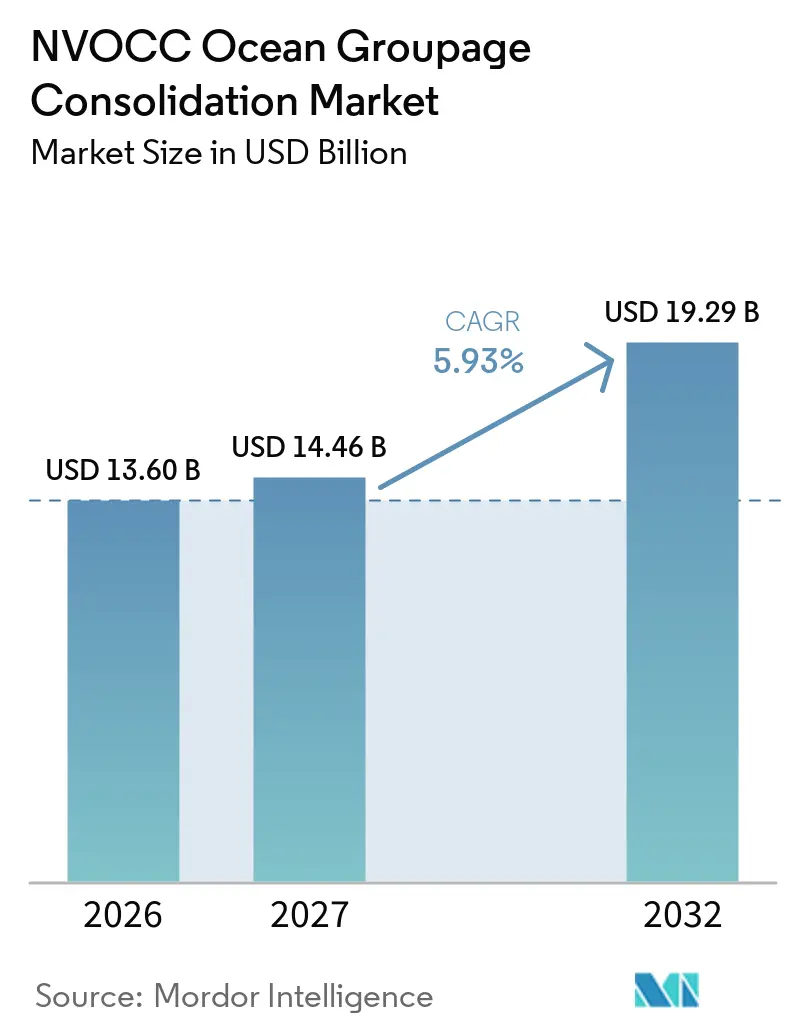
The NVOCC ocean groupage consolidation market size is projected to expand from USD 13.60 billion in 2026 and USD 14.46 billion in 2027 to USD 19.29 billion by 2032, registering a CAGR of 5.93% between 2027 and 2032.
The NVOCC ocean groupage consolidation market is supported by a rising number of sub-container-load shipments that do not justify a full container or air freight. Cross-border e-commerce has widened sourcing across several manufacturing countries and increased the flow of smaller orders. Tariff-related sourcing changes have also increased multi-origin cargo movements from Vietnam, India, and Mexico. This setting favors providers that can consolidate freight reliably, manage documentation, and provide shipment visibility. The NVOCC ocean groupage consolidation market also faces pressure from variable ocean rates, port delays, and higher compliance requirements.
Key Report Takeaways
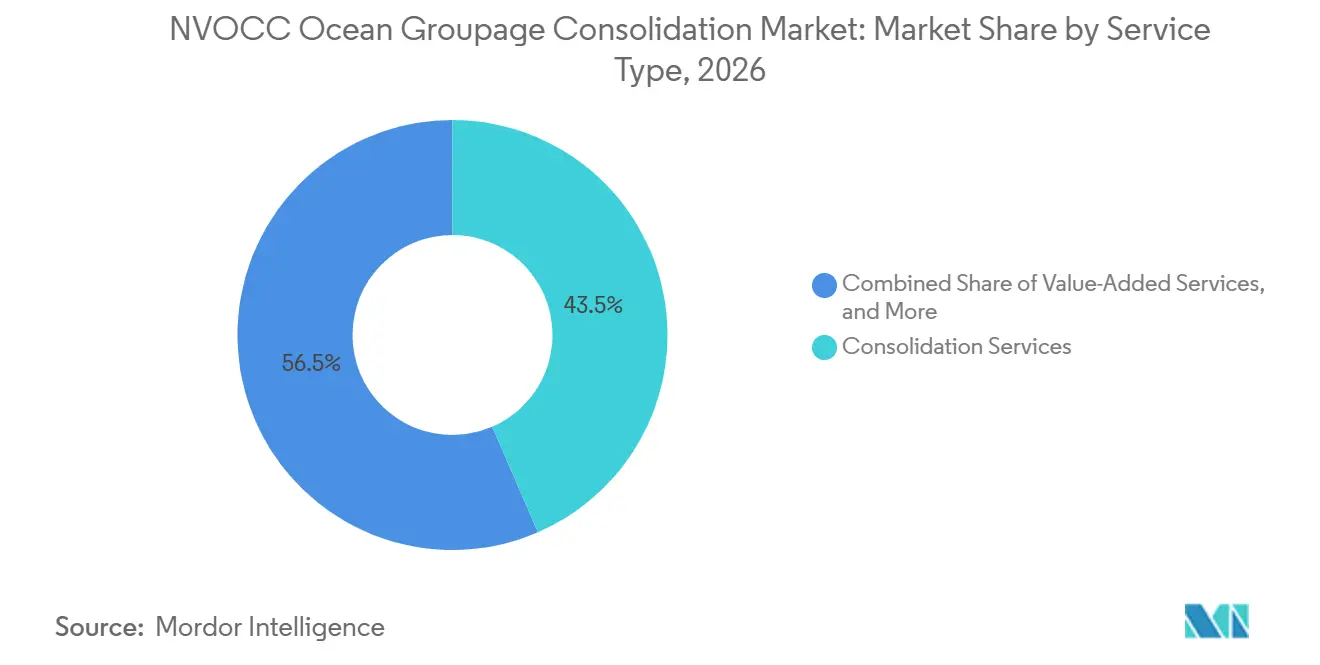
- By service type, consolidation services held 43.50% of the NVOCC ocean groupage consolidation market share in 2026, while value-added services are forecast to expand at a 7.69% CAGR through 2032.
- By end user, manufacturing and automotive held 25.52% of the NVOCC ocean groupage consolidation market size in 2026, while retail and e-commerce recorded the highest projected CAGR at 7.93% through 2032.
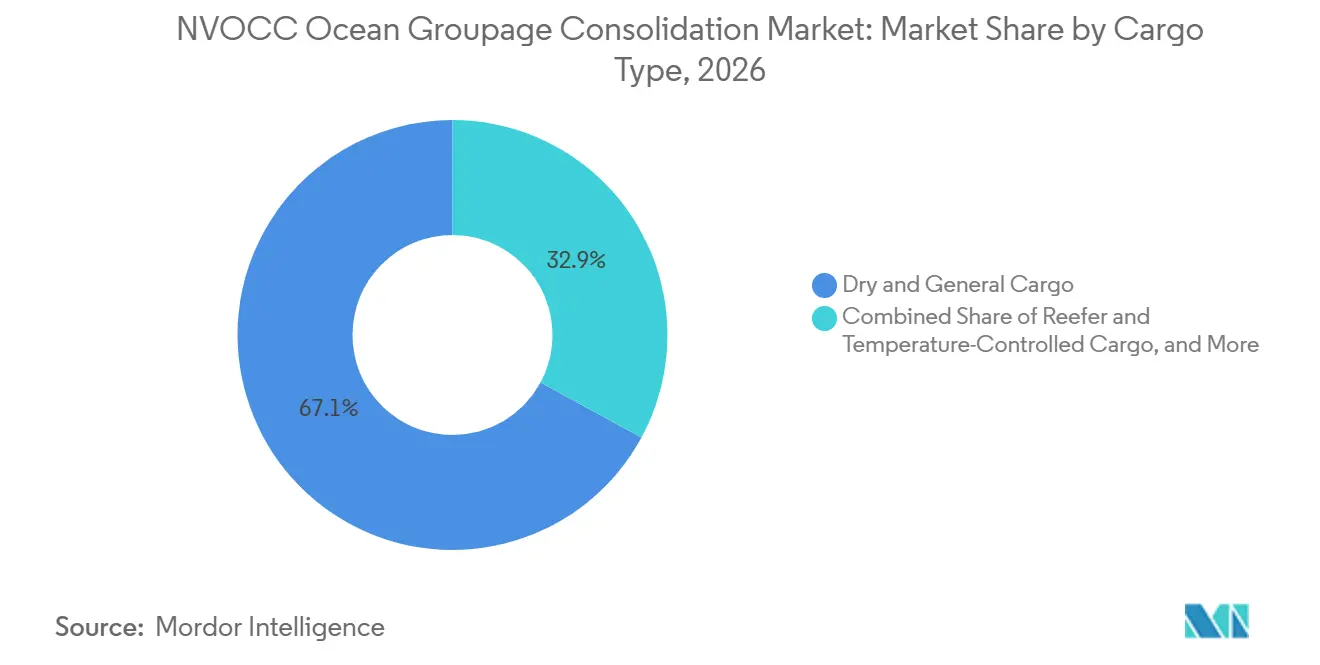
- By cargo type, dry and general cargo accounted for 67.10% of the NVOCC ocean groupage consolidation market share in 2026, while reefer and temperature-controlled cargo is advancing at an 8.05% CAGR through 2032.
- By geography, Asia-Pacific held 35.80% of the NVOCC ocean groupage consolidation market size in 2026 and is forecast to register a 7.78% CAGR through 2032.
Note: Market numbers in this report are based on Mordor Intelligence's proprietary estimation framework, which combines nine months of actuals with Q4 projections for base year 2026.
Global NVOCC Ocean Groupage Consolidation Market Trends and Insights
Drivers Impact Analysis*
| Driver | (~) % Impact on CAGR Forecast | Geographic Relevance | Impact Timeline |
|---|---|---|---|
| Cross-Border E-Commerce and Smaller Shipment Batches | +1.8% | Global, concentrated in Asia-Pacific, North America, and Europe | Short term (≤ 2 years) |
| SME Export Participation and Sourcing Diversification | +1.4% | Global, with high relevance in Southeast Asia, South Asia, and Latin America | Short term (≤ 2 years) |
| Ocean Cost Advantage for Non-Urgent Cargo | +1.2% | Global, strongest in Asia-Pacific to North America and Asia-Pacific to Europe trade lanes | Medium term (2-4 years) |
| API-Enabled Booking, Documentation, and Shipment Visibility | +0.9% | Global, accelerating fastest in Asia-Pacific and Europe | Medium term (2-4 years) |
| Multi-Origin Sourcing and Micro-Consolidation Density | +0.7% | Southeast Asia, South Asia, Mexico, and Eastern Europe origin corridors | Medium term (2-4 years) |
| Free-Trade Agreements and Port-Hinterland Connectivity | +0.5% | RCEP corridor, USMCA zone, EU-Mercosur lanes, and ASEAN-MEA | Long term (≥ 4 years) |
| Source: Mordor Intelligence | |||
Cross-Border E-Commerce and Smaller Shipment Batches
Cross-border e-commerce has changed the size profile of ocean shipments by increasing direct-to-consumer replenishment activity. Sellers that source from Asia frequently move cargo below 10 cubic meters, which is below the threshold for a dedicated 20-foot container. Those orders enter shared-container networks because parcel express is unsuitable for larger replenishment loads. The removal of the USD 800 de minimis threshold for China and Hong Kong-origin goods in early 2025 redirected part of parcel trade into formal, documented ocean movements. UNCTAD expects containerized seaborne trade to grow 2.3% annually from 2026 to 2030, providing a stable volume base for the NVOCC ocean groupage consolidation market.[1]
SME Export Participation and Sourcing Diversification
Small and medium-sized enterprises account for 36% of exports and 41% of imports in developed economies, according to the WCO, WTO, and ICC.[2] These businesses often have shipment sizes that are too large for express freight but too small to fill a container each week. The NVOCC ocean groupage consolidation market, therefore, depends on their access to documented trade and predictable customs processes. Manufacturers expanded secondary sourcing in Vietnam, India, and Mexico during 2025 as tariff policy increased the value of alternative supply locations. Buyer consolidation can combine cargo from several Asian suppliers before export and lower container freight station-to-port costs by 15%-25%. Tiered Authorized Economic Operator programs can reduce the trade-facilitation barriers facing smaller exporters.
Ocean Cost Advantage for Non-Urgent Cargo
Ocean groupage remains less expensive than air freight when the shipper can accept a 14-21 day transit time. Lower spot rates in 2025 made ocean transport more suitable for non-urgent replenishment freight. The NVOCC ocean groupage consolidation market benefits when shippers can accept a longer transit time in exchange for lower transport costs. Lower rate levels also improve the economics of filling shared containers because more shipments qualify for ocean movement. Shippers that moved from LCL to FCL during elevated rate periods can return to shared loads as carrier pricing normalizes. The cost advantage is strongest on major Asia-Pacific to North America and Asia-Pacific to Europe lanes, where consolidation schedules can support frequent departures.
API-Enabled Booking, Documentation, and Shipment Visibility
The Digital Container Shipping Association released the final Booking 2.0 and Bill of Lading 3.0 standards in February 2025.[3] The standards supported 10 major ocean carriers that represented 75% of global trade volume and provided a common API structure for forwarders and NVOCCs. DCSA also completed the first standards-based interoperable electronic bill of lading transaction in May 2025. Shared-container shipments require many house bills and customs records, so fewer manual entries can improve operating discipline. ECU Worldwide’s ECU360 platform and Vanguard Logistics’ real-time rate capabilities show how digital tools are moving into specialist consolidation services. Faster documentation checks can reduce delays before container cut-off and improve the use of available equipment.
Restraints Impact Analysis*
| Restraint | (~) % Impact on CAGR Forecast | Geographic Relevance | Impact Timeline |
|---|---|---|---|
| Port Congestion and Schedule Unreliability | -1.2% | Global, most acute in Northern Europe, South America, and South and Southeast Asia | Short term (≤ 2 years) |
| Ocean-Rate Volatility and Variable Container Utilization | -0.9% | Global, with elevated impact on Asia-Pacific to North America and Asia-Pacific to Europe trade lanes | Short term (≤ 2 years) |
| Customs, Security, and Mixed-Consignment Compliance | -0.7% | Global, amplified at multimodal hubs and across high-tariff jurisdictions | Medium term (2-4 years) |
| Carbon Accounting and Data-Traceability Burden | -0.5% | EU-adjacent corridors and voyages calling at EU ports, with broader global spillover after 2028 | Long term (≥ 4 years) |
| Source: Mordor Intelligence | |||
Port Congestion and Schedule Unreliability
Global container shipping schedule reliability averaged 65.2% in September 2025 and fell to 61.4% in October 2025.[4] Average delays for late vessel arrivals reached 4.98 days during October 2025. A missed sailing affects every co-loader in a shared container because each shipment has a different cargo-ready date and delivery requirement. Capacity churn on the Asia-North Europe lane reached 11.0 million TEU in 2025, compared with a 3-5 million TEU historical range from 2012 to 2019. Antwerp yard utilization reached 90% for dry and reefer containers in late October 2025, while Santos and Paranagua also experienced bottlenecks. These conditions weaken the case for ocean groupage when pharmaceutical, fashion, and seasonal retail cargo cannot tolerate delays.
Ocean-Rate Volatility and Variable Container Utilization
Spot rates on the Shanghai to the United States West Coast route rose 57.3% between April and May 2025 before falling later in the year. Large rate swings change the price difference between LCL and FCL and make long-term quotations harder to maintain. High rates can lead shippers to consolidate freight themselves or defer bookings until prices settle. In stronger freight cycles, carriers may prioritize FCL at constrained ports and reduce available space for LCL bookings. Cargo rollovers then raise the effective cost of shared-container transport. A full tariff-escalation scenario modeled by UNCTAD showed a possible 6%-10% decline in world seaborne trade, which could weaken consolidation density on lower-volume routes.
*Our forecasts treat driver/restraint impacts as directional, not additive. The impact forecasts reflect baseline growth, mix effects, and variable interactions.
Segment Analysis
By Service Type: Consolidation Services Lead Revenue While Value-Added Services Grow Faster
Consolidation services held 43.50% of the NVOCC ocean groupage consolidation market size in 2026. The service brings several consignments into one container and charges each shipper for the volume used. Buyer’s consolidation can reduce container freight station-to-port costs by 15%-25% compared with individual LCL bookings. This service remains central because it gives smaller shippers access to ocean freight without funding a full container. Major hubs such as Singapore, Rotterdam, Long Beach, and Dubai support frequent departures where cargo matching is strong. De-consolidation and distribution are the next major activities because imported shared containers need sorting and delivery after arrival. Providers that manage origin consolidation and destination de-consolidation can control more of the shipment process.
Value-added services are forecast to register a 7.69% CAGR from 2027 to 2032. This category includes customs advice, carbon-data reporting, duty calculations, and last-mile coordination. Mixed containers require consistent shipment information because a documentation error can delay the entire load. The NVOCC ocean groupage consolidation market, therefore, rewards operators that screen records before cargo reaches the port. DCSA’s standards support more consistent electronic booking and bill-of-lading data across carrier systems. Customers can receive these services through one interface rather than buying them from separate providers. This can improve customer retention and lift revenue per TEU-equivalent shipment.

By End User: Manufacturing and Automotive Retain Scale While Retail and E-Commerce Expand
Manufacturing and automotive held 25.52% of the NVOCC ocean groupage consolidation market size in 2026. Tier-2 and tier-3 suppliers often ship components below a full-container threshold on a regular replenishment schedule. Multi-country sourcing has increased the need to bring parts from several locations into a common assembly network. Mexico and Eastern Europe have become more relevant origins as some assembly and supplier activity moves closer to end markets. Electronics and electrical equipment also create suitable LCL demand because many products are high value but do not require a full container. Tracking and insurance are important for these loads, but their density can support shared ocean movements. The segment depends on schedule stability because production systems may have limited tolerance for delayed components.
Retail and e-commerce are projected to record a 7.93% CAGR from 2027 to 2032. Online platforms need smaller and more frequent replenishment shipments for direct-to-consumer and marketplace activity. The NVOCC ocean groupage consolidation market gives retailers a way to hold lower inventory positions while still using ocean freight. ASCM identified supplier diversification as a priority for supply chain organizations in 2025. This approach generates multi-origin purchase orders that fit shared-container services. Healthcare and pharmaceuticals are another developing customer group for temperature-controlled samples and finished-dose products. Agriculture and forestry add demand for specialty foods and premium timber moving in smaller export lots.
By Cargo Type: Dry Cargo Leads While Temperature-Controlled Freight Advances
Dry and general cargo accounted for 67.10% of the NVOCC ocean groupage consolidation market share in 2026. General merchandise, textiles, consumer goods, and industrial components can be combined in standard dry containers with limited specialist handling. Dry container availability at large consolidation hubs supports this leading position. This category covers the broadest range of goods moved through scheduled LCL networks. Dangerous goods and high-value and security-sensitive cargo remain important smaller categories. They need separate stowage declarations, specialized handling, and additional documentation. Those requirements limit the number of qualified providers and support higher-value service offerings.
Reefer and temperature-controlled cargo is projected to register an 8.05% CAGR from 2027 to 2032. Pharmaceutical and premium food exporters increasingly need smaller and more frequent temperature-controlled movements. The NVOCC ocean groupage market can serve routes where weekly reefer FCL volumes do not support a dedicated container. Growth is linked to wider pharmaceutical supply chains across Asia-Pacific, Latin America, and Southeast Africa. Providers need reefer consolidation depots with continuous monitoring and verified cold-chain procedures. C.H. Robinson introduced a Mexico cross-border freight consolidation service in September 2025 that combined consolidation, customs brokerage, and bonded warehousing. Such services show the value of integrating handling and compliance for complex freight.
Geography Analysis
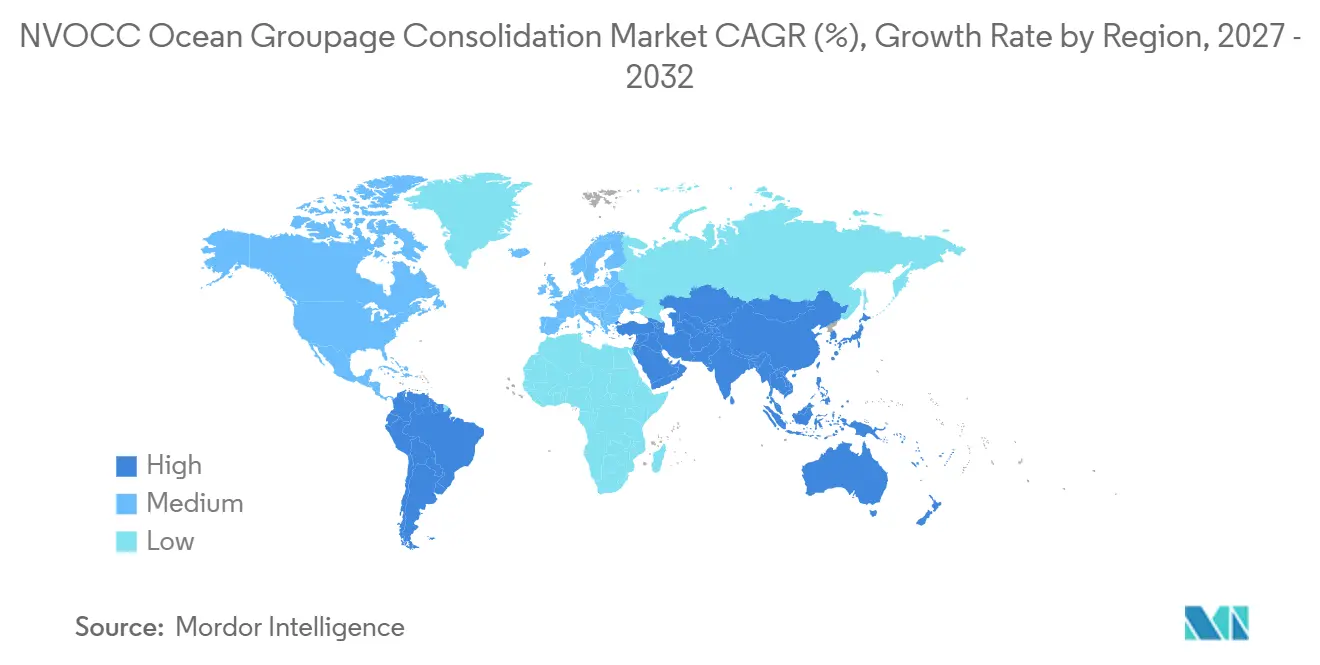
Asia-Pacific held 35.80% of the NVOCC ocean groupage market share in 2026 and is forecast to register a 7.78% CAGR through 2032. China, Vietnam, India, South Korea, and the wider ASEAN region generate the largest concentration of export-side LCL freight. The region also produces inbound demand as consumer spending and e-commerce grow. These two-way flows support higher sailing frequency and more reliable cargo matching. The NVOCC ocean groupage consolidation market benefits when both import and export loads exist on the same lanes. Inland rail, road, and port connections can extend the cargo catchment area of ASEAN consolidation hubs. Such links allow smaller exporters to reach regular ocean consolidation services.
North America and Europe remain the next-largest geographic groups. The USMCA area produces cross-border demand among the United States, Mexico, and Canada as sourcing patterns become more regional. European ports including Rotterdam, Antwerp, and Hamburg serve as origin and de-consolidation locations for Asia-Europe trade. Middle East and Africa is smaller but is gaining more formal NVOCC coverage through port and inland logistics investment. Jebel Ali remains an important regional hub for shared-container freight. South America also offers room for development as trade links with Europe deepen. Service quality in these locations depends on terminal capacity, customs administration, and regular sailing schedules.
Competitive Landscape
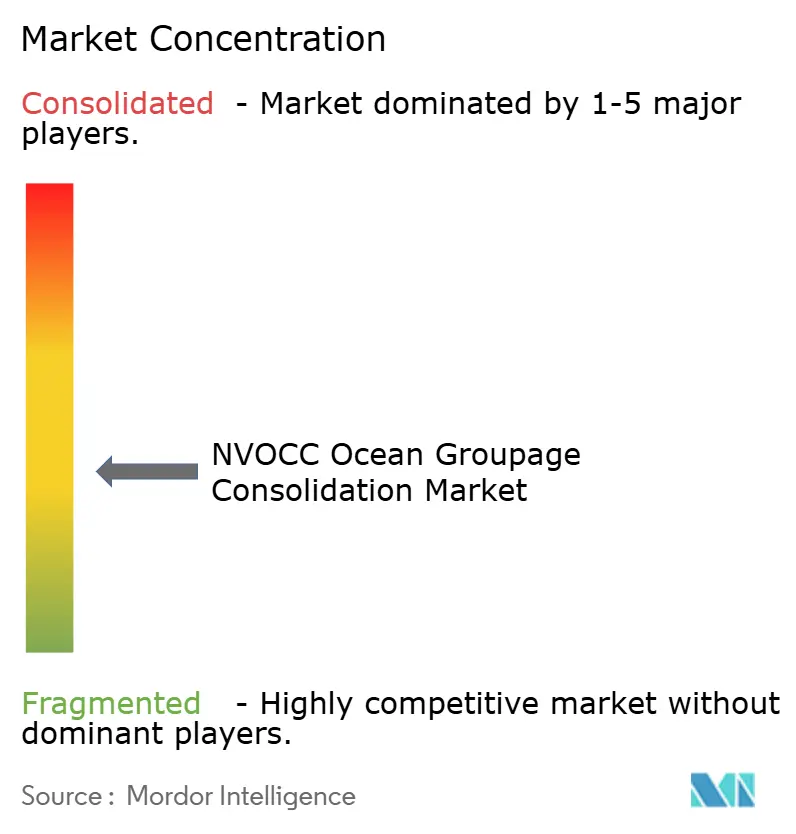
The NVOCC ocean groupage consolidation market has 2 broad competitive tiers. Specialist neutral NVOCCs serve freight forwarders without pursuing direct shipper accounts. Their position depends on direct-lane coverage, weekly sailings, neutral terms, and reliable consolidation stations. ECU Worldwide, Vanguard Logistics, Shipco Transport, and CWT Globelink are prominent specialist providers. Their digital booking systems are designed for freight-forwarder users. Integrated forwarders form the other tier. Kuehne + Nagel, DHL Global Forwarding, DSV, CEVA Logistics, GEODIS, and DACHSER offer LCL services alongside wider multimodal activities.
The market remains fragmented across the mid-tier because local origin capability and lane coverage matter. Digital aggregators can combine capacity from several providers, putting pressure on operators with limited technology investment. ECU Worldwide launched XLERATE 2.0 in March 2026 for Asia-Europe LCL freight through its United States network and the LAX gateway. It also introduced neutral FCL capabilities through ECU360 in November 2025. Vanguard Logistics expanded its Pakistan network through a partnership with QFM Shipping in November 2025. CMA CGM’s acquisition of FedEx Supply Chain strengthened CEVA Logistics’ North American contract logistics operations. These moves show competition through network reach, digital access, and connected transport services.
Providers need dependable origin and destination operations for frequent smaller consignments. Larger networks can offer fixed-day departures and more sailing alternatives when disruption occurs. Smaller networks may rely more on co-loading partners and focus on a limited set of routes. Documentation quality remains important because one incomplete record can delay a mixed container. Temperature-controlled, dangerous, and high-value cargo create openings for providers with specialized facilities. Customs preparation, bonded storage, last-mile planning, and emissions data add to the service offer. Network reliability remains important because each shared container combines the commitments of multiple customers.
NVOCC Ocean Groupage Consolidation Industry Leaders
-
ECU Worldwide (Part of Allcargo Logistics)
-
Vanguard Logistics Services
-
Shipco Transport
-
Rhenus Logistics
-
Kuehne + Nagel
- *Disclaimer: Major Players sorted in no particular order
Recent Industry Developments
- March 2026: ECU Worldwide unveiled XLERATE 2.0 as a strategic expansion to bypass Asia-Europe supply chain disruptions. The service leveraged ECU Worldwide's United States network of 30 strategic locations as an alternative routing via the LAX gateway, providing high-speed and resilient transit for time-sensitive LCL cargo moving between Asia and Europe. The announcement reflected a broader industry shift toward multimodal resilience products embedded within standard LCL contracts.
- November 2025: ECU Worldwide expanded its digital capabilities by launching a neutral Full Container Load product for the United States market on the ECU360 proprietary digital booking platform, enabling customers to access instant quotes, real-time tracking, and automated documentation for both FCL and LCL shipments. The platform extension positioned ECU360 as a comprehensive multimodal digital interface, with plans to extend neutral FCL digital services to additional countries by the end of 2026.
- September 2025: C.H. Robinson introduced a new cross-border freight consolidation service combining LCL freight consolidation in Mexico, cross-border transport, customs brokerage, and bonded warehousing, offering shippers up to 40% cost savings and freight visibility up to 48 hours earlier. The service leveraged C.H. Robinson's AI-powered Optimizer technology to determine routing and consolidation plans across the United States-Mexico-Canada corridor.
- May 2025: The Digital Container Shipping Association completed the first successful standards-based interoperable electronic Bill of Lading transaction. This breakthrough addressed long-standing platform fragmentation that had constrained eBL adoption. The transaction involved HMM as the carrier and leveraged DCSA's Platform Interoperability API, Legal Framework, and Control Tracking Registry, with McKinsey-estimated potential of USD 6.5 billion in direct cost savings and USD 40 billion in increased trade upon full-scale adoption.
Global NVOCC Ocean Groupage Consolidation Market Report Scope
| Consolidation Services |
| De-Consolidation and Distribution |
| Documentation, Customs, and Compliance Services |
| Value-Added Services |
| Manufacturing and Automotive |
| Retail and E-Commerce |
| Healthcare and Pharmaceuticals |
| Electronics and Electrical Equipment |
| Chemicals and Petrochemicals |
| Agriculture and Forestry |
| Other Industries |
| Dry and General Cargo |
| Reefer and Temperature-Controlled Cargo |
| Dangerous Goods |
| High-Value and Security-Sensitive Cargo |
| Others |
| North America | United States |
| Canada | |
| Mexico | |
| South America | Brazil |
| Argentina | |
| Peru | |
| Chile | |
| Rest of South America | |
| Europe | Germany |
| United Kingdom | |
| France | |
| Italy | |
| Spain | |
| Russia | |
| Nordics (Denmark, Finland, Iceland, Norway, and Sweden) | |
| Rest of Europe | |
| Asia-Pacific | China |
| India | |
| Japan | |
| South Korea | |
| Australia | |
| Southeast Asia (ASEAN) | |
| Rest of Asia-Pacific | |
| Middle East and Africa | Saudi Arabia |
| United Arab Emirates | |
| Qatar | |
| South Africa | |
| Nigeria | |
| Egypt | |
| Rest of Middle East and Africa |
| By Service Type | Consolidation Services | |
| De-Consolidation and Distribution | ||
| Documentation, Customs, and Compliance Services | ||
| Value-Added Services | ||
| By End User | Manufacturing and Automotive | |
| Retail and E-Commerce | ||
| Healthcare and Pharmaceuticals | ||
| Electronics and Electrical Equipment | ||
| Chemicals and Petrochemicals | ||
| Agriculture and Forestry | ||
| Other Industries | ||
| By Cargo Type | Dry and General Cargo | |
| Reefer and Temperature-Controlled Cargo | ||
| Dangerous Goods | ||
| High-Value and Security-Sensitive Cargo | ||
| Others | ||
| By Geography | North America | United States |
| Canada | ||
| Mexico | ||
| South America | Brazil | |
| Argentina | ||
| Peru | ||
| Chile | ||
| Rest of South America | ||
| Europe | Germany | |
| United Kingdom | ||
| France | ||
| Italy | ||
| Spain | ||
| Russia | ||
| Nordics (Denmark, Finland, Iceland, Norway, and Sweden) | ||
| Rest of Europe | ||
| Asia-Pacific | China | |
| India | ||
| Japan | ||
| South Korea | ||
| Australia | ||
| Southeast Asia (ASEAN) | ||
| Rest of Asia-Pacific | ||
| Middle East and Africa | Saudi Arabia | |
| United Arab Emirates | ||
| Qatar | ||
| South Africa | ||
| Nigeria | ||
| Egypt | ||
| Rest of Middle East and Africa | ||
Key Questions Answered in the Report
What is driving demand for NVOCC ocean groupage consolidation services?
Smaller e-commerce orders, multi-origin sourcing, and the need to move cargo below full-container volume support demand for shared-container freight.
How large is the NVOCC ocean groupage consolidation market?
The sector is projected to reach USD 19.29 billion by 2032, rising from USD 14.46 billion in 2027 at a 5.93% CAGR.
Which service category is growing fastest?
Value-added services are projected to register a 7.69% CAGR through 2032 as shippers seek customs, carbon-data, and coordination services.
Which end user is expected to expand most quickly?
Retail and e-commerce are forecast to register a 7.93% CAGR through 2032 because online sellers need smaller and more frequent replenishment shipments.
Why is temperature-controlled groupage growing?
Reefer and temperature-controlled cargo is forecast to register an 8.05% CAGR through 2032 as pharmaceutical and premium food supply chains require smaller cold-chain movements.
Which region leads NVOCC ocean groupage consolidation?
Asia-Pacific held a 35.80% share in 2026 and is forecast to register a 7.78% CAGR through 2032, supported by its manufacturing base and dense trade corridors.