
North America Warehouse Real Estate Market Size and Share
Market Overview
| Study Period | 2021 - 2032 |
|---|---|
| Forecast Data Period | 2027 - 2032 |
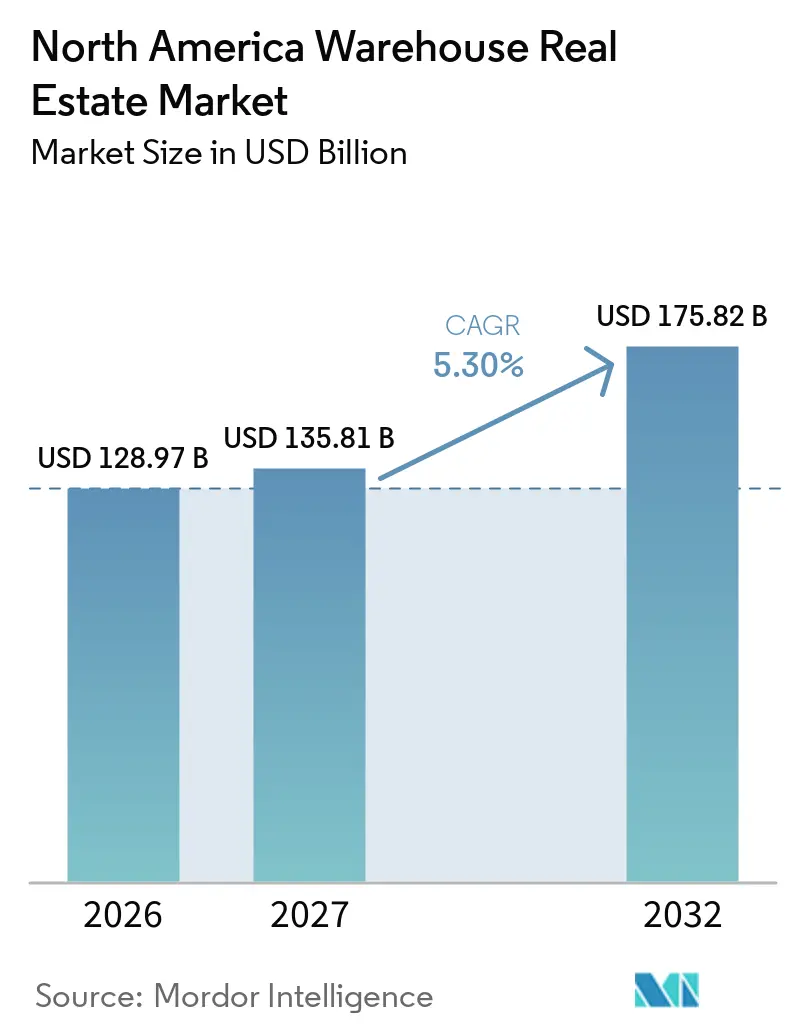
| Base Year Market Size (2026) | USD 128.97 Billion |
| Market Size (2027) | USD 135.81 Billion |
| Market Size (2032) | USD 175.82 Billion |
| Growth Rate (2027 - 2032) | 5.30 % |
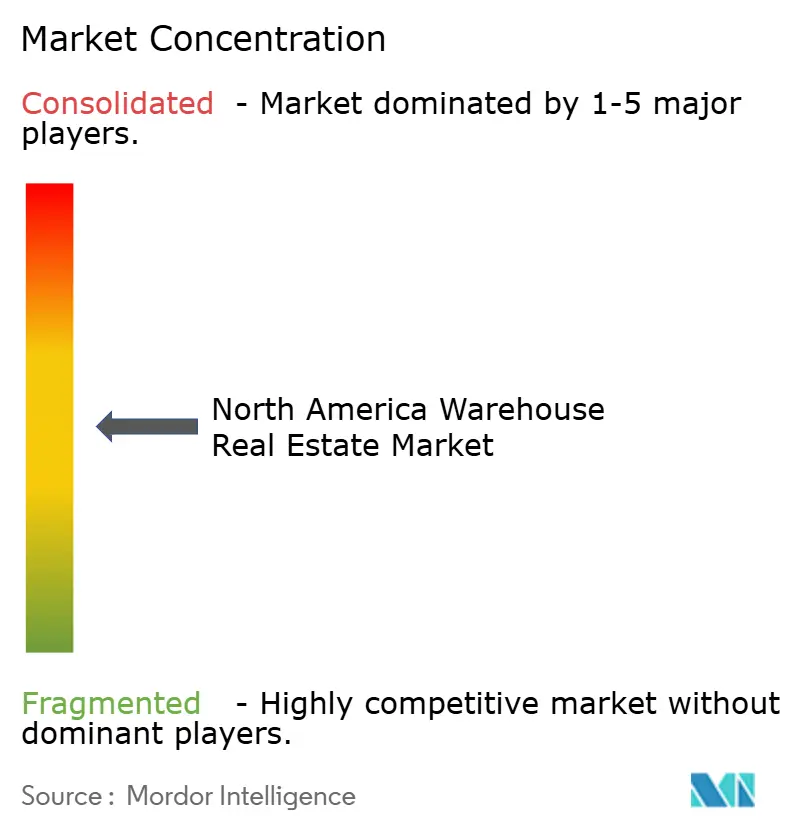
| Market Concentration | Medium |
Major Players *Disclaimer: Major Players sorted in no particular order Image © Mordor Intelligence. Reuse requires attribution under CC BY 4.0. | |
North America Warehouse Real Estate Market Analysis by Mordor Intelligence
The North America Warehouse Real Estate Market size is projected to expand from USD 128.97 billion in 2026 and USD 135.81 billion in 2027 to USD 175.82 billion by 2032, registering a CAGR of 5.30% between 2027 and 2032.
Demand is becoming more selective because occupiers are concentrating activity in newer facilities that can support automation, stronger power systems, and more complex distribution needs. Pharmaceutical logistics, cold-chain capacity, and the supply chains serving data centers are adding demand beyond conventional retail distribution. Lower construction starts can gradually reduce the supply pressure created during the prior building cycle. Higher capitalization rates and uneven vacancy still limit speculative development in some Sun Belt and secondary locations. The North America warehouse real estate market therefore offers its strongest opportunities in specialized, well-located, and modern facilities.
Key Report Takeaways
- By type, private warehouses held 38.00% of the North America warehouse real estate market share in 2026, while other warehouse formats are forecast to grow at a 7.40% CAGR through 2032.
- By temperature control, general warehouses accounted for 72.00% of the North America warehouse real estate market size in 2026, while refrigerated warehouses are forecast to grow at a 6.60% CAGR through 2032.
- By grade, Class A warehouses held a 60.00% share in 2026 and are forecast to grow at an 8.40% CAGR through 2032.
- By warehouse size, large-scale warehouses held 47.00% of the North America warehouse real estate market size in 2026, while small-scale warehouses are forecast to grow at a 7.60% CAGR through 2032.
- By tenant classification, retail and consumer goods held a 28.00% share in 2026, while pharmaceuticals and healthcare are forecast to grow at a 7.30% CAGR through 2032.
- By geography, the United States held 88.00% of the North America warehouse real estate market size in 2026, while Mexico is forecast to grow at a 7.60% CAGR through 2032.
Note: Market numbers in this report are based on Mordor Intelligence's proprietary estimation framework, which combines nine months of actuals with Q4 projections for base year 2026.
Market Trends and Insights
Drivers Impact Analysis of North America Warehouse Real Estate Market*
| Drivers | (~) % Impact on CAGR Forecast | Geographic Relevance | Impact Timeline |
|---|---|---|---|
| E-commerce, Omnichannel Retail, and Same-Day Fulfillment | +1.5% | U.S. gateway markets and urban cores | Medium term (2-4 years) |
| Nearshoring and Manufacturing Relocation into Mexico | +0.9% | Mexico’s northern and central corridors and U.S. border markets | Short term (≤ 2 years) |
| Data Center, Semiconductor, and Advanced Manufacturing Supply Chains | +0.7% | Texas, Chicago, the Southeast, and North Fort Worth | Medium term (2-4 years) |
| Cold-Chain and Pharmaceutical Distribution Expansion | +0.6% | United States, Memphis, the Northeast, and the Pacific Northwest | Long term (≥ 4 years) |
| Tenant Flight to Class A and Automation-Ready Space | +0.6% | United States, Toronto, and Calgary | Short term (≤ 2 years) |
| Urban Infill and Last-Mile Delivery Demand | +0.5% | Dense U.S. metros and the Greater Toronto Area | Long term (≥ 4 years) |
| Source: Mordor Intelligence | |||
E-commerce, Omnichannel Retail, and Same-Day Fulfillment
E-commerce continues to shape leasing demand because domestic fulfillment has become more important for cross-border retailers after changes to de minimis import treatment. Prologis expects U.S. e-commerce penetration to reach 30% by 2030, compared with 25% in 2026, and estimates that each 1 percentage point gain can require 50 million to 70 million square feet of additional logistics space[1]. This need supports regional fulfillment locations as well as facilities close to major consumer centers. The North America warehouse real estate market also benefits when retailers place inventory in several locations to reduce delivery times and manage returns. Large tenants are favoring newer buildings with the clear heights, loading capacity, and systems needed for high-volume order fulfillment. This pattern supports both large regional hubs and smaller urban facilities, rather than a single warehouse format.
Nearshoring and Manufacturing Relocation into Mexico
Manufacturers are adding North American capacity to shorten supply chains and meet regional trade requirements. Mexico’s northern and central corridors are central to this shift because they connect production sites with U.S. population centers and border infrastructure. The North America warehouse real estate market benefits when suppliers need nearby storage for components, finished goods, and cross-border freight consolidation. Demand is particularly relevant in Monterrey, Tijuana, and the Mexico City area, where industrial corridors serve automotive, electronics, consumer goods, and logistics tenants. The effect is not limited to factories, since transport providers and third-party logistics firms also need facilities around manufacturing clusters. Tight conditions in Mexican Class A space can make existing modern properties more valuable while increasing demand for build-to-suit development.
Data Center, Semiconductor, and Advanced Manufacturing Supply Chains
Data center and semiconductor construction require logistics support before equipment reaches a completed site. Warehouses are used to stage servers, power distribution units, cooling equipment, and construction materials under secure conditions. Prologis reports that manufacturing-related logistics leasing represented 14% of U.S[2]. new leases in the past 3 years, compared with less than 10% before the pandemic. Texas, Chicago, and the Southeast are important because they combine industrial land, transport access, and active manufacturing investment. The North America warehouse real estate market gains from this demand, as logistics buildings are near data centers and fabrication clusters. Facilities with reliable power, security, and flexible loading designs are more suitable for this work than standard storage space.
Cold-Chain and Pharmaceutical Distribution Expansion
Cold-chain logistics needs specialized buildings that can maintain controlled temperatures and protect sensitive goods. The Global Cold Chain Alliance reported that the 25 largest North American refrigerated warehouse operators managed 5 billion cubic feet of capacity in 2025, an increase of 629 million cubic feet from the prior year[3]. Capacity growth does not fully remove demand pressure because food and healthcare supply chains require facilities in specific locations. Pharmaceutical distribution creates an additional need for validated facilities that can support controlled handling and documentation. This specialization supports the North America warehouse real estate market because the cost and operating requirements are higher than those of dry storage. Lineage’s 2025 expansion plans show that large operators are using acquisitions and purpose-built projects to add this capacity.
Restraints Impact Analysis of North America Warehouse Real Estate Market*
| Restraints | (~) % Impact on CAGR Forecast | Geographic Relevance | Impact Timeline |
|---|---|---|---|
| Elevated Capitalization Rates and Development Finance Costs | -0.9% | United States, with greater exposure in secondary markets | Short term (≤ 2 years) |
| Sun Belt and Secondary-Market Supply Imbalances | -0.6% | Austin, Phoenix, Indianapolis, Greenville-Spartanburg, and San Antonio | Short term (≤ 2 years) |
| Data Center and Automation Power Interconnection Delays | -0.4% | Sun Belt states, Mexico, and dense U.S. urban cores | Long term (≥ 4 years) |
| Truck-Court, Zoning, and Community Opposition Constraints | -0.4% | Northeast, California, Mid-Atlantic, and peri-urban communities | Long term (≥ 4 years) |
| Source: Mordor Intelligence | |||
Elevated Capitalization Rates and Development Finance Costs
Higher capitalization rates reduce the value investors are prepared to pay for a given income stream. They also make it harder for developers to achieve returns that justify new speculative projects. The Federal Reserve reported tighter standards for commercial real estate and construction loans in its second-quarter 2025 lending survey. This environment can extend the lease-up period for recently delivered buildings and limit financing options for smaller developers. The North America warehouse real estate market remains active, but capital is more selective and places greater weight on tenant quality, lease duration, and building specifications. Lower speculative starts can later support better supply discipline, although that adjustment takes time.
Sun Belt and Secondary-Market Supply Imbalances
Several Sun Belt and secondary markets received substantial large-format warehouse supply during the earlier expansion cycle. Where new buildings were delivered faster than tenant demand, landlords have faced longer marketing periods and greater competition for tenants. This effect is most visible in larger distribution facilities, rather than across every size category. The North America warehouse real estate market therefore has different conditions within the same city, as smaller infill buildings can remain tight while large facilities are available. Owners in affected markets may need to offer more flexible terms or wait longer to reach stabilized occupancy. The restraint is expected to be temporary where construction starts continue to decline and local demand remains diversified.
*Our forecasts treat driver/restraint impacts as directional, not additive. The impact forecasts reflect baseline growth, mix effects, and variable interactions.
North America Warehouse Real Estate Market Segment Analysis
By Type:
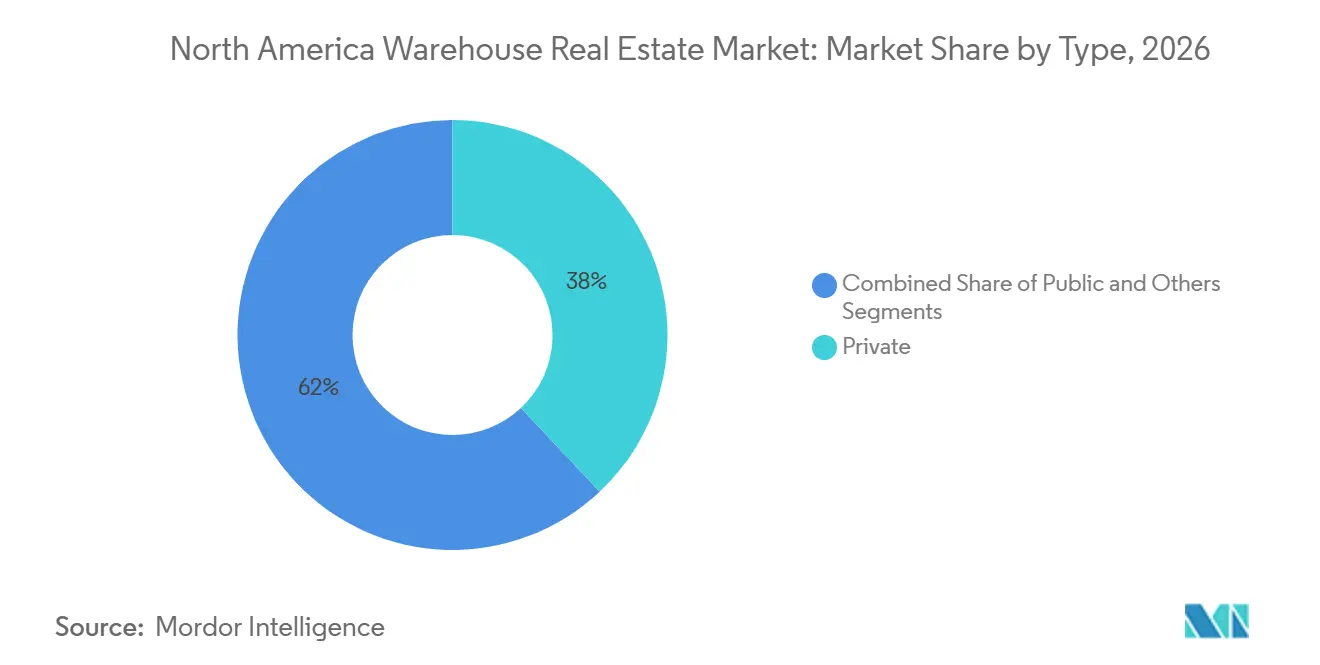
Private Warehouses Hold the Largest Share While Specialty Formats ExpandPrivate warehouses held a 38.00% share in 2026. Their position reflects demand from vertically integrated logistics operators, large third-party logistics providers, and owners that want direct control of specialized facilities. Private operations can support dedicated workflows, inventory systems, and security requirements that are harder to manage in shared facilities. Public warehouses remain useful for fragmented shippers, seasonal demand, and companies entering a region without a long-term facility commitment. These shared-use facilities provide flexible storage and pay-per-pallet pricing. Their shorter lease structures can suit customers that need capacity without major fixed obligations.
Other formats are forecast to grow at a 7.40% CAGR through 2032. This category includes cold storage, pharmaceutical distribution hubs, data center staging sites, and facilities serving specialized manufacturing activity. Demand in these uses is tied to facility specifications, not only to general distribution volume. NewCold is building a USD 222 million automated cold storage facility in Alberta, Canada, showing the scale of capital directed toward specialty formats. The project reflects the need for dedicated facilities where temperature control, automation, and location are integral to the operating model.

By Temperature Control:
General Warehouses Lead While Refrigerated Facilities Grow FasterGeneral warehouses accounted for 72.00% of the temperature-controlled category in 2026. Consumer goods, retail, manufacturing, and third-party logistics operations generally use ambient-temperature storage. This broad use base gives general warehousing a large installed footprint. Dry warehouses also have lower construction and operating requirements than refrigerated facilities. The lower cost profile expands the group of developers and occupiers able to use this format. Demand for general warehouses remains closely linked to e-commerce and consumer goods flows.
Refrigerated warehouses are forecast to grow at a 6.60% CAGR through 2032. Grocery e-commerce, pharmaceutical handling, and fresh food trade all require capacity with tightly managed temperatures. The top 25 refrigerated warehouse operators expanded managed capacity by 629 million cubic feet in 2025, but demand continues to exceed new supply. Validated pharmaceutical facilities can command a premium because users need facilities designed for compliance. Lineage committed more than USD 1 billion in April 2025 to cold storage expansion with Tyson Foods. Americold also agreed to invest USD 127 million in a Houston cold storage facility in March 2025.
By Grade:
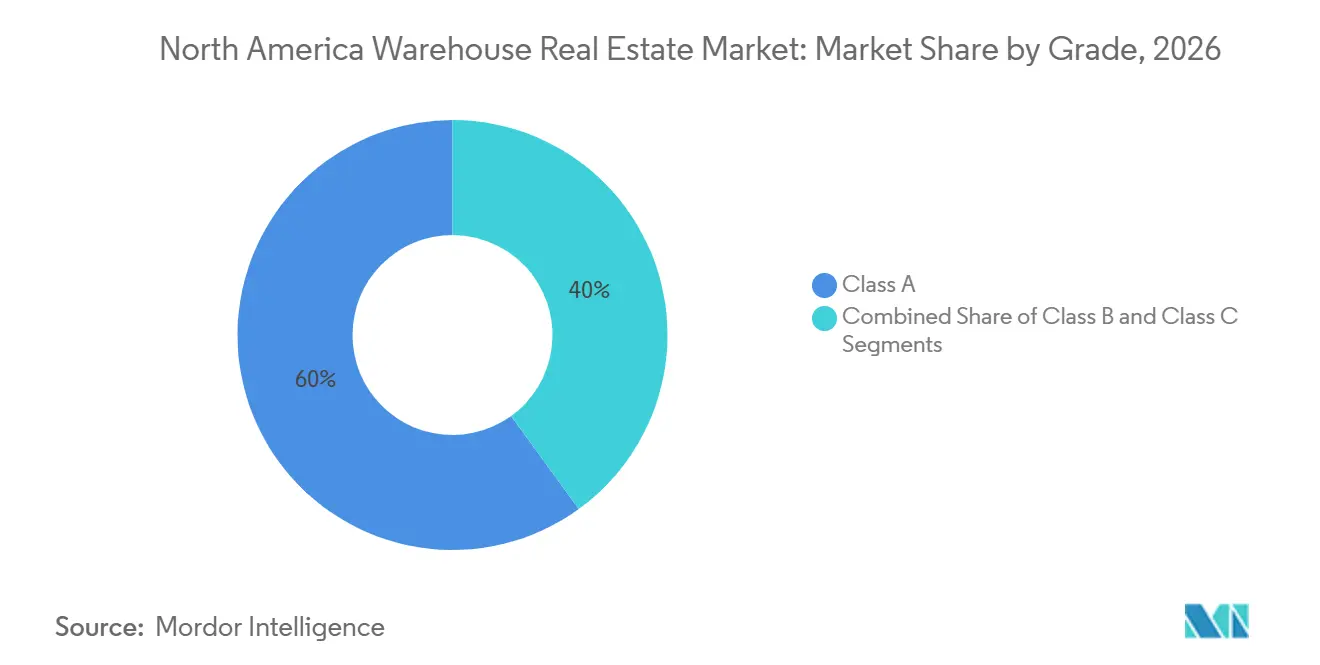
Class A Facilities Lead on Share and GrowthClass A warehouses held a 60.00% share in 2026. These facilities are designed for modern distribution with high clear heights, stronger floor slabs, reliable power, and more efficient truck circulation. Their specifications support robotics, dense racking, and changing tenant requirements. Occupiers are moving from older facilities into buildings that can support these operating needs. The result is a widening difference between modern inventory and properties with limited physical capability. Class A assets are also more likely to meet tenant expectations for energy and environmental performance.
Class A is forecast to grow at an 8.40% CAGR through 2032, making it the fastest-growing grade category. Class B properties have experienced negative net absorption since 2023 as tenants move into newer space. Class C assets are under the greatest pressure, where ceiling heights below 24 feet limit modern racking and autonomous mobile robot use. More than 90% of recent industrial deliveries were built to Class A specifications. The North America warehouse real estate market is therefore adding much of its new supply at the highest quality level. This trend increases the importance of repositioning or upgrading older, well-located buildings.
By Warehouse Size:
Large Facilities Lead While Small Facilities Gain from Supply LimitsLarge-scale warehouses above 250,000 square feet held 47.00% of the category in 2026. These facilities help occupiers consolidate inventory at regional hubs near transport networks. Their scale can lower handling costs and support national or multiregional distribution. Medium-scale properties serve regional distribution and shared logistics operations. Leasing demand for facilities between 300,000 and 499,999 square feet rose 23% in 2025. Large buildings remain valuable when they are new, efficient, and connected to core freight routes.
Small-scale warehouses under 50,000 square feet are forecast to grow at a 7.60% CAGR through 2032. Developers focused heavily on large facilities during the earlier expansion cycle, which left a shortage of smaller properties. Smaller warehouses had a 3.9% vacancy rate in late 2025 and average asking rents of USD 13.51 per square foot. These rents were 31% higher than rents for spaces exceeding 100,000 square feet. Small facilities can serve last-mile delivery, light industrial users, and businesses that need proximity to customers. Institutional ownership remains limited in this part of the North America warehouse real estate market, which leaves room for focused ownership strategies.
By Tenant Classification:
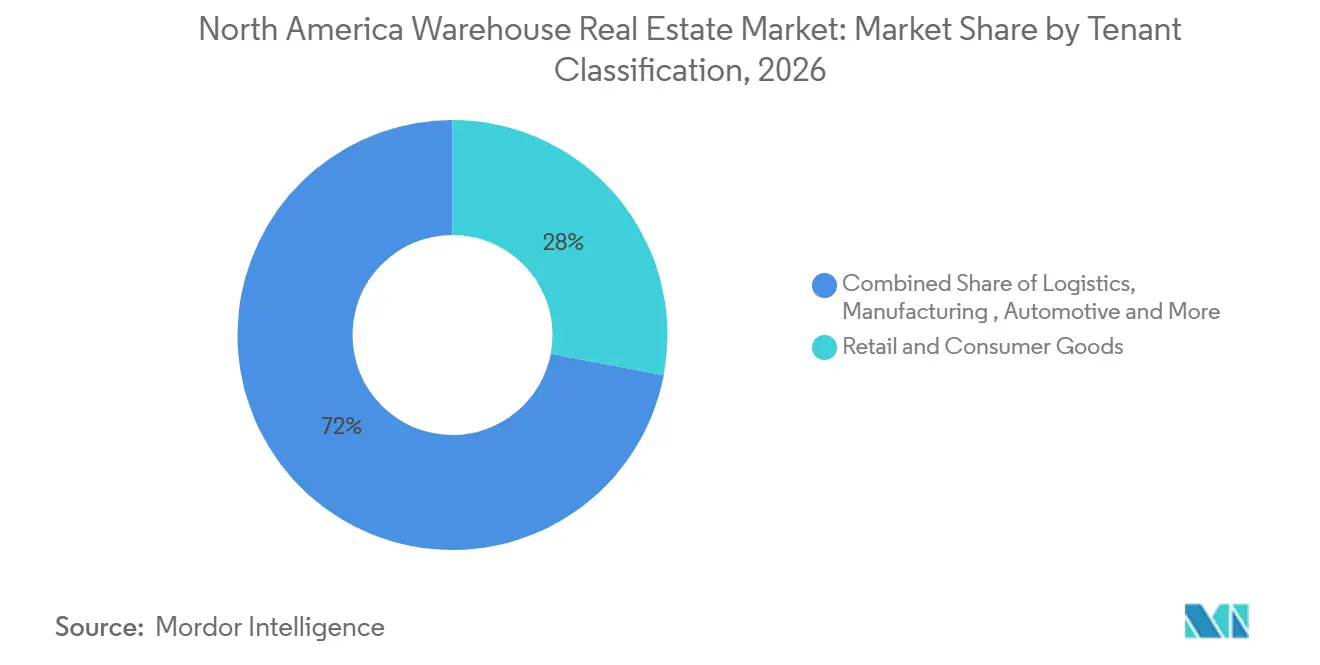
Retail Leads While Pharmaceuticals and Healthcare Expand FasterRetail and consumer goods held a 28.00% share in 2026. These tenants require distribution centers, fulfillment sites, and last-mile facilities to support omnichannel retail. Their demand is linked to inventory availability and the need for faster replenishment. Manufacturing tenants also require warehouse capacity for automotive, electronics, and advanced industrial supply chains. Food and beverage users add demand for both ambient distribution and controlled-temperature facilities. Logistics service providers continue to occupy a larger role where customers prefer outsourced distribution capacity.
Pharmaceuticals and healthcare are forecast to grow at a 7.30% CAGR through 2032. These users need compliant facilities that can protect temperature-sensitive products and support traceable handling processes. The limited availability of validated facilities creates a specialized supply base. EVERSANA opened a 358,000-square-foot current Good Distribution Practice-certified distribution center in Memphis in April 2025. LifeScience Logistics opened a 625,000-square-foot temperature-controlled Memphis facility after investing USD 23.2 million in June 2025. These additions show that healthcare logistics operators are increasing both their capacity and their degree of specialization.
Geography Analysis
The United States accounted for 88.00% of the regional total in 2026. It has deep capital markets, established logistics networks, and great demand from retail, consumer goods, and pharmaceutical tenants. United States logistics demand turned upward in 2025 as occupier activity improved after a subdued 2024. Dallas-Fort Worth, Chicago, Atlanta, Houston, and New Jersey remain important large-block leasing locations. Supply-constrained coastal markets retain particular value because new sites are difficult to replace.
Mexico is forecast to grow at a 7.60% CAGR through 2032. The country benefits from nearshoring, United States-Mexico-Canada Agreement trade, and the need for facilities that manage cross-border manufacturing flows. Mexico City’s Cuautitlan-Tultitlan-Tepotzotlan corridor represented 47.00% of Mexican industrial leasing in the second quarter of 2025 and had a 0.8% vacancy rate. Tijuana recorded a 14% increase in construction starts and a 10% rise in absorption in the third quarter of 2025. Tight availability can support rental growth for existing Class A owners in northern and central corridors. The North America warehouse real estate market is consequently becoming more dependent on cross-border logistics capacity.
Canada recorded 4.2 million square feet of industrial net absorption in the first quarter of 2026. National vacancy was near 5.2% in the fourth quarter of 2025 before declining in early 2026. The national average net asking rent fell 3.7% year over year to CAD 14.91 per square foot in the first quarter of 2026, equivalent to USD 10.59 per square foot. Toronto and Calgary supported the recovery, while Montreal remained softer. A tapering construction pipeline could allow supply gaps to emerge in gateway locations. This would support moderate Class A rent growth as occupier decisions resume.
Competitive Landscape
The North America warehouse real estate market has moderate consolidation among large institutional owners, real estate investment trusts, and private platforms. Prologis remains the leading global industrial real estate investment trust by portfolio scale. Blackstone operates in logistics real estate through Link Logistics. Lineage and Americold compete in the temperature-controlled segment, where automation and operating knowledge create meaningful entry barriers. The mix of large owners and many local or specialized operators means that a single company does not control the market. Competition differs by property quality, geography, and temperature-control requirements.
Companies are increasingly competing on facility capabilities rather than on geographic reach alone. High clear heights, redundant power, heating, ventilation, and air conditioning systems, and robotics compatibility can help facilities serve demanding occupiers. Rexford Industrial stabilized USD 798 million of repositioning investment across 21 projects in 2025 and reported a 5.5% weighted average stabilized yield. Prologis acquired the 1.15 million-square-foot Davie Business Center in Broward County, Florida, for USD 352.2 million in June 2026. The acquisition reflects continued attention to established infill properties even under higher financing costs.
Specialist platforms are also extending networks through targeted acquisitions and new construction. Lineage’s April 2025 commitment of more than USD 1 billion combined a USD 247 million warehouse acquisition with a greenfield development agreement exceeding USD 740 million. EQT Real Estate acquired a 32-building, 5.2 million-square-foot Southern California logistics portfolio in September 2026. Opportunities remain in pharmaceutical logistics, small-format infill facilities, and tight Mexican Class A corridors. The competitive position of a property depends on its specifications and local scarcity as much as its owner’s portfolio size. No combined market-share data for the leading companies is provided, so the market concentration score cannot be calculated under the required methodology.
North America Warehouse Real Estate Industry Leaders
-
Prologis, Inc.
-
Blackstone Real Estate
-
Link Logistics Real Estate
-
Rexford Industrial Realty, Inc.
-
First Industrial Realty Trust, Inc.
- *Disclaimer: Major Players sorted in no particular order
North America Warehouse Real Estate Market Companies Covered in this Report
- Prologis, Inc.
- Blackstone Real Estate
- Link Logistics Real Estate
- Rexford Industrial Realty, Inc.
- First Industrial Realty Trust, Inc.
- STAG Industrial, Inc.
- EastGroup Properties, Inc.
- Americold Realty Trust, Inc.
- CBRE Group, Inc.
- JLL
- Panattoni Development Company, Inc.
- Duke Realty
- Clayco, Inc.
- ARCO/Murray National Construction Company, Inc.
- Terreno Realty Corporation
- CenterPoint Properties
- Lineage Logistics
- Dermody Properties
- Bixby Land Company
- Al. Neyer
Recent Industry Developments in North America Warehouse Real Estate Market
- September 2026: EQT Real Estate acquired a 32-building, 5.2 million square foot industrial logistics portfolio across Southern California from Rexford Industrial Realty. The portfolio is 96% leased to 36 tenants across automotive, logistics, consumer electronics, and aerospace sectors. More than 50% of the square footage is in infill Los Angeles Basin locations within 25 miles of the Los Angeles-Long Beach port complex.
- June 2026: Prologis acquired Davie Business Center, a 7-building, 1.15 million square foot campus in Broward County, Florida, for USD 352.2 million. The 97%-leased campus counts Boeing, Western Union, and Comcast among its tenants. It was South Florida’s largest industrial single-asset transaction year-to-date.
- April 2026: Link Logistics, a Blackstone affiliate, acquired an 8-building, 798,716 square foot industrial portfolio in Boynton Beach, Florida, from Prologis for USD 195.9 million. The transaction followed a separate USD 163.1 million acquisition of a Pompano Beach warehouse campus in March 2026. The 2 transactions totaled more than USD 359 million within 6 weeks.
North America Warehouse Real Estate Market Report Scope
Segmentation Overview
| Public |
| Private |
| Others |
| General Warehouse |
| Refrigerated Warehouse |
| Class A |
| Class B |
| Class C |
| Small-Scale Warehouses, Under 50,000 sq ft |
| Medium-Scale Warehouses, 50,000-250,000 sq ft |
| Large-Scale Warehouses, Above 250,000 sq ft |
| Manufacturing |
| Retail and Consumer Goods |
| Food and Beverage |
| Pharmaceuticals and Healthcare |
| Logistics |
| Other End Users |
| United States |
| Canada |
| Mexico |
| By Type | Public |
| Private | |
| Others | |
| By Temperature Control | General Warehouse |
| Refrigerated Warehouse | |
| By Grade | Class A |
| Class B | |
| Class C | |
| By Warehouse Size | Small-Scale Warehouses, Under 50,000 sq ft |
| Medium-Scale Warehouses, 50,000-250,000 sq ft | |
| Large-Scale Warehouses, Above 250,000 sq ft | |
| By Tenant Classification | Manufacturing |
| Retail and Consumer Goods | |
| Food and Beverage | |
| Pharmaceuticals and Healthcare | |
| Logistics | |
| Other End Users | |
| By Country | United States |
| Canada | |
| Mexico |
Key Questions Answered in the Report
What is the projected value of North America warehouse real estate by 2032?
The sector is projected to grow from USD 135.81 billion in 2027 to USD 175.82 billion by 2032, expanding at a 5.30% CAGR.
Which warehouse type holds the largest share in North America?
Private warehouses lead by type with a 38.00% share in 2026.
Why are refrigerated warehouses growing faster than general warehouses?
Refrigerated facilities are forecast to grow at a 6.60% CAGR because food, grocery, and pharmaceutical users need controlled-temperature capacity.
Which warehouse grade is expanding fastest?
Class A warehouses are forecast to grow at an 8.40% CAGR through 2032, supported by demand for automation-ready space.
Which geography is expected to grow the fastest?
Mexico is forecast to grow at a 7.60% CAGR through 2032, supported by nearshoring and cross-border supply chains.
What tenant group has the strongest projected growth?
Pharmaceuticals and healthcare are forecast to grow at a 7.30% CAGR through 2032 as demand rises for compliant distribution facilities.