
North America Urban Design Market Size and Share
Market Overview
| Study Period | 2020 - 2031 |
|---|---|
| Forecast Data Period | 2026 - 2031 |
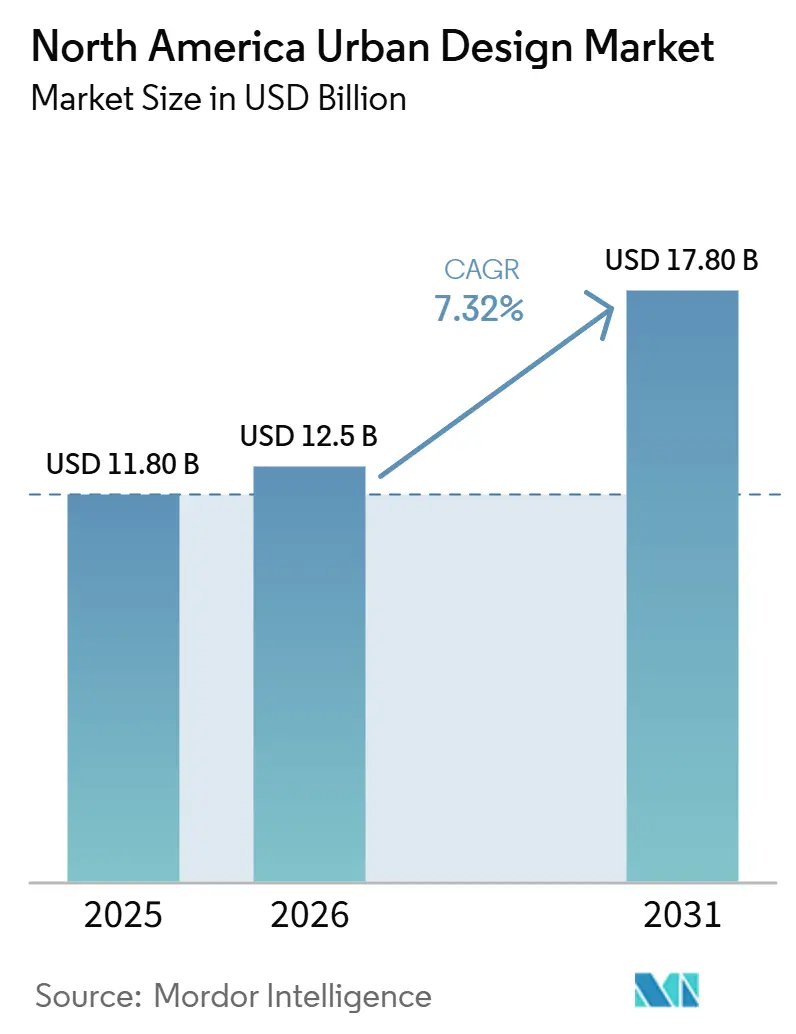
| Base Year Market Size (2025) | USD 11.80 Billion |
| Market Size (2026) | USD 12.5 Billion |
| Market Size (2031) | USD 17.80 Billion |
| Growth Rate (2026 - 2031) | 7.32 % |
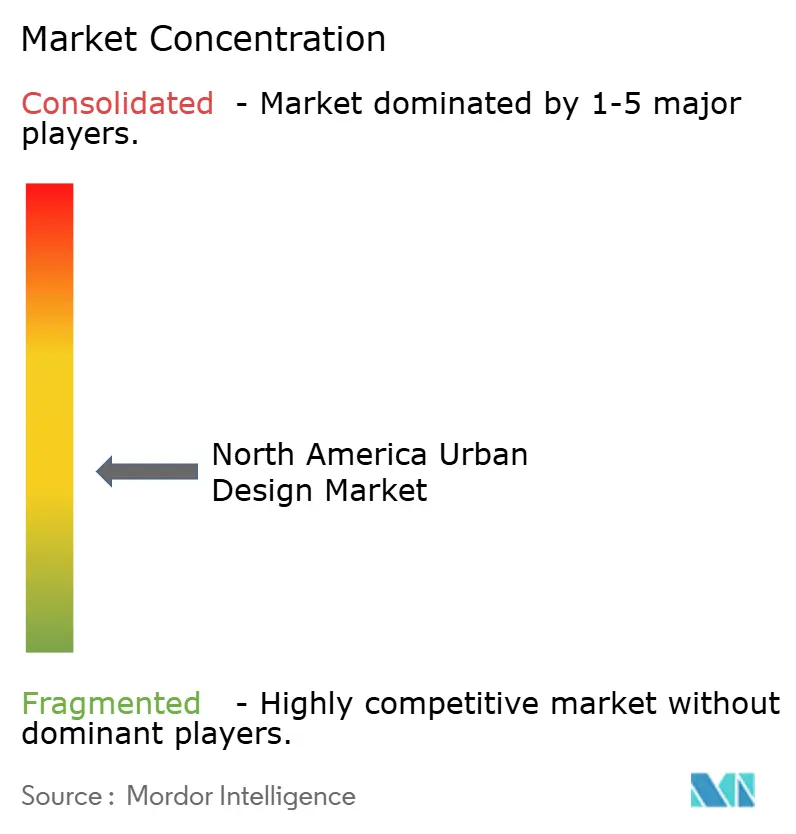
| Market Concentration | Medium |
Major Players *Disclaimer: Major Players sorted in no particular order Image © Mordor Intelligence. Reuse requires attribution under CC BY 4.0. | |
North America Urban Design Market Analysis by Mordor Intelligence
The North America Urban Design Market size is expected to grow from USD 11.80 billion in 2025 to USD 12.5 billion in 2026 and is forecast to reach USD 17.80 billion by 2031 at 7.32% CAGR over 2026-2031.Persistent housing shortages, redevelopment of established urban areas, and demand for walkable communities support a steady flow of design assignments. Urban design work begins before construction procurement, so firms often gain earlier visibility into projects than construction contractors do. Public infrastructure commitments support long planning cycles, while private mixed-use programs provide a large share of current demand. Firms that combine planning, public realm design, and approval support are better placed to retain work through a project’s early stages. Rising project costs and slow approvals can postpone private commissions, but publicly funded transit, housing, and resilience programs provide an offsetting source of work for the North America urban design market.
Key Report Takeaways
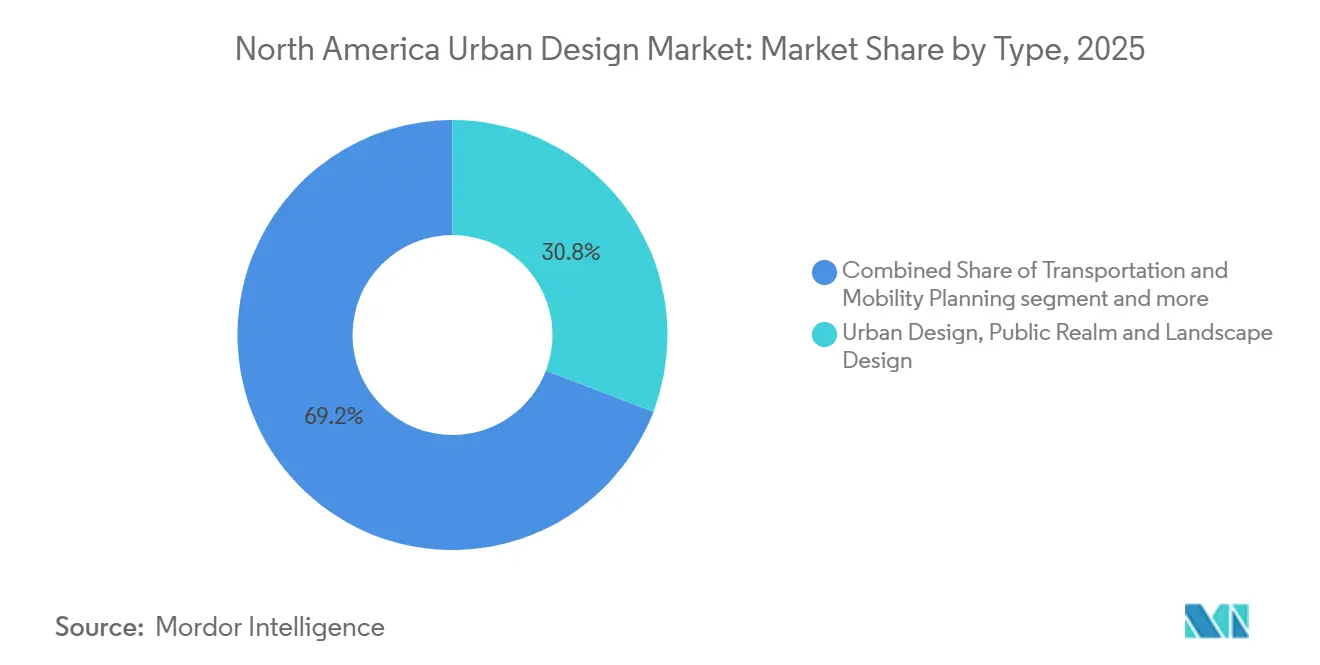
- By type, urban design, public realm, and landscape design led with 30.8% of the North America urban design market share in 2025, while zoning, development control, and Implementation Advisory is forecast to grow at an 8.1% CAGR through 2031.
- By sector, mixed-use and township developments accounted for 35.6% of the North American urban design market size in 2025, while Transportation and Infrastructure is forecast to advance at a 8.4% CAGR through 2031.
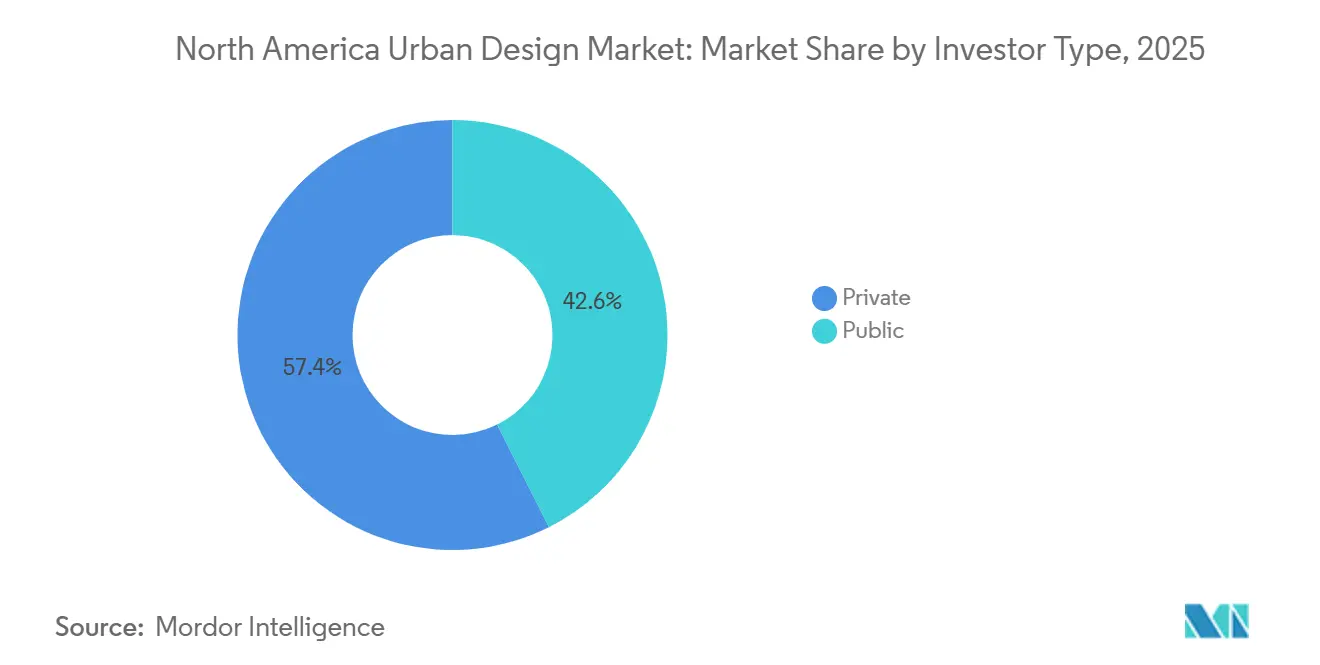
- By investor type, private investors accounted for 57.4% of revenue in 2025, while public commissioning is forecast to grow at a 8.9% CAGR through 2031.
- By country, the United States held 82.5% revenue share in 2025, while Mexico is forecast to grow at a 10.6% CAGR through 2031.
Note: Market size and forecast figures in this report are generated using Mordor Intelligence’s proprietary estimation framework, updated with the latest available data and insights as of January 2026.
North America Urban Design Market Trends and Insights
Drivers Impact Analysis*
| Drivers | (~) % Impact on CAGR Forecast | Geographic Relevance | Impact Timeline |
|---|---|---|---|
| Housing Affordability and Infill Development | +2% | United States, especially California, Texas, and Florida, with effects in Canadian metropolitan areas | Medium term (2-4 years) |
| Federal Infrastructure and Transit Investment | +1.7% | United States, with greater activity in gateway cities and transit-oriented development corridors | Medium term (2-4 years) |
| Suburban Retrofit and Mixed-Use Intensification | +1.4% | United States suburban metropolitan areas and Ontario and British Columbia in Canada | Medium term (2-4 years) |
| Climate Adaptation for Existing Cities | +1% | Coastal metropolitan areas, western United States wildfire corridors, and British Columbia | Long term (≥ 4 years) |
| Regulatory Reform and Standardized Housing Plans | +0.9% | United States and Canada, with early relevance in California, Florida, and municipalities with limited in-house design capacity | Medium term (2-4 years) |
| Demand for Walkable and Inclusive Communities | +0.8% | Major metropolitan areas in the United States, Canada, and Mexico | Short term (≤ 2 years) |
| Source: Mordor Intelligence | |||
Housing Affordability and Infill Development
Housing shortages are extending the pipeline for planning and urban design work across established metropolitan areas. Cities with high housing regulation took 2.5 times longer to approve projects than cities with more streamlined rules, and each month of delay added 1%, or USD 4,400, to per-unit building costs in Washington state, according to Pew Charitable Trusts in 2026. Research reported by the Congress for the New Urbanism identified capacity for 430,000 housing units along California commercial arterials in the near term, with long-term potential of 1.3 million units, and these sites need land-use planning, zoning support, public realm work, and implementation planning before they can move ahead. Florida’s Infill Redevelopment Act, signed in May 2026, added a framework intended to streamline approvals for urban infill sites, while Canada Mortgage and Housing Corporation released more than 50 standardized housing plans in 2025 for municipalities that lack in-house design capacity. A National Association of Realtors survey published in 2026 found that 63% of residents in the 50 largest U.S. metropolitan areas would pay more to live in walkable communities and 89% considered sidewalks and walkable public spaces important in housing decisions. Congress for the New Urbanism found that homes in walkable neighborhoods commanded a 14.9% premium, a 5% improvement in walkable infrastructure increased time spent walking by 32.1%, and listings highlighting walkability rose from 0.6% in October 2024 to 1.3% in October 2025.
Federal Infrastructure and Transit Investment
Federal transportation programs provide a durable source of assignments for the North America urban design market. Highway changes, transit extensions, and multimodal hubs require planning, design coordination, public space work, and consultation before construction contracts are issued. This early work can provide firms with a clearer view of funded projects than private speculative development does. The proposed BUILD America 250 Act was approved by the House Transportation and Infrastructure Committee in May 2026 by a 62-2 vote and would authorize USD 580 billion in surface transportation programs for fiscal years 2027 through 2031. The proposal represents a 25% increase in core formula programs relative to the IIJA, which would expand the project base for corridor, station-area, and public realm planning if enacted. Transit-oriented development links infrastructure spending to residential and commercial programs and needs circulation plans, pedestrian connections, open spaces, land-use rules, and phased implementation plans that allow planning teams to stay involved from early options analysis through design development.
Suburban Retrofit and Mixed-Use Intensification
A growing number of outdated retail and office sites are being repositioned as mixed-use districts. Congress for the New Urbanism tracked more than 2,500 suburban retrofit projects underway or completed in early 2025. The projects include former malls, greyfield office parks, and aging retail corridors that require new street layouts, public spaces, development phasing, and land-use strategies. Lakeside City Center in Sterling Heights, Michigan, is a USD 1.3 billion redevelopment of a 110-acre former mall site approved in late 2024, and its plan includes more than 2,000 housing units across 5 mixed-use neighborhoods. The Espace Canevas redevelopment in Quebec is a CAD 1.3 billion (USD 0.9 billion) program that allocates 33% of its site to parks and urban tree canopy, with Phase 1 scheduled for completion in fall 2026. These commissions favor teams that can connect design decisions with approval requirements and infrastructure sequencing, while specialist practices can contribute public realm and placemaking expertise across many suburban areas.
Climate Adaptation for Existing Cities
Climate adaptation is expanding the scope of planning work in coastal and wildfire-prone metropolitan areas. Existing neighborhoods require design responses that address flooding, heat, water management, evacuation routes, and access to public space. These needs are especially relevant in Miami, New York, Houston, western U.S. wildfire corridors, and British Columbia. Adaptation work often requires changes to streets, parks, waterfronts, and development standards rather than a stand-alone engineering response. Firms that can translate resilience requirements into master plans and development controls can support clients at the earliest project stage, while transit corridors, waterfront projects, and mixed-use districts can combine climate goals with housing, mobility, and public realm priorities. The demand is geographically concentrated, but the North America urban design market can apply the same approach across the region.
Restraints Impact Analysis*
| Restraints | (~) % Impact on CAGR Forecast | Geographic Relevance | Impact Timeline |
|---|---|---|---|
| Lengthy Entitlement and Zoning Approvals | -1.5% | High-cost metropolitan areas, including California, New York, and Massachusetts, with national effects | Short term (≤ 2 years) |
| High Land, Labor, and Construction Costs | -1.3% | North America, with stronger effects in coastal metropolitan areas and Sun Belt growth locations | Short term (≤ 2 years) |
| Community Opposition to Higher Density | -0.7% | Suburban and inner-ring communities in the United States and Canada | Medium term (2-4 years) |
| Fragmented Governance Across Municipal Jurisdictions | -0.6% | Cross-border metropolitan regions, tri-state areas, and multi-municipality growth corridors | Long term (≥ 4 years) |
| Source: Mordor Intelligence | |||
Lengthy Entitlement and Zoning Approvals
Approval delays reduce the share of planned development that moves into detailed design and construction. A UCLA Anderson study published in 2026 found that lengthy approval timelines reduce new housing supply because carrying costs weaken project feasibility. Complex urban sites may require NEPA reviews, state environmental assessments, historic preservation requirements, and local zoning approvals, extending the period between design work and construction start by 18 to 36 months. Community concerns about higher density add uncertainty in suburban and inner-ring locations, and an American Enterprise Institute survey found that skepticism about supply and neighborhood change were central reasons for opposition to zoning flexibility. Projects that cross city, county, or state boundaries can require coordination among agencies with separate priorities and review processes. The North America urban design market is therefore exposed to a slower conversion of planned work into funded assignments.
High Land, Labor, and Construction Costs
High land, labor, and material costs reduce the number of private projects that can proceed to commissioning. The ENR Building Cost Index rose 4.2% in 2025, while U.S. steel prices rose 11.9% by year-end. Higher costs narrow limited margins on residential and mixed-use projects, especially in coastal metropolitan areas and Sun Belt markets where land values and construction activity are high. Labor shortages reinforce this pressure by raising schedules and wage costs, and the supplied research identified 61% of metropolitan markets as labor-constrained in 2026, with the share expected to reach 72% in 2027. It also stated that construction wage inflation was 5% year over year and that the sector needed 499,000 workers by 2026 to avoid USD 124 billion in lost output. Public programs with defined funding provide some protection, but the North America urban design market remains sensitive to whether clients can convert a design concept into an affordable construction program.
*Our forecasts treat driver/restraint impacts as directional, not additive. The impact forecasts reflect baseline growth, mix effects, and variable interactions.
Segment Analysis
By Type: Regulatory Advisory Becomes a Commercial Differentiator
Urban Design, Public Realm, and Landscape Design held 30.8% of segment revenue in 2025. The segment benefits from city investment in streetscapes, parks, waterfronts, station areas, and publicly accessible spaces. It also draws on private developers who must provide public realm improvements to obtain planning approvals. This combination makes demand broad across public and private clients. The segment is active in major metropolitan areas and in suburban redevelopment locations. Its range of assignments helps it remain the largest type within the North America urban design industry.
Zoning, Development Control, and Implementation Advisory is forecast to grow at an 8.1% CAGR through 2031. California’s AB 2243, adopted in 2025 and building on AB 2011, allows mixed-use residential development along commercial corridors. Clients need help converting legislation and local rules into buildable codes, plans, and approval strategies. This gives the segment a role that extends beyond design execution. Master Planning, Land-Use Planning, and Transportation and Mobility Planning remain volume anchors because they serve large infrastructure and mixed-use programs. The Others category includes niche advisory and Indigenous land-planning work, which are gaining visibility in Canada.



By Sector: Mixed-Use Programs Lead While Transportation Gains Momentum
Mixed-Use and Township Developments accounted for 35.6% of the North America urban design market size in 2025. The segment is supported by private investment in walkable, transit-adjacent, and income-diverse projects. Mixed-use planning can support retail activity and residential absorption when single-use properties face weaker demand. It also requires a coordinated approach to streets, services, parks, housing, and commercial space. This complexity creates work for master planners and public realm teams. The sector remains a central source of private assignments for the North America urban design market.
Arcadis serves as master planner for The Point in Draper, Utah, where Phase 1 includes 2.5 million square feet of office space, 3,000 housing units, 350,000 square feet of retail space, and 16 acres of parks. The project shows the integrated design scope required in large mixed-use developments. Transportation and infrastructure are forecast to grow at an 8.4% CAGR through 2031, the fastest rate across sectors. Transit station areas, multimodal hubs, and bus rapid transit corridors require design work before construction begins. Public, Civic, and Institutional Developments maintain a stable role through procurement for civic buildings, universities, and health care campuses. The Others category includes niche advisory and climate resilience work, with stronger growth in Canada.
By Investor Type: Private Demand Sets Scale While Public Work Adds Stability
Private investors commanded 57.4% of the North America urban design market in 2025. Large mixed-use, residential, and commercial programs give private clients a substantial role in total demand. Private commissioning is most concentrated in the United States, where land values, project scale, and institutional investment support larger design budgets. It is also more exposed to changes in commercial property conditions. The office slowdown during 2024 and 2025 showed how a weaker development cycle can reduce commissions. Firms with a high dependence on private clients are therefore more exposed to project postponements.
Public commissioning is forecast to grow at an 8.9% CAGR through 2031. Federal transit appropriations, municipal housing programs, and climate resilience initiatives are supporting multiyear pipelines with identified funding sources. Public and infrastructure-related work provides more stability than several private property categories, according to the 2026 ULI and PwC Emerging Trends report[1] Urban Land Institute, “Emerging Trends in Real Estate, United States and Canada 2026,” Urban Land Institute, uli.org. These projects can take longer to procure, but their funding structures reduce reliance on near-term property sales. The North America urban design market benefits when firms balance private commissions with public agency work. This balance also supports design practices through periods of slower commercial development.
Geography Analysis
The United States held 82.5% of North America urban design market share in 2025. Its position reflects the scale of U.S. real estate capital and federal infrastructure programs. The Northeast Megaregion, Texas Triangle, and Pacific Coast metropolitan areas are generating work across transit-oriented development, infill housing, and climate adaptation. These locations combine development pressure with complex approval and infrastructure needs. The proposed USD 580 billion BUILD America 250 surface transportation authorization could extend the public project pipeline if enacted. New York City’s USD 413 million Jamaica Neighborhood Plan, with phased solicitations expected from late 2026, shows the combined public realm, infrastructure, and community design work required in major public commissions.
Canada is smaller in absolute value but has sustained housing demand and public infrastructure activity. Ontario public-sector spending on major infrastructure projects increased 16% in the first quarter of 2026, supporting demand for design and engineering consultancies in the country’s largest metropolitan region. The 2025 standardized housing plan catalog from Canada Mortgage and Housing Corporation provides municipalities with limited internal design capacity with an implementation tool. British Columbia and Alberta are also generating master planning work through suburban retrofit and mixed-use development. Canadian assignments often combine housing, landscape, transit, and public space objectives. This supports a diverse project base for the North America urban design market.
Mexico is forecast to expand at a 10.6% CAGR through 2031, the fastest national rate in the region. The Mexican government announced the Plan de Inversión en Infraestructura para el Desarrollo con Bienestar in February 2026, a MXN 5.6 trillion program (USD 315 billion), covering more than 1,500 projects through 2030. Infrastructure investment for 2026 is projected at 2.5% of GDP. FIFA World Cup 2026 investments across Mexico City, Monterrey, and Guadalajara include more than MXN 23 billion (USD 1.3 billion), for mobility, water, and public-space works. Mexico City’s 2026 municipal infrastructure budget reached MXN 57.9 billion (USD 3.3 billion), a 31.2% increase from 2025[2]Excélsior, “Rumbo al Mundial, Inversión Récord, 57.9 Mil Millones,” Excélsior, excelsior.com.mx. Nearshoring is also creating greenfield master planning work along northern border corridors.
Competitive Landscape
The North America urban design market includes a consolidated group of large integrated engineering and architecture firms and a fragmented group of specialist studios. Large firms have an advantage in federal frameworks, major transit contracts, and other multidisciplinary assignments. Prequalification requirements, bonding capacity, and broad technical teams can limit access for smaller firms on major public procurements. Their strategy commonly centers on long-term task-order contracts with public agencies. These contracts provide revenue visibility and can make it harder for smaller firms to enter major frameworks. The North America urban design market concentration score is addressed after the citation block because no combined market share of leading firms was supplied.
In June 2026, an HNTB-HOK joint venture with Practice for Architecture and Urbanism was selected as the design team for the transformation of New York Penn Station[3]HOK, “HNTB-HOK Joint Venture Selected as Design Team for New York Penn Station Project,” HOK, hok.com. The selection demonstrates the importance of established public-sector experience and multidisciplinary capacity in major transport projects. In May 2026, Jacobs Solutions received a multiyear contract from Nashville and Davidson County for the Choose How You Move program. The program covers more than 50 project types, including 86 miles of sidewalks and modernization of nearly 600 traffic signals. In June 2025, Arcadis was named design partner for Ontario’s QEW Garden City Skyway Bridge Twinning Project, covering civil, utility, and traffic engineering design. These moves show how leading firms use public infrastructure assignments to strengthen their regional project base.
Specialist and mid-sized firms compete where local context, placemaking, and community engagement are central to the client brief. Digital tools for parametric design, GIS-based zoning analysis, and community engagement can reduce the productivity difference between large and small practices. Firms that can demonstrate walkability, sustainability, and equity outcomes can be competitive when public clients face close community review. Certifications such as LEED Neighborhood Development can support this positioning. The strongest opening is often where design work and regulatory support are offered together. Firms that combine creative planning with entitlement guidance can remain involved through approvals and secure repeat work from developers facing complex zoning conditions.
North America Urban Design Industry Leaders
AECOM
Jacobs Solutions Inc.
WSP Global Inc.
Stantec Inc.
HDR, Inc.
- *Disclaimer: Major Players sorted in no particular order

Recent Industry Developments
- June 2026: An HNTB-HOK Joint Venture, in association with Practice for Architecture and Urbanism (PAU), was selected as design team for the transformation of New York Penn Station alongside Penn Transformation Partners (Halmar/Skanska). Construction is expected to begin in 2027, making it one of the largest intermodal urban design commissions in recent U.S. history.
- May 2026: Jacobs Solutions was awarded a multi-year contract by Nashville and Davidson County for the Choose How You Move program, covering more than 50 project types including 86 miles of new sidewalks and the modernization of nearly 600 traffic signals. The award reflects the growing bundling of urban mobility and public realm design in city-scale transport briefs.
- March 2026: Stantec was selected within a consortium to deliver multidisciplinary engineering and design services for Canada's Arctic Over-the-Horizon Radar project, with a validation phase beginning Q1 2026.


North America Urban Design Market Report Scope
| Master Planning and Land-Use Planning |
| Urban Design, Public Realm and Landscape Design |
| Transportation and Mobility Planning |
| Zoning, Development Control and Implementation Advisory |
| Others |
| Mixed-Use and Township Developments |
| Transportation and Infrastructure |
| Public, Civic and Institutional Developments |
| Others |
| Public |
| Private |
| United States |
| Canada |
| Mexico |
| By Type | Master Planning and Land-Use Planning |
| Urban Design, Public Realm and Landscape Design | |
| Transportation and Mobility Planning | |
| Zoning, Development Control and Implementation Advisory | |
| Others | |
| By Sector | Mixed-Use and Township Developments |
| Transportation and Infrastructure | |
| Public, Civic and Institutional Developments | |
| Others | |
| By Investor Type | Public |
| Private | |
| By Countries | United States |
| Canada | |
| Mexico |


Key Questions Answered in the Report
What is the projected value of the North America urban design market by 2031?
It is projected to reach USD 17.8 billion by 2031, growing at a 7.3% CAGR from 2026.
Which urban design service is forecast to grow fastest in North America?
Zoning, Development Control and Implementation Advisory is forecast to grow at an 8.1% CAGR through 2031.
Which client group accounts for the largest share of demand?
Private investors led demand with 57.4% revenue share in 2025, driven by mixed-use, residential, and commercial programs.
Why does transit investment matter to urban design firms?
Transit projects need station-area planning, public realm design, circulation plans, and implementation support before construction begins.
Which country is expected to grow fastest through 2031?
Mexico is forecast to grow at a 10.6% CAGR through 2031, supported by infrastructure programs and World Cup-related urban works.
Page last updated on:





