
Market Overview
| Study Period | 2021 - 2031 |
|---|---|
| Forecast Data Period | 2026 - 2031 |
| Historical Data Period | 2021 - 2024 |
| Growth Rate | 2.12 % |
| Market Concentration | Medium |
Major Players *Disclaimer: Major Players sorted in no particular order Image © Mordor Intelligence. Reuse requires attribution under CC BY 4.0. | |
North America Subsea Production And Processing Market Analysis by Mordor Intelligence
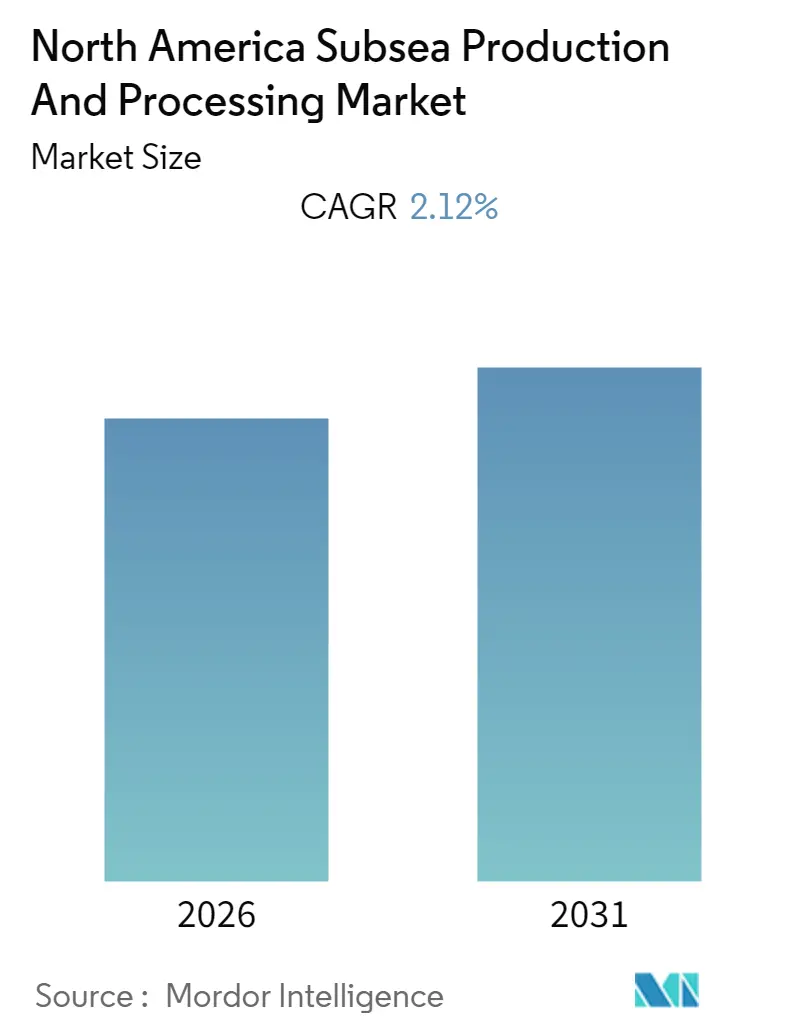
The North America Subsea Production and Processing Market size was valued at USD 5.87 billion in 2025 and estimated to grow from USD 5.99 billion in 2026 to reach USD 6.68 billion by 2031, at a CAGR of 2.12% during the forecast period (2026-2031).
- Due to the high demand for subsea trees, risers, flowlines, umbilicals, and wellheads, subsea production is expected to dominate the market.
- The increasing crude oil prices due to the war between Ukraine and Russia may encourage countries in North America, primarily the United States, to produce their crude oil, principally as offshore shale oil and gas. This factor may directly aid the North American production and processing system market and provide an opportunity during the forecast period.
- The United States is the largest market in the region for subsea production and processing systems, as it has an abundance of offshore oil and gas reserves.
Note: Market size and forecast figures in this report are generated using Mordor Intelligence’s proprietary estimation framework, updated with the latest available data and insights as of 2026.
North America Subsea Production And Processing Market Trends and Insights
Subsea Production Systems to Dominate the Market
- The subsea production system provides a way to produce hydrocarbons economically where offshore platforms cannot be developed or are more expensive. Further, the subsea production system uses several building blocks placed on the seabed connected to the subsea pipeline network and riser systems efficiently and safely to produce the reservoir.
- Further, the subsea production system is gaining popularity in North America as it is an efficient way to produce a deepwater reservoir with a depth of around 7,000 ft. In addition, subsea production includes subsea structures or equipment such as wellheads, trees, jumpers, and manifolds.
- For instance, in January 2022, Subsea 7 was awarded a substantial subsea installation service in the Gulf of Mexico with a water depth of 6,300 ft. In addition, the work scope includes engineering, construction, procurement, installation, and commissioning of the subsea equipment, including umbilicals, structures, production and gas export pipelines, and semi-submersible platforms.
- Similarly, in December 2021, Subsea 7 was awarded a project by Subsea Integration Alliance for the Scarborough project, located 380 km offshore northwest Australia. The project includes engineering, production, construction, and installation (EPCI) for subsea production and pipeline systems. The project consists of eight subsea trees, 42 km of umbilicals, 45 km of rigid flowlines, six flexible flowline risers, and associated equipment.
- Overall, the rising demand for oil and gas in North America and the development of deepwater projects in the Gulf of Mexico may drive the market.


The United States is the Largest Market in the Region
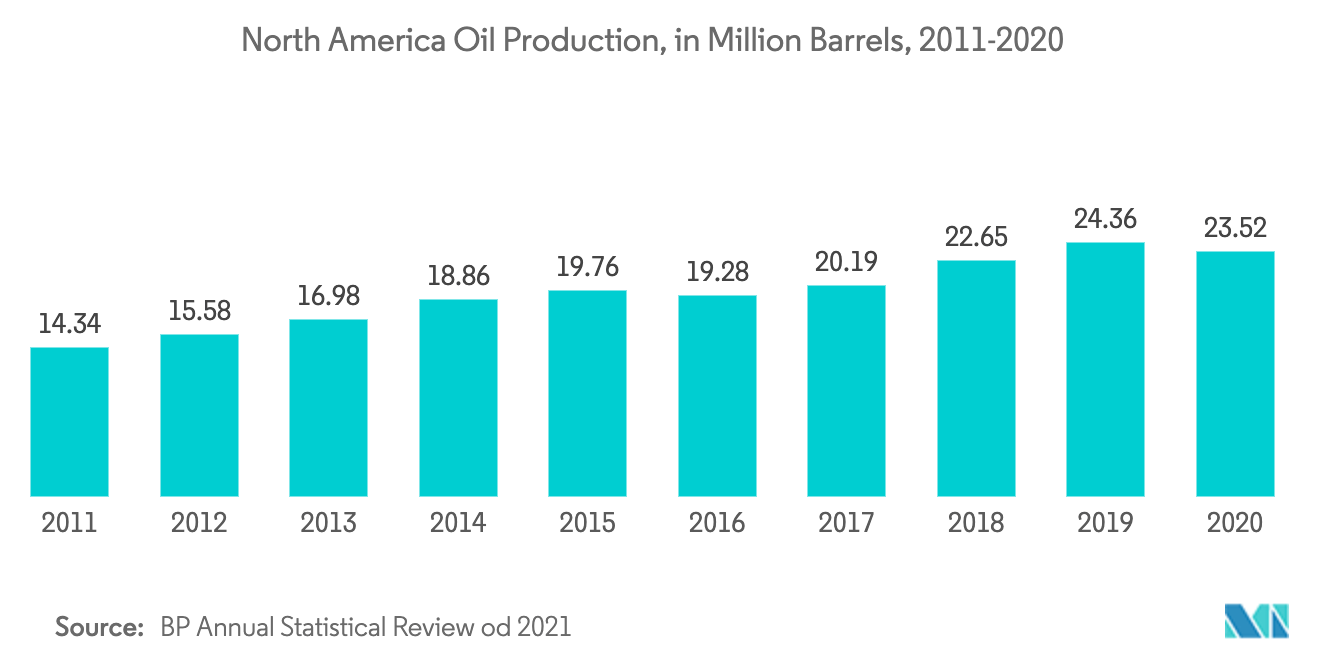
- The United States is the largest market for subsea production and processing system market in the region. It has the highest reserves for oil and gas in the region, complemented by the increased demand for refined petroleum products.
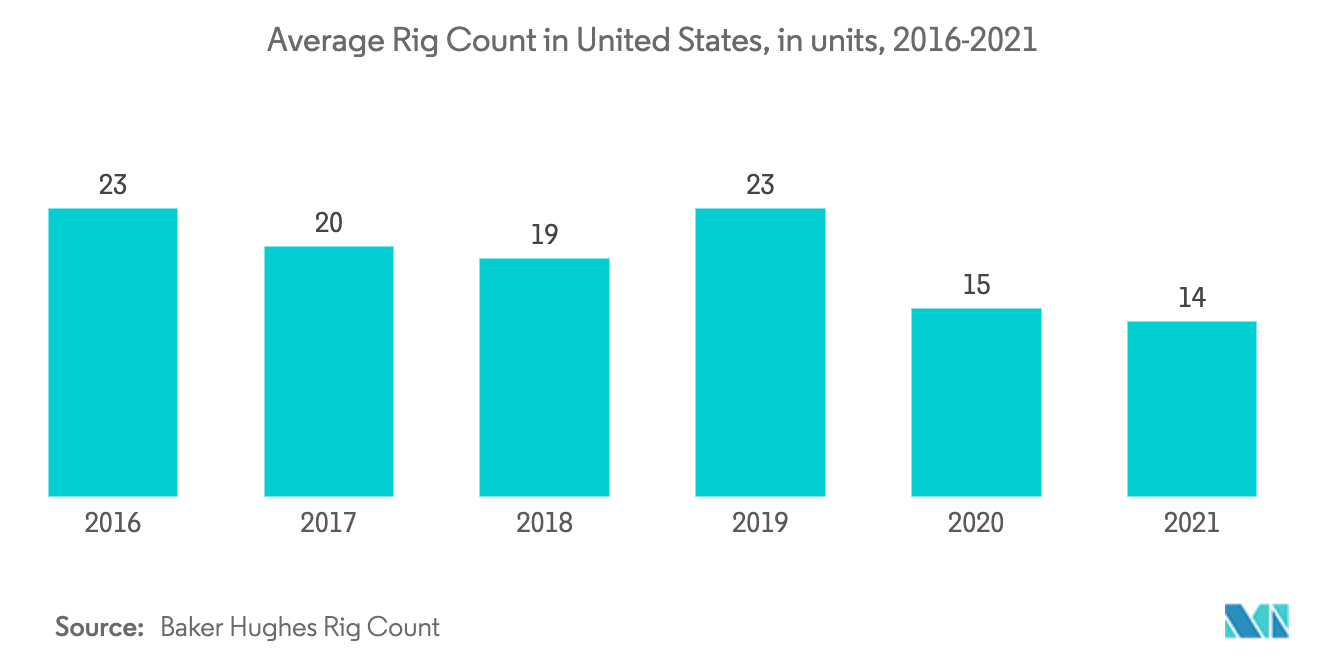
- In addition, the country has the highest number of offshore rigs in the region, which is due to the availability of oil in the Gulf of Mexico and offshore shale gas reserves, making it a significant market for subsea production and processing systems.
- Further, in 2022, there may be more deepwater exploration and project sanctions in the Gulf of Mexico due to the robust oil and gas prices because of the war between Ukraine and Russia. Also, about 12 deepwater projects in the US gulf discoveries were made, directly aiding the subsea production and processing system market during the forecast period.
- In March 2022, Shell PLC announced that it had started production of subsea development at the Powernap located in the Gulf of Mexico, with estimated peak production of 20,000 barrels of oil equivalent per day.
- Overall, the United States is expected to hold a major share of the North American subsea production and processing system market, as it holds the most amount of reserves.
Regulatory Landscape
In the United States, offshore subsea production and processing projects on the Outer Continental Shelf are governed through BOEM and BSEE requirements, including design and installation compliance under 30 CFR Part 285. BSEE issued National Notice to Lessees (NTL) 2024-R01 (December 2024), clarifying that industry standards (such as API, DNV, and IEC) applied in facility design, fabrication, and installation must be explicitly identified within Certified Verification Agent (CVA) nominations and in Facility Design Reports and Fabrication and Installation Reports. This tightens documentation and verification expectations for subsea hardware and tieback infrastructure.
In Canada, offshore subsea operations are overseen under federal regulations and offshore petroleum boards, with integrity and operating requirements addressed through instruments such as the Canada Oil and Gas Installations Regulations (SOR/96-118). In June 2026, amendments published to the Canada-Newfoundland and Labrador Offshore Area Petroleum Operations Framework Regulations replaced volume-based venting limits with a performance-based prohibition on venting, reinforcing emissions and operating-compliance considerations that can shape subsea system design choices, including control systems and processing configurations that support reduced venting.
Value Chain Analysis
The North American subsea production and processing value chain begins with field development planning and FEED by operators, then moves through integrated EPCI/iEPCI delivery for subsea trees, manifolds, umbilicals, risers and flowlines, wellheads, and processing modules such as boosting. Contract awards in 2026 for subsea boosting systems in the US Gulf of Mexico (for example, SLB OneSubsea awards tied to the Shenandoah field and bp's Thunder Horse project) show how operators are bundling engineering and manufacturing with installation readiness. As a result, critical-path activities shift upstream into fewer, larger work packages.
Equipment manufacturing and system integration are concentrated among a small set of global suppliers and alliance models. Execution is supported by fabrication yards, marine logistics, and service bases clustered along the Louisiana-Texas corridor for Gulf of Mexico work. Installation and commissioning rely on specialized vessels and subsea construction capabilities, including metrology, installation, tie-in, and testing, while long-life operations depend on inspection, maintenance, and intervention services, including ROV-based campaigns, to sustain trees, flowlines, and subsea processing equipment across multi-year production life cycles.
Competitive Landscape
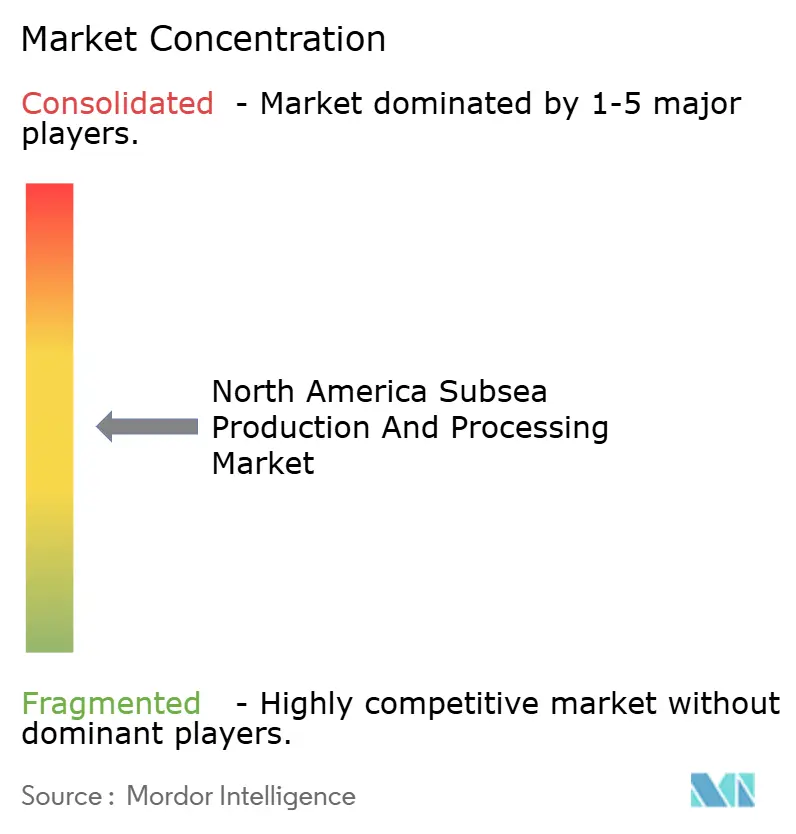
The North American subsea production and processing market is moderately consolidated. The major companies include Subsea 7 SA, TechnipFMC PLC, Aker Solutions, Oceaneering International Inc., and General Electric Company.
North America Subsea Production And Processing Industry Leaders
Aker Solutions
Subsea 7 SA
TechnipFMC PLC
Oceaneering International Inc.
General Electric Company
- *Disclaimer: Major Players sorted in no particular order

Market Opportunities and Future Outlook
A key opportunity is scaling high-pressure, high-temperature (HPHT) and 20,000 psi-class subsea systems in the US Gulf of Mexico, where new developments have moved from concept to operating references. Chevron's Anchor project reached first oil in August 2024 as the first commercial 20,000 psi-rated HPHT subsea production system, and the Shenandoah floating production system commenced production in July 2025 at 20,000 psi. These operational proof points can reduce perceived technical risk for additional HPHT subsea trees, manifolds, and tiebacks in Lower Tertiary-style reservoirs.
Subsea processing, particularly boosting, is also expanding as a practical lever for production uplift and tieback economics around existing deepwater hubs. In 2026, SLB OneSubsea received major Gulf of Mexico boosting awards, including a multiphase boosting system for Shenandoah and an EPC subsea boosting system for bp's Thunder Horse. This indicates continued procurement for standardized boosting packages, with adjacent demand extending beyond pumps and controls into power and umbilical design, subsea integrity management, and intervention services required to operate and maintain these systems over long durations.
Recent Industry Developments
- June 2026: Aker Solutions signed a five-year agreement with Cenovus Energy for engineering and maintenance services covering White Rose field assets offshore Newfoundland and Labrador, Canada. The long-duration scope supports life-extension and reliability work tied to subsea and offshore production infrastructure. It also reinforces the role of aftermarket services and brownfield modification capacity alongside newbuild subsea equipment demand.
- March 2026: Subsea 7 was awarded a sizeable contract by Murphy Exploration & Production Company for the String Music development in the US Gulf of Mexico. The award adds to active EPCI and installation backlogs tied to Gulf of Mexico subsea tiebacks and associated infrastructure. It also underlines continued demand for installation vessel capacity and execution partnerships in deepwater projects.
- January 2026: TechnipFMC won an integrated EPCI (iEPCI) contract from bp for the 20,000 psi Tiber development in the US Gulf of Mexico, reported in the USD 600 million to USD 800 million range. The contract reflects operator preference for integrated delivery models to manage complexity and interfaces in ultra-high-pressure subsea developments. It also supports the commercialization pathway for 20K-rated subsea equipment and associated manufacturing and integration capacity.


Research Methodology Framework and Report Scope
Market Definition and Coverage
This market covers equipment and systems used to produce and process hydrocarbons on the seabed in North America, including subsea production hardware and subsea processing functions that support offshore field development and operations.
Scope exclusions: Onshore surface processing plants and non-subsea (topside-only) processing equipment are excluded from this sizing.
Segmentation Overview
- Production System
- Subsea Trees
- Subsea Umbilicals
- Risers and Flowlines
- Subsea Wellhead
- Other Production Systems
- Processing System
- Boosting
- Separation
- Injection
- Gas Compression
- Geography
- United States
- Canada
- Mexico
Data Sources, Market Sizing, and Validation
Desk Research
Desk research was used to build the basic fact base on offshore activity and the flow of subsea project awards across the United States, Canada, and Mexico. We relied on public sources such as the US Energy Information Administration, the Bureau of Ocean Energy Management, the Canada Energy Regulator, and official trade statistics for import and export signals that reflect subsea equipment movement.
To make the model practical, company annual reports, investor presentations, and reputable energy press releases were also reviewed to map project timing and the typical equipment packages used in tie-backs and new developments. Where financial splits were not clearly stated, we used a paid subscription focused on company financials and a paid patent database to cross-check technology directions and product emphasis. These examples are not exhaustive, and many other public and paid sources were referenced for data collection, validation, and research clarification.
Primary Interviews and Surveys
Primary work focused on validating what is actually being purchased in the region and when it is being installed, since subsea spending can shift quickly with project schedules. We spoke with a mix of operators, engineering teams, and supply chain stakeholders, then checked assumptions across the North America offshore landscape so gaps from desk research could be filled and key inputs could be confirmed.
Distribution of primary research fieldwork respondents
| Company type | Respondent position |
|---|---|
| Top tier: 26% | CXOs: 18% |
| Mid tier: 54% | Functional/Unit leaders: 28% |
| Smaller Players: 20% | Managers: 54% |
Market-Sizing & Forecasting
Sizing starts from a top-down build where offshore development activity and sanctioned project pipelines are translated into demand for subsea production and processing packages, and then split by the main equipment groups used in typical subsea architectures. We then corroborate the totals using selective bottom-up approximations, such as sampled contract values by equipment type, check points from installation schedules, and a simple ASP times volume sense check for common items like trees and SURF-related hardware.
A few inputs that matter most were kept visible in the model so it can be repeated and explained clearly. These include the count and timing of offshore project sanctions, expected subsea tie-back intensity, SURF length and complexity signals, the mix shift between boosting, separation, injection, and compression needs, and a practical currency conversion timing aligned to the year of spend. When deal details are missing, gaps are handled through ranges anchored on comparable project types, followed by adjustments after expert feedback.
For forecasting, scenario analysis was used because subsea demand in North America is strongly shaped by project start dates and offshore capex cycles, which can move with oil price expectations and operator budgets. The forward view was finalized only after our assumptions on award timing and equipment mix were reviewed through primary discussions.
Data Validation & Update Cycle
Outputs are checked in steps, first by testing whether the implied spend per project looks reasonable against known offshore development patterns, and then by comparing the split across production and processing systems with what interviewees describe as typical ordering behavior. We also run variance checks across years to flag spikes that do not match visible signals like sanction waves or installation bottlenecks, and those items are reopened for review.
Before sign-off, another analyst reviews the key assumptions, calculations, and year-to-year movements, and re-contacts are triggered when a material mismatch is found between model results and market signals. Reports are refreshed annually, with interim updates when large project approvals, delays, or policy changes materially shift the demand outlook, and a final pass is done right before delivery so the client receives the latest view.
Mordor Intelligence's North America Subsea Production and Processing Market Market Estimate Compared With Other Published Estimates
Published market numbers for this space often do not align because the market can be counted from different starting points, and because offshore project timing changes the spend curve from year to year. Differences usually show up when one estimate leans more on projected awards, while another emphasizes installed base activity or a narrower country scope.
The main gap comes from geography and system inclusion, where Mordor Intelligence counts North America across the United States, Canada, and Mexico and keeps the scope tied to subsea production systems and subsea processing systems, instead of mixing in broader subsea services or a US-only total.
Benchmark comparison
| Source | Market Size | Gaps in Research Methodology |
|---|---|---|
| Mordor Intelligence | USD 5.87 B (2025) | |
| Regional Consultancy A | USD 8.50 B (2024) | Uses a different base year and appears to bundle a wider set of subsea system spending, which can lift totals when broader equipment groupings and project pipelines are counted more aggressively. |
| Trade Publisher B | USD 4.21 B (2022) | US-only scope and an older base year reduce the reported value, and the estimate is less comparable when North America demand outside the United States is not included. |
The table shows that most of the spread can be explained by which countries are included and how tightly the estimate is limited to subsea production and processing hardware categories. By keeping the scope rules explicit and tying the yearly totals back to project cadence and equipment mix, the result stays easier to audit and repeat when new projects move forward or slip.


Key Questions Answered in the Report
What is the current North America Subsea Production and Processing System Market size?
The North America Subsea Production and Processing System Market is projected to register a CAGR of 2.12% during the forecast period (2026-2031)
Who are the key players in North America Subsea Production and Processing System Market?
Aker Solutions, Subsea 7 SA, TechnipFMC PLC, Oceaneering International Inc. and General Electric Company are the major companies operating in the North America Subsea Production and Processing System Market.
What years does this North America Subsea Production and Processing System Market cover?
The report covers the North America Subsea Production and Processing System Market historical market size for years: 2020, 2021, 2022, 2023 and 2024. The report also forecasts the North America Subsea Production and Processing System Market size for years: 2026, 2027, 2028, 2029, 2030 and 2031.
Page last updated on:


 Your data is secure and never sold or shared.


