
North America STATCOM Market Size and Share
Market Overview
| Study Period | 2021 - 2032 |
|---|---|
| Forecast Data Period | 2027 - 2032 |
| Base Year Market Size (2026) | USD 0.58 Billion |
| Market Size (2027) | USD 0.64 Billion |
| Market Size (2032) | USD 1.05 Billion |
| Growth Rate (2027 - 2032) | 10.41 % |
| Market Concentration | Medium |
Major Players *Disclaimer: Major Players sorted in no particular order Image © Mordor Intelligence. Reuse requires attribution under CC BY 4.0. | |
North America STATCOM Market Analysis by Mordor Intelligence
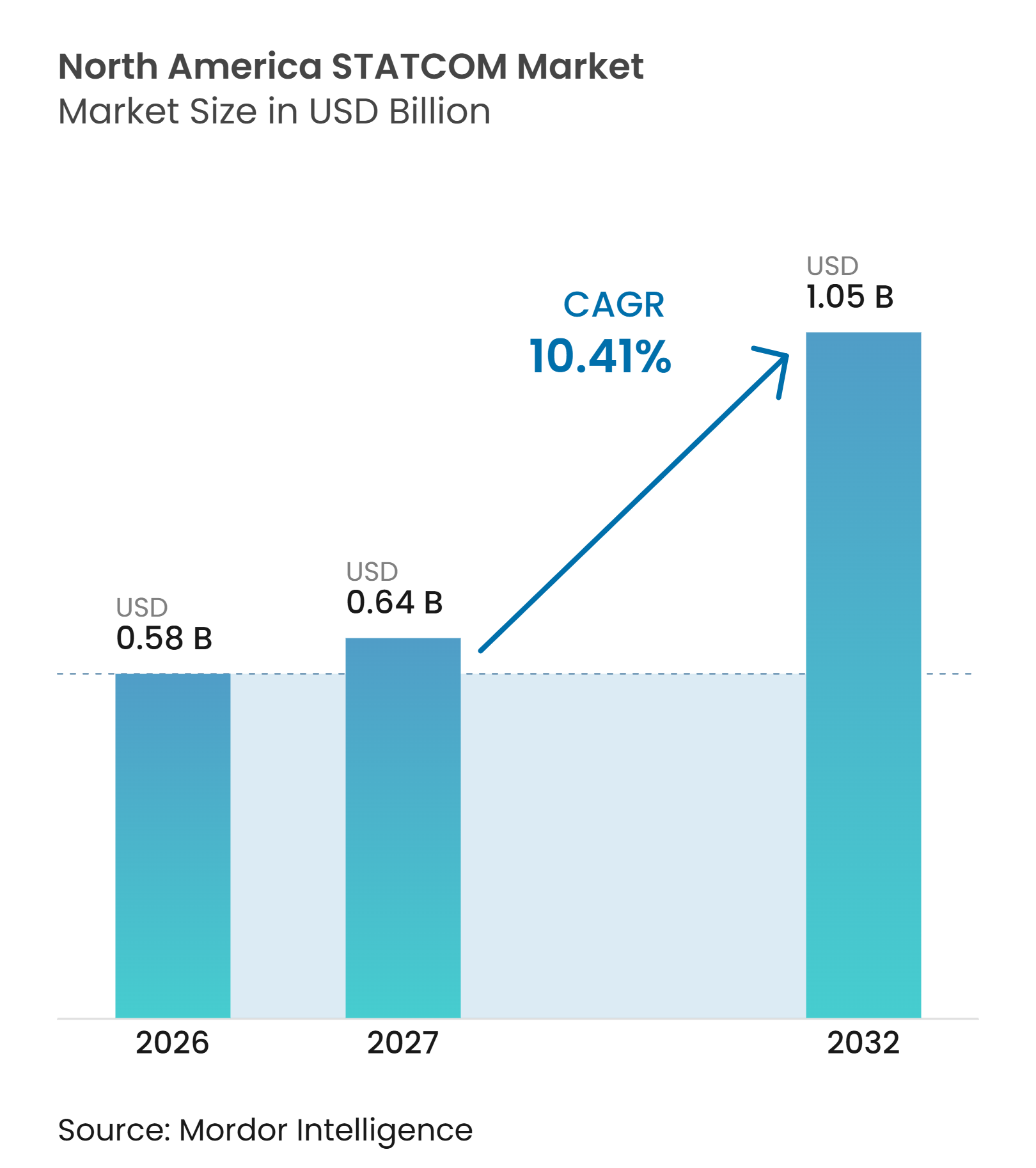
The North America STATCOM market size is projected to expand from USD 0.58 billion in 2026 to USD 1.05 billion by 2032, registering a CAGR of 10.41% between 2027 and 2032. Retiring synchronous generation, renewable interconnection requirements, and higher loads from data centers are tightening the need for dynamic reactive power support across the United States, Canada, and Mexico. The North America STATCOM market is shaped by utility reliability requirements and large-load interconnection needs. Utilities are bringing voltage-control needs forward in transmission projects, while industrial and data-center operators are seeking localized solutions at medium-voltage connection points. Suppliers are responding through modular converter designs, grid-forming controls, and investment in domestic engineering and manufacturing capacity. Procurement remains exposed to long delivery times for power semiconductors and custom coupling transformers, which can delay project schedules.
Key Report Takeaways
- By technology type, MMC and Other Multilevel VSC Topologies held 37.94% of the North America STATCOM market share in 2026, while Grid-Forming STATCOM and E-STATCOM are projected to expand at a 11.17% CAGR through 2032.
- By reactive power rating, Large-Scale Transmission STATCOM held a 46.37% share in 2026, while Small-Scale Distribution and Industrial STATCOM is expected to grow at a 11.29% CAGR through 2032.
- By application, Transmission and Grid Infrastructure accounted for 35.62% of the North America STATCOM market size in 2026, while Data Centers and Commercial Infrastructure is projected to advance at a 10.74% CAGR through 2032.
- By component, Power Electronic Converter Valves held a 38.43% share in 2026, while Control, Protection, and Monitoring Systems are expected to expand at a 11.32% CAGR through 2032.
- By geography, the United States held an 81.98% share in 2026, while Mexico is projected to grow at a 11.21% CAGR through 2032.
Note: Market numbers in this report are based on Mordor Intelligence's proprietary estimation framework, which combines nine months of actuals with Q4 projections for base year 2026.
Market Trends and Insights
Drivers Impact Analysis of North America STATCOM Market*
| Driver | (~) % Impact on CAGR Forecast | Geographic Relevance | Impact Timeline |
|---|---|---|---|
| Renewable Interconnection and Ride-Through Compliance | +3.5% | United States, Canada, and Mexico | Short term (≤ 2 years) |
| Aging Transmission Infrastructure and Voltage-Collapse Risk | +2.8% | United States, Canada, and Mexico | Short term (≤ 2 years) |
| Retirement of Synchronous Generation | +2.0% | United States and Canada | Medium term (2-4 years) |
| Data Center and Electrification Load Growth | +1.8% | United States, Canada, and Mexico | Short term (≤ 2 years) |
| Dynamic Power Quality Requirements in Heavy Industry | +0.8% | United States and Mexico | Medium term (2-4 years) |
| Hybrid STATCOM and Battery Energy Storage Revenue Stacking | +0.5% | United States and Canada | Long term (≥ 4 years) |
| Source: Mordor Intelligence | |||
Renewable Interconnection and Ride-Through Compliance
The North America STATCOM market benefits from the volume and duration of active generation interconnection requests. Lawrence Berkeley National Laboratory reported 1,312 GW of active requests at the end of 2025, while the median project had taken more than 5 years to move from application to commercial operation.[1] FERC Order 2023 is now reflected in cluster-study processes at MISO, PJM, and CAISO, where inverter-based resources must demonstrate fault ride-through and reactive-power capability before receiving an interconnection agreement. Projects at electrically weak locations may require a project-level or substation STATCOM when their inverters alone cannot meet the applicable grid-code requirements. Demand therefore follows both the renewable development pipeline and the pace of interconnection reform. LS Power commissioned an 800 MVAr STATCOM at PG&E's Gates 500 kV substation in March 2025, showing how a reliability requirement can translate into an installed transmission asset.
Aging Transmission Infrastructure and Voltage-Collapse Risk
The North America STATCOM market is also supported by transmission and distribution assets that need modernization. The U.S. Department of Energy reported that 55% of in-service distribution transformers, or nearly 40 million units, were more than 33 years old. Aging lines and transformer fleets can increase voltage stress where bidirectional power flows and new loads are rising. Edison Electric Institute expects investor-owned utilities to invest more than USD 1.1 trillion during the next 5 years, creating projects that can require reactive-power studies and dynamic compensation. PJM approved USD 11.8 billion in transmission improvements in February 2025 for reliability and congestion needs. NERC also identified emerging risks associated with inverter-based resources, even as it reported reliable performance in the bulk power system.
Retirement of Synchronous Generation
The retirement of synchronous generation changes the services that grids must procure. The U.S. Department of Energy stated that retiring 104 GW of firm generation by 2030 without timely replacement could materially increase reliability risks. Synchronous plants supply inertia, fault current, and reactive power as part of normal operation. Their retirement requires grid operators to secure those capabilities through other assets. STATCOM systems provide fast reactive support, and grid-forming configurations can contribute synthetic inertia when paired with suitable active-power capability. CIGRE has described grid-forming STATCOM designs, with and without energy storage, as a means of supporting low-inertia systems. Hitachi Energy's April 2026 investment in a power electronics center in Cary, North Carolina, was directed toward equipment for reactive-power needs and large-load interconnections.
Data Center and Electrification Load Growth
Data centers add a separate demand source for the North America STATCOM market. EPRI expects U.S. data centers to use 9% to 17% of U.S. electricity by 2030 under its 2026 scenarios. Large campuses often connect at locations where voltage constraints are tight, while AI workloads can cause rapid load changes. EPRI identified enhanced STATCOMs, battery energy storage systems, and active filtering as primary options for managing data-center load fluctuations. This need extends to Mexico, where CFE included a 300 MVAr STATCOM in a transmission upgrade tender for Querétaro. Data-center operators and utilities are likely to place greater value on equipment that can manage both voltage stability and power-quality effects at the point of common coupling. This favors suppliers that can integrate controls, protection, and commissioning services with converter hardware.
Restraints Impact Analysis of North America STATCOM Market*
| Restraint | (~) % Impact on CAGR Forecast | Geographic Relevance | Impact Timeline |
|---|---|---|---|
| High Upfront Capital and Installation Cost | -1.5% | United States, Canada, and Mexico | Medium term (2-4 years) |
| Reactive Power Capability Embedded in Plant Inverters | -0.7% | United States and Canada | Medium term (2-4 years) |
| Long Lead Times for Coupling Transformers and Power Semiconductors | -0.5% | United States, Canada, and Mexico | Short term (≤ 2 years) |
| Interconnection Queue and Permitting Delays | -0.3% | United States and Canada | Short term (≤ 2 years) |
| Source: Mordor Intelligence | |||
High Upfront Capital and Installation Cost
High capital requirements remain a restraint for the North America STATCOM market, especially for smaller utilities and industrial operators. A medium-capacity installation can require USD 5 million to USD 15 million for power electronics alone. NB Power's approved plus-or-minus 300 MVAr Salisbury Terminal project had a projected cost of CAD 133.4 million (USD 97 million), with the STATCOM equipment quoted at CAD 57 million to CAD 79 million (USD 41 million to USD 58 million). The cost must often be committed years before the unit enters service or begins to receive tariff recovery. Western University researchers demonstrated that a battery system could deliver STATCOM function through a USD 250,000 controller, supporting reactive capability valued at USD 2.5 million. Hybrid designs can spread the cost across an asset that also earns energy-market revenue, but they do not remove the initial financing hurdle.
Reactive Power Capability Embedded in Plant Inverters
Modern utility-scale solar and wind inverters can provide reactive power within a defined power-factor range. IEEE 2800-2022 sets interconnection and interoperability requirements for inverter-based resources connected to transmission and subtransmission systems. This capability can reduce the need for a dedicated system at strong-grid points in greenfield projects. Its value is limited when voltage falls, since the inverter's reactive capability degrades when support is most needed. It also does not provide the fault-current performance or synthetic inertia available from other grid-support arrangements. FERC Order 904 removed compensation for reactive power supplied within the standard power-factor range, which reduces the incentive for voluntary generator support. Dedicated STATCOM assets therefore remain relevant at critical or weak interconnection nodes.
*Our forecasts treat driver/restraint impacts as directional, not additive. The impact forecasts reflect baseline growth, mix effects, and variable interactions.
North America STATCOM Market Segment Analysis
By Technology Type:
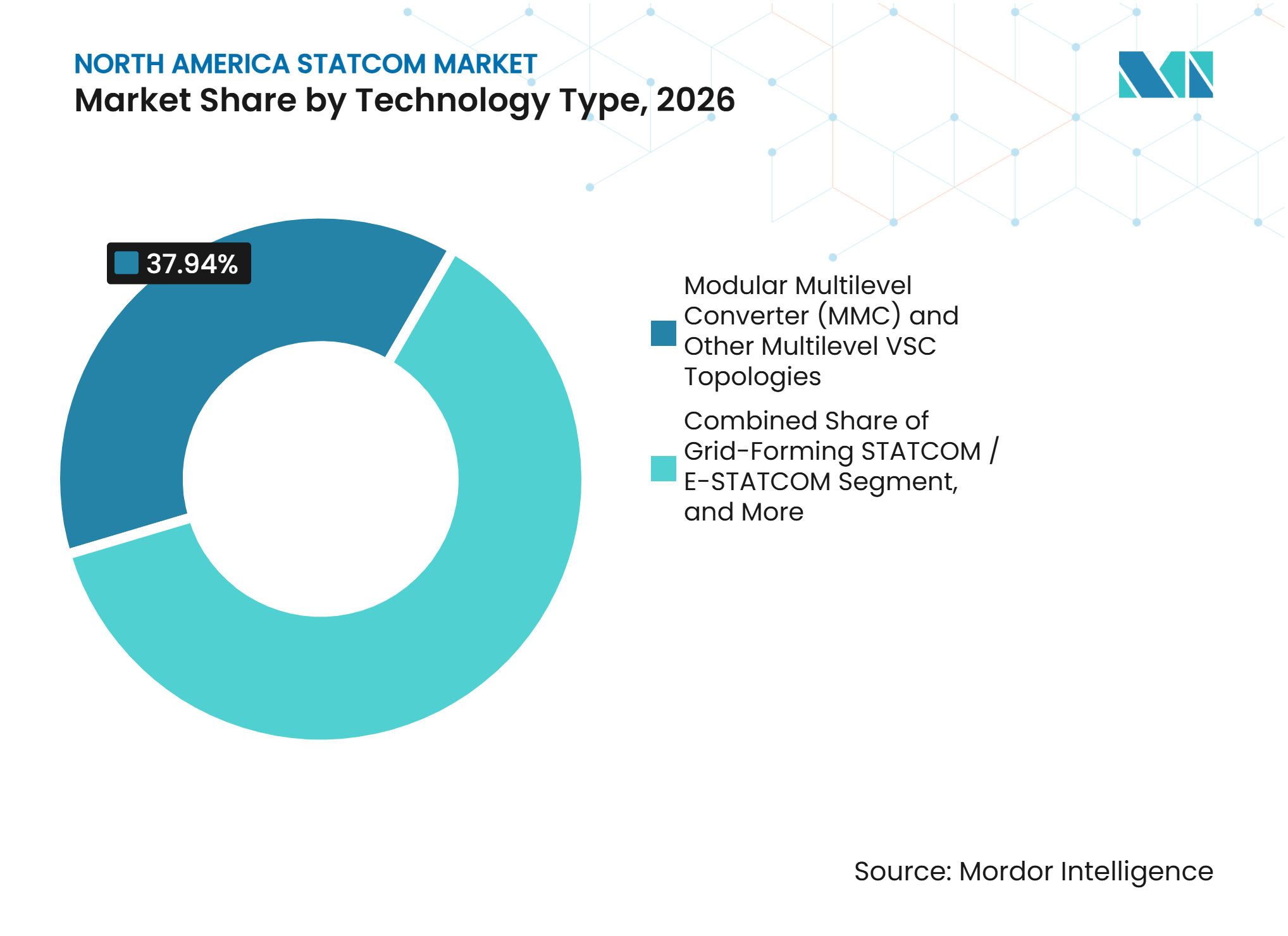
MMC Leads While Grid-Forming Formats ExpandMMC and Other Multilevel VSC Topologies held 37.94% of the North America STATCOM market share in 2026. Their position reflects modular construction, lower harmonic output, and scalability for high-voltage transmission applications. These systems can provide reactive sub-cycle response and work with established substation protection schemes. Conventional VSC-based STATCOM units retain an installed base in distribution and industrial settings where simpler architecture and shorter procurement cycles remain important. Grid-Forming STATCOM and E-STATCOM are projected to grow at a 11.17% CAGR through 2032 as utilities seek reactive support to help low-inertia systems.
Siemens Energy commissioned a 300 MVA SVC PLUS FS system with supercapacitors at TenneT's Mehrum site in Germany in December 2025. Hitachi Energy is positioning its SVC Light Enhanced system from its Cary facility for fast frequency response and reactive support. The North America STATCOM market therefore places greater value on proven control performance. Grid-forming controls make the upgrade increasingly dependent on software, firmware, and testing as well as converter hardware. This also supports demand for suppliers with a proven ability to validate performance under realistic grid conditions.



By Reactive Power Rating:
Transmission-Scale Systems Lead While Distribution GainsLarge-Scale Transmission STATCOM held 46.37% of regional STATCOM demand in 2026. This rating band is supported by a limited number of high-value projects, each of which can exceed USD 50 million. LS Power commissioned the 800 MVAr Gates STATCOM in California in March 2025 after a 2-year delivery period. Small-Scale Distribution and Industrial STATCOM is expected to grow at an 11.29% CAGR through 2032. Mexican industrial expansion and lower-load data centers support localized compensation at 15-35 kV connection points.
Industrial buyers can link STATCOM investments to measurable avoided power-factor penalties and power-quality improvements. This can provide a clearer investment case than utility reliability benefits that depend on probabilistic planning models. AMSC received a USD 25 million turnkey order in July 2026 for a North American mining project that combined modular STATCOM technology with capacitor banks, shunt reactors, and a 138 kV transformer.[2] The North America STATCOM market is gaining support from mining and resource extraction applications. Suppliers that can package transformers, switchgear, and controls with compensation equipment can reduce coordination risk for these customers.
By Application:
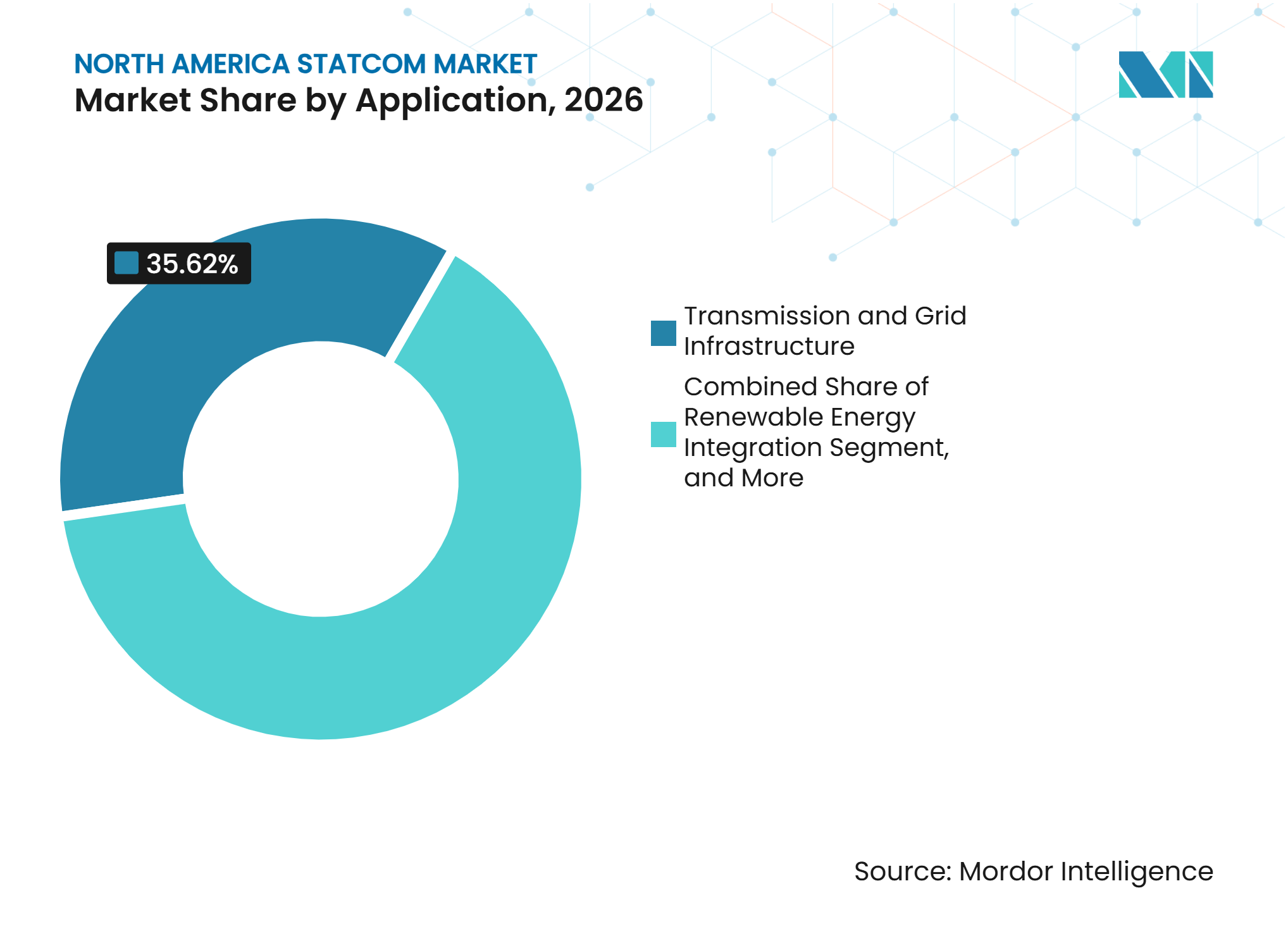
Grid Infrastructure Anchors Demand While Data Centers RiseTransmission and Grid Infrastructure accounted for 35.62% of the North America STATCOM market in 2026. Large utility procurement programs and long project cycles provide the foundation for this application. PJM's February 2025 transmission approval illustrates the types of substation and network investments that may require reactive compensation. Renewable energy integration remains significant in ERCOT, MISO, and CAISO, where developers must demonstrate reactive capability during interconnection. Industrial and manufacturing facilities use STATCOM systems to address arc-furnace flicker, harmonics, and power-factor requirements.
Data Centers and Commercial Infrastructure is projected to advance at a 10.74% CAGR through 2032. The North America STATCOM market can benefit when colocated tenants share an interconnection point and create aggregate reactive-power swings. EPRI's technical work identifies enhanced STATCOMs as an option for limiting the transfer of data-center load fluctuations into adjacent grid systems. Projects may favor systems that operate at the point of common coupling instead of relying solely on tenant-level equipment. This supports demand for solutions that combine power electronics with active filtering and coordinated control.

By Component:
Converter Valves Lead While Controls Gain ValuePower Electronic Converter Valves held 38.43% of regional STATCOM demand in 2026. These valves are the most specialized and costly part of the system, especially in high-voltage multilevel designs. The limited number of qualified suppliers for high-voltage IGBT modules can extend procurement cycles. Standard devices had 20-30-week lead times in 2026, while custom configurations required longer lead times. Coupling transformer delivery periods of 50-70 weeks can be a major schedule risk for utility projects.
Control, Protection, and Monitoring Systems is projected to grow at a 11.32% CAGR through 2032. The North America STATCOM market increasingly depends on control engineering and firmware layered onto power-electronic hardware. IEEE's work on voltage control and reactive power optimization highlights the growing relevance of advanced planning and control practices in emerging transmission systems. Real-time digital simulation and hardware-in-the-loop testing are increasingly used in factory acceptance processes for high-capacity systems. These requirements increase the value of specialist engineering and test-facility capacity.
Geography Analysis
United States
The United States was the largest national market for the North America STATCOM market, accounting for 81.98% of regional demand in 2026. The U.S. Department of Energy stated that 55% of in-service distribution transformers were more than 33 years old.[3] Edison Electric Institute expects USD 1.1 trillion of investor-owned utility investment over the next 5 years. NERC reliability standards provide compliance factors that support investment in voltage control. Siemens Energy supplied equipment for two CAISO substation projects, including the Gates STATCOM.
Mexico
Mexico is projected to record an 11.21% CAGR through 2032. Nearshoring is increasing industrial loads in border states, while data-center growth is adding pressure in Querétaro. CFE's transmission modernization program includes dynamic compensation as part of its network investment plan. CFE commissioned STATCOM units at Subestación Seri and Subestación Mazatlán Dos in February 2026, extending voltage-control coverage across several northwestern states. Private industrial investment in Nuevo Laredo is expanding the North America STATCOM market alongside utility programs.
Canada
Canada is building a longer-term pipeline through electrification and renewable-energy development plans. Natural Resources Canada has committed CAD 115 billion (USD 84 billion) for electrification investment through 2041-42. NB Power's plus or minus 300 MVAr Salisbury Terminal STATCOM is supported by a CAD 50 million (USD 37 million), federal contribution. University of British Columbia found improved voltage recovery with grid-forming STATCOM controls on the U.S.-Canada 500 kV interconnection.
Competitive Landscape
Market Concentration
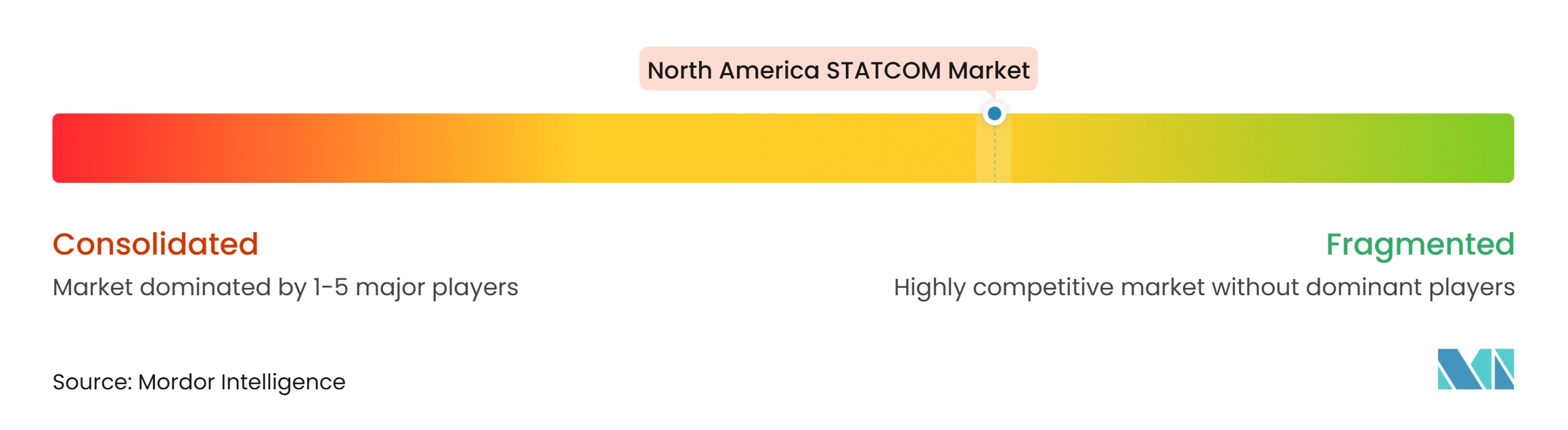
The North America STATCOM market is moderately concentrated in transmission-scale projects and more fragmented in distribution and industrial applications. Hitachi Energy, Siemens Energy, GE Vernova, and ABB compete through engineering depth, installed references, and long-term utility relationships. Siemens Energy announced a USD 1 billion manufacturing expansion in the United States.[4] GE Vernova reported an Electrification backlog of USD 30.5 billion at the end of 2025, up 53% year over year. These investments can strengthen delivery capacity for utility projects.
Competition is moving beyond converter ratings toward controls integration, digital commissioning, and lifetime service value. No single supplier has established a fully standardized rapid-deployment platform dedicated to distribution-voltage data-center interconnections. This creates an opening for suppliers with modular converters and software-defined controls. Hitachi Energy and Siemens Energy have published technical material on enhanced STATCOM formats. Validation methods that demonstrate performance before site commissioning are becoming increasingly important.
AMSC, Merus Power, and COMSYS AB address smaller utility and industrial opportunities. AMSC reported a USD 320 million 12-month backlog in September 2026. In December 2025, AMSC acquired Comtrafo to strengthen its ability to deliver integrated systems. The North America STATCOM market offers space for specialists serving industrial customers.
North America STATCOM Industry Leaders
-
Hitachi Energy Ltd
-
Siemens Energy AG
-
GE Vernova Inc.
-
ABB Ltd
-
American Superconductor Corporation
- *Disclaimer: Major Players sorted in no particular order
North America STATCOM Market Companies Covered in this Report
- Hitachi Energy Ltd
- Siemens Energy AG
- GE Vernova Inc.
- ABB Ltd
- American Superconductor Corporation
- Ingeteam S.A.
- Mitsubishi Electric Corporation
- Hyosung Heavy Industries Corporation
- Toshiba Energy Systems and Solutions Corporation
- Nidec Corporation
- JEMA Energy SA
- Rongxin Power Electronic Co., Ltd.
- S&C Electric Company
- Merus Power Oyj
- COMSYS AB
- Schneider Electric SE
Recent Industry Developments in North America STATCOM Market
- October 2026: CFE launched a USD 1.9 billion transmission tender comprising 245 engineering works across 32 projects, including 107 transmission lines and 138 substations, as part of its 2026-2030 expansion framework, with procurement windows running from October 2026 through March 2027. Multiple packages include STATCOM requirements for data-center and industrial corridors.
- September 2026: the US DOE announced USD 1.9 billion in funding for 31 grid-improvement projects across 26 states under its SPARK initiative, including grid-enhancing technologies and transmission capacity additions targeting over 23 GW of additional grid headroom.
- July 2026: AMSC secured a USD 25 million turnkey contract from a North American utility to supply an integrated power system for a large-scale mining development, combining modular STATCOM technology with a 138 kV transformer, capacitor banks, shunt reactors, and switchgear. It was the largest individual mining-development order in AMSC's history.
- April 2026: Hitachi Energy announced a USD 10 million investment in a 32,000-square-foot Power Electronics Center of Competence in Cary, North Carolina, creating 150 engineering and integration jobs and serving as its primary U.S. hub for STATCOMs, synchronous condenser systems, and HVDC controls.
North America STATCOM Market Report Scope
The North America STATCOM market covers the deployment of static synchronous compensators (STATCOMs), which are power electronic devices that regulate voltage and improve power quality in electrical transmission and distribution systems. These systems provide dynamic reactive power compensation, enhance grid stability, and support the integration of renewable energy sources across North America.
The North America STATCOM Market Report is Segmented by Technology Type (Modular Multilevel Converter (MMC) and Other Multilevel VSC Topologies, Conventional Voltage Source Converter (VSC)-Based STATCOM, Grid-Forming STATCOM / E-STATCOM, and Medium-Voltage and Distribution STATCOM), Reactive Power Rating (Large-Scale Transmission STATCOM, Medium-Scale STATCOM, and Small-Scale Distribution and Industrial STATCOM), Application (Transmission and Grid Infrastructure, Renewable Energy Integration, Industrial and Manufacturing, Data Centers and Commercial Infrastructure, and Railway Electrification and Other Applications), Component (Power Electronic Converter Valves, Converter Transformers and Reactors, Capacitors and Harmonic Filters, Control, Protection, and Monitoring Systems, and Cooling Systems and Auxiliary Components), and Geography (United States, Canada, and Mexico). The Market Forecasts are Provided in Terms of Value (USD).
Segmentation Overview
| Modular Multilevel Converter (MMC) and Other Multilevel VSC Topologies |
| Conventional Voltage Source Converter (VSC)-Based STATCOM |
| Grid-Forming STATCOM / E-STATCOM |
| Medium-Voltage and Distribution STATCOM |
| Large-Scale Transmission STATCOM |
| Medium-Scale STATCOM |
| Small-Scale Distribution and Industrial STATCOM |
| Transmission and Grid Infrastructure |
| Renewable Energy Integration |
| Industrial and Manufacturing |
| Data Centers and Commercial Infrastructure |
| Railway Electrification and Other Applications |
| Power Electronic Converter Valves |
| Converter Transformers and Reactors |
| Capacitors and Harmonic Filters |
| Control, Protection, and Monitoring Systems |
| Cooling Systems and Auxiliary Components |
| United States |
| Canada |
| Mexico |
| By Technology Type | Modular Multilevel Converter (MMC) and Other Multilevel VSC Topologies |
| Conventional Voltage Source Converter (VSC)-Based STATCOM | |
| Grid-Forming STATCOM / E-STATCOM | |
| Medium-Voltage and Distribution STATCOM | |
| By Reactive Power Rating | Large-Scale Transmission STATCOM |
| Medium-Scale STATCOM | |
| Small-Scale Distribution and Industrial STATCOM | |
| By Application | Transmission and Grid Infrastructure |
| Renewable Energy Integration | |
| Industrial and Manufacturing | |
| Data Centers and Commercial Infrastructure | |
| Railway Electrification and Other Applications | |
| By Component | Power Electronic Converter Valves |
| Converter Transformers and Reactors | |
| Capacitors and Harmonic Filters | |
| Control, Protection, and Monitoring Systems | |
| Cooling Systems and Auxiliary Components | |
| By Geography | United States |
| Canada | |
| Mexico |
Key Questions Answered in the Report
What is the projected value of the North America STATCOM sector?
The sector is projected to rise from USD 0.58 billion in 2026 to USD 1.05 billion by 2032, at a 10.41% CAGR.
What is driving STATCOM adoption in North America?
Renewable interconnection rules, aging grid assets, synchronous generator retirements, and data-center load growth are increasing the need for dynamic reactive power support.
Which technology leads North America STATCOM deployments?
MMC and Other Multilevel VSC Topologies led with a 37.94% share in 2026, owing to their combination of modularity, lower harmonic output, and high-voltage scalability.
Which application is projected to grow fastest?
Data Centers and Commercial Infrastructure is projected to grow at a 10.74% CAGR through 2032 as operators manage rapid load changes and voltage constraints.
Which country is projected to grow fastest?
Mexico is projected to expand at an 11.21% CAGR through 2032, supported by nearshoring, data-center development, and CFE transmission investment.
What factors can delay STATCOM projects?
High upfront costs, long delivery periods for coupling transformers and semiconductors, and interconnection or permitting delays can slow deployment.