
North America Soil Monitoring Market Size and Share
Market Overview
| Study Period | 2021 - 2031 |
|---|---|
| Forecast Data Period | 2026 - 2031 |
| Base Year Market Size (2025) | USD 420 Million |
| Market Size (2026) | USD 477 Million |
| Market Size (2031) | USD 935 Million |
| Growth Rate (2026 - 2031) | 14.40 % |
| Market Concentration | Low |
Major Players *Disclaimer: Major Players sorted in no particular order Image © Mordor Intelligence. Reuse requires attribution under CC BY 4.0. | |
North America Soil Monitoring Market Analysis by Mordor Intelligence
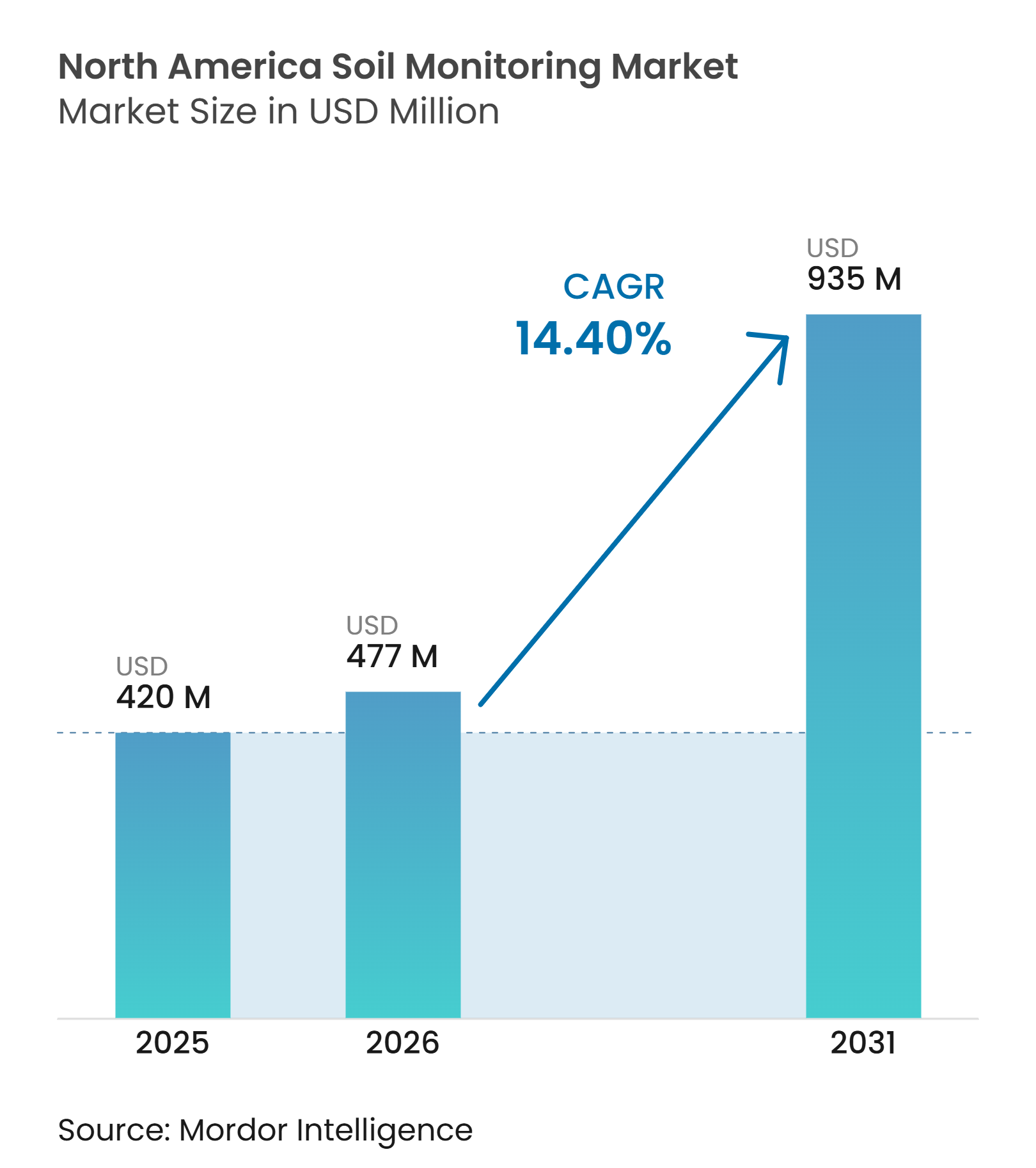
The North America soil monitoring market size was valued at USD 420 million in 2025 and estimated to grow from USD 477 million in 2026 to reach USD 935 million by 2031, at a CAGR of 14.4% during the forecast period (2026-2031). Recurring drought conditions in the western United States are making soil moisture data more important for irrigation decisions. Federal conservation programs are also creating defined routes for producers to obtain monitoring equipment and testing services. Wireless sensing and cloud-based analytics are changing the offer from a stand-alone device into a connected farm tool. This change gives suppliers a reason to compete on useful recommendations, dependable data, and simple integration with existing irrigation workflows. The North America soil monitoring market, therefore, favors companies that can reduce field labor and make sensor outputs easier to use.
Key Report Takeaways
- By component, hardware held 58% of the North America soil monitoring market share in 2025, while software is forecast to expand at a 17.5% CAGR during 2026-2031.
- By product type, in-situ sensors held 55% of the North America soil monitoring market size in 2025, while remote sensing platforms are forecast to expand at an 18.7% CAGR during 2026-2031.
- By connectivity technology, wireless technologies held 68% of the North America soil monitoring market share in 2025 and are forecast to expand at a 16.3% CAGR during 2026-2031.
- By application, open field agriculture held 72% of revenue in 2025, while protected cultivation is forecast to expand at a 17.8% CAGR during 2026-2031.
- By end-user, large commercial farms held 62% of revenue in 2025, while research institutes and universities are forecast to expand at a 16.8% CAGR during 2026-2031.
- By geography, the United States held 78% of revenue in 2025, while Mexico is forecast to expand at an 18.2% CAGR during 2026-2031.
Note: Market size and forecast figures in this report are generated using Mordor Intelligence’s proprietary estimation framework, updated with the latest available data and insights as of January 2026.
Market Trends and Insights
Drivers Impact Analysis of North America Soil Monitoring Market*
| Driver | (~) % Impact on CAGR Forecast | Geographic Relevance | Impact Timeline |
|---|---|---|---|
| Water scarcity and drought resilience programs | +3.8% | North America, with the highest effect in the western United States, Great Plains, and Canadian Prairie provinces | Short term (≤ 2 years) |
| Precision irrigation and root-zone monitoring | +3.0% | North America, led by the United States and expanding in northern Mexico | Short term (≤ 2 years) |
| United States Department of Agriculture conservation funding | +2.5% | United States, with partial spillover to border regions | Short term (≤ 2 years) |
| High-resolution soil variability mapping | +1.8% | United States and Canada, especially row-crop regions using variable-rate prescriptions | Medium term (2-4 years) |
| Specialty crops and protected cultivation data needs | +1.5% | United States and Mexico, including California, the Pacific Northwest, Sonora, Sinaloa, and Jalisco | Medium term (2-4 years) |
| Soil sensor integration with farm data and cloud analytics | +2.2% | North America, with the United States leading and Canada expanding | Short term (≤ 2 years) |
| Source: Mordor Intelligence | |||
Water Scarcity and Drought Resilience Programs
Water scarcity has made soil moisture measurement a practical requirement for irrigation planning in many western production areas. Public drought programs are building reference networks that also strengthen the case for commercial monitoring deployments. In 2025, the United States Army Corps of Engineers worked with state mesonets, the Natural Resources Conservation Service, and landowners to address gaps in soil moisture coverage in the Upper Missouri River Basin[1]. These networks give commercial suppliers data points that can support local calibration and improve confidence in field readings. The North America soil monitoring market benefits when public and private measurements can be used together. Companies that support compatible formats can make their products more useful to irrigation managers.
Precision Irrigation and Root-Zone Monitoring
Precision irrigation is increasing the demand for readings at several depths rather than occasional surface checks. This need is most visible in high-value irrigated crops where root-zone conditions affect water use and crop performance. In April 2026, CropX Technologies launched the Apex sensor with 12-inch, 24-inch, and 36-inch configurations and readings at 4-inch intervals. The product shows how suppliers are designing hardware around the need for vertical detail in the soil profile. Continuous readings also help operators place irrigation decisions within their existing daily workflow. The North American soil monitoring market gains value when information arrives in time to guide irrigation, rather than only documenting field conditions afterward. It also helps users compare moisture conditions across soil depths before deciding whether to apply water. This makes monitoring more directly relevant to the operating decisions made during an irrigation cycle.
United States Department of Agriculture Conservation Funding
United States Department of Agriculture funding is reducing the initial barrier to soil measurement for farms that need support to purchase monitoring tools. In December 2025, the Natural Resources Conservation Service launched the Regenerative Pilot Program with USD 700 million in funding, including USD 400 million from the Environmental Quality Incentives Program and USD 300 million from the Conservation Stewardship Program. The program requires soil health testing during the first and final year of participating contracts. That requirement creates recurring demand for equipment and data collection rather than a one-time purchase cycle. The North America soil monitoring market also has a future procurement path through the 2026 Conservation Innovation Grants On-Farm Trials program, which makes up to USD 50 million available for eligible projects. Suppliers that align with program requirements can reach farms that would otherwise delay adoption.
High-Resolution Soil Variability Mapping
High-resolution soil maps are becoming an operational input for variable-rate decisions rather than a record prepared only during field setup. This raises the value of repeated measurement across large and variable fields. Commercial mapping providers are expanding their analytical capacity to turn field observations into useful maps. This work reflects the calibration effort needed to connect spatial data with measured soil conditions. Remote sensing needs dependable ground measurements if its outputs are to support decisions across whole farms. The North American soil monitoring market can therefore support both field sensors and spatial data products, which are used as complementary tools.
Restraints Impact Analysis of North America Soil Monitoring Market*
| Restraint | (~) % Impact on CAGR Forecast | Geographic Relevance | Impact Timeline |
|---|---|---|---|
| High upfront costs and uncertain return on investment | -2.10% | North America, particularly Mexico and smaller Canadian Prairie farms | Short term (≤ 2 years) |
| Calibration and accuracy challenges | -1.50% | North America, especially saline western United States soils, alkaline Canadian prairie soils, and irrigated Mexican soils | Medium term (2-4 years) |
| Limited rural connectivity and power availability | -1.20% | Canada and remote agricultural areas of the United States | Medium term (2-4 years) |
| Limited interoperability, data standards, and soil analytics expertise | -1.00% | North America, especially multi-vendor farm operations | Medium term (2-4 years) |
| Source: Mordor Intelligence | |||
High Upfront Costs and Uncertain Return on Investment
Upfront sensor costs remain a serious constraint for farms that cannot distribute those costs across a large acreage base. The issue is especially acute when growers need equipment, connectivity, installation, and agronomic support simultaneously. Environmental Quality Incentives Program cost-sharing can reduce acquisition costs for eligible producers, but state payment rates are reviewed annually and may not align with sensor prices. This creates uncertainty for both farms and suppliers that sell through assisted programs. Mexico faces a sharper affordability challenge because smaller, rainfed operations often operate on limited margins. Deveron Corp.'s 2025 financial update also showed that labor-dependent soil data services can face challenging revenue-per-acre economics.
Calibration and Accuracy Challenges
Calibration remains difficult when a field includes saline or high-clay soil conditions. Sensor readings can vary across soil textures, which makes automated irrigation decisions harder to trust. This issue is important in irrigated areas of the western United States and Mexico, where salinity can affect dielectric measurements. In 2025, METER Group introduced the SOLYX 14 with complex dielectric with intersections technology to address salinity-related measurement challenges. The North America soil monitoring market depends on repeat use, so inconsistent readings can limit replacement purchases and reduce referrals. Providers need clear calibration guidance and dependable performance across local conditions.
*Our forecasts treat driver/restraint impacts as directional, not additive. The impact forecasts reflect baseline growth, mix effects, and variable interactions.
North America Soil Monitoring Market Segment Analysis
By Component:
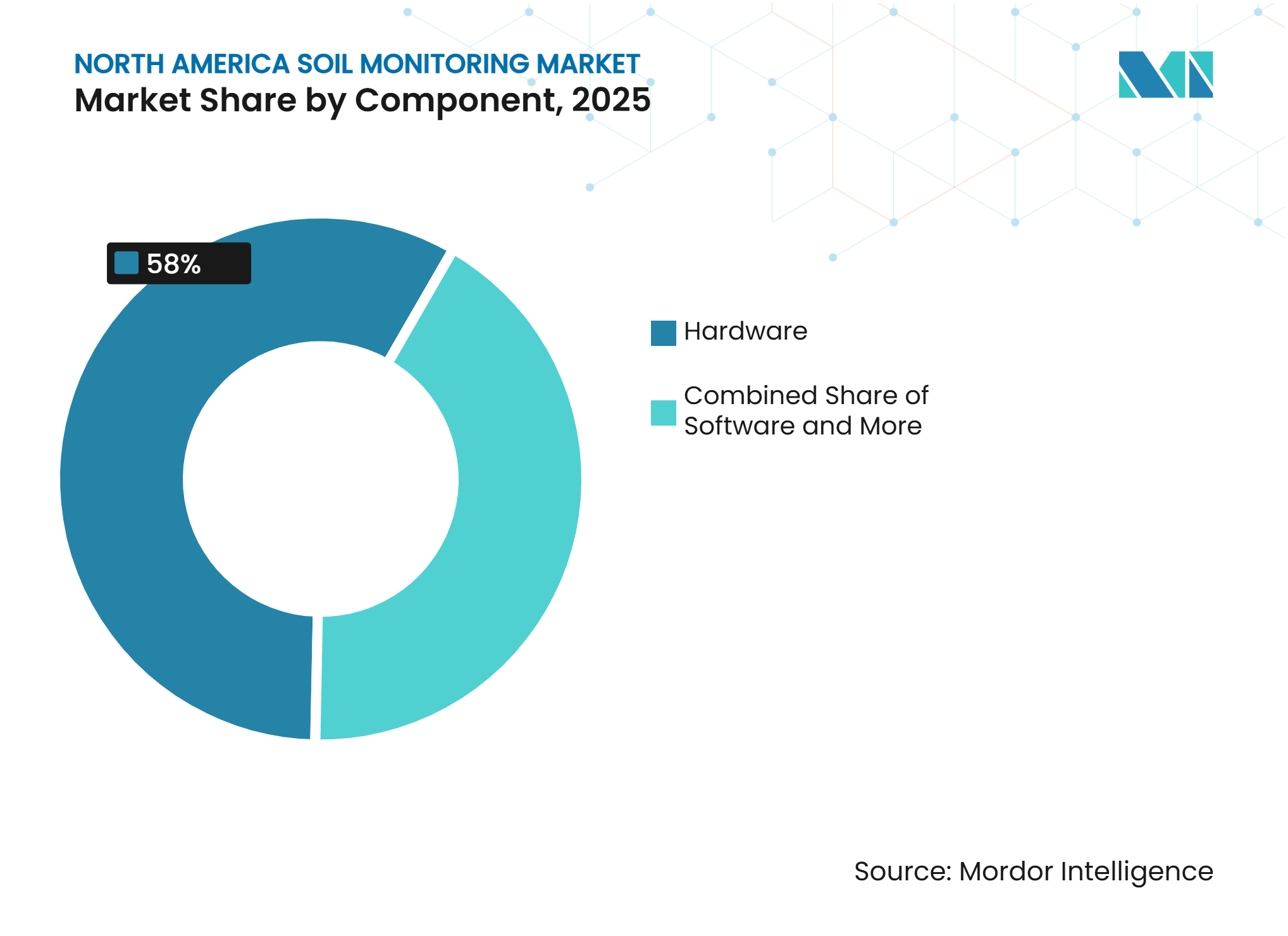
Hardware Remains the Largest Revenue Base While Software Grows FastestHardware held 58% of regional revenue in 2025, making it the largest component. Physical sensors, data loggers, and communication modules remain necessary in every monitoring deployment. Campbell Scientific supports this installed base through its SoilVue 10 time-domain reflectometry profile sensor and CR-series data loggers. Hardware demand is supported by the need for continuous measurements of moisture and electrical conductivity. It also remains the entry point for suppliers that want to build an ongoing customer relationship.
Software is the fastest component, with a 17.5% CAGR during 2026-2031. Its growth reflects a shift from device sales to subscriptions that help users interpret sensor data. The Toro Company showed this approach in 2025 through its TerraRad partnership and Spatial Adjust software. Services remain the smallest component, but installation, calibration, maintenance, and interpretation are important when networks require documented performance. The North American soil monitoring industry is shifting toward a model in which hardware establishes the system and software enables recurring use.



By Product Type:
In-Situ Sensors Lead While Remote Sensing Platforms Grow FastestIn-situ sensors accounted for 55% of product-type revenue in 2025, making them the largest product type. They provide continuous readings at specified locations and depths within a field. This is useful for irrigation control because operators need data during the growing cycle. Satellite and airborne tools cannot provide the same point-level timing on their own. In-situ systems, therefore, remain central to operational decisions that require frequent moisture data.
Remote sensing platforms are the fastest product type, with an 18.7% CAGR during 2026-2031. They combine hyperspectral and synthetic aperture radar information with ground measurements to map variability across larger areas. Commercial mapping providers are increasing the analysis and calibration used for spatial soil data products. Portable probes and test kits serve a separate role in spot checks and pre-installation assessment. Their lower purchase price makes them relevant for agronomists and smaller operations that do not need a continuous network.
By Connectivity Technology:
Wireless Is Both the Largest and Fastest CategoryWireless technologies held 68% of revenue in 2025, making wireless the largest connectivity category in the North America soil monitoring market. Low-Power Wide-Area Networks, cellular links, and satellite links are suited to fields where trenching cables is impractical. Battery-powered nodes can extend measurement coverage across large or remote plots. This matters in North America because farms can span extensive and uneven acreage. Wireless connections also support the data flow needed for cloud analytics and remote irrigation decisions.
Wireless is also the fastest connectivity category, growing at a 16.3% CAGR during 2026-2031. This combination suggests that the category is expanding from a substantial installed base rather than only from a small starting point. Platform providers are combining soil-probe monitoring, infiltration mapping, and irrigation automation into a single operating interface. Wired systems still have a role in protected cultivation, where installed infrastructure can reduce cabling barriers. Their reliability can be useful in fertigation control systems that require stable, low-latency links.
By Application:
Open Field Agriculture Is Largest and Protected Cultivation Is FastestOpen-field agriculture accounted for 72% of revenue in 2025, making it the largest application in the North America soil monitoring market. Row crops, grains, and vegetables across the United States and Canada use soil measurements to schedule irrigation and manage nutrients. Open field networks generally prioritize broad coverage across acreage. This results in lower sensor density per acre than is common in controlled growing environments. The size of cultivated field acreage keeps this application central to regional demand. Field operators also need data that can guide irrigation across different soil zones without requiring continuous manual checks. This makes open-field demand dependent on durable devices, practical communication, and simple farm-level interpretation.
Protected cultivation is the fastest application, with a 17.8% CAGR during 2026-2031. Greenhouses and specialty crop systems have higher input intensity and need close control of root-zone conditions. Dense monitoring can help prevent over-irrigation and stress that could affect production quality. Soil salinity mapping is one example of the additional analytics sought by intensive growers. Forestry remains the smallest application and is linked mainly to research installations that monitor soil carbon dynamics. The Natural Resources Conservation Service soil carbon network supports the need for consistent sampling protocols in these settings.
By End-User:
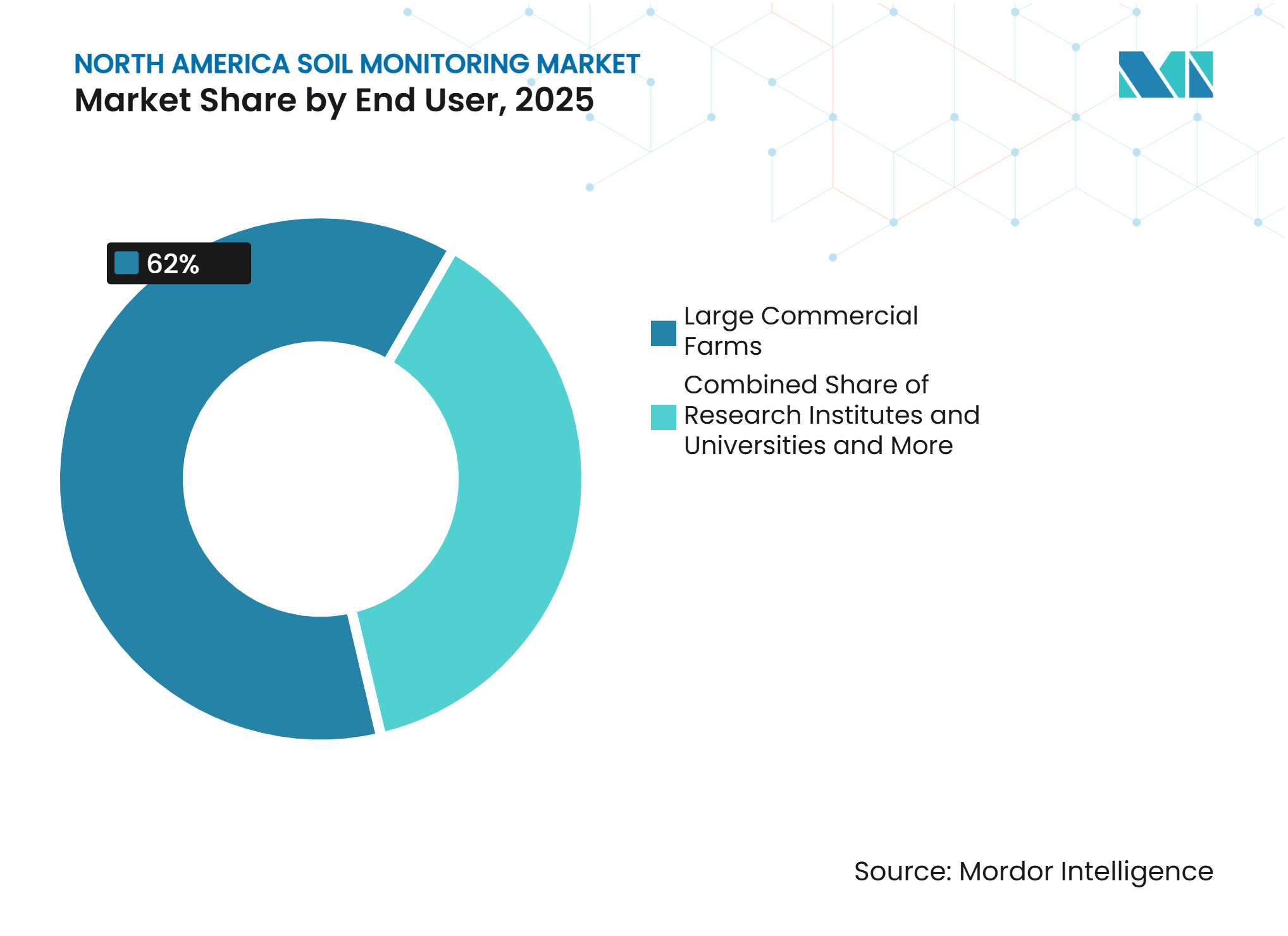
Large Commercial Farms Lead and Research Institutes Grow FastestLarge commercial farms held 62% of end-user revenue in 2025, making them the largest end-user group. Multi-field operations can spread sensor and subscription costs across more acres. Their procurement commonly involves integration with farm management software and multi-year supply arrangements. These arrangements create switching costs for users once historical data has accumulated in a platform. They also give suppliers a more stable revenue base than single-field deployments.
Research institutes and universities are the fastest end-user group, with a 16.8% CAGR during 2026-2031. Federal soil monitoring initiatives need research-grade equipment and consistent records over multiple years. The 2025 National Soil Moisture Workshop highlighted the role of research and agency collaboration in making soil moisture science useful for management[2]. Smallholder and cooperative farms remain underserved due to high costs and limited agronomic capacity. Government and nonprofit users provide a smaller but steadier source of demand when procurement is guided by policy requirements rather than by direct farm returns.

Geography Analysis
The United States held 78% of regional revenue in 2025. Large irrigated operations and established precision agriculture practices support this position. The Environmental Quality Incentives Program can recognize soil moisture sensors as qualifying conservation components for irrigation water management practices. The December 2025 Regenerative Pilot Program also created a multi-year requirement for soil health testing. Federal datasets also provide suppliers with a useful basis for local calibration.
Canada accounted for the larger part of that group through Prairie grain farming and British Columbia's specialty fruit and berry production. Agriculture and Agri-Food Canada's Real-Time In-Situ Soil Monitoring for Agriculture network provides reference data on soil moisture, temperature, and precipitation across Saskatchewan, Manitoba, and Ontario[3]. In March 2026, the Government of Canada announced work on a National Agricultural Soil Health Strategy with the Soil Conservation Council of Canada.
Mexico is the fastest geography, with an 18.2% CAGR during 2026-2031. Government-supported digital water and fertilizer monitoring programs are extending the path to sensor adoption among irrigated-crop producers. The Secretariat of Agriculture and Rural Development expanded its monitoring system to 30,000 hectares across 4,000 producers and planned further coverage in Sinaloa and other states. In 2025, Mexico's Soil Alliance developed a National Soil Restoration Program that targeted rehabilitation of 25% of eroded areas. The North America soil monitoring market has an early entry opportunity in Mexico because dealer and agronomist relationships are still developing. Suppliers need offers that fit local crop systems and producer budgets. Early commercial relationships can help vendors understand installation practices, support needs, and the data requirements of irrigated-crop producers.
Competitive Landscape
Market Concentration
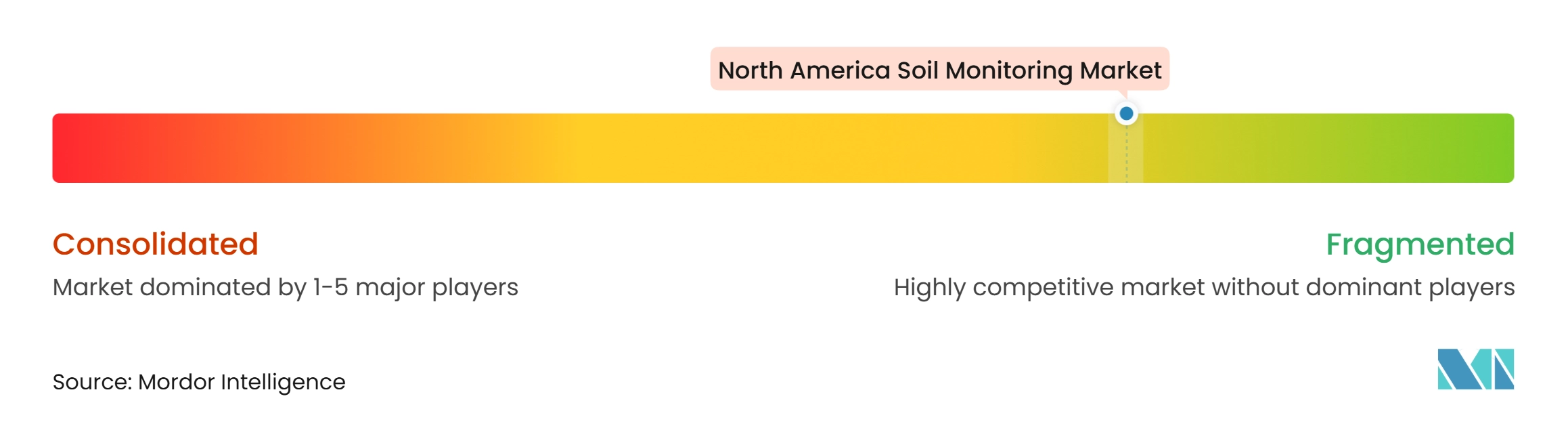
The North America soil monitoring market is moderately fragmented. METER Group, Campbell Scientific, and Acclima hold positions in research-grade and precision agriculture applications. Data-platform providers compete by offering analytics and connections to existing farm systems. The Toro Company's fiscal 2025 results reported USD 4.5 billion in net sales, while soil sensing forms part of its irrigation offering. This model uses soil monitoring to strengthen a broader irrigation relationship rather than to sell a stand-alone sensor.
Companies are following different paths to secure customer relationships. Hardware specialists such as Spectrum Technologies, Stevens Water Monitoring Systems, and Veris Technologies focus on sensing accuracy and field durability. In September 2025, the United States Patent and Trademark Office granted SemiosBio Technologies a patent, US 12,402,580, for soil moisture-based crop irrigation management. CropX and SemiosBio use sensing hardware as a starting point for analytics subscriptions that accumulate farm history over time. EarthOptics and Deveron compete through field collection, agronomist networks, and data assets that support interpretation.
Interoperability remains an open issue across the North America soil monitoring market. Many platforms use proprietary formats that do not easily connect with competing farm management systems. This can discourage large operations that use multiple equipment and software providers. Pessl Instruments adds cross-border pressure through its FieldClimate platform and its existing global deployment base.
North America Soil Monitoring Industry Leaders
-
The Toro Company
-
METER Group, Inc. USA
-
Campbell Scientific, Inc.
-
CropX Technologies Ltd.
-
Spectrum Technologies, Inc.
- *Disclaimer: Major Players sorted in no particular order
North America Soil Monitoring Market Companies Covered in this Report
- The Toro Company
- METER Group, Inc. USA
- Campbell Scientific, Inc.
- CropX Technologies Ltd.
- Spectrum Technologies, Inc.
- Acclima, Inc.
- Stevens Water Monitoring Systems, Inc.
- Veris Technologies, Inc.
- EarthOptics, Inc.
- AquaSpy, Inc.
- SemiosBio Technologies Inc.
- Deveron Corp.
- Soiltech Wireless, Inc.
- Onset Computer Corporation
- Pessl Instruments GmbH
Recent Industry Developments in North America Soil Monitoring Market
- April 2026: CropX Technologies Ltd. launched the Apex multi-depth soil sensor, offering continuous measurements of volumetric water content, temperature, and electrical conductivity at 4-inch intervals across 12-inch, 24-inch, and 36-inch configurations, and is fully integrated into the CropX digital agronomy platform for automated moisture status detection and leaching analytics.
- February 2025: The Toro Company and TerraRad announced an exclusive partnership to develop Spatial Adjust software that integrates TerraRad's turfRad soil moisture sensors with Toro's Lynx Central Control platform to automate irrigation scheduling adjustments for golf course and commercial turf applications.
- January 2025: METER Group, Inc. launched the SOLYX 14 soil moisture sensor, powered by a complex dielectric with intersections technology that directly measures real and imaginary dielectric permittivity, enabling more accurate volumetric water content measurement across a broader range of saline soil conditions.
North America Soil Monitoring Market Report Scope
Soil monitoring involves measuring and tracking soil conditions to optimize agricultural productivity and sustainability. The North America soil monitoring market report is segmented by component (hardware, software, and services), by product type (in-situ sensors, portable soil testing devices, remote sensing solutions, and others), by connectivity technology (wired and wireless), by application (open field agriculture, greenhouse agriculture, research and environmental monitoring, and others), by end-user (large commercial farms, small and medium-sized farms, research institutions, government agencies, and others), and by geography (United States, Canada, Mexico and the rest of North America). The market forecasts are provided in terms of value (USD).
Segmentation Overview
| Hardware |
| Software |
| Services |
| In-situ Sensors |
| Remote Sensing Platforms |
| Portable Probes and Test Kits |
| Wired |
| Wireless (LPWAN, Cellular, Satellite) |
| Open Field |
| Protected Cultivation |
| Forestry |
| Large Commercial Farms |
| Smallholder and Cooperative Farms |
| Research Institutes and Universities |
| Government and NGOs |
| North America | United States |
| Canada | |
| Mexico | |
| Rest of North America |
| By Component | Hardware | |
| Software | ||
| Services | ||
| By Product Type | In-situ Sensors | |
| Remote Sensing Platforms | ||
| Portable Probes and Test Kits | ||
| By Connectivity Technology | Wired | |
| Wireless (LPWAN, Cellular, Satellite) | ||
| By Application | Open Field | |
| Protected Cultivation | ||
| Forestry | ||
| By End-User | Large Commercial Farms | |
| Smallholder and Cooperative Farms | ||
| Research Institutes and Universities | ||
| Government and NGOs | ||
| By Geography | North America | United States |
| Canada | ||
| Mexico | ||
| Rest of North America | ||
Key Questions Answered in the Report
What is the North America soil monitoring market size?
The North America soil monitoring market size is estimated at USD 477 million in 2026 and is forecast to reach USD 935 million by 2031 at a 14.4% CAGR.
Which component leads revenue in North America soil monitoring?
Hardware is the largest component, with 58% of revenue in 2025, because sensors, data loggers, and communications modules are required in each deployment.
Which product type is growing fastest in soil monitoring?
Remote sensing platforms are the fastest product type, with an 18.7% CAGR during 2026-2031, while in-situ sensors remained the largest in 2025.
Which country is expanding fastest in North America?
Mexico is forecast to grow at an 18.2% CAGR during 2026-2031, supported by digital water and fertilizer monitoring programs.