
Market Overview
| Study Period | 2021 - 2031 |
|---|---|
| Forecast Data Period | 2026 - 2031 |
| Base Year Market Size (2025) | USD 1.67 Billion |
| Market Size (2026) | USD 1.74 Billion |
| Market Size (2031) | USD 2.13 Billion |
| Growth Rate (2026 - 2031) | 4.17 % |
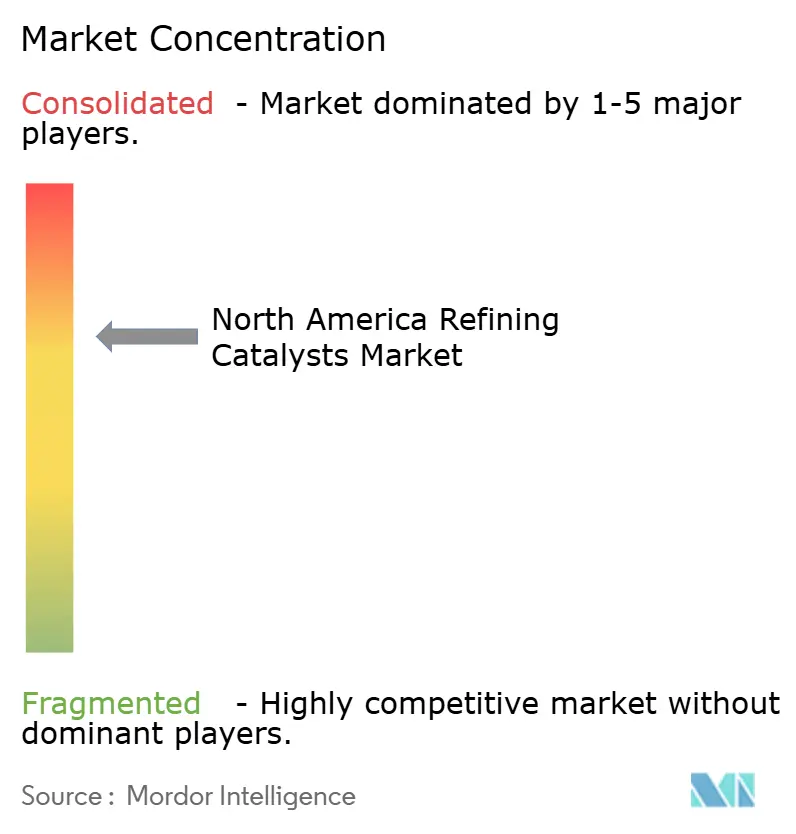
| Market Concentration | Medium |
Major Players *Disclaimer: Major Players sorted in no particular order Image © Mordor Intelligence. Reuse requires attribution under CC BY 4.0. | |
North America Refining Catalysts Market Analysis by Mordor Intelligence
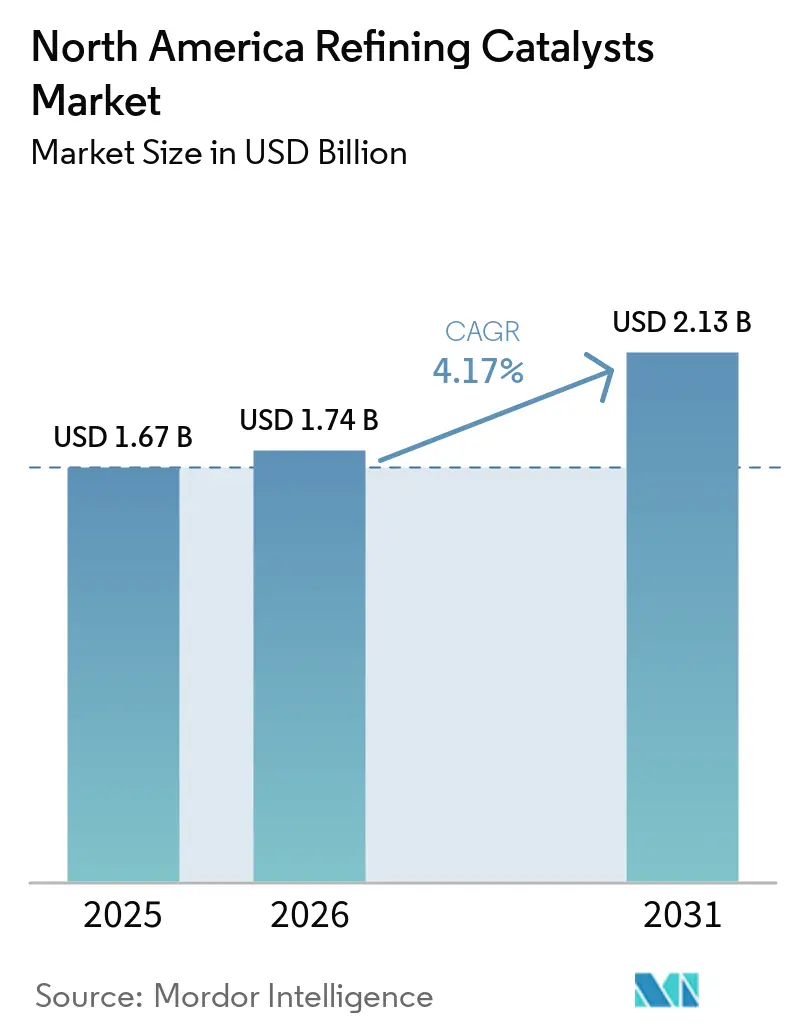
The North America Refining Catalysts Market size was valued at USD 1.67 billion in 2025 and is estimated to grow from USD 1.74 billion in 2026 to reach USD 2.13 billion by 2031, at a CAGR of 4.17% during the forecast period (2026-2031). The United States remains the regional demand center because its large refinery system contains extensive fluid catalytic cracking (FCC) and hydroprocessing capacity. Gulf Coast sites in Texas and Louisiana remain important because they combine access to crude supplies, export terminals, and petrochemical infrastructure. Stricter sulfur rules, refinery upgrades, and renewable-feed co-processing support the North America refining catalysts market. Metal-cost volatility and delayed maintenance can shift catalyst purchases between quarters, even when underlying operating needs remain in place. Suppliers are responding through technical service, specialized formulations, and portfolio expansion across refining and renewable-fuel applications.
Key Report Takeaways
- By product type, zeolites held 32.67% of the North America refining catalysts market share in 2025 and are projected to advance at a 4.36% CAGR through 2031.
- By process, fluid catalytic cracking held 38.14% of the North America refining catalysts market share in 2025, while hydrocracking is projected to advance at a 4.71% CAGR through 2031.
- By geography, the United States held 76.52% of the North America refining catalysts market share in 2025 and is projected to advance at a 4.55% CAGR through 2031.
Note: Market size and forecast figures in this report are generated using Mordor Intelligence’s proprietary estimation framework, updated with the latest available data and insights as of January 2026.
North America Refining Catalysts Market Trends and Insights
Drivers Impact Analysis*
| Driver | (~) % Impact on CAGR Forecast | Geographic Relevance | Impact Timeline |
|---|---|---|---|
| Tightening Sulfur and Fuel Quality Standards | +1.1% | United States (EPA Tier 3), Canada (ECCC fuel quality regulations) | Long term (≥ 4 years) |
| Refinery Modernization and Secondary-Unit Debottlenecking | +0.9% | United States (Gulf Coast, Midwest), Canada | Medium term (2-4 years) |
| Heavier and More Contaminated Crude Processing | +0.7% | United States (Gulf Coast), Canada (oil sands feedstock corridors) | Medium term (2-4 years) |
| Renewable Diesel and Sustainable Aviation Fuel Co-Processing | +0.6% | United States (California, Gulf Coast), Canada | Long term (≥ 4 years) |
| FCC Yield Optimization and Petrochemical Integration | +0.4% | United States (Gulf Coast, Midwest), Mexico | Medium term (2-4 years) |
| Source: Mordor Intelligence | |||
Tightening Sulfur and Fuel Quality Standards
The Environmental Protection Agency Tier 3 gasoline program requires a 10 wt ppm annual average sulfur limit for gasoline supplied to the United States[1]. Fluid catalytic cracking naphtha formed a large part of the gasoline pool and contributed a substantial share of gasoline sulfur, which made fluid catalytic cracking-train hydroprocessing an important compliance point. Increasing hydrotreater severity can reduce olefins and lower octane, which can require higher-cost blending components. This operating balance supports demand for catalysts that improve activity while preserving selectivity. Many United States refineries relied on fluid catalytic cracking gasoline post-treaters without a feed pre-treater, leaving them more exposed when fuel specifications became tighter. Compliance costs also create an incentive to manage sulfur performance closely, supporting recurring catalyst demand in the North America refining catalysts market.
Refinery Modernization and Secondary-Unit Debottlenecking
Investment in secondary-unit capacity remains a catalyst-demand driver across the United States Gulf Coast. Valero Energy Corp. planned targeted upgrades to increase the AVU-146 crude distillation unit at Port Arthur, Texas, from 235,000 barrels per day (bpd) to 260,000 bpd, with work beginning in early 2026. Exxon Mobil Corporation also announced a Baytown, Texas, complex reconfiguration that is planned to start up in 2028. Higher throughput through existing catalyst beds can shorten cycle lengths and bring forward replacement needs. That effect supports the North America refining catalysts market, even where projects do not add a new catalyst unit. Maintenance activity can also create concentrated catalyst purchases when complex units are taken offline and reloaded.
Heavier and More Contaminated Crude Processing
United States Gulf Coast refineries increasingly process heavier, higher-metals feedstocks, which increases the operating burden on catalysts. Canadian heavy crude supplied 13.6 million barrels per month to Gulf Coast refiners in the 12 months ending February 2025. Canadian oil sands output reached 3.3 million bbl/d in 2024 and was expected to reach 3.5 million bbl/d in 2025. The changing crude slate favors cokers, hydrocrackers, and deep-conversion desulfurization units that can process more difficult feedstocks. Iron and calcium in oil sands crude can block fluid catalytic cracking catalyst pores and reduce accessibility. Faster deactivation can increase catalyst addition rates and favor metal-tolerant formulations over standard reload grades.
Renewable Diesel and Sustainable Aviation Fuel Co-Processing
Co-processing bio-based feeds in existing hydrotreaters provides a lower-capital route to renewable fuel production. The International Civil Aviation Organization recognizes co-processing and revamping as pathways that can use existing refinery infrastructure for sustainable aviation fuel production[2]. Bio-derived feeds can introduce oxygen, phosphorus, and other contaminants that deactivate conventional cobalt-molybdenum and nickel-molybdenum catalyst formulations. BASF designed its Elevolve portfolio for renewable diesel and sustainable aviation fuel production. Topsoe provides co-processing solutions for kerosene hydrotreaters used in sustainable aviation fuel production. This need for contaminant-tolerant guard beds and specialized catalyst systems shifts purchases toward higher-specification grades in the North America refining catalysts market.
Restraints Impact Analysis*
| Restraint | (~) % Impact on CAGR Forecast | Geographic Relevance | Impact Timeline |
|---|---|---|---|
| Volatility in Nickel, Molybdenum and Precious-Metal Costs | -0.8% | Global supply chains; direct cost impact across North America | Short term (≤ 2 years) |
| Refining Margin Volatility and Deferred Turnarounds | -0.7% | United States (Gulf Coast, Midwest), Canada | Short term (≤ 2 years) |
| Shorter Catalyst Cycles from Phosphorus and Alkali Contamination | -0.4% | United States (shale crudes), Canada (oil sands crudes) | Medium term (2-4 years) |
| Source: Mordor Intelligence | |||
Volatility in Nickel, Molybdenum and Precious-Metal Costs
Nickel and molybdenum are important cost inputs for nickel-molybdenum and cobalt-molybdenum hydroprocessing catalysts. Price changes in those metals can directly affect catalyst pricing and procurement budgets. Suppliers may use raw-material index-linked agreements rather than fixed annual prices when input costs move sharply. That approach transfers part of the commodity-price exposure to refinery buyers. Platinum and palladium used in alumina-based noble-metal catalysts also expose suppliers to a geographically concentrated metal supply. These cost movements can constrain margins and complicate purchasing decisions across the North America refining catalysts market.
Refining Margin Volatility and Deferred Turnarounds
High refining margins can encourage operators to delay scheduled turnarounds because taking a unit offline sacrifices profitable throughput. Several refineries shifted planned fall 2026 work into 2027, temporarily delaying catalyst changeouts. Deferrals reduce near-term demand but create a backlog of future replacement activity. Extended run lengths under high-severity conditions can raise the risk of hydrothermal sintering and metal accumulation. When units eventually stop, operators may require broader catalyst-bed changes rather than limited top-ups. This pattern can make quarterly demand less predictable for suppliers serving the North America refining catalysts market.
*Our forecasts treat driver/restraint impacts as directional, not additive. The impact forecasts reflect baseline growth, mix effects, and variable interactions.
Segment Analysis
By Product Type: Zeolites Anchor Both Revenue and Growth
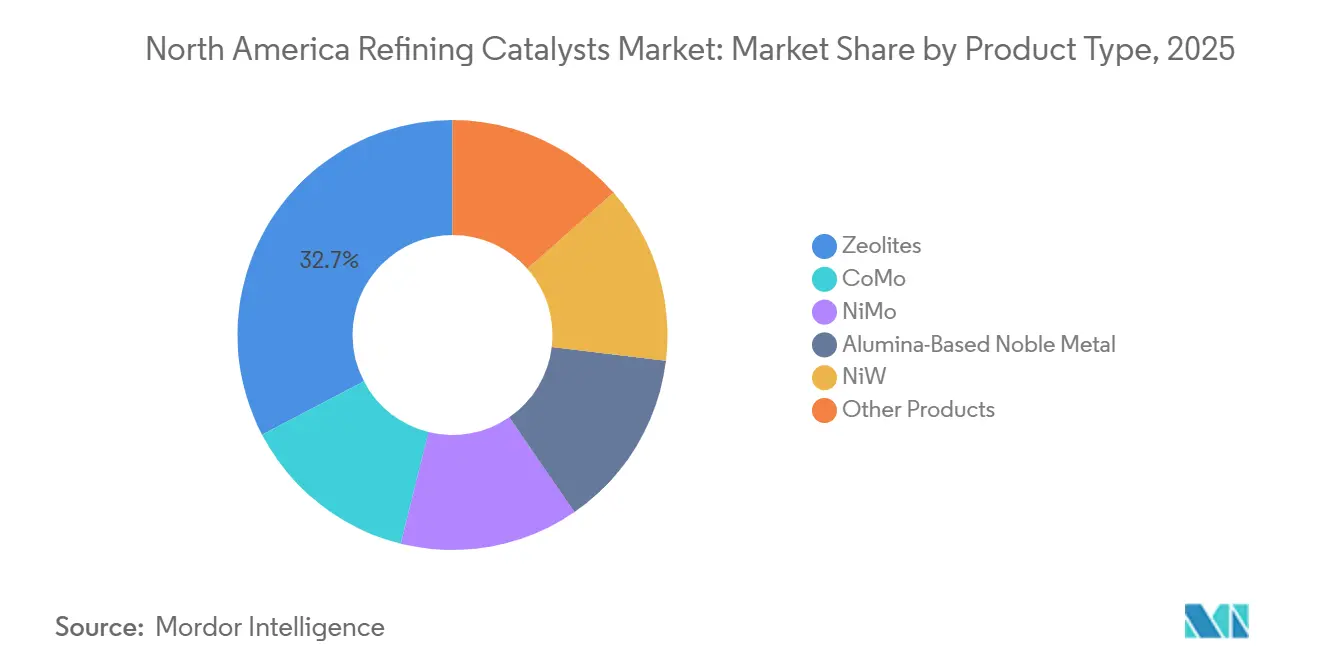
Zeolites held 32.67% of the North America refining catalysts market in 2025, reflecting their role as active cracking components in fluid catalytic cracking catalysts and as shape-selective materials in hydrocracking formulations. The North America refining catalysts market size for zeolites also benefits from refinery demand for upgraded performance in cracking and conversion units. Nickel-molybdenum formulations are used for deep hydrodesulfurization and distillate hydrotreating. Cobalt-molybdenum grades are used in the selective hydrodesulfurization of fluid catalytic cracking naphtha, where refiners seek to limit olefin saturation and protect octane. Alumina-based noble-metal catalysts serve selective hydrogenation and reforming applications. Their high precious-metal content limits their use to a smaller, premium-priced application base.
Zeolites are projected to advance at a 4.36% CAGR through 2031. Growing fluid catalytic cracking integration with petrochemical operations supports demand for ZSM-5 additives designed for higher propylene production. Bio-feed co-processing in hydrocrackers also requires zeolites with suitable pore structures and hydrothermal stability. Steam formed from feed oxygenates can cause framework dealumination under conventional operating conditions. Zeolyst International offers the Opal Renew portfolio for renewable-fuel catalyst demand. Ketjen reported that its SaFeGuard catalyst improved fluid catalytic cracking catalyst accessibility by 77% in a 30-day trial, demonstrating the relevance of heavy-feed-tolerant formulations.

By Process: Fluid Catalytic Cracking Dominates Revenue, While Hydrocracking Advances Growth
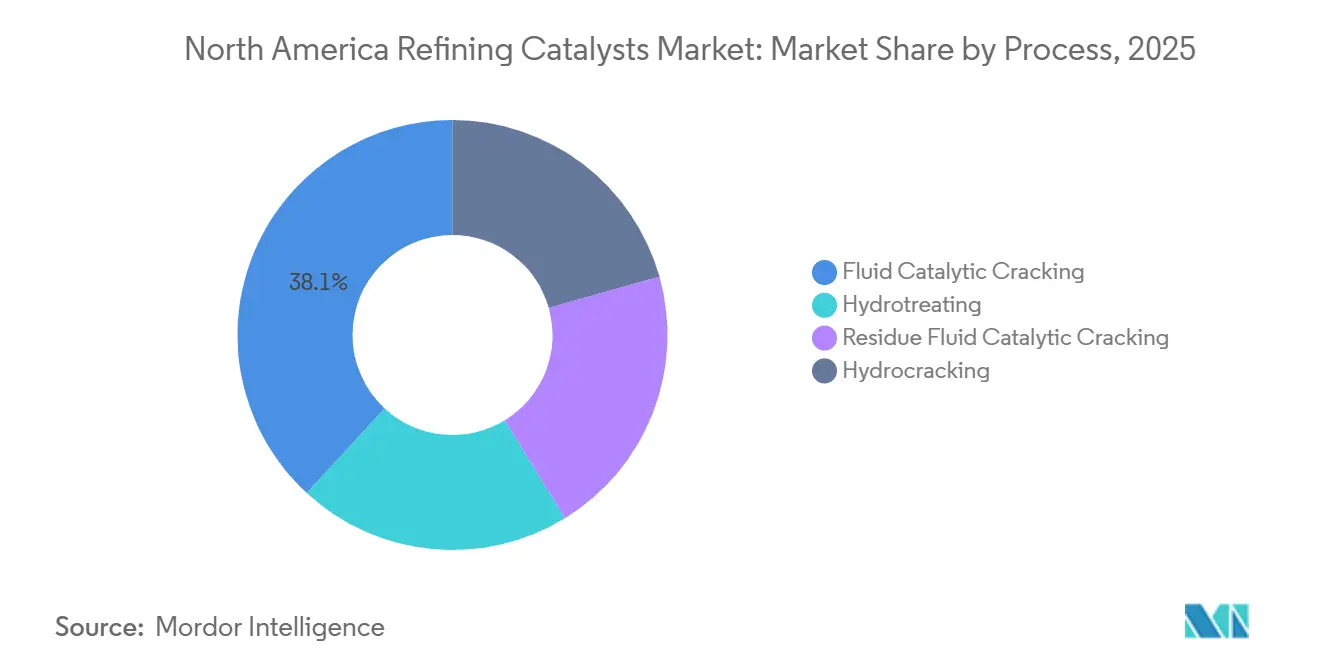
Fluid catalytic cracking accounted for 38.14% of the North America refining catalysts market in 2025. Fluid catalytic cracking units continuously circulate and replace catalyst in a moving-bed configuration, which increases catalyst inventories and recurring purchasing needs. The scale of catalyst programs at complex Gulf Coast refineries can make fluid catalytic cracking the largest item in a refinery's catalyst budget. Hydrotreating covers gasoline, kerosene, diesel, vacuum gas oil, catalytic-cracking gasoline, and residual feeds. It benefits from sulfur-compliance requirements and renewable-fuel co-processing. Residue fluid catalytic cracking processes atmospheric and vacuum residues, and can experience faster deactivation with high-metal feeds.
Hydrocracking is projected to advance at a 4.71% CAGR through 2031. The North America refining catalysts industry depends on hydrocracking to convert vacuum gas oil and residual streams into higher-value diesel and jet fuel. Refiners use these units to improve crude-slate flexibility and deepen conversion of challenging feedstocks. Pemex completed an October 2025 turnaround at its Deer Park, Texas, refinery that covered a 70,000-bpd hydrocracking unit alongside its fluid catalytic cracking and coker units. Hydrocracking catalysts typically command a premium because they use higher active-metal loadings and bifunctional zeolite-metal formulations. Feed contamination also raises the value of advanced grading strategies and higher-activity fresh catalysts.
Geography Analysis
The United States held 76.52% of the North America refining catalysts market in 2025 and is projected to advance at a 4.55% CAGR through 2031. The North America refining catalysts market share held by the United States reflects its extensive refinery base and large concentration of complex units. Texas and Louisiana contain a substantial part of national refining capacity. Their Gulf Coast refineries process crude from Canadian oil sands, the Permian Basin, and imported heavy streams. Regulatory obligations under Tier 3 and the California Low Carbon Fuel Standard support demand for high-activity and long-life catalyst grades. Valero targeted a third-quarter 2026 startup for fluid catalytic cracking optimization at its St. Charles refinery, while Exxon Mobil Corporation's Baytown reconfiguration remains planned for a 2028 startup.
In Canada, the country's refineries process heavy, high-sulfur oil sands crude, which requires higher catalyst activity per barrel than light sweet grades. Nickel and vanadium can increase catalyst deactivation in these operations. Domestic refinery capacity expansion is expected to remain relatively limited through 2031. However, a heavier feedstock mix can continue to increase catalyst consumption for each unit of throughput. Natural Resources Canada noted that integrated operators invest in processing capacity partly to create domestic outlets for growing oil sands production.
Pemex's Olmeca refinery at Dos Bocas produced an average of 175,800 bbl/d in the first quarter of 2026, below its 340,000 bbl/d design capacity. The delayed ramp-up constrained demand from a refinery that had been expected to add regional consumption. Alkylation and butane isomerization units had not yet achieved full operation following operational setbacks. If Dos Bocas reaches its intended throughput during the forecast period, its fluid catalytic cracking and hydrocracking configuration could create further catalyst demand. Pemex's financial constraints and operational record moderate near-term expectations for the North America refining catalysts market.
Competitive Landscape
The North America refining catalysts market is moderately concentrated, with the top five players including Albemarle Corporation, W. R. Grace & Co.-Conn, BASF, Topsoe, and Honeywell International Inc. W. R. Grace & Co.-Conn holds full ownership of the Advanced Refining Technologies hydroprocessing portfolio following the absorption of Chevron's stake in the joint venture. Honeywell International Inc. completed its acquisition of Johnson Matthey's Catalyst Technologies business in July 2026 for GBP 1.325 billion (approximately USD 1.77 billion). The combination brings Universal Oil Products (UOP) process licensing together with Johnson Matthey refining and renewable-fuels catalyst formulations. BASF opened a new applied research and development center at its Attapulgus, Georgia, refinery catalyst site in May 2026.
Ownership changes create opportunities for Axens, Topsoe, Evonik Industries AG, and smaller suppliers to build relationships with refiners seeking supply diversification. Axens gained direct control of the Eurecat catalyst recycling joint venture in January 2026 after acquiring Albemarle Corporation's 50% stake. Albemarle stated that the transaction formed part of the sale of its Eurecat interest and Ketjen controlling stake. Catalyst recycling and spent-metal management can become more relevant as refiners seek value from deactivated materials. BASF commissioned industrial-scale production for catalysts made with its X3D technology in March 2026. The technology uses optimized geometries to reduce reactor pressure drop and increase active surface area.
Technology differentiation remains a central competitive factor in the North America refining catalysts market. Suppliers compete on catalyst activity, selectivity, resistance to contaminants, and the technical support provided during a unit cycle. BASF's Elevolve offering addresses renewable diesel and sustainable aviation fuel applications. Evonik Industries AG offers the Excel catalyst rejuvenation service, which is designed to restore spent catalyst activity. JGC C&C and CLARIANT compete in hydrotreating and specialty fluid catalytic cracking additives. Long-standing customer relationships and operating histories remain important in these specialized applications.
North America Refining Catalysts Industry Leaders
-
Albemarle Corporation
-
W. R. Grace & Co.-Conn
-
BASF
-
Topsoe
-
Honeywell International Inc.
- *Disclaimer: Major Players sorted in no particular order
Recent Industry Developments
- July 2026: Honeywell International Inc. completed its acquisition of Johnson Matthey’s Catalyst Technologies business for GBP 1.325 billion (approximately USD 1.77 billion). The acquisition expands Honeywell’s catalyst portfolio and strengthens its capabilities in refining, hydroprocessing, renewable fuels, and petrochemical applications, supporting the North America refining catalysts market.
- March 2026: Albemarle Corporation completed the sale of a controlling stake in its Ketjen refining catalyst business to KPS Capital Partners, while retaining a minority stake. The transaction establishes a new ownership structure for a major refining catalyst supplier and supports continued development and supply of FCC and hydroprocessing catalyst solutions.
North America Refining Catalysts Market Report Scope
Refining catalysts are specialized materials used to accelerate and control chemical reactions during petroleum refining processes. They help convert refinery feedstocks into desired products while improving process efficiency and supporting the removal of unwanted compounds.
The North America Refining Catalysts Market is segmented by product type, process, and geography. By product type, the market is segmented into zeolites, CoMo, NiMo, alumina-based noble metal, NiW, and other products. By process, the market is segmented into fluid catalytic cracking, hydrotreating, residue fluid catalytic cracking, and hydrocracking. Hydrotreating is further segmented into gasoline, kerosene, diesel, vacuum gas oil, catalytic-cracking gasoline, and residual feed. The report also covers the market size and forecasts for refining catalysts in 3 countries across the region. For each segment, the market sizing and forecasts have been done on the basis of value (USD).
By Product Type
| Zeolites |
| CoMo |
| NiMo |
| Alumina-Based Noble Metal |
| NiW |
| Other Products |
By Process
| Fluid Catalytic Cracking | |
| Hydrotreating | Gasoline |
| Kerosene | |
| Diesel | |
| Vacuum Gas Oil | |
| Catalytic-Cracking Gasoline | |
| Residual Feed | |
| Residue Fluid Catalytic Cracking | |
| Hydrocracking |
By Geography
| United States |
| Canada |
| Mexico |
| By Product Type | Zeolites | |
| CoMo | ||
| NiMo | ||
| Alumina-Based Noble Metal | ||
| NiW | ||
| Other Products | ||
| By Process | Fluid Catalytic Cracking | |
| Hydrotreating | Gasoline | |
| Kerosene | ||
| Diesel | ||
| Vacuum Gas Oil | ||
| Catalytic-Cracking Gasoline | ||
| Residual Feed | ||
| Residue Fluid Catalytic Cracking | ||
| Hydrocracking | ||
| By Geography | United States | |
| Canada | ||
| Mexico | ||
Key Questions Answered in the Report
What is the size of the North America refining catalysts market?
The North America refining catalysts market stands at USD 1.74 billion in 2026 and is projected to reach USD 2.13 billion by 2031.
What is driving demand for refining catalysts in North America?
Sulfur-compliance needs, refinery modernization, heavier crude processing, and renewable-feed co-processing support demand.
Which product type led the market demand in 2025?
Zeolites led with 32.67% of value in 2025.
Which process is projected to grow fastest through 2031?
Hydrocracking is projected to advance at a 4.71% CAGR through 2031, supported by deeper conversion and feedstock flexibility needs.