
North America Pre-engineered Buildings (PEB) Construction Market Size and Share
Market Overview
| Study Period | 2021 - 2032 |
|---|---|
| Forecast Data Period | 2027 - 2032 |
| Base Year Market Size (2026) | USD 20.82 Billion |
| Market Size (2027) | USD 22.70 Billion |
| Market Size (2032) | USD 34.82 Billion |
| Growth Rate (2027 - 2032) | 8.94 % |
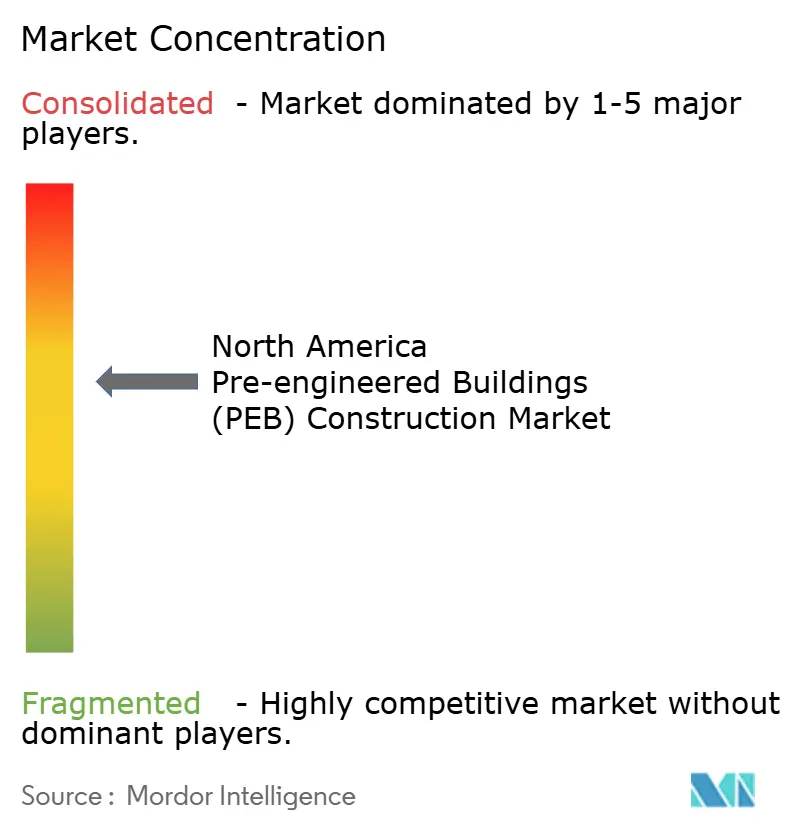
| Market Concentration | Medium |
Major Players *Disclaimer: Major Players sorted in no particular order Image © Mordor Intelligence. Reuse requires attribution under CC BY 4.0. | |
North America Pre-engineered Buildings (PEB) Construction Market Analysis by Mordor Intelligence
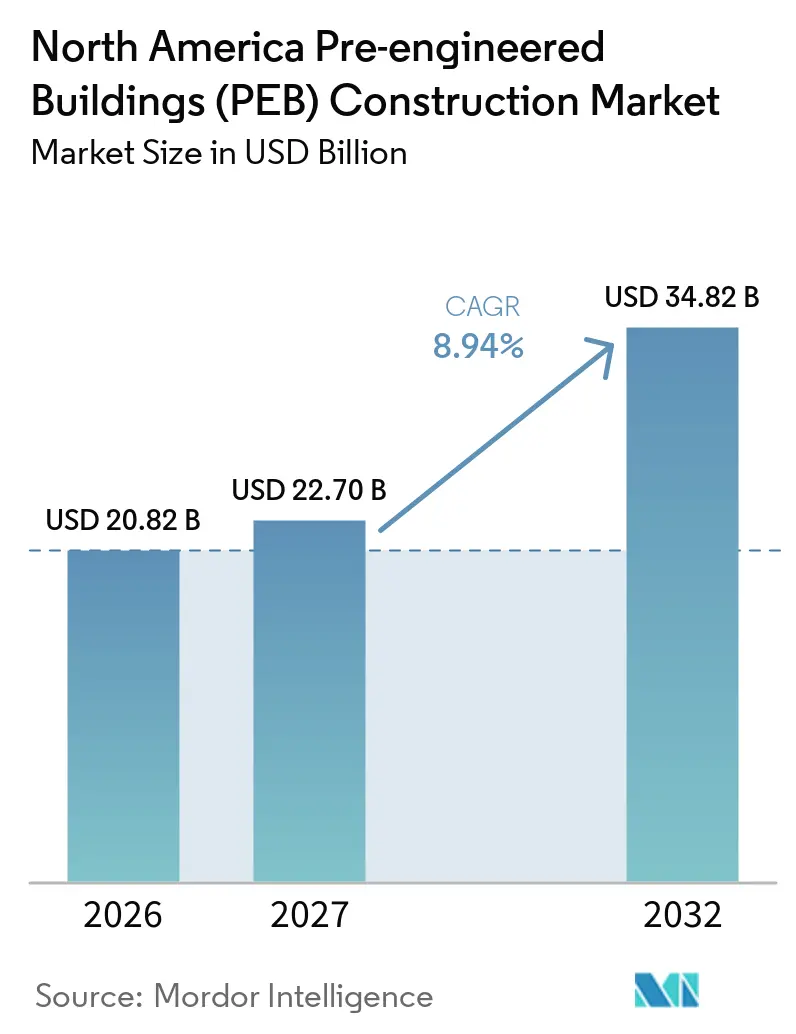
The North America Pre-engineered Buildings Construction Market size is expected to increase from USD 20.82 billion in 2026 to USD 22.70 billion in 2027 and reach USD 34.82 billion by 2032, growing at a CAGR of 8.94% over 2027-2032. The North America pre-engineered buildings (PEB) construction market is benefiting from developers that need more predictable schedules and costs. Factory fabrication allows structural members to arrive cut, punched, and prepared for assembly, reducing the amount of work performed at the site. This advantage matters for logistics, manufacturing, cold storage, and digital infrastructure projects where delayed occupancy can be costly. Demand is also moving toward integrated packages that combine the frame, roof, wall panels, and access systems under one contract. At the same time, steel input costs, crew availability, local permitting, and transport rules continue to affect project margins and delivery timing. The resulting opportunity is strongest for suppliers that combine engineering, fabrication, envelopes, and local erection support in a coordinated offer.
Key Report Takeaways
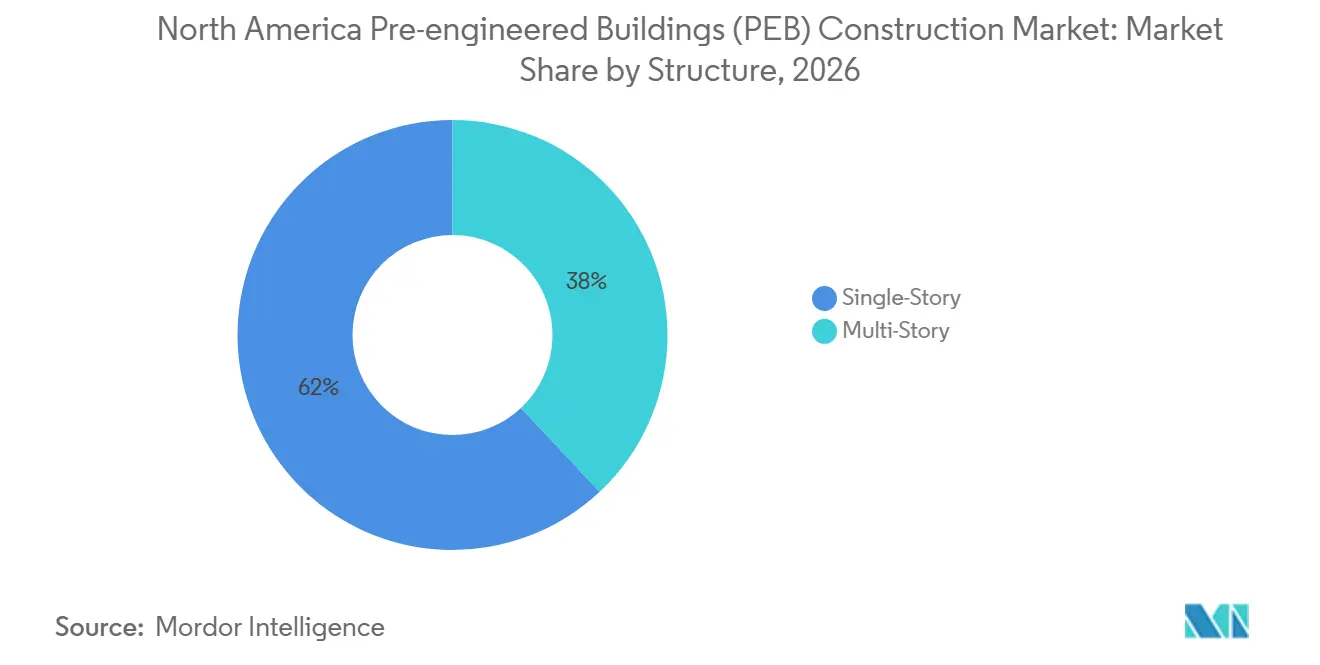
By structure, single-story buildings held 62% of the North America pre-engineered buildings (PEB) construction market share in 2026, while multi-story buildings are forecast to grow at a 9.4% CAGR through 2032.
By product type, panelized and componentized systems held 42% of the 2026 market, while modular buildings are forecast to grow at a 10.5% CAGR through 2032.
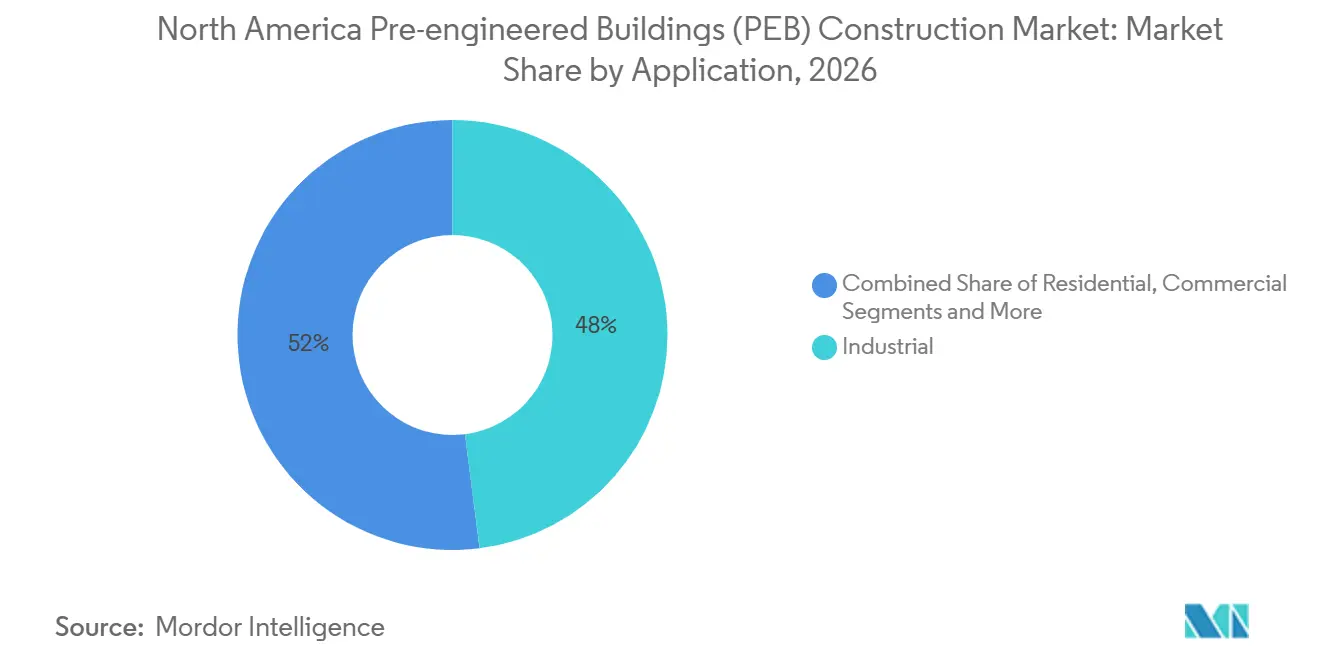
By application, industrial applications held 48% of the 2026 market, while commercial applications are forecast to grow at a 9.6% CAGR through 2032.
By geography, the United States held 78% of the North America pre-engineered buildings (PEB) construction market share in 2026, while Mexico is forecast to grow at a 6.86% CAGR through 2032.
Note: Market numbers in this report are based on Mordor Intelligence's proprietary estimation framework, which combines nine months of actuals with Q4 projections for base year 2026.
North America Pre-engineered Buildings (PEB) Construction Market Trends and Insights
Drivers Impact Analysis*
| Drivers | (~) % Impact on CAGR Forecast | Geographic Relevance | Impact Timeline |
|---|---|---|---|
| E-Commerce Fulfillment and Cold-Chain Distribution-Center Expansion | +2.1% | United States primary, Canada spill-over, Mexico emerging | Short term (≤ 2 years) |
| Hyperscale Data-Center and Semiconductor Fab Shell Construction | +1.8% | United States Sun Belt and Midwest, Canada secondary | Short term (≤ 2 years) |
| Automotive and Battery-Manufacturing Nearshoring in Mexico and the United States | +1.5% | United States Midwest and Southeast, Mexico Nuevo León and Guanajuato | Medium term (2-4 years) |
| Hurricane, Tornado and Seismic Wind-Load Compliance | +0.9% | United States tornado-prone region east of the Rockies, Gulf Coast, and Pacific Coast | Medium term (2-4 years) |
| Dealer-Erector Consolidation and Automated Shop Fabrication | +0.7% | United States national, Canada secondary | Long term (≥ 4 years) |
| Source: Mordor Intelligence | |||
E-Commerce Fulfillment and Cold-Chain Distribution-Center Expansion
The North America pre-engineered buildings (PEB) construction market gains from distribution projects that require clear spans, higher eaves, and refrigeration-ready envelopes. These needs fit steel systems designed around standardized frames and secondary members, allowing operators to plan refrigeration penetrations, insulated envelopes, and high eave heights without repeated field redesign, reducing coordination work during a stage when cold-chain users are managing demanding commissioning schedules. Bolt-up construction can dry in 30% to 50% faster than conventional approaches, helping operators protect tight delivery schedules for perishable goods. Star Building Systems documented the use of a 3D-scan-guided rigid-frame system at a UPS processing facility in Denver during 2025. Insulated metal panels also raise the value of a project because they are increasingly specified with the structural shell. Manufacturers that include these panels in their scope can retain work that would otherwise go to separate suppliers.
Hyperscale Data-Center and Semiconductor Fab Shell Construction
Data-center investment is increasing demand for large structures that can be delivered on compressed schedules. The North America pre-engineered buildings (PEB) construction market is well placed for this work because prefabricated structural components reduce site assembly time. Crusoe began the second phase of its Abilene, Texas, artificial intelligence campus in March 2025, with the site planned at 1.2 gigawatts across 4 million square feet. Vertiv introduced its OneCore prefabricated data-center platform in August 2025 and stated that it could compress schedules by up to 50% compared with traditional construction. Nucor reported 31.9 million square feet of domestic data-center development in 2025. These projects provide manufacturers with large contracts that are less tied to residential and smaller commercial construction cycles, which supports a steadier order pipeline for suppliers aligned with hyperscale owner-operators when residential or light-commercial activity is uneven.
Automotive and Battery-Manufacturing Nearshoring in Mexico and the United States
Automotive and battery projects are creating demand for large, clear-span production buildings in the Midwest, Southeast, and northern Mexico. The North America pre-engineered buildings (PEB) construction market benefits when equipment layouts require flexible secondary framing and early coordination with the building shell. Toyota Battery Manufacturing North Carolina began battery shipments in June 2025 from its 7 million-square-foot campus. Panasonic Energy began production at its Kansas lithium-ion battery facility in 2025 with a target annual capacity of 32 gigawatt-hours. Such facilities place high importance on construction sequence, service coordination, and future expansion. Pre-engineered systems support those requirements because the structural design can be developed alongside equipment planning, allowing building teams to shape the frame around process equipment rather than ask a completed site-built structure to accommodate later changes.
Hurricane, Tornado, and Seismic Wind-Load Compliance
The 2024 International Building Code added tornado wind-load design criteria through references to ASCE 7-22 Chapter 32 for certain risk-category buildings east of the Rockies[1]. The code also updated seismic ground-motion maps and site classifications through ASCE 7-22. These changes favor suppliers that can prepare compliant engineering documents quickly. The North America pre-engineered buildings (PEB) construction market also benefits as project owners seek frames designed for the relevant loading conditions. State adoption timelines differ so that code changes can produce a gradual replacement and upgrade cycle. In-house structural engineering becomes more valuable when requirements vary by jurisdiction and building risk category, while helping manufacturers respond when owners require a faster permit package for buildings with higher wind or seismic design needs.
Restraints Impact Analysis*
| Restraint | (~) % Impact on CAGR Forecast | Geographic Relevance | Impact Timeline |
|---|---|---|---|
| Domestic Steel-Capacity Cycles and Zinc-Coated Coil Price Volatility | -1.2% | The United States is the primary, and Canada and Mexico spill over | Short term (≤ 2 years) |
| Unionized Erection Labor Availability and Wage Escalation | -0.9% | United States national, acutest in coastal metros, Canada secondary | Medium term (2-4 years) |
| State-by-State Permitting, Zoning, and Local Design Requirements | -0.5% | United States national | Long term (≥ 4 years) |
| Oversized-Load Rules and Cross-Border USMCA Logistics Constraints | -0.4% | Mexico-United States border corridors and state-level United States permit jurisdictions | Medium term (2-4 years) |
| Source: Mordor Intelligence | |||
Domestic Steel-Capacity Cycles and Zinc-Coated Coil Price Volatility
Zinc-coated coil remains a significant input for steel building manufacturers. Zinc ingot prices in the United States reached USD 3,445 per metric ton in June 2025, while galvanized plain sheet prices in Illinois reached USD 1,520 per metric ton. Manufacturers commonly price projects before material is procured and fabricate within 12 to 20 weeks. A rapid input-cost change during that period can reduce margins on a fixed-price contract. Price-escalation clauses can offer protection, but owners may resist terms that leave final costs open. The North America pre-engineered buildings (PEB) construction market, therefore, remains exposed to steel-price movements even when demand is firm, making material purchasing discipline and clear contract terms important for producers that commit to delivery dates before coil is procured.
Unionized Erection Labor Availability and Wage Escalation
Crew availability limits how rapidly a fabrication backlog becomes a completed building. Associated Builders and Contractors estimated that the United States construction sector faced a shortfall of 439,000 workers in 2025[2]. Ironworker settlements averaged 3.4% in the first half of 2025, while electricians, pipefitters, and roofers averaged 5%, 5.6%, and 3.9%, respectively. These wage increases affect installed costs even when structural fabrication is efficient. Pre-engineered systems need fewer specialized site tasks than welded or cast-in-place alternatives. That advantage helps manage labor pressure but does not remove the need for qualified erection crews. Contractors must still ensure that the necessary personnel are available when delivered components reach the site, particularly where multiple industrial projects proceed at the same time.
*Our forecasts treat driver/restraint impacts as directional, not additive. The impact forecasts reflect baseline growth, mix effects, and variable interactions.
Segment Analysis
By Structure: Single-Story Buildings Lead Volume and Multi-Story Buildings Grow Faster
Single-story buildings held 62% of the North America pre-engineered buildings (PEB) construction market size in 2026. Fulfillment centers, manufacturing shells, and agricultural storage buildings support this position because they need large floorplates and column-free internal space. Clear spans of up to 300 feet are common for these uses. E-commerce operators are also seeking eave heights above 40 feet to support automated storage and retrieval systems. This raises the engineering content and value per square foot of a typical single-story project. It also gives manufacturers an opportunity to supply structural components suited to automated equipment layouts, rather than a basic low-height warehouse shell. The format remains practical where land is available, and equipment circulation needs open floor space.
Multi-story buildings are forecast to grow at a 9.4% CAGR through 2032. Urban logistics hubs, multi-tenant industrial condominiums, and modular residential projects are supporting the faster pace. The Modular Building Institute reported year-over-year growth in completed multi-story permanent modular projects in the United States and Canada in 2026[3]. Canada is prioritizing 4,000 factory-built units on federal sites in six cities through its Build Canada Homes initiative. Both structure types benefit when owners value certainty in schedules and labor use. The North America pre-engineered buildings (PEB) construction industry also gains when prefabricated frames reduce the time needed to establish a building skeleton.

By Product Type: Panelized and Componentized Systems Lead and Modular Buildings Accelerate
Panelized and componentized systems held 42% of the North America pre-engineered buildings (PEB) construction market in 2026. Their broad use across industrial, commercial, and institutional projects reflects established dealer-erector networks and adaptable designs. A customer can select façade profiles, liner systems, and secondary framing without managing fully volumetric module logistics. This makes these systems appropriate for projects between 50,000 and 300,000 square feet. The same flexibility explains why dealers continue to use them across a broad mix of project types rather than only in a narrow end use. Other prefabricated formats serve agricultural, recreational, and self-storage uses. Their role remains more specialized than that of panelized systems.
Modular buildings are forecast to grow at a 10.5% CAGR through 2032. Growth is linked to multi-family housing, hospitality, healthcare, and institutional projects that can use factory-produced modules. KBS Builders signed a USD 4.2 million contract in April 2026 to manufacture 36 modules for a net-zero assisted-living project in New Hampshire. The example shows modular construction moving into applications that had relied more heavily on conventional building methods. Integrated frame, wall-panel, and roofing packages can reduce coordination work at the site. This proposition is most useful when a project has limited site labor or needs a defined sequence between fabrication and installation. This supports suppliers that can manage more of the building envelope within a single contract.
By Application: Industrial Applications Anchor Demand and Commercial Applications Grow Faster
Industrial applications held 48% of the North America pre-engineered buildings (PEB) construction market size in 2026. Warehousing, manufacturing, cold storage, and data-center shells fit large single-tenant structures with clear-span needs. Battery plants and logistics facilities have reinforced this demand. Nucor serves data-center clients through more than 300 North American facilities that provide structural frames, insulated roof and wall panels, and foundation rebar. This integrated supply approach can simplify procurement for projects with demanding delivery schedules. Industrial construction remains the core application because it aligns closely with the format of pre-engineered steel buildings. Large single-tenant facilities can use repeatable bays and open interiors without the extensive site work associated with other construction methods.
Commercial applications are forecast to grow at a 9.6% CAGR through 2032. Data-center campuses, automotive dealerships, and mixed-use distribution and retail locations support this performance. Residential applications are also expanding through factory-built housing programs in Canada and the United States. Institutional demand is rising as owners consider newer tornado provisions when reviewing risk exposure. Agricultural storage in the United States Midwest and Canadian Prairies remains relevant when farm operators invest in on-site capacity. Across these applications, the North America pre-engineered buildings (PEB) construction industry benefits from owner preference for shorter schedules and fewer labor-intensive site activities. The pattern is consistent across uses because owners are weighing delivery reliability as closely as the initial building cost.
Geography Analysis
The United States held 78% of the North America pre-engineered buildings (PEB) construction market size in 2026. The country combines deep industrial real estate activity with a dense network of dealers, erectors, and manufacturers. Construction unemployment was 3.2% in August 2025, which reinforced the need to reduce site labor where possible. Data-center construction and battery manufacturing across the Sun Belt support large steel building projects. Nucor identified data-center and energy infrastructure demand as important to its Buildings segment in its 2025 results. Building-code adoption in tornado-prone and seismic areas also supports demand for engineering-led upgrades.
Canada has demand from housing programs and resource-related industrial construction. Build Canada Homes is directing federal procurement toward factory-built solutions and has identified 4,000 factory-built units across six cities. Ontario, British Columbia, and Quebec remain important centers for prefabrication supply. A 2025 report cited in the supplied draft found that 64% of Canadian prefab facilities primarily use wood, leaving a distinct role for steel systems in industrial and institutional construction. Data-center projects in the Prairie provinces and industrial activity around Toronto and Vancouver provide further opportunities. The North America pre-engineered buildings (PEB) construction market in Canada is therefore supported by both public housing needs and private industrial projects.
Mexico is forecast to grow at a 6.86% CAGR through 2032, the fastest rate in the region. Nearshoring is directing automotive, electronics, and battery manufacturing toward Nuevo León, Guanajuato, and Coahuila. Hyundai Mobis opened an electric-vehicle battery plant in Pesquería, Nuevo León, in 2025 with USD 28.6 million of investment and more than 200 jobs. The country offers manufacturers proximity to United States customers, but the cross-border movement of large frames needs careful planning. Separate Mexican and United States permit systems can delay the transport of oversized components. Local fabrication capacity, therefore, becomes important for projects with aggressive construction schedules.
Competitive Landscape
The North America pre-engineered buildings (PEB) construction market is moderately consolidated at the manufacturer level. BlueScope Buildings North America, Nucor Building Systems, and Cornerstone Building Brands operate through proprietary or established dealer-erector networks. Beneath this group, regional manufacturers and turnkey design-build contractors create a more fragmented field. Competition centers on engineering support, factory capacity, dealer reach, and the ability to meet project schedules. Larger suppliers can offer structural framing alongside roof, wall, and access products. Their scale can also support broader dealer coverage and a more reliable response when large projects require multiple building components. This reduces the number of suppliers that a developer must coordinate.
Vertical integration is influencing competitive strategies. Manufacturers and erectors are seeking closer control over design, fabrication, delivery, and installation. Automated plasma-cutting lines, parametric design tools, and 3D scanning help mid-sized suppliers compete on speed and accuracy. Compliance with American Institute of Steel Construction requirements and the Metal Building Manufacturers Association manual creates meaningful qualification requirements for risk-category projects. Cornerstone Building Brands completed the acquisition of Metal Sales Manufacturing Corporation in September 2025, adding a nationwide platform of more than 100 combined Shelter Solutions locations. The move expanded its position in residential metal building systems and strengthened its manufacturing footprint.
Higher-performance envelopes are another area of competition in the North America pre-engineered buildings (PEB) construction market. Customers increasingly seek a frame and insulated envelope under one contract because it lowers coordination risk across trades. Nucor completed the acquisition of CHI Overhead Doors and Rytec in 2025, supporting a wider building-systems offer for advanced manufacturing and data-center clients. Nucor also announced a USD 59 million expansion of its Vulcraft Indiana facility in August 2026, adding a 127,000-square-foot building for steel grating production and 20 jobs. Suppliers able to provide better envelope performance, reliable schedules, and local installation support are likely to be better positioned for complex projects.
North America Pre-engineered Buildings (PEB) Construction Industry Leaders
-
BlueScope Steel Limited
-
Nucor Corporation
-
Nucor Building Systems
-
Cornerstone Building Brands, Inc.
-
Butler Manufacturing Company
- *Disclaimer: Major Players sorted in no particular order
Recent Industry Developments
- October 2026: Nucor announced a USD 105 million expansion of its Towers & Structures plant in Crawfordsville, Indiana, to support utility and power-transmission demand.
- August 2026: Nucor Corporation, USD 59 million Vulcraft Indiana expansion. Nucor invested USD 59 million to expand its Vulcraft Indiana facility in St. Joe with a 127,000-square-foot building for steel grating production and 20 new jobs, Nucor's fourth major Indiana investment, complementing its adjacent Building Systems campus.
- April 2026: KBS Builders signed a USD 4.2 million contract to manufacture 36 modules for a net-zero assisted-living project in New Hampshire, with delivery targeted for the third quarter of 2026.
North America Pre-engineered Buildings (PEB) Construction Market Report Scope
| Single-Story |
| Multi-Story |
| Modular Buildings |
| Panelized and Componentized Systems |
| Other Prefabricated Building Types |
| Residential |
| Commercial |
| Industrial |
| Institutional |
| Others |
| United States |
| Canada |
| Mexico |
| By Structure | Single-Story |
| Multi-Story | |
| By Product Type | Modular Buildings |
| Panelized and Componentized Systems | |
| Other Prefabricated Building Types | |
| By Application | Residential |
| Commercial | |
| Industrial | |
| Institutional | |
| Others | |
| By Country | United States |
| Canada | |
| Mexico |
Key Questions Answered in the Report
What is the projected value of North American pre-engineered buildings construction by 2032?
The sector is projected to reach USD 34.8 billion by 2032, expanding at an 8.94% CAGR from 2027.
Which building structure has the largest share in North America?
Single-story buildings held 62% of the 2026 demand, supported by fulfillment, manufacturing, and agricultural storage projects.
Which product type is growing fastest?
Modular buildings are forecast to expand at a 10.5% CAGR through 2032 as use increases in housing, healthcare, and institutional projects.
Which application has the largest role in pre-engineered buildings?
Industrial applications held 48% of 2026 demand, supported by warehousing, manufacturing, cold storage, and data-center projects.
Which country leads regional demand?
The United States held 78% of the regional total in 2026, supported by its industrial base and dealer-erector network.
What factors could limit growth in pre-engineered buildings construction?
Steel-price volatility, shortage of qualified erection crews, local permitting, and oversized-load logistics can affect project costs and timing.