
North America Packaging Technical Textile Market Size and Share
Market Overview
| Study Period | 2021 - 2032 |
|---|---|
| Forecast Data Period | 2027 - 2032 |
| Base Year Market Size (2026) | USD 3.52 Billion |
| Market Size (2027) | USD 3.70 Billion |
| Market Size (2032) | USD 4.51 Billion |
| Growth Rate (2027 - 2032) | 4.04 % |
| Market Concentration | Low |
Major Players *Disclaimer: Major Players sorted in no particular order Image © Mordor Intelligence. Reuse requires attribution under CC BY 4.0. | |
North America Packaging Technical Textile Market Analysis by Mordor Intelligence
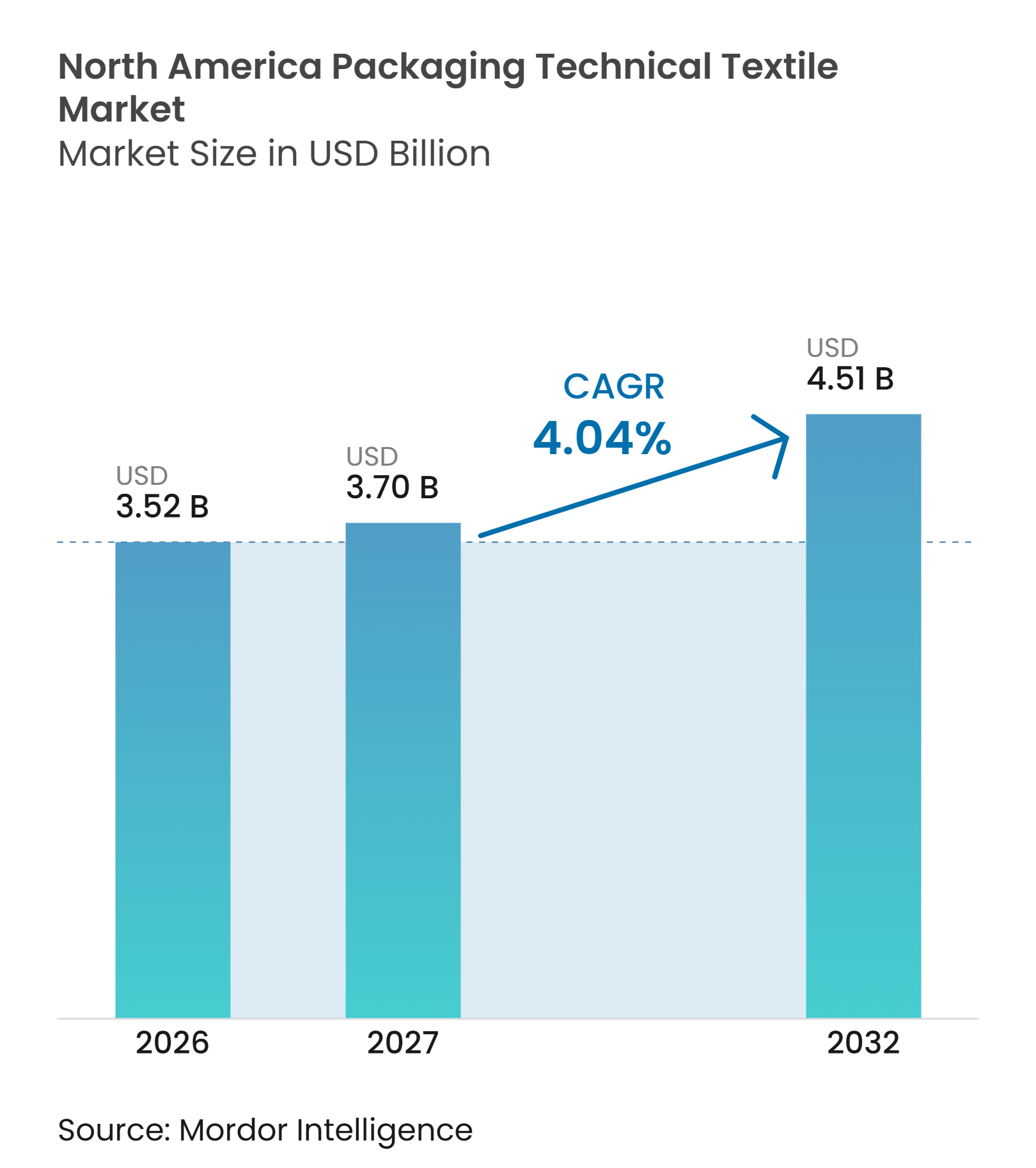
The North America Packaging Technical Textile Market size is projected to be USD 3.52 billion in 2026, USD 3.70 billion in 2027, and reach USD 4.51 billion by 2032, growing at a CAGR of 4.04% from 2027 to 2032.
The market is supported by tighter packaging qualification requirements, more bulk material handling, and production investment within the United States-Mexico-Canada Agreement trade area. Flexible intermediate bulk containers, woven polyolefin sacks, mesh bags, natural-fiber products, protective textiles, and specialty nonwovens serve different handling needs across the region. Compliance requirements for food contact, pharmaceutical packaging, dangerous goods, and electrostatic handling raise the importance of approved designs and documented production controls. Mexico is attracting capacity as suppliers seek regional production that can serve North American customers under United States-Mexico-Canada Agreement rules. At the same time, the United States remains the largest source of demand. Resin cost movement, certification expense, workforce availability, and qualification lead times will continue to shape both supplier margins and new capacity decisions.
Key Report Takeaways
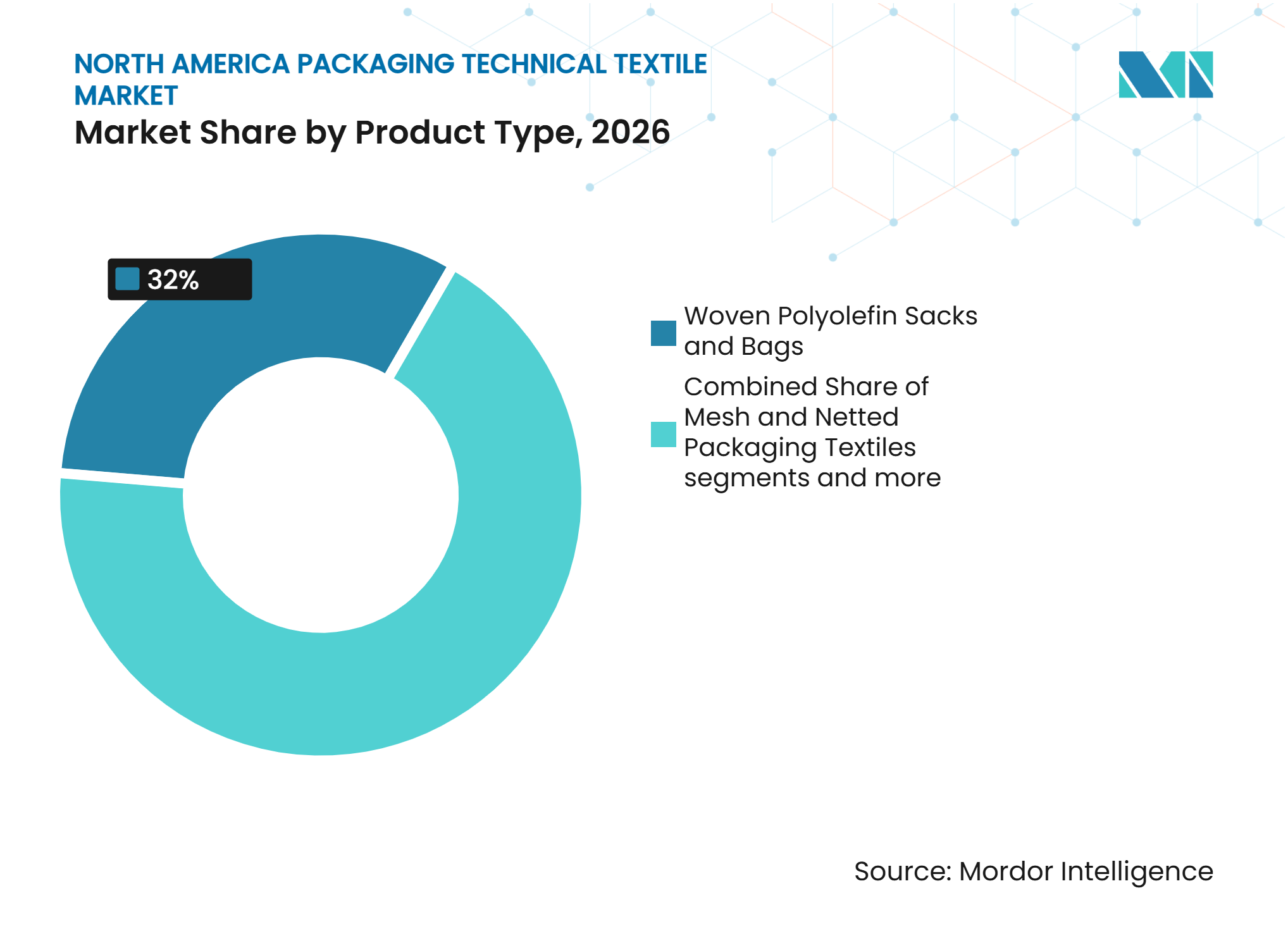
- By product type, woven polyolefin sacks and bags held 32.0% of the North America packaging technical textile market share in 2026, while flexible intermediate bulk containers (FIBCs) are the fastest-growing product category, registering a 5.8% CAGR through 2032.
- By material type, polypropylene accounted for 48.0% of the North America packaging technical textile market size in 2026, while regenerated cellulosic fibers are the fastest-growing material, registering a 6.5% CAGR through 2032.
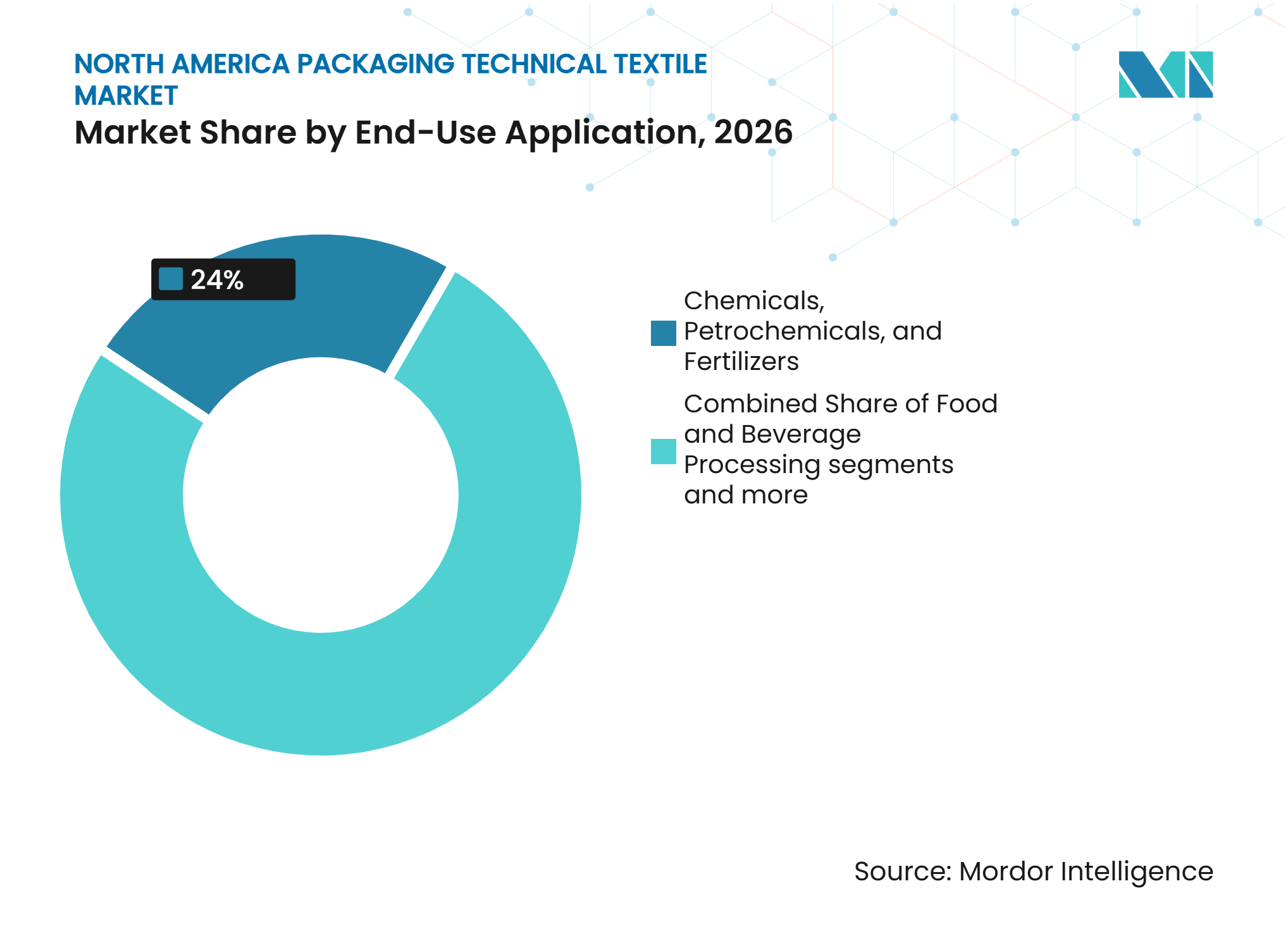
- By end-use application, chemicals, petrochemicals, and fertilizers held 24.0% of the sector total in 2026, while pharmaceuticals and healthcare products are the fastest-growing end-use application, registering a 6.2% CAGR through 2032.
- By geography, the United States accounted for 78.0% of the regional total in 2026, while Mexico is projected to grow at a 5.5% CAGR through 2032.
Note: Market numbers in this report are based on Mordor Intelligence's proprietary estimation framework, which combines nine months of actuals with Q4 projections for base year 2026.
Market Trends and Insights
Drivers Impact Analysis of North America Packaging Technical Textile Market*
| Driver | (~) % Impact on CAGR Forecast | Geographic Relevance | Impact Timeline |
|---|---|---|---|
| Replacement of Rigid Bulk Packaging With Collapsible FIBCs | +1.4% | Global, North America core | Medium term (2-4 years) |
| Demand for Food-Grade and Pharmaceutical Powder Containment | +1.1% | United States core, Canada secondary | Short term (≤ 2 years) |
| Infrastructure, Construction and Mineral Bulk Handling | +0.9% | United States core | Medium term (2-4 years) |
| E-Commerce, Retail and Branded Reusable Textile Packaging | +0.7% | United States and Canada primarily | Short term (≤ 2 years) |
| Low-Carbon and Circular Packaging Procurement | +0.5% | United States and Canada, California-led | Long term (≥ 4 years) |
| Nearshoring and Regional Supply Assurance | +0.3% | United States-Mexico border corridor | Medium term (2-4 years) |
| Source: Mordor Intelligence | |||
Replacement of Rigid Bulk Packaging With Collapsible FIBCs
Replacing rigid intermediate bulk containers, drums, and steel bins with collapsible FIBCs is a major demand driver for the North America packaging technical textile market. An empty single-trip FIBC can fold to 3-5% of its filled volume, which reduces return freight, storage space, and pallet requirements. This matters for chemical powders, food ingredients, mineral products, and other materials that move in large volumes between plants and distribution sites. ISO 21898:2024 specifies a 5:1 safety factor for single-trip FIBCs and a 6:1 safety factor for standard-duty reusable designs used with non-dangerous goods. The standard gives buyers a defined basis for assessing a bag design, while the savings from collapsible return transport support longer procurement programs across chemicals and construction in the North America packaging technical textile market.[1]
Demand for Food-Grade and Pharmaceutical Powder Containment
Food and pharmaceutical processors are increasingly selecting validated bulk packaging systems, which changes how suppliers compete in the North America packaging technical textile market. FDA rules for olefin polymers used in food contact applications set material and extractable requirements for polypropylene, including a 6.4% maximum n-hexane extractable fraction and a 9.8% maximum xylene-soluble fraction under the relevant conditions of use. A change in a bag construction, liner, loop, or additive package can require another review of the complete configuration. USP General Chapter 661.2 requires chemical suitability assessment for plastic pharmaceutical packaging systems and applies to the complete system rather than only the base polymer. Cleanroom capacity, audit readiness, and traceable documentation therefore distinguish certified FIBC suppliers from producers of standard woven bags.
Infrastructure, Construction and Mineral Bulk Handling
Infrastructure and construction activity creates recurring demand for FIBCs and woven sacks used for cement, crushed stone, sand, and dry additives. The Federal Highway Administration has annual federal highway funding commitments of USD 55-62 billion for 2025 and 2026, which support material-intensive project pipelines. Construction operators need packaging that can move materials safely between regional distribution points and work sites. FIBCs suit these flows because they combine high payload capacity with flexible storage and handling. Growth in data center construction and Gulf Coast LNG projects also supports demand for mineral additives, sand, and related construction inputs.
E-Commerce, Retail and Branded Reusable Textile Packaging
E-commerce is increasing demand for nonwoven carriers, printed woven bags, and protective textile packaging that can withstand automated handling. These products offer suppliers a route beyond commodity sacks because printing, lamination, and controlled weave structures add value. In April 2026, Mondi opened a packaging facility in Pittsburgh, Pennsylvania, with automated production and printing designed for e-commerce mailers, food, feed, and construction applications. The facility has a targeted annual capacity of 300 million bags and is designed for scalable output and short lead times. Demand also rises indirectly when dry goods move from bulk pallet distribution toward smaller and mixed-order fulfillment formats. This gives the North America packaging technical textile market a wider range of direct-to-consumer packaging uses.
Restraints Impact Analysis of North America Packaging Technical Textile Market*
| Restraint | (~) % Impact on CAGR Forecast | Geographic Relevance | Impact Timeline |
|---|---|---|---|
| Polypropylene Resin Price Volatility | -1.1% | North America, all three countries | Short term (≤ 2 years) |
| Qualification and Compliance Burden for Food and Hazardous Materials | -0.8% | United States core | Short term (≤ 2 years) |
| Limited Reverse Logistics for Reusable FIBCs | -0.5% | United States core | Medium term (2-4 years) |
| Import Competition and Trade-Remedy Exposure | -0.4% | United States core | Medium term (2-4 years) |
| Source: Mordor Intelligence | |||
Polypropylene Resin Price Volatility
Polypropylene is the main raw material for much of the North America packaging technical textile market, leaving producers exposed to changes in feedstock and resin pricing. Propylene is a petroleum-derived chemical, and its pricing follows changes in crude oil, natural gas liquids, supply conditions, and demand cycles. Contract prices can adjust more slowly than spot prices during supply disruptions, leaving converters with a timing gap between input cost and customer pricing. The risk is most serious when fixed-price supply agreements cover several months and resin increases occur during the contract period. The Bureau of Labor Statistics tracks prices for plastics materials and synthetic resins under NAICS 325211, illustrating the importance of resin price movement for this cost-sensitive supply chain in the North America packaging technical textile market.[2]
Qualification and Compliance Burden for Food and Hazardous Materials
The qualification burden for food-grade, pharmaceutical-grade, and dangerous-goods packaging can delay commercial supply in the North America packaging technical textile market. FDA food-contact requirements apply to the material and intended conditions of use, while USP 661.2 requires assessment of the full pharmaceutical packaging system. The 24th revised edition of the UN Model Regulations specifies design-type tests for dangerous-goods packaging, including lifting, drop, topple, righting, tear, and stacking tests. ISO 21898 also refers to electrostatic classification for FIBCs used in hazardous environments. These requirements can extend qualification, audit, and documentation work for a manufacturer and limit the ability of smaller suppliers to enter certified applications quickly.
*Our forecasts treat driver/restraint impacts as directional, not additive. The impact forecasts reflect baseline growth, mix effects, and variable interactions.
North America Packaging Technical Textile Market Segment Analysis
By Product Type:
Woven Polyolefin Sacks Retain Scale While FIBCs Gain GroundWoven polyolefin sacks and bags accounted for 32.0% of the North America packaging technical textile market size in 2026, equal to USD 1.1264 billion. Their position reflects broad use in agriculture, construction, chemicals, and retail distribution. BOPP-laminated printed bags are used in retail formats, while open-mouth sacks remain common for grain, seed, and other agricultural products. Their lower average selling price supports high unit volumes across multiple end uses. Established converting lines and familiar filling equipment also make them a practical choice for buyers that need dependable commodity packaging.
Flexible intermediate bulk containers (FIBCs) are the fastest-growing product category, registering a 5.8% CAGR during 2027-2032 because they address logistics, compliance, and waste handling together. Food-grade and pharmaceutical-grade specifications support demand for controlled bag and liner systems. Baffled and form-stable designs improve cube use during storage and transport. Certified FIBC programs can reduce total handling and return-transport costs compared with rigid formats. The ability to tailor filling spouts, discharge systems, liners, and lifting configurations also allows a bag design to fit a defined material flow. This makes the format suitable for customers that need controlled discharge, dust reduction, or more efficient storage. Jute and other natural-fiber products remain relevant in agricultural and premium applications, but input supply and cost constraints limit their scale. Mesh and netted bags continue to serve fresh produce supply chains because ventilated structures suit onions, potatoes, fruits, and vegetables. Wrapping textiles, cargo covers, container liners, pallet netwrap, nonwoven shopping bags, and protective pouches serve industrial logistics, retail, and e-commerce needs across the North America packaging technical textile market.



By Material Type:
Polypropylene Holds the Largest Base While Cellulosics ExpandPolypropylene held 48.0% of the regional total in 2026, equivalent to USD 1.6896 billion. It is widely used in woven sacks, standard FIBCs, and nonwoven carriers. Its tensile strength, chemical resistance, ultraviolet stabilization options, and fit with virgin and recycled supply streams support its continued use. Food-grade polypropylene also remains important for applications that need documented material control. These properties make replacement difficult in large-volume packaging applications.
Regenerated cellulosic fibers are the fastest-growing material, registering a 6.5% CAGR during 2027-2032 as buyers evaluate bio-derived, compostable, and certified-recyclable alternatives. Research published in 2025 found that mechanically recycled post-consumer polypropylene could be spun into multifilament yarns with tenacity of up to 4.2 cN/dtex, comparable to virgin textile polypropylene. That finding supports use of recycled polypropylene where the performance requirement permits it. Polyethylene continues to play a necessary role in liners, container liners, and moisture-barrier coatings. Polyester remains relevant for applications requiring dimensional stability under sustained load. Jute, cotton, other natural fibers, polyamide, and specialty synthetics continue to serve targeted applications where material properties or product positioning matter. California packaging rules add further focus to recyclability and lifecycle considerations for covered packaging in the North America packaging technical textile market.
By End-Use Application:
Chemicals Lead Volume While Pharmaceuticals Advance FastestChemicals, petrochemicals, and fertilizers accounted for 24.0% of the regional total in 2026, representing USD 0.8448 billion. Chemical producers use FIBCs to transport reactive, corrosive, flammable, granular, and powder materials. These uses can require UN-certified designs or electrostatic Type C and Type D configurations. The sector has helped drive development of baffled FIBCs, conductive fabrics, and sift-proof seam designs. Its volume base comes from long-established bulk movement requirements across the chemical supply chain.
Pharmaceuticals and healthcare products are the fastest-growing end-use, registering a 6.2% CAGR during 2027-2032. Domestic manufacturing of active pharmaceutical ingredients and excipients supports demand for cleanroom-made FIBCs and controlled liner systems. Pharmaceutical buyers also value qualification records and contamination controls, which limit substitution by lower-cost suppliers. Food and beverage processing remains a large and stable end use for grain, flour, sugar, animal feed, processed ingredients, and beverage components. Agriculture and fresh produce use mesh and netted bags for high-value fruit and vegetables, while construction and mining provide steady industrial demand. Retail, e-commerce, and consumer goods are expanding outlets for printed and nonwoven packaging in the North America packaging technical textile market. California’s requirements for covered packaging to become recyclable or compostable by 2032 are particularly relevant to retail and e-commerce formats.

Geography Analysis
United States
The United States held 78.0% of the regional total in 2026, equal to USD 2.7456 billion. The country’s chemical manufacturing base, pharmaceutical capacity, infrastructure activity, and e-commerce network support broad demand for certified and standard products. Buyers in food, pharmaceutical, and dangerous-goods applications often require packaging that meets FDA, USP, and UN requirements. This increases the value of cleanroom production, traceability, and documented qualification. The Federal Highway Administration’s USD 55-62 billion annual funding commitments for 2025 and 2026 support construction materials that are often supplied in flexible bulk formats. California’s plastic and packaging rules took effect on May 1, 2026, and require a 25% reduction in single-use plastic and 100% recyclable or compostable covered packaging by 2032. Large retailers operating nationally can extend California-oriented requirements through their broader supplier networks.
Mexico
Mexico is the fastest-growing geography in the North America packaging technical textile market and is forecast to record a 5.50% CAGR during 2027-2032. Manufacturing investment is moving into northern and central Mexico as producers seek regional capacity that can serve North American customers. United States-Mexico-Canada Agreement textile rules require yarn, fabric formation, and subsequent production steps to occur in a member country for qualifying textile goods to receive duty-free treatment. In August 2026, SACK Packaging began operations in León, Guanajuato, following a USD 13 million investment that created 170 direct jobs. The 11,417 m² facility was designed to make woven and flexible packaging for Mexican, North American, and international customers. UFlex also commissioned a USD 52 million woven polypropylene bag plant in Altamira with an annual capacity of 80 million bags. These projects point to a supply base that serves domestic food processing, pharmaceutical, construction, and export-oriented manufacturing needs as well as cross-border demand.[3]
Canada and Regional Trade Corridors
Canada is smaller in absolute value but provides stable demand through oil sands logistics, mining, agricultural exports, and food processing. These applications need durable bulk bags that can perform across demanding operating conditions. Duty-free access for qualified goods within the United States-Mexico-Canada Agreement supports regional sourcing and encourages manufacturers to plan production across the trade bloc. United States antidumping and countervailing-duty orders on laminated woven sacks from certain Asian origins also support regional suppliers in commodity applications. Compliance with regional value content and yarn-forward rules shapes location decisions and increases the importance of traceability. The Pacific Northwest is a potential outlet for ventilated and specialty mesh bags used in cross-border fresh produce trade. The Gulf Coast corridor from Corpus Christi to Altamira supports demand for chemical-sector FIBCs as petrochemical complexes expand. The North America packaging technical textile market therefore benefits when suppliers combine compliant regional production with shorter lead times for customized formats.
Competitive Landscape
Market Concentration
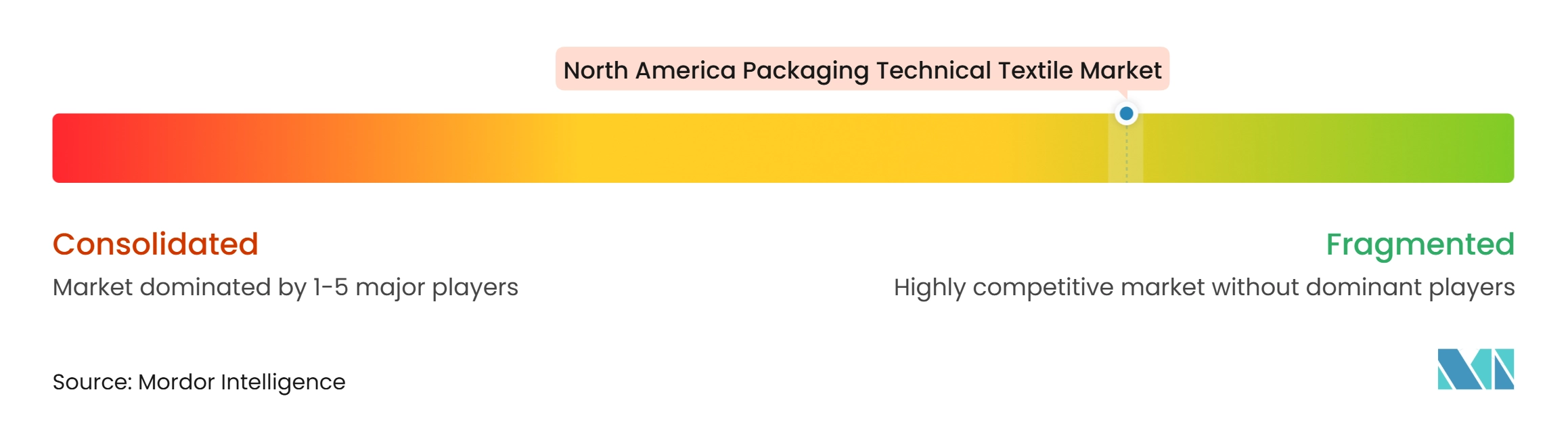
The North America packaging technical textile market is moderately fragmented, with diversified packaging groups operating alongside FIBC and woven-sack specialists. Large suppliers benefit from polymer purchasing scale, wide customer coverage, and the ability to invest in certified cleanroom capacity. Specialized companies compete through bag engineering, including baffled, ventilated, conductive, and custom configurations. Certification depth, application knowledge, lead-time reliability, and documented quality systems are central competitive factors. ISO 21898 type testing, food safety certifications, and dangerous-goods design approvals can widen a supplier’s accessible customer base.
Mondi’s April 2026 Pittsburgh opening shows how a large producer is adding automated capacity for e-commerce and industrial customers. The site combines production and printing capabilities for e-commerce mailers, food, feed, and construction uses, with a 300-million-bag annual capacity target. Greif acquired Spanish polymer container producer Envaplast for USD 61.7 million, net of cash acquired, in fiscal Q3 2026. Greif also reported USD 105 million in cumulative run-rate cost optimization by the end of fiscal 2026. These actions show continued interest in broader product coverage, production efficiency, and targeted acquisitions.
Opportunities remain in cleanroom capacity for pharmaceutical powders, reusable FIBC programs with RFID or digital product records, and Mexico facilities that can support short lead times for United States customers. Supplier qualification is likely to remain especially important in pharma, food, and hazardous-material applications. United States-Mexico-Canada Agreement compliance also requires attention from companies expanding in Mexican industrial locations. Article 6.6 gives United States Customs and Border Protection authority to conduct site-visit verifications of textile and apparel manufacturing operations in Mexico. Nefab expanded its Mexico capabilities with a Guadalajara engineering center in March 2026, combining design, testing, prototyping, and production for digital infrastructure, healthcare, semiconductor, and automotive customers. Competition will remain balanced between scale-led suppliers and specialized producers that can meet complex application requirements.
North America Packaging Technical Textile Industry Leaders
-
Berry Global Inc. (Amcor)
-
Greif, Inc.
-
Gravis Global
-
Conitex Sonoco
-
LC Packaging International BV
- *Disclaimer: Major Players sorted in no particular order
North America Packaging Technical Textile Market Companies Covered in this Report
- Berry Global Inc. (Amcor)
- Greif, Inc.
- Gravis Global
- Conitex Sonoco
- LC Packaging International BV
- Signode Industrial Group LLC
- Intertape Polymer Group Inc.
- AmeriGlobe LLC
- Langston Companies, Inc.
- Global-Pak, Inc.
- United Bags, Inc.
- Halsted Corporation
- Bulk Lift International LLC
- Bag Corporation
- MiniBulk, Inc.
- JohnPac, LLC
- FAST PRO Bags and Textiles, Inc.
- InterBULK, Inc.
- Mondi plc
- Sonoco Products Company
- ProAmpac LLC
- Novolex Holdings, LLC
Recent Industry Developments in North America Packaging Technical Textile Market
- October 2026: Nefab inaugurated a new 7,000 m² facility in the Monterrey metropolitan area, bringing ExPak collapsible plywood packaging production to Mexico for the first time and creating up to 100 jobs. The facility responds to growing demand for industrial packaging from nearshoring manufacturers in northern Mexico across automotive, electronics, datacom, and broader industrial sectors.
- August 2026: SACK Packaging, a joint venture between Sacos y Empaques Internacionales and Finch Pack, part of Grupo Orbion, Mexico, and Knack Packaging, India, commenced operations in León, Guanajuato, with a USD 13 million investment and approximately 170 direct jobs. The 11,417 m² plant in Urban Park Industrial León is designed to manufacture woven and flexible packaging for the Mexican, North American, and international markets.
- April 2026: Mondi officially opened its new state-of-the-art packaging production facility in Pittsburgh, Pennsylvania, consolidating capacity from its Wellsburg, West Virginia, and Oakdale, Pennsylvania, sites and adding advanced automated production lines targeting e-commerce mailers, food, feed, and construction sectors, with an annual capacity target of 300 million paper bags.
North America Packaging Technical Textile Market Report Scope
The North America Packaging Technical Textile Market Report is Segmented by Product Type (Flexible Intermediate Bulk Containers (FIBCs), Woven Polyolefin Sacks and Bags, and More), by Material Type (Polypropylene and More), by End-Use Application (Agriculture and Fresh Produce Packaging and More), and by Geography (United States and More). The Report Offers Market Size and Forecasts in Value (USD) for all the Above Segments.
Segmentation Overview
| Flexible Intermediate Bulk Containers (FIBCs) | Conventional Bulk FIBCs |
| Form-Stable and Baffle FIBCs | |
| Ventilated FIBCs | |
| Other Specialized FIBCs | |
| Woven Polyolefin Sacks and Bags | |
| Jute and Other Natural-Fiber Packaging Textiles | Jute Sacking and Finished Packaging Bags |
| Others (Hessian, Burlap, Natural-Fiber Packaging Cloth, Speciality Packaging) | |
| Mesh and Netted Packaging Textiles | Leno Woven Packaging Bags |
| Raschel Knitted Packaging Bags | |
| Tubular Knitted Packaging Nets and Sleeves | |
| Other Textile Mesh Packaging Products | |
| Wrapping and Transit-Protection Textiles | Industrial Bale and Goods Wrapping Fabrics |
| Textile Packaging Covers and Protective Wraps | |
| Textile-Based Container Liners and Cargo Protection Fabrics | |
| Textile Pallet Netwrap and Load-Securing Materials | |
| Textile Packaging Sleeves, Padding, and Dunnage | |
| Nonwoven and Specialty Textile Packaging Products (Shopping and Carrying Bags, Protective Packaging Bags and Pouches, etc.) |
| Polypropylene |
| Polyethylene |
| Polyester |
| Jute |
| Cotton and Other Natural Fibers |
| Regenerated Cellulosic Fibers |
| Polyamide and Other Specialty Synthetic Fibers |
| Other Materials |
| Agriculture and Fresh Produce Packaging | Fresh Fruits and Vegetables |
| Seeds and Other Agricultural Commodities | |
| Food and Beverage Processing | Food Grains, Flour, and Sugar |
| Processed Food and Food Ingredients | |
| Animal Feed and Pet Food | |
| Beverage Ingredients and Infusion Products | |
| Chemicals, Petrochemicals, and Fertilizers | |
| Construction Materials, Minerals, and Mining | |
| Pharmaceuticals and Healthcare Products | |
| Retail, E-Commerce, and Consumer Goods | |
| Other Industrial Products and Materials |
| United States |
| Canada |
| Mexico |
| By Product Type | Flexible Intermediate Bulk Containers (FIBCs) | Conventional Bulk FIBCs |
| Form-Stable and Baffle FIBCs | ||
| Ventilated FIBCs | ||
| Other Specialized FIBCs | ||
| Woven Polyolefin Sacks and Bags | ||
| Jute and Other Natural-Fiber Packaging Textiles | Jute Sacking and Finished Packaging Bags | |
| Others (Hessian, Burlap, Natural-Fiber Packaging Cloth, Speciality Packaging) | ||
| Mesh and Netted Packaging Textiles | Leno Woven Packaging Bags | |
| Raschel Knitted Packaging Bags | ||
| Tubular Knitted Packaging Nets and Sleeves | ||
| Other Textile Mesh Packaging Products | ||
| Wrapping and Transit-Protection Textiles | Industrial Bale and Goods Wrapping Fabrics | |
| Textile Packaging Covers and Protective Wraps | ||
| Textile-Based Container Liners and Cargo Protection Fabrics | ||
| Textile Pallet Netwrap and Load-Securing Materials | ||
| Textile Packaging Sleeves, Padding, and Dunnage | ||
| Nonwoven and Specialty Textile Packaging Products (Shopping and Carrying Bags, Protective Packaging Bags and Pouches, etc.) | ||
| By Material Type | Polypropylene | |
| Polyethylene | ||
| Polyester | ||
| Jute | ||
| Cotton and Other Natural Fibers | ||
| Regenerated Cellulosic Fibers | ||
| Polyamide and Other Specialty Synthetic Fibers | ||
| Other Materials | ||
| By End-Use Application | Agriculture and Fresh Produce Packaging | Fresh Fruits and Vegetables |
| Seeds and Other Agricultural Commodities | ||
| Food and Beverage Processing | Food Grains, Flour, and Sugar | |
| Processed Food and Food Ingredients | ||
| Animal Feed and Pet Food | ||
| Beverage Ingredients and Infusion Products | ||
| Chemicals, Petrochemicals, and Fertilizers | ||
| Construction Materials, Minerals, and Mining | ||
| Pharmaceuticals and Healthcare Products | ||
| Retail, E-Commerce, and Consumer Goods | ||
| Other Industrial Products and Materials | ||
| By Geography | United States | |
| Canada | ||
| Mexico | ||
Key Questions Answered in the Report
What is the forecast for North America packaging technical textiles?
The market is expected to increase from USD 3.70 billion in 2027 to USD 4.51 billion by 2032, at a 4.04% CAGR, supported by regulated bulk handling and regional manufacturing investment.
Which product category has the largest position in North America packaging technical textiles?
Woven polyolefin sacks and bags hold the largest position, with a 32.0% share in 2026, supported by their use across agriculture, construction, chemicals, and retail distribution
Which material is most widely used for packaging technical textiles in North America?
Polypropylene leads materials with a 48.0% share in 2026 because it is used across woven sacks, standard FIBCs, and nonwoven carriers with established performance characteristics
Which end-use is growing fastest for North America packaging technical textiles?
Pharmaceuticals and healthcare products are the fastest-growing end use through 2032, registering a 6.2% CAGR, supported by controlled packaging systems, cleanroom production, and extensive qualification requirements.
Why are FIBCs gaining use in bulk packaging?
FIBCs reduce return freight and storage requirements because empty single-trip bags can fold to 3-5% of their filled volume and can be configured for defined handling needs.
Which North American country is expected to grow fastest?
Mexico is forecast to grow at a 5.50% CAGR through 2032, supported by regional manufacturing investment, industrial clusters, and United States-Mexico-Canada Agreement rules.