
North America Mechanical Presses Market Size and Share
Market Overview
| Study Period | 2021 - 2032 |
|---|---|
| Forecast Data Period | 2027 - 2032 |
| Base Year Market Size (2025) | USD 0.49 Billion |
| Market Size (2027) | USD 0.52 Billion |
| Market Size (2032) | USD 0.72 Billion |
| Growth Rate (2027 - 2032) | 6.72 % |
| Market Concentration | Medium |
Major Players *Disclaimer: Major Players sorted in no particular order Image © Mordor Intelligence. Reuse requires attribution under CC BY 4.0. | |
North America Mechanical Presses Market Analysis by Mordor Intelligence
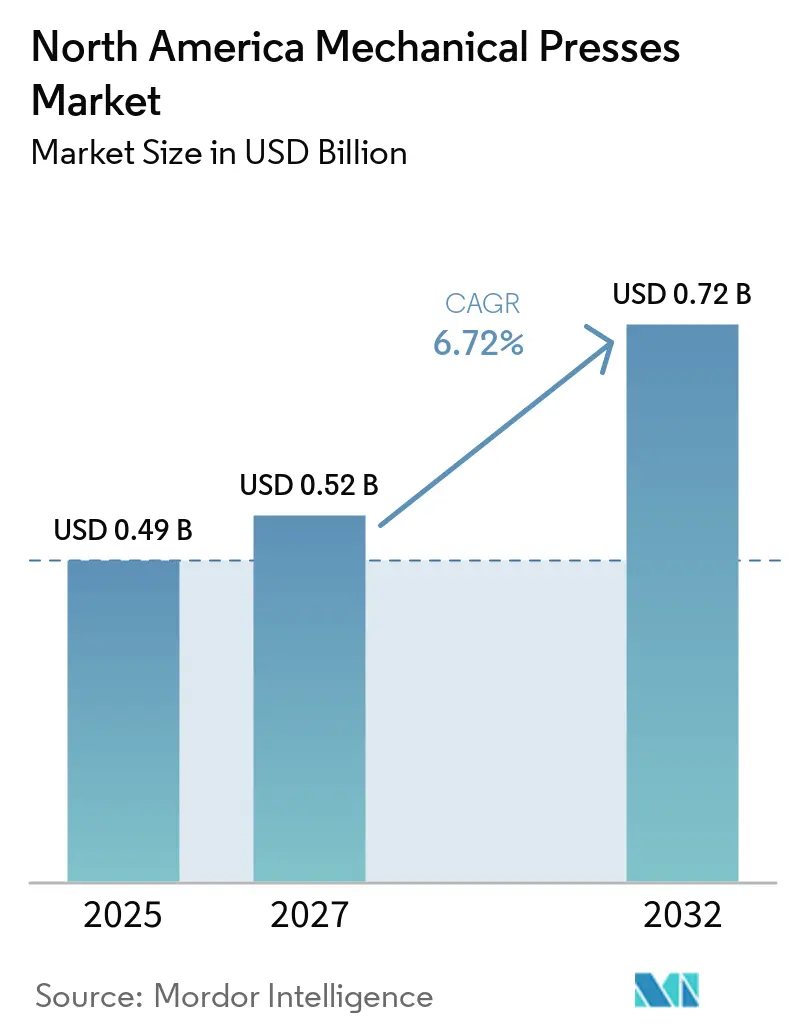
The North America Mechanical Presses Market size is projected to expand from USD 0.49 billion in 2026 and USD 0.52 billion in 2027 to USD 0.72 billion by 2032, registering a CAGR of 6.72% between 2027 and 2032.
Reshoring and nearshoring are bringing metal-forming work closer to North American vehicle, appliance, aerospace, and industrial customers, supporting investment in localized stamping capacity. Electric vehicle production is changing press requirements for battery enclosures, motor laminations, lightweight structural parts, and other high-strength components, while demand from HVAC, electrical equipment, and industrial machinery is creating additional applications. This shift supports both new press purchases and upgrades for equipment already in use. Higher automation, stronger safety systems, servo-driven operation, automated material handling, and connected controls are becoming increasingly important as manufacturers seek higher productivity, shorter setup times, and greater production flexibility amid skilled-labor shortages. Growing use of advanced high-strength steel, aluminum, and other lightweight materials is also encouraging manufacturers to modernize press capacity and tooling capabilities. At the same time, manufacturing investments and supply-chain localization across North America are creating opportunities for mechanical press suppliers, although high equipment and steel costs, qualification requirements, limited availability of skilled technicians, and the capital intensity of replacing large presses may slow the conversion of planned investments into operating capacity.
Key Report Takeaways
- By frame type, straight-side or H-frame mechanical presses held 43.8% of the North America mechanical presses market share in 2026, while C-frame or gap-frame presses are forecast to grow at a 7.2% CAGR through 2032.
- By capacity, the 101 to 500 ton category accounted for 38.6% of the North America mechanical presses market size in 2026, while the 501 to 1,000 ton category is forecast to grow at a 7.6% CAGR through 2032.
- By application, blanking and punching held 30.9% of revenue in 2026, while high-speed and precision stamping is forecast to grow at an 8.1% CAGR through 2032.
- By end-use industry, automotive and transportation held 37.2% of revenue in 2026, while electrical and electronics is forecast to grow at an 8.0% CAGR through 2032.
- By geography, the United States held 83.4% of regional revenue in 2026, while Mexico is forecast to grow at an 8.5% CAGR through 2032.
Note: Market numbers in this report are based on Mordor Intelligence's proprietary estimation framework, which combines nine months of actuals with Q4 projections for base year 2026.
North America Mechanical Presses Market Trends and Insights
Drivers Impact Analysis*
| Driver | (~) % Impact on CAGR Forecast | Geographic Relevance | Impact Timeline |
|---|---|---|---|
| Reshoring and Nearshoring of Metal-Forming Capacity | +2.1% | United States, Mexico | Short term (≤ 2 years) |
| EV Battery, Body and Structural-Component Production | +1.4% | United States, Mexico | Medium term (2-4 years) |
| High-Speed, High-Volume Automotive and Appliance Stamping | +0.9% | United States, Mexico | Short term (≤ 2 years) |
| Aerospace Lightweighting and Defense Capacity Expansion | +0.7% | United States | Medium term (2-4 years) |
| Servo, Robotics and Industry 4.0 Retrofit Demand | +0.5% | United States, Canada | Medium term (2-4 years) |
| Connected Press Monitoring as a Serviceability Differentiator | +0.3% | United States, Canada | Long term (≥ 4 years) |
| Source: Mordor Intelligence | |||
Reshoring and Nearshoring of Metal-Forming Capacity
Reshoring is supporting demand in the North America mechanical presses market because new domestic plants need forming capacity and production automation. The Reshoring Initiative reported that 63% of surveyed OEMs planned United States capital investments in 2026 or 2027 for reshoring or domestic expansion. It also reported that 36% of respondents were already reshoring or executing further reshoring programs, compared with 29% in 2025. New facilities often specify larger beds, automated transfer systems, modern controls, die-change arrangements, and integrated material handling instead of replicating older equipment. These choices raise project complexity but also allow manufacturers to improve repeatability, staffing efficiency, and the consistency of parts supplied to regional assembly programs. This can increase the value of each project even where unit demand changes modestly. Mexico adds a related source of demand because its 2025 to 2030 National Development Plan places nearshoring at the center of industrial development, with 477 industrial parks operating or under construction in 2026.
EV Battery, Body, and Structural-Component Production
Electric vehicle programs are creating a distinct set of requirements for the North America mechanical presses market. Battery trays need deep drawing capacity, while motor laminations require high-speed forming, close process control, repeatable feed accuracy, and reliable die protection, which alters the purchase decision because the buyer must consider the entire forming system, including controls, material handling, monitoring, and service support. Structural components can require more tonnage and larger press beds than conventional parts. Magna described its OPTiForm process as a two-stage method for managing metal flow in one-piece rectangular battery enclosures. The process supports demand for presses with precise slide parallelism and consistent forming conditions. Worthington Steel stated that Tempel introduced its Full Surface Bonding process in October 2025, which was approved for production at multiple automotive OEMs and simplifies electrical steel lamination processing.
High-Speed, High-Volume Automotive and Appliance Stamping
Automotive hardware, appliance enclosures, and electrical components continue to require high-volume progressive-die stamping. This demand supports replacement purchases and capacity additions, especially in the 101 to 500 ton range. AIDA-America states that its NSX mechanical presses operate at 120 to 300 strokes per minute and use a zero-clearance roller-guide system. Such equipment addresses dimensional consistency requirements for suppliers working with advanced high-strength steel, giving manufacturers a way to maintain stable production across long runs, where small variations in alignment, material feed, or press motion can affect downstream assembly and quality work. The 2025 National Metalworking Reshoring Award recognized GE Appliances for domestic manufacturing investment, reinforcing the role of appliance production in United States stamping demand. Nidec Minster introduced its MMC Titan Gap Press series in February 2026 with stock availability and integrated controls, responding to buyers who need shorter delivery periods.
Aerospace Lightweighting and Defense Capacity Expansion
Aerospace and defense manufacturing investment is supporting higher-capacity press demand in the United States. Arconic commissioned a USD 57.5 million expansion at Davenport Works in September 2025 to increase domestic high-purity aluminum production for defense and aerospace applications. Raytheon began a USD 53 million expansion of its Lower Tier Air and Missile Defense Sensor facility in October 2025. These projects strengthen demand across suppliers of formed aluminum, titanium, and high-strength alloy parts and their effect extends beyond the original site because component makers, tooling providers, maintenance teams, and materials processors must prepare for programs with demanding documentation and production requirements. Larger straight-side presses can be suitable for these applications because they provide rigidity and capacity for demanding structural work. Aerospace work, therefore, supports the 501 to 2,000 ton range even though the total number of programs is smaller than that of automotive production.
Restraints Impact Analysis*
| Restraint | (~) % Impact on CAGR Forecast | Geographic Relevance | Impact Timeline |
|---|---|---|---|
| High Capital Intensity and Long Qualification Cycles | -1.2% | North America, especially mid-market | Short term (≤ 2 years) |
| Skilled Service and Controls-Integration Labor Shortages | -0.8% | United States, Canada | Medium term (2-4 years) |
| Steel-Price, Tariff, and Imported-Component Volatility | -0.6% | United States, Mexico | Short term (≤ 2 years) |
| Legacy-Press Safety Upgrades and Cybersecurity Compliance Burden | -0.4% | United States, Canada | Long term (≥ 4 years) |
| Source: Mordor Intelligence | |||
High Capital Intensity and Long Qualification Cycles
Mechanical press procurement requires significant capital, engineering review, installation work, and production validation. OSHA requires mechanical power presses to have point-of-operation safeguarding and requires regular inspection of clutch and brake controls.[1] Buyers in aerospace, defense, and automotive also perform first-article work, dimensional capability studies, and safety documentation before production begins. These steps can extend the period between a purchase order and productive output for large systems because buyers must coordinate press acceptance, foundation work, die development, operator training, safeguarding validation, and production trials before the equipment can provide its planned capacity. United States tax treatment can lower after-tax equipment costs, but it does not remove the technical work required to qualify a press. Steel tariffs also affect project economics because the April 2026 proclamation applied duties to the full entered value of certain imported steel and aluminum articles. Buyers may delay decisions when equipment and component costs become harder to forecast.[2]
Skilled Service and Controls-Integration Labor Shortages
A limited supply of specialized workers can delay new installations and retrofit projects in the North America mechanical presses market. The Bureau of Labor Statistics recorded 56,060 cutting, punching, and press machine setters, operators, and tenders in fabricated metal product manufacturing in 2025.[3] The Reshoring Initiative found that 66% of surveyed OEMs considered hiring welders, machinists, and electrical technicians very difficult or at crisis levels. It also found that 60% gave the same assessment for maintenance and repair staff. The Federal Reserve Bank of Cleveland reported that United States manufacturing employment declined by 6.6 million from 1979 to 2025. Labor shortages limit how quickly we can commission, modernize, and maintain press capacity, and make it more important to work with suppliers that provide clear controls interfaces, remote diagnostics, documented service procedures, and training that help customer teams resolve routine issues more quickly across regional manufacturing operations.
*Our forecasts treat driver/restraint impacts as directional, not additive. The impact forecasts reflect baseline growth, mix effects, and variable interactions.
Segment Analysis
By Frame / Structural Configuration: Straight-Side Presses Support Larger Structural Work
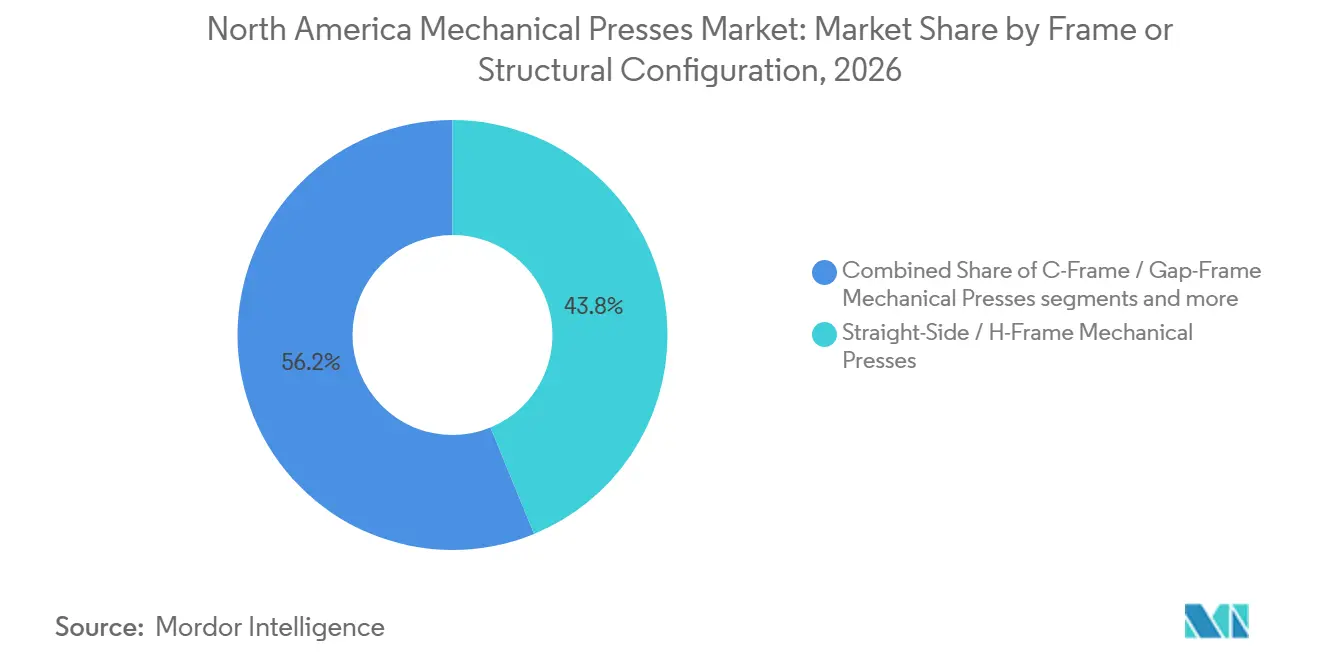
Straight-side or H-frame mechanical presses held 43.8% of the North America mechanical presses market share in 2026. Their rigid construction supports transfer lines and progressive-die operations for automotive structural and closure parts. The configuration helps maintain slide parallelism under uneven loads. It is suited to aerospace components and electric vehicle structural parts that require stable forming conditions. Larger beds and higher tonnage keep this format important in premium automotive and industrial applications.
C-frame or gap-frame mechanical presses are forecast to expand at a 7.2% CAGR through 2032. The North America mechanical presses market size for this configuration benefits from job shops, compact progressive-die operations, and controls retrofits. Its open-front design can simplify setup and die changes in high-mix production. Nidec Minster introduced MMC Titan Gap Press models from 35 to 315 tons in February 2026. Solid or monoblock frames remain relevant for coining and precision blanking, where reduced deflection is important.

By Press Force / Capacity: Mid-Range Capacity Leads While Heavy Presses Grow Faster
The 101 to 500 ton category held 38.6% of the North America mechanical presses market size in 2026. This capacity range serves automotive blanking, appliance enclosure forming, hardware progressive dies, and general fabrication. It has broad tooling availability and a relatively deep pool of service experience. Automotive Tier 1 suppliers and contract fabricators both use this band. This spread supports replacement demand through changing economic conditions.
The 501 to 1,000 ton category is forecast to grow at a 7.6% CAGR through 2032. It is used for battery enclosure forming, aerospace structural parts, and wider progressive or transfer dies. Reshoring projects can require this range when plants bring back work that used wider coils or deeper draws overseas. The upper end of the capacity range supports specialized structural applications where bed length and forming force are critical. Up to 100-ton presses continue to serve fine blanking, coining, and electrical contact production.
By Application / Process: Blanking Leads While High-Speed Stamping Gains Momentum
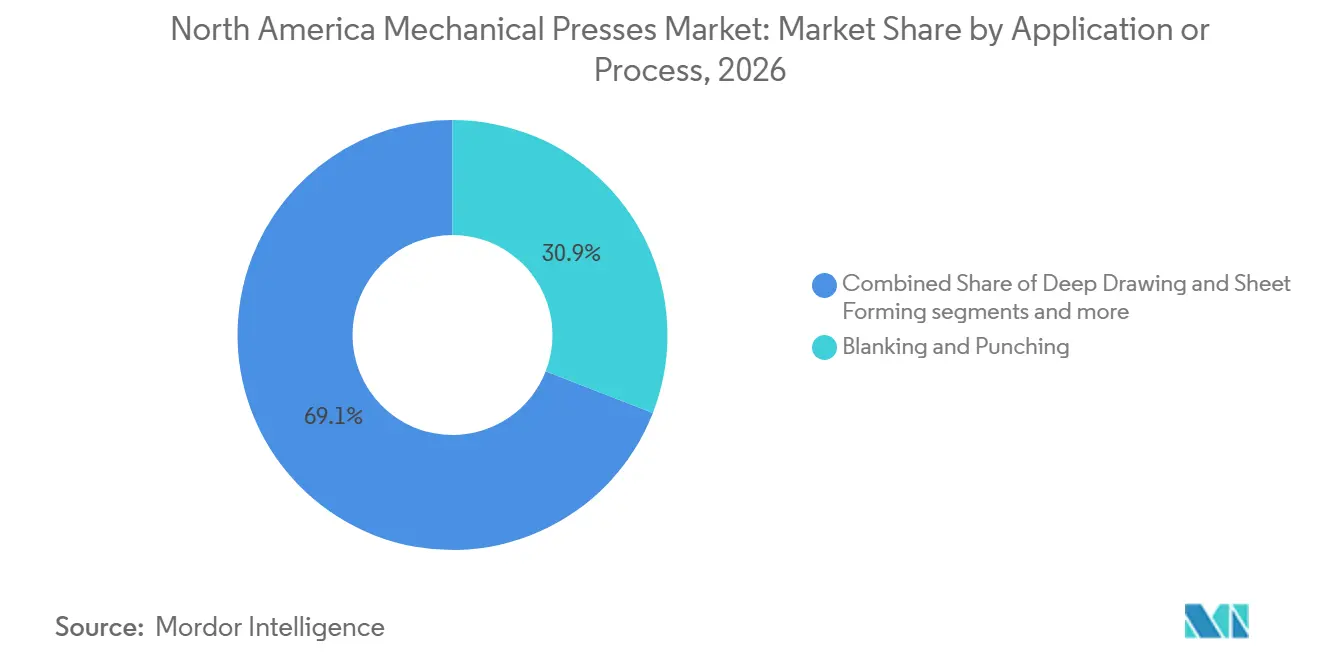
Blanking and punching held 30.9% of application revenue in 2026. The North America mechanical presses market share for this process reflects use across automotive, appliance, and general industrial supply chains. The process suits repeated, high-volume work where cycle time and tooling consistency are important. Its revenue growth is linked closely to production volumes in end markets. The broad installed base also creates demand for controls, safety, and monitoring upgrades.
High-speed and precision stamping is forecast to grow at an 8.1% CAGR through 2032. Thin electrical steel for stator and rotor cores requires high-speed presses, thermal stability, and die-protection systems. Electric motor and battery component production requires high-speed equipment with repeatable motion, stable temperature control, and die-protection systems. Magna’s OPTiForm process highlights the production challenge of forming large rectangular battery enclosures. Fine blanking and coining remain important for precision gearing, transmission, and brake components.
By End-Use Industry: Automotive Leads Demand While Electrical Applications Grow Fastest
Automotive and transportation held 37.2% of revenue in 2026. The North America mechanical presses market size for this end use is supported by stamping plants in the United States Midwest and supply networks across Mexico. Vehicle production uses different press types for body panels, structural parts, battery enclosures, and motor laminations. Body-in-white work favors large, straight-sided, and transfer presses. This range of applications creates separate replacement and expansion cycles within automotive production.
Electrical and electronics is forecast to expand at an 8.0% CAGR through 2032. Motor laminations, transformer cores, connector terminals, consumer electronics, and data-center power systems support demand. Tempel’s Full Surface Bonding technology indicates that electrical steel processing is changing at automotive suppliers. Appliance manufacturing remains a steady source of press demand for high-speed gap-frame and straight-side equipment. Aerospace, defense, industrial machinery, and metal products provide additional demand for specialized presses.
Geography Analysis
The United States held 83.4% of the North America mechanical presses market share in 2026. Its large stamping base includes automotive plants in Michigan, Ohio, Kentucky, and Tennessee. Aerospace and defense supply chains extend across Alabama, Connecticut, Texas, and other states. The Reshoring Initiative reported 247,000 manufacturing jobs announced through reshoring and foreign direct investment in 2025, while fabricated metal manufacturing announcements rose 19%. OSHA safeguards and ANSI requirements create recurring demand for safety work on older presses.
Mexico is forecast to grow at an 8.5% CAGR through 2032. The North America mechanical presses market size in Mexico is supported by nearshoring investment and supply chains that comply with USMCA requirements. The Mexican government reported 477 industrial parks in operation or under construction across 28 states in 2026. Plants operate as extensions of United States assembly programs and must meet comparable process and dimensional standards. Investment in regional automotive supply chains supports demand for presses that meet comparable process and dimensional standards.
Canada represents a smaller but stable portion of regional demand. Automotive Tier 1 suppliers in Ontario and aerospace fabricators in Quebec and British Columbia support equipment replacement and rebuild activity. Canadian facilities work under domestic safety requirements and regional sourcing incentives created by USMCA. Its established manufacturing base supports predictable retrofit and maintenance cycles.
Competitive Landscape
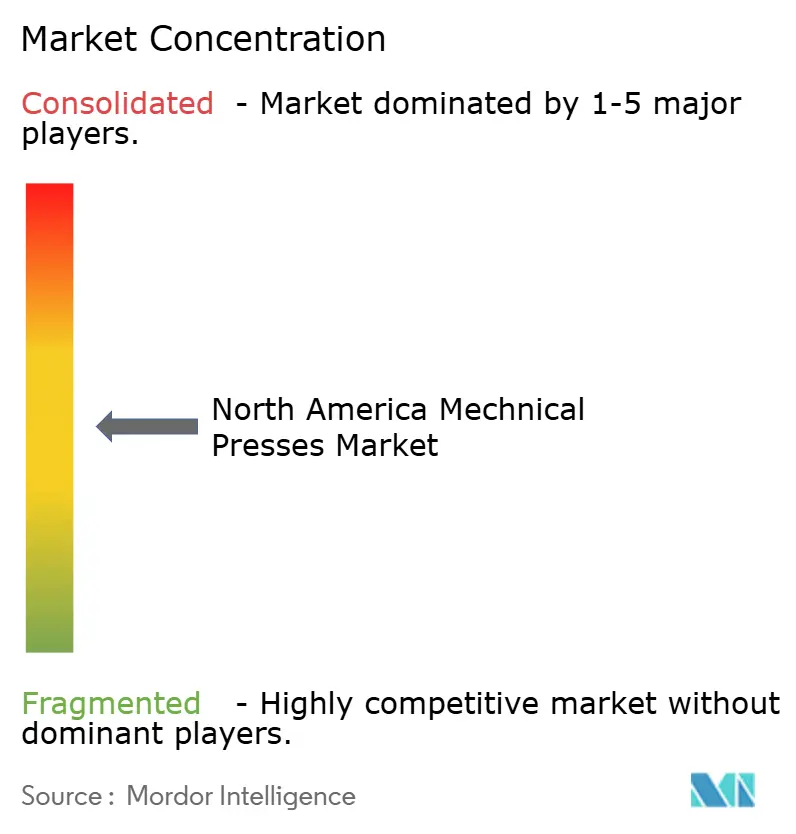
The North America mechanical presses market exhibits a medium level of market concentration. ANDRITZ Schuler Group, AIDA Engineering, and Komatsu Industries are prominent in high-tonnage transfer press programs for automotive OEMs and Tier 1 suppliers. Their application engineering capabilities and long replacement cycles support established customer relationships. ANDRITZ Schuler and Feintool developed next-generation HFA fineblanking presses, with two 8,800 kN HFA plus systems built for Feintool’s United States operations by early 2026. Nidec Minster and Sutherland Presses compete with shorter lead times, local service, and North American-supported control platforms.
The installed base creates a separate opportunity for companies that offer modernization rather than complete replacement. Sutherland Press estimates that 75,000 to 100,000 mechanical presses operate in North America, and many control systems become obsolete each year. Retrofit suppliers can address controls, safety monitoring, tonnage signatures, and connected diagnostics without replacing sound press frames. Sutherland launched a browser-based I-PRESS simulator in April 2026 for pre-sales evaluation. CISA’s December 2025 performance goals make cybersecurity documentation more relevant for connected press installations.
JIER Machine-Tool Group, SEYI Machinery, and Stamtec offer competitive pricing and expanding regional support for price-sensitive buyers. Shorter delivery periods can change purchasing decisions where manufacturers need to bring new production programs online quickly. Buyers compare delivery certainty, field support, controls compatibility, and upgrade options as closely as initial equipment cost.
North America Mechanical Presses Industry Leaders
-
AIDA Engineering Ltd.
-
ANDRITZ Schuler Group
-
Komatsu Industries Corp.
-
Nidec Minster Corporation
-
Stamtec, Inc.
- *Disclaimer: Major Players sorted in no particular order
Recent Industry Developments
- April 2026: Nidec Drive Technology opened a press machine assembly factory in Ritto, Shiga Prefecture. The facility doubled domestic Japanese production capacity from 60 to 120 mechanical press machines per year and increased the product ceiling from 150 to 330 tons.
- April 2026: The United States government restructured Section 232 tariffs to apply duties to the full entered value of specified steel- and aluminum-containing articles.
- February 2026: Nidec Minster introduced the MMC Titan Gap Press series in single-point 35 to 315 ton and two-point 110 to 315 ton configurations for North America stamping customers.
- January 2026: ANDRITZ Schuler and Feintool advanced their fineblanking press collaboration, with two 8,800 kN HFA plus systems built for Feintool’s United States operations.
North America Mechanical Presses Market Report Scope
The North America Mechanical Presses Market is Segmented by Frame Configuration (C-Frame Mechanical Presses, Straight-Side Mechanical Presses, and More), by Press Force (101–500 Tons, and More), by Application (Blanking and Punching, Fine Blanking, and More), by End-Use Industry (Electrical and Electronics, Energy and Power, and More), by Geography (United States, Canada, and More). The Market Forecasts are Provided in Terms of Value (USD).
| C-Frame / Gap-Frame Mechanical Presses |
| Straight-Side / H-Frame Mechanical Presses |
| Solid / Monoblock Frame Mechanical Presses |
| Other Mechanical Press Configurations |
| Up to 100 Tons |
| 101–500 Tons |
| 501–1,000 Tons |
| 1,001–2,000 Tons |
| Above 2,000 Tons |
| Blanking and Punching |
| Deep Drawing and Sheet Forming |
| Coining and Embossing |
| Fine Blanking |
| High-Speed and Precision Stamping |
| Other Mechanical Press Applications |
| Automotive and Transportation |
| Electrical and Electronics |
| Appliances and Consumer Durables |
| Industrial Machinery and Equipment |
| Metal Products and General Manufacturing |
| Aerospace and Defense |
| Construction and Heavy Equipment |
| Energy and Power |
| Other End-Use Industries |
| United States |
| Canada |
| Mexico |
| By Frame / Structural Configuration | C-Frame / Gap-Frame Mechanical Presses |
| Straight-Side / H-Frame Mechanical Presses | |
| Solid / Monoblock Frame Mechanical Presses | |
| Other Mechanical Press Configurations | |
| By Press Force / Capacity | Up to 100 Tons |
| 101–500 Tons | |
| 501–1,000 Tons | |
| 1,001–2,000 Tons | |
| Above 2,000 Tons | |
| By Application / Process | Blanking and Punching |
| Deep Drawing and Sheet Forming | |
| Coining and Embossing | |
| Fine Blanking | |
| High-Speed and Precision Stamping | |
| Other Mechanical Press Applications | |
| By End-Use Industry | Automotive and Transportation |
| Electrical and Electronics | |
| Appliances and Consumer Durables | |
| Industrial Machinery and Equipment | |
| Metal Products and General Manufacturing | |
| Aerospace and Defense | |
| Construction and Heavy Equipment | |
| Energy and Power | |
| Other End-Use Industries | |
| By Geography | United States |
| Canada | |
| Mexico |
Key Questions Answered in the Report
What is the outlook for mechanical presses in North America?
The North America mechanical presses market is projected to rise from USD 0.49 billion in 2026 to USD 0.72 billion by 2032, at a 6.72% CAGR.
Which end-use segment has the greatest demand for mechanical presses in North America?
Automotive and transportation leads with a 37.2% revenue share in 2026, supported by body, structural, battery enclosure, and motor component production.
Which mechanical press configuration is most widely used in North America?
Straight-side or H-frame presses lead with a 43.8% share in 2026 because they support high-tonnage transfer and progressive-die operations.
Why are high-speed mechanical presses gaining demand?
High-speed and precision stamping is forecast to grow at an 8.1% CAGR through 2032 because electric motor laminations require rapid, closely controlled forming.
Which country is growing fastest for mechanical press demand in North America?
Mexico is forecast to grow at an 8.5% CAGR through 2032, supported by nearshoring and automotive supply-chain investment.
How do retrofit programs affect press suppliers?
Controls, safety, and connected monitoring upgrades expand service opportunities across an installed base estimated at 75,000 to 100,000 presses in North America.