
North America Manufacturing Inspection Services Market Size and Share
Market Overview
| Study Period | 2021 - 2032 |
|---|---|
| Forecast Data Period | 2027 - 2032 |
| Base Year Market Size (2026) | USD 6.77 Billion |
| Market Size (2027) | USD 7.22 Billion |
| Market Size (2032) | USD 9.66 Billion |
| Growth Rate (2027 - 2032) | 6.00 % |
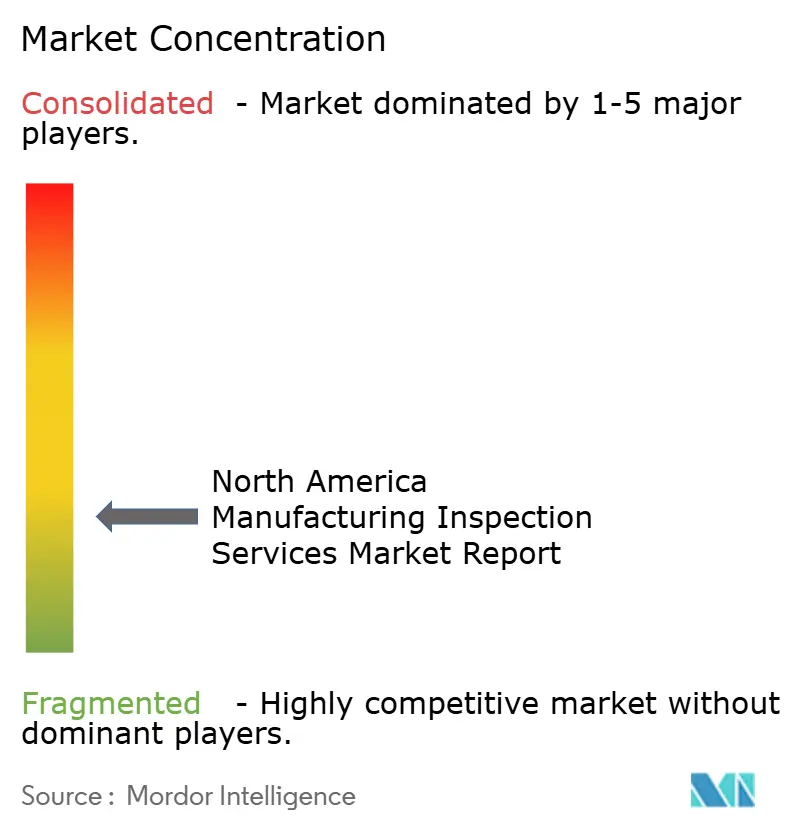
| Market Concentration | Low |
Major Players *Disclaimer: Major Players sorted in no particular order Image © Mordor Intelligence. Reuse requires attribution under CC BY 4.0. | |
North America Manufacturing Inspection Services Market Analysis by Mordor Intelligence
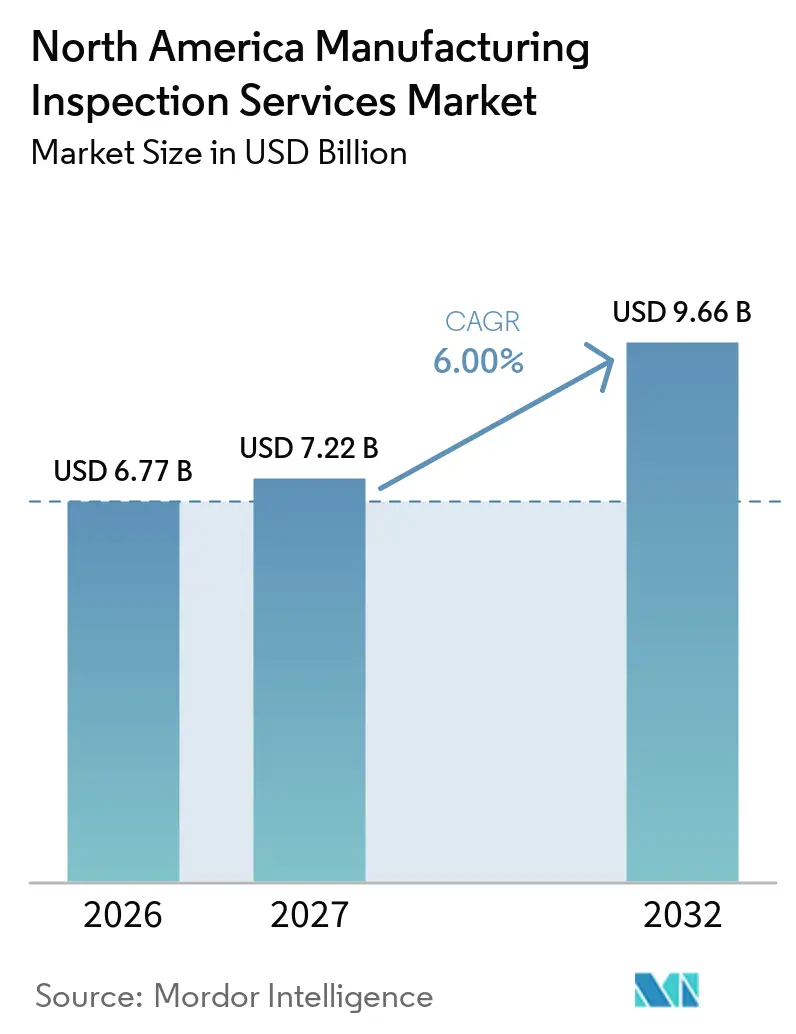
The North America Manufacturing Inspection Services Market Report Industry size is projected to be USD 6.77 billion in 2026, USD 7.22 billion in 2027, and reach USD 9.66 billion by 2032, growing at a CAGR of 6% from 2027 to 2032.
Reshoring and nearshoring are expanding the inspection footprint because new facilities need pre-production, first-article, in-process, and final-product checks before output can scale. Semiconductor fabrication, electric vehicle battery plants, and precision aerospace production are adding work that requires higher technical capability. Regulatory requirements in medical devices, pharmaceuticals, aerospace, and industrial operations support recurring demand for accredited inspection providers. Automated optical systems, defect recognition software, and factory data connections are changing service delivery and favoring firms that can invest in equipment, accreditation, and specialized staff. The North America manufacturing inspection services market is also constrained by the limited supply of certified nondestructive testing personnel, which can slow the ability of providers to take on new assignments.
Key Report Takeaways
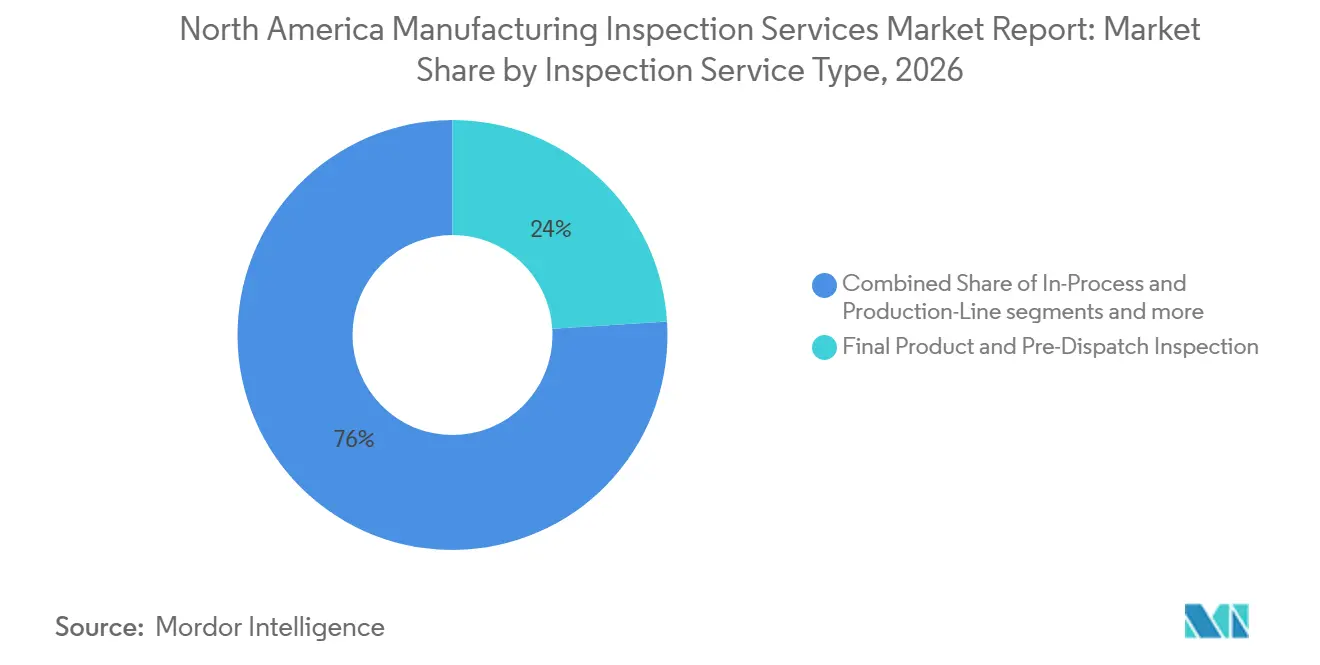
- By inspection service type, final product and pre-dispatch inspection held 24% of the North America manufacturing inspection services market share in 2026, while manufacturing process and production surveillance inspection is projected to grow at a 7.3% CAGR through 2032.
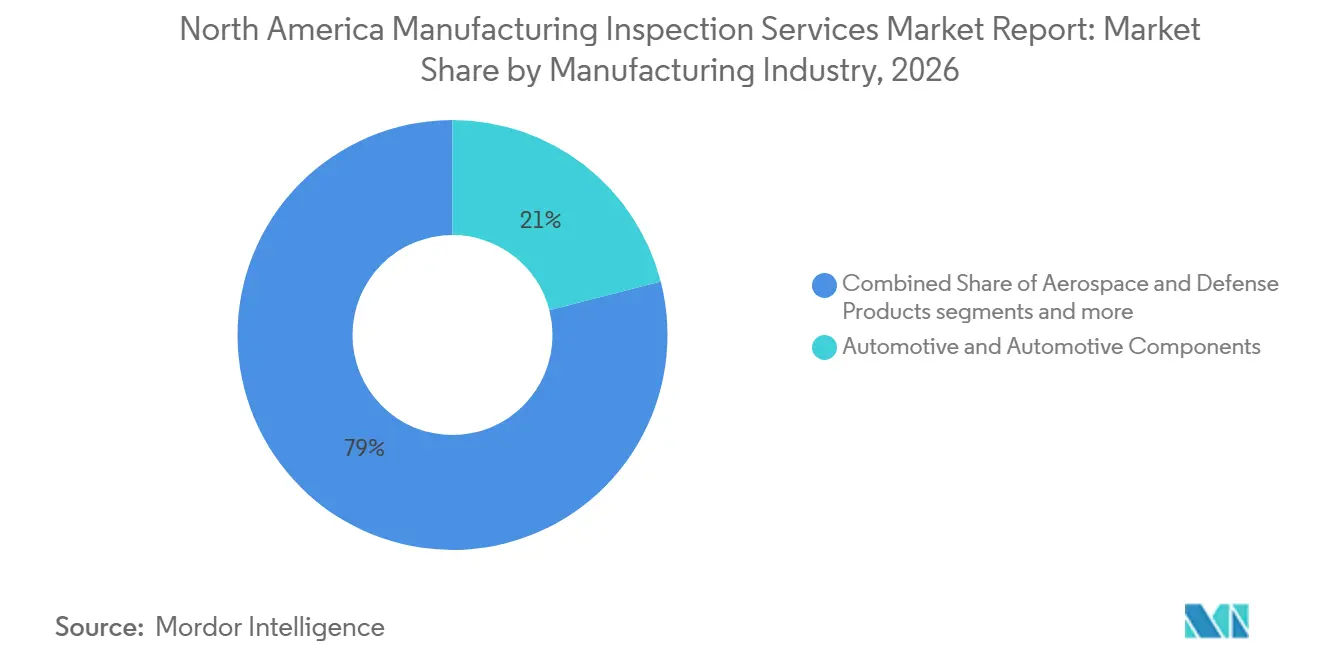
- By manufacturing industry, automotive and automotive components accounted for 21% of the North America manufacturing inspection services market size in 2026, while aerospace and defense products are forecast to expand at a 7.1% CAGR through 2032.
- By geography, the United States held 80% of revenue in 2026, while Mexico is forecast to record a 7.5% CAGR through 2032.
Note: Market numbers in this report are based on Mordor Intelligence's proprietary estimation framework, which combines nine months of actuals with Q4 projections for base year 2026.
Market Trends and Insights
Drivers Impact Analysis of North America Manufacturing Inspection Services Market*
| Driver | (~) % Impact on CAGR Forecast | Geographic Relevance | Impact Timeline |
|---|---|---|---|
| Reshoring and Nearshoring of Manufacturing Capacity | +1.4% | United States Midwest, Southeast, and Southwest, Mexico border states | Short term (≤ 2 years) |
| Increasing Regulatory and Customer Quality Requirements | +1.2% | United States national, Canada Ontario and Alberta | Medium term (2-4 years) |
| Expansion of Semiconductor, Battery and Advanced Electronics Manufacturing | +1% | United States: Arizona, Ohio, Texas, New York, and Oregon; Mexico: Juárez and Monterrey | Medium term (2-4 years) |
| Rising Adoption of Automated and AI-Enabled Inspection | +0.9% | North America manufacturing-dense corridors | Short term (≤ 2 years) |
| Inspection Data Integration with Digital Manufacturing Systems | +0.7% | North America and MRO-heavy export sectors | Medium term (2-4 years) |
| Increasing Outsourcing of Specialized Inspection and Metrology | +0.5% | Global, with North America as primary beneficiary | Long term (≥ 4 years) |
| Source: Mordor Intelligence | |||
Reshoring and Nearshoring of Manufacturing Capacity
Each reshored site creates a new inspection cycle that includes pre-production, first-article, in-process, and final-product work. This work was previously completed offshore or was outside North American service capacity. United States-Mexico truck freight reached USD 872.8 billion in 2025, and computer-related machinery and parts represented 29.4% of bilateral truck trade value after growing 31.2% from the prior year.[1] The National Institute of Standards and Technology expects reshoring to continue as original equipment manufacturers seek local suppliers that need quality assurance across production stages.[2] Peak-hour truck wait times of 40 to 56 minutes at leading United States-Mexico ports encourage inspection in Mexico before goods cross the border. This creates additional inspection points per shipment and extends demand beyond domestic production volumes in the North America manufacturing inspection services market.
Increasing Regulatory and Customer Quality Requirements
Regulatory intensity is increasing in medical devices, pharmaceuticals, and aerospace, which are among the most inspection-dependent manufacturing activities. The Food and Drug Administration implemented its updated medical device inspection framework on February 2, 2026, aligning the Quality Management System Regulation with ISO 13485 and replacing the earlier quality system inspection technique.[3] The agency also extended its voluntary Quality Management Maturity prototype for drug manufacturing in 2025 and continued work on inspection readiness. Aerospace manufacturing requires direct oversight and documented quality controls, particularly for safety-critical production. These requirements create recurring demand for providers that hold relevant accreditations and industry authorizations. They also make compliance capability an important factor when customers select service firms in the North America manufacturing inspection services market.
Expansion of Semiconductor, Battery and Advanced Electronics Manufacturing
Semiconductor and battery production have inspection requirements that are more exacting than many other manufacturing activities. As of July 2025, the Department of Commerce had awarded USD 30.9 billion in direct CHIPS Act funding to 19 companies across 40 projects for semiconductor facilities. More than 100 announced semiconductor projects are expected to create over 500,000 United States jobs and triple domestic chipmaking capacity by 2032. Toyota Battery Manufacturing North Carolina began shipping batteries for North American electric vehicle production in April 2025, while Panasonic started operations at its De Soto, Kansas facility. A 38 GWh annual battery plant can produce 6 million cylindrical cells each day, and cell geometry must be controlled within a few microns. New fabs and battery plants therefore need inspection providers that can qualify for highly specific measurement and verification work in the North America manufacturing inspection services market.
Rising Adoption of Automated and AI-Enabled Inspection
Quality control remained the leading manufacturing use case for artificial intelligence for a second year, and 50% of manufacturers planned to apply AI to product quality in 2025. Vision systems can identify micro-cracks and component misalignment in real time. This supports contract models based on outcomes instead of only billable inspection hours. These systems also create structured defect data that can support predictive quality work when providers have the required software infrastructure. Firms without domain-specific defect-recognition libraries face lower detection performance and less ability to distinguish their pricing. The North America manufacturing inspection services market is therefore placing greater value on inspection firms that combine technical inspection skills with data capability.
Restraints Impact Analysis of North America Manufacturing Inspection Services Market*
| Restraint | (~) % Impact on CAGR Forecast | Geographic Relevance | Impact Timeline |
|---|---|---|---|
| Shortage of Qualified Inspectors and Level III NDT Personnel | -1.4% | United States national, acute in the Southeast, Great Plains, and Gulf Coast | Short term (≤ 2 years) |
| High Cost of Advanced Inspection Equipment and Calibration | -1% | North America and Europe, global supply chain constraints | Medium term (2-4 years) |
| Customer Resistance to Paying for Inspection as a Separate Service | -0.6% | North America small and mid-sized manufacturing and non-regulated sectors | Long term (≥ 4 years) |
| Data Interoperability and Liability Risks in Remote and AI-Assisted Inspection | -0.4% | North America and Europe regulatory harmonization gap | Medium term (2-4 years) |
| Source: Mordor Intelligence | |||
Shortage of Qualified Inspectors and Level III NDT Personnel
The workforce gap is limiting present inspection capacity rather than representing only a future risk. The American Society for Nondestructive Testing wrote to the Departments of Labor, Commerce, and Education in May 2025 to support the inclusion of nondestructive testing in national workforce planning. The Department of Labor approved national apprenticeship guidelines for Level II candidates, creating a formal training route. The ASNT Foundation continued to identify workforce development as the field's most important priority in its 2025 economic impact report released in March 2026. Level III personnel write procedures, qualify lower-level staff, and interpret complex findings after years of supervised experience. Providers that can deploy certified teams on a project basis can serve work that internal inspection teams may not be able to staff in the North America manufacturing inspection services market.
High Cost of Advanced Inspection Equipment and Calibration
Industrial CT scanning, phased-array ultrasonics, coordinate measuring machines, and AI-integrated vision systems require substantial capital investment. Battery-cell production illustrates the challenge because micron-level controls and output near 70 cells per second require continuous, high-volume inspection infrastructure. Calibration under ISO/IEC 17025 and NIST-traceable measurement requirements adds recurring audit, software, and equipment costs. Smaller providers can struggle to carry these costs without raising prices for customers. Large diversified providers can lower unit calibration costs across a broader asset base. This cost structure supports scaled firms in the North America manufacturing inspection services market, while emerging needs in additive manufacturing and composite parts require further specialized investment.
*Our forecasts treat driver/restraint impacts as directional, not additive. The impact forecasts reflect baseline growth, mix effects, and variable interactions.
North America Manufacturing Inspection Services Market Segment Analysis
By Inspection Service Type:
Final-Stage Demand Leads While Surveillance ExpandsFinal Product and Pre-Dispatch Inspection accounted for 24% of revenue in 2026. It operates as the final quality gate for products that need export clearance, retail acceptance, or original equipment manufacturer approval. Supply contracts often require a third-party pre-dispatch check before shipment. This connection to trade requirements makes the service less dependent on manufacturing investment alone. In-Process and Production-Line Inspection also holds a material role because identifying nonconformances during production can limit scrap and rework costs.
Manufacturing Process and Production Surveillance Inspection is projected to grow at a 7.3% CAGR through 2032. The North America manufacturing inspection services market size for this service is supported by a move from periodic sampling toward continuous monitoring through sensors, edge computing, and factory data connections. Production surveillance helps manufacturers observe quality conditions before defects reach the final gate. Quality Containment and Reinspection Services remain needed during economic cycles because recalls and liability exposure persist in automotive, pharmaceutical, and aerospace production. Pre-Production Material and Component Inspection and First-Article and Initial Production Inspection also gain demand as new lines begin operation, since each line needs validation before serial production starts.

By Manufacturing Industry:
Automotive Holds Scale While Aerospace Gains PaceAutomotive and Automotive Components accounted for 21% of revenue in 2026. Multi-tier supplier audit requirements under IATF 16949 help sustain this leading position. Assembly corridors also create dense volumes of parts and supplier quality activity. Original equipment manufacturer programs regularly require production surveillance from third parties. Electric vehicle production adds inspection needs for battery modules, power electronics, and structural battery packaging.
Aerospace and Defense Products is expected to grow at a 7.1% CAGR through 2032. The North America manufacturing inspection services industry benefits in this segment from regulatory oversight, defense procurement, and wider use of advanced composites and additive manufacturing. Pharmaceuticals, Medical Devices and Life Sciences are also consolidating inspection spending following the February 2026 QMSR implementation. Electronics, Electrical Equipment and Semiconductors need specialized metrology for domestic fabs that are entering service under CHIPS Act programs. Food and Beverage Products, Chemicals and Plastics, Industrial Machinery, Building Materials, Textiles, Apparel, and Consumer Products provide broad demand, with Mexico-origin inspections and United States entry reinspection supporting work for consumer goods supply chains.
Geography Analysis
The United States held 80% of North America manufacturing inspection services market revenue in 2026. Manufacturing volume, regulatory complexity, and buyer preference for independent quality checks support this position. FDA-regulated products, FAA-certified aerospace components, and OSHA-governed industrial processes create an ongoing compliance base. More than 100 announced semiconductor projects across 28 states are adding precision-manufacturing demand in areas including Ohio, Arizona, and Texas. This dispersion creates opportunities in locations where nondestructive testing and metrology capacity is still limited.
Mexico is forecast to grow at a 7.5% CAGR through 2032, the highest national rate in the North America manufacturing inspection services market. Global value-chain relocation is directing semiconductor, electric vehicle, and pharmaceutical active-ingredient activity toward Mexico. United States-Mexico truck freight reached USD 872.8 billion in 2025, with computer-related machinery and parts representing 29.4% of bilateral truck value. High-traffic ports including Laredo, Ysleta, and Otay Mesa recorded peak-hour waits of 45 to 56 minutes in 2025. Buyers can therefore choose pre-export inspection in Mexico to reduce the risk of border delays and rejection after entry.
Canada advances more gradually because large original equipment manufacturers already have established in-house inspection capacity. Battery-cell plants in the Ontario-Quebec corridor are creating first-article and in-process inspection needs as new lines enter operation. Canadian standards for electrical, industrial safety, and automotive products create a certification-linked service base. Organizations with both CSA and ISO/IEC 17025 accreditation can serve cross-border customers where this capability is required in the North America manufacturing inspection services market.
Competitive Landscape
The North America manufacturing inspection services market exhibits a low level of market concentration. SGS, Bureau Veritas, Intertek, TÜV Rheinland, and Element Materials Technology have scale in regulated and technically demanding work. MISTRAS Group, Acuren Group, UL Solutions, and National Technical Systems compete through domain expertise and proximity to manufacturing sites. SGS signed an agreement in July 2025 to acquire Applied Technical Services for USD 1.325 billion, adding 85 United States facilities and 2,100 professionals across manufacturing, aerospace and defense, and power work. The company stated that the transaction would take its annual North American revenue above USD 1.5 billion and targeted USD 30 million in annual EBITDA synergies within 3 years.
Technology differentiation becomes important in the North America manufacturing inspection services market once providers meet baseline accreditation requirements. MISTRAS Group launched MISTRAS Data Solutions in April 2025 and combined 9 platforms, including Sensoria, PCMS, and MISTRAS OneSuite. The move links field inspection data with analytics, industrial internet tools, digital twin models, and inspection-data management. UL Solutions expanded its Marketing Claim Verification services to industrial software, AI-enabled factory platforms, digital twins, and augmented reality systems in September 2025. Providers with defect-recognition libraries for weld discontinuities, solder bridges, and electrode misalignment can offer capabilities in the North America manufacturing inspection services market that commoditized firms find difficult to reproduce.
Bureau Veritas announced acquisitions in cybersecurity, nuclear, and transition services in July 2025, broadening its technical portfolio. UL Solutions also began construction of its Global Fire Science Center of Excellence in Illinois in October 2025, with applied research and development capacity for fire-safety testing. MISTRAS appointed Cliff Schaffer as senior vice president of In-Lab Services in April 2025, supporting its laboratory-based work for aerospace, defense, and manufacturing customers. No combined market-share disclosure for leading firms is provided in the supplied material, and competition in the North America manufacturing inspection services market rests on accreditation, qualified personnel, geographic coverage, equipment, and data capability.
North America Manufacturing Inspection Services Industry Leaders
-
SGS Société Générale de Surveillance SA
-
Bureau Veritas SA
-
Intertek Group plc
-
TÜV Rheinland AG
-
TÜV SÜD AG
- *Disclaimer: Major Players sorted in no particular order
North America Manufacturing Inspection Services Market Companies Covered in this Report
- SGS Société Générale de Surveillance SA
- Bureau Veritas SA
- Intertek Group plc
- TÜV Rheinland AG
- TÜV SÜD AG
- Applus+
- MISTRAS Group, Inc.
- TEAM, Inc.
- Acuren Group Inc.
- Baker Hughes Company
- DEKRA SE
- Element Materials Technology Group Ltd.
- UL Solutions Inc.
- CSA Group
- Eurofins Scientific SE
- Eddyfi Technologies Inc.
- FPrimeC Solutions Inc.
- Industrial Inspection & Analysis, Inc.
- Jesse Garant Metrology Center
- Exact Metrology
- National Technical Systems, Inc.
Recent Industry Developments in North America Manufacturing Inspection Services Market
- February 2026: The United States Food and Drug Administration formally withdrew the Quality System Inspection Technique on February 2, 2026, and introduced its updated Inspection of Medical Device Manufacturers Compliance Program. The framework aligns medical device inspections with ISO 13485 Quality Management System Regulation requirements and places greater emphasis on continuous inspection readiness.
- July 2025: SGS signed a definitive agreement to acquire Applied Technical Services, a leading North American provider of testing, inspection, calibration, and forensics solutions with 2,100 professionals and 85 United States facilities serving manufacturing, aerospace and defense, power, and insurance sectors. The deal is expected to bring SGS's North American annual sales above USD 1.5 billion, with at least USD 30 million in targeted annual EBITDA synergies within 3 years of closing.
- July 2025: Bureau Veritas announced signed agreements to acquire Dornier Hinneburg in Germany for nuclear services, the Institute for Cyber Risk for Nordic cybersecurity, and EcoPlus in South Korea for sustainability consulting. These agreements diversify its TIC portfolio through targeted additions in cybersecurity, nuclear, and sustainability.
North America Manufacturing Inspection Services Market Report Scope
The North America Manufacturing Inspection Services Market Report is Segmented by Inspection Service Type (Pre-Production Material and Component Inspection, First-Article and Initial Production Inspection, and More), by Manufacturing Industry (Automotive and Automotive Components, Aerospace and Defense Products, and More), and by Geography (United States, Canada, Mexico). The Market Forecasts are Provided in Terms of Value (USD).
Segmentation Overview
| Pre-Production Material and Component Inspection |
| First-Article and Initial Production Inspection |
| In-Process and Production-Line Inspection |
| Final Product and Pre-Dispatch Inspection |
| Manufacturing Process and Production Surveillance Inspection |
| Quality Containment and Reinspection Services |
| Automotive and Automotive Components |
| Aerospace and Defense Products |
| Electronics, Electrical Equipment and Semiconductors |
| Industrial Machinery, Equipment, and Fabricated Metals |
| Chemicals, Plastics and Industrial Materials |
| Food and Beverage Products |
| Pharmaceuticals, Medical Devices and Life Sciences Products |
| Textiles, Apparel, Footwear and Accessories |
| Furniture, Homeware, Toys and Other Consumer Products |
| Building Materials and Construction Products |
| Packaging, Paper and Printed Products |
| Other Manufactured Products |
| United States |
| Canada |
| Mexico |
| By Inspection Service Type | Pre-Production Material and Component Inspection |
| First-Article and Initial Production Inspection | |
| In-Process and Production-Line Inspection | |
| Final Product and Pre-Dispatch Inspection | |
| Manufacturing Process and Production Surveillance Inspection | |
| Quality Containment and Reinspection Services | |
| By Manufacturing Industry | Automotive and Automotive Components |
| Aerospace and Defense Products | |
| Electronics, Electrical Equipment and Semiconductors | |
| Industrial Machinery, Equipment, and Fabricated Metals | |
| Chemicals, Plastics and Industrial Materials | |
| Food and Beverage Products | |
| Pharmaceuticals, Medical Devices and Life Sciences Products | |
| Textiles, Apparel, Footwear and Accessories | |
| Furniture, Homeware, Toys and Other Consumer Products | |
| Building Materials and Construction Products | |
| Packaging, Paper and Printed Products | |
| Other Manufactured Products | |
| By Geography | United States |
| Canada | |
| Mexico |
Key Questions Answered in the Report
What is the projected growth rate for North America manufacturing inspection services?
The North America manufacturing inspection services market is forecast to expand at a CAGR of 6% from 2027 to 2032, reaching USD 9.66 billion by 2032.
Which inspection service has the largest revenue share?
Final Product and Pre-Dispatch Inspection accounted for 24% of revenue in 2026.
Which inspection service is expected to grow fastest?
Manufacturing Process and Production Surveillance Inspection is forecast to grow at a CAGR of 7.3% through 2032.
Which manufacturing sector creates the largest demand for inspection services?
Automotive and Automotive Components accounted for 21% of revenue in 2026, supported by supplier audit requirements and electric vehicle production needs.
Which country is expected to expand fastest in North America?
Mexico is forecast to record a CAGR of 7.5% through 2032, supported by nearshoring and cross-border trade activity.
What is limiting capacity for inspection providers?
A shortage of qualified inspectors and Level III nondestructive testing (NDT) personnel limits the availability of skilled field and laboratory capacity.