
North America LTPS LCD Module In Automotive Market Size and Share
Market Overview
| Study Period | 2021 - 2032 |
|---|---|
| Forecast Data Period | 2027 - 2032 |
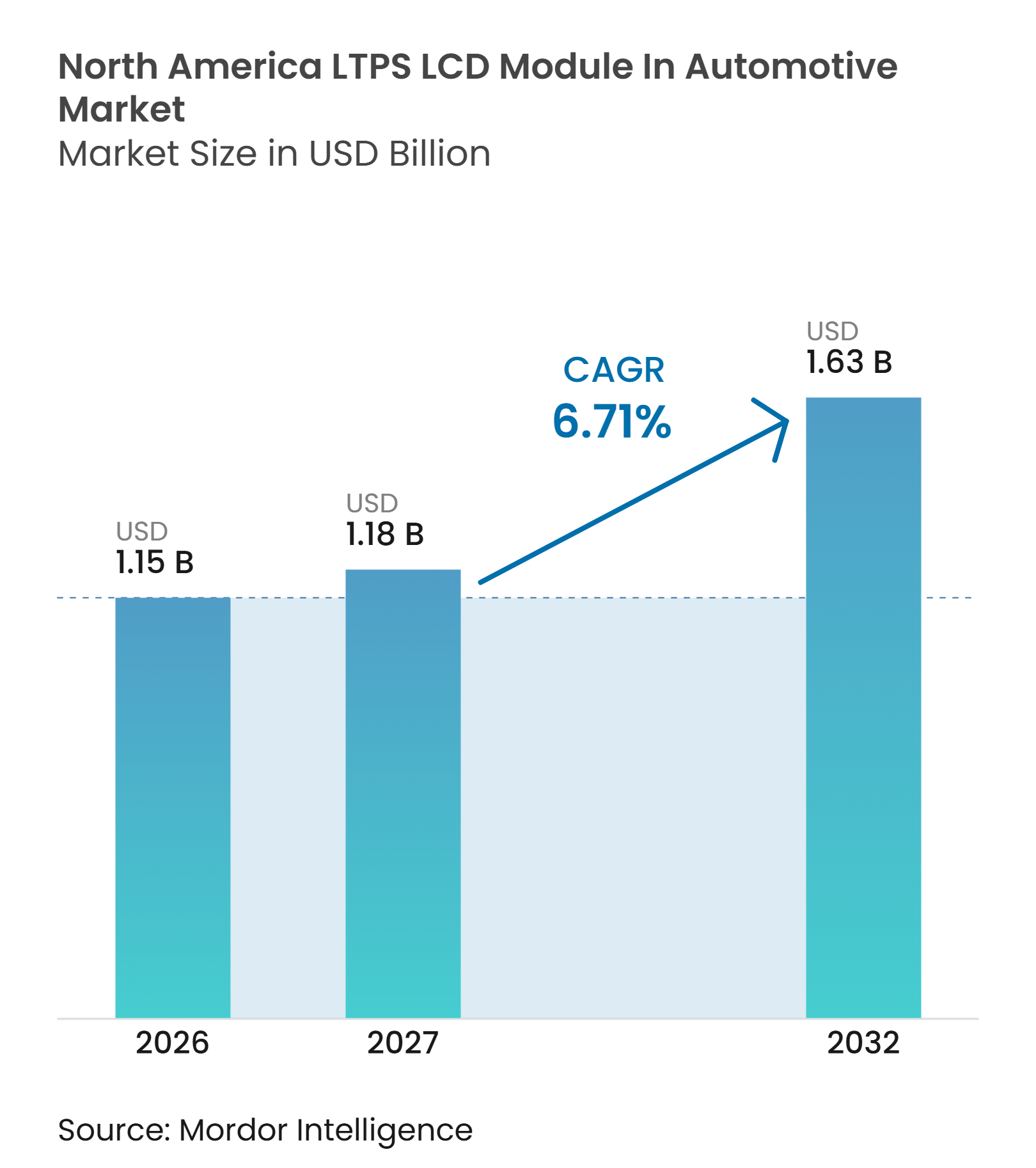
| Base Year Market Size (2026) | USD 1.15 Billion |
| Market Size (2027) | USD 1.18 Billion |
| Market Size (2032) | USD 1.63 Billion |
| Growth Rate (2027 - 2032) | 6.71 % |
| Market Concentration | Medium |
Major Players *Disclaimer: Major Players sorted in no particular order Image © Mordor Intelligence. Reuse requires attribution under CC BY 4.0. | |
North America LTPS LCD Module In Automotive Market Analysis by Mordor Intelligence
The North America LTPS LCD Module (LCM) in Automotive Market size was valued at USD 1.15 billion in 2026 and is estimated to expand to USD 1.63 billion by 2032, at a CAGR of 6.70% during the forecast period (2027-2032). The North America LTPS LCD Module (LCM) in Automotive Market is being shaped by a gradual shift from amorphous silicon LCD toward low-temperature polysilicon backplanes in vehicle displays. LTPS supports smaller transistors, higher pixel density, stronger brightness, and in-cell touch within a thinner module design. Automakers are applying these attributes across digital clusters, center stacks, and wider dashboard display layouts. Supply decisions are also moving closer to vehicle assembly locations as manufacturers respond to North American sourcing requirements. The upgrade cycle in internal combustion engine and hybrid vehicles provides a stable source of demand even if battery electric vehicle adoption changes more slowly than expected.
Key Report Takeaways
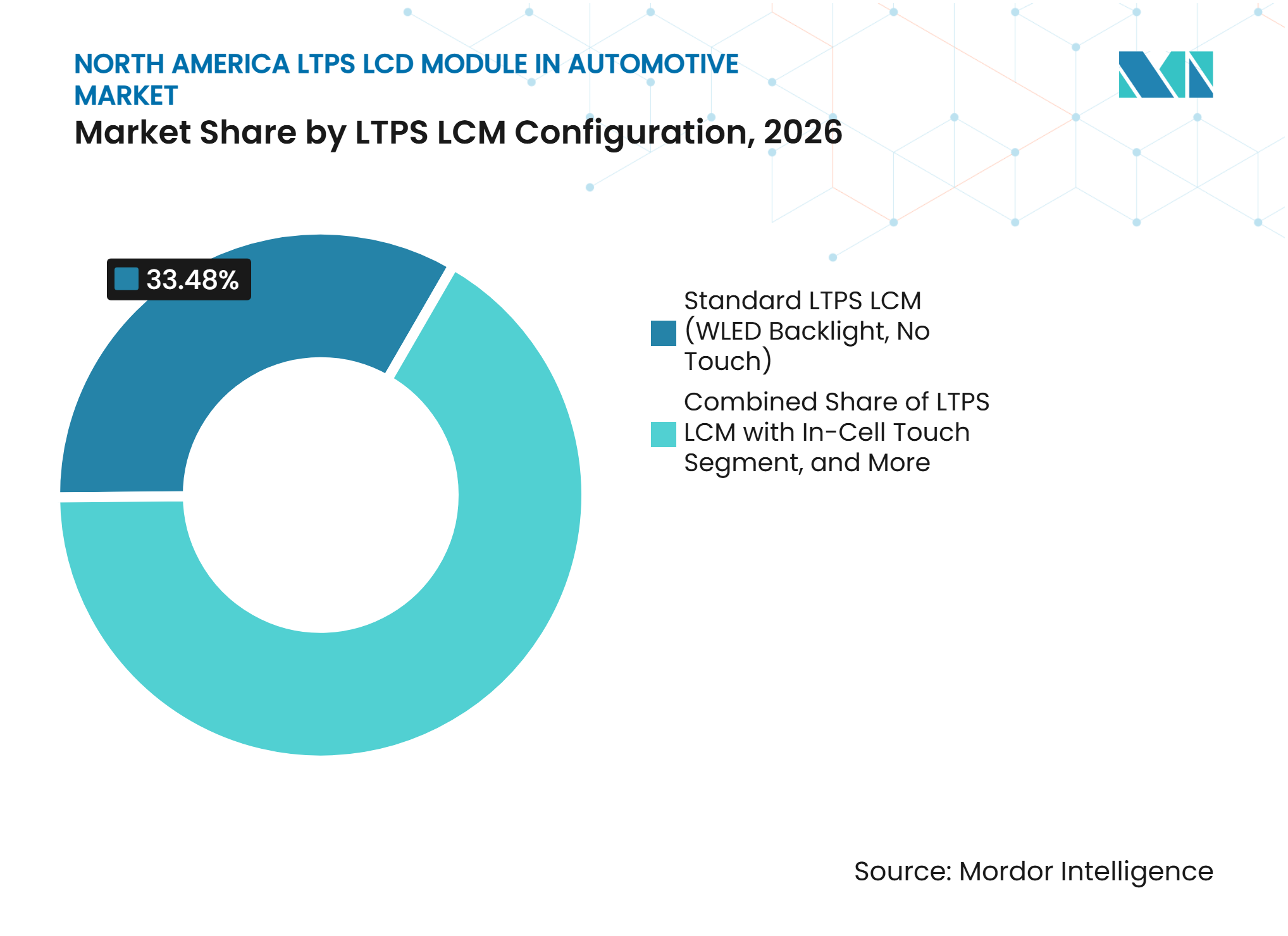
- By LTPS LCM configuration, Standard LTPS LCM with WLED Backlight and No Touch held 33.48% of the North America LTPS LCD Module (LCM) in Automotive Market share in 2026, while LTPS LCM with Mini-LED Backlight and In-Cell Touch is projected to expand at a CAGR of 7.82% through 2032.
- By application, Center Stack and Infotainment accounted for 43.91% of the North America LTPS LCD Module (LCM) in Automotive Market size in 2026, while Pillar-to-Pillar Center Console is projected to expand at a CAGR of 7.56% through 2032.
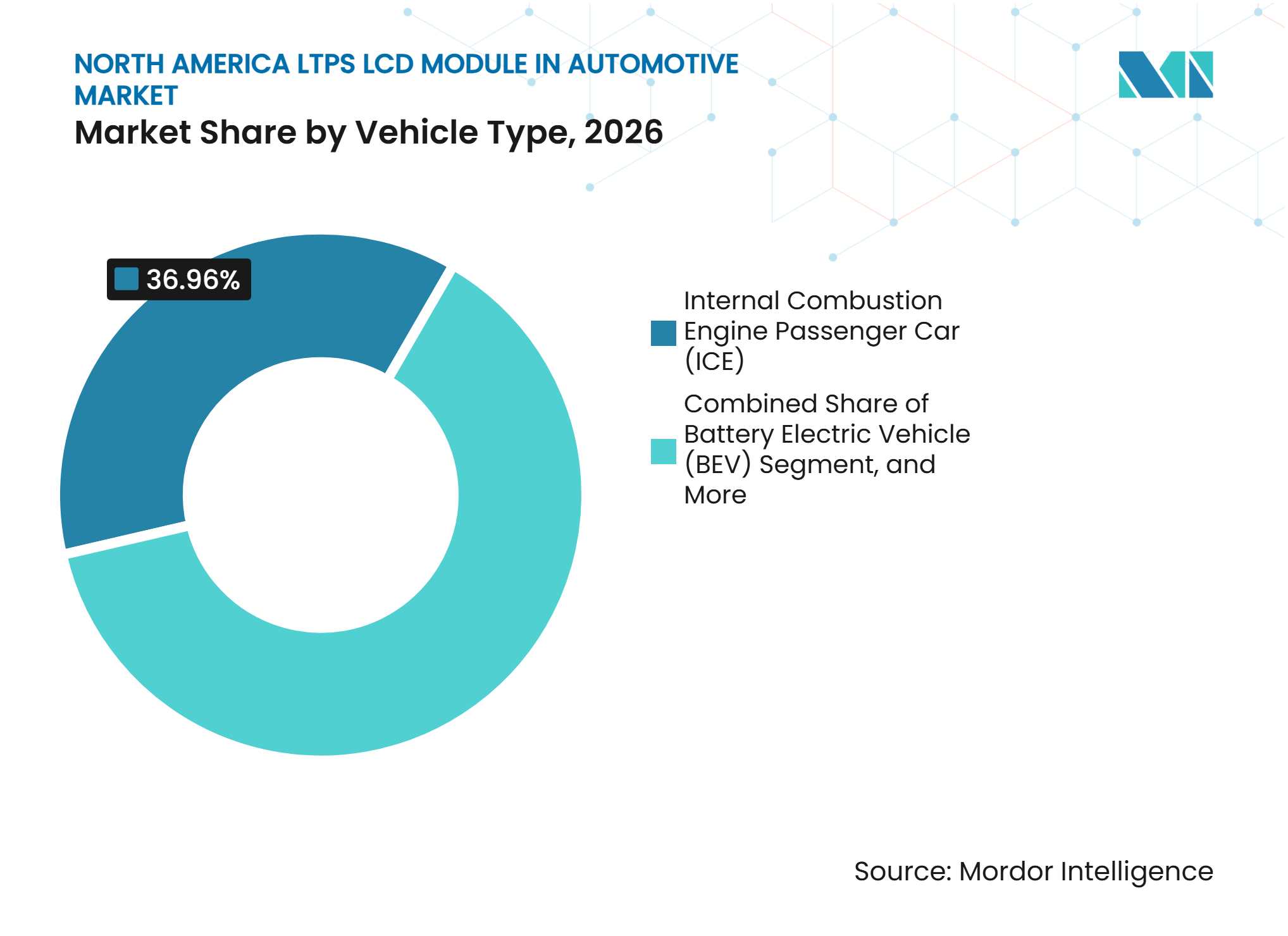
- By vehicle type, Internal Combustion Engine Passenger Cars held 36.96% share in 2026, while Battery Electric Vehicles are projected to expand at a CAGR of 7.75% through 2032.
- By bonding process, Film on Glass held 60.00% share in 2026, while Chip on Glass is projected to expand at a CAGR of 7.84% through 2032.
- By geography, the United States held 72.61% share in 2026, while Mexico is projected to expand at a CAGR of 7.62% through 2032.
Note: Market numbers in this report are based on Mordor Intelligence's proprietary estimation framework, which combines nine months of actuals with Q4 projections for base year 2026.
Market Trends and Insights
Drivers Impact Analysis of North America LTPS LCD Module In Automotive Market*
| Driver | (~) % Impact on CAGR Forecast | Geographic Relevance | Impact Timeline |
|---|---|---|---|
| EV and Hybrid Cockpit Electrification | +1.8% | United States and Mexico, with spillover into Canada | Medium term (2-4 years) |
| Rising Display Content per Vehicle | +1.3% | United States, with early gains in Midwest assembly corridors | Short term (≤ 2 years) |
| Higher Brightness and Resolution Requirements for Safety-Critical Displays | +0.9% | United States and Canada, influenced by FMVSS requirements | Short term (≤ 2 years) |
| LTPS Migration From Legacy a-Si LCD | +0.7% | United States, with spillover to Mexico | Medium term (2-4 years) |
| North American Vehicle and Electronics Localization | +0.5% | United States and Mexico, linked to USMCA rules of origin | Long term (≥ 4 years) |
| Cross-Border Platform Commonization Across USMCA Production | +0.3% | United States, Canada, and Mexico, centered on the Michigan, Ontario, and Nuevo León corridor | Long term (≥ 4 years) |
| Source: Mordor Intelligence | |||
EV and Hybrid Cockpit Electrification
Electrified vehicle programs are increasing the importance of the cockpit display in the North America LTPS LCD Module (LCM) in Automotive Market. Battery electric and hybrid layouts remove some conventional powertrain controls from the center console. This gives designers more flexibility to install larger displays and more integrated screen layouts. High brightness, in-cell touch, and rapid response make LTPS LCD suitable for multi-screen systems that do not use OLED panels. Battery Electric Vehicles are projected to record a CAGR of 7.75% through 2032, which supports demand for advanced display configurations. Hybrid and plug-in hybrid programs also support demand because their cockpit specifications increasingly follow the digital layout used on battery electric vehicle platforms.
Rising Display Content Per Vehicle
The number of screens installed in each vehicle is increasing as digital clusters, passenger displays, and rear-seat systems reach more vehicle classes. This shift supports module demand even when regional vehicle output is uneven. Mid-priced vehicles are increasingly adding displays that were once concentrated in premium models. Each added display creates a separate need for display glass, bonding, driver electronics, touch integration, and thermal management. LG Display began mass production of a 40-inch Pillar-to-Pillar LTPS LCD in February 2025, demonstrating that LTPS can support wide automotive display designs.[1] The North America LTPS LCD Module (LCM) in Automotive Market therefore benefits from rising display content per vehicle as well as from vehicle production volumes.
Higher Brightness and Resolution Requirements for Safety-Critical Displays
Vehicle controls and displays must remain readable across changing light conditions. FMVSS 571.101 establishes requirements related to the location, identification, color, and illumination of vehicle controls and displays.[2] These requirements strengthen the value of displays that offer high brightness, contrast, and clear visual presentation. LTPS enables higher pixel density than legacy a-Si LCD technology within a compact module structure. The National Transportation Safety Board issued Safety Recommendation H-25-016 in 2025, calling for updated driver distraction guidance for in-vehicle electronic devices.[3] As cockpit designs become more display-led, suppliers must balance feature density with visibility and driver attention requirements.
LTPS Migration From Legacy a-Si LCD
Migration from a-Si LCD backplanes is providing a direct technology driver for the North America LTPS LCD Module (LCM) in Automotive Market. LTPS offers higher electron mobility, which enables smaller transistors and supports finer pixel structures. These features are useful as center-stack and cluster displays become larger and require more detailed graphics. LTPS can also support thin modules and in-cell touch designs that reduce optical loss from added layers. Automakers can apply the technology across both new vehicle programs and mid-cycle refreshes of existing platforms. The result is a transition path that extends beyond premium electric vehicles into mainstream internal combustion engine and hybrid vehicles.
Restraints Impact Analysis of North America LTPS LCD Module In Automotive Market*
| Restraint | (~) % Impact on CAGR Forecast | Geographic Relevance | Impact Timeline |
|---|---|---|---|
| North American Light-Vehicle Production Volatility | -1.5% | United States, Canada, and Mexico, linked to tariff policy | Short term (≤ 2 years) |
| Tariff and Rules-of-Origin Compliance Cost | -1.2% | United States and Mexico, with highest exposure for non-compliant display imports | Medium term (2-4 years) |
| Asian Supply Concentration for LTPS Panels and Driver ICs | -0.6% | United States, Canada, and Mexico, with exposure to Taiwan, South Korea, and China | Long term (≥ 4 years) |
| Driver-Distraction Constraints on Display Content and Interaction | -0.4% | United States and Canada, influenced by compliance requirements | Long term (≥ 4 years) |
| Source: Mordor Intelligence | |||
North American Light-Vehicle Production Volatility
Light-vehicle production changes remain a near-term restraint because display modules are installed through vehicle programs. When automakers delay launches or adjust production schedules, module orders can be deferred. Tariff costs can add pressure to vehicle margins and may influence sourcing and investment decisions. This issue affects the United States, Canada, and Mexico because vehicle programs and component flows cross these borders. The North America LTPS LCD Module (LCM) in Automotive Market is exposed to these changes despite rising display content per vehicle. A stable replacement cycle in internal combustion engine and hybrid vehicles can partly offset the effects of slower battery electric vehicle adoption.
Tariff And Rules-Of-Origin Compliance Cost
Rules of origin and tariffs can increase the cost of automotive electronics supplied from outside North America. The USMCA requires 75% regional value content for passenger vehicles, a requirement that became fully phased in during July 2023. The Office of the United States Trade Representative identified reliance on third-country displays, circuit boards, and semiconductors as a supply-chain gap in its 2026 report to Congress. LTPS panels and driver integrated circuits remain concentrated in East Asian supply networks. This structure exposes import-dependent modules to higher compliance work and potential cost escalation. Suppliers that assemble modules within the region may be better placed to respond to future localization requirements.
*Our forecasts treat driver/restraint impacts as directional, not additive. The impact forecasts reflect baseline growth, mix effects, and variable interactions.
North America LTPS LCD Module In Automotive Market Segment Analysis
By LTPS LCM Configuration:
Mini-LED And In-Cell Touch Raise Module ValueStandard LTPS LCM with WLED Backlight and No Touch held 33.48% of the North America LTPS LCD Module (LCM) in Automotive Market share in 2026. The configuration remains important for single-zone, edge-lit displays used in mainstream internal combustion engine and entry-level hybrid programs. These programs were often specified before Mini-LED backlighting and in-cell touch reached broader automotive cost acceptance. The standard architecture offers a familiar option for applications where a separate interface is used for driver input. It also supports established sourcing and qualification processes for vehicle platforms already in production.
LTPS LCM with In-Cell Touch and WLED Backlight remains a major configuration because it removes a separate touch overlay. This can reduce module thickness and optical loss while supporting thin or curved interior designs. LTPS LCM with Mini-LED Backlight and No Touch serves driver displays where touch input is managed elsewhere in the cockpit. LTPS LCM with Mini-LED Backlight and In-Cell Touch is projected to expand at a CAGR of 7.82% through 2032. Mini-LED local dimming can improve contrast while retaining the established durability characteristics of LCD technology. Research published in the International Journal of High Speed Electronics and Systems in 2025 described progress in zone-level dimming algorithms for vehicular Mini-LED displays.



By Application:
Center Stack Volume Supports Wider Dashboard DesignsCenter Stack and Infotainment accounted for 43.91% of the North America LTPS LCD Module (LCM) in Automotive Market size in 2026. The application benefits from the widespread use of touchscreens across vehicle categories, from compact cars to full-size trucks. LTPS is well suited to center-stack systems that require a bright, detailed display and a slim module profile. Digital instrument clusters also represent a major use case as analog displays are replaced by fully digital units. Rear-seat entertainment systems add additional module demand on SUV and family-vehicle programs.
Pillar-to-Pillar Center Console is projected to expand at a CAGR of 7.56% through 2032. Continuous display surfaces are being used to create a more integrated dashboard layout and distinguish new vehicle interiors. LG Display began mass production of its 40-inch Pillar-to-Pillar LTPS LCD display for the AFEELA 1 program in February 2025. Tianma presented a 49.6-inch 8K curved automotive display at CES 2026, showing continued development of larger cockpit displays. A 2025 paper in the SID Symposium Digest of Technical Papers reported that touch sensor multiplexing can reduce driver chip requirements in medium and large LTPS in-cell displays.
By Vehicle Type:
ICE Programs Support The Installed BaseInternal Combustion Engine Passenger Cars held 36.96% of the North America LTPS LCD Module (LCM) in Automotive Market share in 2026. This position shows that demand is not limited to electrified vehicles. Internal combustion engine vehicles undergoing a mid-cycle update can replace a-Si center-stack displays with LTPS designs. These changes can provide a reliable upgrade cycle regardless of the pace of battery electric vehicle adoption. Light commercial vehicles are also incorporating digital clusters and larger displays to support fleet connectivity and vehicle information functions.
Battery Electric Vehicles are projected to expand at a CAGR of 7.75% through 2032. These vehicles often use larger central displays and more detailed digital clusters as part of their cabin design. Their display content can remain high even when vehicle volumes move with incentive or policy changes. The International Energy Agency reported that Korean automakers increased United States battery electric vehicle production in 2025 to reduce tariff exposure. Hybrid and plug-in hybrid vehicle interiors are increasingly aligned with battery electric vehicle display specifications. This alignment positions hybrids as a bridge between traditional vehicle programs and the more display-intensive electric vehicle cockpit.

By Bonding Process:
FOG Holds The Installed Base While COG Gains GroundFilm on Glass held 60.00% of the North America LTPS LCD Module (LCM) in Automotive Market share in 2026. The process uses a flexible film to connect the driver integrated circuit to the display glass. It is well suited to modules that require routing around curved or irregular display borders. The installed manufacturing base also benefits from lower tooling needs and established flexibility across display geometries. Switching a qualified bonding process during a vehicle program can require requalification work, which supports the continuing position of FOG.
Chip on Glass is projected to expand at a CAGR of 7.84% through 2032, the highest rate among the reported segment categories. This process attaches the driver integrated circuit directly to the glass substrate. It can support narrower bezels and strong signal integrity in high-resolution LTPS panels. The SID Symposium Digest of Technical Papers reported in 2025 that TP-MUX touch multiplexing can reduce driver chip count and improve the competitiveness of COG-bonded in-cell displays. As automakers specify larger center-stack displays with narrow visible borders, COG may gain share against the more established FOG process.
Geography Analysis
United States: Display Content Offsets Softer Production Conditions
The United States held 72.61% of the North America LTPS LCD Module (LCM) in Automotive Market share in 2026. Its position reflects the concentration of vehicle assembly and cockpit sourcing activity in Michigan, Tennessee, Texas, and Alabama. Tier 1 integrators maintain engineering and program-management operations near these production locations. The regional opportunity is supported by rising display content per vehicle, including digital clusters, center stacks, and passenger displays. Visteon reported USD 3.6 billion in display-specific new business during 2025, and its results showed the continued importance of display programs to its order intake. FMVSS 571.101 remains an important compliance factor for controls and displays, placing attention on clear visual presentation and illumination. The United States therefore remains the primary location for regional program decisions even when vehicle production is uneven.
Mexico: Local Assembly Expands Under USMCA Conditions
Mexico is projected to expand at a CAGR of 7.62% through 2032. The country is becoming more important for module assembly because it links lower-cost manufacturing with access to North American vehicle programs. AUO approved a second phase of expansion for its Mexico manufacturing facility in January 2026. The added capacity is expected online between 2028 and 2029, following a Phase 1 expansion targeted for mass production in the second half of 2027. The International Energy Agency reported that Mexico supplied more than one-third of United States electric-car imports in 2025. The USTR has also identified displays, semiconductors, and circuit boards as electronics categories relevant to North American supply-chain resilience.These factors support local module assembly and closer coordination with United States vehicle programs.
Canada And Regional Supply Chains: Shared Platforms Shape Sourcing
Canada is part of an integrated North American vehicle production system, with Ontario remaining central to regional assembly activity. Honda, Toyota, and Stellantis programs in the province use the same Tier 1 supply networks that serve United States platforms. This connection gives Canada a role in shared display design, qualification, and sourcing decisions. Canada adjusted its electric vehicle import policy in early 2026, creating an additional consideration for vehicle and cockpit component sourcing. The International Energy Agency documented changes in the policy environment for electric vehicles and trade during 2026. The United States, Canada, and Mexico also share a structural gap between regional value-content goals and current automotive electronics production. The USMCA framework is therefore a regulatory influence that favors more regional display-module activity. This shared platform structure makes cross-border program coordination important for the North America LTPS LCD Module (LCM) in Automotive Market.
Competitive Landscape
Market Concentration
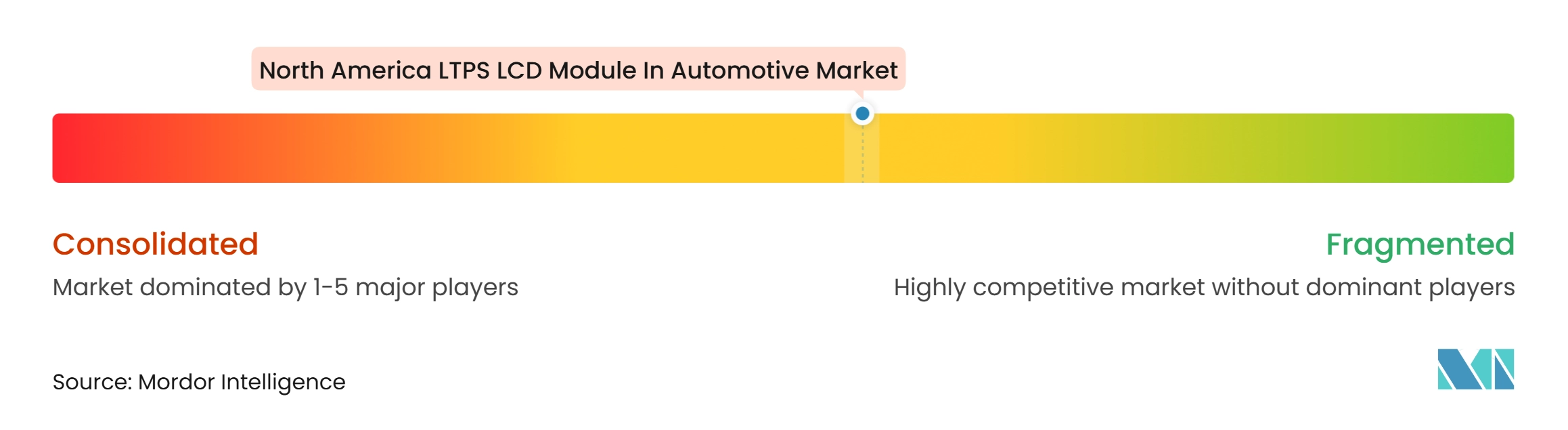
The North America LTPS LCD Module (LCM) in Automotive Market includes panel suppliers, module assemblers, and Tier 1 cockpit integrators. BOE Technology Group, Tianma Microelectronics, AUO Corporation, LG Display, Innolux Corporation, CSOT, and Japan Display supply display glass or assembled modules. Visteon, AUMOVIO, Harman International Industries, Robert Bosch GmbH, DENSO Corporation, and Hyundai Mobis compete through cockpit integration, software-defined display design, optical bonding, and program management. The structure requires coordination between the panel maker and the Tier 1 supplier because display hardware must meet vehicle-level durability and interface requirements. Japan Display continues to emphasize LTPS capability in automotive applications and disclosed United States customer program activity in its fiscal 2026 results. The field is therefore active across both hardware supply and cockpit integration.
Companies are responding through product development, localization, and new display formats. AUO is expanding its Mexico facility in phases, which supports direct service for North American customers and reduces the distance between module assembly and vehicle plants. LG Display started production of a 40-inch Pillar-to-Pillar LTPS LCD for the AFEELA 1, illustrating the movement toward wider integrated cockpit displays. BOE VX began mass production of a 14.6-inch QD Mini-LED center display for Hyundai's eighth-generation Avante in July 2026, with AUMOVIO handling module integration. These examples show that the competitive position of a supplier depends on display technology, integration capability, and proximity to customer programs.
Potential opportunities remain in narrow-bezel commercial-vehicle cockpits and in thermally robust modules that integrate under-panel camera functions. Visteon and Smart Eye introduced an LCD instrument cluster with an integrated driver monitoring system camera behind the LTPS LCD panel in February 2026. This design uses a custom optical stack that supports near-infrared transmission while preserving the display surface. AUMOVIO is also developing surface-projection concepts that could provide broad cockpit imagery without a fixed large-format panel. These alternatives may compete with some future large-format LTPS designs if they meet automotive durability requirements.
North America LTPS LCD Module In Automotive Industry Leaders
-
BOE Technology Group Co., Ltd.
-
Tianma Microelectronics Co., Ltd.
-
AUO Corporation
-
Japan Display Inc.
-
LG Display Co., Ltd.
- *Disclaimer: Major Players sorted in no particular order
North America LTPS LCD Module In Automotive Market Companies Covered in this Report
- BOE Technology Group Co., Ltd.
- Tianma Microelectronics Co., Ltd.
- AUO Corporation
- Japan Display Inc.
- LG Display Co., Ltd.
- Innolux Corporation
- TCL China Star Optoelectronics Technology Co., Ltd.
- Sharp Corporation
- Samsung Display Co., Ltd.
- Truly International Holdings Limited
- Visteon Corporation
- Continental AG
- Robert Bosch GmbH
- Panasonic Automotive Systems Co., Ltd.
- DENSO Corporation
- Hyundai Mobis Co., Ltd.
- Aptiv PLC
- Marelli Holdings Co., Ltd.
- Harman International Industries, Incorporated
- LG Electronics Inc.
- CarUX Technology Inc.
- Varitronix International Limited
- New Vision Display, Inc.
- Newhaven Display International, Inc.
Recent Industry Developments in North America LTPS LCD Module In Automotive Market
- November 2026: AUMOVIO reported Q3 2026 orders doubling to EUR 6.4 billion, anchored by a EUR 1.4 billion automotive supply agreement with BMW following a legal settlement resolution. The company confirmed its decision to retain the User Experience display business unit, citing global leadership in windshield head-up displays.
- July 2026: BOE VX, BOE Technology Group's automotive display subsidiary, commenced mass production of a 14.6-inch QD Mini-LED center information display for the eighth-generation Hyundai Avante, with module integration handled by AUMOVIO. This marked BOE VX's first QD Mini-LED center display above 10 inches for a Hyundai passenger car model.
- June 2026: Visteon Corporation announced its 12.3-inch Narrow Border Driver Display is featured in the newly launched Lexus ES, the company's first production program in Lexus driver information systems. Full display construction and optical bonding for this program were completed at Visteon's Thailand plant.
- April 2026: AUMOVIO and tesa announced a partnership to develop a robotic-applied, debondable adhesive tape solution for automotive display module integration. The partners targeted volume production in Q2 2026 to allow display assemblies to be replaced or reworked selectively without replacing the full module.
North America LTPS LCD Module In Automotive Market Report Scope
The North America LTPS LCD Module (LCM) in Automotive Market encompasses the development, manufacturing, and supply of automotive-grade display modules using Low-Temperature Polycrystalline Silicon (LTPS) technology. These modules deliver high-resolution visuals, enhanced display performance, and power efficiency for advanced vehicle interfaces. Market growth is driven by increasing vehicle digitalization, adoption of sophisticated cockpit systems, and demand for high-quality automotive displays.
The North America LTPS LCD Module (LCM) in Automotive Market Report is Segmented by LTPS LCM Configuration (Standard LTPS LCM (WLED Backlight, No Touch), LTPS LCM with In-Cell Touch (WLED Backlight), LTPS LCM with Mini-LED Backlight (No Touch), and LTPS LCM with Mini-LED Backlight and In-Cell Touch), Application (Center Stack/Infotainment, Instrument Cluster, Pillar-to-Pillar Center Console, and Rear Seat Entertainment and Passenger Screen), Vehicle Type (Battery Electric Vehicle (BEV), Hybrid / Plug-in Hybrid Electric Vehicle (HEV/PHEV), Internal Combustion Engine Passenger Car (ICE), and Light Commercial Vehicle (LCV)), Bonding Process (Film on Glass (FOG), and Chip on Glass (COG)), and Geography (United States, Canada, and Mexico). The Market Forecasts are Provided in Terms of Value (USD).
Segmentation Overview
| Standard LTPS LCM (WLED Backlight, No Touch) |
| LTPS LCM with In-Cell Touch (WLED Backlight) |
| LTPS LCM with Mini-LED Backlight (No Touch) |
| LTPS LCM with Mini-LED Backlight and In-Cell Touch |
| Center Stack / Infotainment |
| Instrument Cluster |
| Pillar-to-Pillar Center Console |
| Rear Seat Entertainment and Passenger Screen |
| Battery Electric Vehicle (BEV) |
| Hybrid / Plug-in Hybrid Electric Vehicle (HEV/PHEV) |
| Internal Combustion Engine Passenger Car (ICE) |
| Light Commercial Vehicle (LCV) |
| Film on Glass (FOG) |
| Chip on Glass (COG) |
| United States |
| Canada |
| Mexico |
| By LTPS LCM Configuration | Standard LTPS LCM (WLED Backlight, No Touch) |
| LTPS LCM with In-Cell Touch (WLED Backlight) | |
| LTPS LCM with Mini-LED Backlight (No Touch) | |
| LTPS LCM with Mini-LED Backlight and In-Cell Touch | |
| By Application | Center Stack / Infotainment |
| Instrument Cluster | |
| Pillar-to-Pillar Center Console | |
| Rear Seat Entertainment and Passenger Screen | |
| By Vehicle Type | Battery Electric Vehicle (BEV) |
| Hybrid / Plug-in Hybrid Electric Vehicle (HEV/PHEV) | |
| Internal Combustion Engine Passenger Car (ICE) | |
| Light Commercial Vehicle (LCV) | |
| By Bonding Process | Film on Glass (FOG) |
| Chip on Glass (COG) | |
| By Geography | United States |
| Canada | |
| Mexico |
Key Questions Answered in the Report
What is the size of the North America LTPS LCD Module (LCM) in Automotive Market?
The market was valued at USD 1.15 billion in 2026 and is estimated to reach USD 1.63 billion by 2032 at a CAGR of 6.70%.
Which LTPS LCM configuration is expanding fastest in North American vehicles?
LTPS LCM with Mini-LED Backlight and In-Cell Touch is projected to expand at a CAGR of 7.82% through 2032.
Which automotive application accounts for the largest LTPS LCD module demand?
Center Stack and Infotainment accounted for 43.91% share in 2026, supported by broad adoption of touchscreen-based vehicle controls.
Why are automakers using LTPS LCD modules in vehicle cockpits?
LTPS supports high pixel density, strong brightness, thin module structures, and in-cell touch for digital clusters and center-stack displays.
Which country leads regional automotive LTPS LCD module demand?
The United States held 72.61% share in 2026 because it has the region's largest concentration of vehicle assembly and cockpit sourcing activity.
What bonding process is projected to expand fastest for LTPS LCD modules?
Chip on Glass is projected to expand at a CAGR of 7.84% through 2032 because it supports narrow bezels and high-resolution display designs.
What bonding process is projected to expand fastest for LTPS LCD modules?
Chip on Glass is projected to expand at a CAGR of 7.84% through 2032 because it supports narrow bezels and high-resolution display designs.