
North America Liquid Packaging Cartons Market Size and Share
Market Overview
| Study Period | 2021 - 2032 |
|---|---|
| Forecast Data Period | 2027 - 2032 |
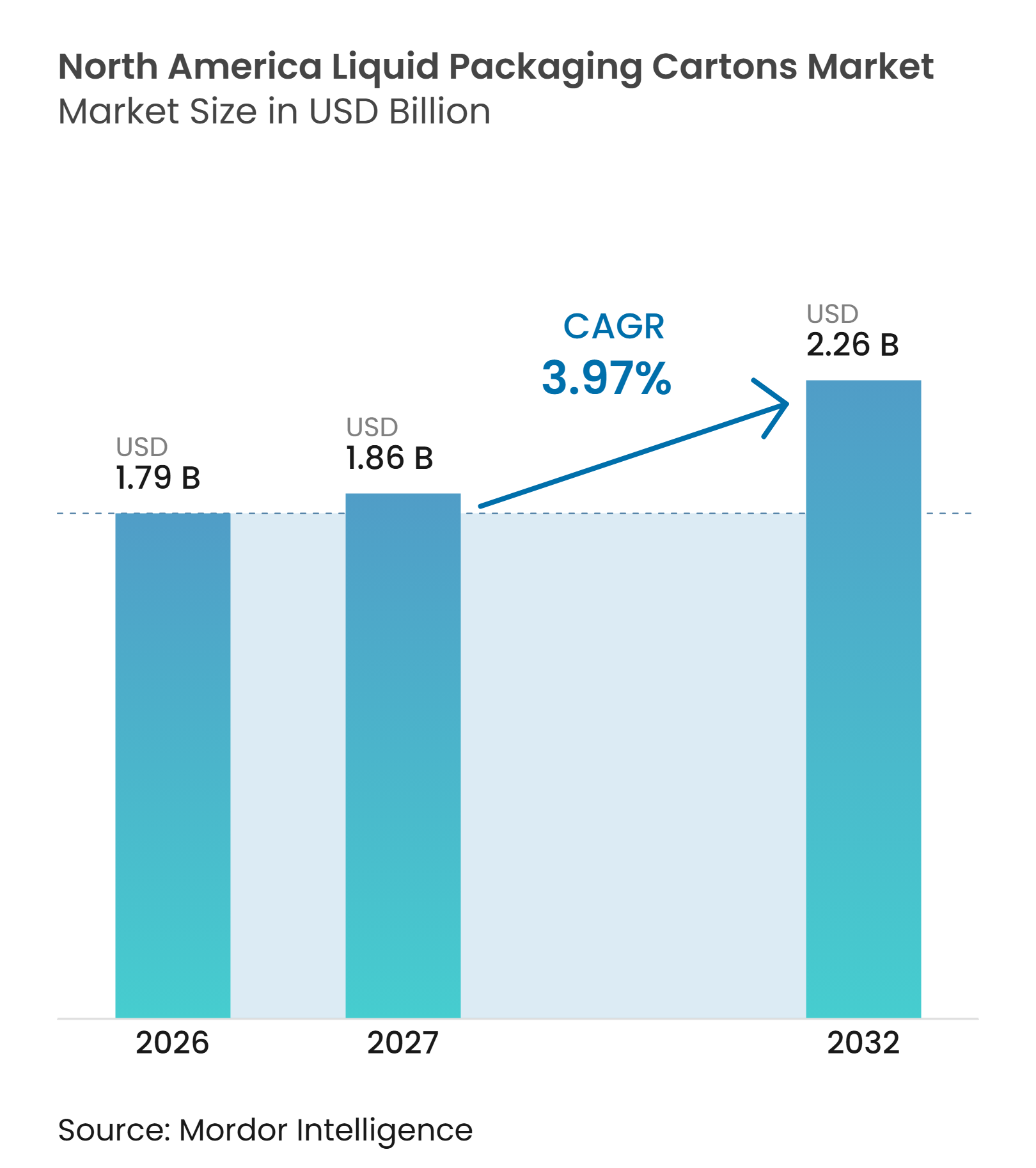
| Base Year Market Size (2026) | USD 1.79 Billion |
| Market Size (2027) | USD 1.86 Billion |
| Market Size (2032) | USD 2.26 Billion |
| Growth Rate (2027 - 2032) | 3.97 % |
| Market Concentration | Medium |
Major Players *Disclaimer: Major Players sorted in no particular order Image © Mordor Intelligence. Reuse requires attribution under CC BY 4.0. | |
North America Liquid Packaging Cartons Market Analysis by Mordor Intelligence
The North America liquid packaging cartons market size stands at USD 1.79 billion in 2026 and is forecast to reach USD 2.26 billion by 2032, growing at a CAGR of 3.97% from 2027 to 2032. The North America liquid packaging cartons market is shifting away from rigid plastic and glass formats as brand owners respond to sustainability requirements and regional logistics costs. Paperboard cartons fit renewable-material procurement goals and extended producer responsibility programs that are becoming increasingly important across the region. Their rectangular shape can also improve storage and freight efficiency compared with round containers. Ambient distribution supports wider availability of dairy alternatives, juices, and functional beverages without the same dependence on refrigerated logistics. The North America liquid packaging cartons market also faces pressure from recycling constraints, input costs, and the capital required to qualify aseptic filling lines.
Key Report Takeaways
- By product type, aseptic cartons held 52.68% of the North America liquid packaging cartons market share in 2026 and are projected to expand at a 4.69% CAGR through 2032.
- By application, milk accounted for 33.29% of the North America liquid packaging cartons market size in 2026, while plant-based beverages are projected to expand at a 4.84% CAGR through 2032.
- By pack size, above 500 ml formats held 54.37% share in 2026, while the 250-500 ml tier is projected to expand at a 4.62% CAGR through 2032.
- By geography, the United States held 83.46% share in 2026, while Mexico is projected to expand at a 4.73% CAGR through 2032.
Note: Market numbers in this report are based on Mordor Intelligence's proprietary estimation framework, which combines nine months of actuals with Q4 projections for base year 2026.
Market Trends and Insights
Drivers Impact Analysis of North America Liquid Packaging Cartons Market*
| Driver | (~) % Impact on CAGR Forecast | Geographic Relevance | Impact Timeline |
|---|---|---|---|
| Plant-Based and Functional Beverage Renovation | +1.1% | National, with faster uptake in the Western United States and urban Canadian centers | Medium term (2-4 years) |
| Sustainability-Led Substitution From Rigid Plastic and Glass | +0.9% | National, with greater relevance in California, the Pacific Northwest, and Quebec | Medium term (2-4 years) |
| Aseptic Shelf-Life Extension for Distributed Retail and E-Commerce | +0.6% | National, with early gains in Texas, the Southeast United States, and Greater Toronto e-commerce corridors | Long term (≥ 4 years) |
| Reclosable and Single-Serve Carton Innovation | +0.4% | National, with rapid uptake in United States metropolitan convenience retail and Canadian foodservice | Short term (≤ 2 years) |
| Retortable Carton Conversion in Soups, Sauces, and Pet Food | +0.3% | National, concentrated in United States mass retail and emerging in Mexico packaged-food channels | Long term (≥ 4 years) |
| North American Carton Recycling Access and EPR Alignment | +0.3% | United States programs in Oregon, Colorado, California, Minnesota, Maryland, and Washington, plus Ontario and Alberta | Medium term (2-4 years) |
| Source: Mordor Intelligence | |||
Plant-Based and Functional Beverage Renovation
Plant-based beverages are a major demand driver for the North America liquid packaging cartons market because oat, almond, pea-protein, and hemp milk brands are expanding shelf-stable offerings. These formulations need barrier performance that protects lipid profiles and limits off-flavor development during ambient storage, including periods in warehouses, retail backrooms, and direct-to-consumer fulfillment networks. Aseptic cartons can provide this protection while supporting broad retail and e-commerce distribution, which makes national launches more practical for brands without extensive refrigerated coverage or established local delivery infrastructure. PMMI reported in June 2025 that surveyed North American beverage companies expected paper-based packaging use to rise 43% over the following 2-3 years, while liquid carton use was expected to rise 16%.[1] The North America liquid packaging cartons market therefore has an opportunity to serve brands that need both shelf stability and a fiber-based package format. Growth is likely to be strongest where products can move through ambient supply chains rather than refrigerated networks, especially when distribution reaches smaller outlets, online customers, and geographically dispersed retail locations.
Sustainability-Led Substitution From Rigid Plastic and Glass
The North America liquid packaging cartons market benefits when retailers and brand owners evaluate packaging through recycling, logistics, and producer-responsibility costs. Paperboard cartons can support renewable-material sourcing goals and take less space in storage and transport than comparable round containers, which is relevant to distribution networks handling large volumes of beverages across long routes. Their rectangular geometry can provide 15-20% higher pallet density than round plastic or glass bottles of similar volume, reducing distribution costs in ambient networks and improving trailer utilization. Extended producer responsibility requirements are increasing scrutiny of packaging choices in several United States states and Canadian provinces. Carton conversion can still take time because smaller brands may require 8-12 months to qualify a filling line, validate product compatibility, and establish operating procedures. This qualification period can delay adoption among mid-sized brands even when cartons meet the brand's sustainability objectives.
Aseptic Shelf-Life Extension for Distributed Retail and E-Commerce
Aseptic packaging gives the North America liquid packaging cartons market a route into areas where cold-chain distribution is costly or limited. Ambient storage can reduce refrigeration needs across distribution and retail operations, which is relevant to procurement teams assessing supply-chain emissions and operating costs over the full path from production to purchase. Elopak opened a USD 100 million Pure-Pak plant in Little Rock, Arkansas, in April 2025, adding regional capacity for dairy, juices, plant-based drinks, and liquid eggs.[2] The investment indicates that converters see demand for resilient domestic carton supply and shorter supply routes for North American customers. Rural and semi-rural markets can be served more easily when products do not require continuous refrigeration. FDA-compliant multi-layer constructions remain important because food safety requirements still apply across these extended distribution routes and longer storage periods.
Reclosable and Single-Serve Carton Innovation
Reclosable fitments and single-serve formats address the convenience gap that has favored resealable PET bottles. Smaller cartons can support on-the-go use, while reclosure helps households keep larger cartons after opening and reduces the risk of waste during repeated use. SIG Group announced a USD 35 million expansion of its Querétaro facility in July 2025, with production planned from the second half of 2026 for formats including MiniBloc and XSlimBloc in sizes from 80 ml to 250 ml.[3] The project gives the North America liquid packaging cartons market additional capacity for compact portions and faster format changes, helping suppliers address different channel, retailer, and customer needs across convenience stores, foodservice outlets, grocery settings, and other high-traffic beverage channels throughout North America. Reclosable designs can also reduce the need for customers to modify existing aseptic filling equipment. These changes allow converters to compete more directly in convenience retail and foodservice applications where portability and repeat use matter.
Restraints Impact Analysis of North America Liquid Packaging Cartons Market*
| Restraint | (~) % Impact on CAGR Forecast | Geographic Relevance | Impact Timeline |
|---|---|---|---|
| Multi-Material Recycling and End-Market Constraints | -0.5% | National, with the strongest effect in California under SB 343 and SB 54 | Short term (≤ 2 years) |
| High Aseptic Line Capex and Customer Onboarding Friction | -0.4% | National, particularly among smaller and mid-sized dairy and plant-based brands | Medium term (2-4 years) |
| Liquid Packaging Board and Barrier-Polymer Cost Volatility | -0.3% | National, with greater exposure in Midwest and Southeast converting hubs that use offshore sourcing | Medium term (2-4 years) |
| Incumbent PET and Aluminum Format Inertia | -0.2% | National, with stronger PET use in energy and functional drinks | Long term (≥ 4 years) |
| Source: Mordor Intelligence | |||
Multi-Material Recycling and End-Market Constraints
Liquid cartons combine paperboard, polyethylene, and, in many aseptic formats, a thin aluminum layer. This construction needs pulping and separation systems that are not available across all municipal recycling networks, making recovery outcomes dependent on local collection and processing capability. The Carton Council of North America stated that CalRecycle updated its SB 343 report in July 2025 to recognize cartons as widely recyclable in California. California's labeling rules make recycling access a material compliance issue for brands that use environmental claims on packs and need a consistent basis for those claims. The North America liquid packaging cartons market also needs more domestic outlets for recovered material as volumes rise. ReCB Iowa launched its Everboard facility in Des Moines in August 2025 to use post-consumer cartons in roofing cover board, showing one path to expand end markets and reduce reliance on limited recycling destinations.
High Aseptic Line Capex and Customer Onboarding Friction
An aseptic filling line requires substantial capital spending, plant qualification, cleaning-in-place certification, and technical support. These requirements limit adoption by smaller dairy and plant-based beverage producers that may not have the scale to absorb the initial investment. The North America liquid packaging cartons market is consequently more accessible to large processors, institutional buyers, and brands with multi-year supply agreements. The need for onboarding support makes filling-system expertise an important competitive advantage for established converters and can shape the pace of customer conversion. It also means that capacity expansions do not translate immediately into customer output. Brands may need time to validate a format, train operations teams, complete food-safety procedures, and integrate the format into existing production schedules before commercial production begins.
*Our forecasts treat driver/restraint impacts as directional, not additive. The impact forecasts reflect baseline growth, mix effects, and variable interactions.
North America Liquid Packaging Cartons Market Segment Analysis
By Product Type:
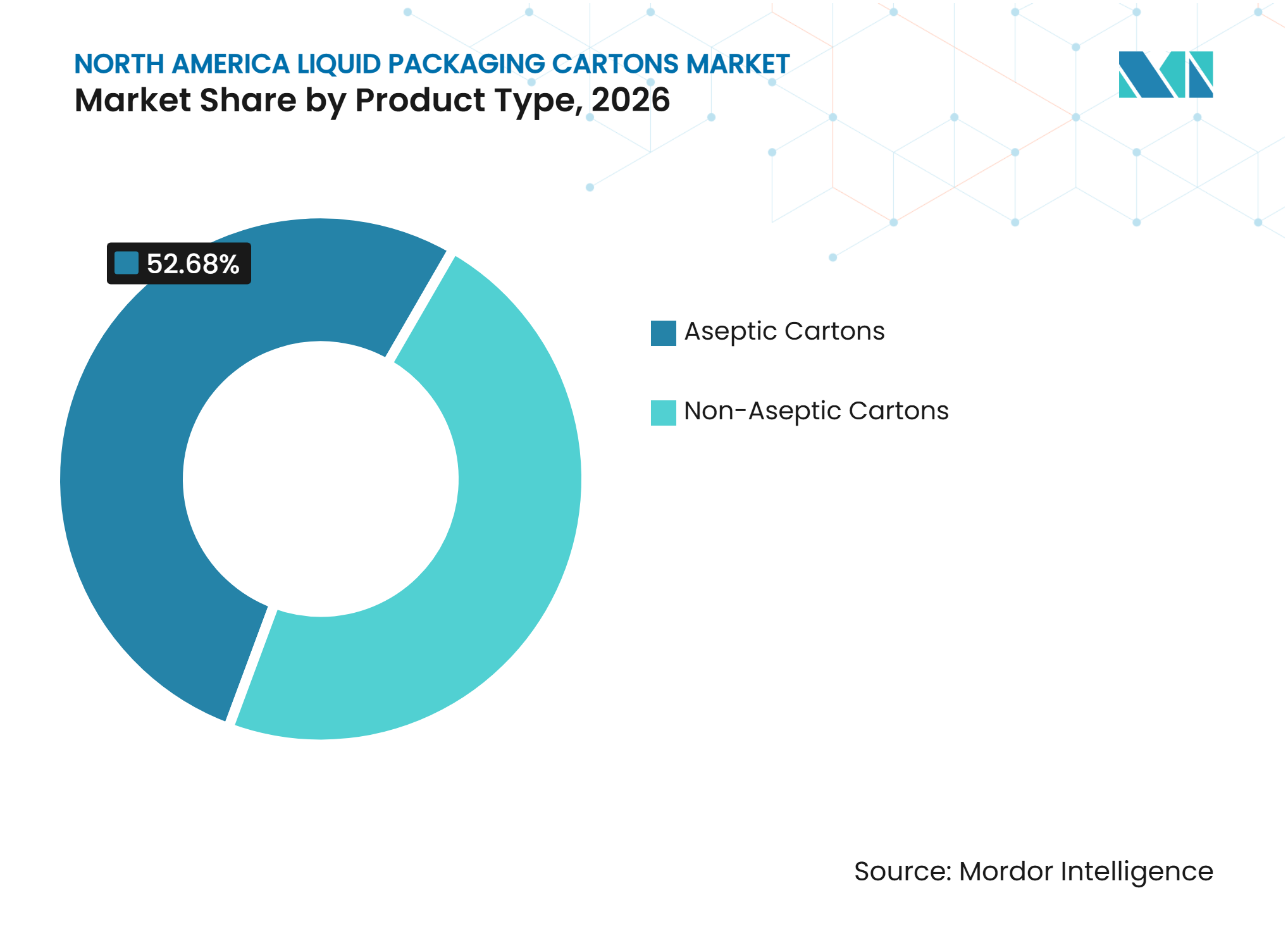
Aseptic Cartons Combine Scale and Faster GrowthAseptic cartons held 52.68% of carton demand in 2026 and are projected to grow at a 4.69% CAGR through 2032. Their multi-layer structure supports ambient storage for 6-12 months without preservatives, an attribute that helps producers maintain product quality across extended distribution cycles. This capability helps brands sell products through national retail systems without continuous refrigeration or short delivery windows. The format is especially relevant to plant-based drinks, juices, and other products that need a longer shelf life before purchase. It also supports e-commerce models that depend on products remaining stable through delivery, storage, and handling across a dispersed customer base. These benefits allow aseptic cartons to support both the established volume base and new demand within the North America liquid packaging cartons market.
SIG launched an aluminum-free, full-barrier 1-liter aseptic carton at commercial scale in July 2025. The development addresses recycling concerns associated with the aluminum layer in conventional aseptic packs while retaining the shelf-life function valued by ambient beverage producers. It also shows how barrier design is changing without abandoning the ambient-storage benefits that differentiate aseptic cartons from chilled packaging. Non-aseptic cartons remain important for refrigerated milk, juices, and liquid eggs, where local distribution and cold storage are already established. These gable-top formats suit short-distance chilled distribution and institutional supply systems that require familiar, practical packs. The 2 product types serve different distribution needs rather than replacing one another. Together, they widen the applications available to carton converters and help suppliers respond to both refrigerated and ambient demand.



By Application:
Milk Remains the Volume Base While Plant-Based Beverages ExpandMilk accounted for 33.29% of the North America liquid packaging cartons market size in 2026. School feeding programs, hospital foodservice, and mass retail continue to use cartons for hygienic, single-serve, and family-size milk delivery. The Carton Council's 2026-27 School Carton Recycling Grant Program supports recycling infrastructure and education in United States and Canadian K-12 schools. This program supports the collection systems connected to a large institutional carton base and reinforces the role of cartons in school cafeterias. Juices and dairy products other than milk also use aseptic formats when distribution reaches wider areas and products need stable shelf life. Liquid food applications, including soups and broths, are adding another route for cartons to enter grocery aisles and serve products beyond conventional beverages.
Plant-based beverages are projected to record the highest application CAGR at 4.84% through 2032. Producers use aseptic cartons to reach consumers who expect a shelf-stable product and closely examine packaging materials during purchase decisions. PMMI's survey results point to growing beverage-industry interest in paper-based packaging and liquid cartons. Energy and functional drinks still rely heavily on PET bottles and aluminum cans for immediate-consumption occasions, which limits cartons' role in those categories today. However, shelf-stable functional water and electrolyte beverages create a narrow opening for carton suppliers that can meet barrier and convenience requirements. The North America liquid packaging cartons market can therefore grow in applications that combine ambient stability with a paperboard-led format. Product developers will need to match barrier performance and portion size to each beverage type and sales channel.
By Pack Size:
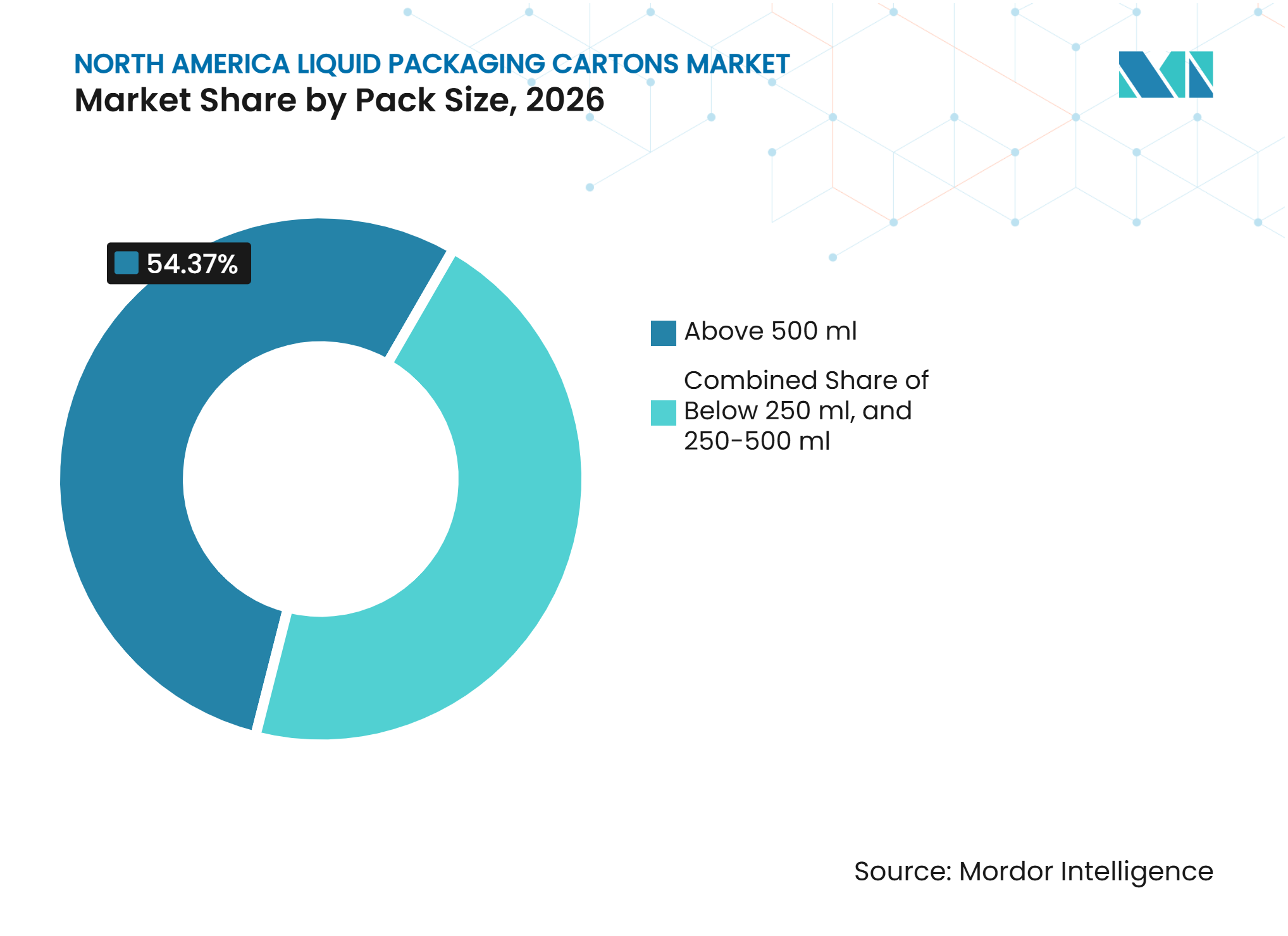
Large Packs Lead While Mid-Range Formats Gain RelevanceAbove 500 ml formats held 54.37% of carton demand in 2026. Family purchasing patterns in milk, plant-based beverages, and juice support this large-format position. The geometry of cartons can improve pallet use and lower unit logistics costs for high-volume formats, particularly in ambient distribution networks. Large packs also fit household value purchasing and foodservice needs, where buyers often prefer a larger unit for repeated use. Tetra Pak launched a 48 oz, or 1,420 ml, Tetra Brik Aseptic Edge carton in the United States and Canada in June 2026. The format uses FSC-certified paperboard and a tethered LightWing 30 cap, according to the supplied development record.
The 250-500 ml tier is projected to grow at a 4.62% CAGR through 2032. This range supports portable, single-serve, and dual-serve purchase occasions, placing it between school portions and large household packs. SIG's Querétaro expansion is designed to support smaller formats, including packs from 80 ml to 250 ml. The below 250 ml category remains relevant to school milk and foodservice portion packs that need controlled serving sizes. The North America liquid packaging cartons market is consequently separating into large formats that emphasize value and mid-range cartons that emphasize convenience. Converters can use this split to develop separate format strategies without relying on a single package size or consumption occasion.

Geography Analysis
United States
The United States accounted for 83.46% of regional carton demand in 2026. Its large share reflects established dairy and juice carton infrastructure, along with demand for ambient plant-based and functional beverages. School milk supply chains remain important because they depend heavily on gable-top cartons for portioned delivery. Elopak's Little Rock facility, opened in April 2025 with a USD 100 million investment, strengthens domestic supply for dairy, juice, plant-based drinks, and liquid eggs. Retortable cartons are also moving into soups, meal components, and wet pet food. Single-serve aseptic packs are creating openings in ready-to-drink coffee and functional beverages. Extended producer responsibility programs and California recyclability requirements remain a regulatory influence on packaging selection.
Mexico
Mexico is projected to grow at a 4.73% CAGR through 2032, the highest rate among the regional geographies. Rising middle-class consumption and demand for shelf-stable dairy drinks and juices support this outlook. Near-shoring also makes the country an important manufacturing location for North American carton supply chains. SIG announced an MXN 1,910 million investment in April 2026, equivalent to USD 97.9 million based on the supplied 2026 average exchange rate, to expand its Querétaro facility to 3 billion cartons annually by 2028. The company stated that the expansion would include local extrusion capability and 2 phases of investment. Tetra Pak also invested more than MXN 1,000 million, equivalent to USD 51.3 million based on the supplied 2025 average exchange rate, in its Mexicali plant during October 2025. Its reported 60% increase in cap capacity, digitalization work, and energy-efficiency upgrades support the country's production base. Mexico's proximity to United States distribution centers supports export-oriented production and regional supply resilience.
Canada and Regional Supply Networks
Canada holds the second-largest regional position by volume, supported by a broad dairy carton network and an established producer-responsibility framework. Ontario completed its transition to full producer responsibility on January 1, 2026, covering more than 5 million households in 383 municipalities and accepting nonalcoholic food and beverage cartons. This framework gives carton suppliers a clearer policy setting for recovery and collection. Quebec's deposit-return approach for multi-layer liquid cartons adds compliance complexity but may help direct funding toward domestic recycling capacity. The North America liquid packaging cartons market can benefit when Canadian recovery systems make carton collection more consistent. Canada also provides a test environment for certified, lower-carbon carton formats that may later gain wider regional acceptance.
Competitive Landscape
Market Concentration
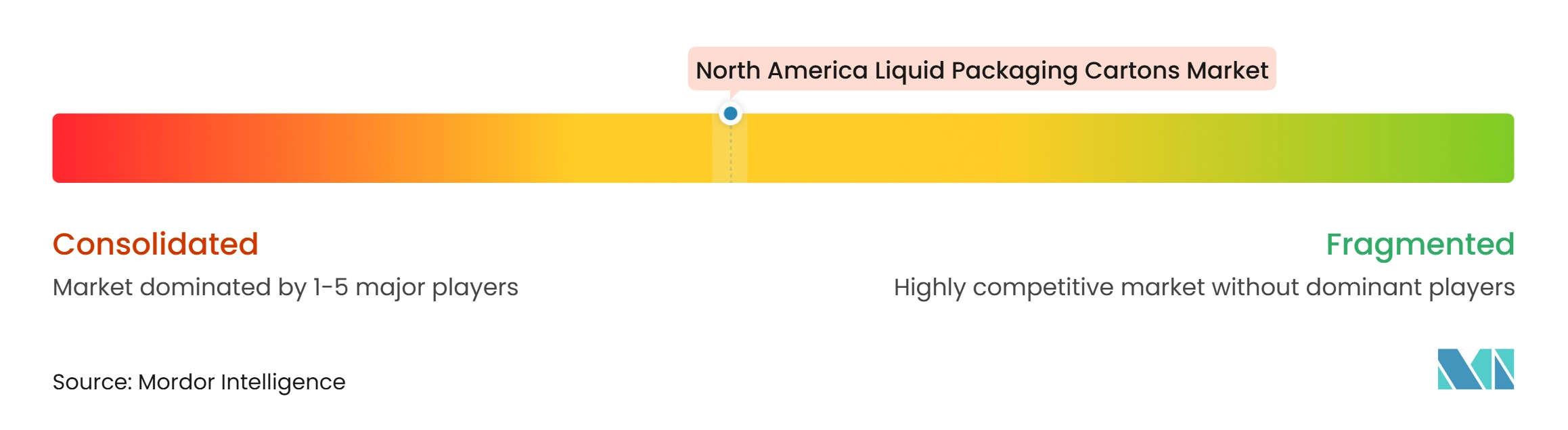
The North America liquid packaging cartons market has moderate concentration, led by Tetra Pak International S.A., SIG Group AG, and Elopak ASA. These companies supply carton materials and filling equipment, which raises switching costs after a customer qualifies a filling line and establishes operating routines. Their integrated model encourages competition through equipment upgrades, barrier design, and sustainability credentials rather than material price alone. System qualification also supports ongoing relationships between converters and large beverage customers, since equipment, packaging material, technical support, and food-safety processes are closely connected.
SIG's aluminum-free, full-barrier carton illustrates how leading suppliers are responding to the recycling challenge without sacrificing ambient storage performance. Its collaboration with PulPac on paper-based closures shows continued attention to fiber-based closure development and lower-material-complexity designs. Tetra Pak's Tetra Recart format is another strategic move that extends cartons into soups and pet food, where retortable formats are relevant. ReZorce's mono-material carton venture in Boston, developed with Refresco, seeks to serve a different technical route for carton packaging. These moves suggest that material composition, closure design, and retortable formats are key areas of product development across the North America liquid packaging cartons market.
Amcor plc, Stora Enso Oyj, Billerud AB, and Smurfit Westrock plc participate in the broader packaging and liquid packaging board ecosystem. Regional converters can compete in niche applications through lower minimum order quantities and more flexible commercial terms, particularly when customers need tailored specifications, short supply runs, or responsive commercial support. ISO 22000 and BRC Global Standards certification requirements create a compliance floor for food-grade carton production and raise the requirements for new suppliers seeking to serve beverage and food customers. Smaller-format aseptic cartons for functional beverages below 250 ml remain a potential area for customized offerings, faster changeovers, and new customer relationships in convenience-oriented channels.
North America Liquid Packaging Cartons Industry Leaders
-
Tetra Pak International S.A.
-
SIG Group AG
-
Elopak ASA
-
Pactiv Evergreen Inc.
-
Greatview Aseptic Packaging Co., Ltd.
- *Disclaimer: Major Players sorted in no particular order
North America Liquid Packaging Cartons Market Companies Covered in this Report
- Tetra Pak International S.A.
- SIG Group AG
- Elopak ASA
- Amcor plc
- Greatview Aseptic Packaging Co., Ltd.
- Nippon Paper Industries Co., Ltd.
- Mondi plc
- Stora Enso Oyj
- Smurfit Westrock plc
- Oji Holdings Corporation
- IPI S.r.l.
- Lami Packaging (Kunshan) Co., Ltd.
- TidePak Aseptic Packaging Material Co., Ltd.
- Adam Pack S.A.
- Italpack Cartons S.r.l.
- Billerud AB
Recent Industry Developments in North America Liquid Packaging Cartons Market
- October 2026: CalRecycle received the Producer Responsibility Organization's (PRO) formal compliance plan under California's SB 54 law and opened public comment through November 2026 ahead of 2027 fee enforcement. It incentivizes U.S. beverage and dairy brands to transition from single-use plastic jugs toward recyclable fiber-based liquid cartons to lower eco-modulated EPR fees.
- June 2026: Tetra Pak launched a 48 oz (1,420 ml) Tetra Brik Aseptic Edge carton in the United States and Canada, incorporating the LightWing 30 tethered cap and FSC-certified paperboard. The format targets premium dairy, plant-based, and juice brands seeking a family-size ambient packaging option with an in-use reclosure feature aligned with evolving litter-prevention regulations.
- April 2026: SIG Group AG announced a phased investment of MXN 1,910 million (USD 97.9 million) to expand its Querétaro, Mexico, facility in 2 phases, ultimately doubling production capacity from 1.5 billion to 3 billion cartons per year by 2028, with Phase 2 integrating an in-house extrusion line to complete the full carton production cycle locally.
- January 2026: Ontario completed the transition of its Blue Box recycling program to a 100% producer-funded Extended Producer Responsibility (EPR) framework, while Colorado joined Oregon in invoicing live state packaging EPR fees. It shifts financial accountability for post-consumer carton collection directly onto brand owners and converters across key North American jurisdictions.
North America Liquid Packaging Cartons Market Report Scope
The North America Liquid Packaging Cartons Market encompasses the manufacturing and supply of paperboard-based packaging solutions designed for the safe storage, transportation, and distribution of liquid beverages and food products. These cartons provide product protection, extended shelf life, and convenient handling while supporting efficient packaging and distribution. The market includes packaging solutions designed to maintain product freshness, prevent contamination, and meet evolving food safety and sustainability requirements.
The North America Liquid Packaging Cartons Market Report is Segmented by Product Type (Aseptic Cartons, and Non-Aseptic Cartons), Applications (Milk, Juices, Plant Based Beverages, Dairy Products Excluding Milk, Energy and Functional Drinks, Liquid Food, and Other Applications), Pack Size (Below 250 ml, 250-500 ml, and Above 500 ml), and Geography (United States, Mexico, and Canada). The Market Forecasts are Provided in Terms of Value (USD).
Segmentation Overview
| Aseptic Cartons |
| Non-Aseptic Cartons |
| Milk |
| Juices |
| Plant Based Beverages |
| Dairy Products (Excluding Milk) |
| Energy and Functional Drinks |
| Liquid Food |
| Other Applications |
| Below 250 ml |
| 250-500 ml |
| Above 500 ml |
| United States |
| Canada |
| Mexico |
| By Product Type | Aseptic Cartons |
| Non-Aseptic Cartons | |
| By Applications | Milk |
| Juices | |
| Plant Based Beverages | |
| Dairy Products (Excluding Milk) | |
| Energy and Functional Drinks | |
| Liquid Food | |
| Other Applications | |
| By Pack Size | Below 250 ml |
| 250-500 ml | |
| Above 500 ml | |
| By Geography | United States |
| Canada | |
| Mexico |
Key Questions Answered in the Report
What is the size of the North America liquid packaging cartons market?
The regional carton category is USD 1.79 billion in 2026 and is forecast to reach USD 2.26 billion by 2032, at a 3.97% CAGR from 2027 to 2032.
Which product type leads liquid packaging carton demand in North America?
Aseptic cartons lead with 52.68% share in 2026 and are projected to expand at a 4.69% CAGR through 2032.
What application is expanding fastest for liquid packaging cartons?
Plant-based beverages are projected to expand at a 4.84% CAGR through 2032, supported by demand for shelf-stable distribution.
Which pack size has the largest share in 2026?
Above 500 ml formats hold 54.37% share, supported by household purchasing and foodservice demand.
Which country is expected to grow fastest through 2032?
Mexico is projected to expand at a 4.73% CAGR, supported by domestic shelf-stable beverage demand and near-shoring investment.
What limits wider carton adoption in North America?
Recycling infrastructure, high aseptic-line capital requirements, raw-material cost volatility, and strong PET and aluminum incumbency remain key constraints.