
North America Inspection Equipment Market Size and Share
Market Overview
| Study Period | 2021 - 2032 |
|---|---|
| Forecast Data Period | 2027 - 2032 |
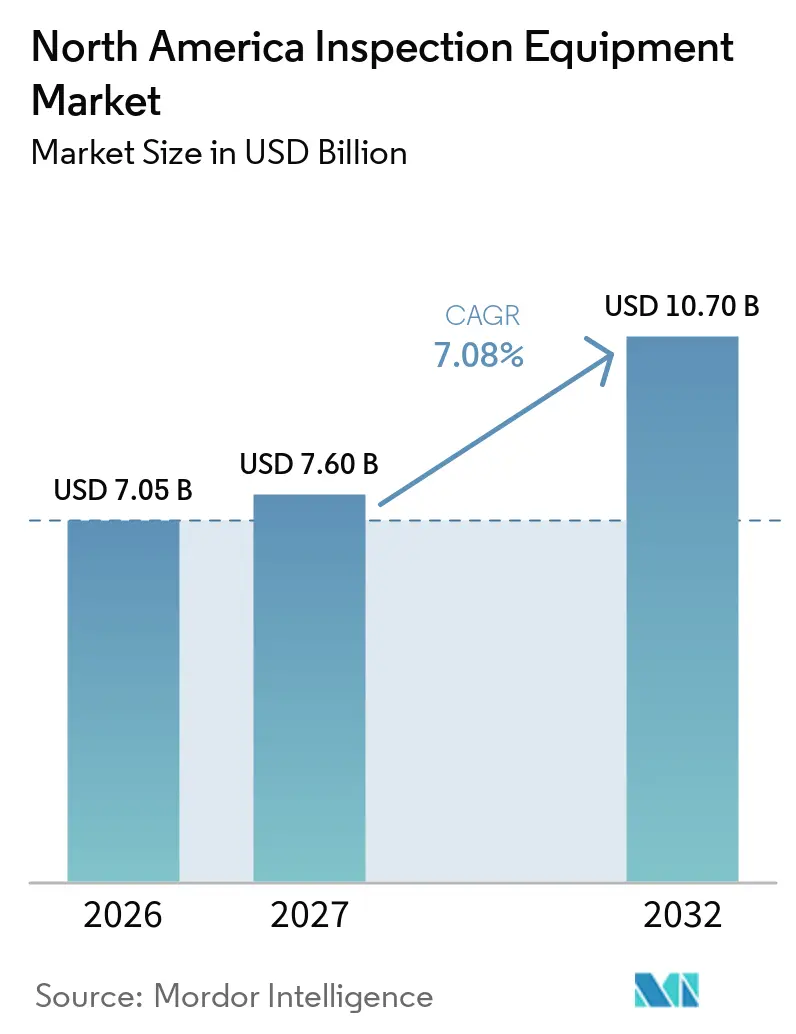
| Base Year Market Size (2026) | USD 7.05 Billion |
| Market Size (2027) | USD 7.60 Billion |
| Market Size (2032) | USD 10.70 Billion |
| Growth Rate (2027 - 2032) | 7.08 % |
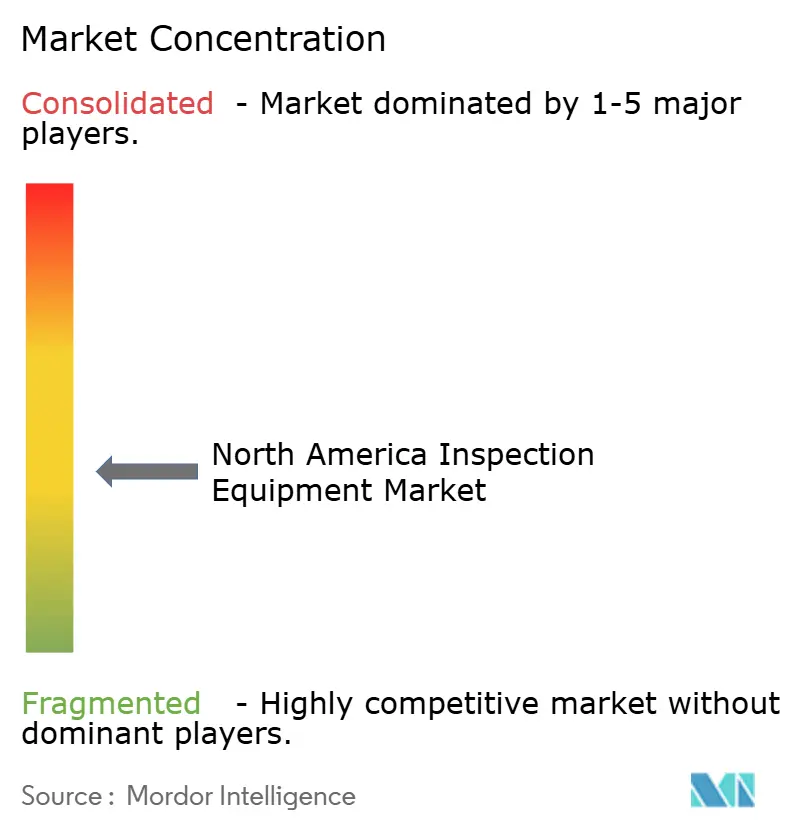
| Market Concentration | Medium |
Major Players *Disclaimer: Major Players sorted in no particular order Image © Mordor Intelligence. Reuse requires attribution under CC BY 4.0. | |
North America Inspection Equipment Market Analysis by Mordor Intelligence
The North America Inspection Equipment Market size is projected to expand from USD 7.05 billion in 2026 and USD 7.60 billion in 2027 to USD 10.70 billion by 2032, registering a CAGR of 7.08% between 2027 and 2032.
Artificial intelligence-enabled quality systems, semiconductor capacity additions, and statutory inspection obligations for older infrastructure support the North America inspection equipment market. Demand is becoming less tied to a single manufacturing cycle because semiconductors, energy, aviation, border security, and industrial users have different procurement triggers. Global semiconductor equipment billings reached USD 135.1 billion in 2025, while test equipment billings increased 55%, reflecting the additional process-control requirements associated with high-bandwidth memory architectures. Companies are responding through broader hardware and software portfolios, although integration costs, workforce shortages, and unstandardized AI defect libraries can slow adoption. The North America inspection equipment market also benefits when manufacturers replace legacy systems with equipment that supports digital records, more frequent inspection, and automated feedback to production lines.
Key Report Takeaways
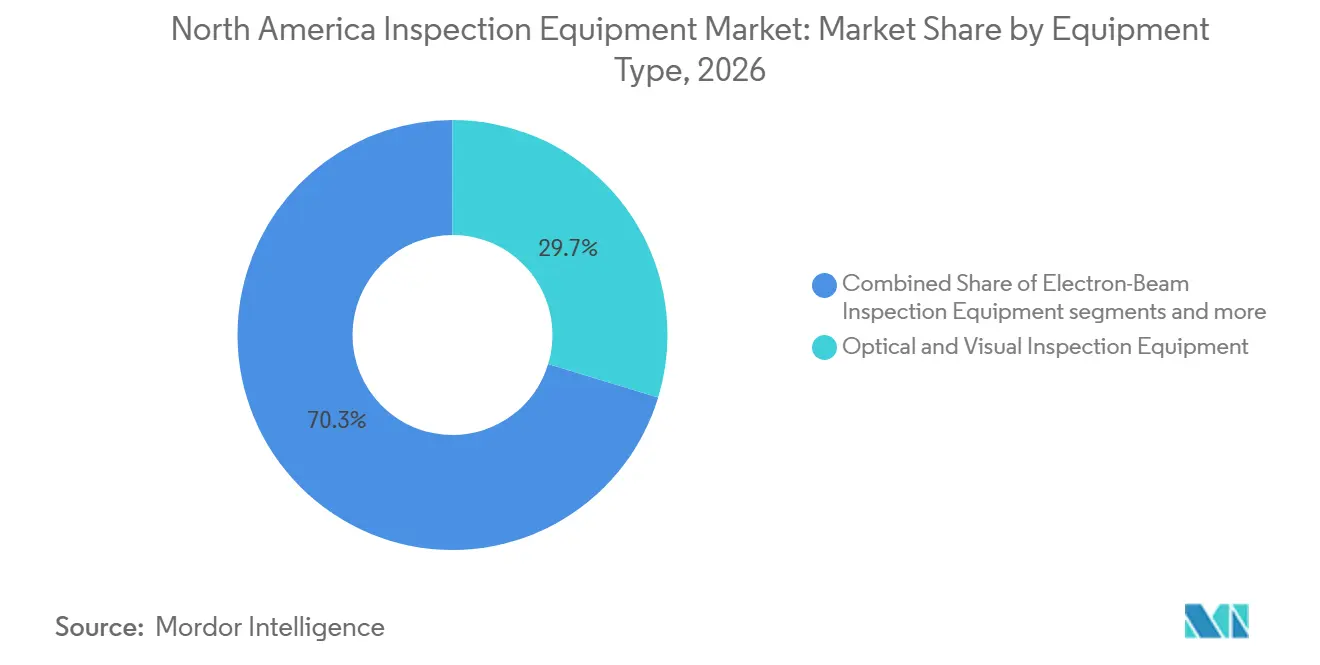
- By equipment type, optical and visual inspection equipment held 29.7% of North America inspection equipment market share in 2026, while electron-beam inspection equipment is forecast to grow at a 9.5% CAGR through 2032.
- By primary inspection application, manufactured product and production-process inspection held 54.7% of North America inspection equipment market size in 2026, while commodity, cargo and trade inspection is forecast to grow at a 7.5% CAGR through 2032.
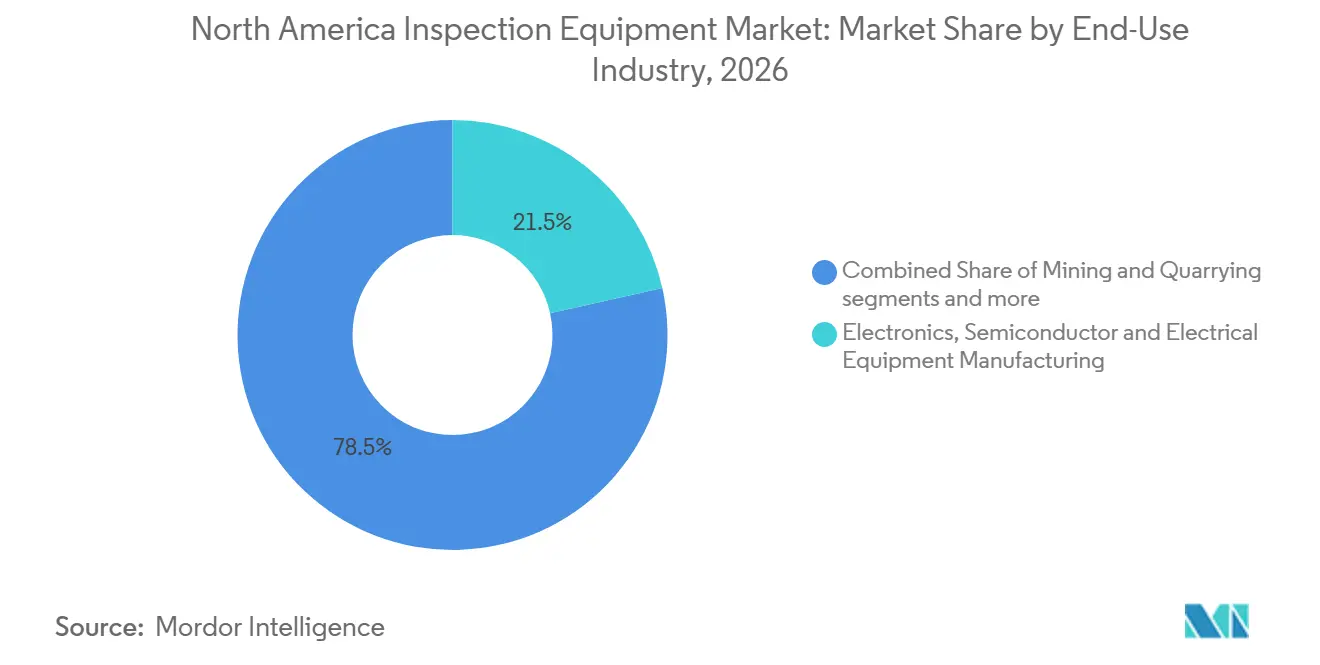
- By end-use industry, electronics, semiconductor and electrical equipment manufacturing held 21.5% of 2026 regional revenue and is forecast to grow at an 8.1% CAGR through 2032.
- By geography, the United States held 78% of 2026 regional revenue and is forecast to grow at a 7.2% CAGR through 2032.
Note: Market numbers in this report are based on Mordor Intelligence's proprietary estimation framework, which combines nine months of actuals with Q4 projections for base year 2026.
Market Trends and Insights
Drivers Impact Analysis of North America Inspection Equipment Market*
| Driver | (~) % Impact on CAGR Forecast | Geographic Relevance | Impact Timeline |
|---|---|---|---|
| AI-Enabled Defect Detection and Closed-Loop Quality Control | +2.0% | Global, with the highest intensity in United States semiconductor and automotive clusters | Short term (≤ 2 years) |
| Reshoring and Semiconductor Fab Expansion | +1.8% | United States, primarily Arizona, Ohio, and Texas, with Canada secondary | Medium term (2-4 years) |
| Aging Industrial Infrastructure and Mandatory Integrity Inspection | +1.4% | United States and Canada pipeline, utility, and industrial corridors | Short term (≤ 2 years) |
| Regulatory Compliance Across Energy, Aviation, and Nuclear | +1.2% | United States nationally and Canada for pipeline and mining | Short term (≤ 2 years) |
| Inspection Demand from Battery and Additive-Manufacturing Qualification | +0.9% | United States EV factories and the Canadian battery supply chain | Medium term (2-4 years) |
| Inspection Data Interoperability as a Production Bottleneck | +0.6% | Global, with North America leading enterprise deployment | Long term (≥ 4 years) |
| Source: Mordor Intelligence | |||
AI-Enabled Defect Detection and Closed-Loop Quality Control
Automated inspection is increasingly valued for its ability to feed defect information back into upstream production settings without interrupting line throughput, helping manufacturers reduce scrap and shorten process-development cycles. Cognex made its OneVision platform generally available in May 2026, following a beta phase that involved more than 100 manufacturing customers since June 2025. The platform is designed to extend AI-based inspection across multiple production sites through a centralized development environment. KLA reported a USD 12.57 billion process-control and inspection order backlog as of June 30, 2026, compared with USD 7.86 billion a year earlier. These developments support recurring demand in the North America inspection equipment market from upgrades at operating facilities and the construction of new manufacturing plants. The growing integration of inspection data into production control allows manufacturers to identify recurring defect patterns and adjust equipment settings and material-handling processes earlier in the production cycle, rather than relying exclusively on final quality checks. Semiconductor manufacturers have a particularly strong need for these capabilities as advanced process nodes and increasingly complex memory structures require additional inspection stages. Automotive and electronics manufacturers also deploy machine vision systems where inspection repeatability and production-line speed influence automation efficiency.
Reshoring and Semiconductor Fab Expansion
Semiconductor construction is driving inspection demand that will likely extend beyond the initial building phase, as fab development schedules typically span several years from chip-design decisions to production readiness. TSMC accelerated mass production at its second Phoenix facility from 2028 to 2027, while Intel continued construction at its New Albany facility after securing an AI production partnership with Nvidia in September 2025.[1] These projects require inspection equipment before production ramps up because process control is essential for equipment qualification and manufacturing consistency. New fabs increasingly design around in-line optical inspection, electron-beam systems, and metrology tools rather than relying primarily on end-of-line sampling, supporting sustained orders in North America's inspection equipment market. The impact extends beyond wafer fabrication plants, as equipment suppliers, component manufacturers, and service providers must meet stringent traceability and quality requirements when supplying domestic semiconductor projects. Inspection intensity also increases at advanced logic nodes because conventional optical methods may not adequately resolve the smallest structures. KLA highlighted strong adoption of single-beam and multi-beam electron-beam systems alongside improvements in AI-based optical inspection in its fiscal 2026 materials.
Aging Industrial Infrastructure and Mandatory Integrity Inspection
Older pipeline, refinery, and utility assets require recurring integrity assessments, particularly where access is limited or equipment failure could create serious safety consequences. Many North American industrial facilities and pipeline networks were constructed between the 1950s and 1970s, increasing the need for condition monitoring and periodic inspections. In May 2025, the Pipeline and Hazardous Materials Safety Administration (PHMSA) proposed updates to repair criteria and inspection timelines for hazardous-liquid and gas transmission pipelines, noting that core hazardous-liquid inspection requirements had not been substantially updated since 1981.[2] A separate proposal in July 2025 recognized the use of thermal imaging and LiDAR for pipeline right-of-way patrols, supporting demand for advanced systems in the North America inspection equipment market.[3] Operators responding to evolving inspection requirements have incentives to consider digital radiography, phased-array ultrasonic testing equipment, and drone-mounted inspection systems as alternatives or complements to legacy instruments. These technologies can improve access to difficult locations and generate digital records that support defect assessment, maintenance planning, and regulatory documentation.
Regulatory Compliance Across Energy, Aviation, and Nuclear
Federal regulatory activity across energy, aviation, and nuclear operations is supporting inspection equipment demand that is less dependent on general capital spending. The Pipeline and Hazardous Materials Safety Administration (PHMSA) finalized its gas pipeline leak detection and repair rule in January 2025, strengthening leakage survey requirements and establishing repair timelines for classified leaks. These requirements support the adoption of advanced leak-detection and inspection technologies across transmission, distribution, and gathering systems. In July 2026, the Nuclear Regulatory Commission published a rulemaking notice addressing reactor licensing, safety oversight, and siting practices, adding to the regulatory framework governing nuclear facilities. These programs reinforce compliance-driven demand in the North America inspection equipment market. Aviation maintenance also generates recurring requirements for borescopes, eddy-current testing equipment, and phased-array ultrasonic systems, as maintenance, repair, and overhaul facilities must meet applicable airworthiness requirements. Although oil and gas operators, nuclear construction projects, and aircraft maintenance providers require different inspection technologies, each depends on reliable inspection records to demonstrate compliance and document equipment condition. ASME, API, and ASTM standards also influence equipment selection and inspection procedures across industrial and pipeline applications.
Restraints Impact Analysis of North America Inspection Equipment Market*
| Restraint | (~) % Impact on CAGR Forecast | Geographic Relevance | Impact Timeline |
|---|---|---|---|
| High Capital Cost and Integration Complexity | -1.8% | North America-wide, with the highest burden on small and mid-sized manufacturers | Medium term (2-4 years) |
| Shortage of Qualified Inspection and Metrology Personnel | -1.2% | United States nationally, especially advanced manufacturing and energy regions | Short term (≤ 2 years) |
| Cybersecurity and Data-Sovereignty Requirements for Connected Inspection | -0.8% | United States and Canada critical infrastructure and defense supply chains | Medium term (2-4 years) |
| Unstandardized AI Defect Libraries and Model Validation | -0.5% | Global, with the greatest friction in regulated aerospace and life sciences production | Long term (≥ 4 years) |
| Source: Mordor Intelligence | |||
High Capital Cost and Integration Complexity
Advanced inspection cells can involve substantial costs beyond the initial equipment quotation, including installation, programmable logic controller (PLC) connections, factory-network configuration, custom interfaces, validation protocols, and commissioning labor. The National Institute of Standards and Technology’s Manufacturing Extension Partnership identifies total cost of ownership as an important consideration in manufacturing technology decisions, while the Pipeline and Hazardous Materials Safety Administration (PHMSA), in its May 2025 proposal, sought feedback on whether inspection technology requirements could impose costs disproportionate to their safety benefits. These factors create an adoption barrier for smaller users in the North America inspection equipment market. Integration complexity adds to the challenge because manufacturers often need new inspection systems to communicate with legacy manufacturing execution systems, enterprise resource planning platforms, and quality-management software. Configuring these connections can extend implementation timelines by several months and require specialized engineering resources that may not be available internally.
Shortage of Qualified Inspection and Metrology Personnel
A shortage of certified inspection and metrology personnel can delay the realization of productivity benefits from new equipment across the North America inspection equipment market. The National Association of Manufacturers projected that 3.8 million manufacturing positions would open in the United States by 2033, with nearly 1.9 million potentially remaining unfilled. This gap reflects workforce retirements alongside demand growth in production and technical occupations. To address skill requirements, the National Institute of Standards and Technology (NIST) offers a five-day Fundamentals of Metrology program covering measurement systems, uncertainty analysis, traceability, and laboratory quality management, all of which are important for reliable inspection and measurement processes. The constraint is particularly significant when equipment operators need both technical familiarity with inspection systems and formal knowledge of quality-management requirements. Calibration technicians require specialized skills, but training pipelines may not expand quickly enough to meet employer demand. Limited personnel availability can extend commissioning timelines, reduce the utilization of installed systems, and delay the productivity gains expected from equipment investments. These challenges increase the value of intuitive software interfaces, remote technical support, automated reporting, and simplified calibration workflows. However, automation cannot fully replace qualified personnel, particularly in regulated environments where inspection results require technical interpretation, quality assurance, and documented review.
*Our forecasts treat driver/restraint impacts as directional, not additive. The impact forecasts reflect baseline growth, mix effects, and variable interactions.
North America Inspection Equipment Market Segment Analysis
By Equipment Type:
Optical Leadership Sustained as Electron-Beam Accelerates at Advanced NodesOptical and visual inspection equipment held 29.7% of the North America inspection equipment market share in 2026, making it the largest equipment category. Machine vision and automated optical inspection are widely used in electronics assembly, automotive production, and consumer goods manufacturing. Borescopes for jet-engine work and surface scanners for composite aerospace structures add to demand. The North America inspection equipment market size for this category is supported by use across high-volume lines and specialized maintenance activities. The installed base allows optical suppliers to add AI tools, centralized data management, and repeatable automated checks.
Electron-beam inspection equipment is forecast to grow at a 9.5% CAGR from 2027 to 2032 because advanced semiconductor process control at sub-3nm nodes can exceed optical-resolution limits. KLA has described adoption of single-beam and multi-beam electron-beam systems alongside AI-based optical improvements. Dimensional and geometric systems, including coordinate measuring machines, laser scanners, and 3D platforms, remain process-critical for automotive and aerospace manufacturing. Ultrasonic and acoustic equipment serve buried, subsurface, and hard-to-access energy and civil assets. Radiographic and computed tomography systems are gaining relevance in battery-cell qualification and additive-manufactured-part verification without damaging the component.

By Primary Inspection Application:
Production Inspection Dominates and Cargo Inspection AcceleratesManufactured product and production-process inspection accounted for 54.7% of the North America inspection equipment market size in 2026. It is the largest application category and reflects the central role of manufacturing competitiveness in equipment purchasing. In-line inspection can identify defects during production rather than after a completed product is assembled. The segment is sensitive to manufacturing output cycles and capital-spending decisions. It includes electronic devices, vehicles, aerospace parts, and other manufactured goods, creating a large installed base for upgrades, replacement tools, and related services.
Commodity, cargo, and trade inspection is projected to expand at a 7.5% CAGR by 2032. Border security equipment programs, pharmaceutical import conformity checks, and modernization at land and seaports support the application. It uses X-ray, computed tomography, and other systems that can evaluate goods while maintaining trade flows. Civil infrastructure inspection benefits bridge, tunnel, and dam programs, while industrial facilities require scheduled inspection of boilers, pressure vessels, heat exchangers, and storage tanks. Vehicles and mobile assets create recurring demand through maintenance schedules set by applicable authorities.
By End-Use Industry:
Semiconductor Dual Leadership Reshapes Investment PrioritiesElectronics, semiconductor, and electrical equipment manufacturing held 21.5% of 2026 regional revenue and is forecast to record the highest end-use growth at an 8.1% CAGR through 2032. This dual position reflects rising inspection intensity per device rather than only increased manufacturing capacity. Gate-all-around transistor structures and 3D stacked memory require more measurement and inspection stages. The North American inspection equipment industry is closely exposed to the shift toward more complex devices and tighter process windows. Inspection revenue can rise per wafer start even when the number of new factories does not increase at the same rate.
Oil and gas, including refining and petrochemicals, remains a significant end-use area for pipeline integrity, pressure-vessel inspection, and corrosion assessment. Aerospace and defense manufacturing requires portable field tools and laboratory metrology systems because airworthiness directives and NADCAP quality requirements create strict documentation needs. Automotive producers are adjusting practices for electric-vehicle battery modules and mixed-material body structures, while healthcare, pharmaceutical, and life-sciences users need traceable records for regulatory compliance. These applications spread demand across several verticals and make technical support important after the original purchase. The North America inspection equipment industry remains dependent on service capabilities because performance and documentation are central to use.
Geography Analysis
United States Inspection Equipment Market
The United States held 78% of 2026 regional revenue and is forecast to grow at a 7.2% CAGR through 2032. Demand spans semiconductor facilities in Arizona and Texas, oil and gas corridors from the Permian Basin to the Gulf Coast, and aerospace maintenance hubs in Seattle, Wichita, and Tulsa. Semiconductor facilities require advanced optical and electron-beam systems, while pipeline operators need nondestructive testing under integrity-management programs. Aerospace MRO providers purchase borescope and eddy-current equipment for scheduled maintenance. U.S. demand is also supported by the CHIPS and Science Act, which committed more than USD 50 billion to semiconductor manufacturing and research.
United States and Canada Inspection Equipment Market
United States facilities often face regulatory requirements and customer specifications, which can support higher-value systems with detailed records and greater automation. Canada remains important through Alberta oil sands and pipelines, Quebec aerospace manufacturing, and Ontario automotive production. Alberta uses recurring ultrasonic and electromagnetic inspection, while Quebec aerospace suppliers require dimensional metrology and nondestructive testing to meet established quality frameworks. In January 2026, FARO Technologies and Creaform reorganized their metrology businesses into FARO CREAFORM and FARO INSIGHT. Canada also benefits from equipment upgrades tied to electric-vehicle production and portable-metrology development.
Mexico Inspection Equipment Market
Mexico is evolving under USMCA rules-of-origin requirements and the transition to electric and hybrid vehicles. Automotive plants in Nuevo León, Coahuila, and Jalisco are adding battery modules, composite parts, and tighter assembly tolerances that require X-ray computed tomography, laser scanning, and machine vision. Tier 2 and Tier 3 suppliers may need certified in-process inspection for tariff-free qualification. The Guadalajara electronics cluster is also adopting automated optical inspection as medical-device and consumer-electronics customers require local suppliers to meet inspection conditions, creating a lower-base but expanding source of demand for the North America inspection equipment market.
Competitive Landscape
The North America inspection equipment market exhibits a medium level of market concentration. Machine vision, electron-beam semiconductor inspection, and ultrasonic nondestructive testing each have a limited number of leading vendors. The broader field is less concentrated because customers buy different combinations of visual, dimensional, radiographic, acoustic, and digital tools. In April 2026, Hexagon agreed to acquire Waygate Technologies from Baker Hughes for USD 1.45 billion, combining precision metrology with radiography, remote visual inspection, and ultrasonic-testing capabilities. The transaction supports customers that seek to consolidate equipment and service relationships with one supplier.
In August 2026, Teledyne entered into an agreement to acquire Varex Imaging for USD 1.1 billion, adding X-ray sources, detectors, and imaging software to its digital-imaging portfolio. In September 2026, Cognex agreed to acquire RealSense for USD 500 million, adding depth-sensing cameras and robotic-perception AI to its machine-vision offering. These moves indicate that software integration and sensing breadth are increasingly relevant to major contract opportunities. KLA and Applied Materials are expanding their competitive overlap in semiconductor process control, with Applied Materials expecting its process diagnostics and control business to grow more than 50% in calendar 2026. The North America inspection equipment market remains open to specialized suppliers where field performance and application knowledge matter more than breadth.
Eddyfi Technologies competes in phased-array and guided-wave ultrasonic testing for oil and gas and aerospace users. Smaller manufacturers with variable inspection needs may favor service arrangements over owning high-cost systems. ISO/IEC 17025 accreditation and NADCAP certification can create switching barriers because suppliers must support documentation and validated procedures. Cybersecurity, data-sovereignty requirements, and unstandardized AI defect libraries can further influence supplier choice in critical infrastructure and regulated production environments.
North America Inspection Equipment Industry Leaders
-
Baker Hughes Company
-
Evident Corporation
-
Hexagon AB
-
Cognex Corporation
-
KEYENCE CORPORATION
- *Disclaimer: Major Players sorted in no particular order
North America Inspection Equipment Market Companies Covered in this Report
- Baker Hughes Company (Waygate Technologies)
- Evident Corporation
- Hexagon AB
- Cognex Corporation
- KEYENCE CORPORATION
- FARO Technologies, Inc.
- KLA Corporation
- Applied Materials, Inc.
- MISTRAS Group, Inc.
- SGS Société Générale de Surveillance SA
- Bureau Veritas
- Nikon Corporation (Nikon Metrology)
- Carl Zeiss AG (ZEISS Industrial Quality Solutions)
- Mitutoyo Corporation
- Eddyfi Technologies Inc.
- Fujifilm Holdings Corporation (FUJIFILM NDT Systems)
- Magnaflux (Illinois Tool Works Inc.)
- SICK AG
- OMRON Corporation
- Teledyne Technologies Incorporated
- Sonatest Ltd.
- Applus Services, S.A.
Recent Industry Developments in North America Inspection Equipment Market
- September 2026: Cognex Corporation signed a definitive agreement to acquire RealSense for USD 500 million in cash, adding depth-sensing cameras and robotic-perception AI to its machine vision portfolio. The robotic-perception market is estimated at USD 600 million currently and is forecast to grow more than 25% annually to USD 1.6 billion by 2030. Closing is expected in Q4 2026, subject to regulatory approvals.
- August 2026: Teledyne Technologies entered into a definitive agreement to acquire Varex Imaging Corporation for USD 1.1 billion in cash, adding X-ray tubes, flat-panel and photon-counting detectors, and imaging software for nondestructive inspection, security scanning, and measurement applications to Teledyne's existing digital imaging portfolio. Closing is anticipated in early 2027.
- April 2026: Hexagon AB signed a definitive agreement to acquire Waygate Technologies from Baker Hughes for USD 1.45 billion in cash. Waygate generates USD 630 million in annual revenue, with 30% from North America, and operates radiography, remote visual inspection, and ultrasonic testing product lines serving the aerospace, automotive, energy, and battery manufacturing sectors.
- May 2026: Cognex launched the In-Sight 3900 Vision System, its highest-performance embedded AI vision system, delivering inspection speeds up to 4X faster than the prior generation at up to 25-megapixel resolution, integrating Qualcomm Dragonwing processing for edge AI inference and connecting to the OneVision cloud-to-edge inspection ecosystem.
North America Inspection Equipment Market Report Scope
The North America Inspection Equipment Market Report is segmented by Equipment Type (Optical and Visual Inspection Equipment, and More), by Primary Inspection Application (Building and Property Inspection, Civil Infrastructure Inspection, and More), by End-Use Industry (Oil and Gas, Including Refining and Petrochemicals, and More), and by Geography (Canada, and more). The Market Forecasts are Provided in Terms of Value (USD).
Segmentation Overview
| Optical and Visual Inspection Equipment | Machine Vision and Automated Optical Inspection Systems |
| Borescopes and Remote Visual Inspection Systems | |
| Other Optical and Surface Inspection Equipment | |
| Dimensional and Geometric Inspection Equipment | Coordinate Measuring Machines |
| Laser Scanning and 3D Measurement Systems | |
| Other Dimensional and Surface Profiling Inspection Systems | |
| Ultrasonic and Acoustic Inspection Equipment | Conventional Ultrasonic Inspection Systems |
| Phased-Array and Advanced Ultrasonic Inspection Systems | |
| Acoustic Emission and Acoustic Imaging Systems | |
| Radiographic and Computed Tomography Inspection Equipment | Conventional and Digital Radiography Systems |
| Industrial Computed Tomography Systems | |
| Cargo and Consignment X-Ray Inspection Systems | |
| Electromagnetic and Magnetic Inspection Equipment | Eddy-Current Inspection Systems |
| Magnetic Particle and Magnetic Flux Leakage Inspection Systems | |
| Ground-Penetrating Radar and Other Electromagnetic Inspection Systems | |
| Thermal and Infrared Inspection Equipment | Handheld Thermal Imaging Systems |
| Fixed and Integrated Thermal Inspection Systems | |
| Electron-Beam Inspection Equipment | Electron-Beam Defect Inspection and Review Systems |
| Other Charged-Particle Inspection Systems | |
| Other Specialized Inspection Equipment | Leak and Pressure-Integrity Inspection Systems |
| Automated Checkweighing and Other Physical Conformity Inspection Systems | |
| Other Dedicated Inspection Instruments and Systems |
| Building and Property Inspection |
| Civil Infrastructure Inspection |
| Industrial Facilities and Fixed Asset Inspection |
| Manufactured Product and Production-Process Inspection |
| Transportation Vehicle and Mobile Asset Inspection |
| Commodity, Cargo and Trade Inspection |
| Other Operational Site and Process Inspection |
| Oil and Gas, Including Refining and Petrochemicals |
| Power Generation, Renewable Energy and Utilities |
| Automotive and Automotive Component Manufacturing |
| Aerospace and Defense Manufacturing |
| Electronics, Semiconductor and Electrical Equipment Manufacturing |
| Other Manufacturing and Industrial Processing |
| Construction, Real Estate and Civil Infrastructure |
| Transportation and Logistics Operations |
| Mining and Quarrying |
| Agriculture, Food and Beverage |
| Healthcare, Pharmaceuticals and Life Sciences |
| Wholesale, Retail and Commodity Trading |
| Government, Regulatory and Border Inspection Agencies |
| Other End Users |
| United States |
| Canada |
| Mexico |
| By Equipment Type | Optical and Visual Inspection Equipment | Machine Vision and Automated Optical Inspection Systems |
| Borescopes and Remote Visual Inspection Systems | ||
| Other Optical and Surface Inspection Equipment | ||
| Dimensional and Geometric Inspection Equipment | Coordinate Measuring Machines | |
| Laser Scanning and 3D Measurement Systems | ||
| Other Dimensional and Surface Profiling Inspection Systems | ||
| Ultrasonic and Acoustic Inspection Equipment | Conventional Ultrasonic Inspection Systems | |
| Phased-Array and Advanced Ultrasonic Inspection Systems | ||
| Acoustic Emission and Acoustic Imaging Systems | ||
| Radiographic and Computed Tomography Inspection Equipment | Conventional and Digital Radiography Systems | |
| Industrial Computed Tomography Systems | ||
| Cargo and Consignment X-Ray Inspection Systems | ||
| Electromagnetic and Magnetic Inspection Equipment | Eddy-Current Inspection Systems | |
| Magnetic Particle and Magnetic Flux Leakage Inspection Systems | ||
| Ground-Penetrating Radar and Other Electromagnetic Inspection Systems | ||
| Thermal and Infrared Inspection Equipment | Handheld Thermal Imaging Systems | |
| Fixed and Integrated Thermal Inspection Systems | ||
| Electron-Beam Inspection Equipment | Electron-Beam Defect Inspection and Review Systems | |
| Other Charged-Particle Inspection Systems | ||
| Other Specialized Inspection Equipment | Leak and Pressure-Integrity Inspection Systems | |
| Automated Checkweighing and Other Physical Conformity Inspection Systems | ||
| Other Dedicated Inspection Instruments and Systems | ||
| By Primary Inspection Application | Building and Property Inspection | |
| Civil Infrastructure Inspection | ||
| Industrial Facilities and Fixed Asset Inspection | ||
| Manufactured Product and Production-Process Inspection | ||
| Transportation Vehicle and Mobile Asset Inspection | ||
| Commodity, Cargo and Trade Inspection | ||
| Other Operational Site and Process Inspection | ||
| By End-Use Industry | Oil and Gas, Including Refining and Petrochemicals | |
| Power Generation, Renewable Energy and Utilities | ||
| Automotive and Automotive Component Manufacturing | ||
| Aerospace and Defense Manufacturing | ||
| Electronics, Semiconductor and Electrical Equipment Manufacturing | ||
| Other Manufacturing and Industrial Processing | ||
| Construction, Real Estate and Civil Infrastructure | ||
| Transportation and Logistics Operations | ||
| Mining and Quarrying | ||
| Agriculture, Food and Beverage | ||
| Healthcare, Pharmaceuticals and Life Sciences | ||
| Wholesale, Retail and Commodity Trading | ||
| Government, Regulatory and Border Inspection Agencies | ||
| Other End Users | ||
| By Geography | United States | |
| Canada | ||
| Mexico | ||
Key Questions Answered in the Report
What is the 2026 size of North America inspection equipment market?
North America inspection equipment market revenue is USD 7.05 billion in 2026 and is projected to reach USD 10.7 billion by 2032 at a 7.08% CAGR.
Which equipment category has the largest revenue share?
Optical and visual inspection equipment leads with 29.7% of 2026 revenue, supported by machine vision use across electronics and automotive production.
Which inspection technology is growing the fastest?
Electron-beam inspection equipment is projected to grow at a 9.5% CAGR through 2032 because advanced semiconductor nodes require more detailed process control.
Which application has the greatest demand?
Manufactured product and production-process inspection holds 54.7% of 2026 revenue because in-line quality control is widely used across manufacturing sites.
Which country leads regional demand?
The United States holds 78% of 2026 regional revenue and is projected to grow at a 7.2% CAGR through 2032.
What are the main limits on equipment adoption?
High implementation cost, integration complexity, a shortage of qualified personnel, cybersecurity requirements, and AI model validation can delay deployment.