
North America Esim Hardware Market Size and Share
Market Overview
| Study Period | 2020 - 2031 |
|---|---|
| Forecast Data Period | 2026 - 2031 |
| Base Year Market Size (2025) | 234 Million units |
| Market Volume (2026) | 283 Million units |
| Market Volume (2031) | 682 Million units |
| Growth Rate (2026 - 2031) | 19.21 % |
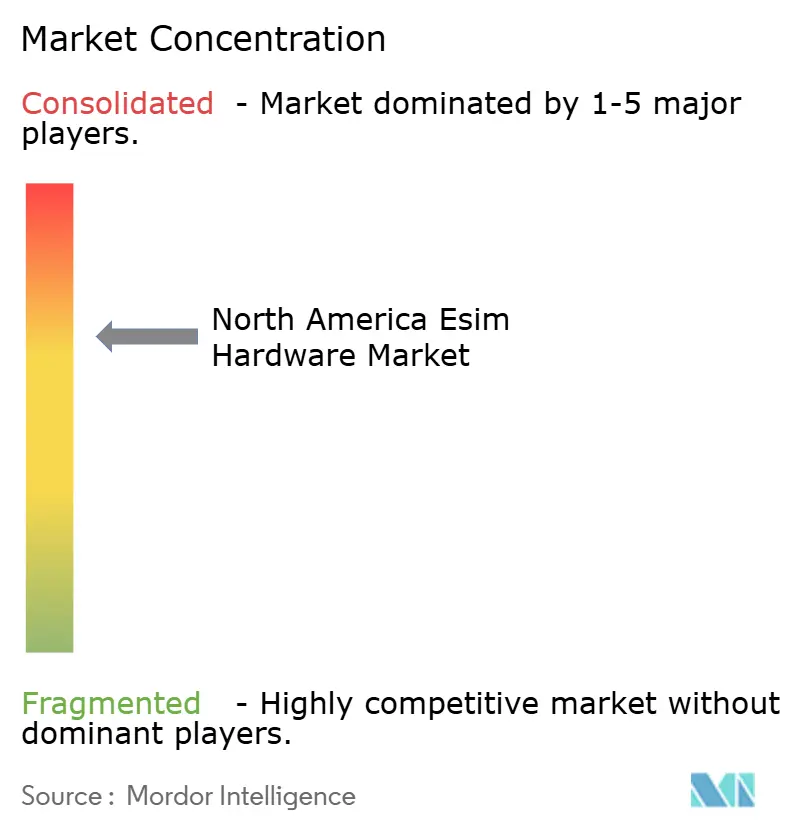
| Market Concentration | Medium |
Major Players *Disclaimer: Major Players sorted in no particular order Image © Mordor Intelligence. Reuse requires attribution under CC BY 4.0. | |
North America Esim Hardware Market Analysis by Mordor Intelligence
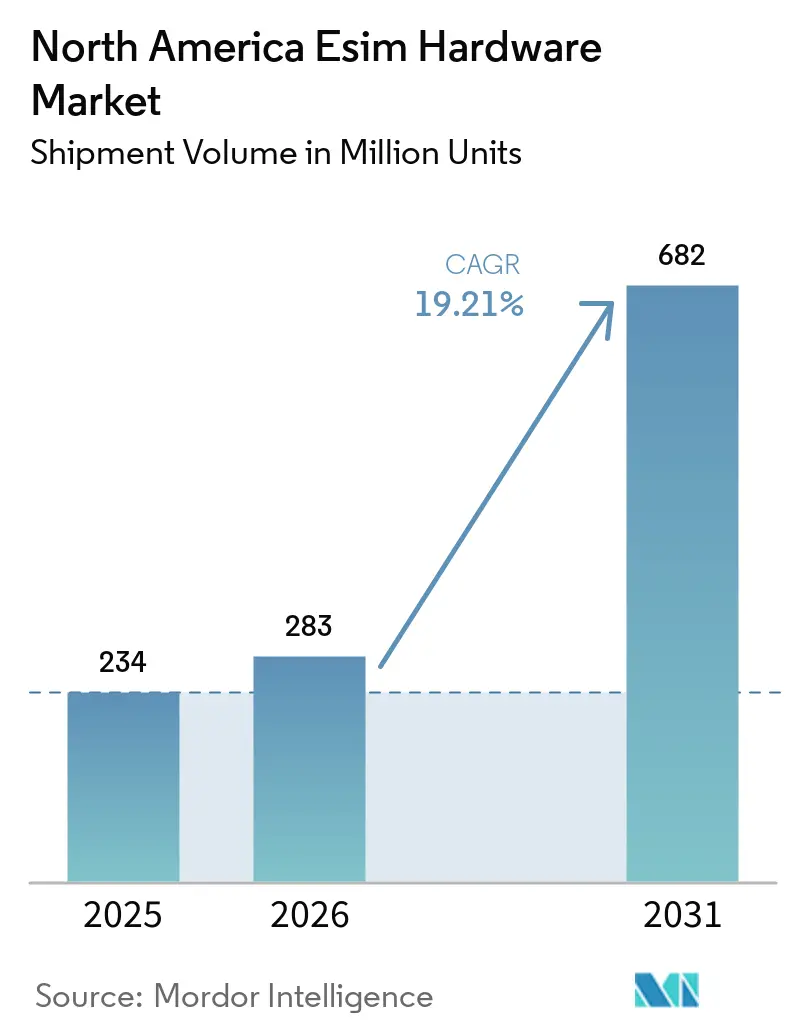
The North America Esim Hardware Market size in terms of shipment volume is expected to grow from 234 million units in 2025 to 283 million units in 2026 and is forecast to reach 682 million units by 2031 at 19.21% CAGR over 2026-2031.
The North America eSIM hardware market is being shaped by eSIM-only smartphone designs, wider private 5G activity, and connected-vehicle programs. These changes increase demand for secure components that can be provisioned remotely and embedded during device production. Consumer devices provide the established volume base, while automotive and IoT deployments add demand that is less dependent on replacement cycles. Certification readiness and compact form factors are becoming more important in vendor selection. The North America eSIM hardware market also faces slower adoption where legacy provisioning systems and carrier practices limit profile flexibility.
Key Report Takeaways
- By network type, 5G held 45.86% of North America eSIM hardware market share in 2025 and is projected to expand at a 19.87% CAGR through 2031.
- By form factor, MFF2 held 33.53% of North America eSIM hardware market share in 2025, while System-in-Package and Integrated iUICC is expected to expand at a 20.17% CAGR through 2031.
- By device type, Smartphones accounted for 48.27% of the North America eSIM hardware market size in 2025, while M2M and IoT Modules is projected to expand at a 21.15% CAGR through 2031.
- By application, Consumer Electronics held 44.32% of volume in 2025, while Automotive and Transportation is expected to expand at a 19.95% CAGR through 2031.
- By geography, the United States held 84.32% of volume in 2025, while Mexico is projected to expand at a 21.04% CAGR through 2031.
Note: Market size and forecast figures in this report are generated using Mordor Intelligence’s proprietary estimation framework, updated with the latest available data and insights as of January 2026.
North America Esim Hardware Market Trends and Insights
Drivers Impact Analysis*
| Driver | (~) % Impact on CAGR Forecast | Geographic Relevance | Impact Timeline |
|---|---|---|---|
| IPhone-Led eSIM-Only Flagship Migration | +4.5% | United States, Canada, Mexico | Short term (≤ 2 years) |
| 5G Fixed-Wireless Access and Private Network Expansion | +3.8% | United States, with early expansion to Canada | Medium term (2-4 years) |
| Automotive Embedded Connectivity for Software Updates | +3.2% | United States, Canada, Mexico | Medium term (2-4 years) |
| GSMA SGP.32 for Headless IoT Deployments | +2.8% | Global, with North America as an early commercial adopter | Medium term (2-4 years) |
| Carrier-Grade Provisioning for Public-Safety Networks | +2.0% | United States, including FirstNet Band 14 coverage | Short term (≤ 2 years) |
| Insurance-Linked Asset Tracking Adoption | +1.5% | United States, Canada | Long term (≥ 4 years) |
| Source: Mordor Intelligence | |||
IPhone-Led Migration to eSIM-Only Flagships
Apple made the iPhone 17 series eSIM-only across the United States, Canada, and Mexico in September 2025. The iPhone 17 Air also became the first iPhone sold globally without a physical SIM tray exception. This decision moved all 3 North American markets to a common device design requirement. The North America eSIM hardware market benefits because carriers need compatible remote provisioning systems for premium device users. The policy also raises the technical standard for smartphone components and profile management. It creates a faster path for Samsung and other premium OEMs to expand eSIM support in North American models. Budget Android brands still have limited eSIM hardware availability at volume, so adoption remains uneven between premium and lower-priced devices. Apple's device direction makes provisioning capability a basic carrier requirement rather than a feature reserved for early adopters. Carriers must support GSMA-certified SM-DP+ and SM-DS infrastructure to serve eSIM-only handsets. This requirement can place greater investment pressure on mobile virtual network operators. The North America eSIM hardware market therefore gains from hardware demand and from wider carrier readiness. The resulting divide is between premium eUICC procurement today and later adoption in lower-priced devices. That lag can preserve physical-SIM compatibility needs in parts of the handset base. No flagship smartphone OEM in the region retained a physical-SIM-only option across the United States, Canada, and Mexico in 2026.
5G Fixed-Wireless Access and Private Network Expansion
Private 5G networks create an eSIM hardware demand base outside traditional consumer carrier channels. Enterprise installations require connected controllers, sensors, gateways, and related endpoints. These devices commonly use MFF2 or integrated iUICC designs because the components are soldered into equipment. The North America eSIM hardware market gains where enterprises procure hardware for factory, campus, and logistics operations. Private network buyers also manage subscriber systems that differ from standard consumer activation processes. This can bring eSIM operating-system vendors directly into enterprise integration projects. Verizon extended Ericsson Private 5G to international enterprise campuses in June 2026. The enterprise model shifts part of the procurement decision from carriers to equipment makers and private-network operators. It favors components that can support remote lifecycle management and multiple credentials. It also gives manufacturers a reason to package connectivity features during the original device design stage. Industrial hardware cycles are longer than smartphone replacement cycles. This can make demand less exposed to annual handset launches. The North America eSIM hardware market is consequently linked to private network investment decisions across several end uses. These deployments also increase the relevance of tested provisioning and security capabilities.
Automotive Embedded Connectivity for Software Updates
Software-defined vehicle designs require dependable connectivity for updates and connected services. Automotive eSIM hardware is becoming part of the vehicle platform rather than an optional telematics feature. Rivian confirmed that its R2 uses GSMA SGP.32-compliant eSIM hardware from Giesecke+Devrient with initial United States 5G connectivity from ATandT. This design supports a global hardware SKU and reduces regional SIM complexity. The North America eSIM hardware market benefits when a vehicle platform standardizes an embedded component across production volumes. The design can also reduce supply-chain complexity for manufacturers.[1]IDEMIA Secure Transactions, “IDEMIA Secure Transactions and Hyundai Motor Group Partner to Deploy Advanced Global Automotive Connectivity Solution,” IDEMIA, idemia.comVerizon and KDDI announced connectivity for new BMW Group vehicles in the United States in July 2026. The arrangement used KDDI's Global Communications Platform with 5G Standalone and LTE services. Vehicle design decisions are commonly made several years before production. Hardware selections made in 2026 can therefore influence component demand through 2028-2031. This timing overlaps with the forecast period for the North America eSIM hardware market. Telematics control units also favor smaller integrated designs when vehicle space and component count are constrained. System-in-Package designs can support this requirement without separating connectivity and security functions across multiple parts.
GSMA SGP.32 for Headless IoT Deployments
SGP.32 addresses remote SIM provisioning for IoT devices that do not have screens or user controls. The GSMA released its stable SGP.32 version 1.2 in June 2024. The specification reduces operating friction found in older M2M provisioning frameworks. The North America eSIM hardware market can benefit as industrial devices move from individual SIM handling to remote profile management. IDEMIA Secure Transactions achieved a fully GSMA-certified SGP.32 solution covering eUICC hardware and an eIM server in 2025. The company partnered with Hyundai Motor Group in February 2026 for automotive connectivity management across Hyundai, Kia, and Genesis vehicles. KORE Group Holdings and Kigen announced SGP.32-compliant IoT connectivity solutions in April 2026. Commercial availability was planned for the second half of 2026. The offering covered configurations from high-power gateways to battery-powered sensors. The North America eSIM hardware market gains where a common specification lowers the operational burden of multi-country deployments. IDEMIA also demonstrated In-Factory Profile Provisioning at MWC Barcelona 2026. This process allows operator profiles to be placed during manufacturing. It can reduce onboarding work for large deployments and make eSIM selection earlier in an OEM production plan.
Restraints Impact Analysis*
| Restraint | (~) % Impact on CAGR Forecast | Geographic Relevance | Impact Timeline |
|---|---|---|---|
| Legacy and Next-Generation IoT Specification Fragmentation | -3.2% | Global, with large United States enterprise IoT deployments | Medium term (2-4 years) |
| Carrier Resistance to Losing SIM-Lock Economics | -2.8% | United States, Canada | Short term (≤ 2 years) |
| Remote Profile-Swap Cybersecurity Exposure | -1.8% | United States federal and defense sectors, Canada | Medium term (2-4 years) |
| Ultra-Thin Wearable Space and Power Constraints | -1.2% | United States, Canada | Long term (≥ 4 years) |
| Source: Mordor Intelligence | |||
Legacy and Next-Generation IoT Specification Fragmentation
SGP.02, SGP.22, and SGP.32 remain in use for M2M, consumer, and IoT applications. This creates separate procurement and integration paths for connected-device programs. Large enterprises have installed SGP.02 devices in fleets, smart meters, and industrial sensor networks. Those devices cannot move directly to SGP.32 without replacing hardware. Refresh cycles of 5 years or more can delay that transition. The North America eSIM hardware market must therefore serve both new SGP.32 programs and legacy-compatible replacement demand. STMicroelectronics and COMPRION introduced an SGP.32 interoperability reference environment in September 2026. Their work shows that component-level protocol qualification remains an active requirement. Enterprises may maintain parallel purchases while they validate newer provisioning methods. This approach increases project complexity and can delay larger hardware commitments. It also makes demand forecasting less direct for vendors and device makers. The constraint does not eliminate demand, but it slows the consolidation that a complete SGP.32 transition could provide. The North America eSIM hardware market remains exposed to the pace at which installed equipment is replaced.
Carrier Resistance to Losing SIM-Lock Economics
SIM-lock practices support handset subsidy recovery, churn management, and roaming revenue for many carriers. Remote profile swapping can reduce switching friction because customers do not need a store visit or new physical card. This creates a financial reason for some operators to proceed cautiously with advanced eSIM provisioning. The North America eSIM hardware market can be affected when carrier enablement does not match device capability. National carriers have stronger provisioning infrastructure than many regional carriers and mobile virtual network operators. That difference can leave multi-profile hardware operating with limited functionality on part of the carrier base. The issue is most visible where smaller operators must fund GSMA-compliant provisioning systems while defending established commercial models. It can delay the full value of eSIM-enabled hardware for customers who use regional service providers. The installed base of physical-SIM devices also remains relevant during this adjustment. Hardware suppliers must maintain support for different carrier requirements across the region. The North America eSIM hardware market therefore faces a deployment challenge that is commercial as well as technical. Progress depends on broader carrier readiness, rather than solely on component availability.
*Our forecasts treat driver/restraint impacts as directional, not additive. The impact forecasts reflect baseline growth, mix effects, and variable interactions.
Segment Analysis
By Network Type: 5G Leads Consumer and Enterprise Adoption
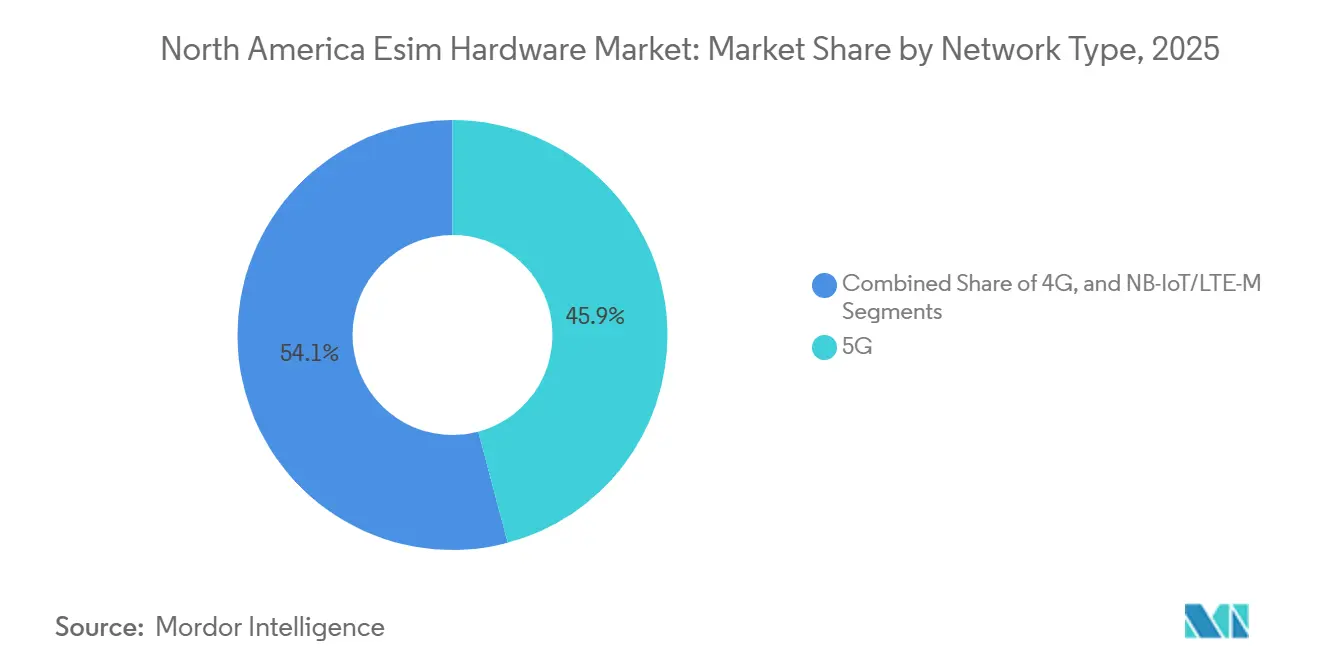
5G held 45.86% of the North America eSIM hardware market share in 2025 and is projected to expand at a 19.87% CAGR through 2031. Its lead reflects established 5G smartphone adoption and wider use in industrial and automotive programs. The North America eSIM hardware market size for 5G also benefits from private networks that require managed device credentials. ATandT activated a nationwide dedicated 5G Standalone core for FirstNet in July 2026. The service supports more than 27,500 public-safety agencies and 5.5 million connections. The program includes a USD 2 billion incremental investment. It supports a shift from 4G and LTE SIM modules toward 5G eSIM hardware in public-safety procurement.
4G and LTE eSIM hardware remains important for enterprise IoT in places with coverage constraints. These modules serve established devices that do not need the performance or cost profile of 5G. NB-IoT and LTE-M support low-power tracking and smart-meter uses. Their lower power requirements are useful when devices must operate for long periods without frequent maintenance. 5G slicing can require devices to manage separate service-level credentials. This favors eSIM operating systems with multiple active profile capabilities. Infineon's OPTIGA Connect Consumer OC1230 is a 28 nm eSIM solution compliant with GSMA SGP.22 v3.[2]Infineon Technologies, “OPTIGA Connect Consumer OC1230,” Infineon Technologies, infineon.com It supports Multiple Enabled Profile functionality for simultaneous carrier credentials.



By Form Factor: MFF2 Supports Reliability While Integrated Designs Save Space
MFF2 held 33.53% of form-factor volume in 2025, while System-in-Package and Integrated iUICC are projected to expand at a 20.17% CAGR through 2031. MFF2 is widely used where a permanently bonded component is required. Industrial and automotive equipment can be exposed to vibration, humidity, and temperature changes. A soldered interface can reduce a common physical failure point. The North America eSIM hardware market, therefore, retains MFF2 demand in equipment designed for difficult operating conditions. MFF2 also suits manufacturers that prioritize long-term device reliability over removable card flexibility.
Integrated designs are gaining attention in wearables, hearables, and compact IoT devices. These categories must balance silicon area, weight, battery capacity, and connectivity features. Wafer-Level CSP supports smaller consumer devices, while Plug-In eSIM remains relevant in replacement and mobile virtual network operator settings. STMicroelectronics introduced the ST54M in June 2026. The single-die device combines NFC, a secure element, eSIM, and a post-quantum cryptography accelerator. Valid received GSMA eSA certification for an SGP.32 IoT eUICC based on Infineon's TEGRION SLx22 in August 2026.
By Device Type: Smartphones Provide Volume While IoT Modules Expand Faster
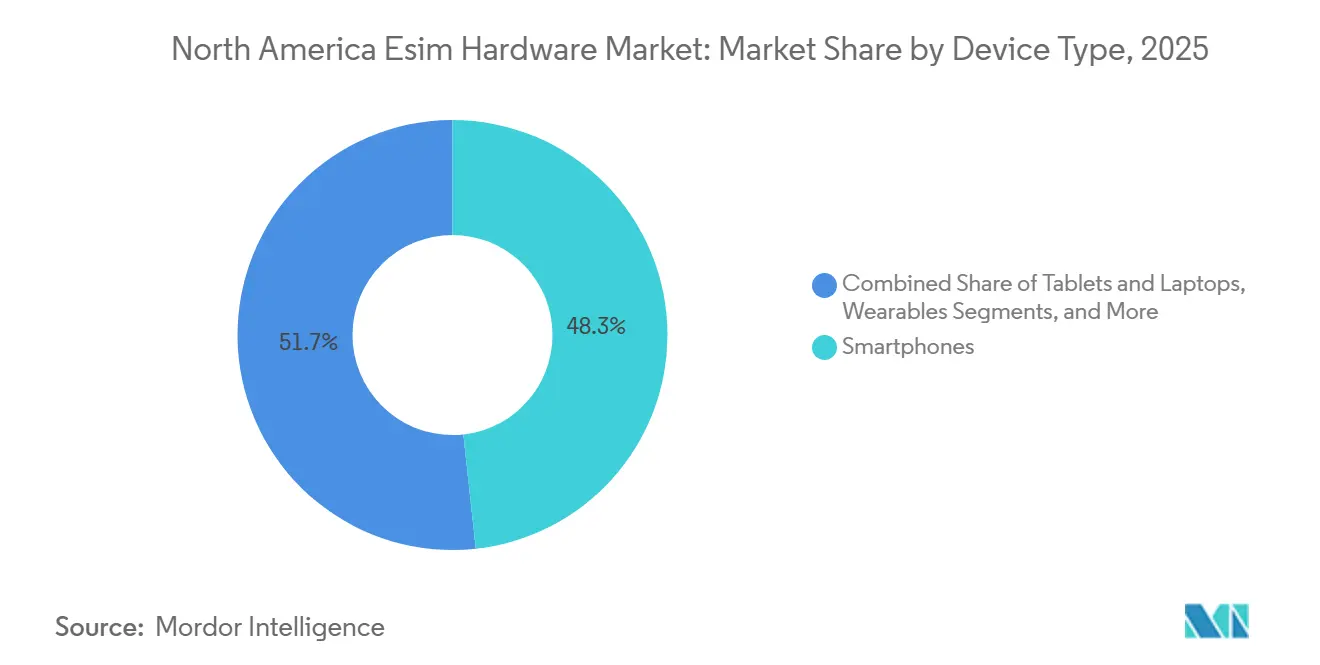
Smartphones accounted for 48.27% of the North America eSIM hardware market size in 2025. Smartphones establish the largest device base for eSIM component volumes. Their requirements influence eUICC operating-system standards across vendor portfolios. Multiple Enabled Profile support and SGP.22 v3 compliance are important for premium handsets. These requirements can influence component design in adjacent device categories. The North America eSIM hardware market continues to use smartphone demand as its volume foundation. Tablets and laptops add demand as enterprise IT buyers procure cellular-enabled commercial devices.
M2M and IoT Modules is expected to expand at a 21.15% CAGR through 2031. The segment reflects large-scale deployments in industrial, logistics, energy, and automotive environments. Digi International released an SGP.32-compatible eSIM accessory in December 2025. The accessory supports up to 8 profiles and zero-touch provisioning for its router and gateway portfolio. Wearables face stricter space and power limits than phones. The device category needs smaller components without reducing secure profile management. The North America eSIM hardware market will benefit where IoT hardware providers make remote connectivity a standard integrated feature.
By Application: Consumer Electronics Leads While Automotive Demand Advances
Consumer Electronics held 44.32% of application volume in 2025. Smartphones, smartwatches, tablets, and connected home products account for this established base. The segment benefits from high levels of consumer device use across North America. eSIM-only smartphone designs add to the requirement for compatible embedded hardware. The North America eSIM hardware market receives consistent demand from consumer replacement and upgrade activity. Consumer demand also encourages suppliers to improve component size and operating-system capabilities. These advances can later be adapted for other connected products.
Automotive and Transportation is projected to expand at a 19.95% CAGR through 2031. Vehicle makers are adopting SGP.32-capable hardware as a platform standard for connected services and updates. Industrial and Manufacturing demand also rises as private 5G networks connect factory equipment. Logistics and Asset Tracking applications benefit from recurring telematics hardware demand. Sensolus launched TRACK 1105 across the United States, Canada, and Mexico in September 2025.[3]Sensolus, “Sensolus Unveils NextGen Industrial IoT Tracking Solution for US, Canada and Mexico,” Sensolus, sensolus.com The hardware has a 7-year battery life and uses NB-IoT and LTE-M connectivity. Energy, utilities, healthcare, and medical devices provide additional opportunities where replacing physical SIMs in fixed equipment is costly.
Geography Analysis
The United States held 84.32% of the North America eSIM hardware market share in 2025. The country has 3 national operators with GSMA-certified provisioning infrastructure. It also has the region's largest base of eSIM-capable smartphones. Spectrum policy and public-safety networks create further demand for connected hardware. FirstNet's dedicated 5G Standalone core supported a technology refresh across emergency services in 2026.[4]First Responder Network Authority, “FY2025 Annual Report,” FirstNet Authority, firstnet.gov The North America eSIM hardware market size is therefore concentrated in the United States. Government and enterprise programs provide demand alongside consumer handset sales.
Canada became an eSIM-only Apple flagship market in September 2025. This moved consumer device demand quickly toward stronger provisioning requirements for Rogers, Bell, and Telus. Mexico is projected to expand at a 21.04% CAGR through 2031. The country benefits from eSIM-only iPhone availability and private wireless demand connected with manufacturing activity. The North America eSIM hardware market is also supported by Telcel's eSIM provisioning rollout across postpaid and prepaid services. Premium smartphone adoption remains important because many lower-priced brands have limited eSIM availability at scale.
The 3 countries increasingly operate as a connected provisioning region. Mexico's automotive assembly activity can require eSIM-enabled M2M modules for cross-border supply chains. Aeris and Verizon Business integrated GSMA SGP.32 eSIM for cross-border IoT expansion in February 2026. The program targeted automotive and industrial automation deployments. Canada benefits from alignment with United States provisioning platforms. Rogers and Bell have GSMA-certified SM-DP+ infrastructure that mirrors the tier-1 United States carrier model. This alignment can reduce certification friction for new form factors entering both countries.
The United States anchors regional demand because its carrier, enterprise, and public-safety systems are more developed at scale. Canada shares a similar premium smartphone and carrier infrastructure environment. Mexico adds a faster expansion profile through consumer adoption and manufacturing-linked connectivity needs. Cross-border supply chains make common provisioning approaches valuable. Hardware suppliers can reduce complexity when they offer components that support operations across the 3 countries. The North America eSIM hardware market is not 3 separate technology systems. It is increasingly a regional platform with country-specific carrier and regulatory conditions.
The North America eSIM hardware market connects secure components, device design, and remote connectivity operations. A component decision can affect how a device is activated, managed, updated, and redeployed. This makes qualification more detailed than it is for a conventional removable SIM card. Hardware suppliers must consider secure elements, operating systems, antenna constraints, and operator credentials. Device makers must also plan for certification and provisioning before a product is shipped. These requirements are visible in smartphone, automotive, industrial, and public-safety applications. The North America eSIM hardware market is therefore influenced by the readiness of the wider connectivity ecosystem.
Competitive Landscape
The North America eSIM hardware market is moderately concentrated. Infineon Technologies AG, STMicroelectronics N.V., NXP Semiconductors N.V., Thales S.A., and Giesecke+Devrient GmbH accounted for 70%-80% of regional hardware value. Competition focuses on process technology, GSMA eSA certification, and SGP.32 readiness. Infineon's OPTIGA Connect OC1230 set a 28 nm miniaturization reference point in 2026. STMicroelectronics introduced the ST54M with embedded post-quantum cryptography hardware in June 2026. These moves place security and component integration at the center of product differentiation.
Giesecke+Devrient is extending its position from eSIM technology into cloud-based provisioning. Its SGP.32 technology was deployed for Amazon's eero Signal device in 2026. Kigen partnered with KORE to provide an SGP.32 connectivity portfolio for IoT deployments. IDEMIA is also expanding beyond hardware and profile management. It launched SCAI for mobile network operators in August 2026.[5]IDEMIA Secure Transactions, “IST Launches SCAI, an eSIM Analytics and Agentic AI Platform for Mobile Network Operators,” IDEMIA, idemia.com The platform combines eSIM analytics with automated operational workflows. These moves show that vendors are seeking to retain value through provisioning and management services.
GSMA eSA certification is an important qualification factor for industrial and enterprise buyers. Valid's certified SGP.32 IoT eUICC demonstrates how compliance can support access to these procurement programs. Hardware suppliers also compete through integration with operators, module vendors, and device OEMs. The North America eSIM hardware market contains concentrated chip and secure-element suppliers, but broader procurement remains distributed across device and module makers. Suppliers that support legacy standards as well as SGP.32 can address a wider installed base. Vendors without certification depth may face longer qualification cycles. Product security, compact design, and remote provisioning support remain central competitive requirements.
North America Esim Hardware Industry Leaders
Infineon Technologies AG
STMicroelectronics N.V.
NXP Semiconductors N.V.
Thales S.A.
Giesecke+Devrient GmbH
- *Disclaimer: Major Players sorted in no particular order

Recent Industry Developments
- February 2026: IDEMIA Secure Transactions partnered with Hyundai Motor Group to provide eSIM and connectivity management for Hyundai, Kia, and Genesis vehicles, supporting remote operator management across global vehicle deployments.
- December 2025: Digi International released an SGP.32-compatible eSIM accessory for its EX, IX, and TX cellular devices, supporting up to eight carrier profiles and remote carrier switching.
- September 2025: Sensolus launched the TRACK 1105 IoT asset-tracking hardware in the United States, Canada, and Mexico, featuring NB-IoT and LTE-M connectivity and IP68/IP69K durability.
- August 2025: IDEMIA Secure Transactions achieved GSMA certification for an end-to-end SGP.32 solution covering both the eUICC and eIM remote-management platform under the GSMA IoT Compliance Scheme.


North America Esim Hardware Market Report Scope
The North America eSIM Hardware Market Report is Segmented by Network Type (4G/LTE, 5G, and NB-IoT/LTE-M), Form Factor (MFF2, Wafer-Level CSP, Plug-In eSIM, and System-in-Package and Integrated iUICC), Device Type (Smartphones, Tablets and Laptops, Wearables, and M2M/IoT Modules), Application (Consumer Electronics, Automotive, Industrial, Logistics, and Other Applications (Energy and Utilities, and Healthcare and Medical Devices)), and Geography (United States, Canada, and Mexico). The Market Forecasts are Provided in Terms of Volume (Units).
| 4G/LTE |
| 5G |
| NB-IoT/LTE-M |
| MFF2 |
| Wafer-Level CSP |
| Plug-In eSIM |
| System-in-Package and Integrated iUICC |
| Smartphones and Feature Phones |
| Tablets and Laptops |
| Wearables |
| M2M and IoT Modules |
| Consumer Electronics |
| Automotive and Transportation |
| Industrial and Manufacturing |
| Logistics and Asset Tracking |
| Other Applications (Energy and Utilities and Healthcare and Medical Devices) |
| United States |
| Canada |
| Mexico |
| By Network Type | 4G/LTE |
| 5G | |
| NB-IoT/LTE-M | |
| By Form Factor | MFF2 |
| Wafer-Level CSP | |
| Plug-In eSIM | |
| System-in-Package and Integrated iUICC | |
| By Device Type | Smartphones and Feature Phones |
| Tablets and Laptops | |
| Wearables | |
| M2M and IoT Modules | |
| By Application | Consumer Electronics |
| Automotive and Transportation | |
| Industrial and Manufacturing | |
| Logistics and Asset Tracking | |
| Other Applications (Energy and Utilities and Healthcare and Medical Devices) | |
| By Geography | United States |
| Canada | |
| Mexico |


Key Questions Answered in the Report
What is the North America eSIM hardware market size?
The North America eSIM hardware market size is projected to rise from 283 million units in 2026 to 682 million units by 2031, at a 19.21% CAGR.
Which network technology leads eSIM hardware demand in North America?
5G led volume with a 45.86% share in 2025 and is projected to expand at a 19.87% CAGR through 2031.
Which eSIM hardware form factor is expanding the fastest?
System-in-Package and Integrated iUICC is expected to expand at a 20.17% CAGR through 2031, supported by compact IoT and wearable devices.
Why are connected vehicles important for eSIM hardware suppliers?
Automotive and Transportation is projected to expand at a 19.95% CAGR as OEMs standardize embedded connectivity for software updates and vehicle services.
Which country has the largest regional demand?
The United States held 84.32% of 2025 volume, supported by national carrier infrastructure, consumer devices, and public-safety connectivity programs.
What limits wider eSIM adoption across North America?
Parallel SGP.02, SGP.22, and SGP.32 environments, along with uneven carrier provisioning readiness, can slow larger IoT deployments.
Page last updated on:


 Your data is secure and never sold or shared.


