
North America Energy Retrofit Market Size and Share
Market Overview
| Study Period | 2022 - 2032 |
|---|---|
| Forecast Data Period | 2027 - 2032 |
| Base Year Market Size (2026) | USD 126.40 Billion |
| Market Size (2027) | USD 136.89 Billion |
| Market Size (2032) | USD 207.95 Billion |
| Growth Rate (2027 - 2032) | 8.72 % |
| Market Concentration | Medium |
Major Players *Disclaimer: Major Players sorted in no particular order Image © Mordor Intelligence. Reuse requires attribution under CC BY 4.0. | |
North America Energy Retrofit Market Analysis by Mordor Intelligence
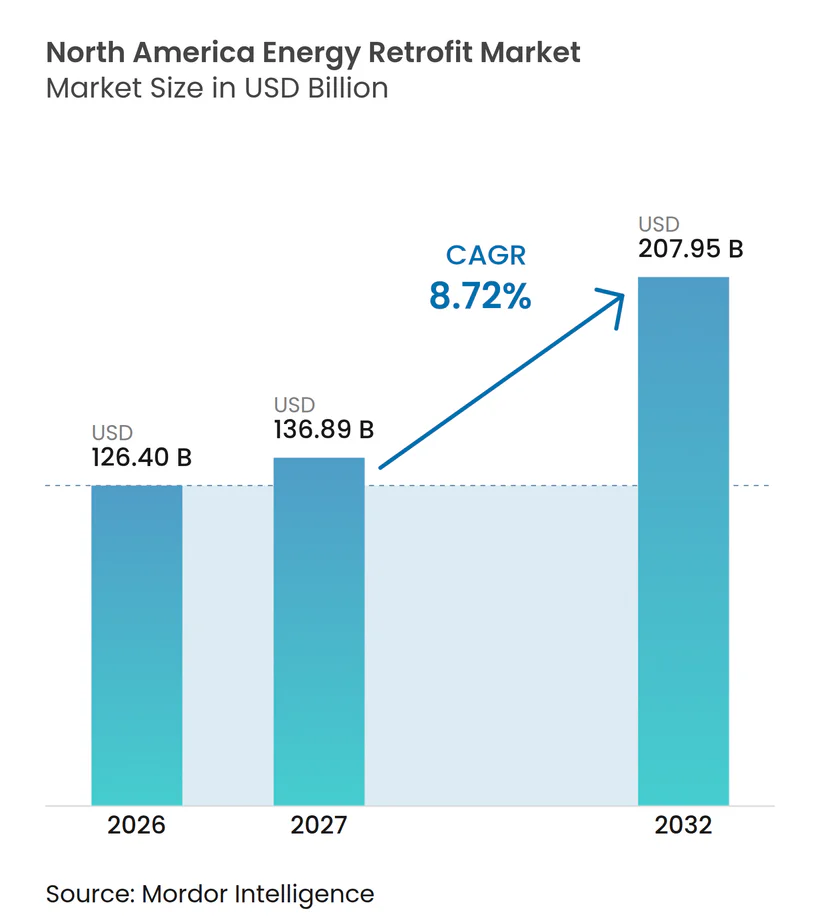
The North America Energy Retrofit Market size is expected to grow from USD 126.40 billion in 2026 to USD 136.89 billion in 2027 and is forecast to reach USD 207.95 billion by 2032 at 8.72% CAGR over 2027-2032. The North America energy retrofit market is supported by incentives that favor measured energy savings, aging commercial properties, and wider use of electrified building systems across commercial, public, industrial, and residential properties. The 2025 changes to federal energy incentives retained Section 179D deductions for qualifying commercial projects while shortening the timetable for certain solar and wind credits, which favors well-documented projects with substantial reductions in energy use. Building owners are increasingly combining heating electrification, envelope work, and digital controls rather than replacing one piece of equipment at a time. This approach raises the value of each project but also makes financing, installation, coordination among trades, and measurement more demanding for owners and service providers. Competition centers on the ability to deliver performance guarantees, manage complex projects, coordinate equipment and control systems, and show compliance with building performance rules.
Key Report Takeaways
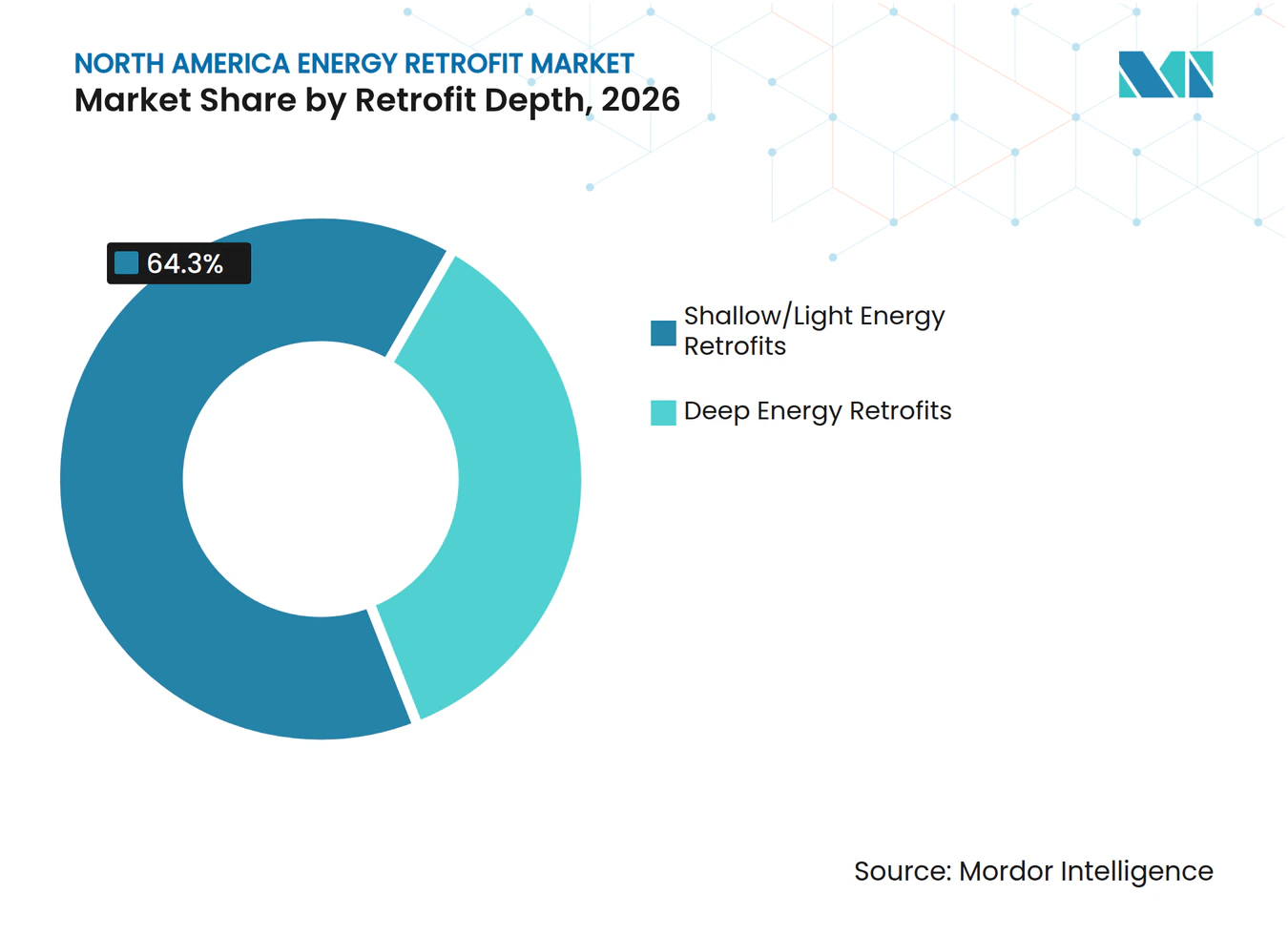
- By retrofit depth, shallow or light retrofits held 64.3% of the North America energy retrofit market share in 2026, while deep energy retrofits are forecast to grow at an 8.9% CAGR through 2032.
- By technology, HVAC systems accounted for 43.2% of the North America energy retrofit market share in 2026, while renewable integration is forecast to expand at a 10.3% CAGR through 2032.
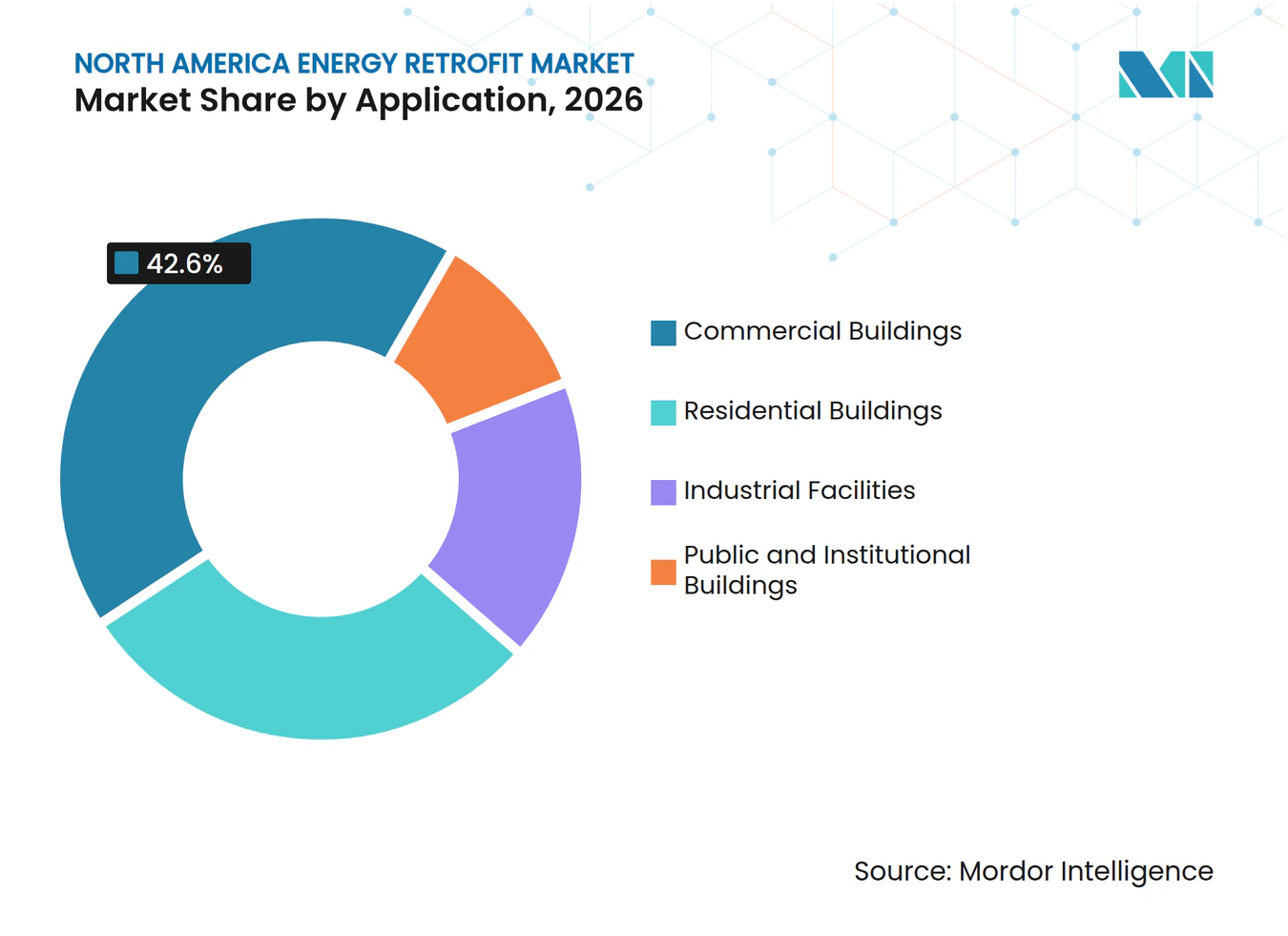
- By application, commercial buildings held 42.6% of revenue in 2026, while public and institutional buildings are forecast to grow at a 9.7% CAGR through 2032.
- By geography, the United States held 87.1% of revenue in 2026, while Mexico is forecast to grow at a 9.3% CAGR through 2032.
Note: Market numbers in this report are based on Mordor Intelligence's proprietary estimation framework, which combines nine months of actuals with Q4 projections for base year 2026.
Market Trends and Insights
Drivers Impact Analysis of North America Energy Retrofit Market*
| Driver | % Impact on CAGR Forecast | Geographic Relevance | Impact Timeline |
|---|---|---|---|
| Federal, State, Provincial and Utility Incentives | +1.80% | United States, Canada; secondary relevance in Mexico | Short term (≤ 2 years) |
| Aging Pre-1990 Commercial Building Stock | +1.50% | United States dominant; significant in Canada | Long term (≥ 4 years) |
| Corporate Net-Zero and Building Decarbonization Commitments | +1.20% | North America-wide, particularly US and Canadian metro markets | Medium term (2–4 years) |
| Electrification of Heating and Water Heating | +1.00% | US Northeast and Pacific Coast; Canada Ontario and BC | Medium term (2–4 years) |
| Smart Building Analytics and Grid-Interactive Efficiency | +0.80% | US and Canada; early-stage in Mexico's industrial corridor | Long term (≥ 4 years) |
| Performance-Contracting and Energy-as-a-Service Financing | +0.70% | US federal estate and institutional sectors; Canadian commercial | Medium term (2–4 years) |
| Source: Mordor Intelligence | |||
Federal, State, Provincial, and Utility Incentives Sustain the Retrofit Pipeline
Federal, provincial, state, and utility programs continue to shape near-term project decisions in the North America energy retrofit market because they influence project timing, scope, capital planning, and acceptable performance documentation. The 2025 federal legislation retained the Section 179D deduction for qualifying commercial projects that achieve 50% energy reductions, directing available federal support toward projects with documented performance. The same legislation accelerated the phaseout timetable for certain solar and wind credits when construction did not begin before July 5, 2026. This timing encouraged owners to advance solar-linked projects in 2026 while placing more emphasis on verified project design, construction schedules, eligibility reviews, and measurable savings. Canada launched the Canada Greener Homes Affordability Program in Quebec, British Columbia, Nova Scotia, and Prince Edward Island in June 2026 with more than CAD 500 million in co-funding, equivalent to USD 368 million, for direct-install upgrades for low- to median-income households[1]. These programs work alongside ASHRAE 90.1 and local requirements that connect eligibility and compliance to measurable outcomes, making documentation important before, during, and after project delivery.
Aging Pre-1990 Commercial Building Stock Creates a Structural Retrofit Mandate
The age of commercial buildings gives the North America energy retrofit market a durable source of demand because older buildings often require coordinated work on heating, cooling, controls, and envelope performance. NREL modeling shows that 48% of U.S. commercial floor area was built before 1980 and another 30% was built from 1980 through 2000[2]. Much of this building base predates current efficiency expectations and requires more than a routine equipment change to meet newer performance requirements, particularly when buildings must maintain operations during construction. Department of Energy research found that many older commercial envelopes lack effective air barriers, allowing air infiltration to add substantially to HVAC loads[3]. Owners therefore have a stronger reason to combine insulation, air sealing, controls, and mechanical upgrades in one project rather than addressing related energy losses through disconnected maintenance decisions. The result is a broader project scope and a larger amount of work per building for the North America energy retrofit market.
Corporate Net-Zero Commitments Translate Sustainability Pledges into Retrofit Capital
Corporate targets are moving retrofit decisions from long-range planning into property-level capital programs, where property teams must identify equipment needs, savings pathways, and workable construction sequences. In June 2026, RBC and Pontegadea committed Royal Bank Plaza in Toronto to a net-zero emissions path by 2040 that includes a fossil fuel-to-electric roadmap for HVAC, water heating, and controls. Prologis reported a Science-Based Targets initiative validated target to reduce Scope 1 and 2 emissions by 90% from its 2019 baseline by 2040, with interim 2030 objectives guiding asset decisions. Cadillac Fairview achieved Zero Carbon Building Performance Certification across 12 Canadian properties in 2025, including the program's first Toronto office property. These actions make energy use and building emissions a more direct part of portfolio management, alongside occupancy needs, equipment reliability, operating costs, and lease-related considerations. They also give tenants and owners a shared reason to improve building systems, where reporting requirements are becoming more important and where building data affects wider corporate targets. This pattern supports integrated capital planning in the North America energy retrofit market.
Electrification of Heating Systems Redefines Retrofit Scope and Economic Logic
Electrification is changing both the scope and economics of building upgrades by connecting heating, water heating, controls, energy supply, operational data, and compliance obligations. In September 2025, Trane completed a Storage Source Heat Pump installation at 55 Water Street in New York City, a 3.8 million-square-foot office tower[4]. The project reduced steam use by 72% and lowered overall energy use intensity by nearly 20%. It also received USD 14.5 million in combined utility rebates and tax credits and avoided USD 1.2 million in annual Local Law 97 penalties. Canada reported 281,278 heat pumps installed with federal support since 2020, as of January 2026, and 6 out of 10 participants chose a heat pump upgrade. Avoided compliance costs can now be as important as equipment savings when owners evaluate heat pump projects in cities with carbon limits, particularly where annual penalties affect total ownership costs.
Restraints Impact Analysis of North America Energy Retrofit Market*
| Restraint | % Impact on CAGR Forecast | Geographic Relevance | Impact Timeline |
|---|---|---|---|
| High Upfront Capital Cost and Long Payback Periods | -0.50% | Widespread across North America; most acute in mid-market commercial | Medium term (2–4 years) |
| Split Incentives in Leased Commercial Properties | -0.30% | US and Canada urban commercial markets | Medium term (2–4 years) |
| Skilled Contractor and Commissioning Capacity Constraints | -0.30% | United States and Canada; acute in cold-climate provinces | Long term (≥ 4 years) |
| Interoperability, Measurement and Verification Complexity | -0.20% | US and Canada institutional buildings | Medium term (2–4 years) |
| Source: Mordor Intelligence | |||
Capital Costs and Payback Uncertainty Dampen Broad Market Participation
Upfront cost and uncertainty over returns limit participation in the North America energy retrofit market, particularly among mid-sized property owners that have fewer internal technical and financing resources. A 2025 National Institute of Building Sciences study identified lack of funding as the most commonly reported barrier to commercial energy upgrades. Respondents also raised concerns about payback timing and confidence in projected savings. Owners of buildings between 50,000 and 250,000 square feet often do not have access to institutional green finance or public-sector performance contracting channels, even when their buildings have clear upgrade needs. Deep projects can require USD 50 to USD 200 per square foot, depending on building type and climate zone. Skilled contractor capacity and commissioning resources add delivery pressure as project activity rises, while complex measurement and verification make occupied mixed-use buildings harder to finance and complete. More than 83% of U.S. energy-efficiency employers reported hiring difficulty in 2024, adding labor cost and delivery risk as demand rises.
Split Incentives in Leased Properties Suppress Owner Investment Decisions
Lease structures remain a persistent barrier when owners pay for improvements, but tenants receive the utility savings, reducing the direct financial case for owners to invest. This split incentive is common in U.S. and Canadian commercial properties where tenants pay utility bills under net leases and owners remain responsible for longer-term capital decisions. A 2025 Association for Smarter Homes & Buildings study identified green leases, performance requirements, and incentive pass-through clauses as tools to address the gap, although adoption remained uneven. UC Davis research found that large commercial tenants with electricity-included leases used up to 14% less electricity during summer temperature events than comparable tenants with tenant-paid contracts. This difference shows how contract design can shape energy behavior across a property portfolio, including the signals that occupants receive when electricity use rises during demanding periods. Green lease clauses, including New York City's Energy Aligned Clause model, can allow cost recovery through rent adjustments, but their use is not yet widespread.
*Our forecasts treat driver/restraint impacts as directional, not additive. The impact forecasts reflect baseline growth, mix effects, and variable interactions.
North America Energy Retrofit Market Segment Analysis
By Retrofit Depth:
Deep Retrofits Gain Ground on a Shallow-Dominated BaseShallow or light energy retrofits held 64.3% of the North America energy retrofit market in 2026 by retrofit depth. Their leading position reflects lower capital needs, shorter payback periods, and less disruption in occupied buildings. LED conversions, basic HVAC control improvements, and window film can often be completed through existing maintenance budgets. Established contractor networks also make these measures accessible to owners without internal energy engineering teams. Many mid-market owners remain focused on compliance-driven upgrades rather than broad decarbonization programs.
Deep energy retrofits are forecast to grow at an 8.9% CAGR from 2027 through 2032. Federal procurement and performance contracts make comprehensive work more feasible for the government and large institutional owners. In February 2026, the General Services Administration awarded Ameresco a USD 217 million energy savings performance contract covering 25 buildings across 4 states through November 2048. The award shows how multiple facilities can be combined under a long-term performance structure. PHIUS Zero and EnerPHit frameworks support envelope-centered multifamily work that combines insulation, air sealing, and heat pumps. Documented projects in this setting have achieved energy reductions of 50% to 86% through integrated measures.



By Technology:
HVAC Electrification Reshapes a Dominant SegmentHVAC systems accounted for 43.2% of the North America energy retrofit market size in 2026 by technology. The segment is supported by the replacement needs of mechanical equipment in older buildings and by local electrification requirements. The 55 Water Street project showed that an electrified HVAC system can reduce steam use by 72% and total energy use intensity by nearly 20%. HVAC work increasingly includes controls, thermal storage, and water heating rather than a direct replacement of existing equipment. Lighting remains relevant in industrial and warehouse projects where LED upgrades are established and easy to deploy.
Renewable integration, including solar PV and solar thermal, is forecast to grow at a 10.3% CAGR through 2032. Owners are pairing on-site generation with electrified heating and cooling to improve long-term energy cost predictability. The 2025 credit timetable created a construction-start deadline before July 5, 2026, for certain solar projects, which brought some decisions forward. Smart controls, connected submetering, and heat pump water heating are also being included in wider electrification packages. These systems help owners understand energy use across separate loads and manage equipment more precisely. The technology mix is moving toward linked systems rather than isolated upgrades in the North America energy retrofit industry.
By Application:
Public Buildings Accelerate Ahead of Commercial's Anchor RoleCommercial buildings held 42.6% of the North America energy retrofit market size in 2026 by application. Their scale reflects the large commercial property base and the need to meet city-level energy and emissions standards. Corporate occupiers increasingly influence technology choices through tenant-led requests instead of waiting for landlord-initiated programs. This changes how demand is combined and financed within leased properties. Residential demand is fragmented, but Canada's direct-install affordability program now reaches 6 provinces in 2026.
Public and institutional buildings are forecast to grow at a 9.7% CAGR from 2027 through 2032. Federal and state decarbonization timelines, public financing vehicles, and concentrated ownership make it easier to bundle facilities. The Federal Energy Management Program identifies deep retrofits that exceed a 40% reduction in energy use intensity from 2019 baselines as a key pathway. Honeywell was selected in January 2026 to modernize building automation across more than 3 million square feet at Fort Benning. Industrial facilities are also increasing activity as near-shoring brings new or updated manufacturing sites to the United States and Mexico.

Geography Analysis
United States Energy Retrofit Market
The United States accounted for 87.1% of the North America energy retrofit market in 2026. Its position is supported by federal procurement channels, a large institutional building base, and city and state performance standards. New York City's Local Law 97 applies carbon intensity penalties to covered buildings, and the 55 Water Street project avoided USD 1.2 million in annual penalties while receiving USD 14.5 million in combined incentives. The U.S. Army Corps of Engineers awarded 18 ESCOs positions on the USD 3 billion ESPC IV contract in June 2025. These structures support long-term project flow across public and private properties.
Canada Energy Retrofit Market
Canada holds a substantial position within the North America energy retrofit market. The Canada Greener Homes Affordability Program began its rollout in 4 provinces in June 2026 with more than CAD 500 million, equivalent to USD 368 million, in co-funding. Its direct-install approach removes the upfront payment barrier that restricted participation in the earlier grant model. By January 2026, 281,278 heat pumps had been installed with federal support since 2020. The Canada Green Building Council stated that the green retrofit workforce must triple by 2030 to meet expected demand.
Mexico Energy Retrofit Market
Mexico is forecast to grow at a 9.3% CAGR through 2032, the fastest rate in the North America energy retrofit market. Industrial near-shoring, tighter efficiency standards, and residential financing programs support this outlook. Mexico's housing sector accounts for 26% of national electricity consumption and 32% of greenhouse gas emissions. Government programs have set a goal to renovate 1-third of existing housing stock by 2030. The Sustainable Improvement in Existing Housing program provides subsidies up to 30% of project costs, with a further 10% energy incentive from SENER
Competitive Landscape
Market Concentration
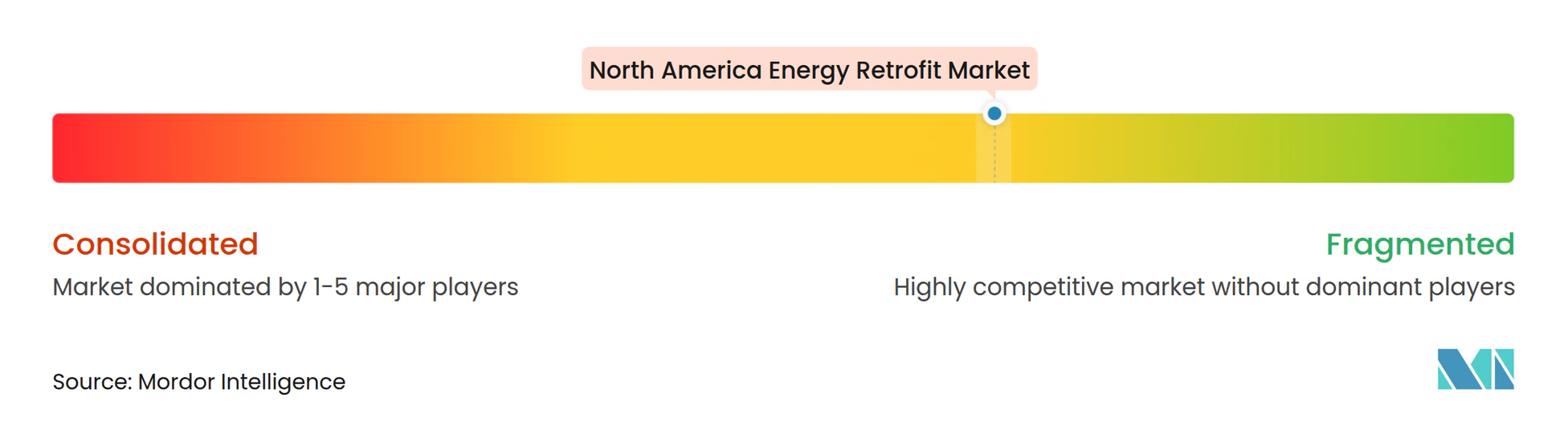
The North America energy retrofit market is moderately concentrated. Johnson Controls, Siemens, Schneider Electric, Honeywell, and Trane Technologies compete for large government, institutional, and commercial contracts. Their position rests on building management platforms, performance guarantees, and access to established procurement programs. Ameresco, NORESCO, McKinstry, and Willdan Group compete strongly where technical depth, local relationships, and bonding capacity matter. Large bundled awards favor companies that can finance complex programs and manage projects over many years.
Digital building operations are becoming a clearer point of competition in the North America energy retrofit market. Schneider Electric introduced EcoStruxure Foresight Operation in November 2025 as a unified platform for energy, power, and building systems. The platform had broader commercial availability targeted for Q3 2026. This move shows how equipment providers are extending their role into ongoing building operations. Suppliers that connect project work to verified operating data can stand apart in complex procurement decisions.
The mid-market commercial segment offers an opening for the North America energy retrofit market. Owners of 50,000 to 250,000 square feet often sit between residential programs and large public-sector performance contracts. Energy-as-a-service providers are addressing this gap with off-balance-sheet arrangements and performance guarantees. Johnson Controls received a USD 25 million deep energy retrofit assessment contract at U.S. Army Garrison Kwajalein in October 2024, extending work from a prior USD 40 million performance contract. Firms are also differentiating through third-party measurement and verification aligned with the International Performance Measurement and Verification Protocol.
North America Energy Retrofit Industry Leaders
-
Ameresco, Inc.
-
Johnson Controls International plc
-
Siemens AG
-
Schneider Electric SE
-
Honeywell International Inc.
- *Disclaimer: Major Players sorted in no particular order
North America Energy Retrofit Market Companies Covered in this Report
- ABB Ltd.
- AECOM
- Ameresco, Inc.
- Carrier Global Corporation
- Comfort Systems USA, Inc.
- Daikin Industries, Ltd.
- Eaton Corporation plc
- EMCOR Group, Inc.
- ENGIE
- Honeywell International Inc.
- Johnson Controls International plc
- McKinstry
- Metrus Energy, Inc.
- NORESCO
- Orion Energy Systems, Inc.
- Schneider Electric SE
- Siemens AG
- Signify N.V.
- SitelogIQ
- Trane Technologies plc
- Veregy
- Willdan Group, Inc.
Recent Industry Developments in North America Energy Retrofit Market
- June 2026: Canada's government announced the rollout of the Canada Greener Homes Affordability Program in Quebec, British Columbia, Nova Scotia, and Prince Edward Island, mobilizing over CAD 500 million, equivalent to USD 368 million, in co-funding. The direct-install model removes upfront payment barriers for low- to median-income households, significantly expanding the addressable residential retrofit base in these provinces.
- January 2026: Honeywell was selected by the U.S. Army to modernize building automation systems at Fort Benning, Georgia, deploying the Niagara building control platform across more than 3 million square feet. The project is projected to generate USD 1.8 million in additional annual savings, bringing cumulative projected annual savings to USD 4.5 million over 15 years.
- September 2025: Trane completed the first U.S. commercial building Storage Source Heat Pump deployment at 55 Water Street, New York City. The retrofit reduced steam consumption by 72%, lowered overall energy use intensity by nearly 20%, and secured USD 14.5 million in combined incentives while avoiding USD 1.2 million in annual New York City Local Law 97 carbon penalties.
- June 2025: The U.S. Army Corps of Engineers awarded 18 ESCOs positions on the ESPC IV Multiple Award Task Order Contract, with a USD 3 billion ceiling and 10-year performance period. Ameresco, AECOM, and 16 other NAESCO-accredited ESCOs are among the contract holders competing for task orders across domestic and international military installations.
North America Energy Retrofit Market Report Scope
Energy retrofit refers to the process of upgrading or modifying existing buildings, facilities, or energy systems to improve energy efficiency, reduce energy consumption and operating costs, and lower greenhouse gas emissions. Retrofits can involve replacing outdated equipment, improving building insulation and windows, upgrading HVAC and lighting systems, installing smart energy controls, and integrating renewable energy technologies such as solar PV.
The North America Energy Retrofit Market is segmented by retrofit depth, technology, application, and geography. By retrofit depth, the market is segmented into deep energy retrofits and shallow/light energy retrofits. By technology, the market is segmented into HVAC systems, lighting systems, building envelope, renewable integration, smart building controls, IoT, and water heating and plumbing. By application, the market is segmented into residential, commercial, industrial, and public and institutional buildings. The report also covers the market size and forecasts for the North America energy retrofit market across 3 countries in the region. For each segment, the market sizing and forecasts have been provided on the basis of value (USD).
Segmentation Overview
| Deep Energy Retrofits |
| Shallow/Light Energy Retrofits |
| HVAC Systems |
| Lighting Systems |
| Building Envelope (Insulation and Glazing) |
| Renewable Integration (Solar PV, Solar Thermal) |
| Smart Building Controls and IoT |
| Water Heating and Plumbing |
| Residential Buildings |
| Commercial Buildings |
| Industrial Facilities |
| Public and Institutional Buildings |
| North America | United States |
| Canada | |
| Mexico |
| By Retrofit Depth | Deep Energy Retrofits | |
| Shallow/Light Energy Retrofits | ||
| By Technology | HVAC Systems | |
| Lighting Systems | ||
| Building Envelope (Insulation and Glazing) | ||
| Renewable Integration (Solar PV, Solar Thermal) | ||
| Smart Building Controls and IoT | ||
| Water Heating and Plumbing | ||
| By Application | Residential Buildings | |
| Commercial Buildings | ||
| Industrial Facilities | ||
| Public and Institutional Buildings | ||
| By Geography | North America | United States |
| Canada | ||
| Mexico | ||
Key Questions Answered in the Report
What is driving energy retrofit activity in North America?
Incentives tied to documented savings, aging building stock, electrification requirements, and building performance rules are supporting project demand. These factors also encourage owners to combine equipment, controls, and envelope work into larger projects.
How large is the North America energy retrofit market?
The North America energy retrofit market size is projected to reach USD 207.95 billion by 2032 from USD 136.89 billion in 2027, at an 8.72% CAGR.
Which retrofit technology has the strongest growth outlook?
Renewable integration is forecast to grow at a 10.3% CAGR through 2032 as owners combine on-site generation with electrified systems. The 2026 credit timetable is also influencing the timing of eligible solar-linked projects.
Which building application is growing the fastest?
Public and institutional buildings are forecast to expand at a 9.7% CAGR through 2032, supported by public-sector mandates and financing structures. Concentrated portfolios can make multi-building performance contracts easier to organize.
Why are deep energy retrofits gaining adoption?
Deep retrofits are forecast to grow at an 8.9% CAGR because performance contracts and public procurement can support integrated, whole-building projects. Integrated insulation, air sealing, and heat pump measures can deliver documented energy reductions.
Which country will grow the fastest through 2032?
Mexico is forecast to grow at a 9.3% CAGR, supported by industrial near-shoring, efficiency standards, and residential retrofit support. Current projects focus on HVAC, insulation, solar water heaters, and manufacturing facilities in northern corridors.