
North America Dumpsters Market Size and Share
Market Overview
| Study Period | 2021 - 2032 |
|---|---|
| Forecast Data Period | 2027 - 2032 |
| Base Year Market Size (2026) | USD 2.14 Billion |
| Market Size (2027) | USD 2.23 Billion |
| Market Size (2032) | USD 2.76 Billion |
| Growth Rate (2027 - 2032) | 4.36 % |
| Market Concentration | Medium |
Major Players *Disclaimer: Major Players sorted in no particular order Image © Mordor Intelligence. Reuse requires attribution under CC BY 4.0. | |
North America Dumpsters Market Analysis by Mordor Intelligence
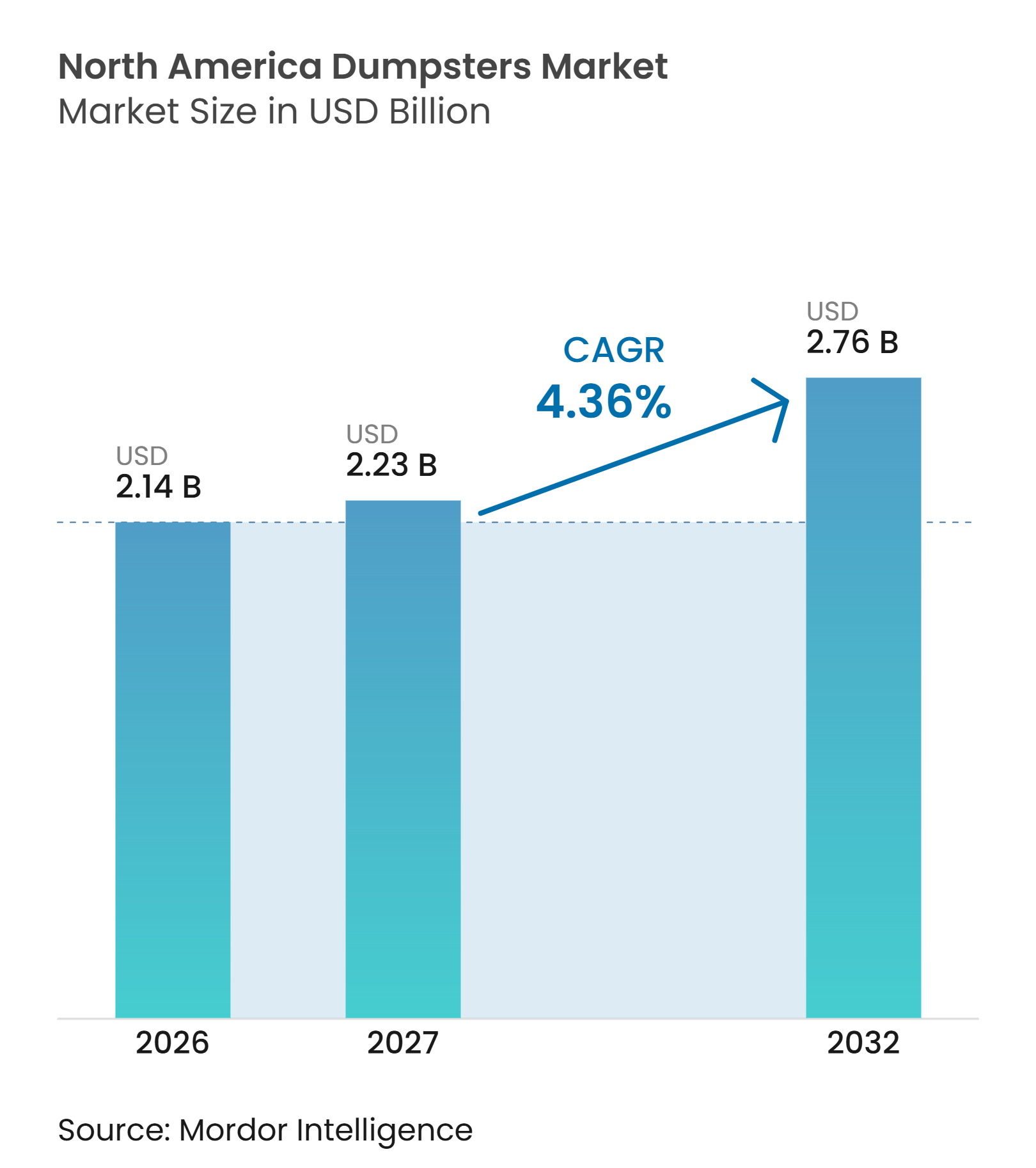
The North America Dumpsters Market size is projected to expand from USD 2.14 billion in 2026 and USD 2.23 billion in 2027 to USD 2.76 billion by 2032, registering a CAGR of 4.36% between 2027 and 2032.
Demand is supported by construction and demolition activity, replacement of aging municipal fleets, and wider use of containers designed for separated waste streams. Public investment in recycling, transfer, and organics facilities is converting local waste-management plans into purchases of containers and related equipment. The North America dumpsters market also benefits when municipalities replace collection trucks because automated equipment requires containers that meet compatible safety and lifting specifications. Steel, freight, and labor costs remain important constraints because containers are bulky to transport and use steel-intensive designs. Larger manufacturers can partly limit these pressures through regional production, supply relationships, and shorter delivery distances.
Key Report Takeaways
- By dumpster type, detachable bulk waste containers held 48.9% of the North America dumpsters market share in 2026 and are forecast to grow at a CAGR of 4.8% through 2032.
- By end-user, waste collection and hauling companies held 51.3% of the North America dumpsters market size in 2026, while construction, demolition, and infrastructure contractors are forecast to grow at a 4.8% CAGR through 2032.
- By waste type, general and mixed non-hazardous solid waste held a 38.5% share in 2026, while organic and green waste is forecast to grow at an 8.4% CAGR through 2032.
- By bin size, 6 to 10 cubic yard bins held a 22.5% share in 2026, while bins above 40 cubic yards are forecast to grow at a 5.1% CAGR through 2032.
- By geography, the United States held an 84.6% share in 2026, while Mexico is forecast to grow at a 6.8% CAGR through 2032.
Note: Market numbers in this report are based on Mordor Intelligence's proprietary estimation framework, which combines nine months of actuals with Q4 projections for base year 2026.
Market Trends and Insights
Drivers Impact Analysis of North America Dumpsters Market*
| Driver | (~) % Impact on CAGR Forecast | Geographic Relevance | Impact Timeline |
|---|---|---|---|
| Construction and Demolition Waste Capacity Expansion | +1.5% | United States primary, Canada secondary, Mexico emerging | Short term (≤ 2 years) |
| Municipal Fleet Replacement and Waste-Infrastructure Procurement | +0.9% | United States and Canada core, growing in Mexico | Medium term (2-4 years) |
| Growth in Commercial and Industrial Waste-Handling Equipment Demand | +0.7% | United States and Canada, select industrial corridors in Mexico | Medium term (2-4 years) |
| Increasing Demand for Durable and Customized Containers | +0.5% | North America-wide, concentrated in the United States | Long term (≥ 4 years) |
| Regional Manufacturing and Shorter Lead-Time Requirements | +0.3% | United States Southeast and Midwest manufacturing hubs | Medium term (2-4 years) |
| Demand for Covered, Leak-Controlled, and Diversion-Ready Containers | +0.2% | United States coastal and urban markets, Pacific Canada | Long term (≥ 4 years) |
| Source: Mordor Intelligence | |||
Construction and Demolition Waste Capacity Expansion
Construction, demolition, and infrastructure projects require frequent exchanges of high-capacity containers, particularly for handling dense or contaminated materials such as concrete, masonry, and asphalt. This drives demand for durable roll-off, cable-hoist, and hook-lift dumpsters with reinforced floors and sides that support efficient collection, hauling, and unloading without disrupting project operations. Demand also extends to transfer stations and material processing facilities that handle construction waste. The United States Environmental Protection Agency allocated USD 55 million annually to the Solid Waste Infrastructure for Recycling program through fiscal year 2026, while its second funding round for political subdivisions received 307 applications seeking USD 1.072 billion, highlighting demand for local recycling infrastructure beyond available funding.[1] Investments in transfer, recycling, and processing facilities create additional requirements for containers used in collection, staging, hauling, and material separation, supporting recurring purchases by waste operators and public agencies beyond project-driven construction demand.
Municipal Fleet Replacement and Waste-Infrastructure Procurement
Municipal collection departments are replacing older trucks and containers after extended periods of deferred capital spending. The container purchase is not separate from the truck purchase because automated loaders depend on compatible lift points, dimensions, and operating clearances. The National Waste and Recycling Association maintains standards covering containers, compactors, and related collection equipment through its ANSI committees.[2] These requirements make compatibility a practical condition of public procurement. They also encourage agencies to buy standardized equipment that can be safely used across a route network. The North America dumpsters market benefits when public agencies shift from isolated replacement orders to recurring fleet renewal programs. A truck replacement plan can lead to replacement of containers that no longer match updated collection systems. This relationship is particularly relevant for side-loading and automated collection operations. Philadelphia opened its USD 33 million Northwest Transfer Station in November 2025, replacing a facility that had operated for 55 years. The city stated that the site uses automated weighing, RFID-related information systems, and processing capacity for 550 tons per day of trash and 100 tons per day of recycling.[3] Projects of this type raise the importance of traceable and purpose-specified containers in municipal networks.
Commercial and Industrial Waste-Handling Equipment Demand
Commercial facilities need dependable front-load and rear-load containers for regular waste collection. Industrial users often require larger, reinforced, or specialized units because material characteristics and handling practices differ by site. The North America dumpsters market is also shaped by customers that separate recyclable, organic, and general waste at the point where waste is generated. These arrangements require multiple container types rather than a single general-waste unit. Separate streams can increase the number of containers required at a location even when total waste volume does not rise. This is particularly relevant to retail, food service, healthcare, education, manufacturing, and material recovery operations. Waste-management companies are investing in sorting and processing facilities that need compatible containers throughout their collection systems. The Environmental Protection Agency’s 2025 national strategy calls for expanded infrastructure and technical assistance to reduce food loss and waste and improve organics recycling. Dedicated organics service requires separate collection equipment and containers. Commercial buyers also increasingly request covered models where material needs protection from weather or where sites need better control of leaks and litter. These needs create demand for configurations that cannot be addressed through undifferentiated container procurement. They also support sales of customized products that fit specific loading equipment and collection routes.
Durable, Customized, and Regionally Available Containers
Buyers are giving greater attention to higher-gauge steel, corrosion-resistant coatings, reinforced floors, and dimensions suited to restricted sites. These specifications matter when containers are used intensively or exposed to heavy and abrasive materials. The North America dumpsters market gains from this shift because customers may choose a longer-life container rather than the lowest initial-cost design. Covered and leak-controlled containers can also become necessary where site conditions or stormwater management practices require better containment. The Environmental Protection Agency regulates stormwater discharges through the National Pollutant Discharge Elimination System under the Clean Water Act. That regulatory influence supports attention to container design and site-specific waste handling. Regional production is increasingly important because finished containers occupy substantial transport space relative to their value. Shorter travel distances can lower freight exposure and improve delivery reliability for contract-sensitive customers. Wastequip opened a 43,000-square-foot steel production facility in Salisbury, North Carolina, in June 2026 to produce front-load dumpsters, roll-off containers, and compactors for the Southeast and Mid-Atlantic. The investment illustrates how multi-site production can support faster delivery and customization. It also gives large manufacturers an advantage when buyers value local service coverage and supply continuity. These factors can encourage regional fabricators to retain specialized positions even as national suppliers expand.
Restraints Impact Analysis of North America Dumpsters Market*
| Restraint | (~) % Impact on CAGR Forecast | Geographic Relevance | Impact Timeline |
|---|---|---|---|
| Steel, Polymer, and Component Cost Volatility | -0.6% | North America-wide, United States fabricators most exposed | Short term (≤ 2 years) |
| Freight, Labor, and Manufacturing Cost Pressure | -0.4% | United States and Canada, elevated in coastal and metro markets | Medium term (2-4 years) |
| Used, Refurbished, and Locally Fabricated Container Substitution | -0.3% | United States secondary markets, rural and small-municipality buyers | Long term (≥ 4 years) |
| Customer-Specific Specifications Increasing Engineering and Production Complexity | -0.2% | National, concentrated in large municipal and industrial contracts | Medium term (2-4 years) |
| Source: Mordor Intelligence | |||
Steel, Polymer, and Component Cost Volatility
Steel is a central input for dumpster and roll-off container fabrication. Changes in steel and component costs can pressure manufacturers when they are committed to fixed-price orders. The effect can be more severe for smaller fabricators that have limited purchasing scale or lack long-term supply arrangements. Cost uncertainty can also make firms cautious about holding inventory for specialized products. This may extend lead times or narrow the range of configurations offered to smaller customers. The North America dumpsters market can therefore favor suppliers that have stronger supply relationships, processing capacity, or the ability to manage material purchases across several facilities. The constraint is not limited to the price paid for steel. Galvanized surfaces, hydraulic components, lids, wheels, locks, and lifting hardware can all add to the final manufacturing cost. Suppliers must balance durable specification requirements against customers’ budget limits. Used and refurbished units can become more attractive to buyers when new-unit prices rise quickly. That is especially relevant for small municipalities, rural customers, and operators buying equipment for less demanding applications. While this substitution does not eliminate demand for new units, it can delay replacement cycles. It can also widen the cost advantage of manufacturers that can offer standard products efficiently.
Freight, Labor, and Manufacturing Cost Pressure
Finished dumpsters have a high transport requirement because of their physical size and nested shipping limits. Freight therefore represents a meaningful share of delivered cost, especially on long routes or to coastal and major metropolitan markets. The United States Bureau of Labor Statistics series published through the Federal Reserve Bank of St. Louis showed truck transportation unit labor costs at 129.594 in 2025, compared with 126.912 in 2024 on a 2017 base of 100. Higher delivery and labor costs can delay discretionary purchases when customers can continue using existing containers. They also support the move toward regional manufacturing and distribution. Manufacturers face similar pressure inside their factories. Welding, fabrication, finishing, engineering, and quality checks require skilled labor, while customized designs can increase setup time and production complexity. A municipality or industrial customer may request non-standard dimensions, special openings, coverings, coatings, or lift interfaces. These requests can create value for suppliers with engineering capability, but they can also make scheduling and costing less predictable. The North America dumpsters market must therefore balance customization with production efficiency. Manufacturers that standardize core platforms while offering selected options are better placed to serve both large contracts and smaller recurring orders.
*Our forecasts treat driver/restraint impacts as directional, not additive. The impact forecasts reflect baseline growth, mix effects, and variable interactions.
North America Dumpsters Market Segment Analysis
By Dumpster Type:
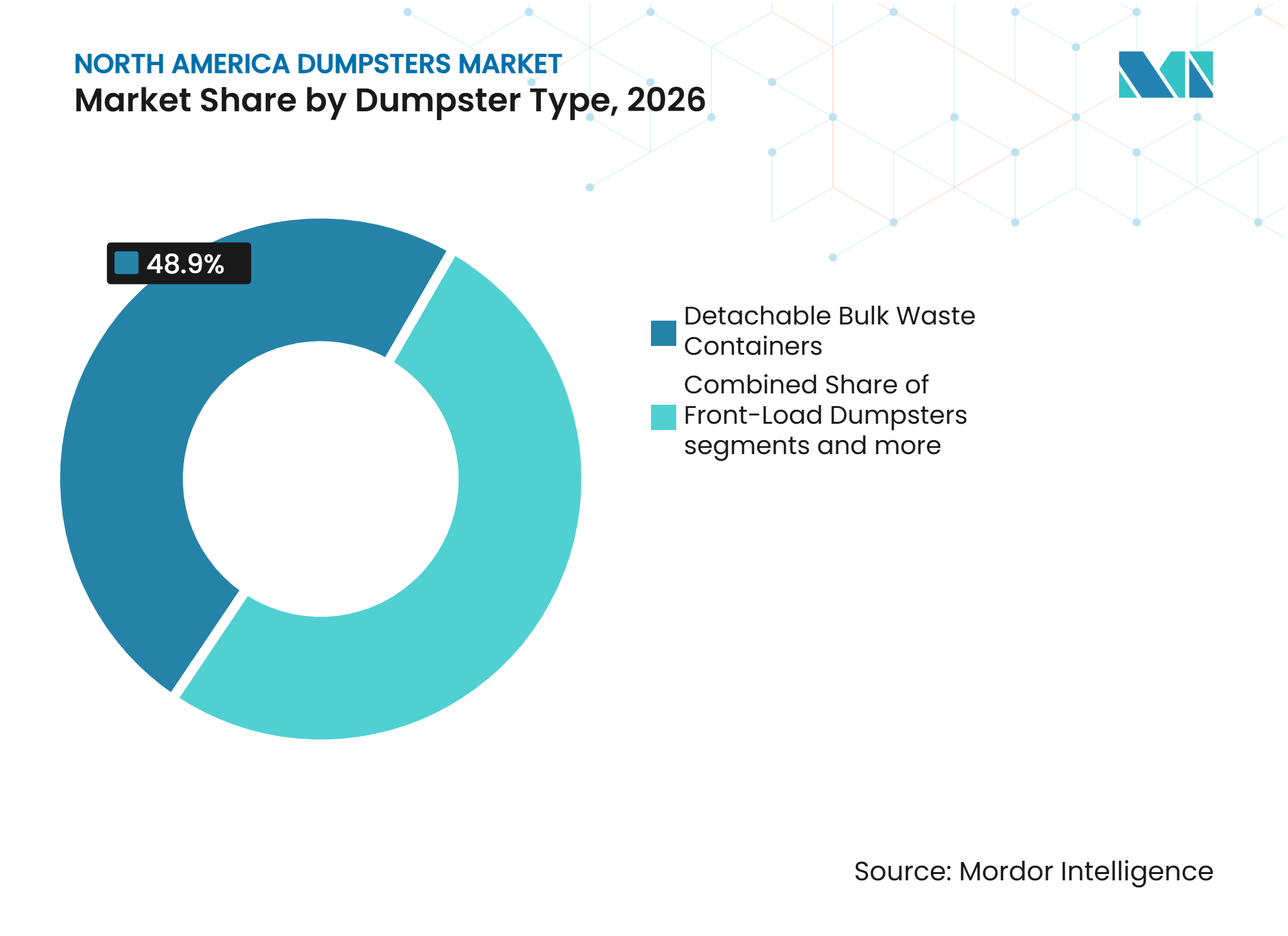
Detachable Bulk Containers Support High-Volume WorkDetachable bulk waste containers held 48.9% of the North America dumpsters market share in 2026 and are forecast to grow at a 4.8% CAGR through 2032. Their position reflects use in construction, demolition, industrial activity, and large waste-handling operations. Roll-off, cable-hoist, hook-lift, and skip-lift designs allow vehicles to exchange containers as loads are filled. This supports operations where delays in removal can interrupt work or limit available site space.
The North America dumpsters market size for detachable bulk units is supported by demand for reinforced equipment that can carry concrete, masonry, asphalt, and bulky material. Hook-lift designs are gaining relevance in dense locations where operators value quick exchange cycles and flexible vehicle use. Front-load dumpsters remain important for commercial routes that depend on regular, compact collection schedules. Rear-load units serve sites with limited access, alleys, and lower-volume accounts. ANSI container and collection-equipment standards remain relevant because compatibility can influence which designs haulers and public agencies will buy.



By End-User:
Haulers Lead Purchases While Contractors Drive GrowthWaste collection and hauling companies accounted for a 51.3% share of the North America dumpsters market in 2026, supported by their extensive container fleets, recurring waste collection contracts, and requirements for regular container replacement and fleet expansion. Construction, demolition, and infrastructure contractors are forecast to be the fastest-growing end-user group, registering a 4.8% CAGR through 2032, driven by increasing requirements for dedicated waste containment across multiple project phases. Rental and leasing companies further support market demand by expanding their fleets as contractors, businesses, and households increasingly prefer renting containers over purchasing them.
Municipalities and public waste authorities generate steady procurement demand through long-term waste management contracts and cooperative purchasing arrangements. Meanwhile, commercial and institutional users sustain replacement demand for front-load dumpsters used in routine waste collection. At the same time, industrial and recycling customers require specialized bulk containers designed for heavy, segregated, and material-specific waste streams. Additionally, growing emphasis on waste diversion, recycling, and efficient material handling is encouraging end users to adopt larger-capacity and application-specific container configurations, supporting demand across both established waste management operators and emerging infrastructure-related applications.
By Waste Type:
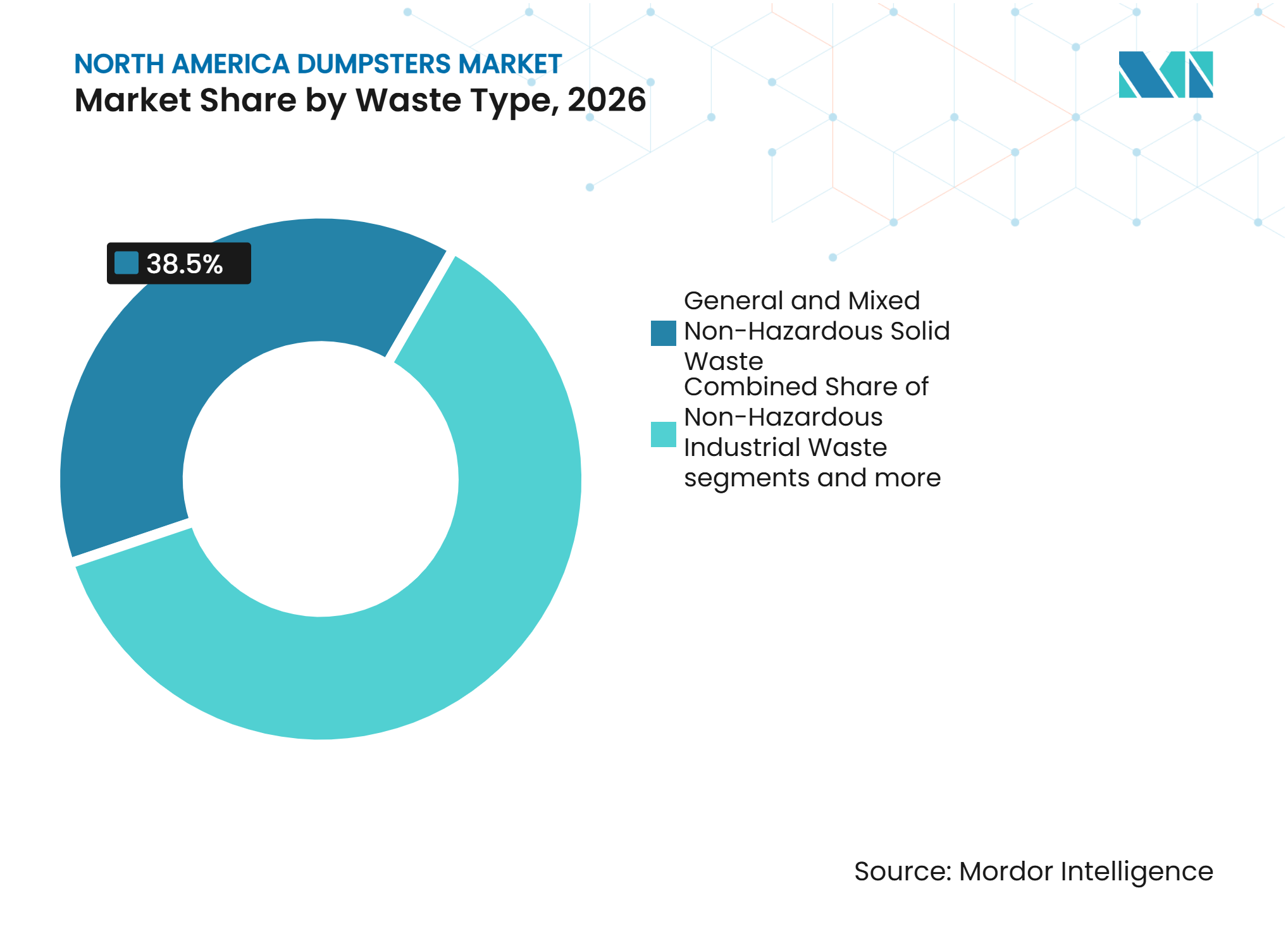
Organics Collection Changes Container RequirementsGeneral and mixed non-hazardous solid waste held a 38.5% share of the North America dumpsters market in 2026. This category supports broad demand for front-load and rear-load containers across commercial and residential collection routes. Its size reflects established collection infrastructure in many United States metropolitan areas. The segment remains important because basic collection service requires reliable and replaceable standardized containers.
Organic and green waste is forecast to grow at an 8.4% CAGR through 2032, the fastest rate among waste types. The North America dumpsters market responds as cities and private operators add separate organic-waste collection programs. The Environmental Protection Agency’s 2025 strategy supports infrastructure that reduces food waste and expands organics recycling. Dedicated organics routes need containers kept separate from general waste, often using distinct lids and servicing schedules. Construction and demolition waste continues to require large detachable containers, while recyclable material supports commercial collection and material recovery needs.

By Bin Size:
Mid-Range Bins Lead While Large Formats Gain DemandThe 6- to 10-cubic-yard category held a 22.5% share of the North America dumpster market in 2026, supported by its widespread use in commercial front-load services, light construction projects, recycling facilities, and institutional locations. This capacity range offers a balance between waste-holding capacity, collection frequency, and operational efficiency, allowing waste haulers to serve multiple commercial accounts through dense collection routes while maintaining manageable servicing schedules. Its compatibility with standard front-load collection vehicles and established lifting mechanisms further supports adoption among waste management operators, particularly in retail centers, restaurants, offices, and educational facilities.
Meanwhile, dumpsters above 40 cubic yards are projected to register a 5.1% CAGR through 2032, driven by large construction projects, industrial facilities, and applications involving bulky waste volumes that exceed standard roll-off capacities. These containers are particularly suitable for demolition debris, bulky industrial waste, and large-scale site clearances, where higher payload capacity can reduce container exchanges and transportation frequency. The 30 to 40 cubic yard category continues to serve residential cleanouts and large construction and demolition projects, while smaller containers remain relevant for high-traffic commercial locations and organics collection programs requiring frequent servicing. Similarly, the 10 to 20 and 20 to 30 cubic yard categories address diverse commercial, construction, and industrial waste requirements. Differences in container dimensions, loading configurations, site accessibility, and hauling equipment influence purchasing decisions across these capacity ranges, encouraging manufacturers to offer varied designs to meet customer-specific operational requirements.
Geography Analysis
United States
The United States held 84.6% of the North America dumpsters market share in 2026. Its installed collection network creates replacement demand alongside new purchasing for recycling, transfer, and organics facilities. The Environmental Protection Agency’s SWIFR program provided annual funding through fiscal year 2026 and received 307 applications seeking USD 1.072 billion in its second local-government round. This funding gap indicates that local governments have more planned recycling infrastructure than current program budgets can support. New processing facilities need containers for collection, staging, transfer, and separated material streams.
Municipal modernization adds another source of demand. Philadelphia’s Northwest Transfer Station opened in November 2025 with RFID-related data systems, automated weighing, and capacity for trash and recycling processing. Such systems make identification and tracking more relevant when agencies define container specifications. State organics rules and local diversion programs can add separate containers rather than simply replacing general-waste units. Compliance with Clean Water Act stormwater controls also supports use of covered and leak-controlled equipment where site conditions warrant it. These factors favor suppliers that offer compatible, traceable, and durable containers.
Mexico
Mexico is forecast to grow at a 6.8% CAGR through 2032, the highest rate in the North America dumpsters market. The country’s National Development Plan for 2025 to 2030 identifies waste management improvement, infrastructure modernization, and circular economy development as policy priorities. Mexico City committed MXN 500 million (USD 27.8 million) for waste infrastructure investment during 2025 and 2026. The program includes collection vehicles under a co-investment approach with boroughs. These measures can increase the need for compatible waste containers as collection capacity expands.
Tamaulipas also advanced the CIR Victoria integrated waste-management project in 2025 with support from BANOBRAS and FONADIN. Facilities that separate, transfer, and process material require containers for distinct points in the waste chain. Mexico therefore offers a growth path based on infrastructure buildout rather than replacement activity alone. Procurement will depend on municipal budgets, project execution, and the ability of suppliers to provide service across geographically dispersed locations.
Canada, Including Regional Infrastructure Programs
Provincial extended producer responsibility programs and federal co-investment in processing infrastructure shape Canada’s container demand. The City of Saskatoon secured up to CAD 8.4 million (USD 6.1 million) for an organics processing facility planned to open in late 2026. A new facility of this type needs a collection system that keeps organics separated from other material. This can support procurement of green bins and related container fleets. The market opportunity grows when municipalities align processing capacity with collection-program expansion.
Atlantic Canada also illustrates the effect of extended producer responsibility on container requirements. CP Group and REgroup were selected in December 2025 to build a 112,000-square-foot advanced material recovery facility in Halifax for Circular Materials. The facility is designed for 30 tons per hour of processing and uses advanced imaging systems. It can increase demand for containers that help maintain separated streams from collection through sorting. The Canadian federal government also invested CAD 2.5 million (USD 1.8 million) in Metro Vancouver’s Waste-to-Energy District project in 2025. These projects show how provincial frameworks and federal support can create durable, region-specific demand for specialized waste-handling equipment.
Competitive Landscape
Market Concentration
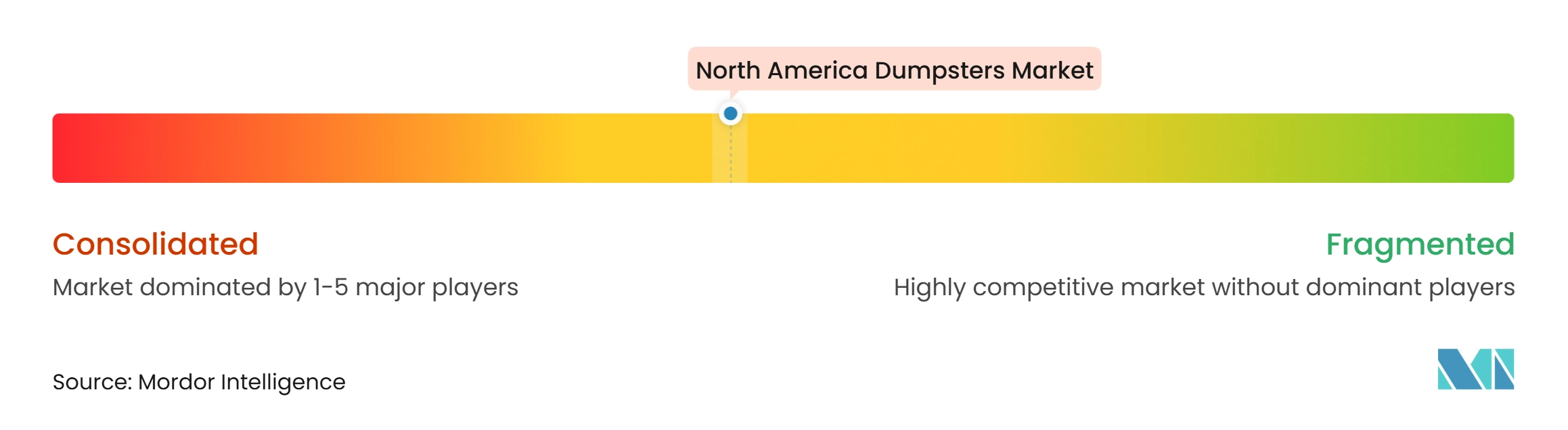
The North America dumpsters market exhibits a medium level of market concentration. Wastequip holds a national position across front-load, rear-load, and roll-off products, while regional manufacturers compete through local production, specialized fabrication, and responsive service. The Iron Container, Thompson Fabricating, E-Pak Manufacturing, Marathon Equipment, and Heil Environmental are regional or product-focused participants. This structure gives national suppliers advantages in scale and manufacturing coverage. Regional firms can remain competitive where buyers require shorter lead times, specialized designs, or close service relationships.
Wastequip expanded this approach by opening a 43,000-square-foot steel production facility in Salisbury, North Carolina, in June 2026. The facility produces front-load dumpsters, roll-off containers, and compactors for Southeast and Mid-Atlantic customers. The investment supports faster delivery and enables the company to respond to regional procurement needs. It also reflects the competitive value of locating production closer to customers when freight costs and delivery timing matter. Companies with several production sites can use this model to improve supply continuity across markets.
Standards remain an important competitive condition because haulers and public agencies need containers that work safely with existing collection equipment. The National Waste and Recycling Association’s ANSI standards cover safety and compatibility issues affecting container and collection operations. This reduces the practical scope for suppliers that cannot meet common procurement requirements. It also gives established manufacturers an advantage when buyers prefer familiar, interoperable designs. Standard compliance does not eliminate competition because customers still compare price, customization, delivery terms, and local support. Technology is an emerging area of product differentiation. Municipal facilities such as Philadelphia’s new transfer station show growing use of data systems and automated tracking in waste operations. Sensor-ready containers, RFID-compatible designs, and ports for fill-level devices may therefore become more relevant in future bids.
North America Dumpsters Industry Leaders
-
Wastequip, LLC
-
Iron Container, LLC
-
Thompson Fabricating
-
E-Pak Manufacturing
-
Rhino Containers
- *Disclaimer: Major Players sorted in no particular order
North America Dumpsters Market Companies Covered in this Report
- Wastequip, LLC
- Iron Container, LLC
- Thompson Fabricating
- E-Pak Manufacturing
- Rhino Containers
- Al Melideo, Inc.
- Cedar Corporation
- Manser Welding
- Environmental Metal Works
- Mountain View Waste Systems
- Skip Units
- GMS Steel Fabrications
- Doncaster Steel Fabrications
- Marathon Equipment Company
- Box Gang Manufacturing
- Hol-Mac Corporation
- Petersen Industries, Inc.
- McNeilus Truck and Manufacturing, Inc.
- Heil Environmental
- Wastebuilt Environmental Solutions
Recent Industry Developments in North America Dumpsters Market
- June 2026: Wastequip opened a new 43,000-square-foot steel manufacturing facility in Salisbury, North Carolina, within its existing AMREP operation, producing front-load dumpsters, roll-off containers, and compactors to serve Southeast and Mid-Atlantic markets and reduce delivery lead times.
- December 2025: EPA selected 16 SWIFR grant recipients from 307 applications requesting USD 1.072 billion in its second round of political subdivisions. Kansas City received USD 5 million to expand organic waste collection and composting infrastructure.
- December 2025: CP Group and REgroup were selected to build a 112,000-square-foot advanced material recovery facility in Halifax, Nova Scotia, for Circular Materials under Canada’s extended producer responsibility framework. The facility includes advanced imaging systems and 30 tons per hour of processing capacity.
North America Dumpsters Market Report Scope
The North America Dumpsters Market Report is Segmented by Dumpster Type (Front-Load Dumpsters, Rear-Load Dumpsters, and More), by End-User/Buyer (Waste Collection and Hauling Companies, and More), by Waste Type (General and Mixed Non-Hazardous Solid Waste, and More), by Bin Size (Up To 3 Cubic Yards, and More), and by Geography (United States, Canada, and Mexico). The Market Forecasts are Provided in Terms of Value (USD).
Segmentation Overview
| Front-Load Dumpsters | |
| Rear-Load Dumpsters | |
| Detachable Bulk Waste Containers | Cable-Hoist / Rail Roll-Off Containers |
| Hook-Lift Containers | |
| Skip-Lift / Chain-Lift Containers | |
| Other Detachable Container Configurations | |
| Other Dumpster Types |
| Waste Collection and Hauling Companies | |
| Dumpster Rental and Leasing Companies | |
| Municipalities and Public Waste Authorities | |
| Construction, Demolition and Infrastructure Contractors | |
| Commercial and Institutional Establishments | Retail and Shopping Centers |
| Hospitality, Restaurants and Food Service | |
| Offices and Commercial Buildings | |
| Healthcare and Educational Institutions | |
| Real Estate and Facility Management Companies | |
| Other Commercial and Institutional Establishments | |
| Industrial and Manufacturing Companies | |
| Recycling and Material Recovery Companies | |
| Other Direct Buyers |
| General and Mixed Non-Hazardous Solid Waste |
| Construction and Demolition (C&D) Waste |
| Recyclable Waste (Paper, Cardboard, Plastics, Glass and Metals) |
| Organic and Green Waste (Food, Yard, Landscape and Horticultural Waste) |
| Non-Hazardous Industrial Waste |
| Bulky Waste and Cleanout Materials |
| Other Non-Hazardous Waste |
| Up to 3 Cubic Yards |
| 3 to 6 Cubic Yards |
| 6 to 10 Cubic Yards |
| 10 to 20 Cubic Yards |
| 20 to 30 Cubic Yards |
| 30 to 40 Cubic Yards |
| Above 40 Cubic Yards |
| United States |
| Canada |
| Mexico |
| By Dumpster Type | Front-Load Dumpsters | |
| Rear-Load Dumpsters | ||
| Detachable Bulk Waste Containers | Cable-Hoist / Rail Roll-Off Containers | |
| Hook-Lift Containers | ||
| Skip-Lift / Chain-Lift Containers | ||
| Other Detachable Container Configurations | ||
| Other Dumpster Types | ||
| By End-User/Buyer | Waste Collection and Hauling Companies | |
| Dumpster Rental and Leasing Companies | ||
| Municipalities and Public Waste Authorities | ||
| Construction, Demolition and Infrastructure Contractors | ||
| Commercial and Institutional Establishments | Retail and Shopping Centers | |
| Hospitality, Restaurants and Food Service | ||
| Offices and Commercial Buildings | ||
| Healthcare and Educational Institutions | ||
| Real Estate and Facility Management Companies | ||
| Other Commercial and Institutional Establishments | ||
| Industrial and Manufacturing Companies | ||
| Recycling and Material Recovery Companies | ||
| Other Direct Buyers | ||
| By Waste Type | General and Mixed Non-Hazardous Solid Waste | |
| Construction and Demolition (C&D) Waste | ||
| Recyclable Waste (Paper, Cardboard, Plastics, Glass and Metals) | ||
| Organic and Green Waste (Food, Yard, Landscape and Horticultural Waste) | ||
| Non-Hazardous Industrial Waste | ||
| Bulky Waste and Cleanout Materials | ||
| Other Non-Hazardous Waste | ||
| By Bin Size (Capacity) | Up to 3 Cubic Yards | |
| 3 to 6 Cubic Yards | ||
| 6 to 10 Cubic Yards | ||
| 10 to 20 Cubic Yards | ||
| 20 to 30 Cubic Yards | ||
| 30 to 40 Cubic Yards | ||
| Above 40 Cubic Yards | ||
| By Geography | United States | |
| Canada | ||
| Mexico | ||
Key Questions Answered in the Report
What is the projected size of the North America dumpsters market by 2032?
The North America dumpsters market is forecast to reach USD 2.76 billion by 2032, growing at a 4.36% CAGR from 2027 to 2032.
Which dumpster type leads North American demand?
Detachable bulk waste containers lead with a 48.9% share in 2026 and are forecast to grow at a 4.8% CAGR through 2032.
Which end users buy the most dumpsters in North America?
Waste collection and hauling companies lead with a 51.3% share in 2026 because they purchase containers for broad residential, commercial, and industrial deployment.
Why is organic waste collection important for container suppliers?
Organic and green waste is forecast to grow at an 8.4% CAGR through 2032, requiring separate containers and collection routes.
Which country is growing fastest for dumpsters in North America?
Mexico is forecast to grow at a 6.8% CAGR through 2032, supported by waste-management infrastructure and circular-economy priorities.
What are the main cost pressures for dumpster manufacturers?
Steel, components, freight, and labor raise delivered and production costs, especially for bulky containers transported over longer distances.