
North America Data Center Testing, Inspection, and Certification Market Size and Share
Market Overview
| Study Period | 2021 - 2032 |
|---|---|
| Forecast Data Period | 2027 - 2032 |
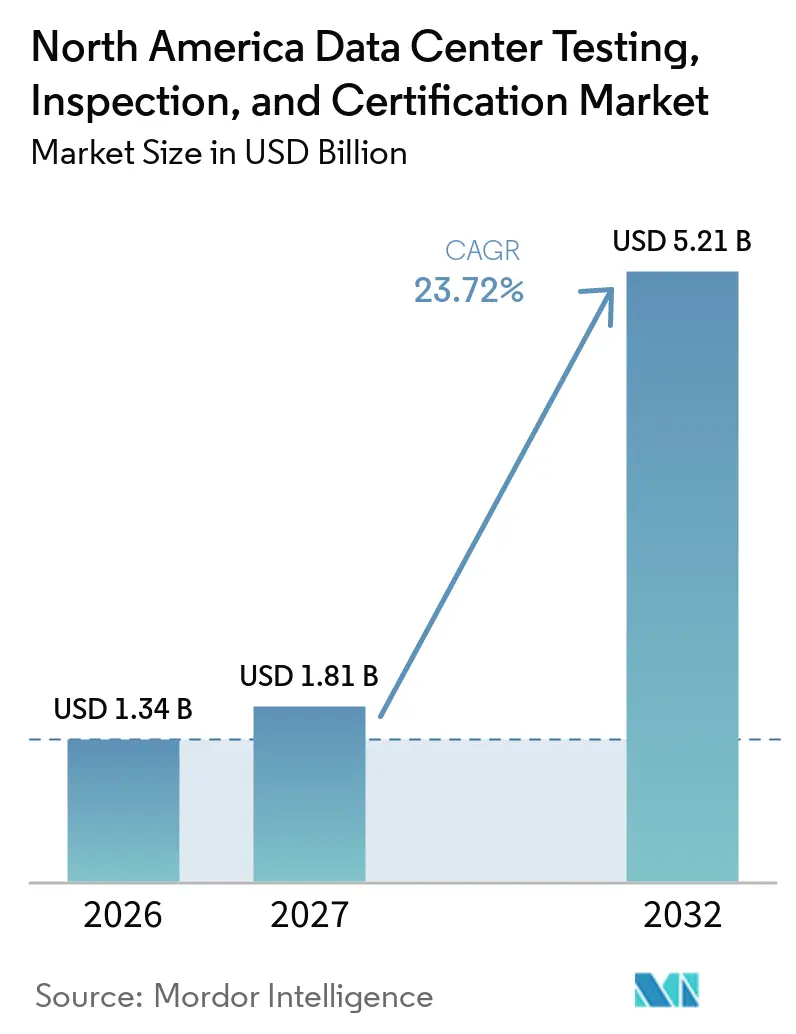
| Base Year Market Size (2026) | USD 1.34 Billion |
| Market Size (2027) | USD 1.81 Billion |
| Market Size (2032) | USD 5.21 Billion |
| Growth Rate (2027 - 2032) | 23.72 % |
| Market Concentration | Medium |
Major Players *Disclaimer: Major Players sorted in no particular order Image © Mordor Intelligence. Reuse requires attribution under CC BY 4.0. | |
North America Data Center Testing, Inspection, and Certification Market Analysis by Mordor Intelligence
The North America testing, inspection, and certification market size is projected to expand from USD 1.34 billion in 2026 and USD 1.80 billion in 2027 to USD 5.21 billion by 2032, registering a CAGR of 23.72% between 2027 to 2032. Demand is tied to the commissioning and validation needs of AI-focused data centers, where power density and cooling systems are changing faster than common certification practices. Independent verification is becoming important from design review through operations because uptime, cybersecurity, and sustainability requirements now affect financing, leasing, and operating decisions. New construction remains the main source of work, although recurring certification and operational assurance are becoming more important as recently commissioned facilities enter service. Providers are responding through acquisitions, digital commissioning platforms, and broader assurance packages that combine technical, security, and compliance work. The North America testing, inspection, and certification market also faces capacity limits because qualified engineers, cybersecurity auditors, and specialized test equipment remain scarce.
Key Report Takeaways
- By service type, Testing held 39.15% of revenue in 2026, while Compliance and Assurance Services is projected to expand at a 24.43% CAGR through 2032 in the North America Data Center Testing, Inspection, and Certification Market.
- By data center lifecycle, Construction, Installation, and Commissioning accounted for 52.14% of revenue in 2026, while Operations, Maintenance, and Recertification is projected to expand at a 24.56% CAGR through 2032.
- By infrastructure system, Electrical Infrastructure accounted for 37.83% of revenue in 2026, while IT, Network, and Cybersecurity Infrastructure are projected to expand at a 23.92% CAGR through 2032.
- By data center type, Hyperscale and CSP Data Centers accounted for 44.22% of revenue in 2026 and are projected to grow at a 24.22% CAGR through 2032.
- By tier type, Tier 3 accounted for 58.31% of revenue in 2026, while Tier 4 is projected to grow at a 24.34% CAGR through 2032 in the North America Data Center Testing, Inspection, and Certification Market.
- By geography, the United States held 86.24% of regional revenue in 2026, while Mexico is projected to expand at a 24.11% CAGR through 2032.
Note: Market numbers in this report are based on Mordor Intelligence's proprietary estimation framework, which combines nine months of actuals with Q4 projections for base year 2026.
North America Data Center Testing, Inspection, and Certification Market Trends and Insights
Drivers Impact Analysis*
| Driver | (~) % Impact on CAGR Forecast | Geographic Relevance | Impact Timeline |
|---|---|---|---|
| AI Workloads Increasing Power Density and Commissioning Complexity | +4.5% | Global, concentrated in United States hyperscale corridors including Virginia, Texas, and Ohio | Short term (≤ 2 years) |
| Expansion of Hyperscale and Colocation Capacity | +4.0% | North America, led by the United States, with Canada and Mexico emerging | Short term (≤ 2 years) |
| Mandatory Reliability, Cybersecurity, and Sustainability Validation | +3.5% | Global, with strongest regulatory influence in the United States and Canada | Medium term (2-4 years) |
| Demand for Independent Risk Transfer Before Facility Handover | +2.8% | North America, primarily the United States | Medium term (2-4 years) |
| Liquid-Cooling Commissioning Standards Lagging Behind Deployment Speed | +2.2% | Global, concentrated in United States hyperscale markets | Short term (≤ 2 years) |
| Power-Availability Constraints Increasing the Value of Site and Infrastructure Assurance | +1.8% | National, acute in Northern Virginia, Texas, and Ohio | Medium term (2-4 years) |
| Source: Mordor Intelligence | |||
AI Workloads Increasing Power Density and Commissioning Complexity
AI training and inference workloads are increasing rack density beyond the conditions covered by conventional air-cooled commissioning practices. NVIDIA GB200 NVL72 systems can reach 120 kW per rack, compared with 7-10 kW in standard server settings, which requires validation of liquid-to-chip loops, pressure integrity, and thermal performance under full load.[1] ASHRAE has revised its liquid-cooling water-class nomenclature from W1-W5 to W17 through W40+, reflecting the changing thermal requirements of AI infrastructure. The North America testing, inspection, and certification market benefits when the commissioning scope includes these systems rather than conventional checklist testing alone. Uptime Institute identifies compressed project schedules and limited margins for error as normal conditions for AI data center projects. Providers that collect evidence digitally and connect building information models to commissioning workflows can handle a larger project volume without a matching increase in staff.
Expansion of Hyperscale and Colocation Capacity
Hyperscale and colocation operators are expanding capacity across North America, which creates work in design review, inspection, commissioning, and certification. The North America testing, inspection, and certification market is exposed to construction activity because each new campus needs formal validation before handover. Crusoe announced a 900 MW AI factory campus in Abilene, Texas, to support Microsoft AI infrastructure in 2026. A single large campus can create several years of work across design review, system testing, initial certification, and subsequent recertification. Capacity development in Canada and Mexico broadens the regional project base beyond established United States hubs. Providers with established hyperscale relationships can retain work across successive phases of a campus lifecycle.
Mandatory Reliability, Cybersecurity, and Sustainability Validation
Third-party validation is increasingly included in leasing arrangements, lender requirements, and insurance terms rather than treated as optional protection. The ISO/IEC 27001:2013 to ISO/IEC 27001:2022 transition required a full re-audit for certificates based on the earlier edition after October 31, 2025.[2] BSI Group launched the Mark of Trust in January 2026 as a modular framework that covers reliability, security, and sustainability. ASHRAE Standard 90.4-2025 and ISO/IEC 30134-2:2026 are also used in sustainability-focused assurance work. ISO/IEC AWI TS 22237-44, approved in April 2026, provides dedicated liquid-cooling guidance within the data center facility standards family. These requirements encourage bundled assurance programs and expand the types of systems that can be assessed.
Demand for Independent Risk Transfer Before Facility Handover
Data center handovers can involve campuses valued above USD 1 billion, so lenders, insurers, and tenants often require independent validation. Aon launched a USD 1.5 billion Data Center Lifecycle Insurance Program in July 2025 that covers construction, cyber, cargo, and operational exposure through defined lifecycle stages.[3] Zurich introduced Data Center Project Guard from January 1, 2026, adding up to 12 months of operational property coverage across phased handovers. Independent commissioning sign-off can support a financing drawdown or activate an insurance layer. Delays caused by labor shortages or unavailable test equipment can therefore produce direct financial consequences for developers. Firms that can provide committed resources and service-level agreements have a clearer role in project risk management
Restraints Impact Analysis*
| Restraint | (~) % Impact on CAGR Forecast | Geographic Relevance | Impact Timeline |
|---|---|---|---|
| Shortage of Qualified Commissioning Engineers and Cybersecurity Auditors | -3.2% | Global, most severe in United States hyperscale corridors | Short term (≤ 2 years) |
| Fragmented Standards and Jurisdictional Compliance Requirements | -2.5% | National, with divergence across 50 United States states and compliance factors spanning federal and state agencies | Medium term (2-4 years) |
| High Cost of Recurring Certification and Continuous Monitoring | -1.8% | North America-wide, acute for enterprise data centers | Long term (≥ 4 years) |
| Limited Availability of Liquid-Cooling Load Banks and High-Density Test Protocols | -1.5% | Global, with procurement bottlenecks concentrated in the United States | Short term (≤ 2 years) |
| Source: Mordor Intelligence | |||
Shortage of Qualified Commissioning Engineers and Cybersecurity Auditors
The North America testing, inspection, and certification market is constrained by a shortage of commissioning engineers and cybersecurity auditors. Uptime Institute highlights a significant global shortfall of qualified data center professionals and notes that a considerable share of the United States workforce is nearing retirement. The gap is especially difficult for specialized roles that combine cloud security, AI governance, and physical-logical data center controls. Commercial demand alone cannot raise delivery capacity when the qualified workforce is unavailable. Long hiring cycles can delay project work and increase overhead for providers and clients. Training academies, remote commissioning tools, and structured knowledge transfer can help firms preserve expertise as experienced practitioners retire.
Fragmented Standards and Jurisdictional Compliance Requirements
Different state and local requirements increase the time required for compliance planning across multi-site data center portfolios. The North America testing, inspection, and certification market must account for rules covering energy procurement, water use, zoning, and environmental reporting. Operators in Northern Virginia, Texas, Ohio, and Arizona can face distinct documentation and approval requirements across their facilities. This raises the cost of regulatory mapping, jurisdictional coordination, and evidence collection for each engagement. It also makes a single standardized operating process less practical for providers serving multiple states. Firms with multi-jurisdictional compliance libraries can handle recurring documentation work more consistently than firms focused on one local market, supporting a more consistent North America testing, inspection, and certification market delivery model.
*Our forecasts treat driver/restraint impacts as directional, not additive. The impact forecasts reflect baseline growth, mix effects, and variable interactions.
Segment Analysis
By Service Type: Cybersecurity Compliance Reshapes Revenue Mix
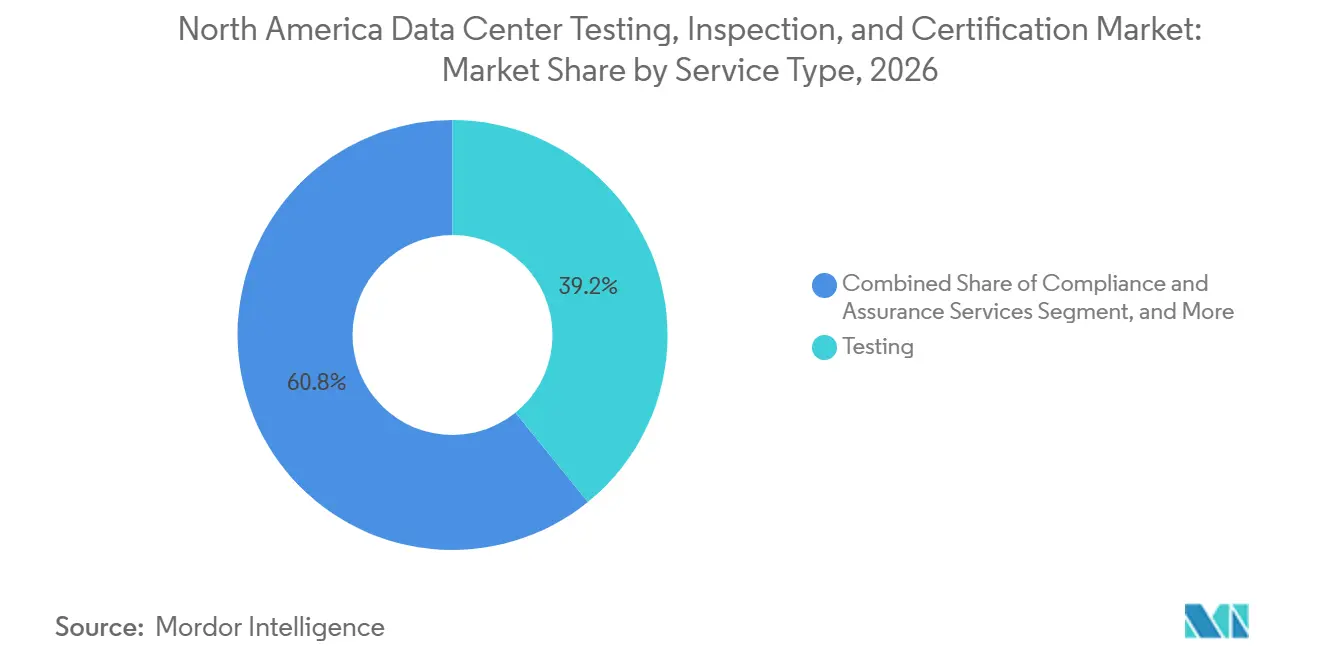
Testing held 39.15% of revenue in 2026, supported by factory acceptance tests, site acceptance tests, and integrated system testing across the construction pipeline. Testing is central to facility handover because power, cooling, and control systems need to operate together under specified conditions. Inspection provides ongoing quality assurance during construction and operations. Certification covers formal credentialing under Uptime Institute Tier standards, ISO/IEC 27001, and SOC 2 programs. Compliance and Assurance Services is the smallest current service type, but it is projected to expand at a 24.43% CAGR through 2032. The North America testing, inspection, and certification industry is moving toward assurance services when tenants require recurring evidence of compliance, a change that broadens the North America testing, inspection, and certification market beyond project-based testing.
The 2013 to 2022 ISO/IEC 27001 transition created a concentrated re-audit cycle after October 31, 2025. This requirement benefited certification and compliance specialists that could conduct the required reviews. ISO/IEC 42001 AI management system audits are also being combined with cybersecurity and quality management certifications. Testing retains volume leadership, although liquid-cooling load-bank tests and medium-voltage energization work require scarce equipment and specialist skills. These operating needs can place pressure on testing margins. The service mix is therefore expected to shift gradually toward compliance and assurance work with recurring audit requirements in the North America testing, inspection, and certification market.

By Data Center Lifecycle: Operations Phase Accelerates Alongside New Construction
Construction, Installation and Commissioning accounted for 52.14% of revenue in 2026. The share reflects the current scale of hyperscale construction across the region. Pre-Construction and Design services provide early revenue through design-document review and Tier Certification of Design Documents. Hyperscale developers increasingly seek these reviews before construction begins. Retrofit and Modernization remains smaller, but it serves legacy enterprise facilities that are adapting power and cooling systems for AI workloads. These facilities were not originally designed for rack densities above 10-20 kW.
Operations, Maintenance and Recertification is projected to expand at a 24.56% CAGR through 2032. Each facility commissioned from 2023 through 2027 can become a future recertification client. Gold-rated Operational Sustainability certifications expire after 3 years, silver certifications after 2 years, and bronze certifications after 1 year. This renewal schedule creates a defined audit calendar for providers in the North America testing, inspection, and certification market. SGS uses a digital commissioning framework that connects design inputs, equipment tagging, and functional testing. Such systems can turn project documentation into an asset for continued operational assurance.
By Infrastructure System: Cybersecurity Testing Gains Ground on Electrical
Electrical Infrastructure held 37.83% of revenue in 2026. Medium-voltage switchgear, uninterruptible power supply systems, generators, and transfer systems require extensive testing before a hyperscale facility enters service. Mechanical, Cooling, and Fire-Safety Infrastructure ranks second because cooling architecture and fire-suppression systems need validation before occupancy permits are issued. Structural, building, and Physical Security Systems testing also remains necessary for Tier 3 and Tier 4 deployments. These systems support physical access control and perimeter-security obligations for colocation tenants. The North America testing, inspection, and certification market continues to need electrical expertise as power systems become more complex.
IT, Network, and Cybersecurity Infrastructure is projected to expand at a 23.92% CAGR through 2032. Penetration testing, red-team exercises, and network-integrity verification are moving toward annual or semiannual assurance cycles. UL Solutions introduced new data center certification programs in September 2026, including UL 4501 for direct-to-chip liquid cooling and UL 2140 for prefabricated power distribution assemblies. ISO/IEC AWI TS 22237-44 was approved in April 2026 to guide liquid-cooling application in data centers. These standards establish clearer qualification paths for equipment and systems in the North America testing, inspection, and certification market. They also expand the role of independent assessment in AI-focused facilities.
By Data Center Type: Hyperscale Dominance Extends Across Both Share and Growth
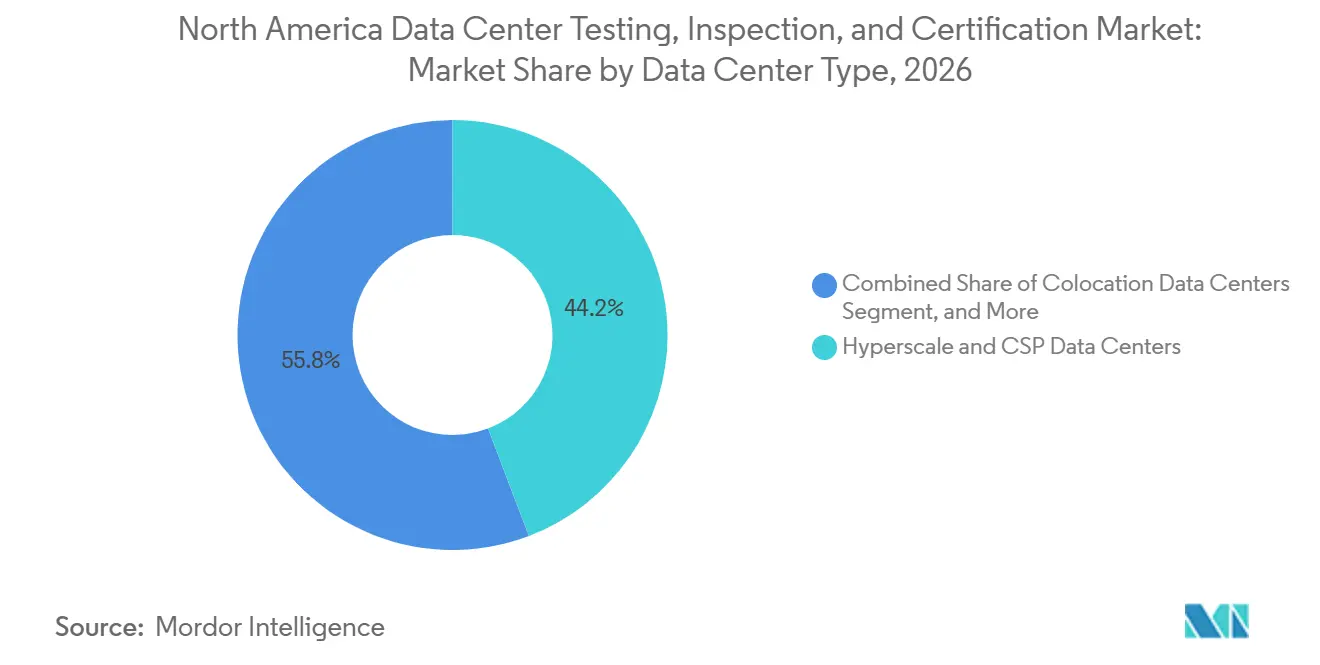
Hyperscale and CSP Data Centers held 44.22% of revenue in 2026. These facilities account for a high share of active construction and require more commissioning work per MW when designed for AI loads. Colocation data centers are the second-largest type. Cologix committed to a USD 5 billion long-term Northern Virginia expansion plan that includes a 38-acre Ashburn campus acquired in February 2026. Enterprise data centers remain a stable base, although operators may delay major recommissioning until tenant demands or regulatory requirements require upgrades. Edge and Modular data centers remain smaller, but their faster deployment creates a need for commissioning approaches tailored to distributed assets.
Hyperscale and CSP Data Centers are projected to expand at a 24.22% CAGR through 2032. More new campuses create a larger scope for commissioning, while completed facilities create a future base for recertification. This gives providers with established hyperscale relationships an advantage across the full campus lifecycle in the North America testing, inspection, and certification market. Preferred-provider provisions in master development agreements can narrow the eligible group of commissioning firms. These arrangements can raise switching costs for developers and increase revenue visibility for providers. The North America testing, inspection, and certification industry is consequently shaped by the ability to secure relationships before a campus enters construction.
By Tier Type: Tier 4 Emerges as the Fastest-Growing Reliability Tier
Tier 3 facilities held 58.31% of revenue in 2026. This tier is widely used as a reliability benchmark for colocation and hyperscale operations and is associated with very high annual uptime. Lower-tier facilities serve cost-sensitive applications, development environments, and edge deployments where short interruptions can be accepted. These lower tiers remain relevant, but they expand more slowly as critical workloads move to higher reliability settings. Uptime Institute has issued thousands of Tier Certification awards across numerous countries. North America remains the largest installed base by geographic concentration.
Tier 4 is projected to expand at a 24.34% CAGR through 2032. Financial services, healthcare, and government users need fault-tolerant infrastructure and fully redundant systems. Real-time AI inference also increases the number of applications that cannot accommodate planned outages. Tier 4 systems require each redundant path to be tested independently under full load, increasing the technical scope within the North America testing, inspection, and certification market. This makes commissioning work per facility more intensive than for Tier 3 systems. The North America testing, inspection, and certification market can therefore gain a larger amount of work from Tier 4 deployments than their facility count alone would suggest.
Geography Analysis
The United States held 86.24% of the North America testing, inspection, and certification market share in 2026. This position is supported by hyperscale campuses in Northern Virginia, Texas, Ohio, and the Pacific Northwest. The United States has an established Uptime Institute Tier Certification ecosystem. Construction activity and AI deployment support continued testing of electrical, cooling, and control systems. The United States remains the main location for providers seeking large hyperscale mandates.
Canada accounts for the remainder of the established regional base. Hyperscale and colocation operators are developing capacity in Ontario and British Columbia, where renewable power availability and cooler conditions can reduce cooling needs for AI workloads. Canadian facilities increasingly seek Uptime Institute Tier, ISO/IEC 27001, and SOC 2 certifications to serve United States enterprise and government tenants. These certifications generate ongoing assurance work after initial commissioning.
Mexico is projected to expand at a 24.11% CAGR through 2032. Nearshoring investment has established Querétaro as the country’s leading data center hub. KIO Data Centers completed subsequent phases of QRO2 following significant cumulative investment and plans a substantial QRO3 expansion over the medium term. International certification requirements, including ICREA assessments, Uptime Institute Tier certification, ISO/IEC information security standards, and SOC compliance, can widen the addressable project base. Investment toward Monterrey, Mexico City, and San Luis Potosí can further extend the geographic spread of facilities.
Competitive Landscape
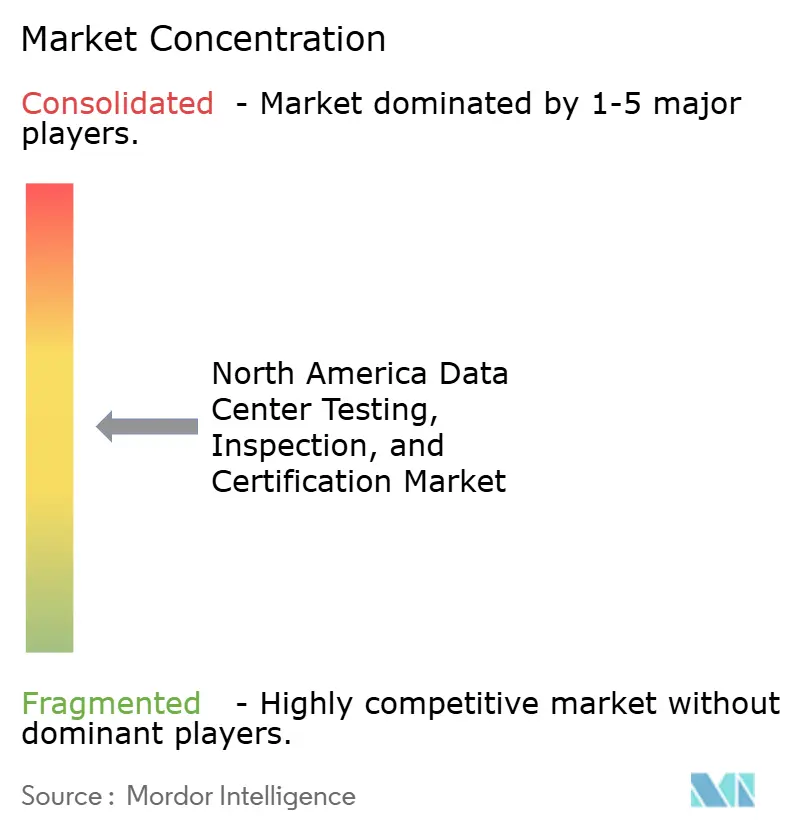
The North America testing, inspection, and certification market is moderately concentrated at the level of leading providers. Bureau Veritas, SGS, Intertek, TÜV SÜD, and UL Solutions compete for hyperscale commissioning mandates. Specialist cybersecurity compliance firms, including Schellman, Coalfire, and A-LIGN, also serve colocation and cloud tenants. Large TIC providers offer scale across technical assessment and geographic coverage. Specialists compete through cybersecurity, commissioning, or liquid-cooling expertise.
Bureau Veritas signed an agreement in April 2026 to acquire Lotusworks, a mission-critical commissioning and quality-assurance specialist that generated EUR 131 million (USD 142 million) in revenue in 2025. The combined platform represents EUR 300 million (USD 324 million) in revenue. SGS positions its Digital Trust framework as a continuous-assurance model that links design, testing, and operational documentation. BSI Group introduced the Mark of Trust in January 2026 for modular certification across reliability, security, and sustainability. These actions indicate a shift toward broader service coverage and ongoing relationships.
No provider has a dominant liquid-cooling commissioning methodology, leaving room for standardized approaches. Integrated annual packages that cover Tier certification, ISO/IEC 27001:2022, SOC 2 Type 2, and ASHRAE 90.4-2025 are another area of competition. NV5 Global and Salute combine commissioning engineering with direct-to-chip liquid-cooling capabilities. UL Solutions added 3 data center certification programs in September 2026, reinforcing its role in equipment qualification.
North America Data Center Testing, Inspection, and Certification Industry Leaders
-
Uptime Institute
-
TÜV SÜD AG
-
Bureau Veritas SA
-
SGS SA
-
Intertek Group plc
- *Disclaimer: Major Players sorted in no particular order
Recent Industry Developments
- September 2026: UL Solutions launched a certification program for direct-to-chip liquid cooling subassemblies under UL 4501, evaluating coolant compatibility, pressure and leak integrity, durability, and interoperability. The program fills a critical qualification gap for AI data center liquid cooling supply chains that previously had no standardized independent certification pathway.
- September 2026: UL Solutions introduced the UL 2140 certification program for prefabricated data center power distribution assemblies. Schneider Electric received the first certification. The standard qualifies factory-built open power skids combining switchboards, uninterruptible power supply systems, and batteries before site delivery, compressing AI-scale commissioning timelines.
- April 2026: ABB's HiPerGuard achieved the first certification from UL Solutions under UL 9540 for a medium-voltage, multi-mode static inverter designed to serve as an uninterruptible power supply in data centers. The certification supports permitting, inspection, and utility acceptance for medium-voltage backup power architectures.
- April 2026: Bureau Veritas signed an agreement to acquire Lotusworks, a mission-critical commissioning and quality assurance specialist generating EUR 131 million (USD 142 million) in revenue in 2025. The deal creates a combined platform representing EUR 300 million (USD 324 million) in revenue.
North America Data Center Testing, Inspection, and Certification Market Report Scope
The North America Data Center Testing, Inspection, and Certification (TIC) Market comprises third-party services that verify the safety, performance, reliability, and compliance of data center infrastructure across the US, Canada, and Mexico, from design review and commissioning through ongoing operations and modernization.
The North America Data Center Testing, Inspection, and Certification Market Report is Segmented by Service Type (Testing, Inspection, Certification, and Compliance), Data Center Lifecycle (Pre-Construction and Design, Construction, Installation and Commissioning, Operations, Maintenance and Recertification, and Retrofit and Modernization), Infrastructure System (Electrical Infrastructure, Mechanical, Cooling and Fire-Safety Infrastructure, Structural, Building and Physical Security Systems, and IT, Network and Cybersecurity Infrastructure), Data Center Type (Hyperscale and Cloud Service Provider Data Centers, Colocation, Enterprise, Edge and Modular), Tier (1 and 2, 3, 4), and Geography (United States, Canada, and Mexico). The Market Forecasts are Provided in Terms of Value (USD).
| Testing |
| Inspection |
| Certification |
| Compliance and Assurance Services |
| Pre-Construction and Design |
| Construction, Installation and Commissioning |
| Operations, Maintenance and Recertification |
| Retrofit and Modernization |
| Electrical Infrastructure |
| Mechanical, Cooling and Fire-Safety Infrastructure |
| Structural, Building and Physical Security Systems |
| IT, Network and Cybersecurity Infrastructure |
| Hyperscale and Cloud Service Provider Data Centers |
| Colocation Data Centers |
| Enterprise Data Centers |
| Edge and Modular Data Centers |
| Tier 1 and Tier 2 |
| Tier 3 |
| Tier 4 |
| United States |
| Canada |
| Mexico |
| By Service Type | Testing |
| Inspection | |
| Certification | |
| Compliance and Assurance Services | |
| By Data Center Lifecycle | Pre-Construction and Design |
| Construction, Installation and Commissioning | |
| Operations, Maintenance and Recertification | |
| Retrofit and Modernization | |
| By Infrastructure System | Electrical Infrastructure |
| Mechanical, Cooling and Fire-Safety Infrastructure | |
| Structural, Building and Physical Security Systems | |
| IT, Network and Cybersecurity Infrastructure | |
| By Data Center Type | Hyperscale and Cloud Service Provider Data Centers |
| Colocation Data Centers | |
| Enterprise Data Centers | |
| Edge and Modular Data Centers | |
| By Tier Type | Tier 1 and Tier 2 |
| Tier 3 | |
| Tier 4 | |
| By Country | United States |
| Canada | |
| Mexico |
Key Questions Answered in the Report
What is the North America testing, inspection, and certification market size?
The market size is projected to expand from USD 1.34 billion in 2026 and USD 1.80 billion in 2027 to USD 5.21 billion by 2032, at a 23.72% CAGR.
What is driving demand for data center TIC services in North America?
AI-related power density, hyperscale construction, mandatory security validation, and facility handover requirements are increasing demand.
Which service type leads data center TIC revenue in North America?
Testing leads with a 39.15% share in 2026 because facilities need factory, site, and integrated system testing before handover.
Which lifecycle phase has the highest projected expansion rate?
Operations, Maintenance and Recertification is projected to expand at a 24.56% CAGR through 2032, supported by recurring certification renewals.
Which country is the largest regional market for data center TIC services?
The United States holds 86.24% of regional revenue in 2026, supported by major hyperscale clusters and a mature certification ecosystem.
Why is Tier 4 certification becoming more important for data centers?
Tier 4 is projected to expand at a 24.34% CAGR through 2032 as fault tolerance and uninterrupted operation become more important for AI, healthcare, financial services, and government workloads.