
North America Data Center Water Management Market Size and Share
Market Overview
| Study Period | 2027 - 2032 |
|---|---|
| Forecast Data Period | 2027 - 2032 |
| Base Year Market Size (2026) | USD 1.43 Billion |
| Market Size (2027) | USD 1.59 Billion |
| Market Size (2032) | USD 2.58 Billion |
| Growth Rate (2027 - 2032) | 10.17 % |
| Market Concentration | Medium |
Major Players *Disclaimer: Major Players sorted in no particular order Image © Mordor Intelligence. Reuse requires attribution under CC BY 4.0. | |
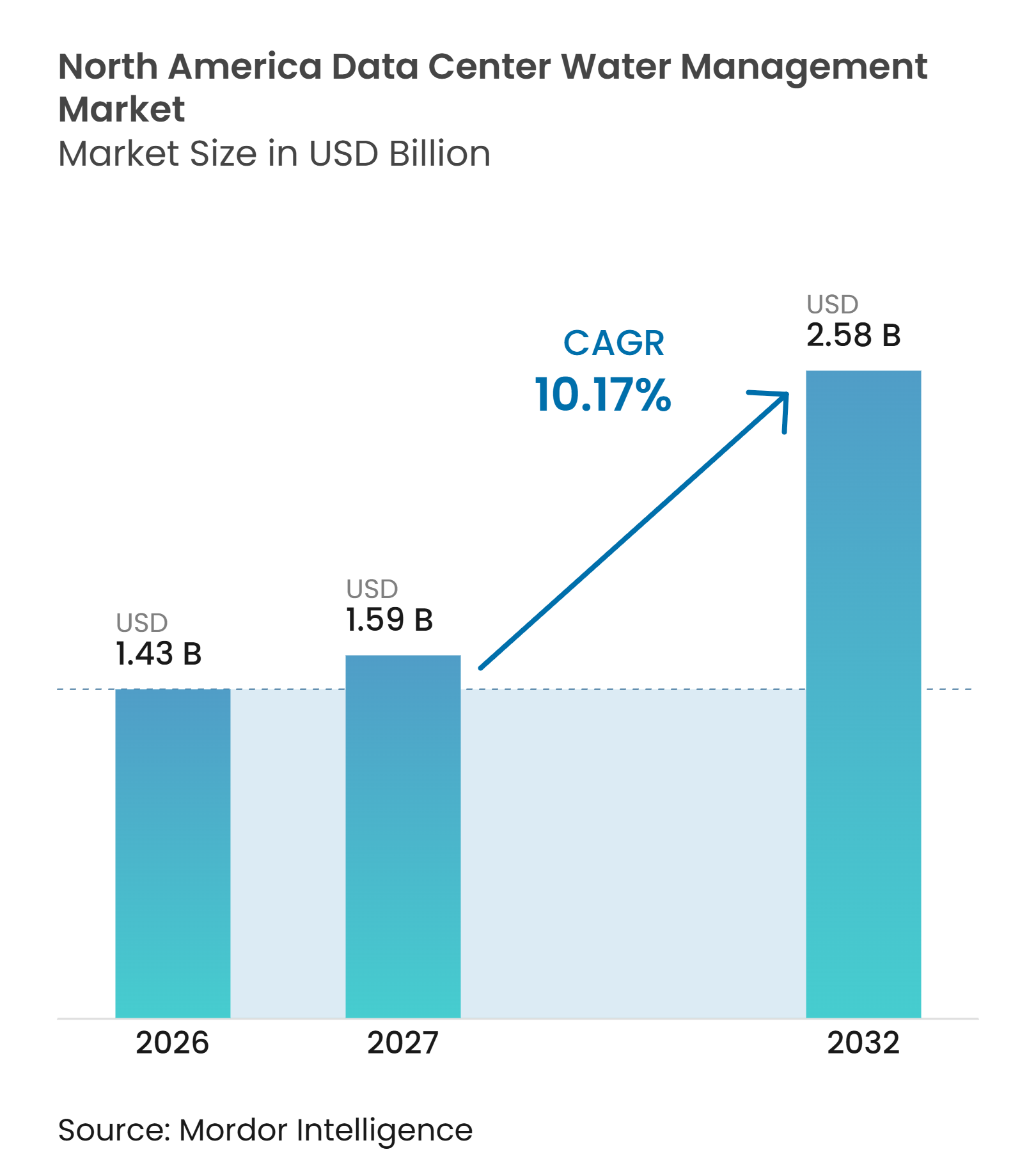
North America Data Center Water Management Market Analysis by Mordor Intelligence
The North America data center water management market was valued at USD 1.43 billion in 2026 and is estimated to expand from USD 1.58 billion in 2027 to reach USD 2.58 billion by 2032, at a CAGR of 10.17% during the forecast period 2027-2032. AI infrastructure deployment is concentrating new capacity in major computing corridors where water availability is already a site planning concern. This makes monitoring, treatment, reuse, and reporting part of core facility planning rather than supporting activities. The North America data center water management market is also moving toward closed-loop cooling systems that require tighter control of coolant quality. Suppliers are responding with service models that combine equipment, chemicals, monitoring, and field support. The United States remains the main source of regional demand, while Mexico offers the fastest country-level expansion as new campuses are planned.
Key Report Takeaways
- By solution type, water recycling and reuse management systems held 22.87% of the North America data center water management market share in 2026, while the same segment is projected to expand at a 10.22% CAGR through 2032.
- By water management application, cooling system water management accounted for 42.88% of the market in 2026, while water consumption reporting and optimization is expected to expand at a 10.46% CAGR through 2032.
- By deployment model, on-premises systems held 44.67% of the market in 2026, while integrated and hybrid systems are projected to expand at a 10.87% CAGR through 2032.
- By service type, system installation and integration accounted for 33.46% of the market in 2026, while managed water management services are expected to expand at a 10.39% CAGR through 2032.
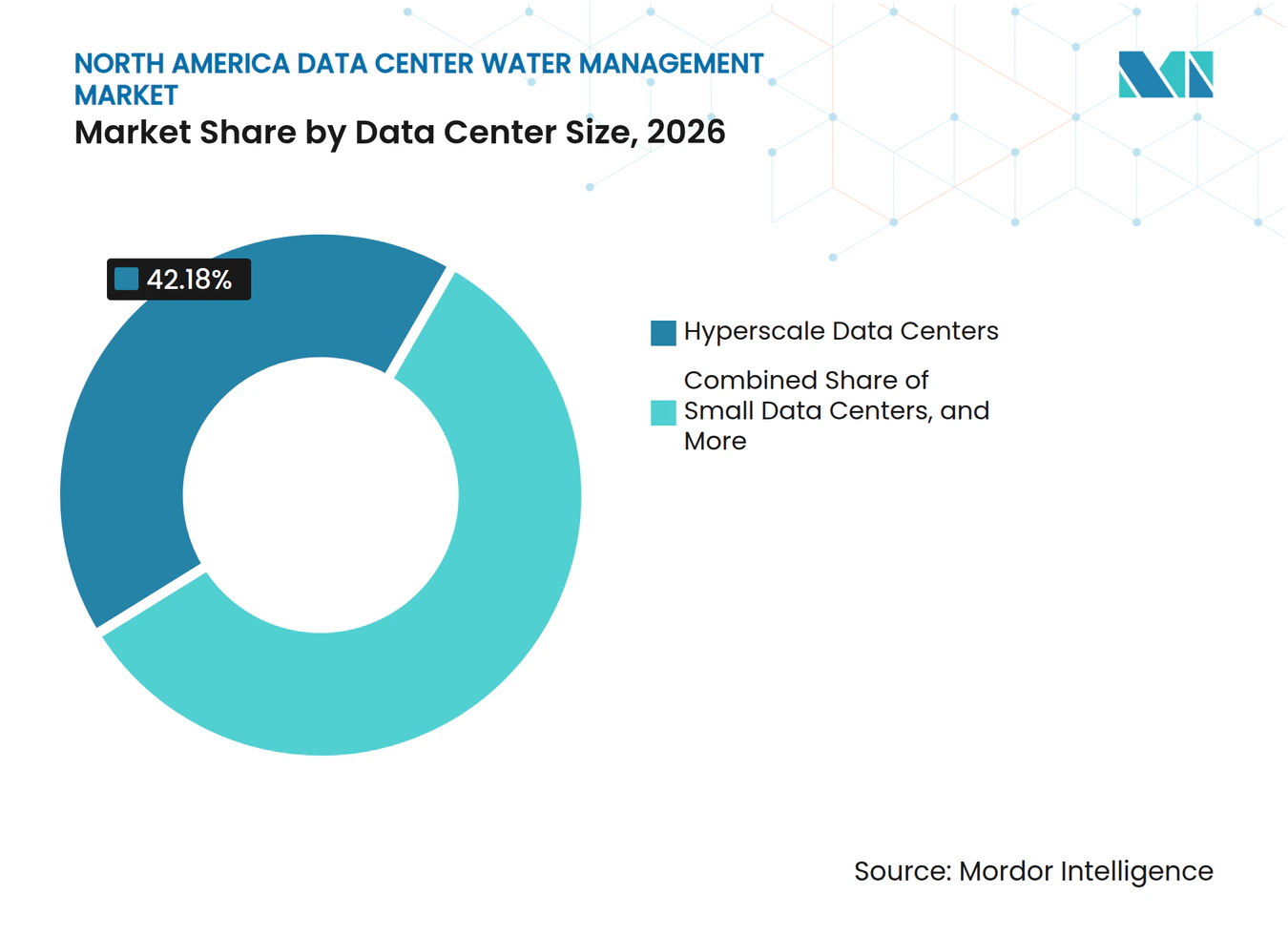
- By data center size, hyperscale data centers held 42.18% of the market in 2026 and are projected to expand at a 10.36% CAGR through 2032.
- By data center type, cloud service providers accounted for 42.97% of the market in 2026 and are expected to expand at a 10.42% CAGR through 2032.
- By geography, the United States held 82.36% of the market in 2026, while Mexico is projected to expand at a 10.58% CAGR through 2032.
Note: Market numbers in this report are based on Mordor Intelligence's proprietary estimation framework, which combines nine months of actuals with Q4 projections for base year 2026.
Market Trends and Insights
Drivers Impact Analysis of North America Data Center Water Management Market*
| Driver | (~) % Impact on CAGR Forecast | Geographic Relevance | Impact Timeline |
|---|---|---|---|
| AI and Hyperscale Data Center Expansion | +4.2% | United States, especially Virginia, Texas, and Arizona, and Mexico | Short term (≤ 2 years) |
| Direct-to-Chip Liquid Cooling Adoption | +2.1% | United States and Canada, with emerging adoption in Mexico | Medium term (2-4 years) |
| Water-Use Disclosure and Permitting Requirements | +1.2% | United States, especially Minnesota, Kansas, Virginia, and Texas, with spillover to Canada | Short term (≤ 2 years) |
| Corporate Water-Positive and ESG Commitments | +1% | North America, led by hyperscale operators | Medium term (2-4 years) |
| Reclaimed-Water Infrastructure for Cooling | +0.8% | United States, especially Virginia, Georgia, Mississippi, and Oregon, with emerging activity in Mexico | Medium term (2-4 years) |
| Higher Rack Densities and Closed-Loop Cooling Requirements | +0.7% | United States and Canada, linked to NVIDIA Blackwell and Vera Rubin deployments | Long term (≥ 4 years) |
| Source: Mordor Intelligence | |||
AI and Hyperscale Data Center Expansion
AI-led expansion has made water management a core infrastructure requirement for hyperscale campuses. U.S. data centers used 17 billion gallons of water directly in 2023, and federal research projects this demand could double or quadruple by 2028. Much of the new capacity is being considered in areas with water constraints, which places water access alongside power and land in site-selection decisions. The North America data center water management market therefore benefits from upgrades within operating campuses as well as from greenfield construction. Higher AI workload density also shortens infrastructure refresh cycles and brings forward spending on cooling and fluid-management systems. Minnesota HF 16 requires certain large data centers to evaluate conservation measures before receiving a water appropriation permit, making compliance a separate source of demand.[1]
Direct-to-Chip Liquid Cooling Adoption
Direct-to-chip cooling is changing the type of water management services required by data center operators. Closed loops depend on stable fluid chemistry because pH variation, particulates, and microbial growth can reduce server performance or cause outages. ChemTreat introduced CTSolutions D2C with aqueous coolant technology, direct-to-chip biocides, and real-time fluid monitoring to address those operating requirements.[2] Ecolab launched Cooling as a Service in November 2025, combining its 3D TRASAR monitoring technology with coolant distribution equipment and service support.[3] These offers show why the North America data center water management market is adding recurring revenue tied to fluid lifecycle management. NVIDIA also announced in January 2026 that Vera Rubin racks can operate with coolant at 45°C, which can reduce dependence on chillers in future AI facilities.
Water-Use Disclosure and Permitting Requirements
Reporting and permitting rules are turning water use into a formal management measure for operators. Minnesota HF 16 connects water permits for large data centers with an evaluation of conservation practices. Kansas SB 98 created tax exemptions for qualifying data centers that adopt water conservation, reuse, and replacement practices. The Clean Water Act remains relevant when discharge and water infrastructure decisions require federal review. These requirements are raising demand for metering, records, and systems that can demonstrate performance. The North America data center water management market is therefore supported by compliance spending even where operators are not yet replacing their cooling equipment.
Corporate Water-Positive and ESG Commitments
Hyperscale water commitments are creating procurement requirements for equipment and service providers. Amazon reported a water-use effectiveness level of 0.12 L/kWh in 2025 and stated that it had reached 75% of its water-positive target. Microsoft reported that its average water-use effectiveness declined from 2.3 L/kWh in its first-generation facilities to 0.27 L/kWh in 2025. Microsoft also stated that its owned data centers replenished more water than they withdrew during fiscal year 2025. These goals favor vendors that can document water-use effectiveness through reliable monitoring. They also make reporting quality commercially important, because operators need data that can support public sustainability disclosures.
Restraints Impact Analysis of North America Data Center Water Management Market*
| Restraint | (~) % Impact on CAGR Forecast | Geographic Relevance | Impact Timeline |
|---|---|---|---|
| Drought, Groundwater Caps, and Water Tariffs | -1.8% | United States, especially the Southwest and Texas, and Western Canada | Short term (≤ 2 years) |
| Capital Cost of Reuse and Zero-Liquid-Discharge Systems | -1.2% | North America, especially Mexico and mid-market operators | Medium term (2-4 years) |
| Water-Chemistry Failure Risk in Direct-to-Chip Loops | -0.6% | United States and Canada with high direct-to-chip deployment density | Medium term (2-4 years) |
| Permitting Delays and Community Opposition | -0.5% | United States, especially Arizona, California, and Virginia, and Mexico, especially Querétaro | Short term (≤ 2 years) |
| Source: Mordor Intelligence | |||
Drought, Groundwater Caps, and Water Tariffs
Water scarcity is a direct constraint on site selection and operating continuity in several North American data center locations. Federal research identifies water availability, local climate conditions, and competing uses as factors that can affect data center development. The issue is particularly material in areas where new campus development overlaps with drought planning and groundwater controls. Operators in these locations must weigh the operating cost of evaporative cooling against investments in reuse, monitoring, and alternative cooling designs. Rising water tariffs can weaken the economics of existing cooling assets before normal replacement schedules are complete. This creates a risk of stranded infrastructure for facilities that cannot adjust their water strategy quickly enough.
Capital Cost of Reuse and Zero-Liquid-Discharge Systems
Advanced reuse and zero-liquid-discharge systems can reduce freshwater demand but require substantial capital investment. Climate Adaptive Infrastructure announced a USD 66 million Water as a Service project with Veolia Water Technologies for a Midwest semiconductor manufacturer in May 2025. The project shows how third-party financing can shift investment from upfront capital spending to operating payments. Veolia and Amazon also announced a reclaimed-water cooling project in Mississippi that is expected to reuse more than 83 million gallons of potable water each year when operational. Smaller operators still face a gap between water-neutrality goals and the cost of advanced infrastructure. Financing-inclusive service models can address that gap, but the cost barrier remains a restraint for operators without hyperscale scale or credit capacity.
*Our forecasts treat driver/restraint impacts as directional, not additive. The impact forecasts reflect baseline growth, mix effects, and variable interactions.
North America Data Center Water Management Market Segment Analysis
By Solution Type:
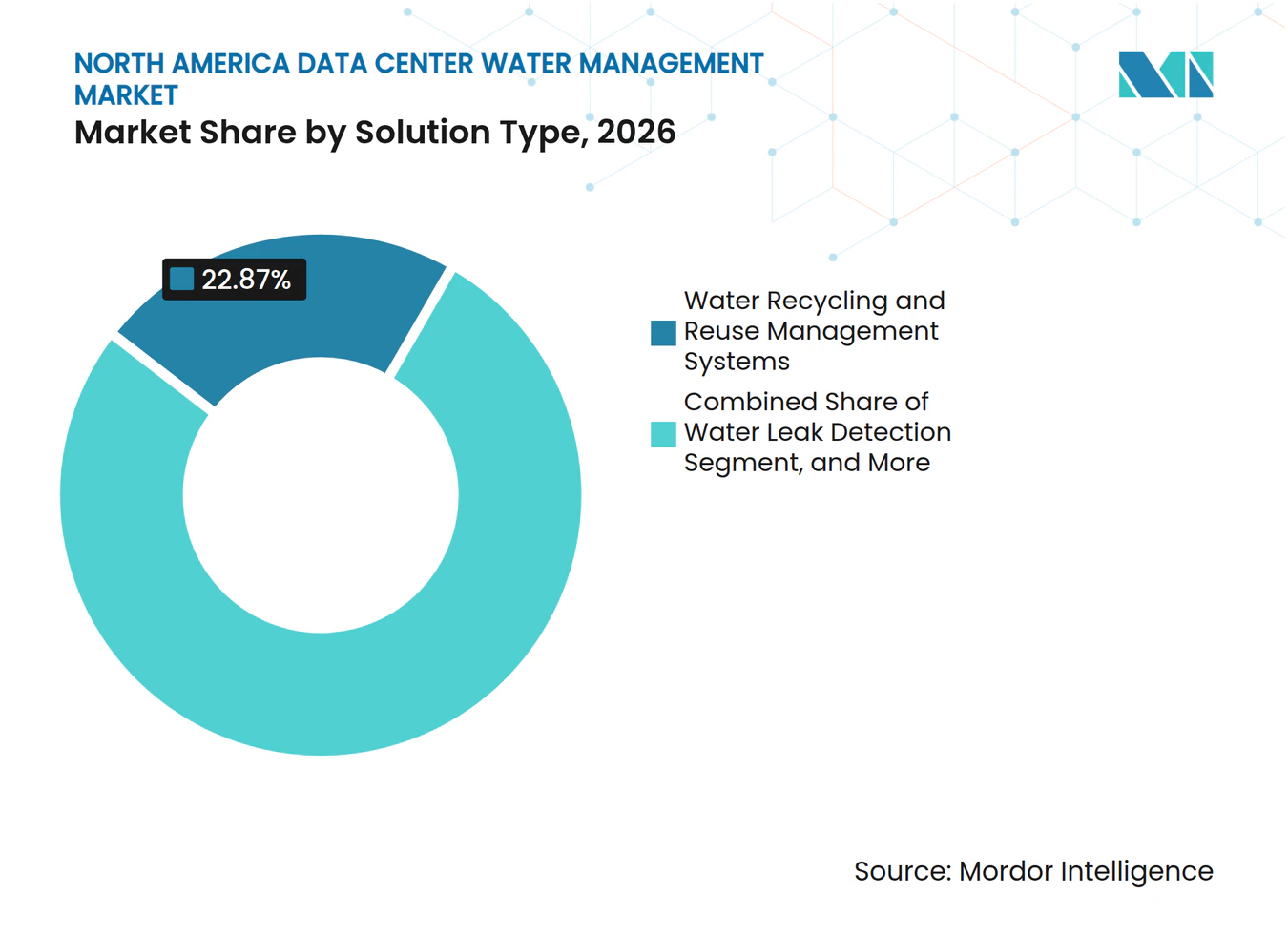
Recycling and Reuse Systems Lead in Share and Forecast ExpansionWater recycling and reuse management systems held 22.87% of the North America data center water management market share in 2026 and are projected to expand at a 10.22% CAGR through 2032. This position reflects the move toward circular water use as a basic procurement requirement. Amazon committed in June 2025 to expand recycled water use to more than 120 U.S. data center locations by 2030. Its program demonstrates the scale of the procurement pipeline available to reuse-system suppliers. The North America data center water management market also includes monitoring, metering, treatment, leak detection, optimization, and analytics solutions. These offerings are increasingly sold together because operators want coordinated control over water quality, use, and reporting.
Water monitoring and metering systems are important because operators require continuous data for water-use effectiveness reporting. Water management software and analytics are being integrated with treatment hardware to provide real-time operational visibility. Leak-detection systems are particularly relevant for direct-to-chip loops, where fluid integrity affects server availability. Gradiant stated in 2025 that its HyperSolved platform combines cooling-water management, monitoring, and treatment support for hyperscale users. Optimization and control systems support facility teams as they adjust cooling operations to changing compute loads. The segment is broadening from stand-alone equipment sales to connected systems with ongoing operating support.



By Water Management Application:
Cooling Holds the Largest Position While Reporting Expands FastestCooling system water management commanded 42.88% of the North America data center water management market size in 2026. Cooling remains the primary application because heat rejection needs increase with campus scale and higher rack density. The Congressional Research Service identifies cooling as a major source of data center water demand. Water consumption reporting and optimization is projected to expand at a 10.46% CAGR through 2032. Disclosure rules and internal sustainability commitments are driving demand for metering and analytical tools. These tools help operators track consumption at a level that can support both facility control and public reporting.
Leak prevention and detection are becoming more important as direct-to-chip loops operate with narrower chemistry tolerances. ChemTreat designed CTSolutions D2C to monitor coolant condition and help support direct-to-chip cooling uptime. Wastewater management and water supply and distribution management remain essential to the operation of large campuses. Water recycling and reuse applications also benefit from commitments by hyperscale operators to reduce potable water use. Veolia and Amazon’s Mississippi project connects reclaimed-water treatment directly with cooling operations. Together, these applications show that the segment includes both established utility-linked functions and newer data-led management activities.
By Deployment Model:
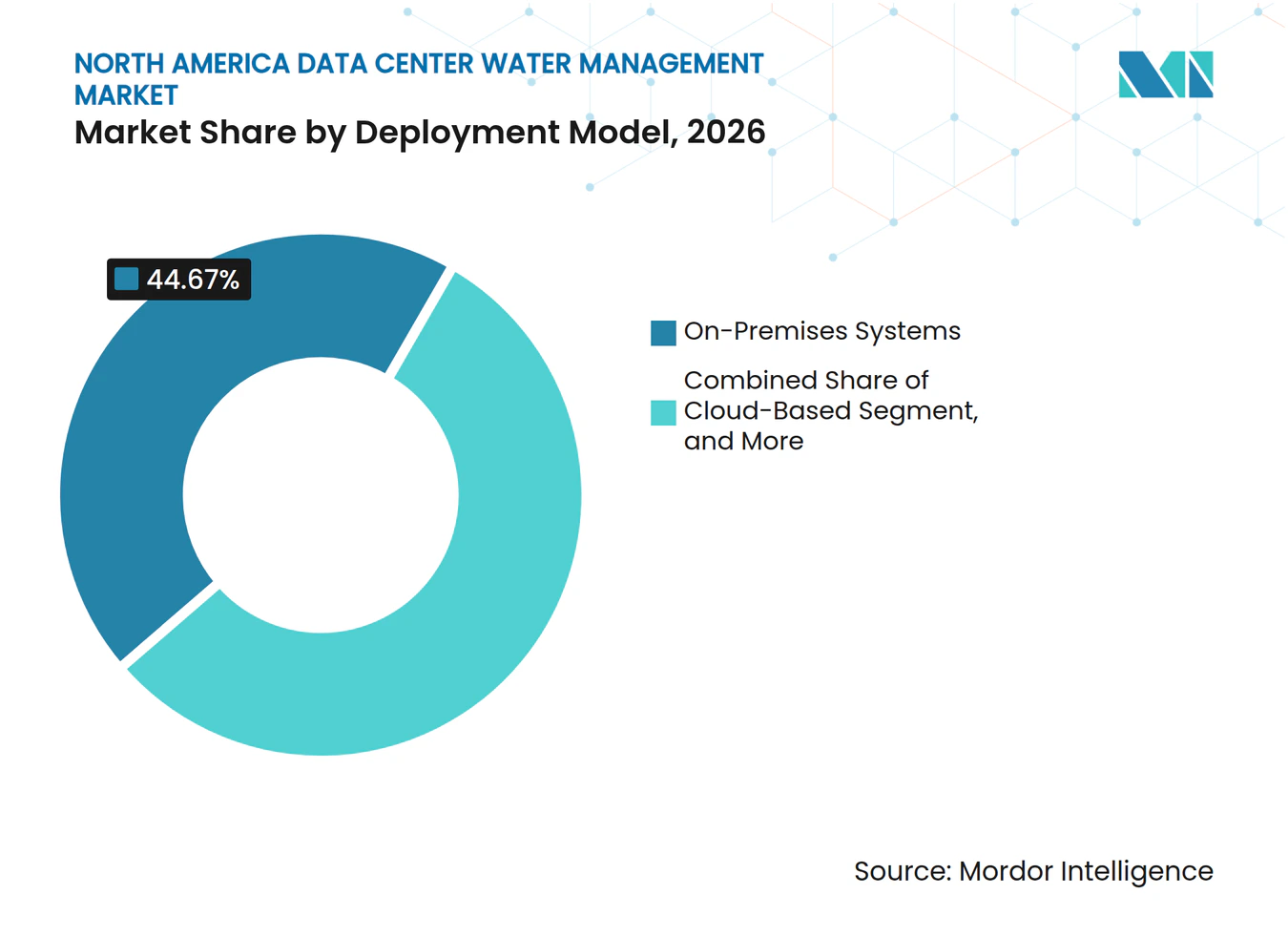
On-Premises Systems Lead While Hybrid Architectures AdvanceOn-premises systems held 44.67% of the North America data center water management market in 2026. Operators use on-site systems to retain direct control over cooling chemistry and critical infrastructure. This preference is strong where a fluid-system failure can affect costly computing equipment. Integrated and hybrid systems are projected to expand at a 10.87% CAGR through 2032. These models combine on-site hardware with connected monitoring platforms and remote data access. The approach can give operators local redundancy while allowing centralized oversight.
Microsoft stated that its new facilities use closed-loop cooling approaches that reduce water intensity and support more efficient operations. Such systems illustrate how physical infrastructure and digital management can operate together. Cloud-based systems are starting from a smaller base but support analytics-as-a-service and reporting functions. Vendors need open interfaces when customers want to connect water data with cooling, building, and sustainability systems. Data sovereignty and local resiliency requirements still limit full migration to remote-only management. The expected result is a gradual shift toward hybrid deployments rather than a replacement of on-premises control.

By Service Type:
Installation Leads While Managed Services Gain MomentumSystem installation and integration held 33.46% of the North America data center water management market in 2026. The leading position reflects construction activity and the need to fit water systems into complex data center designs. Managed water management services are projected to expand at a 10.39% CAGR through 2032. Operators are seeking recurring support that can link fluid control, monitoring, maintenance, and uptime objectives. This is particularly relevant where direct-to-chip cooling requires specialist chemical and operational knowledge. The service mix is therefore moving beyond installation toward lifecycle management.
Ecolab’s Cooling as a Service offer combines connected monitoring, cooling equipment, and field expertise under a recurring contract. Water auditing and efficiency consulting also support the service market because operators often establish a baseline before selecting a treatment or reuse upgrade. Monitoring and maintenance services benefit from tighter coolant chemistry requirements in closed-loop systems. Engineering and integration providers can use assessments to identify later opportunities for equipment and managed-service contracts. The North America data center water management industry is thus adding service revenue without reducing the importance of installation work. This combination can help suppliers stay involved after initial capital projects are complete.
By Data Center Size:
Hyperscale Facilities Drive the Largest Share and Forecast CAGRHyperscale data centers held 42.18% of North America data center water management market share in 2026 and are projected to expand at a 10.36% CAGR through 2032. Their position reflects the concentration of AI workloads and the capital capacity to deploy advanced water systems. Large data centers remain a major demand group because enterprise cloud migration and colocation expansion continue across U.S. hub markets. Hyperscale operators can also fund reuse, advanced monitoring, and closed-loop cooling at a scale that smaller sites cannot match. This gives them an outsized role in shaping technology requirements. Their water commitments also influence suppliers across treatment, sensors, software, and service categories.
Mexico highlights the opportunity beyond established U.S. campuses. CloudHQ announced a USD 4.8 billion commitment in September 2025 for 6 data centers in Querétaro. Large and medium facilities will require solutions that fit local water infrastructure and service availability. Small data centers face the greatest adoption barrier for zero-liquid-discharge and closed-loop reuse systems because these solutions favor larger installations. Monitoring and analytics provide a more accessible initial offering for smaller sites. This creates a tiered demand pattern in which advanced infrastructure is concentrated in large facilities while digital tools can reach a broader customer base.
By Data Center Type:
Cloud Service Providers Lead While Colocation Demand Follows Tenant RequirementsCloud service providers held 42.97% of the North America data center water management market in 2026 and are projected to expand at a 10.42% CAGR through 2032. These operators manage large water loads and face close investor scrutiny of water-use performance. Their scale makes them early users of reclaimed-water systems, outcome-based services, and detailed monitoring. Colocation operators form a separate demand group because their large tenants increasingly set requirements for water efficiency and disclosure. This creates a pull-through effect from hyperscale tenants to colocation facilities. Water requirements can therefore rise even when the colocation operator has not independently set the same targets.
Enterprise and edge data centers face increasing attention as permitting requirements extend beyond the largest facilities. Government and institutional facilities also operate under procurement frameworks that address sustainability and operational resilience. Amazon’s reclaimed-water project with Veolia in Mississippi shows the procurement influence cloud operators can have on the broader supplier ecosystem. The project is expected to begin operating in 2027 and will reuse more than 83 million gallons of potable water annually. Suppliers can use cloud-provider projects as references when approaching colocation and enterprise customers. The demand pattern links large cloud commitments with wider adoption across the North America data center water management market.
Geography Analysis
The United States held 82.36% of the North America data center water management market share in 2026. Its leading position reflects the concentration of hyperscale campuses in Northern Virginia, Phoenix, Chicago, and Dallas-Fort Worth. Water conditions differ sharply between these locations, so system requirements are shaped by local availability, regulation, and utility infrastructure. The Congressional Research Service reported that U.S. data centers used 17 billion gallons of water directly in 2023 and projected that use could double or quadruple by 2028. Virginia passed SB 1449 in 2025, which addresses local review requirements related to proposed data center development. Amazon received approval in December 2025 for a USD 100 million water treatment and cooling facility in Covington, Georgia. Microsoft also invested in water and sewer improvements near its Leesburg, Virginia, data center, showing how site viability can depend on local infrastructure planning.
Mexico is projected to expand at a 10.58% CAGR through 2032, making it the region’s fastest-growing country market. The MEXDC investment pipeline for data center construction and equipment is stated at USD 82.5 billion between 2026 and 2031. Querétaro concentrates a large share of installed national capacity and is receiving projects from major cloud and colocation developers. CloudHQ’s USD 4.8 billion commitment for 6 Querétaro data centers illustrates the scale of planned expansion. The country had 236 MW of operational data center capacity in late 2025, with 200 MW under construction. Water infrastructure is less developed than the planned buildout, which gives early entrants an opportunity to establish local service networks. The North America data center water management market can therefore gain from investments made before new campuses become operational.
Canada ranks third in the regional structure and has a different operating profile from the United States and Mexico. Temperate conditions and longer free-cooling periods reduce reliance on water-intensive evaporative cooling during parts of the year. This limits absolute water intensity in many locations, although it does not remove the need for water planning and disclosure. Microsoft’s Quebec facilities are designed to collect up to 1.5 million liters of rainwater annually. Canadian operators are likely to prioritize analytics, monitoring, and reporting where the immediate need for capital-intensive treatment is lower. These needs can support consulting and software work relative to transaction volume. Canada remains part of the North America data center water management market, but its growth is shaped by sustainability management rather than widespread water-use restrictions.
Competitive Landscape
Market Concentration
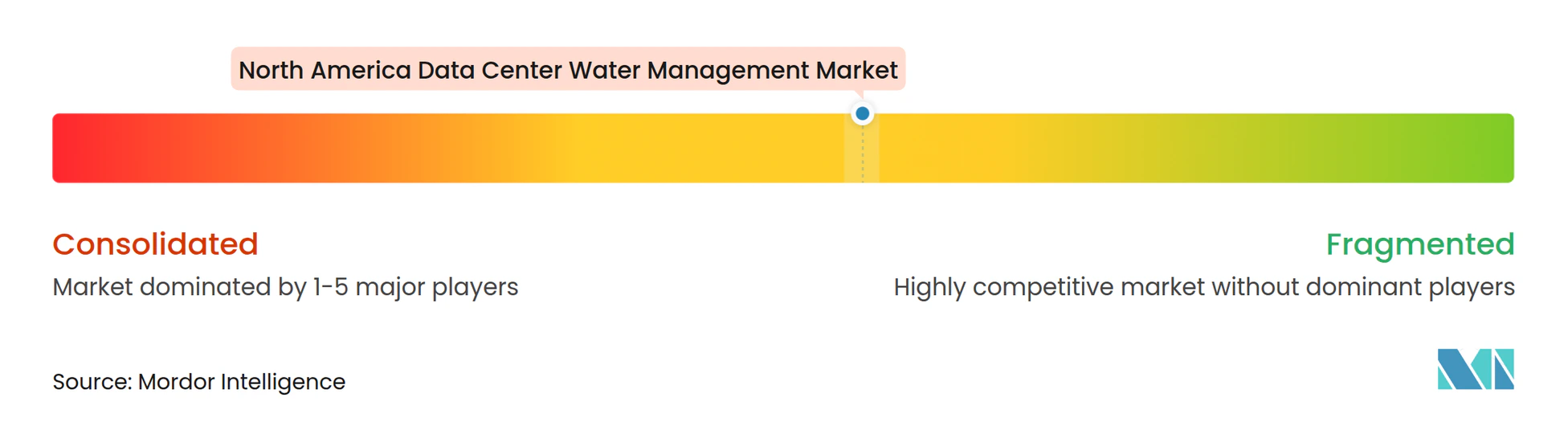
The North America data center water management market is moderately fragmented across water technology suppliers, chemical treatment companies, engineering specialists, and digital infrastructure managers. Ecolab, Veolia, Gradiant, ChemTreat, Xylem, and Kurita Water Industries provide treatment, monitoring, chemical, and reuse capabilities. Black and Veatch, Aquatech International, Carollo Engineers, and Veralto add engineering and implementation capabilities. Schneider Electric, Vertiv, and Johnson Controls provide monitoring and controls that can connect water systems with facility operations. This mix makes the supplier landscape broad and creates competition between specialists and integrated providers. It also makes the addressable market difficult to define for suppliers focused on a single water technology.
Service-led offers have become more important since 2025. Ecolab launched Cooling as a Service in November 2025, integrating monitoring, cooling equipment, and specialist support in a recurring contract. Veolia announced its reclaimed-water cooling collaboration with Amazon in April 2026 under its Data Center Resource 360 program. Gradiant stated that HyperSolved brings sourcing, treatment, monitoring, and discharge management together for hyperscale data centers. These approaches respond to buyers that prefer one accountable partner for water performance and uptime. Integrated contracts can also reduce the coordination burden across separate equipment, chemical, and software suppliers.
Opportunities remain among mid-tier colocation operators, in Mexico where planned infrastructure is moving faster than established vendor networks, and in systems that link water analytics with ESG reporting. Reliable water-use effectiveness data can support operator reporting and improve the value of monitoring platforms. Compliance knowledge also matters because permit requirements can affect project schedules and technology choices. Suppliers with technical, operational, and permitting capabilities can have an advantage in water-constrained locations. No combined market-share data for the leading suppliers is available in the supplied material. The competitive narrative therefore supports a fragmented structure rather than dominance by a small group of vendors.
North America Data Center Water Management Industry Leaders
-
Ecolab Inc.
-
Veolia Environnement S.A.
-
Xylem Inc.
-
SUEZ S.A.
-
Gradiant Corporation
- *Disclaimer: Major Players sorted in no particular order
North America Data Center Water Management Market Companies Covered in this Report
- Ecolab Inc.
- Veolia Environnement S.A.
- Xylem Inc.
- SUEZ S.A.
- Gradiant Corporation
- ChemTreat, Inc.
- Aquatech International LLC
- Black & Veatch Holding Company
- Carollo Engineers, Inc.
- H2O Innovation Inc.
- Kurita Water Industries Ltd.
- Veralto Corporation
- Schneider Electric SE
- Vertiv Group Corp.
- Johnson Controls International plc
- Carrier Global Corporation
- Modine Manufacturing Company
- Microsoft Corporation
- Amazon Web Services, Inc.
- Google LLC
- Meta Platforms, Inc.
- Digital Realty Trust, Inc.
- Equinix, Inc.
- QTS Realty Trust, LLC
- CyrusOne Inc.
- Switch, Inc.
- Iron Mountain Data Centers, LLC
- NTT Global Data Centers Americas, Inc.
- STACK Infrastructure, Inc.
- Vantage Data Centers, LLC
- CoreSite Realty Corporation
Recent Industry Developments in North America Data Center Water Management Market
- September 2026: Gradiant secured a contract to deliver a turnkey water and wastewater system for a hyperscale AI data center campus in West Texas, designed for zero surface discharge using its HyperSolved platform with SmartOps AI monitoring and CURE Chemicals integration, for one of the world's largest hyperscalers.
- June 2026: Microsoft reported that its average data center WUE improved from 2.3 L/kWh in first-generation facilities to 0.27 L/kWh in 2025, with approximately 90% of its owned fleet operating with low- to zero-water cooling systems. Fiscal year 2025 was the first year Microsoft's owned data centers globally replenished more water than they withdrew.
- April 2026: Veolia Environnement S.A. and Amazon Web Services announced a collaboration to develop reclaimed water-based cooling infrastructure for Amazon data center operations in Mississippi under Veolia's Data Center Resource 360 program, with the first facility expected operational in 2027 and projected to reuse more than 83 million gallons of potable water annually.
- February 2026: Oracle Corporation announced closed-loop, zero-freshwater-consumption cooling for new AI data centers in New Mexico, Michigan, Texas, and Wisconsin, designed to eliminate reliance on continuous potable water input as a community water stewardship commitment.
North America Data Center Water Management Market Report Scope
The North America Data Center Water Management Market comprises technologies and services that help data center operators monitor, manage, conserve, and optimize water use across facility operations. It focuses on improving water efficiency, reducing wastage, supporting sustainable cooling practices, ensuring water quality, and meeting environmental compliance requirements. The market enables organizations to enhance operational resilience, lower resource consumption, and achieve sustainability goals through advanced monitoring, automation, analytics, and water conservation strategies, supporting the growing demand for environmentally responsible and resource-efficient digital infrastructure.
The North America Data Center Water Management Market Report is Segmented by Solution Type (Water Monitoring and Metering Systems, Water Leak Detection Systems, Water Usage Optimization and Control Systems,Water Recycling and Reuse Management Systems,Water Treatment and Quality Monitoring Systems, and Water Management Software and Analytics), Water Management Application (Cooling System Water Management, Water Supply and Distribution Management, Wastewater Management, Water Recycling and Reuse, Leak Prevention and Detection, and Water Consumption Reporting and Optimization), Deployment Model (On-Premises Systems, Cloud-Based Systems, and Integrated and Hybrid Systems), Service Type (System Installation and Integration, Monitoring and Maintenance, Water Auditing and Efficiency Consulting, and Managed Water Management Services), Data Center Size (Small, Medium, Large, and Hyperscale), Data Center Type (Colocation, Cloud Service Providers (CSPs), Enterprise and Edge, and Government and Institutional Data Centers), and Geography (United States, Canada, and Mexico). The Market Forecasts are Provided in Terms of Value (USD).
Segmentation Overview
| Water Monitoring and Metering Systems |
| Water Leak Detection Systems |
| Water Usage Optimization and Control Systems |
| Water Recycling and Reuse Management Systems |
| Water Treatment and Quality Monitoring Systems |
| Water Management Software and Analytics |
| Cooling System Water Management |
| Water Supply and Distribution Management |
| Wastewater Management |
| Water Recycling and Reuse |
| Leak Prevention and Detection |
| Water Consumption Reporting and Optimization |
| On-Premises Systems |
| Cloud-Based Systems |
| Integrated and Hybrid Systems |
| System Installation and Integration |
| Monitoring and Maintenance |
| Water Auditing and Efficiency Consulting |
| Managed Water Management Services |
| Small Data Centers |
| Medium Data Centers |
| Large Data Centers |
| Hyperscale Data Centers |
| Colocation Data Centers |
| Cloud Service Providers |
| Enterprise and Edge Data Centers |
| Government and Institutional Data Centers |
| United States |
| Canada |
| Mexico |
| By Solution Type | Water Monitoring and Metering Systems |
| Water Leak Detection Systems | |
| Water Usage Optimization and Control Systems | |
| Water Recycling and Reuse Management Systems | |
| Water Treatment and Quality Monitoring Systems | |
| Water Management Software and Analytics | |
| By Water Management Application | Cooling System Water Management |
| Water Supply and Distribution Management | |
| Wastewater Management | |
| Water Recycling and Reuse | |
| Leak Prevention and Detection | |
| Water Consumption Reporting and Optimization | |
| By Deployment Model | On-Premises Systems |
| Cloud-Based Systems | |
| Integrated and Hybrid Systems | |
| By Service Type | System Installation and Integration |
| Monitoring and Maintenance | |
| Water Auditing and Efficiency Consulting | |
| Managed Water Management Services | |
| By Data Center Size | Small Data Centers |
| Medium Data Centers | |
| Large Data Centers | |
| Hyperscale Data Centers | |
| By Data Center Type | Colocation Data Centers |
| Cloud Service Providers | |
| Enterprise and Edge Data Centers | |
| Government and Institutional Data Centers | |
| By Country | United States |
| Canada | |
| Mexico |
Key Questions Answered in the Report
What is the size of the North America data center water management market?
The North America data center water management market is valued at USD 1.43 billion in 2026 and is forecast to reach USD 2.58 billion by 2032.
What is driving demand for data center water management systems in North America?
AI infrastructure expansion, direct-to-chip cooling, water reporting rules, and hyperscaler water commitments are increasing demand for treatment, monitoring, and reuse solutions.
Which solution type has the largest share in the North America data center water management market?
Water recycling and reuse management systems hold the largest 2026 share at 22.87% and are projected to expand at a 10.22% CAGR through 2032.
Which deployment model is expanding fastest for data center water management?
Integrated and hybrid systems are projected to expand at a 10.87% CAGR through 2032, supported by demand for on-site control and connected monitoring.
Which country leads regional demand for data center water management?
The United States leads with 82.36% of regional demand in 2026, supported by its concentration of hyperscale data center capacity.
Why is Mexico important for data center water management suppliers?
Mexico is projected to expand at a 10.58% CAGR through 2032 as data center construction plans increase, especially in Querétaro.