
North America Data Center Waste Heat Recovery Market Size and Share
Market Overview
| Study Period | 2021 - 2032 |
|---|---|
| Forecast Data Period | 2027 - 2032 |
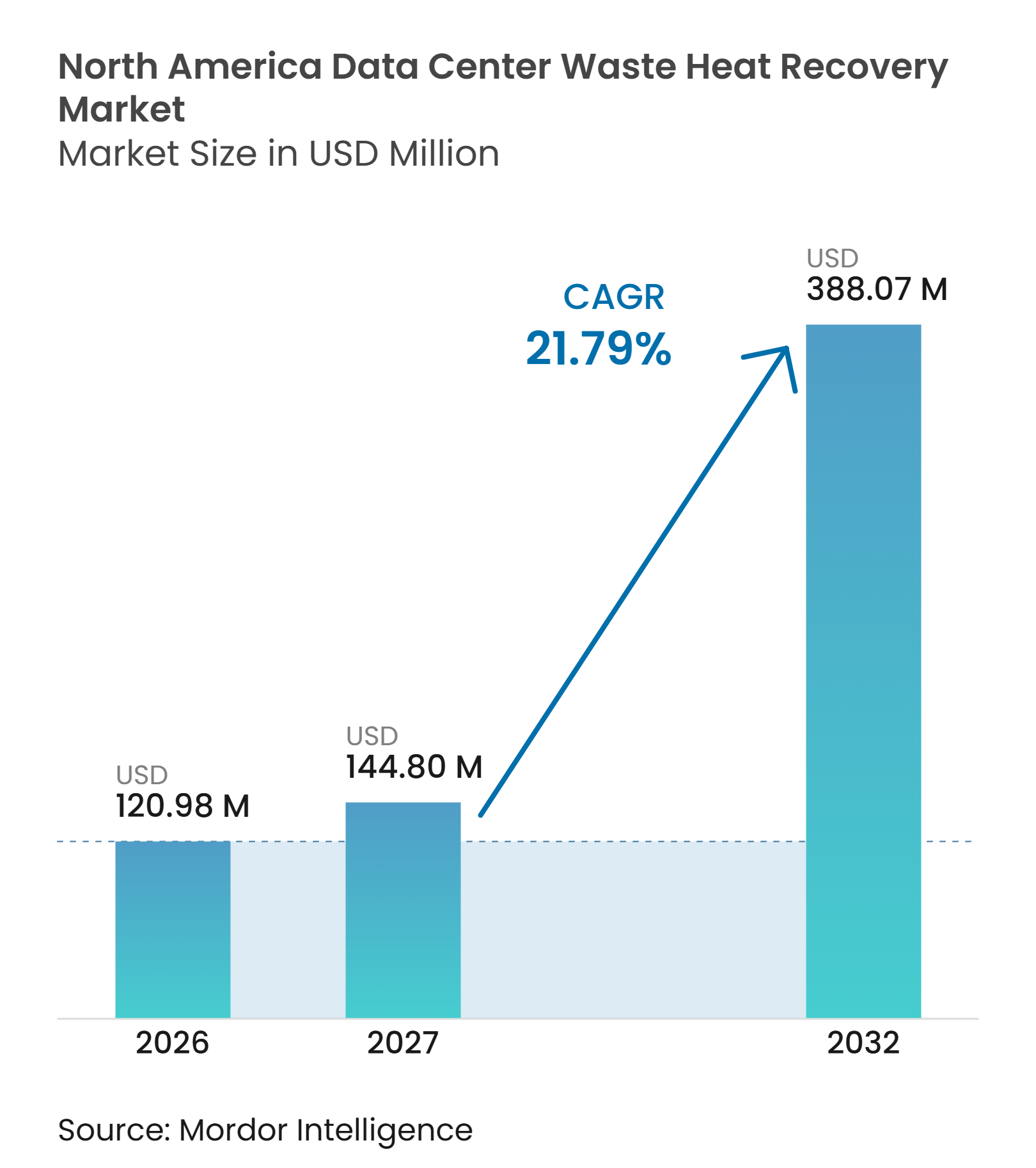
| Base Year Market Size (2026) | USD 120.98 Million |
| Market Size (2027) | USD 144.80 Million |
| Market Size (2032) | USD 388.07 Million |
| Growth Rate (2027 - 2032) | 21.79 % |
| Market Concentration | Medium |
Major Players *Disclaimer: Major Players sorted in no particular order Image © Mordor Intelligence. Reuse requires attribution under CC BY 4.0. | |
North America Data Center Waste Heat Recovery Market Analysis by Mordor Intelligence
The North America data center waste heat recovery market size is projected to expand from USD 120.98 million in 2026 to USD 388.07 million by 2032, registering a CAGR of 21.79% between 2027 and 2032. AI and high-performance computing campuses are concentrating larger thermal loads in Virginia, Texas, Quebec, and Alberta. Liquid-cooled racks can release heat at 45-80°C, which is compatible with lower-temperature district heating systems and makes recovery more practical at new sites. The North America data center waste heat recovery market benefits when operators plan cooling, storage, and heat delivery together, rather than treating recovered heat as a separate retrofit. State and provincial reporting programs are making heat-reuse readiness more relevant to site selection and project design. Commercial opportunities remain strongest where a large data center sits close to a steady thermal user and a utility can recognize recovered heat as a system resource.
Key Report Takeaways
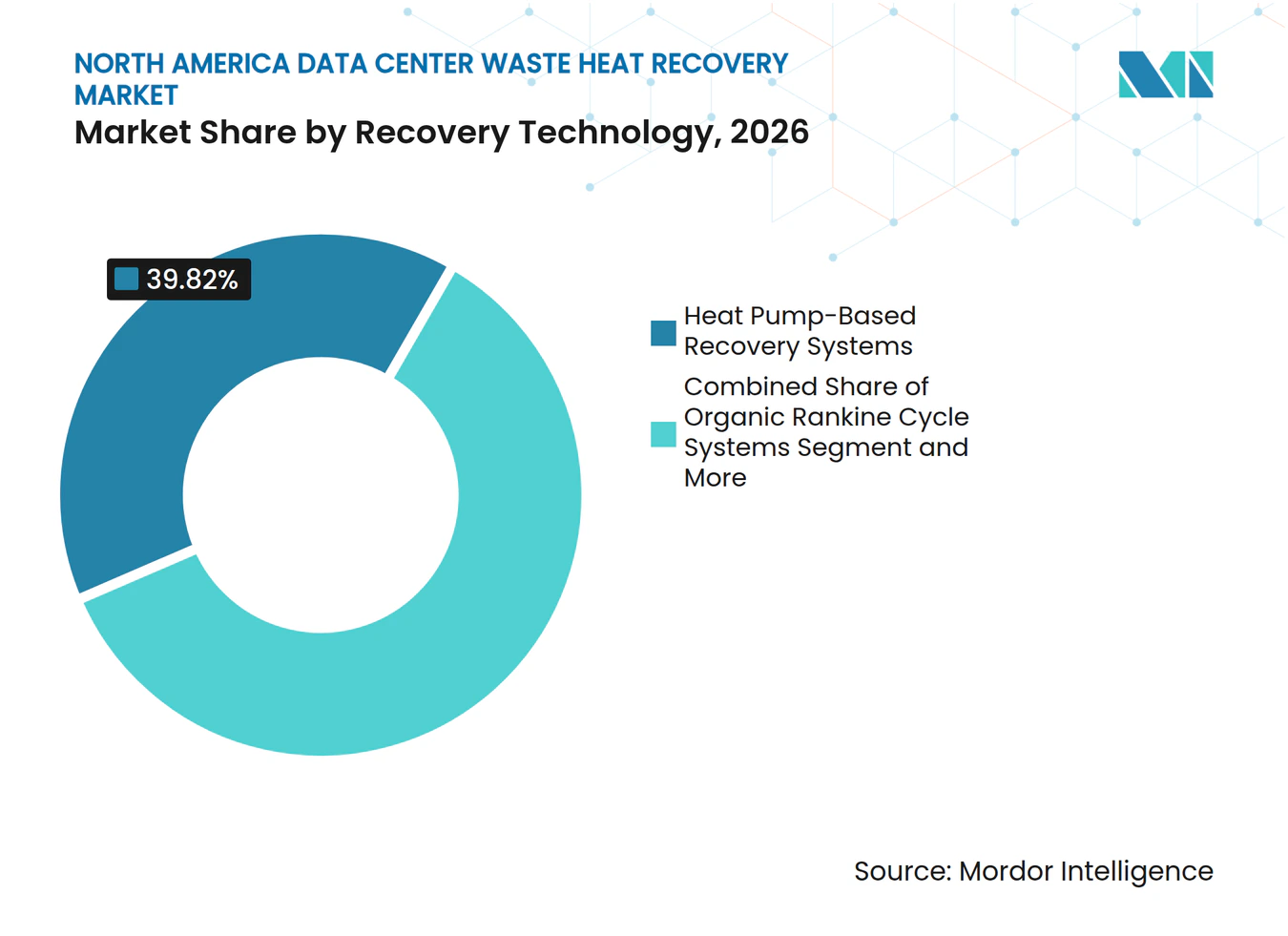
- By recovery technology, heat pump-based systems held 39.82% of revenue in 2026, while thermal energy storage-integrated systems are projected to expand at a 28.42% CAGR through 2032.
- In heat reuse applications, commercial and residential building heating accounted for 31.64% of revenue in 2026, while greenhouse and agricultural heating is expected to grow at a 29.64% CAGR through 2032.
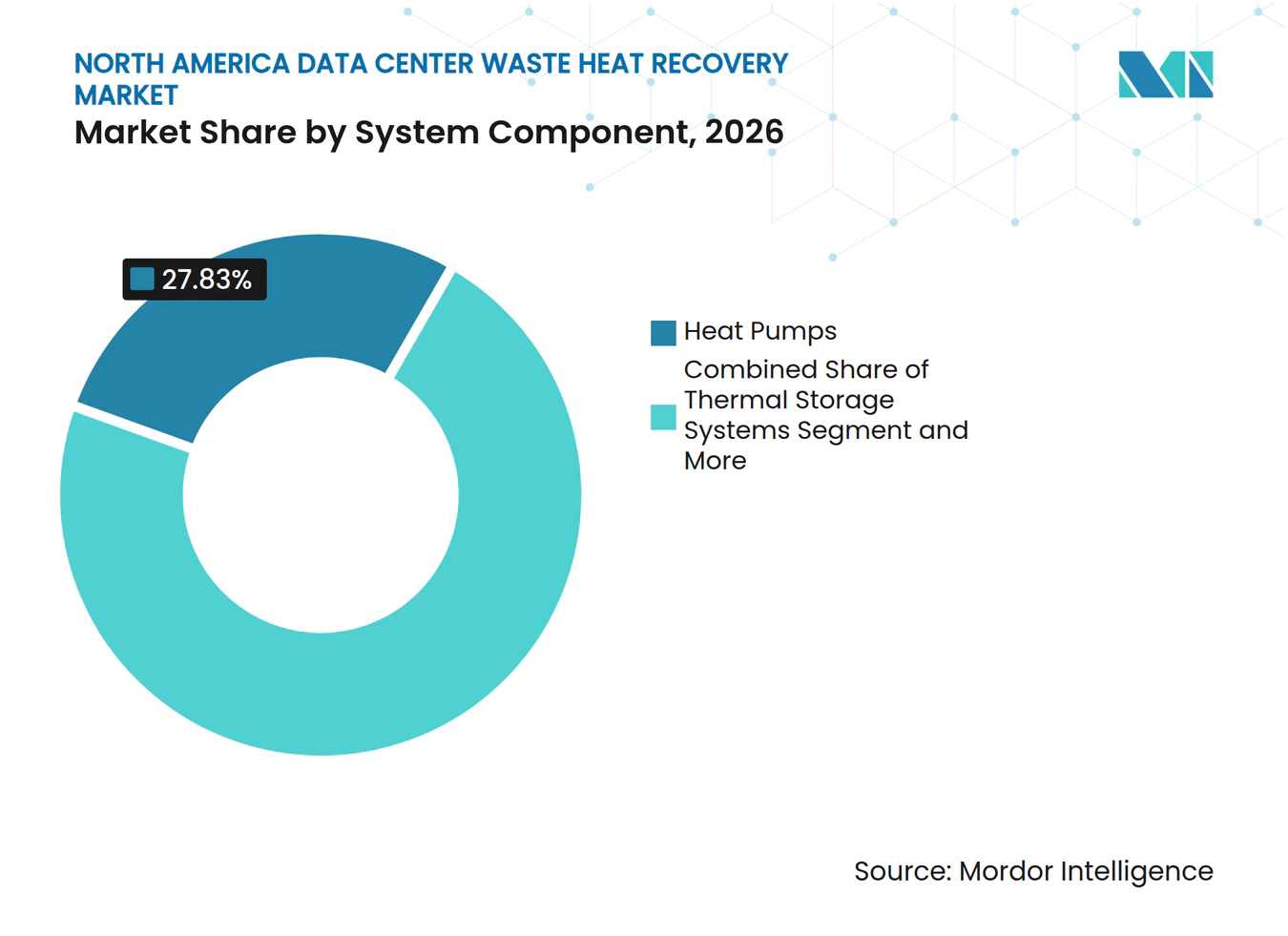
- By system component, heat pumps accounted for 27.83% of revenue in 2026, while thermal storage systems are projected to grow at a 28.17% CAGR through 2032.
- By heat delivery model, on-site heat reuse captured 39.72% of revenue in 2026, while district heating network offtake is expected to advance at a 27.22% CAGR through 2032.
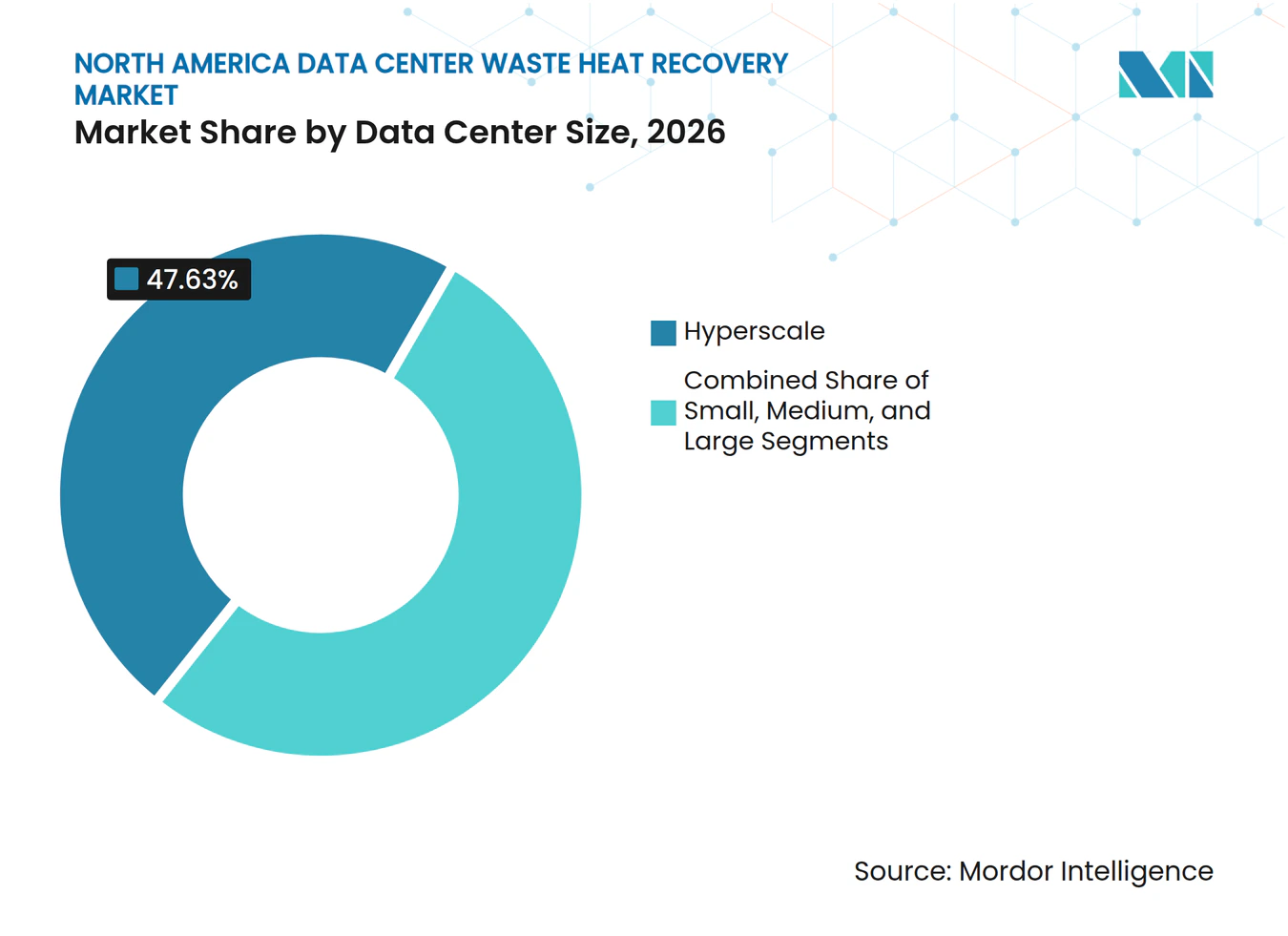
- By data center size, hyperscale facilities accounted for 47.63% of the North America data center waste heat recovery market in 2026 and are projected to expand at a 24.43% CAGR through 2032.
- By data center type, cloud service providers held 48.37% of revenue in 2026, while colocation operators are expected to advance at a 25.15% CAGR through 2032.
- By geography, the United States held 82.12% of revenue in 2026, while Canada is projected to expand at a 25.41% CAGR through 2032.
Note: Market numbers in this report are based on Mordor Intelligence's proprietary estimation framework, which combines nine months of actuals with Q4 projections for base year 2026.
Market Trends and Insights
Drivers Impact Analysis of North America Data Center Waste Heat Recovery Market*
| Driver | (~) % Impact on CAGR Forecast | Geographic Relevance | Impact Timeline |
|---|---|---|---|
| US and Canadian AI/HPC Hyperscale Build-Out | +7.0% | United States, including Virginia, Texas, and Arizona, and Canada, including Quebec, Alberta, and Ontario | Short term (≤ 2 years) |
| North American Liquid-Cooling and Heat-Reuse Supply-Chain Maturity | +5.5% | United States and Canada, with spill-over to Mexico | Short term (≤ 2 years) |
| State and Provincial Heat-Reuse Reporting and Incentive Programs | +3.4% | United States, including Virginia and New York, and Canada, including Quebec and British Columbia | Medium term (2-4 years) |
| Cold-Climate and Low-Carbon Grid Economics | +2.0% | Canada, including Quebec, British Columbia, Alberta, and Ontario, and northern United States | Medium term (2-4 years) |
| Utility Grid-Relief Value From Recovered Heat | +1.7% | United States, including Virginia, New York, and Texas, and Canada | Medium term (2-4 years) |
| North American Heat-Offtake Demonstration Projects | +1.2% | United States, including North Dakota, Michigan, Ohio, and Virginia, and Canada, including Manitoba and Quebec | Long term (≥ 4 years) |
| Source: Mordor Intelligence | |||
US and Canadian AI and HPC Hyperscale Build-Out
AI workloads are increasing thermal density, which supports viable heat recovery at large campuses. The IEA 4E program projects global data center electricity consumption will reach 945 TWh by 2030, and its work identifies liquid cooling as a key response to denser computing equipment.[1] Liquid-cooled AI racks can produce heat at 45-80°C, which can be supplied to fourth-generation district heating networks without the high-temperature requirements of steam systems. Hyperscale facilities accounted for 47.63% of the North America data center waste heat recovery market in 2026 and are projected to grow at a 24.43% CAGR through 2032. Canadian AI compute policy and new campus investment are concentrating high-density workloads in provinces where low-carbon power and cold weather improve the economics of thermal reuse. Lawrence Berkeley National Laboratory reported that data centers could account for up to 12% of United States electricity demand by 2028, up from 4.4% in 2023, increasing the incentive for utilities to examine recovered heat as a grid resource.[2]
North American Liquid-Cooling and Heat-Reuse Supply-Chain Maturity
The North America data center waste heat recovery market is supported by wider availability of liquid cooling equipment, heat exchangers, controls, and thermal interfaces. The American Council for an Energy-Efficient Economy reported that high-temperature direct liquid cooling can reduce heat-recovery capital expenditure by 75% at 1 MW and by 78% at 10 MW when compared with air-cooled retrofit baselines.[3] The IEA 4E program found that 61% of data center operators were considering liquid cooling, as graphics processing unit thermal design power moved beyond 600 W per chip IEA-4E.ORG. Trane Technologies and NVIDIA published an Open Compute Project reference design in 2025 that specified interfaces for delivering 60-80°C heat to external loops. Vertiv introduced CoolLoop in 2025 with coolant temperatures up to 60°C, while Alfa Laval launched FreeWaterLoop in 2026 as an integrated liquid-cooling system. These products reduce integration work for operators who want to reserve the option to sell or reuse heat later.
State and Provincial Heat-Reuse Reporting and Incentive Programs
Policy activity is making heat recovery a planning matter rather than a voluntary addition after construction. Virginia Senate Bill 1353 produced the 2026 RD661 feasibility report, which described technical routes and institutional barriers for using data center heat.[4] New York Assembly Bill A09136, pending in October 2026, would require thermal energy networks for new data centers exceeding 1 MW after January 1, 2027. NYSERDA's DATA-HEAT report outlines an approach to linking data centers and district energy systems. These measures favor new facilities that incorporate heat-recovery connections before site layouts, contracts, and cooling choices become fixed. Operators can then assess heat delivery requirements before the facility enters construction.
Cold-Climate and Low-Carbon Grid Economics
Canada offers a favorable setting for the North America data center waste heat recovery market because cold weather raises heating demand and supports efficient cooling. More than 80% of Canadian electricity generation came from non-emitting sources, according to the Canada Energy Regulator. A 2026 Applied Thermal Engineering study found that using data center cooling-loop water with residential air-source heat pumps improved seasonal coefficient of performance by 8.5% in Vancouver and by up to 55% in Edmonton. The study reported a seasonal coefficient of performance of 3.0 across the 4 Canadian cities assessed, with internal rates of return of 27-49% and payback periods of 2.3-4.4 years. University of Calgary research estimated annual fuel savings of CAD 65,280, USD 46,870, per MW of IT load in Alberta when recovered heat displaced natural gas for space heating. These conditions give Canadian projects a larger potential heating load and a lower emissions burden from heat pump operation.
Restraints Impact Analysis of North America Data Center Waste Heat Recovery Market*
| Restraint | (~) % Impact on CAGR Forecast | Geographic Relevance | Impact Timeline |
|---|---|---|---|
| Steam-Based District-Heating Limits in Major US Cities | -2.4% | United States, including New York City, Boston, and Chicago | Medium term (2-4 years) |
| Data Center Siting Away From Dense Thermal Loads | -1.8% | United States, including Virginia exurbs, Texas, Arizona, and North Dakota, and Canada, including Alberta | Medium term (2-4 years) |
| Mission-Critical Time-to-Market and Retrofit Aversion | -1.2% | United States and Canada | Short term (≤ 2 years) |
| Fragmented State, Provincial, and Municipal Rules | -0.9% | North America | Long term (≥ 4 years) |
| Source: Mordor Intelligence | |||
Steam-Based District-Heating Limits in Major US Cities
Legacy steam systems limit how quickly recovered data center heat can enter district networks in major cities across the United States. Con Edison's New York City steam network has 105 miles of piping and operates above 100°C, creating a demanding temperature requirement for low-grade heat. Conventional air-cooled facilities typically reject heat at 25-45°C, whereas liquid-cooled sites at 45-80°C often require heat pumps to support a steam network. NYSERDA stated that steam systems need boiler-feedwater preheating and eventual hot-water conversion for meaningful data center heat integration. Con Edison's Chelsea thermal energy network pilot uses a parallel hot-water circuit, but this arrangement limits the buildings and temperatures it can serve. New York City's Local Law 97 adds pressure to move away from district steam, yet the pace of conversion complicates long-duration offtake agreements.
Data Center Siting Away From Dense Thermal Loads
The distance between data centers and heat users remains a major barrier to the North America data center waste-heat recovery market. Virginia's RD661 report noted that data centers are often located in commercial or industrial parks away from residential and institutional heat users. NYSERDA also noted that large loads can be located far from concentrated heating demand, making off-site thermal transport difficult. The Open Compute Project identified proximity to heat users as a central constraint on the feasibility of heat reuse. Each additional mile of insulated pipe increases the capital requirement and reduces the value of potential heat revenue. Operators also hesitate to add project complexity when rapid delivery is critical for a new mission-critical campus.
*Our forecasts treat driver/restraint impacts as directional, not additive. The impact forecasts reflect baseline growth, mix effects, and variable interactions.
North America Data Center Waste Heat Recovery Market Segment Analysis
By Recovery Technology:
Heat Pumps Lead, Storage Systems AccelerateHeat pump-based systems accounted for 39.82% of the North America data center waste heat recovery market share in 2026. They raise low-temperature waste heat to the level needed by a building loop or district network. The University of Reading study found integrated heat pump systems achieved a coefficient of performance of 3.0 across 4 Canadian cities. It also reported internal rates of return of 27-49% and payback periods of 2.3-4.4 years. Direct heat-exchange and heat-recovery chillers suit facilities where liquid cooling already produces heat that can be used without a large temperature lift. Organic Rankine Cycle equipment remains a specialized option when operators have no practical thermal offtake.
Thermal energy storage-integrated systems are projected to advance at a 28.42% CAGR through 2032. Storage can hold thermal energy until heating demand is available and can reduce the mismatch between continuous server loads and seasonal space-heating needs. Stanford University modeling found that reservoir thermal energy storage for data center cooling in northern Virginia could reduce grid investment needs by USD 349-746 million per 1,000 MW of new load. This utility value can support more durable offtake pricing structures. The North America data center waste heat recovery industry therefore has reason to treat storage as an operating asset, not only as a buffer tank. Its uptake will depend on utility tariffs, land access, and the ability to coordinate cooling and heating operations.



By Heat Reuse Application:
Greenhouse Agriculture Emerges as the Fastest-Growing OfftakeCommercial and residential building heating represented 31.64% of revenue in 2026. Hot-water district networks in Toronto, Seattle, and Washington, DC can accept lower-temperature heat with fewer modifications than high-temperature steam systems. Industrial process heating and domestic hot water can provide steadier demand than seasonal space heating. Their year-round demand profile improves the financing case for a heat-recovery connection. Building projects are still sensitive to the physical distance between the data center and the customer. Existing network connections can therefore be more decisive than the total available heat load.
Greenhouse and agricultural heating is projected to advance at a 29.64% CAGR through 2032. The Legendary Harvest Project was launched in North Dakota in 2026 to assess a Farm Park model that colocates greenhouses with data center heat. QScale's Lévis project also pairs AI-ready capacity with a waste-heat recovery system intended for greenhouse applications. These settings can use a continuous heat supply from the data center throughout the year. Heating can account for 60-70% of annual operating expenses for Canadian greenhouse operators, creating a practical commercial reason to consider this model. Its wider adoption will depend on greenhouse siting, reliable water and power services, and operating agreements that match agricultural and data center needs.
By System Component:
Controls and Storage Drive the Next Investment WaveHeat pumps held 27.83% of system component revenue in 2026. They are the main devices used to raise data center outlet temperatures before heat enters a district network or building system. Johnson Controls, Danfoss, Mayekawa, and Oilon offer industrial packages that use natural refrigerants such as ammonia and CO₂. This can reduce exposure to changing rules for fluorinated gases. Heat exchangers from Alfa Laval, Kelvion, and SWEP connect facility cooling loops to heat delivery circuits. Pumps and thermal distribution equipment complete the hydraulic path between the source and the heat user.
Thermal storage systems are projected to advance at a 28.17% CAGR through 2032. They provide flexibility when server heat production and customer demand do not align. Controls, sensors, supervisory control and data acquisition systems, and building energy management integrations add a measurement layer for billing and remote diagnostics. These systems enable data-center operators to document thermal delivery across multi-site agreements. Schneider Electric and McKinstry are integrating storage controls with data center platforms to support demand response and utility price signals. The North America data center waste heat recovery market also depends on these controls to establish trustworthy service data for offtake contracts.

By Heat Delivery Model:
District Heating Offtake Gains Momentum Despite Higher ComplexityOn-site heat reuse accounted for 39.72% of revenue in 2026. It is usually easier to manage because the operator keeps the heat within a facility boundary. Common uses include space conditioning, domestic hot water preheating, and server preconditioning in cold climates. This model has a lower regulatory burden than an external utility connection. It also avoids the cost and time required to build a long thermal pipeline. Its limitation is that on-site thermal demand may not be large enough to use all available heat.
District heating network offtake is projected to advance at a 27.22% CAGR through 2032. District utilities in Quebec, Ontario, and Washington State are beginning to consider data center heat as a controllable thermal resource. NYSERDA noted that, without policy requiring heat reuse, the economics of district heating offtake can favor the utility over the data center operator. Incentive programs and standard contract structures can narrow that imbalance. Direct off-site supply to one nearby building can offer a middle path between on-site use and utility-scale delivery. The North America data center waste heat recovery market will need clear metering, responsibility, and pricing terms to make these arrangements repeatable.
By Data Center Size:
Hyperscale Anchors Volume and GrowthHyperscale facilities accounted for 47.63% of revenue in 2026 and are projected to grow at a 24.43% CAGR through 2032. Their large and concentrated heat loads can justify dedicated pipeline and storage infrastructure. A 100-500 MW campus can produce a far larger usable thermal stream than a 1-5 MW edge facility. Microsoft, Google, and Amazon Web Services are incorporating heat-recovery specifications into new campus planning in Virginia and Quebec. These decisions also respond to customer requests for more complete operational emissions reporting. Large facilities in the 10-100 MW range can be viable when a nearby anchor heat user is available.
Small and medium sites are more likely to use heat within their own buildings. Domestic hot water preheating and facility space heating offer simpler options for these locations. Their heat volume rarely supports the fixed cost of a long off-site connection. This makes a local building load important during site assessment. Hyperscale projects remain central to the North America data center waste heat recovery market because their capacity can support dedicated district-scale infrastructure. The development pipeline for AI campuses can therefore shape both the volume and the geographic pattern of future heat-reuse projects.
By Data Center Type:
Cloud Service Providers Lead, Colocation Advances QuicklyCloud service providers accounted for 48.37% of revenue in 2026. They operate many of the largest AI training campuses and can fund cooling and heat-recovery infrastructure over a long investment horizon. Their liquid-cooled designs create a clearer starting point for thermal reuse. Multi-year offtake contracts can also fit their long-term ownership and operating models. This position gives cloud operators influence over design practices across the North America data center waste-heat recovery industry. Enterprise and edge sites tend to be smaller and may favor direct supply to nearby buildings.
Colocation operators are projected to advance at a 25.15% CAGR through 2032. Their enterprise customers increasingly request sustainability reporting for operational emissions. Heat recovery can help a colocation provider distinguish its facilities in leasing discussions. Enwave's Markham District Energy arrangement in Ontario connected thermal output from an Equinix Markham campus to a regulated district utility. The ITU-T L.1328 standard offers a voluntary framework for assessing data center energy efficiency and can support more consistent reporting. These features make colocation sites an important test case for repeatable heat-offtake contracts.
Geography Analysis
United States: The Scale Engine for Heat Recovery
The United States held an 82.12% market share in the North America data center waste heat recovery market in 2026. Its large hyperscale and colocation base supports the region's broadest pipeline of potential heat sources. Virginia Senate Bill 1353 and the 2026 RD661 report examined the feasibility of heat reuse statewide and recommended planning approaches that place future facilities near industrial and agricultural heat users. Stanford and Princeton modeling found that thermal storage for data center cooling in northern Virginia could reduce grid investment costs by USD 349-746 million per 1,000 MW of new load. New York's pending A09136 bill would require thermal energy networks at new data centers above 1 MW after January 1, 2027.[5] Con Edison's Chelsea thermal energy network pilot shows a practical path around the technical constraints of a legacy steam network. The Great Lakes region is also drawing attention through projects such as Deep Green's proposed Lansing data center, which is designed to supply heat to the local district system.
Canada: Cold-Climate Economics Support Faster Expansion
Canada is projected to advance at a 25.41% CAGR through 2032. Cold weather and low-carbon electricity improve the use case for heat pumps and create more seasonal heating demand. The Canada Energy Regulator reported that more than 80% of national electricity generation was non-emitting. The University of Reading study found an 8.5% improvement in seasonal heat-pump performance in Vancouver and up to a 55% improvement in Edmonton when data center cooling-loop water was used. QScale began construction of Q01-Building-B in Lévis in June 2026, a CAD 700 million (USD 503 million) investment that adds 60 MW of AI-ready capacity with integrated heat recovery. These projects show how grid composition, climate, and land-use planning can align around a shared heat load.
Mexico and Emerging Continental Corridors
Mexico has a developing opportunity in the North America data center waste-heat recovery market, but warm weather limits building heating demand in Mexico City, Querétaro, Monterrey, and Guadalajara. Nearshoring is driving edge-computing demand from United States manufacturers and may create industrial process heat and commercial hot water opportunities. District energy infrastructure remains limited, which constrains near-term use of recovered heat. A potential hyperscale development in the Mexico City metropolitan area could support a pilot if it is co-located with a manufacturing tenant that needs low-temperature heat. Comisión Federal de Electricidad has not established data center heat-recovery reporting requirements, unlike evolving frameworks in Virginia and New York. The Pacific Northwest offers a different setting because major campuses in Washington State are near existing district energy infrastructure. Michigan's Great Lakes corridor also combines a cool climate with potential thermal users, which makes it a useful secondary area for project development.
Competitive Landscape
Market Concentration
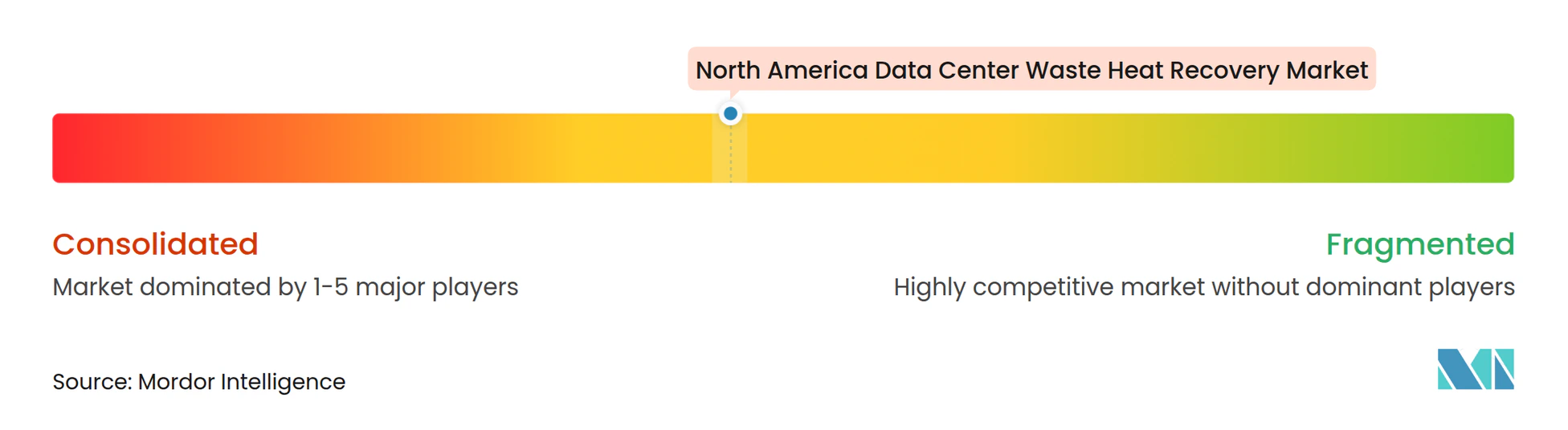
The North America data center waste heat recovery market is moderately fragmented. Thermal equipment manufacturers, cooling specialists, district energy operators, and data center owners each hold different roles in the heat value chain. Johnson Controls, Trane Technologies, Carrier Global, and Danfoss compete in the integrated thermal systems market. Trane's 2025 Open Compute Project reference design with NVIDIA set out standardized heat-reuse interfaces for liquid-cooled AI equipment. Alfa Laval launched FreeWaterLoop in March 2026, combining heat exchangers, pumps, and filtration in a modular external cooling system. These steps aim to reduce integration risk for large facilities that may connect to a heat user.
Vertiv, Schneider Electric, Kelvion, and SWEP focus on equipment across the server and facility thermal chain. Mayekawa and Oilon supply high-temperature heat pump packages that use natural refrigerants. Enwave and Veolia are active in integrated models that combine cooling assets with heat delivery networks. McKinstry and QScale also provide engineering and development capability around planned heat-reuse projects. Enwave's Ontario arrangement with a Markham colocation campus illustrates a contract model that links a data center to a regulated district utility. Such projects require clear allocation of capital cost, temperature performance, and operating responsibility.
Software and controls are becoming more relevant as operators need real-time thermal measurement, pricing data, and maintenance oversight. ITU-T L.1328 provides an energy-efficiency assessment framework that can support comparable reporting by data center operators. Vendors with documented heat-recovery performance may be better placed as state disclosure rules develop. Established manufacturers retain advantages in equipment scale and service networks. Specialized providers can compete by structuring long-term heat-offtake contracts and combining storage, controls, and local delivery infrastructure. The competitive field remains varied because no single supplier controls the full thermal chain or the necessary local utility relationship.
Recent Industry Developments in North America Data Center Waste Heat Recovery Market
- August 2026: AirJoule Technologies and the Net Zero Innovation Hub for Data Centers announced a collaboration to deploy AirJoule Prime heat-to-water systems at commercial data center member sites, converting low-grade waste heat into atmospheric water for resource-efficient facility operations.
- June 2026: QScale began construction of Q01-Building-B at its Lévis, Quebec campus, a CAD 700 million, USD 503 million, investment adding 60 MW of AI-ready, liquid-cooled capacity with an integrated waste-heat recovery system targeting greenhouse agricultural applications, running on Quebec's hydro-dominated low-carbon grid.
- January 2026: Alfa Laval launched FreeWaterLoop, a fully integrated external liquid-based cooling system for data center facility loops, combining heat exchanger technology, pump engineering, and filtration in a single modular unit designed to enable heat recovery readiness at high-density AI campuses.
- January 2026: Sapphire Technologies partnered with Anax Power to deploy a FreeSpin In-line Turboexpander system at a co-located data center, converting excess pipeline pressure into emission-free power and cooling, with commissioning expected by the end of 2026.
North America Data Center Waste Heat Recovery Market Report Scope
The North America Data Center Waste Heat Recovery Market covers the equipment, technologies, engineering solutions, and associated implementation services used to capture, upgrade, transfer, store, and reuse excess thermal energy generated by data center operations across the United States, Canada, and Mexico. The market includes Heat Pump-Based Recovery Systems, Direct Heat Exchange Systems, Heat Recovery Chiller Systems, Thermal Energy Storage-Integrated Recovery Systems, Organic Rankine Cycle Systems, and Other Waste Heat Recovery Technologies. These solutions encompass heat extraction from air-cooled and liquid-cooled data center infrastructure, temperature upgrading through industrial heat pumps, thermal energy storage, heat transfer and distribution, automated thermal controls, and integration with district heating networks, commercial and residential buildings, industrial facilities, and agricultural applications. Market revenue includes heat recovery equipment sales, system integration, engineering and installation services, and directly associated project implementation charges, while excluding conventional data center cooling systems without heat recovery functionality, standalone district heating infrastructure unrelated to data center heat reuse, electricity and thermal energy sales, and ongoing facility operating expenses not directly attributable to waste heat recovery systems.
The North America Data Center Waste Heat Recovery Market Report is segmented by Recovery Technology (Heat Pump-Based Recovery Systems, Direct Heat Exchange Systems, Heat Recovery Chiller Systems, Thermal Energy Storage-Integrated Recovery Systems, Organic Rankine Cycle Systems, and Other Waste Heat Recovery Technologies), Heat Reuse Application (District Heating; Commercial and Residential Building Heating; Industrial Process Heating; Domestic Hot Water; Greenhouse and Agricultural Heating; and Other Heat Reuse Applications), System Component (Heat Exchangers, Heat Pumps, Pumps and Thermal Distribution Systems, Thermal Storage Systems, Heat Recovery Controls and Monitoring, Piping and Heat Transfer Infrastructure, and Other Equipment, Engineering and Installation), Heat Delivery Model (On-Site Heat Reuse, Direct Off-Site Heat Supply, and District Heating Network Offtake), Data Center Size (Small, Medium, Large, and Hyperscale), Data Center Type (Colocation, Cloud Service Providers, and Enterprise and Edge), and Geography (United States, Canada, and Mexico). Market sizes and forecasts are presented in value terms (USD).
Segmentation Overview
| Heat Pump-Based Recovery Systems |
| Direct Heat Exchange Systems |
| Heat Recovery Chiller Systems |
| Thermal Energy Storage-Integrated Recovery Systems |
| Organic Rankine Cycle Systems |
| Other Waste Heat Recovery Technologies |
| District Heating |
| Commercial and Residential Building Heating |
| Industrial Process Heating |
| Domestic Hot Water |
| Greenhouse and Agricultural Heating |
| Other Heat Reuse Applications |
| Heat Exchangers |
| Heat Pumps |
| Pumps and Thermal Distribution Systems |
| Thermal Storage Systems |
| Heat Recovery Controls and Monitoring |
| Piping and Heat Transfer Infrastructure |
| Other Equipment, Engineering and Installation |
| On-Site Heat Reuse |
| Direct Off-Site Heat Supply |
| District Heating Network Offtake |
| Small |
| Medium |
| Large |
| Hyperscale |
| Colocation |
| Cloud Service Providers (CSPs) |
| Enterprise & Edge |
| United States |
| Canada |
| Mexico |
| By Recovery Technology | Heat Pump-Based Recovery Systems |
| Direct Heat Exchange Systems | |
| Heat Recovery Chiller Systems | |
| Thermal Energy Storage-Integrated Recovery Systems | |
| Organic Rankine Cycle Systems | |
| Other Waste Heat Recovery Technologies | |
| By Heat Reuse Application | District Heating |
| Commercial and Residential Building Heating | |
| Industrial Process Heating | |
| Domestic Hot Water | |
| Greenhouse and Agricultural Heating | |
| Other Heat Reuse Applications | |
| By System Component | Heat Exchangers |
| Heat Pumps | |
| Pumps and Thermal Distribution Systems | |
| Thermal Storage Systems | |
| Heat Recovery Controls and Monitoring | |
| Piping and Heat Transfer Infrastructure | |
| Other Equipment, Engineering and Installation | |
| By Heat Delivery Model | On-Site Heat Reuse |
| Direct Off-Site Heat Supply | |
| District Heating Network Offtake | |
| By Data Center Size | Small |
| Medium | |
| Large | |
| Hyperscale | |
| By Data Center Type | Colocation |
| Cloud Service Providers (CSPs) | |
| Enterprise & Edge | |
| By Geography | United States |
| Canada | |
| Mexico |
Key Questions Answered in the Report
What is the North America data center waste heat recovery market size?
The sector is valued at USD 120.98 million in 2026 and is forecast to reach USD 388.07 million by 2032, at a 21.79% CAGR from 2027 to 2032. The forecast reflects the expected addition of liquid-cooled AI capacity and more projects designed with a usable heat connection. It also assumes that project developers can secure practical heat users, enabling delivery infrastructure, and the commercial terms needed to turn recovered heat into a dependable local energy service.
What is driving data center heat recovery in North America?
AI and high-performance computing campuses are increasing thermal density, while liquid cooling, policy activity, and district energy connections are improving project feasibility. The opportunity is strongest where the data center, heat user, and delivery infrastructure are planned together from the outset. Cold locations with clean electricity can further improve the economics by lowering cooling demand, increasing local heating demand, and supporting more efficient heat pump operation.
Which recovery technology leads data center heat reuse?
Heat pump-based recovery systems held 39.82% of revenue in 2026. Thermal energy storage-integrated systems are expected to have the fastest expansion at a 28.42% CAGR through 2032 because storage can align continuous server heat with changing customer demand. Heat pumps are useful where a temperature increase is needed, while storage becomes important when the best time to recover heat differs from the best time to use it.
Which application is expected to expand fastest for recovered data center heat?
Greenhouse and agricultural heating is projected to advance at a 29.64% CAGR through 2032, supported by projects in North Dakota and Quebec. This application can use heat throughout the year and may reduce the fuel demand that otherwise supports greenhouse operations. The arrangement is most practical when greenhouse space is close enough to the data center to avoid a costly thermal transport connection.
Why is Canada important for data center heat recovery?
Canada is expected to advance at a 25.41% CAGR through 2032 because cold weather supports heating demand and more than 80% of its electricity generation is non-emitting. Its combination of climate, hydropower, and new AI capacity makes it a leading setting for integrated projects. Research cited in this report also found stronger seasonal heat-pump performance when data center cooling-loop water is available as a heat source.
What is the main obstacle to broader data center heat reuse?
Many large campuses are located away from concentrated heat demand, so the cost of insulated pipe and external delivery infrastructure can limit project economics. Steam-based urban district networks can also require heat pumps or network conversion before they can accept lower-temperature recovered heat. Project timing is another constraint because operators may resist changes that delay a new facility where rapid access to computing capacity is commercially important.