
North America Data Center Video Surveillance Market Size and Share
Market Overview
| Study Period | 2021 - 2032 |
|---|---|
| Forecast Data Period | 2027 - 2032 |
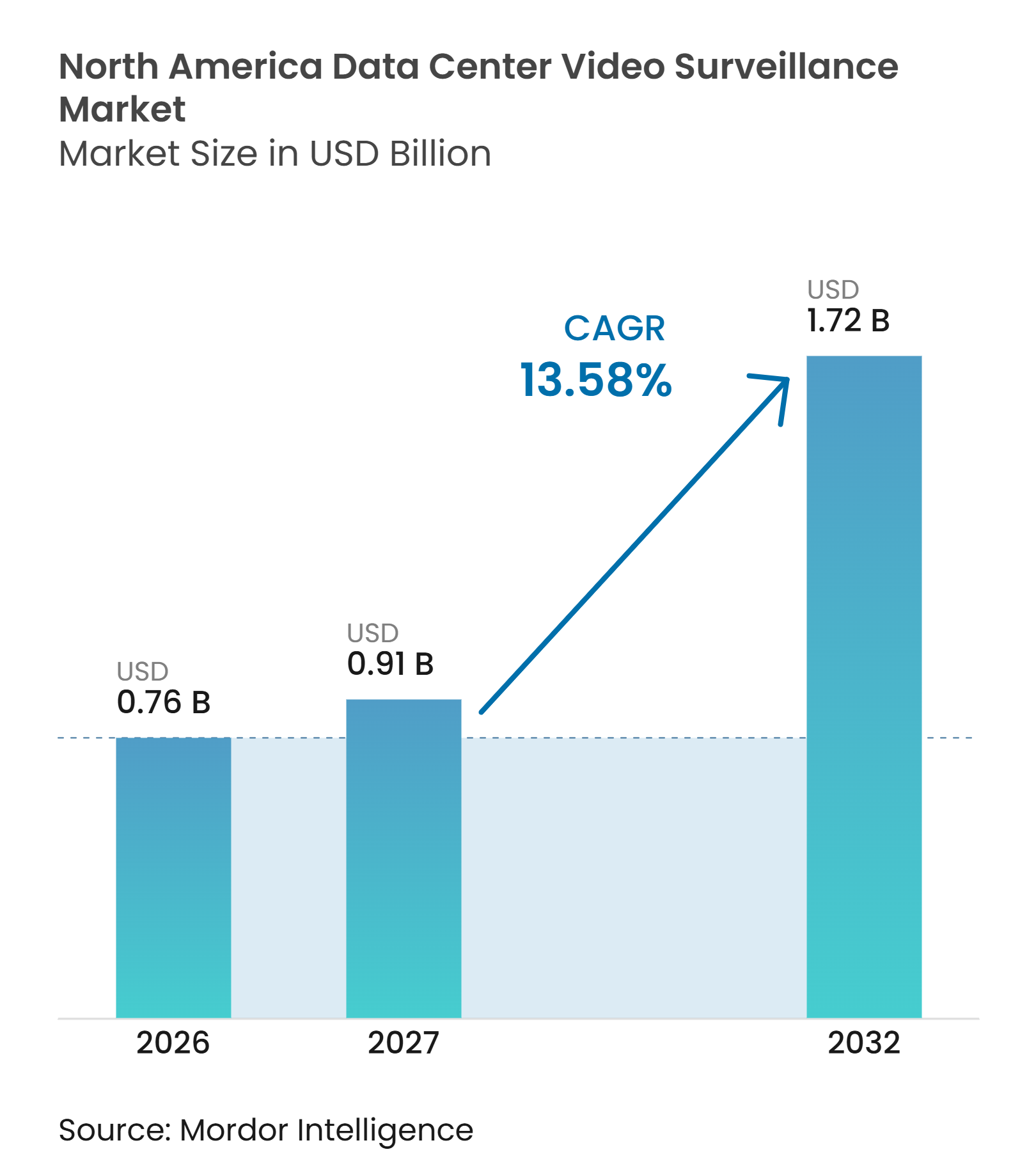
| Base Year Market Size (2026) | USD 0.76 Billion |
| Market Size (2027) | USD 0.91 Billion |
| Market Size (2032) | USD 1.72 Billion |
| Growth Rate (2027 - 2032) | 13.58 % |
| Market Concentration | Medium |
Major Players *Disclaimer: Major Players sorted in no particular order Image © Mordor Intelligence. Reuse requires attribution under CC BY 4.0. | |
North America Data Center Video Surveillance Market Analysis by Mordor Intelligence
The North America data center video surveillance market size is projected to expand from USD 0.76 billion in 2026 to USD 1.72 billion by 2032, registering a CAGR of 13.58% between 2027 and 2032. The North America data center video surveillance market is supported by record construction of hyperscale and colocation facilities, where physical security is planned with the wider campus design rather than added after opening. New projects need coverage across access points, data halls, loading areas, perimeter zones, and utility equipment. Higher values of AI hardware have also made video evidence, restricted access, and rapid incident response more important to operators. Procurement is shifting toward systems that connect cameras with access control, environmental data, and operating workflows. This shift gives integrated suppliers a stronger position in the North America data center video surveillance market, while cybersecurity and equipment compliance requirements lengthen some replacement decisions.
Key Report Takeaways
- By component, cameras and imaging hardware held 34.71% of the North America data center video surveillance market revenue share in 2026, while analytics and monitoring software is projected to expand at a 14.26% CAGR through 2032.
- By camera type, fixed cameras held a 63.28% share in 2026, while PTZ cameras are projected to expand at a 15.92% CAGR through 2032.
- By deployment model, cloud-based systems held a 59.78% share in 2026 and are projected to expand at a 16.39% CAGR through 2032.
- By application, perimeter and external area monitoring held a 26.54% share of the North America data center video surveillance market in 2026, while electrical and mechanical room monitoring is projected to expand at a 14.59% CAGR through 2032.
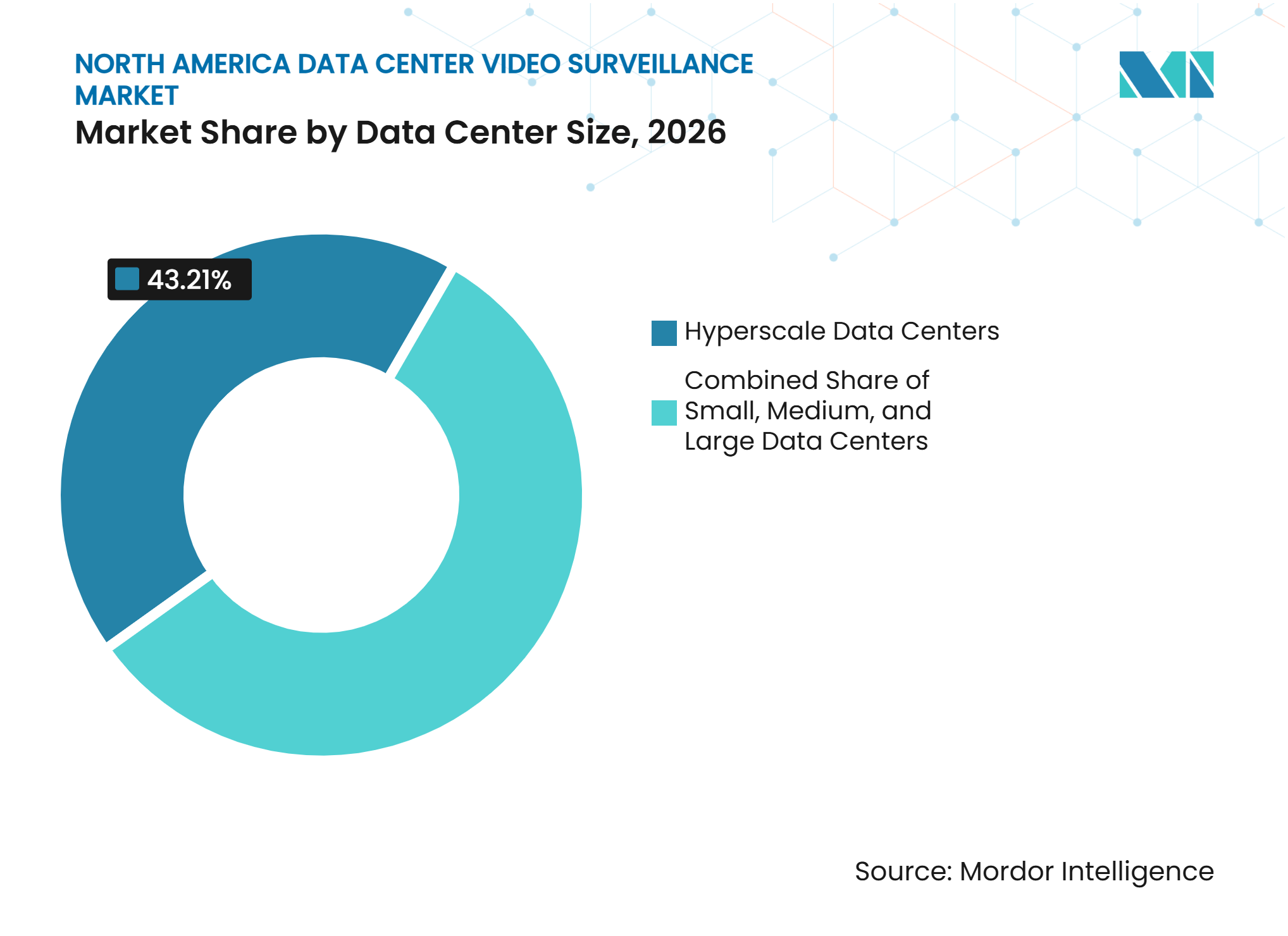
- By data center size, hyperscale facilities held a 43.21% share in 2026 and are projected to expand at a 15.27% CAGR through 2032.
- By data center type, colocation operators held a 36.64% share in 2026, while cloud service providers are projected to expand at a 15.38% CAGR through 2032.
- By geography, the United States held a 79.58% share of the North America data center video surveillance market in 2026, while Mexico is projected to expand at a 16.91% CAGR through 2032.
Note: Market numbers in this report are based on Mordor Intelligence's proprietary estimation framework, which combines nine months of actuals with Q4 projections for base year 2026.
Market Trends and Insights
Drivers Impact Analysis of North America Data Center Video Surveillance Market*
| Driver | (~) % Impact on CAGR Forecast | Geographic Relevance | Impact Timeline |
|---|---|---|---|
| Hyperscale and Colocation Campus Expansion | +4.2% | United States, Canada, Mexico | Medium term (2-4 years) |
| AI Workloads Increasing Physical Security Criticality | +3.1% | United States, Canada | Medium term (2-4 years) |
| Compliance-Driven Video Evidence and Auditability | +2.0% | United States, Canada | Short term (≤ 2 years) |
| Convergence of Video, Access Control, and Environmental Telemetry | +1.5% | United States, Canada, Mexico | Long term (≥ 4 years) |
| Edge Analytics Reducing Bandwidth and Response Latency | +1.0% | United States | Medium term (2-4 years) |
| Rack-Level and Thermal Monitoring Requirements | +0.7% | United States, Canada | Long term (≥ 4 years) |
| Source: Mordor Intelligence | |||
Hyperscale and Colocation Campus Expansion
The North America data center video surveillance market benefits directly from the large construction pipeline for new facilities. New campuses require layered coverage before they can support customer workloads or meet tenant security requirements. More than 80% of capacity under construction was already preleased in the first half of 2026, showing that security installations can be tied to confirmed projects rather than speculative capacity.[1] A hyperscale campus above 100 MW can need 500 or more cameras across external and internal security zones. Integrated contracts can exceed USD 5 million when cameras, video management software, analytics, and managed monitoring are delivered together. The 2025 construction pipeline also extended into newer locations, which broadens demand beyond the established data center hubs.
AI Workloads Increasing Physical Security Criticality
AI workloads increase the value of equipment housed inside data centers and raise the cost of physical intrusion or unauthorized observation. A single AI training rack can contain hardware worth more than USD 1 million, making rack access and facility visibility material security issues. The Security Industry Association identified siloed security systems and partners unfamiliar with data center needs as common facility resilience concerns.[2] Operators are therefore connecting access events with camera footage to identify unusual behavior as it occurs. This approach reduces dependence on manual review of video clips and supports faster responses. It also supports premium demand for analytics software in the North America data center video surveillance market.
Compliance-Driven Video Evidence and Auditability
Compliance requirements set a baseline for surveillance investment at many data centers. SOC 2 criteria require controlled physical access and monitoring for anomalies at physical barriers. ISO/IEC 27001:2022 includes requirements for protecting physical perimeters, secure areas, and physical security monitoring. PCI DSS v4.0.1 requires at least 3 months of video retention for entry points to cardholder data environments. Providers supporting federal workloads also need continuous video coverage and stronger access controls under FedRAMP requirements. These requirements increase demand for tamper detection, reliable audit trails, and video records that can be retrieved when needed.
Convergence of Video, Access Control, and Environmental Telemetry
The North America data center video surveillance market is moving toward systems that combine security and operations information. Thermal cameras at cooling equipment can identify unauthorized presence and detect temperature conditions that may indicate an equipment issue. Motorola Solutions presented its Operator platform in 2026 to connect video, access control, and sensor data in automated incident-response workflows.[3] Johnson Controls introduced C-CURE IQ 3.20 to bring access control, video management, and incident management into one web-based system. The company reported that 43% of organizations plan hybrid security architectures and 50% identify AI as a key physical security priority. Bundled systems can therefore compete for both security and operations budgets.
Restraints Impact Analysis of North America Data Center Video Surveillance Market*
| Restraint | (~) % Impact on CAGR Forecast | Geographic Relevance | Impact Timeline |
|---|---|---|---|
| Cybersecurity Exposure From Connected Cameras and VMS | -1.8% | United States, Canada | Short term (≤ 2 years) |
| Integration Cost Across Legacy CCTV, VMS, and BMS | -1.3% | United States, Canada | Medium term (2-4 years) |
| Biometric Privacy and Regulatory Fragmentation | -0.8% | United States, Canada | Short term (≤ 2 years) |
| Competing Capital Allocation for Power, Cooling, and Compute Capacity | -0.6% | United States, Canada, Mexico | Medium term (2-4 years) |
| Source: Mordor Intelligence | |||
Cybersecurity Exposure From Connected Cameras and VMS
Connected cameras and video management systems introduce a distinct cybersecurity risk for the North America data center video surveillance market. The Centre for Cybersecurity Belgium warned in September 2026 that threat actors were compromising internet-connected cameras for cyberespionage, botnet activity, and corporate network access. Check Point Research documented Iran-linked activity targeting flaws in Hikvision and Dahua products, including command injection and remote command execution vulnerabilities. A compromised device may expose facility layouts, access routines, and rack locations to an attacker. Operators are responding with encrypted video streams, secure hardware, firmware policies, and stricter device testing. These measures improve resilience but can increase equipment cost and extend purchasing cycles.
Integration Cost Across Legacy CCTV, VMS, and BMS
Many established colocation sites still use analog or early IP systems that were installed before 2020. Their migration to advanced analytics or cloud video management can require changes to networks, storage, operating procedures, and links with building management and access control systems. Projects can extend for 12 to 18 months when old infrastructure needs replacement or integration bridges. The Security Industry Association identified siloed systems as a major issue for data center security operations. Delays can widen the gap between legacy capabilities and the evidence requirements expected by current audits. This places some upgrade budgets into longer capital planning cycles and slows near-term installation revenue.
*Our forecasts treat driver/restraint impacts as directional, not additive. The impact forecasts reflect baseline growth, mix effects, and variable interactions.
North America Data Center Video Surveillance Market Segment Analysis
By Component:
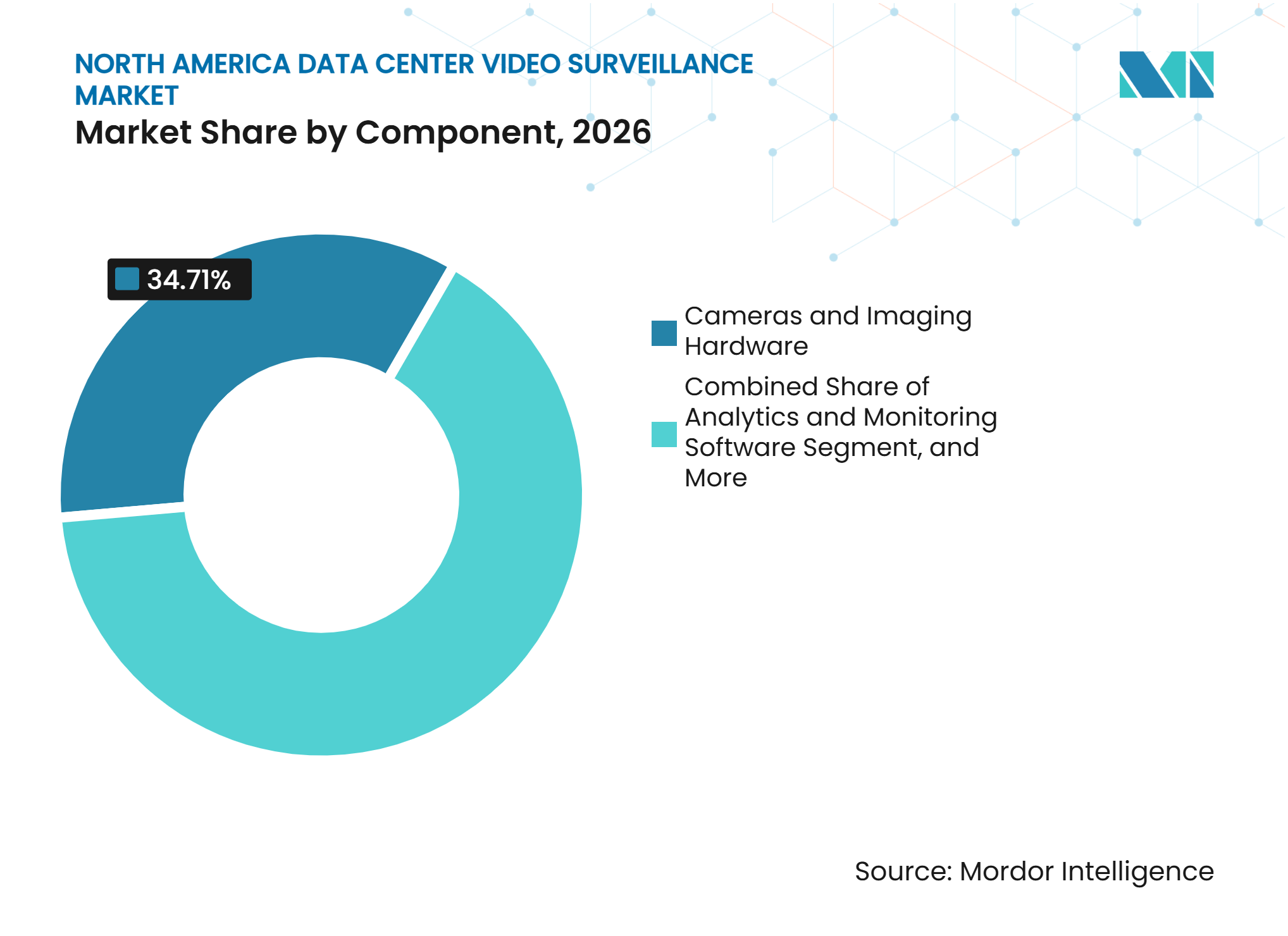
Hardware Revenue Leads While Analytics Software Expands FastestCameras and imaging hardware held 34.71% of the North America data center video surveillance market share in 2026. Initial campus deployments are capital intensive because operators commission hundreds of devices across separate security zones. These devices provide the core visual coverage for entrances, aisles, loading areas, utility equipment, and external boundaries. Video management systems bring feeds from multiple cameras and sites into a common operating interface. Storage and recording hardware faces pressure as cloud storage options become more widely used. Installation, integration, and support services remain important because specialist data center security skills are limited.
Analytics and monitoring software is projected to expand at a 14.26% CAGR through 2032. The segment benefits from demand for systems that identify behavioral anomalies without requiring teams to review large volumes of footage. AI-powered video analysis and cloud camera services support the use of software within surveillance deployments. Edge-enabled cameras can process information locally, which reduces the need to send continuous high-resolution footage to a central processor. Johnson Controls introduced exacqVision 26.2 with AI-driven event identification and fleet monitoring tools in 2026. These capabilities make software a larger part of surveillance value even when camera volumes remain central to a project.



By Camera Type:
Fixed Cameras Define Coverage While PTZ Supports Perimeter ResponseFixed cameras held 63.28% of the camera type segment in 2026. They are used across access corridors, server aisles, loading bays, entry points, and other areas that need continuous visual records. Fixed coverage supports compliance requirements because the device does not depend on active operator control. Their broad use also reflects the need to remove blind spots from facilities with many restricted areas. Data center operators can use these cameras to maintain a consistent evidence record across routine activity. This installed base keeps fixed devices central to the North America data center video surveillance market.
PTZ cameras are projected to expand at a 15.92% CAGR through 2032. They are particularly useful along perimeter lines because a steerable camera can track movement over a larger field of view. Analytics triggers can direct a PTZ camera toward a possible intrusion, which helps security teams validate alerts. Axis Communications introduced the AXIS P1486-LE in March 2026 with global-shutter technology and on-device ARTPEC-9 analytics for vehicle and license plate capture. Thermal cameras also serve perimeter detection and hot-aisle monitoring in low-light or complex environments. The AXIS Q2802-E combines thermal sensing, 4K visual imaging, and temperature alerts, which supports both security and operations needs.
By Deployment Model:
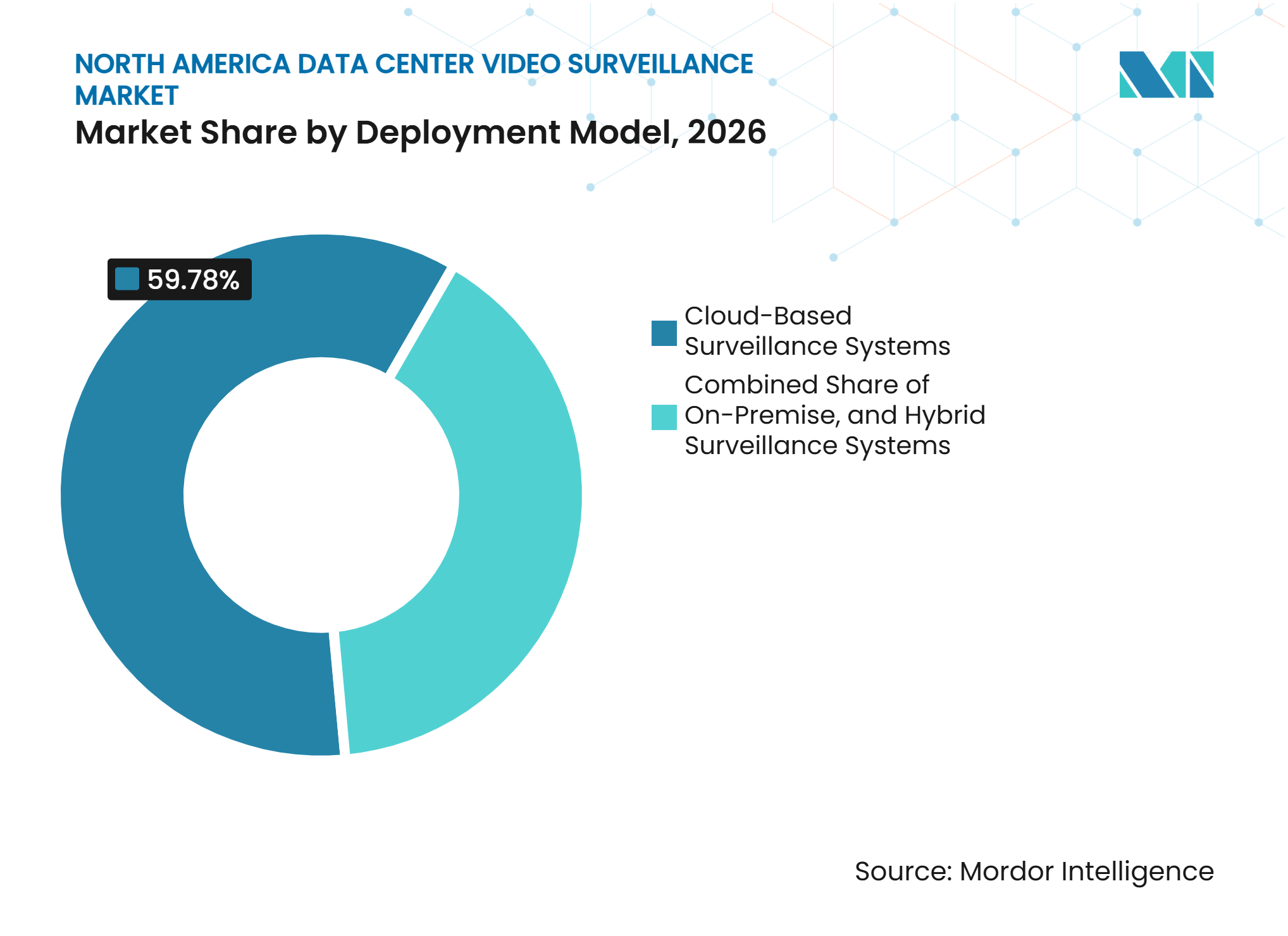
Cloud-Based Systems Lead Share and Projected ExpansionCloud-based systems accounted for 59.78% of the North America data center video surveillance market share in 2026. New hyperscale campuses can deploy cloud-native video management systems from the start of construction. This provides centralized oversight across dispersed facilities without requiring a separate video server at every location. Large operators can apply common policies and retain a shared view of activity across their sites. The leadership of cloud-based systems reflects the operating model of multi-site cloud and colocation providers. It also supports the transition from isolated camera installations to wider security platforms.
Cloud-based systems are projected to expand at a 16.39% CAGR through 2032. Operators use cloud systems to connect video data with analytics, access control, and other enterprise workflows. On-premise systems retain a role in facilities with air-gapped requirements or strict limits on external data transfer. Hybrid systems provide another option by keeping primary recording on-site while using cloud resources for analytics or storage. Eagle Eye Networks reported that customers increasingly assess individual workloads according to performance, cost, and data residency rather than selecting one architecture for every use case. This supports continued demand for cloud systems while preserving a practical place for hybrid designs.

By Application:
Perimeter Monitoring Leads While Equipment Room Coverage AcceleratesPerimeter and external area monitoring held 26.54% of the North America data center video surveillance market size in 2026. Hyperscale campuses need continuous coverage across fences, vehicle checkpoints, parking areas, and multiple external entrances. These locations often use fixed thermal devices for night detection and PTZ cameras for tracking. Layered coverage helps operators detect an event before it reaches a critical building area. It also creates visual evidence for investigations involving visitors, vehicles, or attempted intrusion. The large footprint of new campuses keeps perimeter monitoring the leading application.
Electrical and mechanical room monitoring is projected to expand at a 14.59% CAGR through 2032. Higher AI compute density makes power and cooling equipment more critical to uninterrupted service. Bispectral cameras can detect both an unauthorized person and a possible equipment overheating condition in UPS rooms or transformer yards. This enables a single system to support physical security and operational reliability. Data hall, loading bay, and remote-site surveillance are also gaining consistent coverage as operators reduce potential blind spots. The dual-use role of equipment room monitoring supports its faster projected expansion in the North America data center video surveillance market.
By Data Center Size:
Hyperscale Facilities Concentrate the Largest ContractsHyperscale facilities held 43.21% of the North America data center video surveillance market share in 2026. These campuses concentrate some of the largest surveillance contracts because they cover extensive buildings, high-value equipment, and layered restricted zones. A 100 MW hyperscale facility can require 500 or more cameras across all monitoring areas. Bundled contracts can exceed USD 5 million when they include hardware, analytics, video management software, and managed monitoring. Their scale allows operators to standardize technology across multiple buildings and later phases. This makes hyperscale projects important reference accounts for leading suppliers.
Hyperscale facilities are projected to expand at a 15.27% CAGR through 2032. The wider construction pipeline has moved into newer data center locations, extending demand beyond long-established hubs. Large data centers remain an important second tier for enterprise and national colocation customers. Medium-sized facilities are expanding in number as regional colocation providers address enterprise demand. Small facilities and edge deployments are more cost sensitive and can favor surveillance-as-a-service because it reduces on-site server costs. These differences require vendors to offer a scalable product range rather than a single hardware configuration.
By Data Center Type:
Colocation Leads Revenue While Cloud Service Providers Advance FasterColocation operators held 36.64% of the North America data center video surveillance market share in 2026. They must meet the physical security requirements of several tenants at the same location. Those tenants can include financial services firms with PCI DSS needs and government contractors working under FedRAMP requirements. This creates demand for video management systems that support separate access policies and retrieval of tenant-specific evidence. Genetec deployed its Security Center platform across more than 50 CDW sites in 2025 to consolidate fragmented access control, video surveillance, and identity management systems. Multi-tenant complexity therefore supports premium demand for integrated surveillance platforms.
Cloud service providers are projected to expand at a 15.38% CAGR through 2032. Their growth is tied to investment in AI infrastructure and new cloud campuses. Enterprise operators often prioritize connection with their existing corporate security systems. Edge operators tend to favor cloud-managed surveillance because remote nodes may not have dedicated on-site security teams. Hanwha Vision ended Wisenet SKY in 2026 and directed customers to its BLAZE Hybrid AI VMS platform. The move reflects demand for broader platforms that combine video, access control, and operational information.
Geography Analysis
United States
The United States held 79.58% of the North America data center video surveillance market share in 2026. Its position reflects the region’s largest installed base of data centers and strong compliance-driven demand for video evidence. Vacancy reached 1.4% in the first half of 2026 as Virginia, Atlanta, Chicago, and Dallas continued to attract hyperscale activity. Existing colocation sites built before 2020 are also a source of replacement demand as operators update analog or early IP systems. Current SOC 2 and ISO/IEC 27001:2022 requirements make evidence retention and reliable security records more important for these upgrades. Federal action on covered surveillance equipment adds another reason for operators to review their installed equipment base.
Canada
Canada is a stable secondary geography for the North America data center video surveillance market. Microsoft committed USD 5.5 billion to Canadian digital and AI infrastructure through 2028, which supports demand for associated facility security systems. The buyer base is more diversified than in the United States because providers including IREN and Vantage Data Centers have meaningful roles alongside large cloud operators. This gives surveillance providers access to a wider group of facility customers. Edge analytics are useful on large Canadian campuses where vegetation and severe weather can create false motion alerts. Systems that distinguish people and vehicles from environmental movement can reduce unnecessary responses. These conditions support the use of analytics alongside conventional visual coverage.
Mexico
Mexico is projected to expand at a 16.91% CAGR through 2032. The Queretaro corridor is the main center of new hyperscale construction and provides a large opportunity for the North America data center video surveillance market. CloudHQ announced a USD 4.8 billion commitment for a six-building and 900 MW campus in Queretaro in September 2025. KIO Data Centers announced a potential USD 1.3 billion investment through 2030 for its 100 MW QRO3 project in 2026. OData launched the first 72 MW phase of its QR03 campus in 2025 and commissioned QR04 later that year. Greenfield sites can specify cloud-based, AI-integrated surveillance from commissioning, unlike established facilities where legacy systems still coexist.
Competitive Landscape
Market Concentration
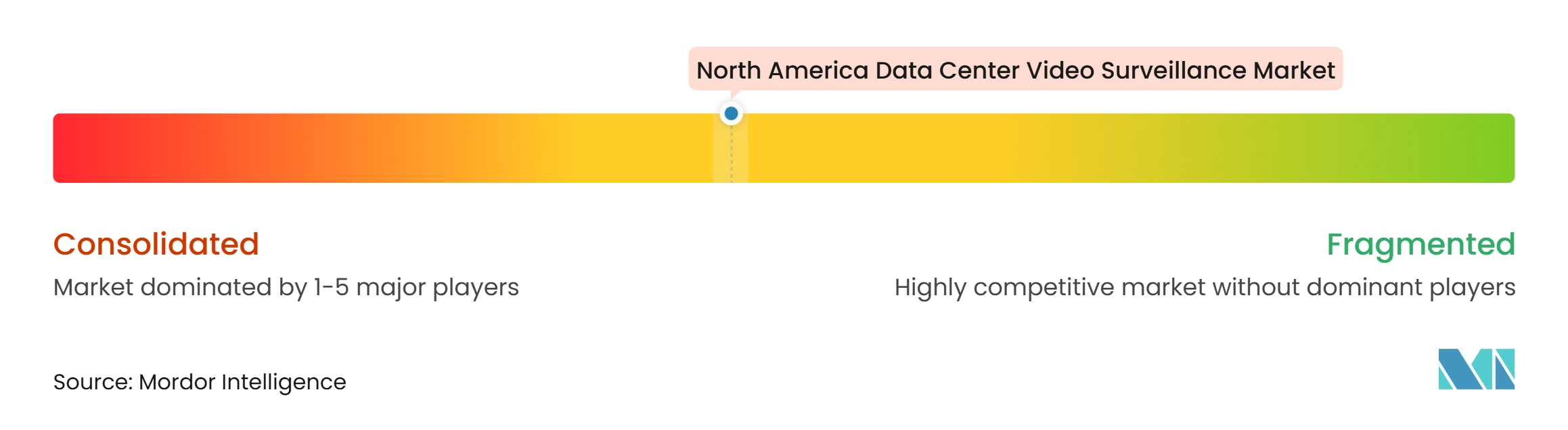
The North America data center video surveillance market is moderately consolidated among several integrated security suppliers. Motorola Solutions, Axis Communications, Johnson Controls, Honeywell, and Genetec compete for major hyperscale and enterprise contracts. Verkada and Eagle Eye Networks pursue greenfield opportunities with cloud-based architectures that do not require extensive on-site infrastructure. Supplier choice is increasingly determined by integration capability, cybersecurity features, compliance status, and the ability to support large multi-site deployments. This favors vendors that combine cameras, video management, access control, analytics, and services. Point solutions remain relevant, but they face stronger pressure when buyers seek unified operations.
Motorola Solutions treats AI-powered analytics as central to its video strategy in its 2025 annual report. Its 2026 Operator platform connected video, access events, and sensor data to support automated response workflows. Axis Communications has expanded Axis Cloud Connect to work with Genetec Security Center SaaS and Eagle Eye Networks integrations, which embeds cloud connectivity in its hardware offering. Johnson Controls introduced unified security products at ISC West 2026, including C-CURE IQ and C-CURE IQ VMS. These moves show how suppliers are trying to make their platforms central to both security and operational workflows. They also raise the importance of open integration and lifecycle support in competitive decisions.
NDAA Section 889 compliance is a material barrier in applications involving critical infrastructure. The Federal Communications Commission proposed a revised definition of critical infrastructure in December 2025 as part of its continuing work on covered communications equipment. This requirement can favor verified compliant suppliers when operators replace covered devices. Mexico’s Queretaro corridor remains an open area for providers that can establish installation and support capability before new campuses are commissioned. Rack-level and server-room monitoring also remains a developing product area with no single supplier holding a clear position. Security research on camera firmware vulnerabilities has increased the importance of secure boot, encrypted communications, and tested device security. Competition will therefore depend on product security and local delivery capability as much as conventional camera performance.
North America Data Center Video Surveillance Industry Leaders
-
Motorola Solutions, Inc.
-
Axis Communications AB
-
Honeywell International Inc.
-
Genetec Inc.
-
Johnson Controls International plc
- *Disclaimer: Major Players sorted in no particular order
North America Data Center Video Surveillance Market Companies Covered in this Report
- Motorola Solutions, Inc.
- Axis Communications AB
- Honeywell International Inc.
- Genetec Inc.
- Johnson Controls International plc
- Hanwha Vision Co., Ltd.
- Bosch Security Systems GmbH
- Dahua Technology Co., Ltd.
- Hikvision Digital Technology Co., Ltd.
- Panasonic i-PRO Sensing Solutions Co., Ltd.
- Eagle Eye Networks, Inc.
- Verkada, Inc.
- Milestone Systems A/S
- Cisco Systems, Inc.
- NVIDIA Corporation
- Teledyne Technologies Incorporated
- Brivo Systems, LLC
- Senstar Corporation
- Pelco, Inc.
- VIVOTEK Inc.
- Salient Systems Corporation
Recent Industry Developments in North America Data Center Video Surveillance Market
- October 2026: The FCC voted to tighten NDAA Section 889 equipment authorization restrictions, proposing a revised "critical infrastructure" definition that could extend prohibitions on Hikvision, Dahua, and Hytera surveillance equipment to a broader set of data center environments, expanding the replacement market for NDAA-compliant vendors.
- September 2026: Johnson Controls showcased exacqVision 26.2, C-CURE IQ 3.20, Proactive Video Solutions, and three new Illustra Multisensor Camera configurations at GSX 2026, noting that 50% of physical security teams identify AI as a key priority and 43% plan hybrid security architectures.
- September 2026: The Centre for Cybersecurity Belgium issued a formal advisory warning that threat actors are compromising internet-connected IP cameras for cyberespionage, DDoS botnet construction, and corporate network pivoting, explicitly flagging critical infrastructure including data centers as high-risk environments.
- August 2026: KIO Data Centers surpassed USD 900 million in cumulative investment after completing phases two and three of its QRO2 campus in Queretaro, Mexico, and announced a potential USD 1.3 billion further commitment through 2030 for the 100 MW QRO3 project, alongside USD 200 million in 2026 expansions across Mexico City, Monterrey, and Queretaro.
North America Data Center Video Surveillance Market Report Scope
The North America Data Center Video Surveillance Market encompasses technologies and services that enable visual security, monitoring, and surveillance of data center facilities. It includes solutions designed to enhance physical security, detect unauthorized activities, support incident response, and provide real-time operational visibility across critical infrastructure environments. The market is driven by increasing concerns over facility protection, asset security, business continuity, and the growing adoption of intelligent surveillance systems with advanced monitoring and analytics capabilities.
The North America Data Center Video Surveillance Market is Segmented by Component (Cameras and Imaging Hardware, Video Management Software, Storage and Recording Hardware, Analytics and Monitoring Software, and Installation, Integration, and Support Services), Camera Type (Fixed Cameras, Pan-Tilt-Zoom Cameras, Thermal Cameras, and Specialized Low-Light and Infrared Cameras), Deployment (On-Premise Surveillance Systems, Cloud-Based Surveillance Systems, and Hybrid Surveillance Systems), Application (Perimeter and External Area Monitoring, Entrance and Access Point Monitoring, Data Hall and Internal Corridor Monitoring, Electrical and Mechanical Room Monitoring, Loading Bay and Delivery Area Monitoring, and Remote Site and Campus Monitoring), Size (Small, Medium, Large, Hyperscale), Data Center Type (Colocation, Cloud Service Provider(CSPs), Enterprise / Edge, and Edge Data Centers), and Country (United States, Canda, and Mexico). The Market Forecasts are Provided in Terms of Value (USD).
Segmentation Overview
| Cameras and Imaging Hardware |
| Video Management Software |
| Storage and Recording Hardware |
| Analytics and Monitoring Software |
| Installation, Integration, and Support Services |
| Fixed Cameras |
| Pan-Tilt-Zoom Cameras |
| Thermal Cameras |
| Specialized Low-Light and Infrared Cameras |
| On-Premise Surveillance Systems |
| Cloud-Based Surveillance Systems |
| Hybrid Surveillance Systems |
| Perimeter and External Area Monitoring |
| Entrance and Access Point Monitoring |
| Data Hall and Internal Corridor Monitoring |
| Electrical and Mechanical Room Monitoring |
| Loading Bay and Delivery Area Monitoring |
| Remote Site and Campus Monitoring |
| Small |
| Medium |
| Large |
| Hyperscale |
| Colocation |
| Cloud Service Provider(CSPs) |
| Enterprise / Edge |
| Edge Data Centers |
| United States |
| Canada |
| Mexico |
| By Component | Cameras and Imaging Hardware |
| Video Management Software | |
| Storage and Recording Hardware | |
| Analytics and Monitoring Software | |
| Installation, Integration, and Support Services | |
| By Camera Type | Fixed Cameras |
| Pan-Tilt-Zoom Cameras | |
| Thermal Cameras | |
| Specialized Low-Light and Infrared Cameras | |
| By Deployment Model | On-Premise Surveillance Systems |
| Cloud-Based Surveillance Systems | |
| Hybrid Surveillance Systems | |
| By Application | Perimeter and External Area Monitoring |
| Entrance and Access Point Monitoring | |
| Data Hall and Internal Corridor Monitoring | |
| Electrical and Mechanical Room Monitoring | |
| Loading Bay and Delivery Area Monitoring | |
| Remote Site and Campus Monitoring | |
| By Data Center Size | Small |
| Medium | |
| Large | |
| Hyperscale | |
| By Data Center Type | Colocation |
| Cloud Service Provider(CSPs) | |
| Enterprise / Edge | |
| Edge Data Centers | |
| By Country | United States |
| Canada | |
| Mexico |
Key Questions Answered in the Report
What is the size of the North America data center video surveillance market?
The market is valued at USD 0.76 billion in 2026 and is projected to reach USD 1.72 billion by 2032, with a 13.58% CAGR from 2027 to 2032.
What is driving demand for data center surveillance systems in North America?
New hyperscale construction, AI hardware protection, compliance requirements, and integration of video with access and environmental systems are supporting demand.
Which component leads revenue in this sector?
Cameras and imaging hardware leads with a 34.71% share in 2026, while analytics and monitoring software has the fastest projected component CAGR of 14.26%.
Why are cloud-based surveillance systems important for data centers?
Cloud-based systems held 59.78% share in 2026 and help operators manage security across multiple facilities without separate video servers at each site.
Which country is expanding fastest in the regional sector?
Mexico is projected to expand at a 16.91% CAGR through 2032, supported by large hyperscale investments in the Queretaro corridor.
What are the key security challenges for data center camera deployments?
Cybersecurity exposure from connected devices and integration costs for legacy systems can delay deployment and require stronger device security controls.