
North America Data Center Transformer Market Size and Share
Market Overview
| Study Period | 2021 - 2032 |
|---|---|
| Forecast Data Period | 2027 - 2032 |
| Base Year Market Size (2026) | USD 3.05 Billion |
| Market Size (2027) | USD 3.31 Billion |
| Market Size (2032) | USD 4.65 Billion |
| Growth Rate (2027 - 2032) | 7.03 % |
| Market Concentration | Medium |
Major Players *Disclaimer: Major Players sorted in no particular order Image © Mordor Intelligence. Reuse requires attribution under CC BY 4.0. | |
North America Data Center Transformer Market Analysis by Mordor Intelligence
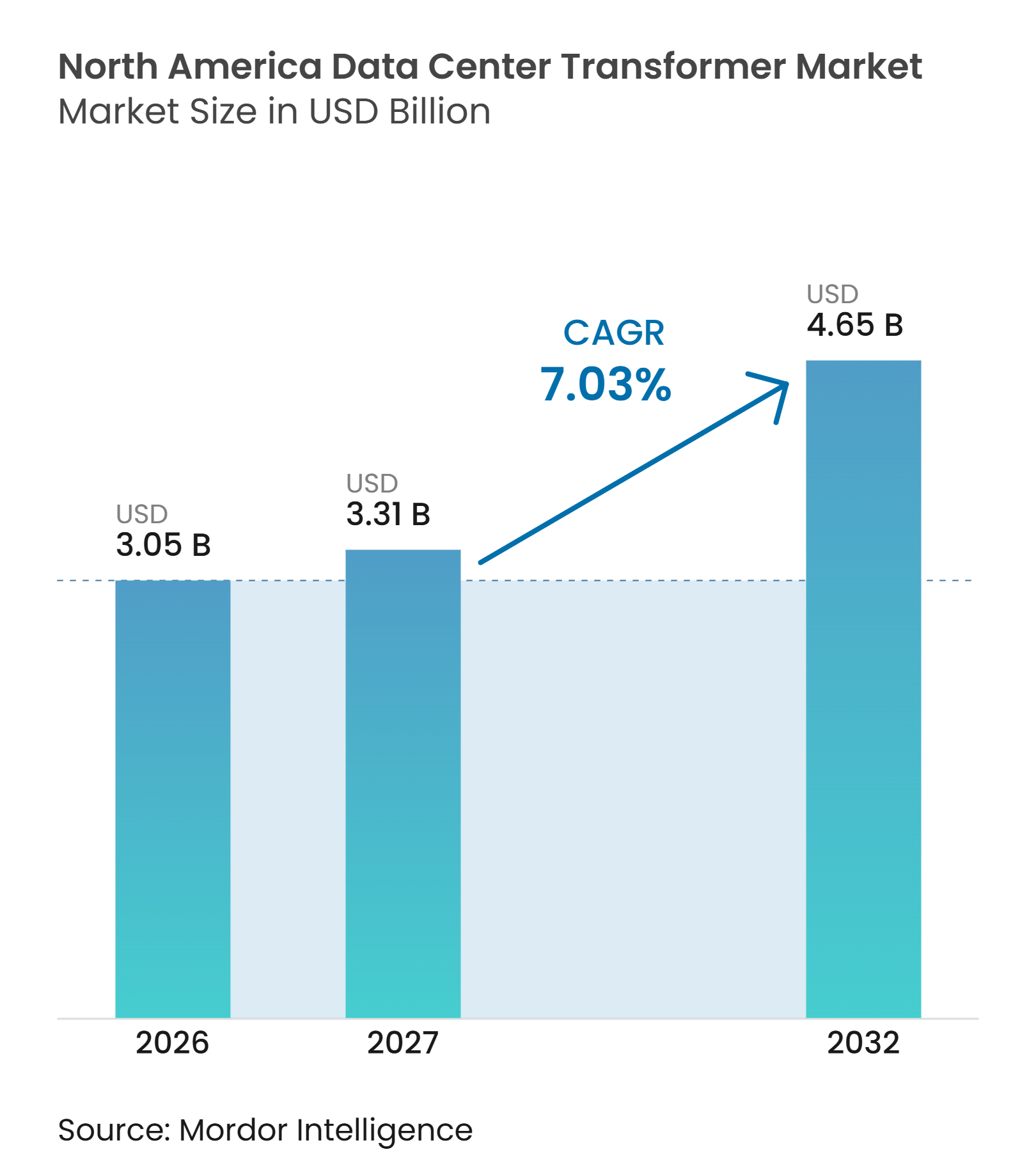
The North America data center transformer market size was valued at USD 3.05 billion in 2026 and estimated to expand from USD 3.31 billion in 2027 to reach USD 4.65 billion by 2032, at a CAGR of 7.03% during the forecast period (2027-2032). AI workloads are increasing electricity demand at larger campuses and are changing transformer procurement from a late construction activity into an early project decision. Hyperscale operators are increasingly seeking high-voltage interconnections, which increases demand for larger transformer ratings and longer factory testing programs. Supply constraints in transformer manufacturing, electrical steel, copper, and skilled labor support a price premium and favor manufacturers with committed North American capacity. Utilities, developers, and equipment suppliers are also competing for the same qualified transformer supply as renewable generation projects and grid modernization programs. The North America data center transformer market therefore offers opportunities for suppliers that can provide reliable delivery schedules, application engineering, and locally supported service.
Key Report Takeaways
- By transformer type, liquid-immersed transformers held 64.27% of the North America Data Center transformer market share in 2026 and are projected to expand at an 8.19% CAGR through 2032.
- By power rating, the above 10 MVA to 30 MVA segment held 39.21% revenue share in 2026, while the above 30 MVA segment is projected to expand at a 9.41% CAGR through 2032.
- By voltage level, medium voltage held 52.39% of the North America Data Center transformer market share in 2026, while high voltage is projected to expand at a 9.73% CAGR through 2032.
- By installation, outdoor systems held 62.45% revenue share in 2026 and are projected to expand at an 8.32% CAGR through 2032.
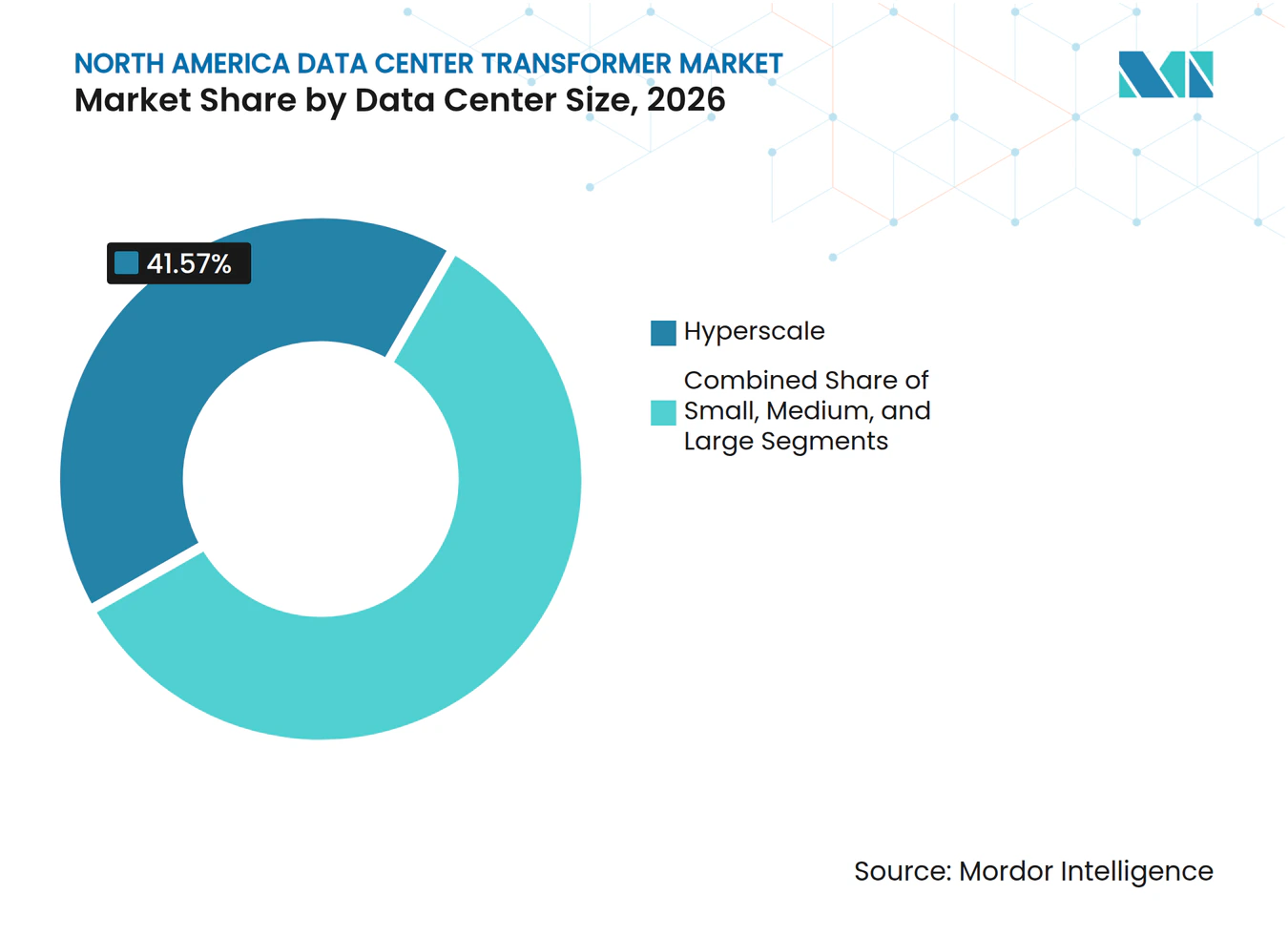
- By data center size, hyperscale facilities held 41.57% of the North America Data Center transformer market share in 2026 and are projected to expand at a 10.12% CAGR through 2032.
- By data center type, cloud service providers held 46.51% revenue share in 2026 and are projected to expand at a 9.37% CAGR through 2032.
- By country, the United States held 84.39% revenue share in 2026, while Mexico is projected to expand at an 8.97% CAGR through 2032.
Note: Market numbers in this report are based on Mordor Intelligence's proprietary estimation framework, which combines nine months of actuals with Q4 projections for base year 2026.
Market Trends and Insights
Drivers Impact Analysis of North America Data Center Transformer Market*
| Driver | (~) % Impact on CAGR Forecast | Geographic Relevance | Impact Timeline |
|---|---|---|---|
| AI and Hyperscale Data Center Expansion | +3.2% | United States, with expansion into Canada and Mexico | Short term (≤ 2 years) |
| Rising Rack and Facility Power Density | +1.4% | North America, primarily United States hyperscale and colocation facilities | Short term (≤ 2 years) |
| Grid Modernization and Renewable Power Integration | +0.8% | United States and Canada, with influence on Mexico sites connected to CFE | Medium term (2-4 years) |
| Replacement of Aging and Underspecified Transformers | +0.5% | United States, particularly Virginia, Texas, and the PJM region | Short term (≤ 2 years) |
| Standardization of Modular Power Infrastructure and Advanced Procurement | +0.3% | North America, strongest at hyperscale greenfield sites | Medium term (2-4 years) |
| Utility Interconnection Queue Asymmetry Favoring Distributed Data Center Sites | +0.2% | United States, particularly PJM, MISO, and ERCOT | Medium term (2-4 years) |
| Source: Mordor Intelligence | |||
AI and Hyperscale Data Center Expansion
AI infrastructure is changing the demand profile of the North America data center transformer market because larger campuses require greater power capacity at higher voltages. RAND reported that the United States AI data center power capacity reached 21 GW in 2025, more than 4 times the 2023 level. The same work projected global AI chip production to increase 1.3 to 2 times annually through 2030. This need favors high-voltage and substation-class transformers that can support large single-site loads, which differ from the distribution equipment used for conventional server rooms. Each electrical stage must be sized for higher fault levels, greater continuous loads, and future capacity additions. GE Vernova reported more than USD 5 billion in Electrification data center orders during the first half of 2026, more than double its total for 2025. Early allocation agreements are becoming important because transformer availability can determine whether a large project proceeds on schedule.
Rising Rack and Facility Power Density
Rising rack density increases the electrical requirements for each data center building and supports demand in the North America data center transformer market. AFCOM reported an average rack density of 27 kW in 2026, compared with 16 kW in 2025. NVIDIA's Vera Rubin platform can require 246 kW for an individual rack, which raises the need for higher-capacity distribution equipment. Higher-density racks require larger conductors, stronger cooling systems, and transformers with compact designs and low-loss performance. Engineering teams must also maintain redundant paths so that maintenance or a single equipment failure does not disrupt critical computing loads. The result is a shift toward higher value equipment even when the number of individual transformers does not increase at the same rate. New 800V DC architectures may alter some internal conversion stages, but campus substations will continue to require large transformers.
Grid Modernization and Renewable Power Integration
Grid investment creates transformer demand that adds to data center procurement rather than replacing it. United States grid investment is projected to increase 23% between 2025 and 2030 after increasing 27% between 2020 and 2025. Renewable generation projects and data centers often draw from the same qualified supplier base for generator step-up and substation transformers. This overlap affects factory slots, engineering resources, transport capacity, and the availability of tested designs. The Department of Energy's fiscal year 2026 program supports advanced transformer monitoring, solid-state transformer development, and alternative core materials. These priorities encourage buyers to specify more capable equipment and expand engineering requirements. For the North America data center transformer market, renewable energy agreements may also extend delivery schedules when generation projects compete for the same equipment.
Replacement of Aging and Underspecified Transformers
Replacement needs add a stable source of demand alongside new AI construction. The National Renewable Energy Laboratory stated that 55% of in-service United States distribution transformers are at least 33 years old.[1] Many of these assets were designed for 30 to 40 years of service and are operating beyond their planned life. Colocation operators converting industrial and office properties can inherit pad-mounted units that do not meet current power quality needs. These sites require predictable voltage control and resilient service before new computing equipment can be installed. That condition requires replacement rather than deferred maintenance when the site is converted to a data center. The Department of Energy has a program worth up to USD 375 million to strengthen domestic production of distribution and power transformers and other grid components.
Restraints Impact Analysis of North America Data Center Transformer Market*
| Restraint | (~) % Impact on CAGR Forecast | Geographic Relevance | Impact Timeline |
|---|---|---|---|
| Multi-Year Transformer Lead Times and Limited Manufacturing Capacity | -1.8% | North America, particularly the United States, with spillover to Canada and Mexico | Short term (≤ 2 years) |
| Electrical Steel, Copper and Skilled Labor Bottlenecks | -1.0% | United States, influenced by tariffs and GOES import restrictions | Medium term (2-4 years) |
| Local Grid Capacity and Utility Interconnection Delays | -0.6% | United States PJM, MISO, and ERCOT regions, and Mexico CFE transmission corridors | Medium term (2-4 years) |
| Efficiency Compliance and Certification Burden for New Designs | -0.3% | North America, with United States DOE efficiency standards | Short term (≤ 2 years) |
| Source: Mordor Intelligence | |||
Multi-Year Transformer Lead Times and Limited Manufacturing Capacity
Long procurement cycles constrain the North America data center transformer market because equipment availability can delay an otherwise funded project. Reuters reported that substation transformer lead times exceeded 160 weeks in the first quarter of 2026, compared with an average of 143 weeks in 2024. Some generator step-up transformer orders in North America were quoted at up to 5 years. Manufacturers have announced new capacity, but several projects will not reach meaningful output until 2028 to 2030. The interval includes factory construction, equipment installation, workforce training, product qualification, and customer testing. Developers are therefore placing orders years before commissioning and, in some cases, before permits are filed. Buyers without early allocation agreements face a greater risk of construction delays, redesign costs, and higher project costs.
Electrical Steel, Copper and Skilled Labor Bottlenecks
Material and labor limits make it difficult for the transformer output to respond quickly to higher demand. The Congressional Research Service documented the importance of domestic grain-oriented electrical steel supply and the effect of tariffs on transformer and electrical steel imports.[2] Copper demand adds a second constraint because it is essential to transformer windings and is also required across new grid infrastructure. Qualified winding, assembly, and testing labor requires specialized training that cannot be expanded quickly. These limits extend the time required for new plants to reach their rated output, even when capital investment is available. They also increase the importance of reliable material supply and careful production sequencing. The North America data center transformer market, therefore, remains exposed to higher input costs and restricted availability for large units.
*Our forecasts treat driver/restraint impacts as directional, not additive. The impact forecasts reflect baseline growth, mix effects, and variable interactions.
North America Data Center Transformer Market Segment Analysis
By Transformer Type:
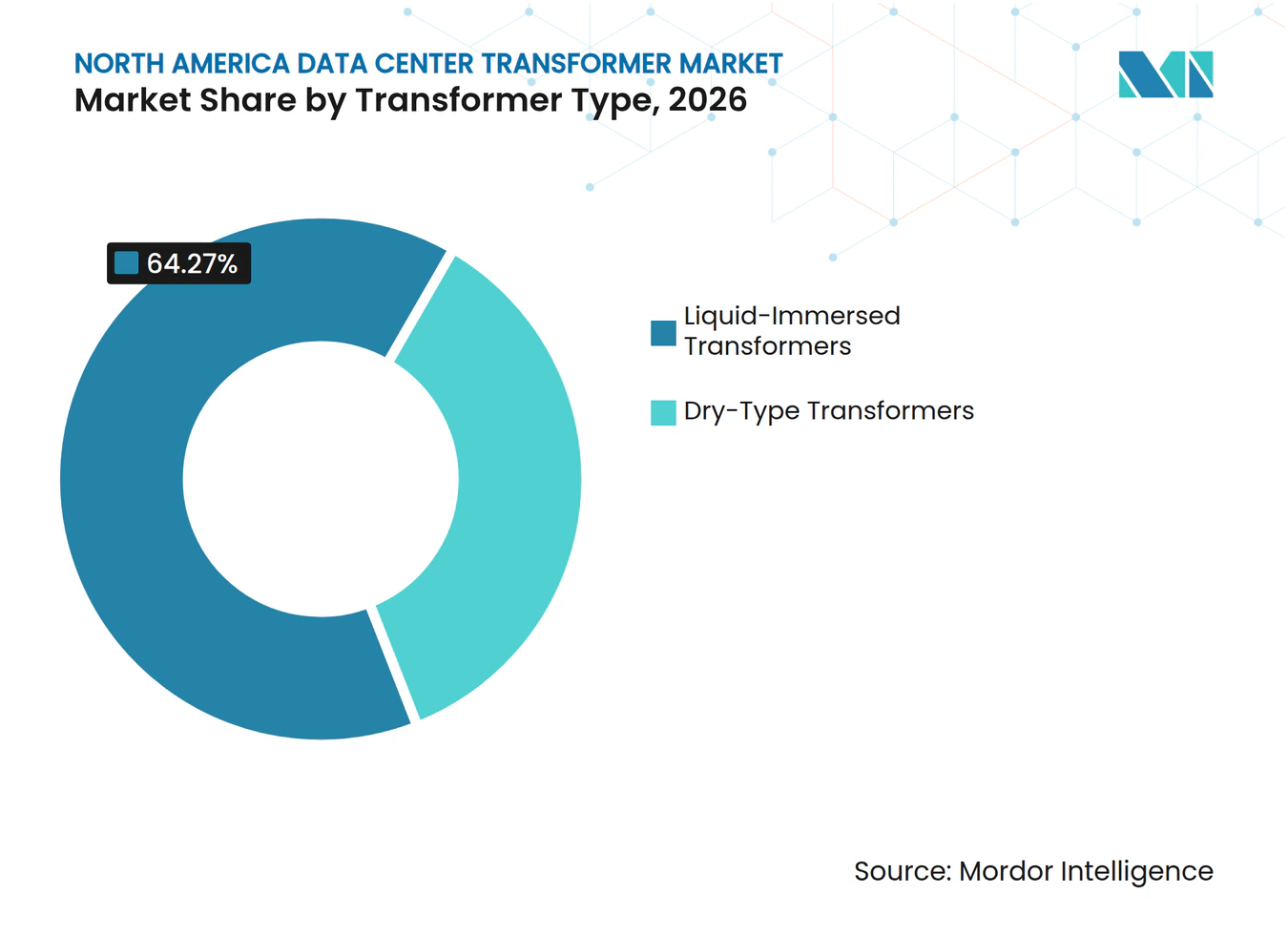
Liquid-Immersed Units Support Large Campus LoadsLiquid-immersed transformers held 64.27% of the North America data center transformer market share in 2026 and are projected to expand at an 8.19% CAGR through 2032. Their leading position reflects the need for oil-insulated equipment at campus substations that receive utility power at 115 kV to 500 kV. Large sites use these units because they can manage high ratings, insulation requirements, and fault energy that dry-type units cannot address at the same scale. The North America data center transformer industry relies on liquid-immersed units for power ratings that commonly exceed 40 MVA. Their role is especially important as developers build campuses that require dedicated substations rather than conventional commercial service connections, because those substations must manage bulk power intake, voltage conversion, protection requirements, and future expansion within a single coordinated electrical design.
Dry-type transformers serve a different layer of the electrical system, including switchgear rooms, UPS inputs, and step-down applications near the server floor. Indoor facilities often prefer these units because they avoid oil and can support fire safety and environmental requirements. Liquid cooling in server clusters also makes outdoor liquid-immersed equipment more acceptable to facility teams because liquid systems already form part of the wider site design. IEEE C57 standards guide performance requirements for both technologies and affect utility approval of new designs. Product selection also depends on the available footprint, access for maintenance, fire rules, and the boundary between utility-owned and customer-owned equipment. The North America data center transformer market will continue to use both transformer types, but the largest campus installations favor liquid-immersed equipment.


By Power Rating:
Above 30 MVA Units Gain From Larger CampusesThe above 10 MVA to 30 MVA class accounted for 39.21% of the North America data center transformer market in 2026. This range has been widely used for campus substations in established clusters in Northern Virginia and Texas. The above 30 MVA category is projected to expand at a 9.41% CAGR through 2032 as campuses connect more directly to transmission infrastructure. Larger facilities require transformers rated at 100 MVA and above when their load exceeds the capability of medium-power substations. This transition places greater emphasis on custom design, transport planning, factory testing, and coordination with the serving utility, since larger units require specialized shipping routes, more detailed site preparation, and delivery dates that must align with a broader construction schedule.
The up to 10 MVA segment serves edge data centers, enterprise upgrades, and smaller colocation facilities. It is expected to expand more slowly because much of the incremental capacity is moving toward hyperscale developments. Virginia Transformer announced large-format data center contracts in January 2025 for deliveries in 2026 and 2027, covering installations in Arizona, Ohio, Texas, and South Carolina.[3] This order pattern shows how manufacturers are prioritizing higher-rating equipment in their forward books. Smaller ratings nevertheless remain essential for local distribution and phased site expansion. The North America data center transformer market size for large power ratings benefits from broader campus boundaries and direct transmission connections.
By Voltage Level:
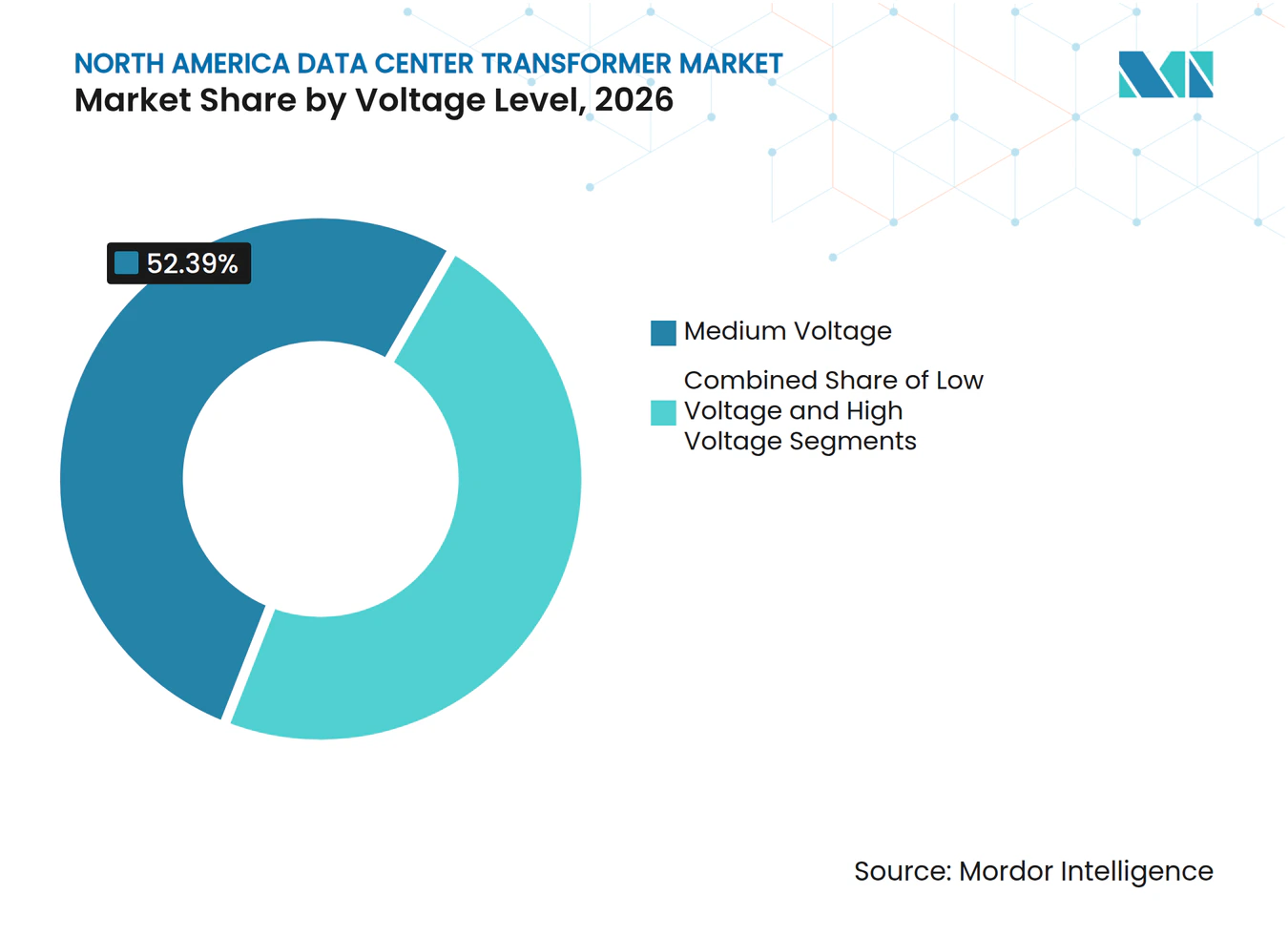
High-Voltage Connections Change Equipment NeedsMedium voltage held 52.39% of the North America data center transformer market in 2026 because existing campuses commonly use 12 kV to 36 kV switchgear rooms. High voltage is projected to expand at a 9.73% CAGR through 2032 as operators seek direct access to transmission networks. These sites require transformers that can step down from 115 kV, 138 kV, or higher voltage levels. This approach bypasses some distribution-level constraints but requires more complex equipment, specialized logistics, and close coordination with utility interconnection work. The equipment also requires longer test cycles before delivery, as suppliers must demonstrate that the transformer can operate safely at the required voltage, withstand expected fault conditions, and integrate with the protection approach selected for the site.
Low-voltage transformers remain necessary for the innermost distribution layer, usually at 480V and below. Rising power density increases demand for step-down points near larger rack clusters, although low voltage remains the smallest of the 3 voltage categories. The Department of Energy's fiscal year 2026 program supports high-voltage components and transformer monitoring technology. These programs support more capable designs and may increase the requirements placed on new procurements. The North America data center transformer industry is therefore shifting toward higher voltage applications while maintaining medium- and low-voltage equipment across the facility. This mix means suppliers must support several voltage classes within a single campus program.


By Installation:
Outdoor Systems Match Campus DesignOutdoor installations held 62.45% of the North America data center transformer market in 2026 and are projected to expand at an 8.32% CAGR through 2032. Campus substations are usually located outside the building envelope, where transformer bays can support larger equipment and site-wide power distribution. Multi-building campuses increasingly use outdoor ring-main arrangements instead of routing high-voltage feeders through enclosed spaces. This structure supports expansion across the site, reduces the need for large indoor electrical rooms, and provides clearer access for utility work. It also aligns with the scale of new hyperscale construction across the region, where developers need repeatable site layouts that can be expanded over time without rebuilding the core electrical infrastructure or placing high-voltage equipment inside occupied buildings.
Indoor installations remain important for colocation facilities, enterprise data centers, and edge deployments. Building codes, fire suppression needs, and space limitations favor dry-type equipment positioned close to server floors. Urban and suburban edge projects can increase indoor demand when they reuse industrial or commercial properties. NFPA 70 and local fire codes affect indoor transformer selection through ventilation and arc-flash requirements. Indoor systems can also simplify equipment placement when the site has limited external space. The North America data center transformer market will retain an outdoor lead because its largest projects require campus-scale substations, separate transformer bays, and enough space for safety clearances, maintenance access, and the staged addition of electrical equipment as the site expands.
By Data Center Size:
Hyperscale Projects Raise Unit ValueHyperscale facilities held 41.57% of the North America data center transformer market in 2026 and are projected to expand at a 10.12% CAGR through 2032. Their leading position reflects major capital programs by AWS, Microsoft, Google, and other cloud operators. EPRI projected that data centers could account for 9% to 17% of the United States electricity demand by 2030. Hyperscale campuses are expected to account for much of the added load, which supports demand for larger transformer units. Each campus can require several stages of high-voltage, medium-voltage, and low-voltage transformation, connecting the utility interface to the substation, site distribution system, backup power design, and the final electrical equipment that serves individual rack clusters. Developers also need equipment that can be installed in phases without interrupting existing operations.
Bloom Energy reported that 1 in 5 data center campuses could exceed gigawatt scale by 2030, increasing to 1 in 3 by 2035. Large and medium facilities together account for 40% of the market and are expanding near the overall market rate as colocation operators add capacity. Small sites remain necessary for edge and remote enterprise computing, but they contribute less revenue and expand more slowly. Larger, power-efficient facilities concentrate computing capacity and reduce the case for widespread small-site construction. The North America data center transformer market is consequently weighted toward fewer projects with much larger equipment requirements. This concentration can increase the value of individual orders and the cost of a missed delivery date.
By Data Center Type:
Cloud Providers Set Purchasing PatternsCloud service providers held 46.51% of the North America data center transformer market in 2026 and are projected to expand at a 9.37% CAGR through 2032. Their demand is linked to the concentration of AI training and inference workloads within major hyperscaler platforms. Cloud operators can place orders 2 to 5 years before commissioning, which gives them greater access to constrained manufacturing capacity. These forward-booking programs can reduce equipment availability for colocation and enterprise customers. They also make delivery certainty, factory capacity, and technical support important parts of supplier selection, because customers need suppliers that can respond to design changes, provide testing support, and coordinate delivery across several facilities.
Colocation providers represent a meaningful secondary customer group and can pay premiums for reliable delivery dates. Enterprise data centers and edge sites include diverse private installations and distributed nodes, but their budgets are more sensitive to equipment price increases. ABB announced a collaboration with NVIDIA in 2026 to develop power architectures for gigawatt-scale AI data centers. The collaboration shows that cloud-scale requirements are influencing the design standards used across the sector. Larger customers can also reserve production slots across several sites, giving them leverage in a constrained supply environment. The North America data center transformer industry will continue to depend on cloud purchasing patterns as these operators influence specifications and order timing, while other customer groups adjust their procurement plans to the availability, technical choices, and delivery practices established by the largest buyers.
Geography Analysis
The United States held 84.39% of the North America data center transformer market share in 2026. Its position reflects the concentration of hyperscale operators, AI chip activity, and large cloud infrastructure programs. EPRI stated that AI workloads account for 15% to 25% of the United States data center electricity demand and that this proportion is increasing. Virginia remains a major center for transformer procurement because of its large data center base and demand in the PJM interconnection queue. MISO and ERCOT are also active regions, with Texas adding substantial capacity. The Department of Energy's USD 375 million supply-chain program supports domestic transformer manufacturing and improves the position of local producers.
Canada is the second-largest regional market and is expanding as cloud and AI facilities seek reliable power. Microsoft committed CAD 7.5 billion (USD 5.5 billion) over 2 years to Canadian cloud and AI data center capacity, with new facilities expected to come online in the second half of 2026. AWS also committed USD 18.3 billion to Canadian cloud infrastructure through 2037. Hitachi Energy committed an additional CAD 270 million (USD 195 million) in September 2025 to expand its Varennes, Quebec transformer facility.[4] The company stated that the investment would nearly triple local production capacity and create more than 500 jobs.
Mexico is projected to expand at an 8.97% CAGR through 2032, the fastest rate in the region. AWS launched its Mexico Central Region in January 2025 with a USD 5 billion commitment over 15 years. CloudHQ announced a USD 4.8 billion investment in September 2025 for 6 data centers with 900 MW of critical IT load in Queretaro. KIO Data Centers committed more than USD 200 million to new projects in Mexico in 2026 and is evaluating a further USD 1.3 billion investment through 2030 for QRO3. The North America data center transformer market size in Mexico benefits from these larger facilities and their need for outdoor substations and medium-voltage distribution. Constrained CFE transmission capacity in Queretaro can also increase transformer investment per MW of IT load.
Competitive Landscape
Market Concentration
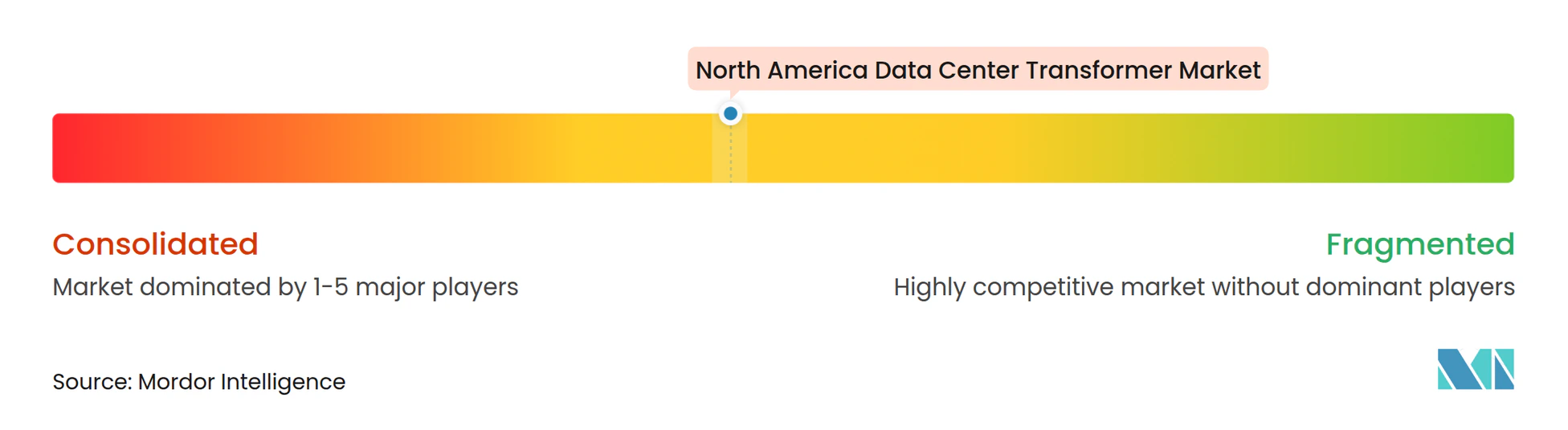
The North America data center transformer market is moderately consolidated in the large-power tier, led by GE Vernova, Hitachi Energy, Siemens Energy, ABB, and Eaton. These companies combine utility relationships, qualified product lines, and investments in United States manufacturing capacity. GE Vernova completed its USD 5.275 billion acquisition of the remaining 50% stake in Prolec GE in February 2026. The transaction integrated Prolec GE into GE Vernova's Electrification segment and added manufacturing sites across the Americas. Large suppliers compete on equipment capability, delivery allocation, service coverage, and their ability to support complex substation projects.
Hitachi Energy is expanding its United States manufacturing footprint through a USD 528 million transformer facility in Gallman, Mississippi, and a USD 457 million large-power-transformer expansion in South Boston, Virginia. The South Boston project began construction in June 2026 and is expected to reach production around 2029. Hitachi Energy's Canadian investment also adds capacity in Varennes, Quebec. Eaton is building a USD 340 million three-phase transformer plant in South Carolina with production expected in 2027. These investments show that supply security is becoming a central competitive factor for the North America data center transformer market.
Mid-tier suppliers compete through specialized engineering, shorter lead times, and proximity to new construction corridors. Hammond Power Solutions announced a USD 36 million transformer plant in Fort Worth, Texas, with phased production expected from the fourth quarter of 2027. Virginia Transformer broke ground in April 2026 on a 50% capacity expansion of its Rincon, Georgia facility, with completion planned for March 2027. Eaton acquired Resilient Power Systems in July 2025 to add solid-state transformer technology, while ABB partnered with NVIDIA on gigawatt-scale AI facility power design. The competitive field also includes opportunities for modular, factory-tested transformer and switchgear packages for smaller hyperscale and distributed edge projects.
North America Data Center Transformer Industry Leaders
-
GE Vernova Inc.
-
Hitachi Energy Ltd.
-
Siemens Energy AG
-
ABB Ltd.
-
WEG S.A.
- *Disclaimer: Major Players sorted in no particular order
North America Data Center Transformer Market Companies Covered in this Report
- GE Vernova Inc.
- Hitachi Energy Ltd.
- Siemens Energy AG
- ABB Ltd.
- Eaton Corporation plc
- Schneider Electric SE
- WEG S.A.
- Hyosung Heavy Industries Co., Ltd.
- SGB-SMIT Group
- Mitsubishi Electric Corporation
- Toshiba Corporation
- Hyundai Electric and Energy Systems Co., Ltd.
- Hammond Power Solutions Inc.
- Wilson Power Solutions Limited
- MGM Transformer Company
- Virginia Transformer Corporation
- Kirloskar Electric Company Limited
- SPX Transformer Solutions
- CG Power and Industrial Solutions Ltd.
Recent Industry Developments in North America Data Center Transformer Market
- October 2026: Hammond Power Solutions announced a USD 36 million transformer manufacturing plant in Fort Worth, Texas, under a long-term lease, with phased production from Q4 2027 and full operation by Q1 2028.
- September 2026: Hitachi Energy announced a USD 528 million transformer factory in Gallman, Mississippi, expected to more than double production capacity in the area and create more than 700 jobs.
- September 2026: Hyosung Heavy Industries secured a USD 286 million order for United States data center transformers, reflecting the uptake of the Korean manufacturer's ultra-high-voltage transformer capabilities at its Memphis, Tennessee facility.
- June 2026: Hitachi Energy broke ground on its USD 457 million South Boston, Virginia large-power-transformer expansion, which is expected to reach production around 2029.
North America Data Center Transformer Market Report Scope
The North America data center transformer market encompasses the regional supply and demand for specialized electrical transformers engineered to scale voltage for hyper-scale, colocation, and enterprise data facilities. This market is primarily driven by the rapid expansion of AI workloads, cloud computing infrastructure, and the subsequent need for highly efficient, reliable power distribution systems. It specifically tracks revenue, technological advancements, and deployment across the United States and Canada.
The North America Data Center Transformer Market Report is Segmented by Transformer Type (Liquid-Immersed Transformers and Dry-Type Transformers), Power Rating (Up to 10 MVA, Above 10 MVA to 30 MVA, and Above 30 MVA), Voltage Level (Low Voltage, Medium Voltage, and High Voltage), Installation (Indoor Installation and Outdoor Installation), Data Center Size (Small, Medium, Large, and Hyperscale), Data Center Type (Colocation, Cloud Service Provider, and Enterprise Data Centers/Edge), and Country (United States, Canada, and Mexico). The Market Forecasts are Provided in Terms of Value (USD).
Segmentation Overview
| Liquid-Immersed Transformers |
| Dry-Type Transformers |
| Up to 10 MVA |
| Above 10 MVA to 30 MVA |
| Above 30 MVA |
| Low Voltage |
| Medium Voltage |
| High Voltage |
| Indoor Installation |
| Outdoor Installation |
| Small |
| Medium |
| Large |
| Hyperscale |
| Colocation |
| Cloud Service Provider |
| Enterprise Data Centers/Edge |
| United States |
| Canada |
| Mexico |
| By Transformer Type | Liquid-Immersed Transformers |
| Dry-Type Transformers | |
| By Power Rating | Up to 10 MVA |
| Above 10 MVA to 30 MVA | |
| Above 30 MVA | |
| By Voltage Level | Low Voltage |
| Medium Voltage | |
| High Voltage | |
| By Installation | Indoor Installation |
| Outdoor Installation | |
| By Data Center Size | Small |
| Medium | |
| Large | |
| Hyperscale | |
| By Data Center Type | Colocation |
| Cloud Service Provider | |
| Enterprise Data Centers/Edge | |
| By Country | United States |
| Canada | |
| Mexico |
Key Questions Answered in the Report
What is the size of the North America data center transformer market?
The market is valued at USD 3.05 billion in 2026 and is estimated to reach USD 4.65 billion by 2032, at a 7.03% CAGR from 2027 to 2032. This outlook reflects larger power requirements at AI-focused campuses and the continued need for new utility and on-site transformer capacity.
Which transformer type leads data center projects in North America?
Liquid-immersed transformers lead with 64.27% revenue share in 2026 and are projected to expand at an 8.19% CAGR through 2032. They are widely used for large outdoor substations because they can support higher ratings and demanding utility interconnections.
Why are high-voltage transformers becoming more important for data centers?
Larger hyperscale campuses are seeking direct transmission connections, which requires high-voltage step-down transformers and dedicated substation infrastructure. These projects need custom equipment, extended factory testing, specialized transportation, and early coordination with the serving utility.
Which data center customers purchase the most transformer capacity?
Cloud service providers hold 46.51% revenue share in 2026 and are projected to expand at a 9.37% CAGR through 2032. Their early, multi-year orders influence product specifications, production planning, and the availability of transformer capacity for other buyer groups.
Which country is expected to expand fastest in North America?
Mexico is projected to expand at an 8.97% CAGR through 2032, supported by new cloud and colocation investments in Queretaro and other locations. Large planned facilities require outdoor substations and medium-voltage distribution equipment, which supports transformer demand across their development cycle.
What is constraining transformer availability for data center projects?
Long equipment lead times, limits in manufacturing capacity, electrical steel and copper supply pressure, and specialized labor shortages constrain supply. Developers increasingly place orders well before commissioning to improve the chance of receiving equipment within their construction schedule.