
North America Data Center Switchgear Market Size and Share
Market Overview
| Study Period | 2021 - 2032 |
|---|---|
| Forecast Data Period | 2027 - 2032 |
| Base Year Market Size (2026) | USD 1.81 Billion |
| Market Size (2027) | USD 2.07 Billion |
| Market Size (2032) | USD 3.66 Billion |
| Growth Rate (2027 - 2032) | 12.07 % |
| Market Concentration | Medium |
Major Players *Disclaimer: Major Players sorted in no particular order Image © Mordor Intelligence. Reuse requires attribution under CC BY 4.0. | |
North America Data Center Switchgear Market Analysis by Mordor Intelligence
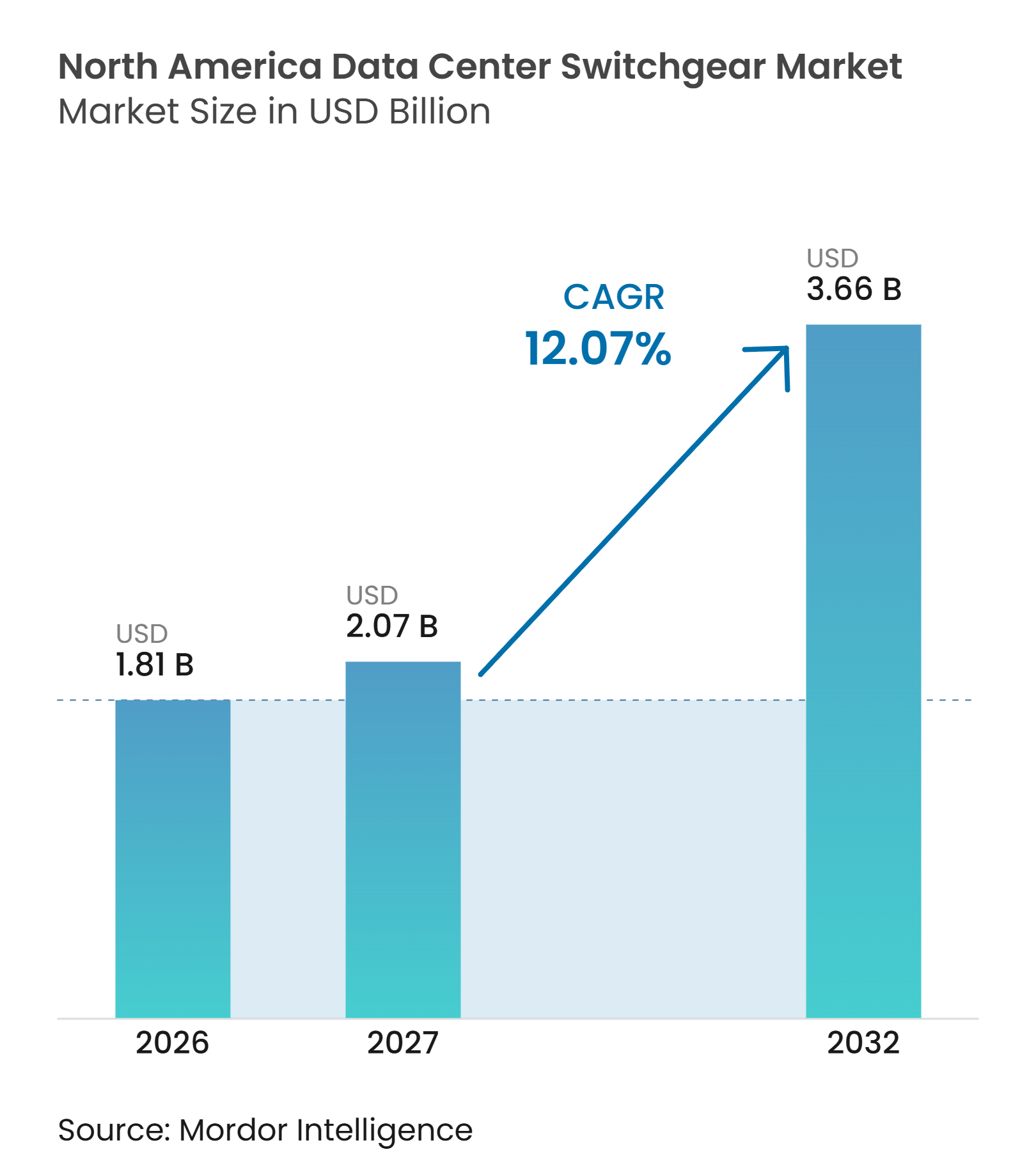
The North America data center switchgear market size was valued at USD 1.81 billion in 2026 and estimated to increase from USD 2.07 billion in 2027 to reach USD 3.66 billion by 2032, at a CAGR of 12.07% during the forecast period (2027-2032). Demand is increasingly shaped by a redesign of power distribution rather than by routine building activity. Higher-density AI computing has moved more medium-voltage equipment closer to data halls and increased the need for switching, protection, and fault isolation. The North America data center switchgear market also reflects a shift toward factory-built power blocks and equipment that can be ordered earlier in the construction cycle. Suppliers are responding with local capacity investments, modular platforms, and digital controls. Supply constraints and grid access delays remain material limits, but they also increase the need for behind-the-meter equipment on projects that proceed.
Key Report Takeaways
- By voltage level, low-voltage switchgear held 46.19% of the North America data center switchgear market share in 2026, while medium-voltage switchgear is projected to expand at a 14.23% CAGR through 2032.
- By insulation type, air-insulated switchgear held 50.47% of revenue in 2026, while gas-insulated switchgear is projected to expand at a 14.08% CAGR through 2032.
- By installation type, indoor switchgear held 66.71% of revenue in 2026, while outdoor switchgear is projected to expand at a 14.79% CAGR through 2032.
- By configuration, withdrawable switchgear held 51.33% of revenue in 2026, while modular switchgear is projected to expand at a 14.92% CAGR through 2032.
- By data center size, hyperscale facilities held 48.30% of revenue in 2026 and are projected to expand at a 15.39% CAGR through 2032.
- By data center type, cloud service providers held 45.29% of revenue in 2026 and are projected to expand at a 15.53% CAGR through 2032.
- By geography, the United States held 83.17% of revenue in 2026, while Canada is projected to expand at a 15.71% CAGR through 2032.
Note: Market numbers in this report are based on Mordor Intelligence's proprietary estimation framework, which combines nine months of actuals with Q4 projections for base year 2026.
Market Trends and Insights
Drivers Impact Analysis of North America Data Center Switchgear Market*
| Driver | (~) % Impact on CAGR Forecast | Geographic Relevance | Impact Timeline |
|---|---|---|---|
| Hyperscale and AI Data Center Capacity Expansion | +3.5% | United States, Canada, and Mexico | Short term (≤ 2 years) |
| Cloud, Colocation, and High-Density Compute Deployment | +2.5% | United States and Canada | Short term (≤ 2 years) |
| Power-Distribution Modernization and Redundancy Requirements | +1.8% | United States | Medium term (2-4 years) |
| Electrical Equipment Localization and Capacity Investment | +1.4% | United States and Canada | Medium term (2-4 years) |
| Standardized Prefabricated Power Blocks | +1.0% | United States and Canada | Medium term (2-4 years) |
| 800 V Direct-Current and Higher-Voltage Distribution Architectures | +0.7% | United States | Long term (≥ 4 years) |
| Source: Mordor Intelligence | |||
Hyperscale and AI Data Center Capacity Expansion
AI facilities require more electrical equipment per megawatt than earlier cloud campuses because their servers operate at far higher rack densities. The resulting demand places medium-voltage distribution closer to the IT load and adds protection points across each site. Powell Industries reported a single data center order exceeding USD 400 million in May 2026, showing the scale of equipment programs tied to large campuses. The North America data center switchgear market benefits when developers standardize these larger electrical designs across several sites. This approach gives manufacturers clearer production schedules and provides operators a more repeatable path for capacity additions, particularly when campuses are delivered in phases, and later buildings use the same electrical design. The repeated specification also lets project teams coordinate protection settings, spare parts, testing, and commissioning practices across a wider site portfolio. The same concentration of demand raises the importance of supplier capacity, delivery certainty, and application engineering.
Cloud, Colocation, and High-Density Compute Deployment
Cloud service providers and colocation operators need power systems that can be expanded without shutting down adjacent equipment. Withdrawable medium-voltage designs support live extensions and maintenance in facilities with stringent uptime commitments. Schneider Electric introduced a software-defined medium-voltage switchgear platform in 2026 that was piloted at an Equinix facility. Its related technical paper states that the design can reduce deployment schedules by 64% by separating platform ordering from project-specific engineering. This matters for the North America data center switchgear market because customers are trying to secure equipment before every building detail is finalized. Digital controls and standardized interfaces can therefore become procurement advantages instead of optional features. They can reduce field wiring, make status information easier to use, and support a consistent operating model when customers add capacity across several locations.
Power-Distribution Modernization and Redundancy Requirements
Older facilities built around 480 V systems face greater pressure to support denser computing loads. Operators are upgrading buses, protection, and monitoring while trying to avoid planned maintenance windows. ABB launched MNS 4.0 in 2026 with AI-enabled condition monitoring and cybersecurity features aligned with IEC 62443. The equipment supports operators who need more visibility over electrical assets during modernization. ANSI/IEEE C37.20.2 and UL 1558 also narrow the qualifying supplier base for North American installations. These requirements reinforce the role of established testing, certification, and field-service capabilities in the North America data center switchgear market. They also require customers to assess protection coordination, maintenance access, and cyber controls before equipment is installed in a live environment.
Electrical Equipment Localization and Capacity Investment
Long equipment lead times have increased the value of domestic manufacturing capacity. Siemens invested more than USD 165 million in expanded North and South Carolina facilities in March 2026, adding capacity for low- and medium-voltage products for data center customers.[1] Eaton committed more than USD 30 million for a new Bellevue, Nebraska, facility focused on medium-voltage switchgear, with initial production expected in the first half of 2027. Local production reduces logistics exposure and helps suppliers align factory slots with customer construction schedules. It also supports qualification and service needs that are difficult to meet through imports alone. These investments strengthen supply responsiveness across the North America data center switchgear market. Regional production can also give suppliers a closer working relationship with engineering contractors, utilities, and data center operators during complex delivery programs.
Restraints Impact Analysis of North America Data Center Switchgear Market*
| Restraint | (~) % Impact on CAGR Forecast | Geographic Relevance | Impact Timeline |
|---|---|---|---|
| Extended Switchgear Lead Times and Component Bottlenecks | -1.8% | United States, Canada, and Mexico | Short term (≤ 2 years) |
| Grid Interconnection Delays and Local Power Availability Constraints | -1.3% | United States and Canada | Medium term (2-4 years) |
| Skilled High-Voltage Commissioning Labor Shortages | -0.8% | United States and Canada | Short term (≤ 2 years) |
| Qualification, Cybersecurity, and Design-Lock-In Complexity | -0.5% | United States | Medium term (2-4 years) |
| Source: Mordor Intelligence | |||
Extended Switchgear Lead Times and Component Bottlenecks
Equipment availability remains a direct constraint on project schedules. Data center-specific medium-voltage equipment can require 2-3 years, while supply conditions have encouraged developers to place orders before finalizing facility designs. Nexans identifies equipment and grid constraints as central barriers to data center delivery. Earlier ordering protects delivery slots but can increase exposure when designs change. It also favors manufacturers with established order books, certified platforms, and capacity that can be committed to large programs. The North America data center switchgear market must therefore balance rapid demand with the limits of component supply and factory throughput.
Grid Interconnection Delays and Local Power Availability Constraints
Grid access determines whether planned campuses can enter service on schedule. GridLab documented the importance of coordination for large-load interconnections as data center demand increases. Princeton University found that flexible connection approaches can shorten the time to operation by 3-5 years in some cases.[2] When utility access is delayed, developers may use on-site generation and behind-the-meter designs that require dedicated medium-voltage equipment. This provides partial support for equipment demand, but it does not remove the cost and schedule pressure facing new facilities. Reliable interconnection planning remains necessary for sustained expansion.
*Our forecasts treat driver/restraint impacts as directional, not additive. The impact forecasts reflect baseline growth, mix effects, and variable interactions.
North America Data Center Switchgear Market Segment Analysis
By Voltage Level:
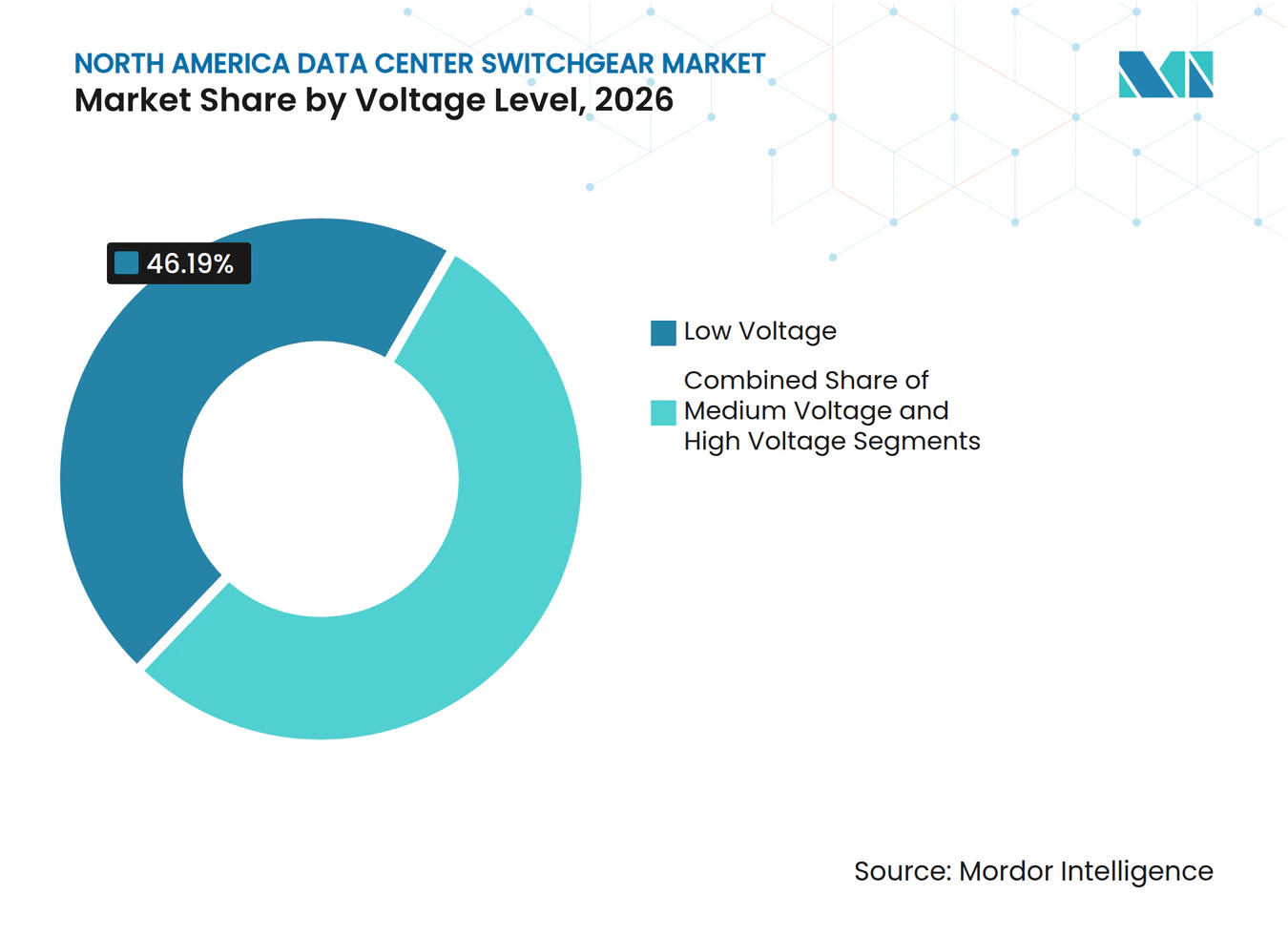
Medium Voltage Rising as AI Rack Power ScalesLow-voltage switchgear held 46.19% of North America data center switchgear market share in 2026, supported by its established role in enterprise and legacy colocation facilities. Medium-voltage switchgear is projected to expand at a 14.23% CAGR through 2032 as dense AI deployments raise power requirements. Rack densities of 50-75 kW make it more practical to move medium-voltage distribution closer to the IT load. This reduces the need for repeated low-voltage conversion stages across the facility. High-voltage switchgear serves a narrower role at primary substations for campuses above 100 MW.
Medium-voltage systems need specialized relays, arc-flash protection, and experienced commissioning teams. These requirements can extend delivery and installation schedules when projects are moving quickly. ANSI/IEEE C37.20.2 and UL 1558 compliance remains important for equipment selection and supplier qualification. The North America data center switchgear market size for medium-voltage equipment is supported by the shift from conventional cloud loads to power-intensive AI clusters. Established suppliers can use their test records and application expertise to address this need. Smaller suppliers may still compete where they can provide responsive engineering and secure manufacturing slots, especially where customers need specialized lineups or a faster response to a changed site plan. Their role is strongest when technical support and available factory capacity are as important as global scale.



By Insulation Type:
Air-Insulated Leads but GIS Closes the GapAir-insulated switchgear held 50.47% of the North America data center switchgear market share in 2026 because it remains widely used where the first cost is central to procurement. Gas-insulated switchgear is projected to expand at a 14.08% CAGR through 2032. Its sealed design can reduce the required footprint by 60-70%, which is useful where electrical rooms face space limits. This benefit is relevant to both urban colocation sites and high-density hyperscale buildings. Air-insulated equipment remains a practical choice for sites with greater room for conventional lineups.
Schneider Electric announced RM AirSeT 38 in 2026, extending vacuum interruption and pure-air insulation to 38 kV for high-density data center power systems. Alternative gas options can help customers address restrictions on SF₆ while maintaining compact equipment layouts. IEC 62271-203 provides a relevant technical framework for gas-insulated switchgear. The North America data center switchgear industry is likely to see insulation choices shaped by site space, compliance needs, maintenance practices, and availability. These factors mean that air-insulated and gas-insulated designs will continue to serve different operating conditions. Customers will assess room layout, access for maintenance, environmental requirements, project timing, and total installed cost before making a final selection.
By Installation Type:
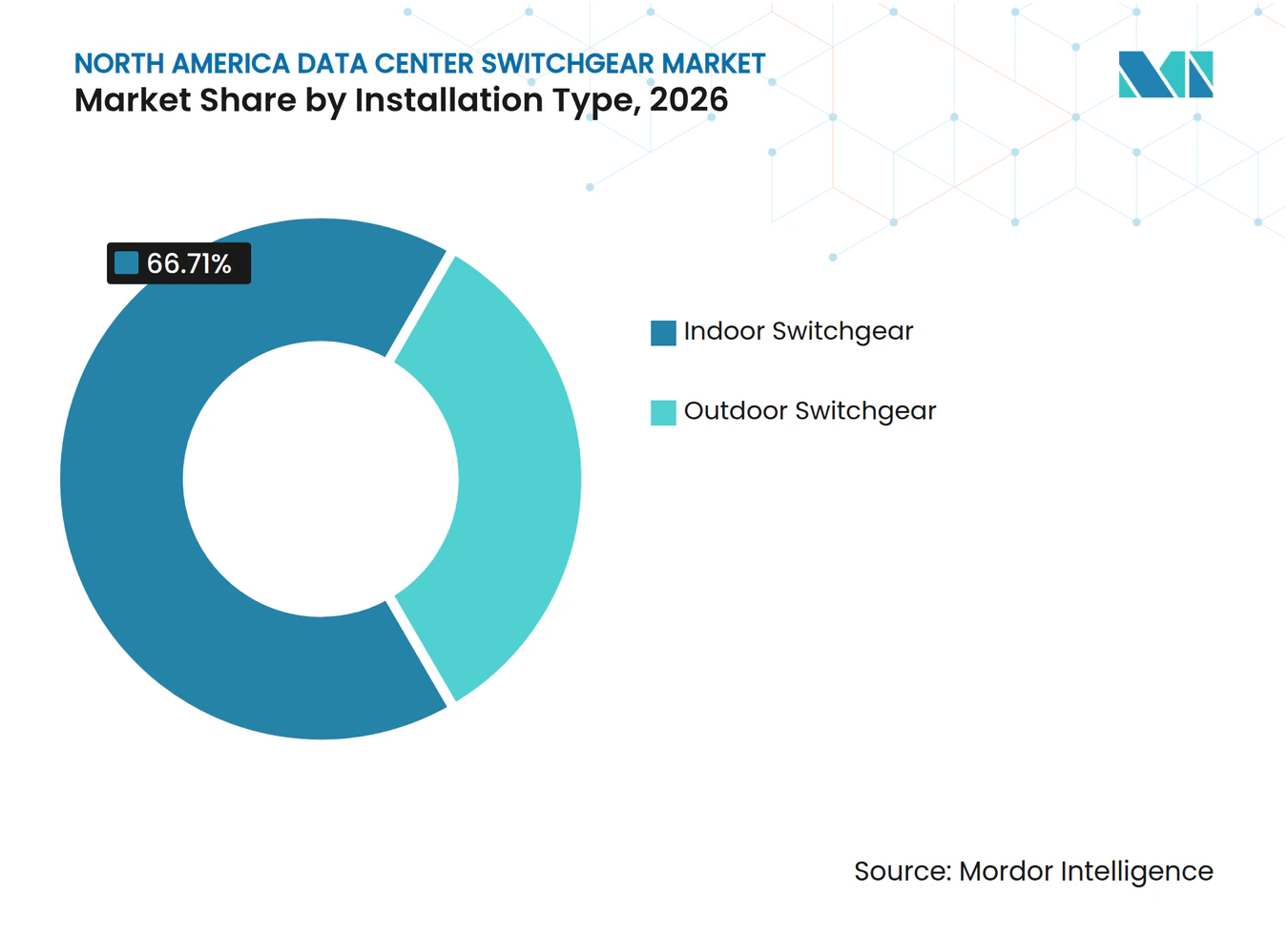
Indoor Dominates While Outdoor Gains AI-Scale MomentumIndoor switchgear accounted for 66.71% of the North America data center switchgear market size in 2026, reflecting the long-standing preference for dedicated electrical rooms. Outdoor switchgear is projected to expand at a 14.79% CAGR through 2032. Prefabricated containerized substations can move medium-voltage equipment outside the facility and preserve valuable indoor space. This format can also shorten installation work at the site. Indoor layouts remain important where physical security, climate control, and multi-tenant separation are key requirements.
Siemens entered a multi-year agreement to supply Compass Datacenters with up to 1,500 outdoor modular medium-voltage skid units over 5 years. The agreement shows how outdoor equipment can be integrated into repeatable campus designs. Behind-the-meter generation further supports outdoor installations because equipment can be placed near generation assets. Outdoor systems may need less civil construction than comparable indoor arrangements. The North America data center switchgear market, therefore, gains from projects that prioritize rapid deployment and standardized physical layouts. This model can reduce field labor, improve factory quality control, and make the physical arrangement of electrical equipment easier to repeat from one campus to another.

By Configuration:
Modular Switchgear Accelerates Prefabricated Power DeliveryWithdrawable switchgear held 51.33% of revenue in 2026 because it allows a circuit breaker element to be removed without de-energizing adjacent bus sections. Modular switchgear is projected to expand at a 14.92% CAGR through 2032. Tier III and Tier IV facilities place a high value on designs that maintain service during maintenance activity. Factory-tested modular power blocks also address labor constraints and compressed construction schedules. Fixed-mounted systems remain relevant for cost-sensitive enterprise and edge facilities.
Schneider Electric states that its software-defined medium-voltage platform can reduce control wiring by 87% and terminals by 91% compared with conventional engineered-to-order equipment. Fewer connections can simplify installation and support faster ordering cycles. The North America data center switchgear market benefits when equipment can be reused across campuses with limited redesign. Modular systems also give operators a clearer route for adding capacity in phases. Their adoption depends on whether customers can accept standardized configurations without losing needed flexibility. Procurement teams must weigh faster manufacturing and simpler installation against the need to adapt protection schemes, bus arrangements, and future expansion points for each individual site.
By Data Center Size:
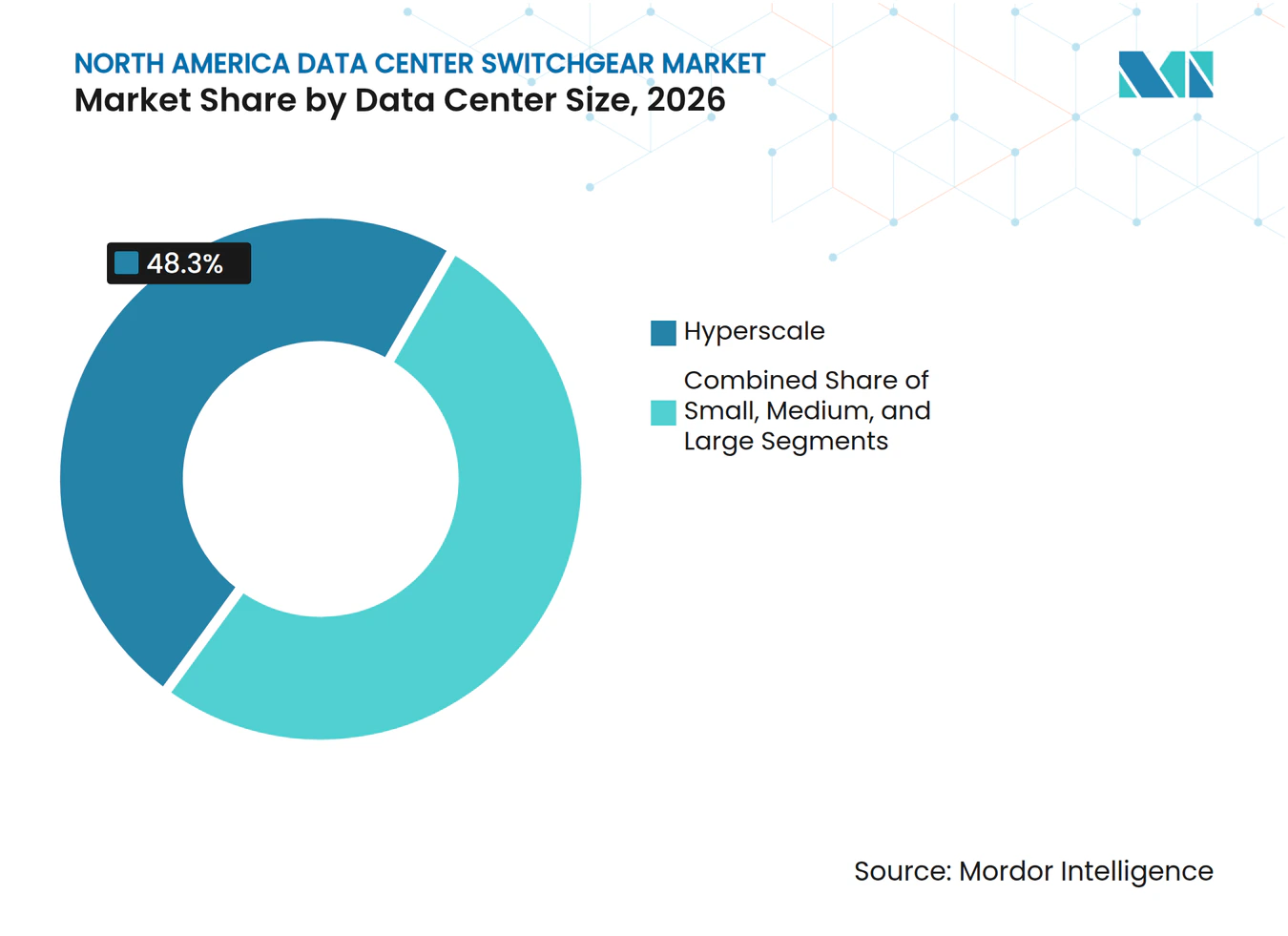
Hyperscale Anchors Both Share and GrowthHyperscale facilities accounted for 48.30% of revenue in 2026 and are projected to expand at a 15.39% CAGR through 2032. Their large campuses require hundreds of medium-voltage sections and create concentrated procurement programs. Powell Industries recorded an order above USD 400 million for behind-the-meter medium-voltage electrical equipment in 2026. Large data centers also contribute meaningful demand through colocation operations. Small and medium facilities support edge computing and enterprise AI inference needs.
AI training clusters can operate at 150-300 kW per rack, increasing electrical content per megawatt across facility sizes. This raises demand for protection, switching, monitoring, and distribution equipment regardless of the final campus footprint. Hyperscale buyers are especially influential because they can set equipment specifications across repeated sites. The North America data center switchgear market has room for suppliers that can meet scale, delivery, and consistency requirements. Other facility sizes remain important because distributed workloads require local infrastructure. The result is a broad demand base, even though the largest programs are concentrated among a smaller group of buyers. This mix gives suppliers a need for both large-program execution and a catalog of reliable products that can serve regional facilities with different operating requirements.
By Data Center Type:
Cloud Service Providers Set the Pace for MV AdoptionCloud service providers held 45.29% of revenue in 2026 and are projected to expand at a 15.53% CAGR through 2032. These buyers operate large campuses with standardized medium-voltage procurement programs. GE Vernova reported more than USD 5 billion in data center orders in its electrification business in the first half of 2026. The scale of cloud projects helps suppliers plan production and service capacity. Colocation operators also require equipment that supports live additions for multiple tenants.
Enterprise and edge sites provide a separate demand stream through digital transformation and distributed AI workloads. These customers often need smaller systems, but their projects can favor standard products and short lead times. Vertiv reported 44% organic revenue expansion in its Americas critical-power business during the first quarter of 2026. The North America data center switchgear market is therefore not dependent on a single facility model. Cloud service providers set the pace, while colocation, enterprise, and edge operators support a wider base of applications. Suppliers, therefore, need portfolios that accommodate highly engineered campus projects as well as repeatable systems for smaller deployments that still require dependable protection and uptime.
Geography Analysis
United States: Dominant Hub Confronting Power Access Limits
The United States held 83.17% of the North America data center switchgear market share in 2026. Northern Virginia, Dallas-Fort Worth, Phoenix, Chicago, Texas, and Ohio remain important centers for hyperscale and AI-focused development. The United States also leads equipment localization as suppliers seek shorter delivery routes and closer customer support. Siemens invested more than USD 165 million in Carolinas manufacturing facilities for low- and medium-voltage products. Hitachi Energy announced USD 1 billion in United States manufacturing investments in 2025, including a USD 457 million transformer facility in Virginia. Grid interconnection limits are a major structural constraint, especially in established hubs. NERC CIP considerations can also affect sites using behind-the-meter generation that interfaces with the bulk power system. These conditions encourage more careful power planning and increase interest in modular, locally supported equipment.
Canada: Hydro Advantage Powering the Fastest-Growing Market
Canada is projected to expand at a 15.71% CAGR through 2032, the fastest rate in the North America data center switchgear market. Its hydroelectric resources and sovereign AI initiatives support interest in larger computing facilities. Innovation, Science and Economic Development Canada sought proposals for large-scale sovereign AI data centers, including facilities above 100 MW.[3] Ontario-based manufacturing has also received support as customers seek local equipment supply. Ontario supported an EnerQuest Technologies expansion in Harrow in 2026, with the company adding switchgear sub-assembly capacity for confirmed demand. Provincial power constraints, especially where new requests exceed available capacity, can redirect projects toward hydro-rich locations or behind-the-meter arrangements. Canadian projects, therefore, combine a low-carbon power advantage with a need for careful interconnection planning.
Mexico and Remaining Markets: Querétaro as the Critical Infrastructure Nexus
Mexico is an emerging longer-term source of demand as new campuses cluster in Querétaro. El Economista reported that Querétaro held 72% of Mexico's installed data center capacity in May 2026.[4] The region offers a focal point for suppliers extending North American coverage and for developers seeking new capacity locations. AWS and CloudHQ commitments reinforce the importance of large projects in the state. Grid connectivity remains a core risk, and developers may turn to on-site natural gas generation when utility supply is delayed. This increases the need for medium-voltage protection and switching at the project level. Mexico's development path will depend on how quickly grid infrastructure can keep pace with facility construction. Local partnerships, equipment service capability, and compliant designs will matter as projects advance.
Competitive Landscape
Market Concentration
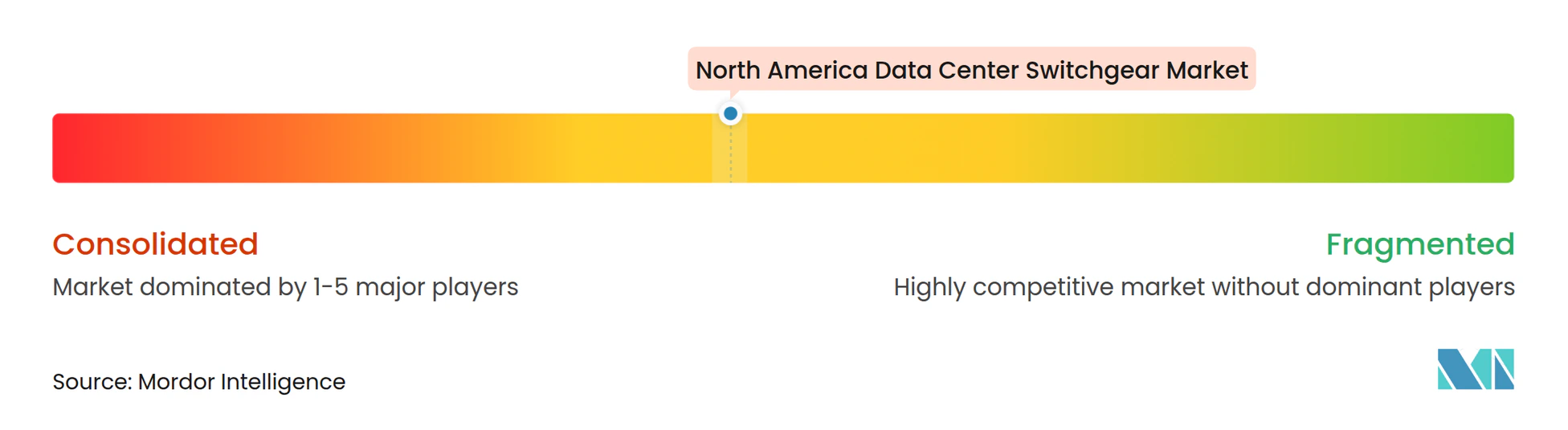
The North America data center switchgear market is moderately consolidated among major suppliers that can provide design, manufacturing, certification, and commissioning support. Schneider Electric, Eaton, ABB, Siemens, and Hitachi Energy serve many hyperscale requirements, while specialists can win projects when capacity is constrained. The group does not have a disclosed combined share, so concentration cannot be quantified from the available evidence. Powell Industries reported a record order exceeding USD 400 million in 2026, demonstrating the scale available to qualified specialists. ANSI/IEEE C37 and UL 1558 certification requirements provide an entry barrier because suppliers must demonstrate tested, reliable equipment. Competition is therefore based on more than price, including delivery certainty, compliance records, and service depth.
Technology is a key differentiator as customers seek shorter time to power and tighter operational control. Schneider Electric's software-defined medium-voltage platform seeks to reduce engineering dependence and speed deployment. ABB introduced MNS 4.0 in 2026 with condition monitoring, embedded cybersecurity, and support for direct-current architectures. ABB also stated that its SACE Emax 3 was the first air circuit breaker to receive IEC 62443 Security Level 2 certification. These moves address customers that want better equipment visibility and stronger protection for connected electrical systems. 800 VDC-rated protection and DC-native switchgear remain early-stage opportunities for suppliers that can scale them.
Manufacturing and portfolio expansion are also changing the competitive field. Legrand acquired Kratos Industries in February 2026 to add low-voltage switchboards and medium-voltage switchgear to its critical-power portfolio. Eaton introduced an 800 VDC reference architecture in 2025 for AI factories that combines medium-voltage conversion and downstream direct-current switchgear. Hitachi Energy's United States manufacturing program adds grid infrastructure capacity that supports the wider power ecosystem. Korean manufacturers are also increasing United States capacity, which could broaden qualified supply over the next several years. The competitive environment is likely to remain active as customers prioritize suppliers that can combine standardized equipment with local support.
North America Data Center Switchgear Industry Leaders
-
Schneider Electric SE
-
Eaton Corporation plc
-
Siemens AG
-
Mitsubishi Electric Corporation
-
G&W Electric Company
-
Legrand SA
- *Disclaimer: Major Players sorted in no particular order
North America Data Center Switchgear Market Companies Covered in this Report
- Schneider Electric SE
- Eaton Corporation plc
- ABB Ltd.
- Siemens AG
- Hitachi Energy Ltd.
- Vertiv Holdings Co
- GE Vernova Inc.
- Powell Industries, Inc.
- Legrand SA
- Mitsubishi Electric Corporation
- S&C Electric Company
- G&W Electric Company
- SEL Schweitzer Engineering Laboratories, Inc.
- Hubbell Incorporated
- Mitsubishi Electric Power Products, Inc.
- WEG S.A.
- Socomec Group S.A.
- Anord Mardix
- Hyosung Heavy Industries
- HD Hyundai Electric
Recent Industry Developments in North America Data Center Switchgear Market
- October 2026: HD Hyundai Electric, LS Electric, and Hyosung Heavy Industries announced simultaneous United States manufacturing capacity expansion programs targeting AI data center demand. LS Electric plans to invest USD 240 million in United States operations by 2030, including a six-fold expansion of its Utah switchgear plant. HD Hyundai Electric's second Alabama plant, due in April 2027, will increase extra-high-voltage capacity by 50%.
- September 2026: Schneider Electric unveiled the world's first fully software-defined medium-voltage switchgear at YOTTA 2026. The platform was piloted at an Equinix colocation data center and can reduce ordering and manufacturing time by up to 3x and commissioning by up to 2x. Schneider Electric also announced RM AirSeT 38, which extends SF₆-free gas-insulated switchgear technology from 24 kV to 38 kV, with first deliveries expected in 2028.
- June 2026: Hyosung Heavy Industries, with HD Hyundai Electric and LS Electric, the three domestic power equipment companies, announced expanding production in the United States to supply transformers and switchgear for data centers and grid upgrades.
- February 2026: Legrand acquired Kratos Industries, a Colorado manufacturer of low-voltage switchboards and medium-voltage switchgear. The acquisition expanded Legrand's critical-power portfolio alongside its strategic investment in Accelsius.
North America Data Center Switchgear Market Report Scope
The North America data center switchgear market encompasses the regional supply, demand, and revenue generated by switchgears engineered to protect and isolate data center power infrastructure. It specifically monitors technological deployments, smart-grid integrations, and market values across the United States, Canada, and Mexico.
The North America Data Center Switchgear Market Report is Segmented by Voltage Level (Low Voltage, Medium Voltage, and High Voltage), Insulation Type (Air-Insulated Switchgear, Gas-Insulated Switchgear, and Other Insulation Technologies), Installation Type (Indoor Switchgear and Outdoor Switchgear), Configuration (Fixed-Mounted Switchgear, Withdrawable Switchgear, and Modular Switchgear), Data Center Size (Small, Medium, Large, and Hyperscale), Data Center Type (Colocation, Cloud Service Providers [CSPs], and Enterprise / Edge), and Country (United States, Canada, and Mexico). The Market Forecasts are Provided in Terms of Value (USD).
Segmentation Overview
| Low Voltage |
| Medium Voltage |
| High Voltage |
| Air-Insulated Switchgear |
| Gas-Insulated Switchgear |
| Other Insulation Technologies |
| Indoor Switchgear |
| Outdoor Switchgear |
| Fixed-Mounted Switchgear |
| Withdrawable Switchgear |
| Modular Switchgear |
| Small |
| Medium |
| Large |
| Hyperscale |
| Colocation |
| Cloud Service Providers (CSPs) |
| Enterprise / Edge |
| United States |
| Canada |
| Mexico |
| By Voltage Level | Low Voltage |
| Medium Voltage | |
| High Voltage | |
| By Insulation Type | Air-Insulated Switchgear |
| Gas-Insulated Switchgear | |
| Other Insulation Technologies | |
| By Installation Type | Indoor Switchgear |
| Outdoor Switchgear | |
| By Configuration | Fixed-Mounted Switchgear |
| Withdrawable Switchgear | |
| Modular Switchgear | |
| By Data Center Size | Small |
| Medium | |
| Large | |
| Hyperscale | |
| By Data Center Type | Colocation |
| Cloud Service Providers (CSPs) | |
| Enterprise / Edge | |
| By Geography | United States |
| Canada | |
| Mexico |
Key Questions Answered in the Report
What is the size of the North America data center switchgear market?
The market is valued at USD 1.81 billion in 2026 and is estimated to reach USD 3.66 billion by 2032, at a 12.07% CAGR from 2027 to 2032.
What is driving demand for data center switchgear in North America?
AI computing, hyperscale campus expansion, higher rack power density, and a shift toward medium-voltage distribution are increasing equipment demand.
Which voltage class has the strongest outlook?
Medium-voltage switchgear is projected to expand at a 14.23% CAGR through 2032 as operators move power distribution closer to dense computing loads.
Why is gas-insulated switchgear gaining adoption?
Gas-insulated equipment can reduce the required footprint by 60-70%, which is valuable in constrained electrical rooms and high-density facilities.
Which country has the largest demand base?
The United States held 83.17% of 2026 revenue, supported by major hyperscale clusters and new AI-focused facilities.
What limits project delivery for switchgear suppliers and data center developers?
Long equipment lead times, skilled commissioning labor shortages, and grid interconnection delays can extend development schedules.