
North America Data Center Sustainable Cooling Market Size and Share
Market Overview
| Study Period | 2021 - 2032 |
|---|---|
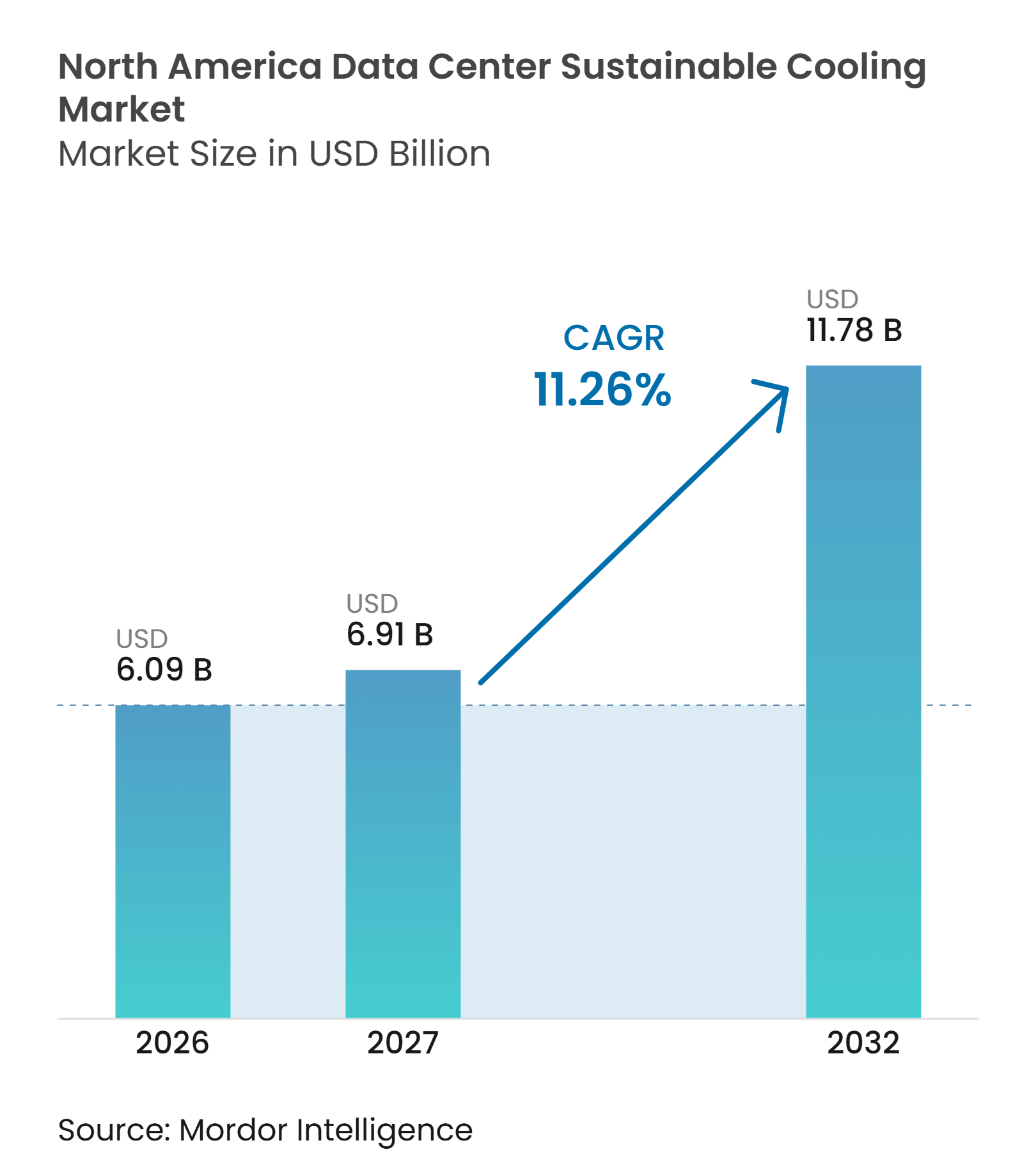
| Base Year Market Size (2026) | USD 6.09 Billion |
| Market Size (2027) | USD 6.91 Billion |
| Market Size (2032) | USD 11.78 Billion |
| Growth Rate (2027 - 2032) | 11.26 % |
| Fastest Growing Market | Asia-Pacific |
| Largest Market | North America |
Major Players *Disclaimer: Major Players sorted in no particular order Image © Mordor Intelligence. Reuse requires attribution under CC BY 4.0. | |
North America Data Center Sustainable Cooling Market Analysis by Mordor Intelligence
The North America data center sustainable cooling market size was USD 6.09 billion in 2026 and is forecast to reach USD 11.78 billion by 2032, at a CAGR of 11.26% during the forecast period from 2027 to 2032. AI and high-performance computing workloads are changing how operators plan cooling capacity because rack power density is moving beyond the range that conventional air systems can manage efficiently. The North America data center sustainable cooling market is therefore shifting toward liquid cooling, hybrid heat rejection, and systems that use less energy and water. Cooling requirements increasingly influence site selection, equipment design, the layout of distribution equipment, maintenance planning, and the timing of data center construction. Suppliers with tested liquid-cooling systems, local manufacturing capacity, close links with server vendors, and the ability to support commissioning are better positioned to serve large projects. Retrofit complexity, utility connections, water permits, coolant supply reliability, and the availability of specialized technicians remain practical limits on deployment, particularly when facilities must continue serving customer workloads during an upgrade.
Key Report Takeaways
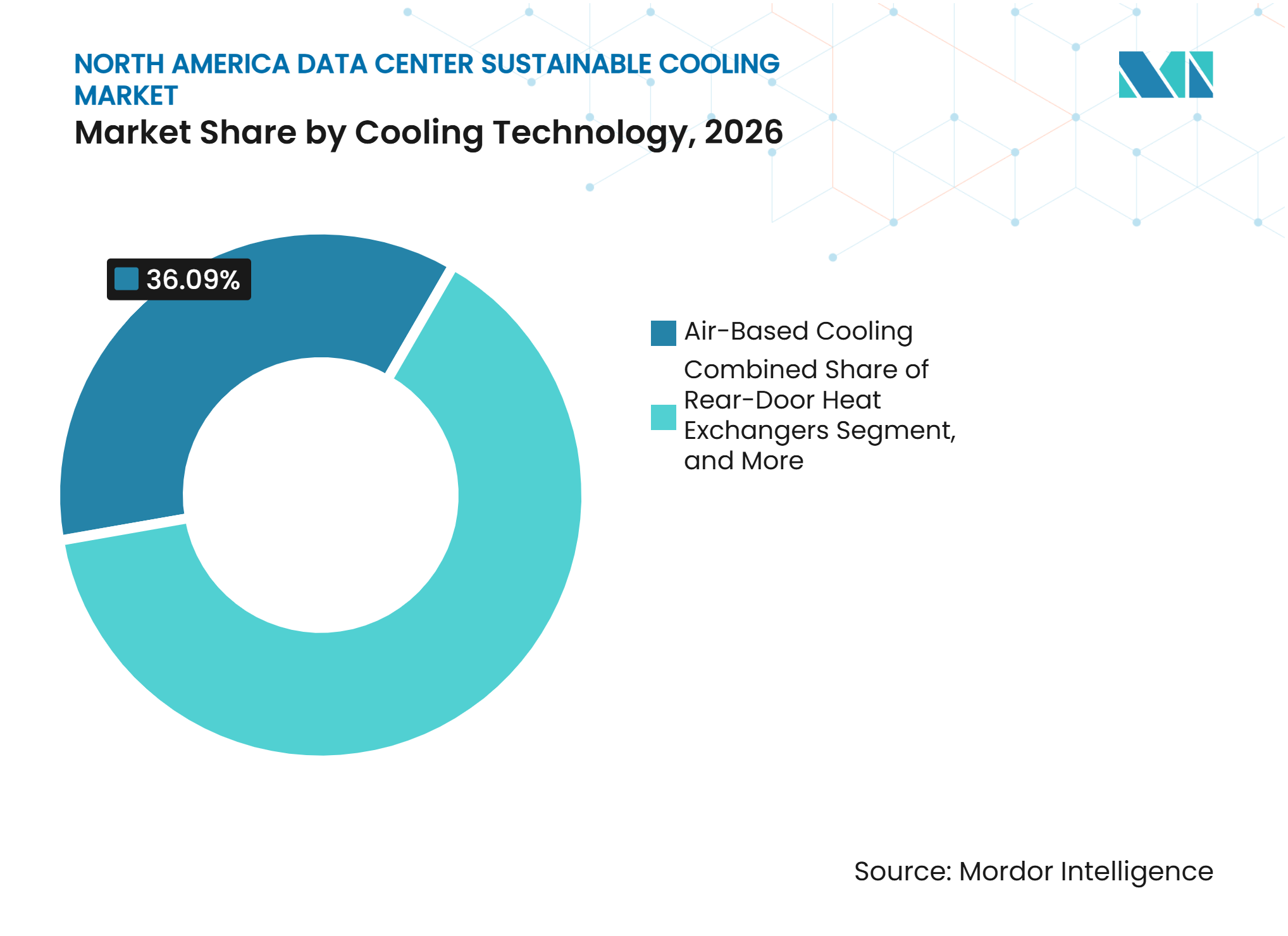
- By cooling technology, air-based cooling held 36.09% of the North America data center sustainable cooling market share in 2026, while direct-to-chip liquid cooling is projected to expand at an 11.58% CAGR through 2032.
- By heat rejection technology, air-cooled systems held 34.27% of the North America data center sustainable cooling market share in 2026, while hybrid heat rejection systems are projected to expand at an 11.82% CAGR through 2032.
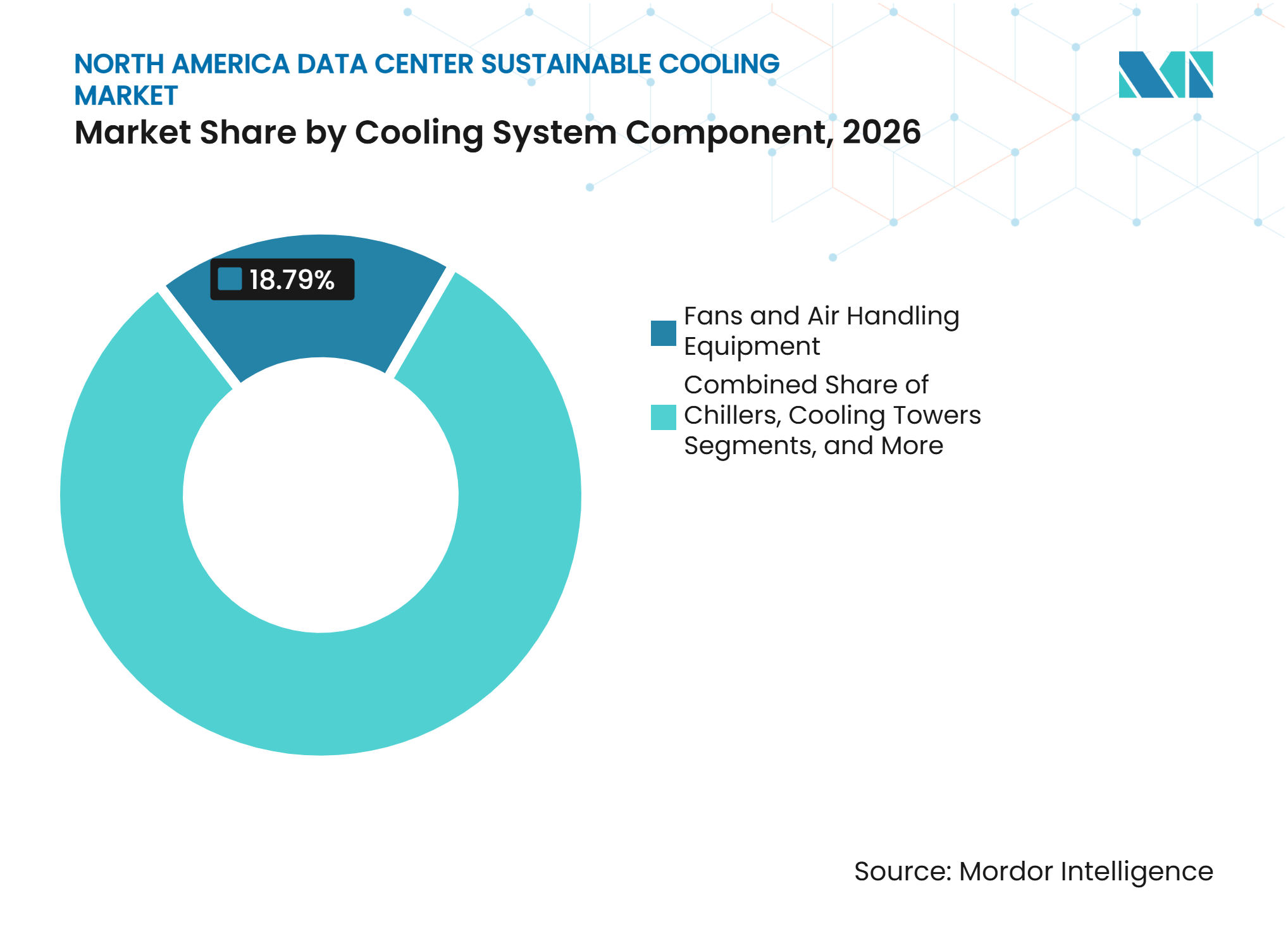
- By cooling system component, fans and air-handling equipment held an 18.79% share in 2026, while cooling distribution units are projected to expand at a 11.79% CAGR through 2032.
- By sustainability approach, energy-efficient cooling held a 39.66% share in 2026, while heat recovery-enabled cooling is projected to expand at an 11.56% CAGR through 2032.
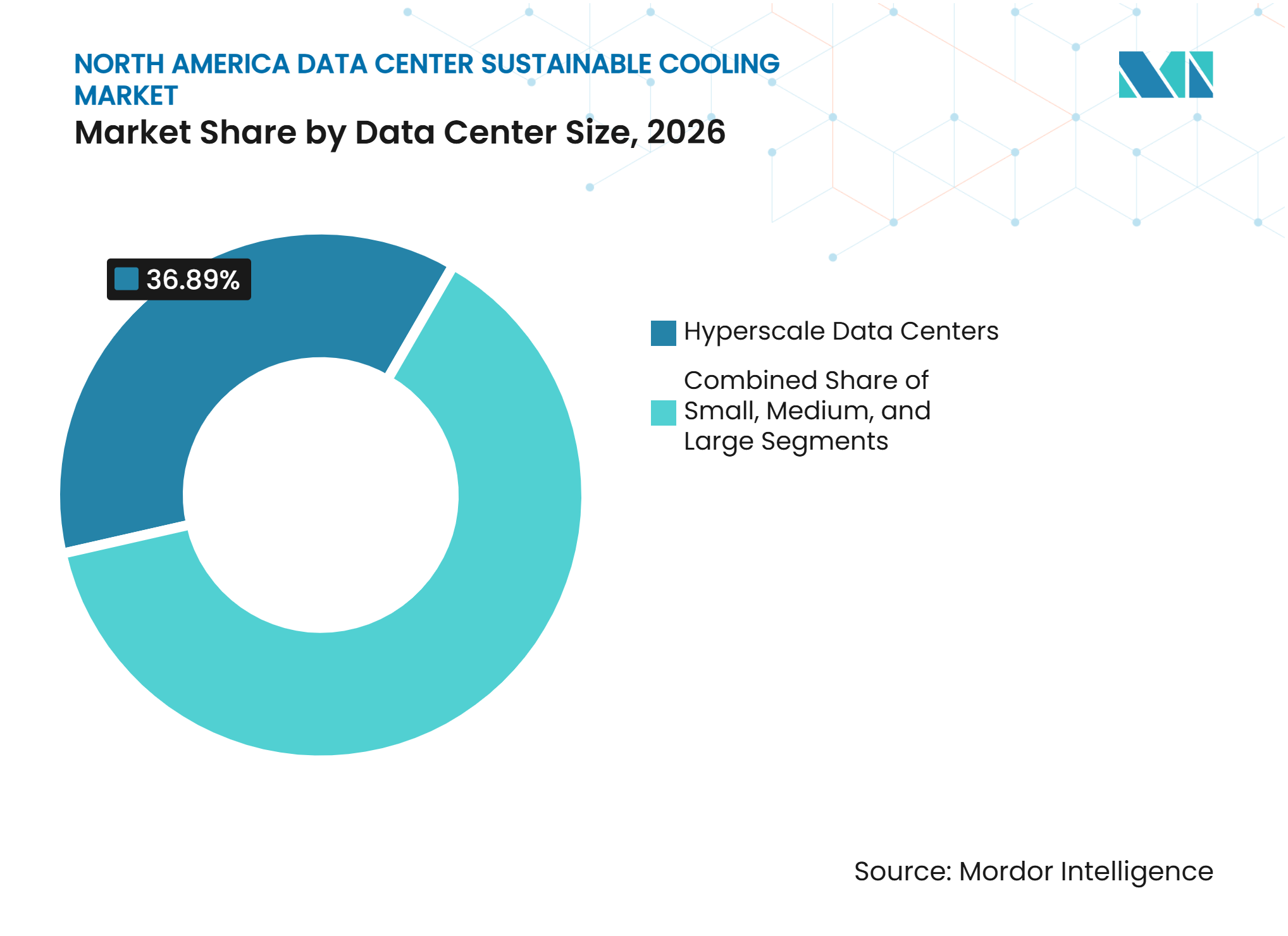
- By data center size, hyperscale data centers held a 36.89% share in 2026 and are projected to expand at an 11.68% CAGR through 2032.
- By data center type, cloud service providers held a 44.68% share in 2026 and are projected to expand at an 11.73% CAGR through 2032.
- By geography, the United States held an 89.48% share in 2026, while Mexico is projected to expand at an 11.94% CAGR through 2032.
Note: Market numbers in this report are based on Mordor Intelligence's proprietary estimation framework, which combines nine months of actuals with Q4 projections for base year 2026.
Market Trends and Insights
Drivers Impact Analysis of North America Data Center Sustainable Cooling Market*
| Driver | (~) % Impact on CAGR Forecast | Geographic Relevance | Impact Timeline |
|---|---|---|---|
| AI and HPC Rack-Density Expansion | +3.5% | Global, concentrated in U.S. hyperscale markets including Northern Virginia, Georgia, and Texas | Short term (≤ 2 years) |
| Hyperscale and Cloud Infrastructure Build-Outs | +2.8% | U.S. primary markets, with spillover to Mexico frontier markets | Short term (≤ 2 years) |
| Corporate Net-Zero Commitments and Cooling Retrofits | +1.5% | North America, with early gains in U.S. enterprise and Canadian colocation facilities | Medium term (2-4 years) |
| Rising Electricity Costs and Cooling Energy Optimization | +1.2% | United States, particularly the PJM Interconnection zone and ERCOT | Medium term (2-4 years) |
| Water-Use Reporting and Closed-Loop Cooling Requirements | +0.8% | Canada and water-stressed U.S. regions | Medium term (2-4 years) |
| Liquid-Ready Server Reference Designs and Warranty Adoption | +0.5% | Global, with the strongest effect in U.S. hyperscale and colocation facilities | Long term (≥ 4 years) |
| Source: Mordor Intelligence | |||
AI and HPC Rack-Density Expansion
AI infrastructure is raising the thermal load that a single rack must handle. NVIDIA GB200 NVL72 rack-scale systems operate at 132 kW per rack, while the next generation could approach 240 kW per rack. Traditional data halls were generally designed for 10-15 kW per rack, so many installations need a different cooling architecture. Schneider Electric described the rapid movement in AI data center design as a response to higher-density GPU deployments and changing facility requirements.[1] The North America data center sustainable cooling market benefits as operators replace air-only capacity with cold plates, liquid loops, and supporting heat rejection equipment. Server reference designs and evolving ASHRAE guidance give operators clearer operating parameters for these systems.
Hyperscale and Cloud Infrastructure Build-Outs
Hyperscale construction is expanding the addressable base for sustainable cooling equipment. Major hyperscalers are planning substantial capital expenditure for AI infrastructure. These projects direct more facility spending toward cooling and power systems because AI workloads require denser and more resilient infrastructure. New campuses across key U.S. regions provide opportunities to specify sustainable cooling before equipment is installed. The North America data center sustainable cooling market gains from greenfield projects because a new facility can integrate liquid loops and monitoring systems without disrupting active workloads. The same projects also strengthen demand for cooling equipment that can be expanded in stages as compute capacity is added.
Corporate Net-Zero Commitments and Cooling Retrofits
Corporate environmental targets are making water and energy performance part of cooling procurement. AWS reported a global data center water-use effectiveness of 0.12 liters per kilowatt-hour in 2025, a 20% improvement from 2024 and a 52% improvement from 2021.[2] Microsoft reported a global water use effectiveness of 0.27 L/kWh in fiscal year 2025, compared with 0.30 L/kWh in fiscal year 2024. Operators that report water-use effectiveness and power-use effectiveness need suppliers that can document equipment-level results. ITU-T Recommendation L.1510 provides environmental key performance indicators for digital infrastructure, including measures relevant to water performance.[3] This reporting environment supports the North America data center sustainable cooling market because cooling decisions are increasingly based on operating outcomes as well as purchase price.
Rising Electricity Costs and Cooling Energy Optimization
Electricity costs reinforce the case for equipment that lowers cooling energy use. U.S. industrial electricity prices remained significant during the first half of the year. Reducing PUE can substantially lower a facility's total power draw, though site conditions and operating practices determine the actual result. Liquid cooling can support substantially lower PUE values than conventional air systems, as reported in the supplied research. This cost relationship makes energy-efficient cooling relevant even where carbon reporting is not the primary purchase driver. It also makes controls, variable-speed equipment, and hybrid systems more important across the North America data center sustainable cooling market.
Restraints Impact Analysis of North America Data Center Sustainable Cooling Market*
| Restraint | (~) % Impact on CAGR Forecast | Geographic Relevance | Impact Timeline |
|---|---|---|---|
| High Retrofit CAPEX and Brownfield Integration Complexity | -1.8% | U.S. legacy colocation and enterprise data centers, especially Northern Virginia | Short term (≤ 2 years) |
| Shortage of Liquid-Cooling and Facilities-Engineering Skills | -1.2% | North America, most acute in fast-growing frontier markets | Medium term (2-4 years) |
| Specialty Coolant Compatibility and Supply-Chain Risk | -0.7% | Global supply chain, most disruptive at rapidly deployed U.S. hyperscale campuses | Medium term (2-4 years) |
| Power Interconnection, Water Permitting and Community Approval Delays | -0.5% | U.S. primary and frontier markets, and grid-constrained Canadian provinces | Long term (≥ 4 years) |
| Source: Mordor Intelligence | |||
High Retrofit CAPEX and Brownfield Integration Complexity
Existing facilities can face material technical and financial barriers when converting to liquid cooling. The supplied research indicated that liquid-cooling conversions in existing halls can involve substantial costs, while new greenfield liquid-cooled capacity requires significantly higher investment. Brownfield work can require structural reinforcement, fluid distribution systems, waterproofing, and scheduled interruptions to live customer workloads. Direct-to-chip and immersion retrofits can also require considerable per-rack investment, with immersion conversions generally involving higher costs. The North America data center sustainable cooling market therefore sees faster adoption in newly built capacity and in mature locations where liquid-cooled capacity earns a clear price premium. Smaller enterprise operators may continue with hybrid systems or targeted air-cooling improvements until the financial case becomes stronger.
Shortage of Liquid-Cooling and Facilities-Engineering Skills
Liquid cooling requires skills that many operating teams have not needed at scale. Operators need mechanical engineers for fluid circuits, thermal engineers for heat transfer, and electro-mechanical technicians for commissioning and maintenance. The U.S. Bureau of Labor Statistics provides occupational data that illustrates the continuing importance of skilled technical roles across the economy. The World Economic Forum also identified workforce development as a major need for data center expansion. When a facility lacks this knowledge, managers may delay deployment even if capital is available. This constraint affects the North America data center sustainable cooling market most strongly in new regions where project development is advancing faster than the local specialist workforce.
*Our forecasts treat driver/restraint impacts as directional, not additive. The impact forecasts reflect baseline growth, mix effects, and variable interactions.
North America Data Center Sustainable Cooling Market Segment Analysis
By Cooling Technology:
Liquid Cooling Addresses Higher Rack DensitiesAir-based cooling held 36.09% of the regional market in 2026 because many colocation and enterprise data centers still use raised-floor air distribution. Direct-to-chip liquid cooling is projected to expand at an 11.58% CAGR through 2032 as GPU systems require heat removal closer to the processor. Immersion cooling also serves extreme-density applications where direct-to-chip equipment may not address all thermal requirements. Rear-door heat exchangers provide an intermediate option for colocation sites that cannot complete a full liquid retrofit. Evaporative and adiabatic systems, along with free cooling and economizer systems, remain relevant where local climate conditions support their use.
The choice of technology increasingly follows the server roadmap rather than a facility standard that applies to every workload. AMD and NVIDIA publish thermal specifications that influence the cooling design selected by data center operators. Schneider Electric documented the movement from roughly 25 kW per rack for NVIDIA A100 DGX SuperPods in 2022 to 132 kW per rack for GB200 systems in 2025. This shift brings cooling suppliers into the purchasing process earlier because plumbing, equipment placement, and service procedures must be considered with the compute design. The North America data center sustainable cooling market is consequently moving toward integrated offerings that combine server-side and facility-side equipment.



By Heat Rejection Technology:
Hybrid Systems Support Staged TransitionsAir-cooled systems held 34.27% of the regional market in 2026, reflecting the installed base of air-handling infrastructure. Hybrid heat rejection systems are projected to expand at an 11.82% CAGR through 2032 because they can accept heat from air and liquid loops. This flexibility helps operators upgrade a portion of a facility without rebuilding every thermal system. Water-cooled and evaporative systems can deliver strong thermal performance but may face scrutiny over water use in water-stressed areas. Dry coolers have a clearer role in temperate and subarctic locations where ambient conditions support waterless operation.
The segment is shaped by the balance between power efficiency and water use. High-density AI sites may favor water-cooled designs for thermal performance, yet corporate goals and local rules can favor closed-loop or low-water systems. Johnson Controls presented an approach that combines combined heat and power with absorption cooling and can achieve a PUE of 1.23 with zero on-site water use. Such configurations show how heat-rejection equipment can be designed to suit local utility conditions. This flexibility creates an opening for suppliers that can demonstrate both energy and water performance to facility owners.
By Cooling System Component:
CDUs Link Rack and Facility Cooling LoopsFans and air handling equipment held an 18.79% share of the North America data center sustainable cooling market in 2026 because air-cooled infrastructure remains widely deployed. Cooling distribution units are projected to expand at an 11.79% CAGR through 2032 as they connect rack-level liquid loops to facility cooling circuits. This role becomes more important as operators combine liquid-cooled AI racks with conventional equipment in the same campus. Chillers, cooling towers, heat exchangers, and pumps continue to serve distinct roles across water-cooled and hybrid facilities. Controls and monitoring systems add value by matching cooling output to changing compute demand.
Suppliers are developing CDU platforms that serve both enterprise and hyperscale applications. Johnson Controls launched its Silent-Aire CDU platform as a scalable solution for high-density data center environments. Schneider Electric and Motivair also introduced the MCDU-70 for high-density AI environments. Modine announced a long-term capacity agreement with a strategic data center customer. The North America data center sustainable cooling market depends on this production capacity because component delays can postpone an entire liquid-cooling installation.

By Sustainability Approach:
Energy Efficiency Leads While Heat Recovery AdvancesEnergy-efficient cooling held a 39.66% share in 2026, making it the largest sustainability approach in the North America data center sustainable cooling market. Variable-speed drives, economizers, and controls can improve operating efficiency in existing air-cooled facilities without requiring a full liquid-cooling installation. This gives energy efficiency a broader immediate customer base than more specialized approaches. ENERGY STAR provides tools that help organizations benchmark data center energy performance. Integrated cooling optimization and controls extend this approach through software that adjusts cooling capacity to real-time demand.
Heat recovery-enabled cooling is projected to expand at an 11.56% CAGR through 2032. It allows operators to consider using data center waste heat for district heating or absorption cooling when local infrastructure supports these options. ITU-T Recommendation L.1328 sets out specifications for the reuse of waste heat in telecommunication rooms and data centers. Water-efficient systems and lower-global-warming-potential refrigerant solutions are also becoming more relevant in cooling procurement. The North America data center sustainable cooling market can therefore combine efficiency improvements with broader changes in water and refrigerant management.
By Data Center Size:
Hyperscale Sites Set the Pace for Cooling DemandHyperscale data centers held 36.89% of the North America data center sustainable cooling market size in 2026 and are projected to expand at an 11.68% CAGR through 2032. Their scale gives them the ability to secure power, specify new cooling architectures, and commit to substantial equipment orders. These companies are expected to make significant investments in AI infrastructure. These projects compress delivery schedules for cooling suppliers and favor companies with available manufacturing capacity. Large data centers follow similar patterns at a smaller scale and often support regional cloud or AI inference requirements.
Small data centers face a different decision because their economics rarely support a complete liquid-cooling conversion. They may use incremental air-cooling improvements, hybrid air-liquid systems, or advanced monitoring to extend current assets. For hyperscale operators, cooling decisions are connected to campus-level power and construction plans. This increases the importance of modular equipment that can be installed as new halls are commissioned. The North America data center sustainable cooling market is therefore weighted toward suppliers that can meet high-volume campus requirements while also serving smaller retrofit projects.
By Data Center Type:
Cloud Providers Standardize Sustainable CoolingCloud service providers held a 44.68% share in 2026 and are projected to expand at an 11.73% CAGR through 2032. Their hardware roadmaps, long facility commitments, and public environmental reporting encourage the use of repeatable cooling designs. Cloud service providers can deploy similar liquid-cooling architectures across multiple campuses, helping suppliers build standardized product lines. Alphabet, Amazon, Microsoft, and Meta invested substantially in capital expenditure, with AI infrastructure representing the dominant use in the supplied research. This investment also increases the importance of vendor qualification and reliable field service.
Colocation providers have a different operating model because they must prepare for tenants with varying rack densities and incomplete hardware roadmaps. They need systems that can support legacy low-density racks and high-density AI clusters within the same facility. Enterprise and edge data centers are also relevant as organizations place AI inference closer to users to reduce latency. Self-contained liquid cooling modules may be better suited to these environments than conventional central chiller plants. This diversity of requirements broadens the set of products sold through the North America data center sustainable cooling market.
Geography Analysis
United States
The United States held 89.48% of the regional market in 2026. The concentration reflects the country’s large installed data center base and the scale of AI infrastructure construction. Northern Virginia remains a major location, while Atlanta, Texas, Ohio, Indiana, and the Carolinas are attracting new capacity. Newer locations allow suppliers to place liquid cooling and hybrid systems at the design stage, avoiding some disruption found in older air-cooled facilities. U.S. deployment also remains exposed to power interconnection delays, water permits, and local review of proposed sites.
Mexico
Mexico is projected to expand at an 11.94% CAGR through 2032 within the North America data center sustainable cooling market. The Mexican Data Center Association projected substantial investment in data center construction and equipment over the coming years. AWS launched its Mexico Central Region in Querétaro with a long-term investment commitment. CloudHQ also announced a major investment in multiple data centers in Querétaro, including a private substation and waterless cooling systems. Transmission development in congested areas such as Querétaro can take several years, supporting demand for closed-loop, waterless, and energy-efficient cooling systems.
Canada
Canada benefits from a power system in which more than 80% of electricity comes from non-emitting sources, while Quebec and British Columbia offer hydroelectric power and cold conditions that support cooling efficiency. Canada’s Responsible Data Center Development Principles ask operators to minimize freshwater use, prioritize closed-loop and efficient water technologies, and disclose water use using recognized standards. Microsoft announced a multibillion-dollar commitment for Canadian digital and AI infrastructure and highlighted water conservation and advanced cooling in new Canadian capacity. Canada’s rules and climate conditions make water-efficient cooling, free cooling, and heat recovery practical areas for equipment development.
Competitive Landscape
Market Concentration
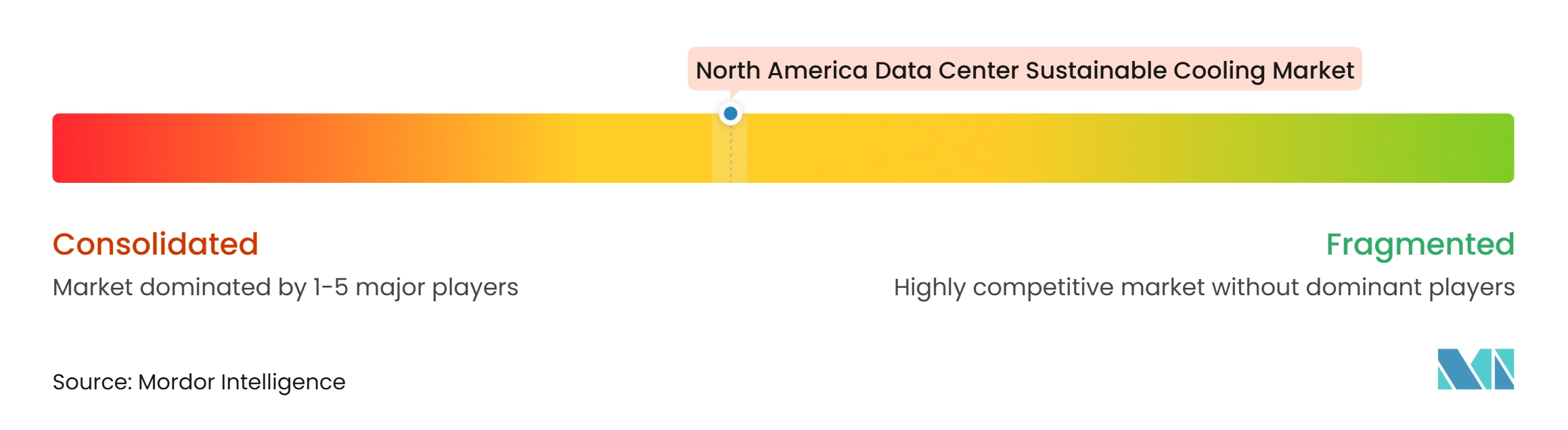
The North America data center sustainable cooling market includes a diverse range of thermal management companies and liquid cooling specialists. Vertiv, Schneider Electric, Johnson Controls, Carrier Global, Trane Technologies, Modine Manufacturing, and STULZ offer portfolios that include chillers, precision cooling, CDUs, and controls. Their established relationships with large data center operators and manufacturing-scale support enabled integrated equipment sales. Modine secured a long-term capacity agreement with a strategic data center customer, including an upfront payment to support capacity investments. Vertiv also announced investments at its Tognana campus to expand regional chiller production capacity and establish a large-scale testing laboratory.
Specialists, including CoolIT Systems, LiquidStack, Iceotope Technologies, Green Revolution Cooling, Chilldyne, and Submer Technologies, compete on focused thermal expertise and product differentiation. Their position is strongest where operators need fast deployment and equipment tailored to liquid-cooled AI hardware. Trane Technologies developed a thermal management reference design for large-scale NVIDIA AI factories.
Procurement decisions increasingly depend on product breadth, proven performance, local manufacturing, and alignment with server vendor roadmaps rather than price alone. ASHRAE-compliant designs, ISO-certified manufacturing, and validated performance data can help suppliers meet hyperscaler qualification requirements. Vendors also compete in integrated controls, modular CDU platforms, and heat recovery systems for phased campus buildouts. Large providers can bundle equipment across a facility, while specialists can focus on specific thermal applications. The North America data center sustainable cooling market remains moderately concentrated because established providers have scale, while specialized firms retain opportunities in rapidly evolving liquid-cooling applications.
North America Data Center Sustainable Cooling Industry Leaders
-
Vertiv Group Corp.
-
Schneider Electric SE
-
Johnson Controls International plc
-
STULZ GmbH
-
Rittal GmbH & Co. KG
- *Disclaimer: Major Players sorted in no particular order
North America Data Center Sustainable Cooling Market Companies Covered in this Report
- Vertiv Group Corp.
- Schneider Electric SE
- Johnson Controls International plc
- STULZ GmbH
- Rittal GmbH & Co. KG
- Mitsubishi Electric Corporation
- Asetek A/S
- Alfa Laval AB
- CoolIT Systems Inc.
- LiquidStack Inc.
- Iceotope Technologies Ltd.
- Green Revolution Cooling Inc.
- Chilldyne Inc.
- Submer Technologies SL
- Carrier Global Corporation
- Trane Technologies plc
- Daikin Industries, Ltd.
- Modine Manufacturing Company
- Munters Group AB
- nVent Electric plc
- Delta Electronics, Inc.
- Airedale International Air-Conditioning Ltd.
- Nortek Air Solutions, LLC
- Hewlett Packard Enterprise Company
- Super Micro Computer, Inc.
Recent Industry Developments in North America Data Center Sustainable Cooling Market
- August 2026: KIO Data Centers announced it had surpassed USD 900 million in total investment in Mexico and committed more than USD 200 million in 2026 for new capacity in Mexico City, Monterrey, and Querétaro. The company simultaneously disclosed plans for a potential USD 1.3 billion investment through 2030 for the QRO3 campus, which would represent the largest facility in its history at approximately 100 MW of capacity, reinforcing Querétaro's position as a primary data center corridor in South America.
- July 2026: Vertiv announced investments at its Tognana campus near Padua, Italy, to expand manufacturing and integrated testing capabilities for data center cooling systems. The company expects to double chiller production capacity in the region by the end of 2026 and plans to complete a new large-scale cooling testing laboratory in early 2027, enabling customers to validate the thermal performance of AI-density deployments under real-world operating conditions.
- July 2026: Johnson Controls published a global blueprint demonstrating that combining on-site power generation with Combined Heat and Power and absorption cooling can achieve a PUE as low as 1.23 with zero on-site water use and up to 43% lower carbon dioxide cooling system emissions, positioning heat recovery as a viable strategy for grid- and water-constrained AI factory deployments.
- May 2026: Modine Manufacturing announced a landmark USD 4 billion long-term capacity agreement through 2029 with a strategic data center customer for its Airedale by Modine cooling solutions, with USD 165 million paid upfront to support capacity investments. The agreement represents one of the largest forward-supply commitments in the North American data center cooling sector and underpins Modine's target of exceeding USD 2 billion in data center revenue by fiscal year 2028.
North America Data Center Sustainable Cooling Market Report Scope
The North America Data Center Sustainable Cooling Market refers to the regional market for energy-efficient, low-carbon, and water-conscious cooling technologies, systems, and services designed to manage thermal loads in data centers across the United States, Canada, and Mexico while minimizing environmental impact, covering liquid cooling (direct-to-chip, immersion, rear-door heat exchangers), free/air-side economization, evaporative and adiabatic cooling, low-GWP refrigerant chillers, waste-heat recovery, AI-driven thermal optimization, and water-efficient closed-loop systems.
The North America Data Center Sustainable Cooling Market Report is Segmented by Cooling Technology (Air-Based Cooling, Direct-to-Chip Liquid Cooling, Immersion Cooling, Rear-Door Heat Exchangers, Evaporative and Adiabatic Cooling, Free Cooling and Economizer Systems, and Other Sustainable Cooling Technologies), Heat Rejection Technology (Air-Cooled Systems, Water-Cooled Systems, Evaporative Heat Rejection, Dry Coolers, and Hybrid Heat Rejection Systems), Cooling System Component (Cooling Distribution Units (CDUs), Chillers, Cooling Towers, Heat Exchangers, Pumps and Fluid Distribution Systems, Fans and Air Handling Equipment, and Cooling Controls and Monitoring Systems), Sustainability Approach (Energy-Efficient Cooling, Water-Efficient Cooling, Low-Global-Warming-Potential Refrigerant Solutions, Heat Recovery-Enabled Cooling, and Integrated Cooling Optimization and Controls), Data Center Size (Small Data Centers, Medium Data Centers, Large Data Centers, and Hyperscale Data Centers), Data Center Type (Colocation Data Centers, Cloud Service Providers (CSPs), and Enterprise and Edge Data Centers), and Geography (United States, Canada, and Mexico). The Market Forecasts Are Provided in Terms of Value (USD).
Segmentation Overview
| Air-Based Cooling |
| Direct-to-Chip Liquid Cooling |
| Immersion Cooling |
| Rear-Door Heat Exchangers |
| Evaporative and Adiabatic Cooling |
| Free Cooling and Economizer Systems |
| Other Sustainable Cooling Technologies |
| Air-Cooled Systems |
| Water-Cooled Systems |
| Evaporative Heat Rejection |
| Dry Coolers |
| Hybrid Heat Rejection Systems |
| Cooling Distribution Units (CDUs) |
| Chillers |
| Cooling Towers |
| Heat Exchangers |
| Pumps and Fluid Distribution Systems |
| Fans and Air Handling Equipment |
| Cooling Controls and Monitoring Systems |
| Energy-Efficient Cooling |
| Water-Efficient Cooling |
| Low-Global-Warming-Potential Refrigerant Solutions |
| Heat Recovery-Enabled Cooling |
| Integrated Cooling Optimization and Controls |
| Small Data Centers |
| Medium Data Centers |
| Large Data Centers |
| Hyperscale Data Centers |
| Colocation Data Centers |
| Cloud Service Providers (CSPs) |
| Enterprise and Edge Data Centers |
| United States |
| Canada |
| Mexico |
| By Cooling Technology | Air-Based Cooling |
| Direct-to-Chip Liquid Cooling | |
| Immersion Cooling | |
| Rear-Door Heat Exchangers | |
| Evaporative and Adiabatic Cooling | |
| Free Cooling and Economizer Systems | |
| Other Sustainable Cooling Technologies | |
| By Heat Rejection Technology | Air-Cooled Systems |
| Water-Cooled Systems | |
| Evaporative Heat Rejection | |
| Dry Coolers | |
| Hybrid Heat Rejection Systems | |
| By Cooling System Component | Cooling Distribution Units (CDUs) |
| Chillers | |
| Cooling Towers | |
| Heat Exchangers | |
| Pumps and Fluid Distribution Systems | |
| Fans and Air Handling Equipment | |
| Cooling Controls and Monitoring Systems | |
| By Sustainability Approach | Energy-Efficient Cooling |
| Water-Efficient Cooling | |
| Low-Global-Warming-Potential Refrigerant Solutions | |
| Heat Recovery-Enabled Cooling | |
| Integrated Cooling Optimization and Controls | |
| By Data Center Size | Small Data Centers |
| Medium Data Centers | |
| Large Data Centers | |
| Hyperscale Data Centers | |
| By Data Center Type | Colocation Data Centers |
| Cloud Service Providers (CSPs) | |
| Enterprise and Edge Data Centers | |
| By Geography | United States |
| Canada | |
| Mexico |
Key Questions Answered in the Report
What is the size of the North America data center sustainable cooling market?
The North America data center sustainable cooling market was valued at USD 6.09 billion in 2026 and is forecast to reach USD 11.78 billion by 2032, at an 11.26% CAGR from 2027 to 2032.
What is driving demand for sustainable data center cooling in North America?
Higher AI rack densities, hyperscale construction, energy costs, and water-use targets are accelerating demand for efficient liquid, hybrid, and closed-loop cooling systems.
Which cooling technology is expanding fastest in North America?
Direct-to-chip liquid cooling is projected to expand at an 11.58% CAGR through 2032 as GPU-based AI systems require higher heat removal capacity.
Which customer group leads sustainable cooling spending?
Cloud service providers held 44.68% share in 2026 and are projected to expand at an 11.73% CAGR through 2032.
Why are cooling distribution units important for AI data centers?
CDUs connect rack-level liquid loops with facility cooling circuits and are projected to expand at an 11.79% CAGR through 2032.
Which North American country is expanding fastest for sustainable data center cooling?
Mexico is projected to expand at an 11.94% CAGR through 2032, supported by major new data center investments in Querétaro and other locations.