
North America Data Center Security Services Market Size and Share
Market Overview
| Study Period | 2021 - 2032 |
|---|---|
| Forecast Data Period | 2027 - 2032 |
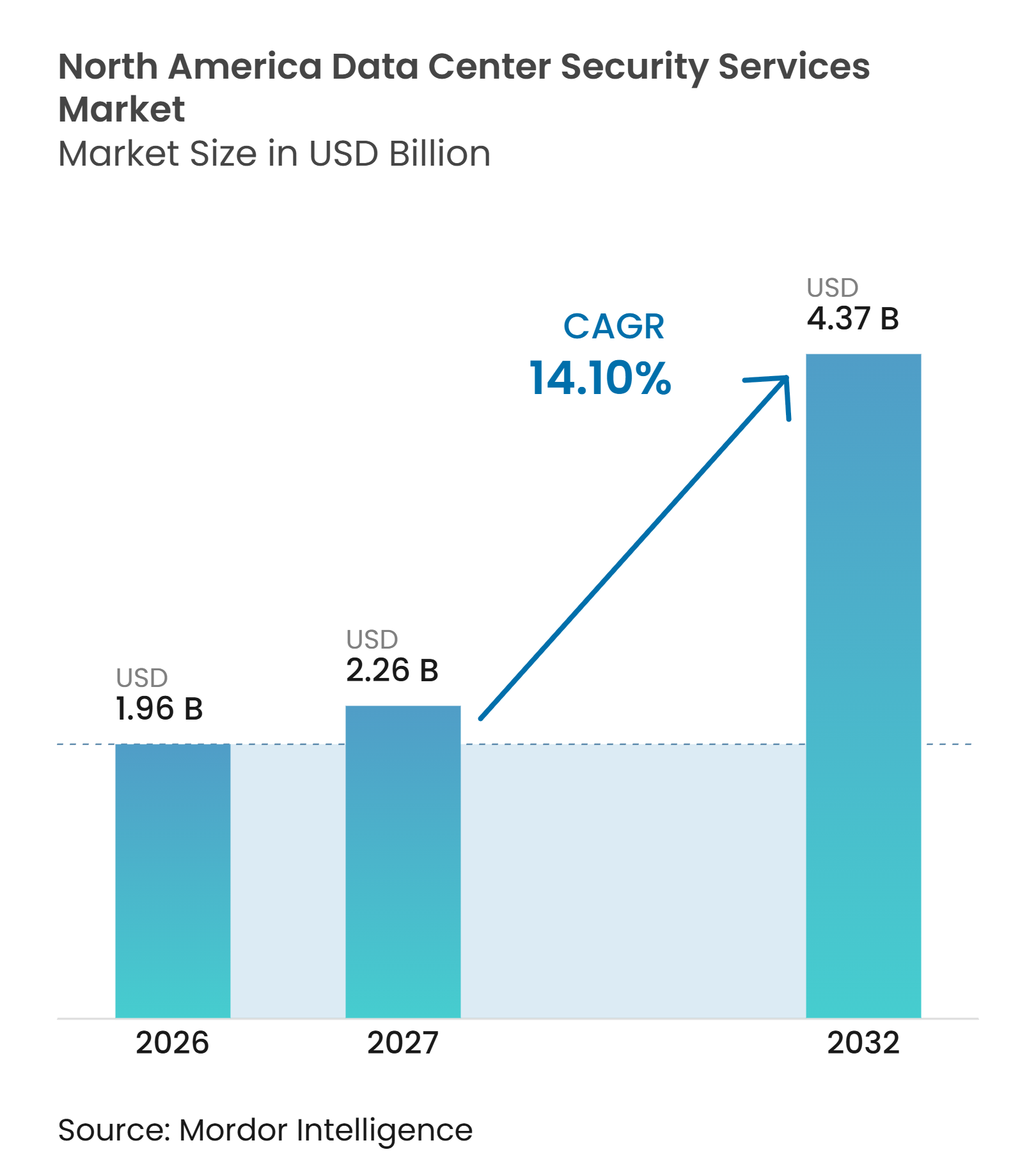
| Base Year Market Size (2026) | USD 1.96 Billion |
| Market Size (2027) | USD 2.26 Billion |
| Market Size (2032) | USD 4.37 Billion |
| Growth Rate (2027 - 2032) | 14.10 % |
| Market Concentration | Medium |
Major Players *Disclaimer: Major Players sorted in no particular order Image © Mordor Intelligence. Reuse requires attribution under CC BY 4.0. | |
North America Data Center Security Services Market Analysis by Mordor Intelligence
The North America data center security services market size is projected to expand from USD 1.96 billion in 2026 to an estimated USD 2.24 billion in 2027 and USD 4.37 billion by 2032, registering a CAGR of 14.10% between 2027 and 2032. The North America data center security services market is supported by extensive construction activity, preleased capacity, and the need to protect facilities through construction, commissioning, and operations. The shift toward artificial intelligence workloads increases the need to secure physical systems, operational technology, and networked platforms as connected parts of the same facility. Providers are responding with managed agreements, remote monitoring, and integrated command-center services that can support portfolios rather than individual sites. The North America data center security services market also faces higher integration costs and limited availability of people with combined physical, operational technology, and cybersecurity skills. These conditions favor providers with national coverage, established customer relationships, and the ability to combine on-site and remote delivery.
Key Report Takeaways
- By service type, manned guarding and physical security led with 32.71% of the North America data center security services market revenue share in 2026, while Security Operations Center services are projected to expand at a 15.26% CAGR through 2032.
- By service delivery model, on-site security services held 46.28% of the North America data center security services market share in 2026, while remote and centralized security services are projected to expand at a 16.92% CAGR through 2032.
- By contract type, dedicated site-level contracts held 38.74% revenue share in 2026, while managed service agreements are projected to expand at a 16.39% CAGR through 2032.
- By customer type, colocation providers held 46.54% revenue share in 2026, while cloud service providers are projected to expand at a 15.59% CAGR through 2032.
- By data center size, hyperscale facilities held 46.21% revenue share in 2026 and are projected to expand at a 17.27% CAGR through 2032.
- By geography, the United States held 38.64% revenue share in 2026, while Mexico is projected to expand at a 17.96% CAGR through 2032.
Note: Market numbers in this report are based on Mordor Intelligence's proprietary estimation framework, which combines nine months of actuals with Q4 projections for base year 2026.
Market Trends and Insights
Drivers Impact Analysis of North America Data Center Security Services Market*
| Driver | (~) % Impact on CAGR Forecast | Geographic Relevance | Impact Timeline |
|---|---|---|---|
| Hyperscale and Colocation Capacity Expansion | +3.2% | United States, Canada, and Mexico | Short term (≤ 2 years) |
| Rising Cyber-Physical Threat Exposure | +2.8% | North America, concentrated in United States hyperscale corridors | Short term (≤ 2 years) |
| Physical and Cybersecurity Convergence | +2.1% | United States and Canada, with Mexico developing | Medium term (2-4 years) |
| Regulatory and Customer Compliance Requirements | +1.8% | United States, Canada, and Mexico | Medium term (2-4 years) |
| Construction-Phase Security Demand for AI Infrastructure | +1.4% | United States and Mexico's Querétaro corridor | Short term (≤ 2 years) |
| Remote Monitoring Demand Across Edge Sites | +0.9% | North America, especially secondary United States locations and Canada | Long term (≥ 4 years) |
| Source: Mordor Intelligence | |||
Hyperscale and Colocation Capacity Expansion
Hyperscale operators are adding facilities faster than internal security teams can be recruited and trained. This creates a sustained need for third-party services throughout the construction and operating phases. More than 80% of 7,481 MW under construction in North America's primary markets at mid-2026 had already been preleased. That pattern requires security providers to pursue contracts before facilities enter service. It also gives an early contractor a stronger position when a customer later seeks operating-phase coverage. The North America data center security services market, therefore, benefits when a provider can support access controls, perimeter protection, contractor screening, and response arrangements from the earliest project stage.
Rising Cyber-Physical Threat Exposure
Data centers increasingly operate as cyber-physical environments rather than as separate buildings and networks. A compromise affecting building management systems, access control, or remote monitoring tools can disrupt cooling, power distribution, or access to critical areas. This connection increases the scope of security contracts because providers must consider physical entry, device integrity, and operational continuity together. The North America data center security services market is responding to this exposure by coordinating more closely among guards, security operations centers, facilities teams, and cyber teams. Ransomware remained the most frequently identified data center threat for 9 consecutive years, while human threats were identified by 57% of respondents in 2025, and DDoS concerns by 47%. The resulting demand is not limited to a single tool because operators need monitoring, escalation procedures, and evidence that controls were followed.
Physical and Cybersecurity Convergence
Physical and cybersecurity convergence is changing the design of managed security offerings. Hyperscalers are integrating cyber, operational technology, and physical security information in unified command environments. Many colocation and legacy facilities still use separate teams and platforms, which creates a gap that integrated providers can address. The North America data center security services market benefits when a provider can bring physical-access logs, operational telemetry, and cyber-event data into a shared response process. A 2025 data center cybersecurity cohort led by Idaho National Laboratory identified fragmented governance at the information technology and operational technology boundary as a systemic vulnerability.[1] The work involved 17 organizations and noted that mature managed-service coverage for this boundary was still limited.
Regulatory and Customer Compliance Requirements
Compliance obligations are making documented security controls more valuable to data center customers. ISO/IEC 27001, SOC 2 Type II, and the Cybersecurity Maturity Model Certification are among the frameworks that shape contract requirements. The CMMC program became effective under the Defense Federal Acquisition Regulation Supplement on November 10, 2025.[2] These requirements increase the value of monitoring records, accessing evidence, and documenting incident processes. The North America data center security services market gains where customers need outside providers to produce evidence that controls work consistently. This is particularly relevant for facilities supporting regulated enterprise, public-sector, or sensitive workloads.
Restraints Impact Analysis of North America Data Center Security Services Market*
| Restraint | (~) % Impact on CAGR Forecast | Geographic Relevance | Impact Timeline |
|---|---|---|---|
| High Integration and Retrofit Costs | -1.5% | United States legacy facilities and older Canadian colocation stock | Medium term (2-4 years) |
| Shortage of Specialized Security Personnel | -1.2% | North America, with pressure in secondary United States construction locations | Short term (≤ 2 years) and Medium term (2-4 years) |
| Construction-Site Access Volatility and Supply-Chain Tampering Risk | -0.8% | Active United States corridors in Texas, Indiana, and Northern Virginia | Short term (≤ 2 years) |
| Interoperability Gaps Across Legacy and Modern Platforms | -0.6% | North America, especially retrofitted colocation assets | Long term (≥ 4 years) |
| Source: Mordor Intelligence | |||
High Integration and Retrofit Costs
Deploying a converged security architecture in older facilities can exceed initial project budgets. Legacy building management systems and separate monitoring platforms often require replacement, integration work, and additional testing. The Security Industry Association identified outdated specifications, siloed systems, and limited integration expertise as significant physical-security risks for data centers in 2025.[3] Smaller operators can find that perimeter upgrades, artificial intelligence-enabled video, and operational technology-aware monitoring cost as much as, or more than, a yearly managed-service agreement. This limits the speed of comprehensive adoption in facilities with tight capital budgets. It also gives operators an incentive to extend existing contracts and modernize systems in stages.
Shortage of Specialized Security Personnel
The supply of people with relevant security and data center experience is not keeping pace with capacity additions. Operators need personnel who can manage physical access, understand operational technology environments, and follow cybersecurity incident procedures. The World Economic Forum reported in 2025 that more than half of operators struggled to attract and retain qualified data center staff. This shortage can delay service mobilization and raises the cost of staffing high-security facilities. It is particularly challenging in newer construction corridors where large campuses require personnel at the same time. The North America data center security services market must balance customer demand for rapid expansion against the time required to train and retain qualified teams.
*Our forecasts treat driver/restraint impacts as directional, not additive. The impact forecasts reflect baseline growth, mix effects, and variable interactions.
North America Data Center Security Services Market Segment Analysis
By Service Type:
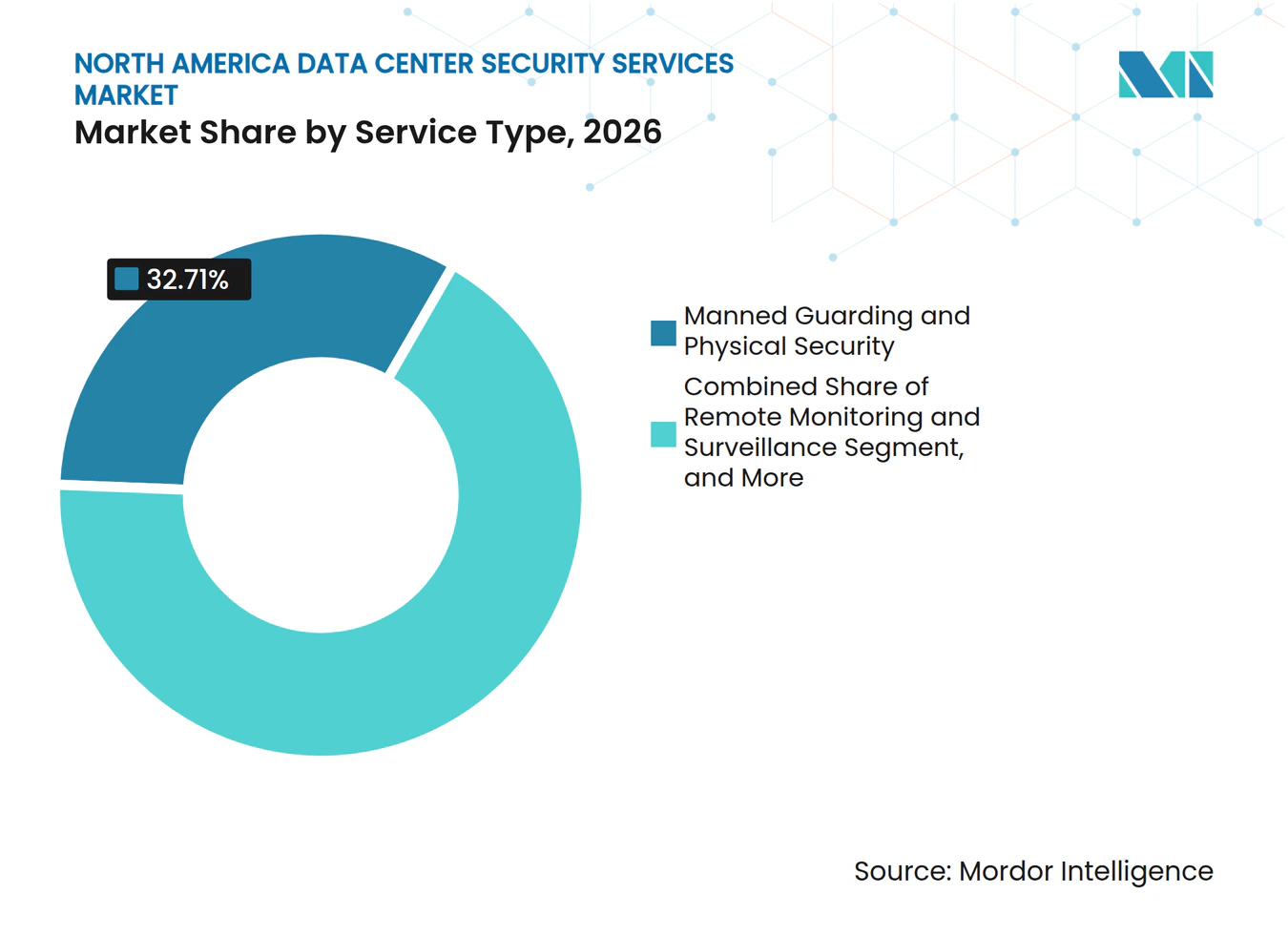
SOC Services Shift the Mix Beyond GuardingManned guarding and physical security accounted for 32.71% of the North America data center security services market share in 2026. The segment remains important because perimeter protection, access verification, visitor control, and immediate incident response require people at the facility. A single unauthorized entry can create operational disruption, particularly in restricted areas with power or network equipment. Guards can apply judgment when a construction area changes, a visitor arrives unexpectedly, or a local issue requires immediate escalation. Providers also use on-site personnel to coordinate with facilities teams, contractors, and local authorities. This service category is therefore central to customer expectations for physical presence and accountable access control. Its position reflects the fact that technology-supported security has not replaced the need for trained site teams.
Security Operations Center services are projected to expand at a 15.26% CAGR through 2032, the fastest rate among service types. SOC teams can correlate physical-access logs, operational technology telemetry, camera alerts, and cyber events on a continuous basis. This enables an operator to view a potential incident in the context of other changes occurring at the facility. Remote monitoring and surveillance form an important middle tier by using camera analytics and drone patrols to extend coverage. Access control and visitor management are also gaining importance as customers automate contractor credentials and investigate anomalies. Genetec identified artificial intelligence-driven anomaly detection in unified platforms as a key procurement priority for 2026.[4] Maintenance, support, risk assessment, and consulting complete the service mix by helping customers maintain controls and improve site-specific procedures.



By Service Delivery Model:
Remote Delivery Changes Operating EconomicsOn-site security services commanded 46.28% of the segment in 2026. This delivery model remains necessary because hyperscaler and colocation leases require controlled physical access and an on-location response. On-site teams can manage credential checks, escort rules, delivery activity, and emergency coordination. They also provide a visible presence at facilities where customers expect strict perimeter management. The North America data center security services industry relies on this model for locations with high asset values and complex daily operations. In many cases, an on-site team provides the local knowledge needed to make a centralized security plan practical. It is especially relevant during construction, commissioning, and periods of increased contractor activity.
Remote and centralized security services are projected to expand at a 16.92% CAGR through 2032. A central monitoring center can support many distributed edge locations and reduce the number of personnel required at each site. Securitas described a deployment in which a customer expanded from 20 to more than 300 standardized data centers with remote management. Remote delivery is not a complete replacement for local response because physical incidents still require action at the site. It is more often used alongside on-site teams, with each model serving different parts of the security process. Hybrid delivery allows staffing levels to follow changes in operational risk rather than lease requirements alone. The North America data center security services market is likely to see more blended models as customers seek consistent coverage across both major campuses and smaller facilities.
By Contract Type:
Managed Agreements Support Portfolio ConsistencyDedicated site-level contracts held 38.74% of the segment in 2026. These agreements are supported by hyperscaler demand for providers familiar with a campus's specific power systems, access points, and perimeter layout. A dedicated provider can build detailed local procedures and maintain relationships with the site's operating team. This can be valuable when a facility has strict visitor rules, sensitive equipment, or a large construction workforce. Site-level arrangements also give customers direct oversight of staffing, hours, and daily performance. The model remains relevant where security risks and operating routines are highly specific to one location. However, it can be less efficient for operators with a growing network of facilities.
Managed service agreements are projected to expand at a 16.39% CAGR through 2032. Colocation and cloud providers are increasingly seeking consistent security procurement across portfolios rather than separate site-by-site arrangements. These agreements can include service-level guarantees, outcome-based pricing, technology refresh provisions, and recurring reporting. They give operators a way to apply common controls while retaining room for local site requirements. SOC 2 Type II expectations also support this transition because continuous monitoring and documented control effectiveness are easier to organize under a defined managed scope. Multi-site and regional contracts offer a related option for mid-tier operators that need consistency across a cluster of facilities. The North America data center security services market benefits when providers can translate these shared requirements into reliable delivery across locations.
By Customer Type:
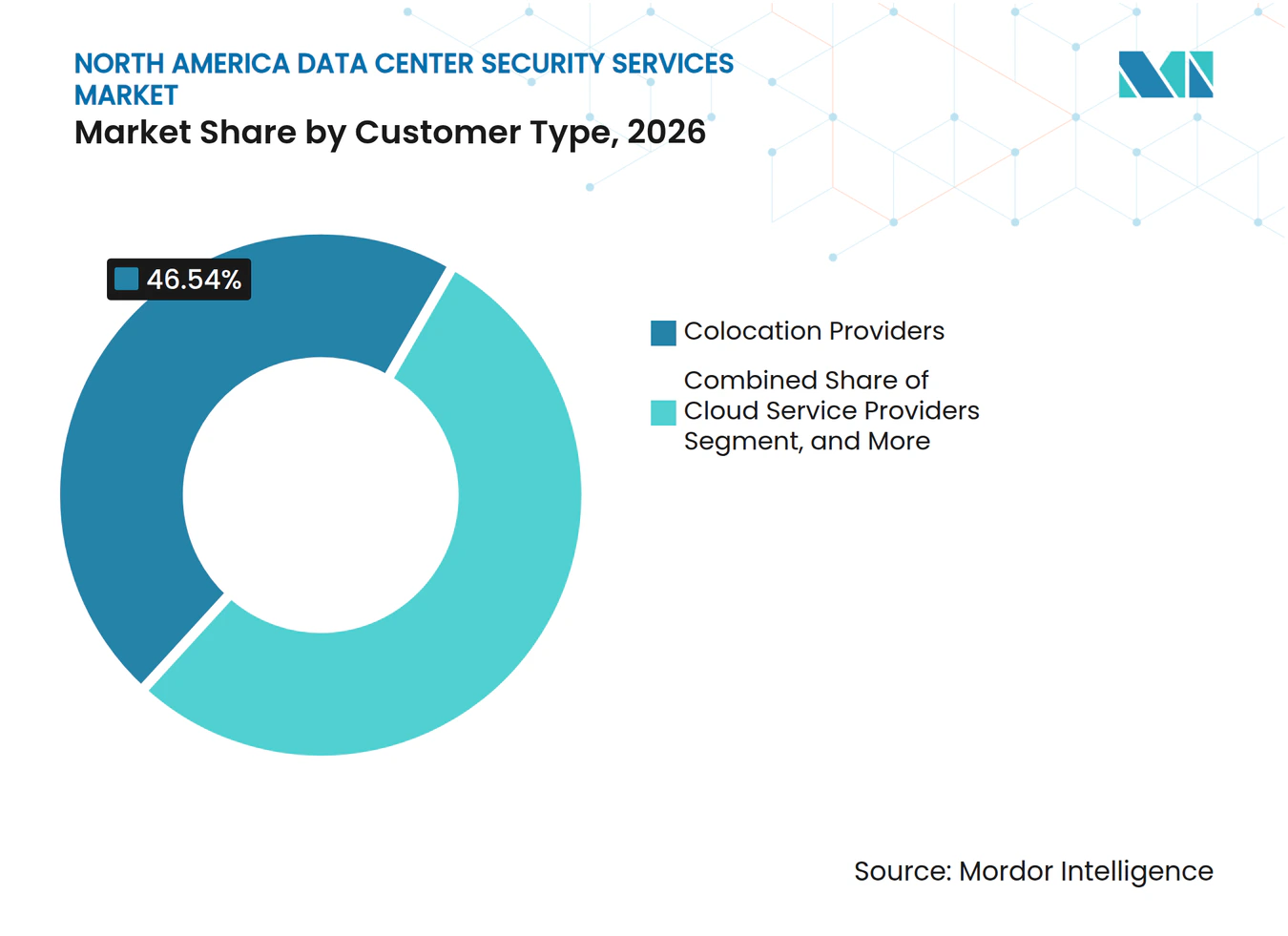
Colocation Demand Leads, Cloud Demand AcceleratesColocation providers accounted for 46.54% of the segment in 2026. Their business model depends on delivering a secure and verifiable operating environment to multiple tenants. Security is therefore a core part of the service proposition rather than a discretionary cost. Colocation operators need clear access rules, visitor processes, records, and response procedures that customers can review. Their multi-tenant setting can also require detailed separation of permissions and areas. This supports demand for managed security, access-control administration, and evidence of control performance. The segment's scale reflects the importance of trusted facility operations in attracting and retaining tenants.
Cloud service providers are projected to expand at a 15.59% CAGR through 2032. Their security partners need to scale across many campuses while applying common practices and reporting standards. These contracts can be large and standardized because a provider is supporting repeatable facility designs and centralized operating policies. Enterprise and edge operators represent a smaller revenue base, but they need support across a larger number of dispersed sites. Their security budgets are more cost-sensitive, which favors remote monitoring and managed services over dedicated teams. Cloud-serving contracts are generally larger in value, while edge mandates can be more numerous and operationally varied. The North America data center security services market requires different delivery approaches for these customer groups rather than a single standard service model.

By Data Center Size:
Hyperscale Facilities Lead Scale and MomentumHyperscale data centers held 46.21% of the North America data center security services market size in 2026 and are projected to expand at a 17.27% CAGR through 2032. The combination of the largest share and the fastest projected expansion makes this tier particularly important for providers. Hyperscale facilities require extensive access management, perimeter controls, monitoring, and procedures for large contractor populations. Their scale also creates demand for integrated processes that can handle physical, operational, and cyber events. Fortinet launched its Secure AI Data Center solution in November 2025 with zero-trust architecture, LLM threat protection, and the FortiGate 3800G platform. Such architecture standards influence the security frameworks customers seek across their facilities. This category sets a demanding benchmark for service providers because its customers expect scale without weaker controls.
Large data centers form the next tier and serve enterprise operators and multi-tenant colocation customers with structured security needs. Medium facilities, typically 5-20 MW, are more sensitive to the cost of replacing legacy access and monitoring systems. They can also face greater interoperability issues between older controls and newer operational technology-aware platforms. Small facilities and enterprise edge sites are strategically important when workloads are decentralized for latency and resilience purposes. Their individual budgets often favor remote monitoring and managed arrangements instead of dedicated on-site teams. Each size tier therefore has a different balance of staffing, technology, and integration needs. Providers that can adjust coverage without weakening the control environment are better positioned to serve a mixed portfolio.
Geography Analysis
United States
The United States held 38.64% of the regional segment in 2026. It has the largest concentration of operating capacity, construction activity, and hyperscale investment in the region. Security demand extends across established corridors and newer locations that are attracting large campuses. Atlanta had nearly 2,900 MW under construction through mid-2026, while Northern Virginia recorded a 0.2% vacancy rate. Texas and the Midwest accounted for 33% of operating hyperscale capacity in the United States at the end of 2025 and are expected to account for 53% of new capacity in the following years. This broader geography creates demand for providers capable of mobilizing teams outside the Northern Virginia corridor. It also increases the importance of centrally managed procedures that still work under local operating conditions.
Canada
Canada has a smaller hyperscale pipeline than the United States but remains a mid-maturity location for data center security services. Ontario and Quebec concentrate much of the country's investment and support multi-site portfolios operated by major cloud and colocation providers. Canadian privacy rules increase the need for audit trails and documented security processes in managed contracts. On-site guard models continue to have a strong role in the country's data centers. This leaves room for hybrid services that link a local response team with regional monitoring support. The North America data center security services market size in Canada is supported by customers that need geographically consistent service across more than 1 site. Providers with North America-wide capabilities can address this requirement without treating Canadian facilities as isolated deployments.
Mexico
Mexico is projected to expand at a 17.96% CAGR through 2032, the fastest rate among the countries covered. MexDC projected USD 82.5 billion in investment between 2026 and 2031, with 279 MW operating, 205 MW under construction, and 1,730 MW announced. Querétaro accounted for 65% of installed national capacity and had active projects from AWS, Microsoft Azure, CloudHQ, and OData. The pace of announced capacity means security providers must develop local workforces and integrator relationships quickly. Construction contracts can be awarded before providers have assembled the required local operating capability. This creates an opening for firms that combine regional standards with local delivery partners. It also makes workforce development and project mobilization important considerations for customers entering the country.
Competitive Landscape
Market Concentration
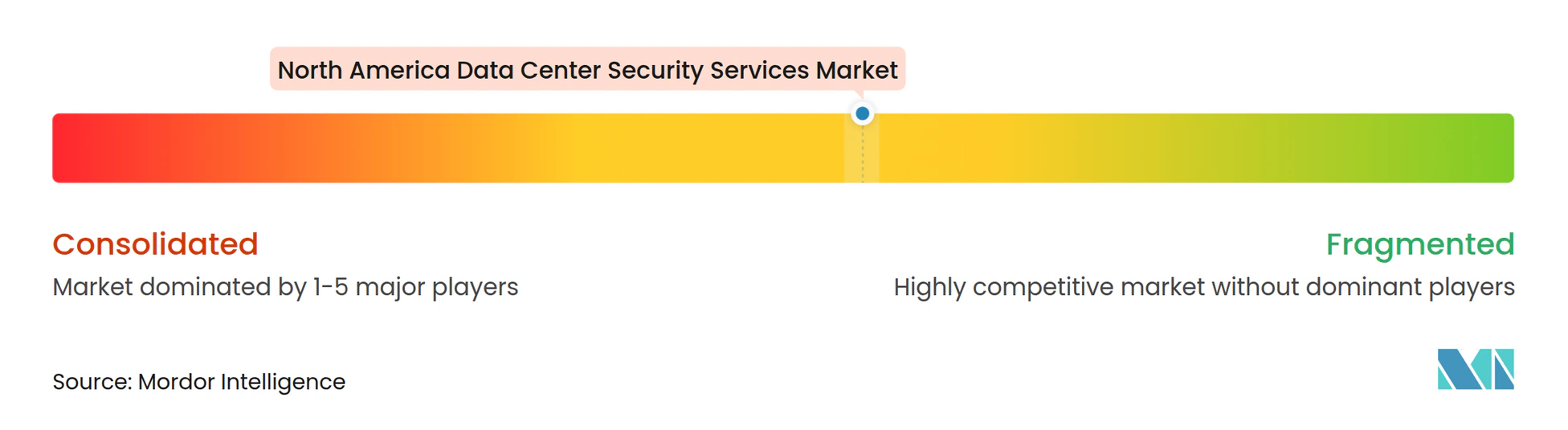
The North America data center security services market is moderately fragmented at the top tier. Allied Universal, Securitas, and Johnson Controls have strong positions through scale, long-term customer relationships, and technology-supported managed services. Specialized integrators such as Convergint Technologies, ASSA ABLOY, and HID Global compete through specific physical-security capabilities. Cisco, Palo Alto Networks, Fortinet, and IBM offer cybersecurity capabilities relevant to customers seeking integrated monitoring. The competitive field, therefore, includes providers with different starting points rather than a uniform set of guard-service businesses. Larger companies can support national accounts, while specialists can compete through technical depth or deep knowledge of a particular facility type. Customers are likely to assess both service coverage and the ability to connect systems across physical and digital environments.
Technology integration is a central competitive theme in the North America data center security services market. Securitas signed a binding agreement in February 2026 to acquire Liferaft, a software-as-a-service threat intelligence platform focused on North America. The move adds digital risk intelligence to its recurring-revenue offering and broadens its security-service scope. Johnson Controls introduced managed SOC services and artificial intelligence-enabled video analytics at GSX 2026. This shows how building systems providers are moving toward managed models as customers seek centralized monitoring and response. Palo Alto Networks launched Unit 42 Managed XSIAM in March 2025 with 24/7 monitoring supported by more than 7,000 detectors and 2,400 behavioral models. These moves increase competition for SOC-related work that crosses physical and cybersecurity responsibilities.
Convergint delivered a multilayer physical security solution for a hyperscale facility in September 2026. The deployment included biometric authentication, anti-tailgating technology, server-cabinet access controls, video surveillance, and intelligent key management. This example shows the value of specialized execution in sites with multiple layers of controlled access. Opportunities remain in cyber-physical security for hyperscale campuses and managed services for smaller edge locations. Smaller sites may be underserved because their budgets do not support the same staffing model as those at large campuses. Providers that combine remote monitoring with clear local response arrangements can address this group. Competition will depend on whether companies can turn technical capabilities into services that operators can deploy consistently across changing facility portfolios.
North America Data Center Security Services Industry Leaders
-
Cisco Systems, Inc.
-
Johnson Controls International plc
-
Securitas AB
-
Allied Universal
-
Palo Alto Networks, Inc.
- *Disclaimer: Major Players sorted in no particular order
North America Data Center Security Services Market Companies Covered in this Report
- Cisco Systems, Inc.
- Johnson Controls International plc
- Securitas AB
- Allied Universal
- Palo Alto Networks, Inc.
- Honeywell International Inc.
- Fortinet, Inc.
- ASSA ABLOY AB
- Siemens AG
- Schneider Electric SE
- Robert Bosch GmbH
- Axis Communications AB
- Genetec Inc.
- Convergint Technologies LLC
- Motorola Solutions, Inc.
- IBM Corporation
- Check Point Software Technologies Ltd.
- Juniper Networks, Inc.
- Brivo Systems, LLC
- HID Global Corporation
- BioConnect Inc.
- Digitus Biometrics, Inc.
Recent Industry Developments in North America Data Center Security Services Market
- September 2026: Convergint delivered a complex, scalable physical security solution for a confidential hyperscale data center in Frankfurt, Germany, encompassing enterprise video surveillance, access control, biometric authentication, anti-tailgating technology, intelligent key management, and server cabinet locks, demonstrating a replicable delivery model for large-campus critical infrastructure.
- September 2026: Johnson Controls showcased AI-enabled security at GSX 2026, including managed SOC services for centralized monitoring and incident response, and Proactive Video Solutions combining intelligent analytics with expert human monitoring.
- March 2026: Johnson Controls reinforced its data center and mission-critical security leadership at ISC West 2026, launching C•CURE IQ 3.2 with built-in video management and standardized incident workflows, alongside hardware updates spanning PowerSeries Neo 5, IQ Panel 5, Kantech EntraPass 9.10, and exacqVision 26.0.
- February 2026: Securitas signed a binding agreement to acquire Liferaft, a SaaS-based threat intelligence platform focused on North America, to add digital risk intelligence capabilities and expand high-margin recurring monthly revenue.
North America Data Center Security Services Market Report Scope
The North America data center security services market covers revenue from security services deployed in data centers across the United States, Canada, and Mexico. The market is driven by hyperscale campus expansion, stringent compliance requirements, high labor costs, and increasing adoption of remote monitoring, SOC-as-a-Service, and hybrid security operating models.
The North America Data Center Security Services Market Report is Segmented by Service Type (Manned Guarding and Physical Security, Remote Monitoring and Surveillance, Security Operations Center Services, Security Risk Assessment and Consulting, Access Control and Visitor Management Services, and Security System Maintenance and Support), Service Delivery Model (On-Site Security Services, Remote and Centralized Security Services, and Hybrid Security Services), Contract Type (Dedicated Site-Level Contracts, Multi-Site and Regional Contracts, Integrated Security Service Contracts, and Managed Service Agreements), Customer Type (Colocation Providers, Cloud Service Providers (CSPs), and Enterprise / Edge Data Center Operators), Data Center Size (Small, Medium, Large, and Hyperscale), and Country (United States, Canada, and Mexico). The Market Forecasts are Provided in Terms of Value (USD).
Segmentation Overview
| Manned Guarding and Physical Security |
| Remote Monitoring and Surveillance |
| Security Operations Center Services |
| Security Risk Assessment and Consulting |
| Access Control and Visitor Management Services |
| Security System Maintenance and Support |
| On-Site Security Services |
| Remote and Centralized Security Services |
| Hybrid Security Services |
| Dedicated Site-Level Contracts |
| Multi-Site and Regional Contracts |
| Integrated Security Service Contracts |
| Managed Service Agreements |
| Colocation Providers |
| Cloud Service Providers (CSPs) |
| Enterprise / Edge Data Center Operators |
| Small |
| Medium |
| Large |
| Hyperscale |
| United States |
| Canada |
| Mexico |
| By Service Type | Manned Guarding and Physical Security |
| Remote Monitoring and Surveillance | |
| Security Operations Center Services | |
| Security Risk Assessment and Consulting | |
| Access Control and Visitor Management Services | |
| Security System Maintenance and Support | |
| By Service Delivery Model | On-Site Security Services |
| Remote and Centralized Security Services | |
| Hybrid Security Services | |
| By Contract Type | Dedicated Site-Level Contracts |
| Multi-Site and Regional Contracts | |
| Integrated Security Service Contracts | |
| Managed Service Agreements | |
| By Customer Type | Colocation Providers |
| Cloud Service Providers (CSPs) | |
| Enterprise / Edge Data Center Operators | |
| By Data Center Size | Small |
| Medium | |
| Large | |
| Hyperscale | |
| By Country | United States |
| Canada | |
| Mexico |
Key Questions Answered in the Report
What is the North America data center security services market size?
The North America data center security services market size is projected to expand from USD 1.96 billion in 2026 to an estimated USD 2.24 billion in 2027 and USD 4.37 billion by 2032, registering a CAGR of 14.10% between 2027 and 2032.
Which service type has the largest revenue share?
Manned guarding and physical security leads with 32.71% revenue share in 2026 because sites still require on-location access control and incident response.
Which service is expected to expand fastest?
Security Operations Center services are projected to expand at a 15.26% CAGR through 2032 as operators connect physical, operational technology, and cybersecurity monitoring.
Why are managed security agreements gaining adoption?
They allow colocation and cloud providers to standardize service levels, reporting, technology refreshes, and control evidence across several sites.
Which country is projected to expand fastest?
Mexico is projected to expand at a 17.96% CAGR through 2032, supported by planned data center investment and new capacity announcements.
How does remote monitoring affect security delivery?
Remote and centralized security services are projected to expand at a 16.92% CAGR because they extend continuous coverage across distributed facilities while retaining local response arrangements.