
North America Data Center Renewable Energy Market Size and Share
Market Overview
| Study Period | 2021 - 2032 |
|---|---|
| Forecast Data Period | 2027 - 2032 |
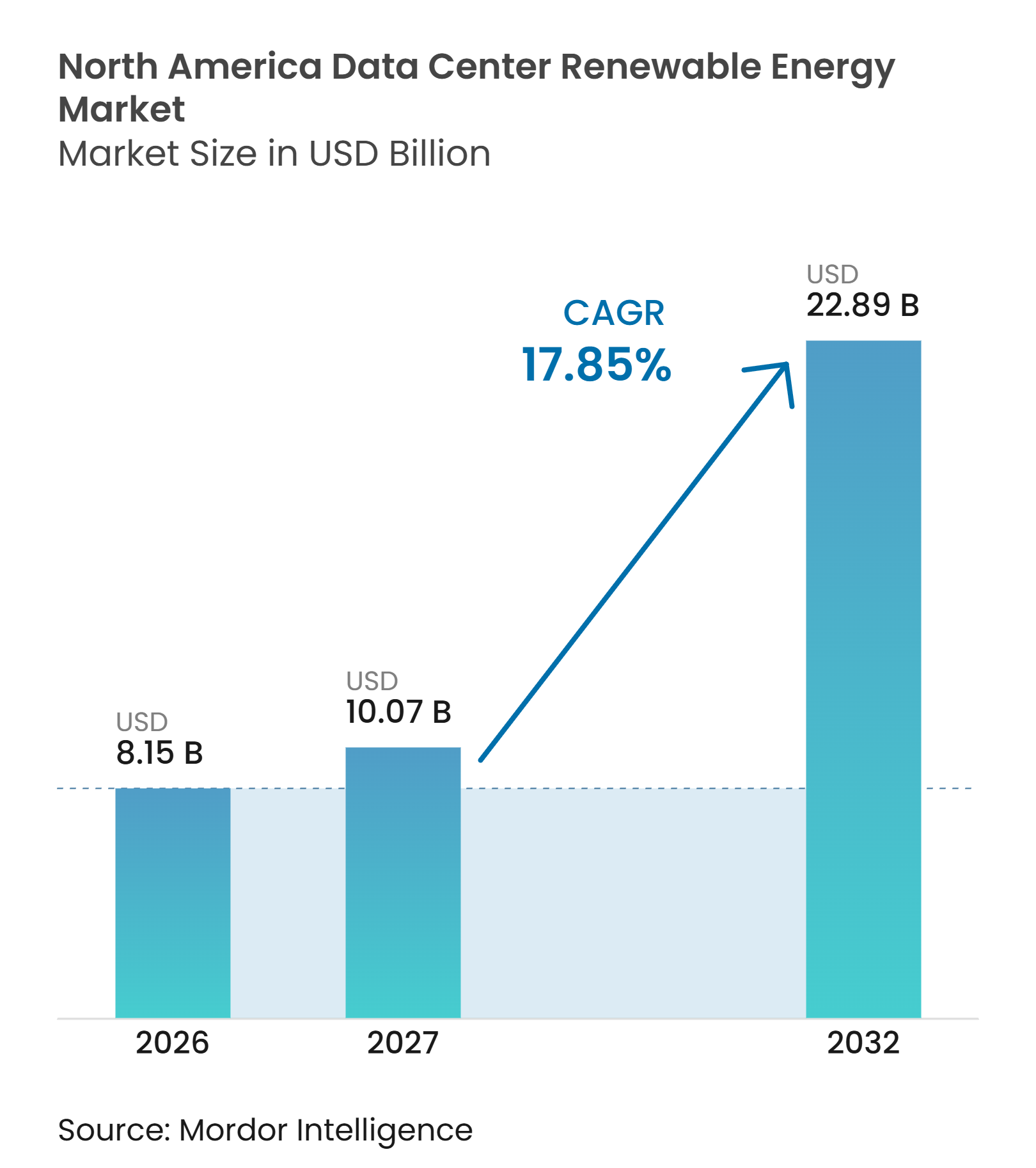
| Base Year Market Size (2026) | USD 8.15 Billion |
| Market Size (2027) | USD 10.07 Billion |
| Market Size (2032) | USD 22.89 Billion |
| Growth Rate (2027 - 2032) | 17.85 % |
| Market Concentration | Medium |
Major Players *Disclaimer: Major Players sorted in no particular order Image © Mordor Intelligence. Reuse requires attribution under CC BY 4.0. | |
North America Data Center Renewable Energy Market Analysis by Mordor Intelligence
The North America data center renewable energy market was valued at USD 8.15 billion in 2026 and is estimated to expand from USD 10.07 billion in 2027 to reach USD 22.89 billion by 2032, at a CAGR of 17.85% during the forecast period (2027-2032). By volume, the market is projected to increase from 95.88 GWh in 2026 to 118.47 GWh in 2027 and reach 245.19 GWh by 2032, at a CAGR of 15.71% during 2027-2032. AI workloads are increasing electricity requirements and are making renewable power procurement a central part of capacity planning. Corporate commitments to 24/7 carbon-free electricity are shifting attention from annual renewable energy certificates toward power that can be matched by hour and location. Solar paired with battery storage is becoming more economical, which is supporting demand for dispatchable clean power. Grid connection delays, equipment shortages, and permitting constraints remain the main limits on project delivery. The North America data center renewable energy market is also seeing larger operators bring energy sourcing, project development, and long-term contracts closer together.
Key Report Takeaways
- Among renewable energy sources, solar power held a 36.02% share in the North America data center renewable energy market in 2026, while geothermal power is projected to expand at an 18.72% CAGR through 2032.
- By procurement model, virtual or financial PPAs held 31.23% share in 2026 and are expected to expand at an 18.52% CAGR through 2032.
- By project configuration, standalone renewable projects accounted for 54.46% share in 2026, while renewable projects with battery storage are projected to expand at an 18.29% CAGR through 2032.
- By contract duration, long-term contracts held a 62.28% share in the 2026 North America data center renewable energy market, while medium-term contracts are expected to expand at an 18.17% CAGR through 2032.
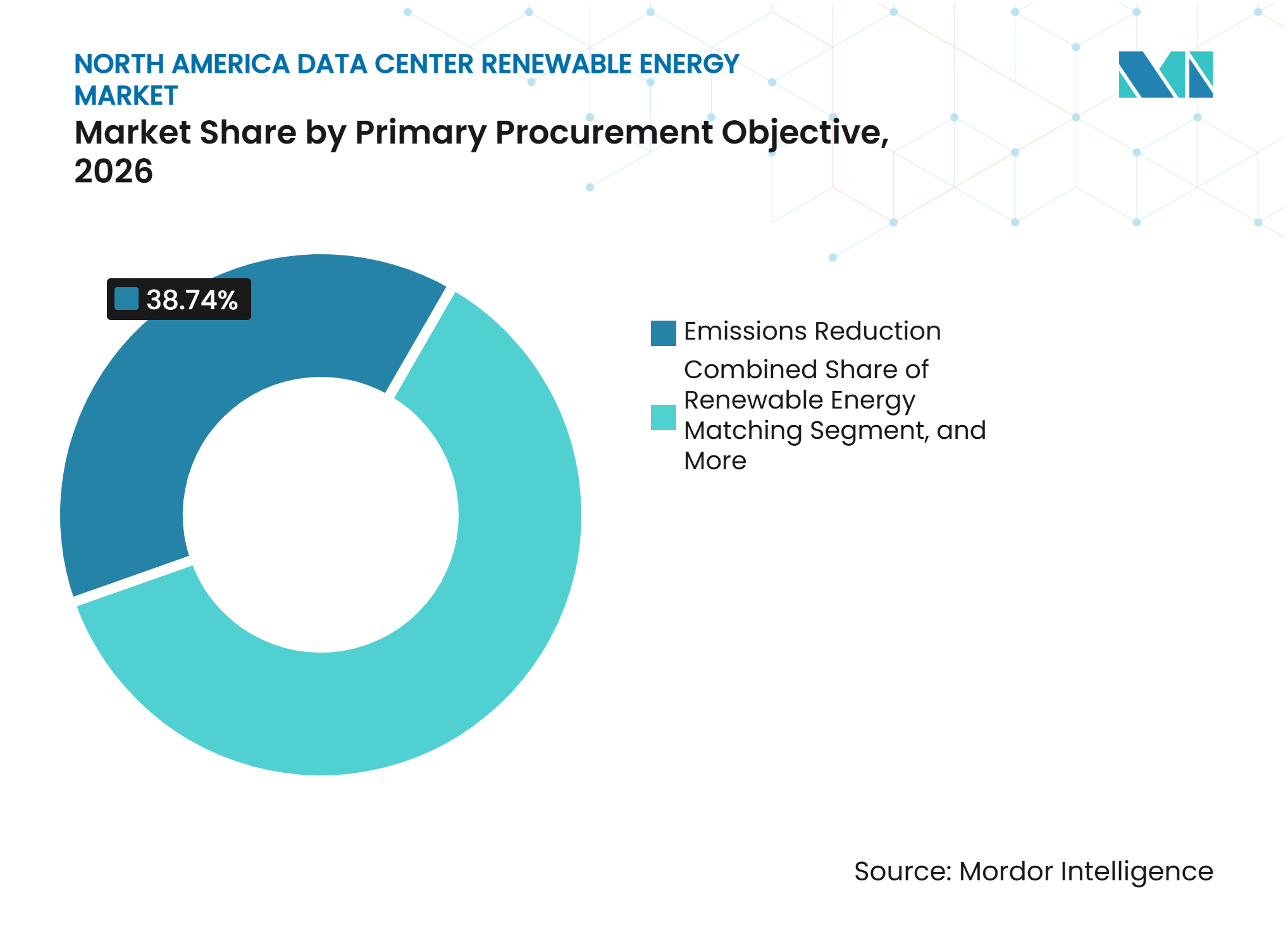
- By primary procurement objective, emissions reduction accounted for 38.74% share in 2026, while renewable energy matching is projected to expand at an 18.21% CAGR through 2032.
- By data center size, hyperscale facilities held 57.86% share in 2026 and are expected to expand at an 18.33% CAGR through 2032.
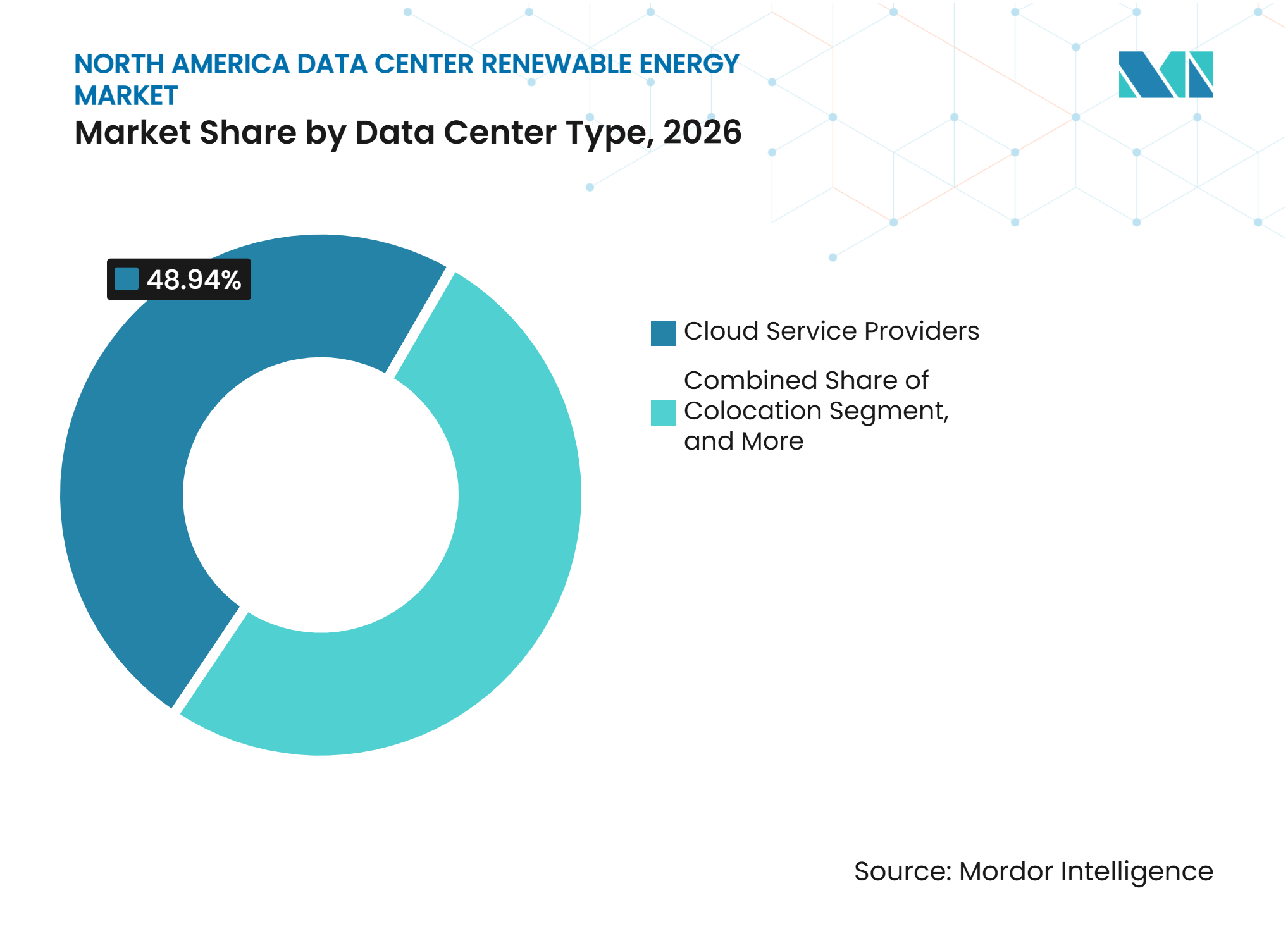
- By data center type, cloud service providers accounted for 48.94% share in 2026, while colocation operators are projected to expand at an 18.16% CAGR through 2032.
- By geography, the United States held an 87.14% share in the North America data center renewable energy market in 2026, while Mexico is expected to expand at an 18.36% CAGR through 2032.
Note: Market numbers in this report are based on Mordor Intelligence's proprietary estimation framework, which combines nine months of actuals with Q4 projections for base year 2026.
Market Trends and Insights
Drivers Impact Analysis of North America Data Center Renewable Energy Market*
| Driver | (~) % Impact on CAGR Forecast | Geographic Relevance | Impact Timeline |
|---|---|---|---|
| AI and Hyperscale Data Center Expansion | +4.2% | United States, Canada, Mexico | Short term (≤ 2 years) |
| Corporate Carbon-Free Energy Commitments | +3.5% | United States, Canada | Medium term (2-4 years) |
| Falling Solar and Battery Economics | +2.6% | United States, Mexico | Short term (≤ 2 years) |
| Renewable Power Price Visibility Through Long-Term Contracting | +2.0% | United States, Canada | Medium term (2-4 years) |
| Hourly Carbon-Free Energy Matching Requirements | +1.7% | United States, select Canadian provinces | Long term (≥ 4 years) |
| Behind-the-Meter Renewable Generation at Constrained Grid Nodes | +1.1% | United States, Mexico | Medium term (2-4 years) |
| Source: Mordor Intelligence | |||
AI and Hyperscale Data Center Expansion
Artificial intelligence workloads have changed the scale of electricity demand from North American data centers. U.S. data center power demand is projected to increase from 31 GW in 2025 to 41 GW in 2026 and 66 GW in 2027. Data centers could account for 11.8% of US electricity consumption by 2030.[1] This demand profile requires developers to secure clean generation well before a campus becomes operational. The North America data center renewable energy market, therefore, depends on synchronized planning for computing capacity, transmission access, and generation assets. Developers who wait until construction begins can face limited access to deliverable renewable capacity.
Corporate Carbon-Free Energy Commitments
Corporate decarbonization programs are turning clean power procurement into a governance issue for data center operators. Data centers procured 180 TWh of clean energy through PPAs in 2025, which represented nearly 90% of corporate PPA volumes across North America and Europe. Hyperscalers increased their share of North American PPA activity from 76% in the fourth quarter of 2025 to 90% in early 2026. Microsoft matched 100% of its 2025 electricity use with renewable energy and held more than 40 GW of contracted capacity globally, including 19 GW in operation. Large PPAs help developers secure financing for new projects. This leaves smaller buyers competing for fewer contracts and a more limited supply.
Falling Solar and Battery Economics
Solar and battery projects are becoming increasingly relevant for operators that require clean power beyond daylight hours. The global benchmark cost for battery projects declined year over year. Developers added substantial combined solar and storage capacity at an average cost lower than that of new-build combined-cycle gas turbines. Fixed-axis solar also remained cost-competitive. These conditions support storage-integrated procurement in ERCOT, select CAISO zones, and Mexico, while standalone solar agreements may become less competitive over time.
Renewable Power Price Visibility Through Long-Term Contracting
Long-term agreements give renewable projects predictable revenue and help convert proposals into financeable assets. Microsoft and Brookfield Renewable Partners established a framework that could support 10.5 GW of new renewable capacity in the United States and Europe from 2026 through 2030. Such arrangements give operators more visibility on power prices and development schedules. They also provide developers with creditworthy offtake that supports project financing. In the North America data center renewable energy market, project origination is becoming as important as selecting a PPA. This favors operators that can commit to capacity years before it is needed.
Restraints Impact Analysis of North America Data Center Renewable Energy Market*
| Restraint | (~) % Impact on CAGR Forecast | Geographic Relevance | Impact Timeline |
|---|---|---|---|
| Grid Interconnection and Transmission Delays | -2.5% | United States, Mexico | Short term (≤ 2 years) |
| Renewable Intermittency and 24/7 Reliability Requirements | -1.8% | United States, Canada | Medium term (2-4 years) |
| Renewable Project Permitting, Land, and Community Opposition | -1.3% | United States, Canada | Medium term (2-4 years) |
| Transformer, Switchgear, and Battery Supply Constraints | -0.9% | United States, Canada, Mexico | Short term (≤ 2 years) |
| Source: Mordor Intelligence | |||
Grid Interconnection and Transmission Delays
Grid interconnection remains the primary barrier between contracted capacity and delivered electricity. Thousands of projects across the United States are awaiting grid connection, representing substantial generation and storage capacity. The median timeline from an interconnection request to commercial operation has increased significantly compared with earlier years. FERC Order 2023 and ISO-level reforms are intended to improve queue management. Their effect on clearance times remains uncertain. These delays are prompting data center developers to consider behind-the-meter generation and locations with available infrastructure.
Renewable Intermittency and 24/7 Reliability Requirements
Solar and wind output do not always align with continuous data center demand. Data centers typically operate at 85% to 95% utilization, while solar generation peaks for 4 to 6 hours each day. The 24/7 carbon-free electricity model requires that consumption be matched with carbon-free generation, hour by hour, on the same grid. Google, Microsoft, and Iron Mountain have adopted this approach. It increases the value of geothermal power, nuclear power, hydropower, and long-duration storage. Operators using annual matching arrangements may need more complex procurement structures as hourly accounting becomes more common.
*Our forecasts treat driver/restraint impacts as directional, not additive. The impact forecasts reflect baseline growth, mix effects, and variable interactions.
North America Data Center Renewable Energy Market Segment Analysis
By Renewable Energy Source:
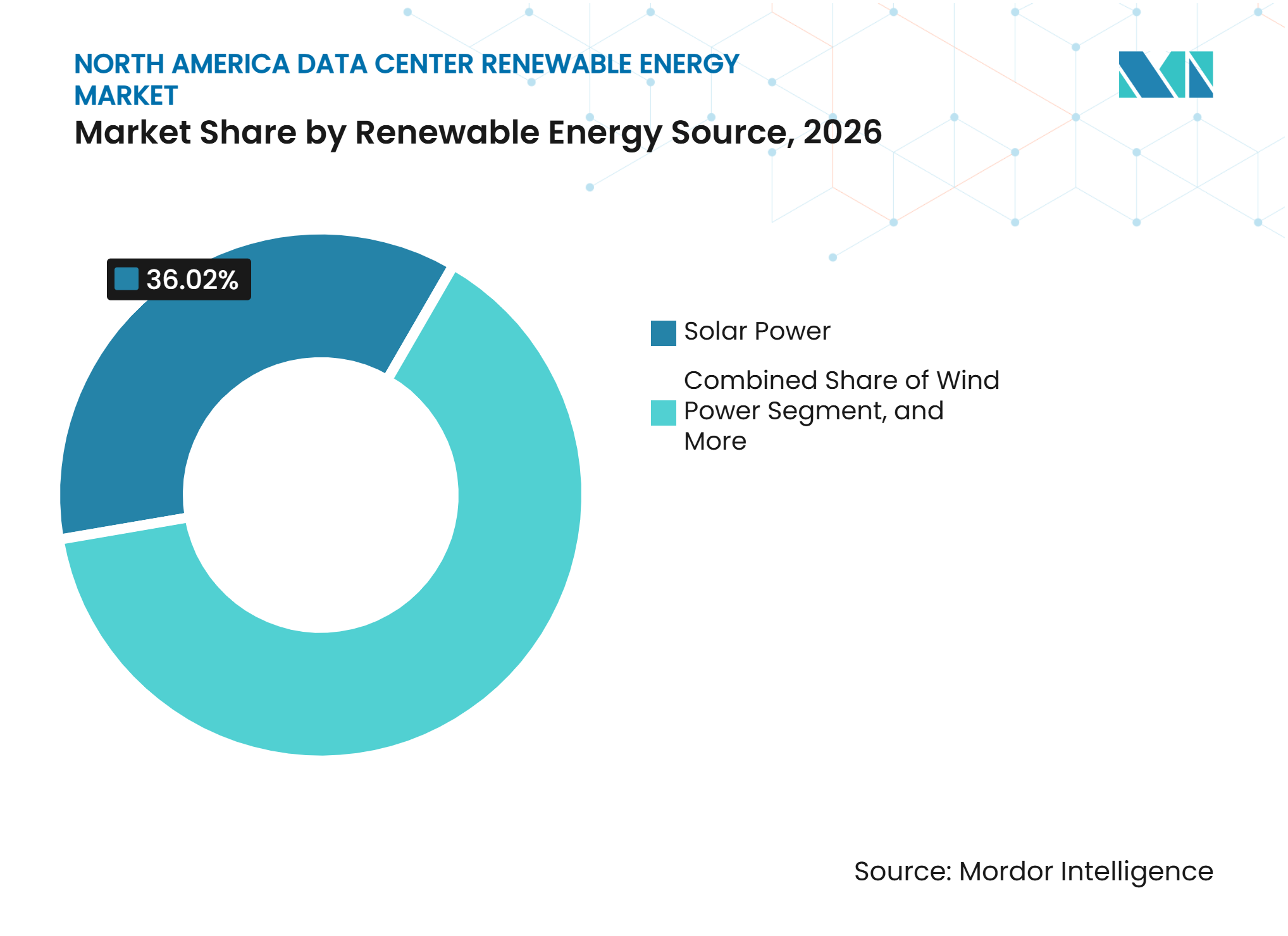
Geothermal Gains Value for Reliable SupplySolar power held 36.02% of the renewable energy source segment in 2026. Utility-scale virtual PPAs across ERCOT, MISO, and SPP helped establish its leading position. Wind and hydropower remained significant sources, while biomass and biogas served smaller, stable applications. Geothermal power is projected to expand at an 18.72% CAGR from 2027 to 2032. The US geothermal sector signed 26 new PPAs representing more than 1,000 MWe of capacity after 2025. Several agreements are linked to AI-focused data center loads.
Geothermal assets can deliver power with a capacity factor above 90%. This capability reduces the need for storage firming when serving continuous data center demand. The North America data center renewable energy market size for geothermal is driven by demand for power that meets hourly matching expectations. Enhanced geothermal systems can also be developed closer to demand centers where resource conditions allow. Geothermal contracts may provide an early position in markets that value hourly clean power. Solar, wind, and hydropower will still serve a broad mix of procurement needs. The resulting source mix depends on grid conditions, resource availability, and the operator's reliability target.



By Procurement Model:
Virtual PPAs Lead Volume and ExpansionVirtual or financial PPAs held 31.23% of the procurement model segment in 2026. They are projected to expand at an 18.52% CAGR through 2032. These contracts enable an operator to purchase renewable output without receiving physical delivery of the output from the project. This flexibility suits multi-gigawatt procurement across interconnected power markets. On-site generation and off-site physical PPAs hold smaller positions but are gaining relevance in grid-constrained areas. Utility green power programs and renewable energy certificates provide options for buyers who cannot support independent project financing.
Virtual PPAs also create basis risk when the project settlement price differs from the price at the customer load location. That difference can create financial losses even when a project produces surplus energy. Managing this exposure requires capabilities that many mid-sized operators lack. Utility green tariff products can reduce some of this complexity. The North America data center renewable energy market share of virtual PPAs reflects the purchasing scale and geographic reach of hyperscale buyers. Operators must still assess location, congestion, settlement structure, and carbon accounting before selecting this model. Physical delivery and on-site assets may be more suitable where reliability and local matching are priorities.
By Project Configuration:
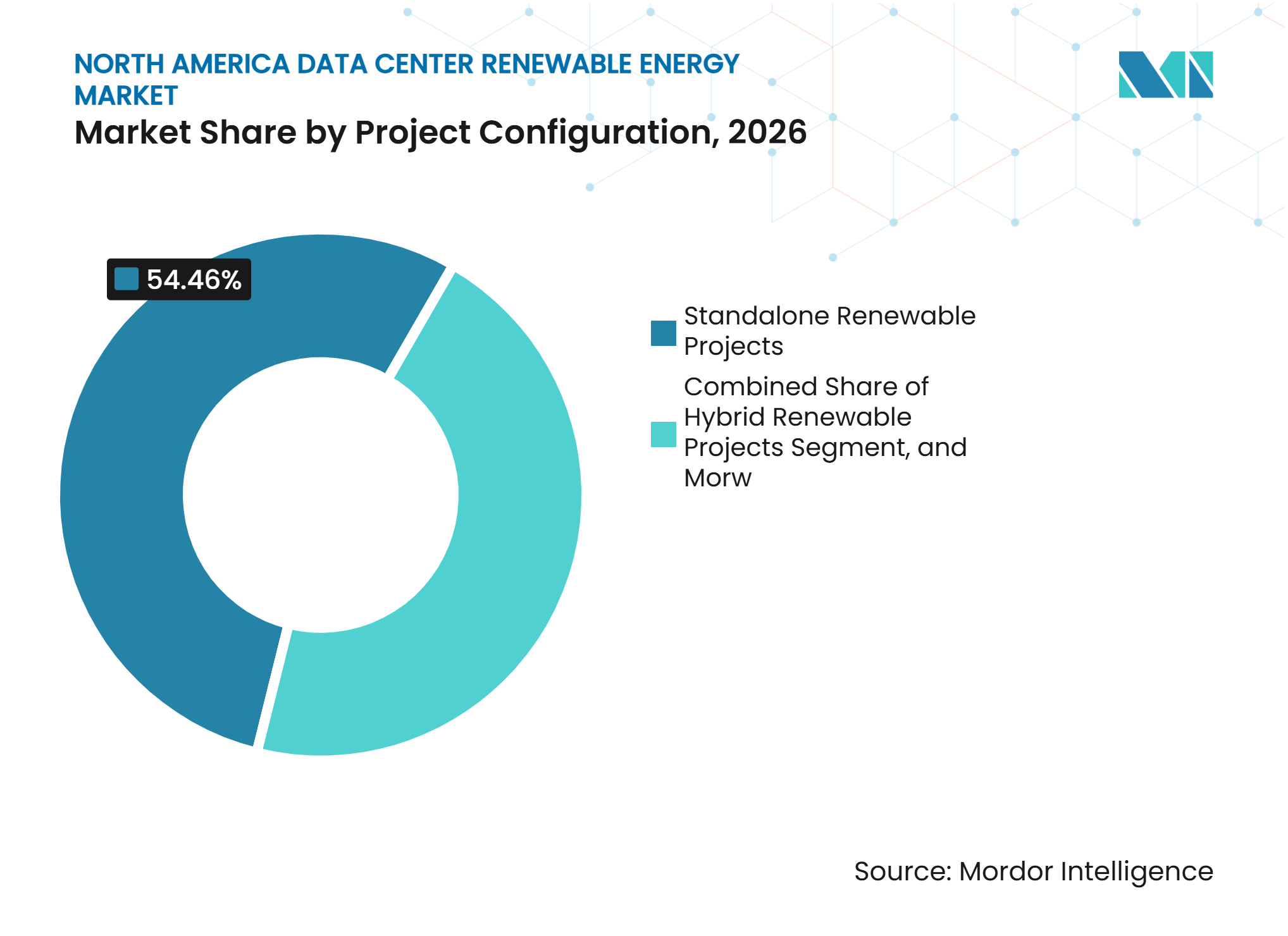
Storage Becomes Part of New Project DesignStandalone renewable projects accounted for 54.46% of the project configuration segment in 2026. Renewable projects with battery storage are projected to expand at an 18.29% CAGR from 2027 to 2032. The large standalone base reflects earlier procurement centered on single-technology projects. Storage integration responds to demand for cleaner power after solar output falls. Hybrid projects and projects using other firming methods serve customers with specific grid tariff or accounting requirements. The 2025 addition of 87 GW of solar and storage globally shows the wider shift toward integrated configurations.
Battery storage is moving from an optional feature to a more regular component of project design. It can move renewable output to higher-value hours and improve a project's value for continuous loads. Contracts signed before 2024 for standalone solar may appear less attractive by 2028 if storage costs decline further. Some operators may need to renegotiate existing contracts to improve hourly coverage. Others may retain older contracts and add new storage-linked capacity. The North America data center renewable energy industry is responding to this choice by developing more flexible portfolios. The preferred configuration will differ by load shape, grid pricing, and carbon reporting requirements.

By Contract Duration:
Long-Term Commitments Support Project FinanceLong-term contracts held 62.28% of the contract duration segment in 2026. They provide the multiyear revenue certainty needed for large renewable projects to reach financial close. Ten-to-twenty-year agreements align with the development and operating life of many clean energy assets. Medium-term contracts are projected to expand at an 18.17% CAGR through 2032. These agreements commonly provide 5- to 10-year terms for operators who want to revisit procurement before the next technology cycle. Short-term contracts continue to support hedging and compliance needs.
Long-term offtake is particularly relevant to hyperscale buyers that can commit significant capacity. It lowers financing risk for developers and can support more competitive project economics. Medium-term agreements give smaller buyers a route into structured procurement without a multidecade commitment. They also enable a buyer to adjust its strategy as storage, carbon accounting, and grid rules evolve. Short-term contracts can fill gaps between larger commitments. The North America data center renewable energy market will continue to use a mix of contract durations rather than a single-contract approach. The appropriate structure depends on credit quality, demand visibility, and tolerance for price risk.
By Primary Procurement Objective:
Emissions Reduction Remains the Main ObjectiveEmissions reduction held 38.74% of the primary procurement objective segment in 2026. Renewable energy matching is projected to expand at an 18.21% CAGR through 2032. Cost optimization and long-term supply security remain important for operators in deregulated markets. In ERCOT, renewable contracts can provide a route to lower or more predictable power costs. Renewable energy matching is gaining relevance as sustainability programs expand among second-tier operators. This places greater emphasis on the time and location of clean energy delivery.
Annual emissions reduction targets remain a useful starting point for procurement. They are increasingly insufficient for buyers who need credible hourly carbon reporting. Operators that invest in hourly matching capabilities can better document the relationship between electricity use and clean generation. This may become important as reporting requirements become more detailed. The North America data center renewable energy market, therefore, includes both cost-led and reporting-led procurement decisions. The balance differs by company, location, and customer contract requirement. Supply security remains essential when a new load must operate without interruption.
By Data Center Size:
Hyperscale Facilities Set the PaceHyperscale facilities held 57.86% of the data center size segment in 2026. They are projected to expand at an 18.33% CAGR through 2032. This reflects the concentration of AI investment in large campuses with extensive computing capacity. Large buyers represented a substantial share of corporate renewable contracting in 2025. Large, medium, and small data centers are also increasing renewable procurement. Their arrangements are generally more incremental and more dependent on utility offerings.
Hyperscalers can provide the scale and credit support needed to finance the new generation. Their contracts can also improve the availability of clean electricity for the surrounding grid. Smaller operators benefit from this wider supply but may not have comparable procurement resources. SEC climate disclosure rules and European CSRD obligations can make energy procurement records important for some parent companies. ASHRAE and LEED criteria also affect renewable energy discussions in colocation sales cycles. The North America data center renewable energy market size is shaped by this difference in buyer capability. Larger facilities are likely to remain the primary drivers of new contracted capacity.
By Data Center Type:
Colocation Operators Build Renewable CapabilityCloud service providers accounted for 48.94% of the data center type segment in 2026. Colocation operators are projected to expand at an 18.16% CAGR through 2032. Cloud providers have large balance sheets and established PPA capabilities. Colocation operators are responding to enterprise customers that include renewable sourcing in service agreements. Equinix reached 96% renewable energy coverage in 2025 and operated 854 MW of PPAs. Digital Realty held 1.7 GW of contracted renewable capacity and had 185 sites with 100% renewable coverage as of the third quarter of 2025.
Enterprise and edge facilities frequently use utility green tariffs or shorter PPAs. These structures avoid the need to directly finance a dedicated project. Tenant requirements are raising the importance of renewable sourcing within colocation contracts. This means that clean energy credentials are becoming a condition for retaining larger customers. Operators are building procurement capability, partnerships, and reporting systems to meet those expectations. The North America data center renewable energy market is widening beyond traditional hyperscale buyers as this requirement moves through the value chain. Smaller facilities can adopt different contract structures while still responding to customer demand.
Geography Analysis
United States: Demand and Grid Access Shape the Largest Regional Base
The United States held 87.14% of the North America data center renewable energy market share in 2026. Its large data center base in Virginia, Texas, Arizona, and Georgia supports sizable renewable procurement needs. US data center power demand is projected to reach 66 GW in 2027. Federal Energy Regulatory Commission reforms seek to improve the interconnection process. Connection timelines continue to affect the schedule for new campuses and supporting generations. In March 2026, leading hyperscalers committed to financing power generation, grid upgrades, and utility rate structures for data center expansion. The move shifts more development responsibility toward operators. Behind-the-meter supply is becoming a practical option where grid access is slow. The United States remains the central demand base for the regional clean power ecosystem.
Mexico: Nearshoring Supports Faster Expansion
Mexico is projected to expand at an 18.36% CAGR from 2027 to 2032. Installed data center capacity was 279 MW in 2026, while the Mexican Data Center Association has set a 2030 target of 1,516 MW. CloudHQ committed USD 4.8 billion to develop 6 data centers in Querétaro. Its planned private substation has a capacity of 900 MW. The National Electricity System Expansion Plan for 2025-2030 targets 32 GW of new generation. It includes 11.3 GW from CFE renewable projects and 10.9 GW from private developers. Grid gaps are encouraging operators to consider solar generation next to data center campuses. This can shorten the route from contracted power to delivered electricity. Mexico's position in the North America data center renewable energy market is supported by nearshoring investment and the need for locally deliverable energy.
Canada: Clean Electricity Supports a Differentiated Offer
Canada benefits from a power system in which 85% of electricity generation came from renewable, non-emitting sources in 2025. Hydroelectricity accounted for 54.9% of national electricity generation that year. Quebec and British Columbia use hydroelectric resources as a data center location advantage. Bell Canada's AI Fabric initiative targets 500 MW of hydro-powered AI compute capacity across 6 facilities in British Columbia. Its first 7 MW site in Kamloops was operational by June 2025.[2] Ontario's nuclear fleet can support 24/7 carbon-free electricity needs without storage pairing. Alberta offers a growing pipeline of renewable projects, built on a gas-heavy generation base. Provincial tariffs and cross-border power arrangements can influence location choices. Canada can benefit where long US interconnection timelines lead operators to consider nearby clean power options.
Competitive Landscape
Market Concentration
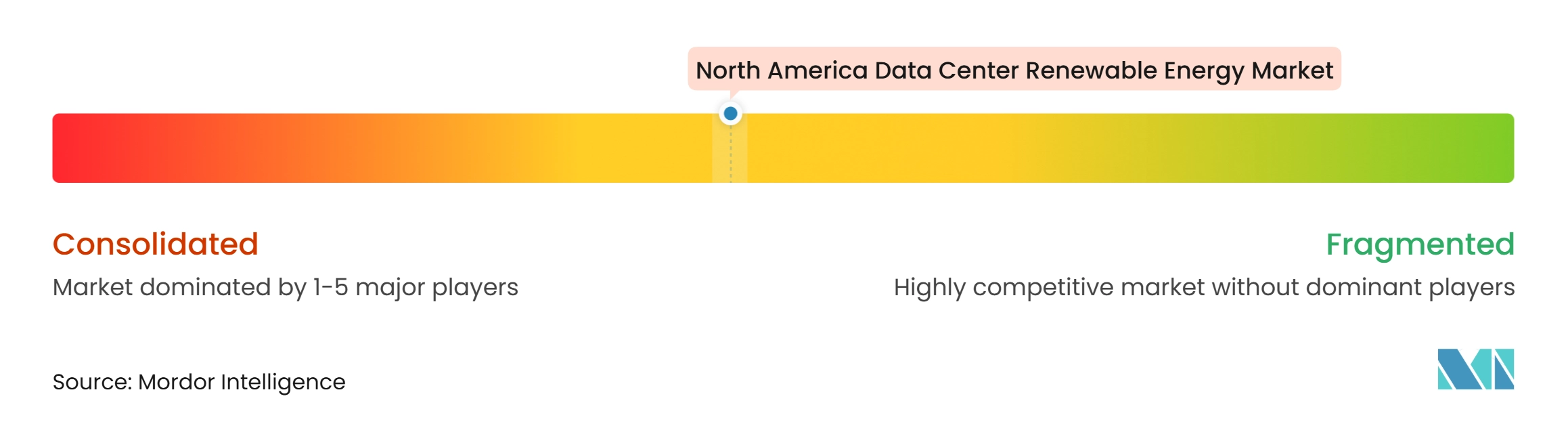
The North America data center renewable energy market is moderately consolidated on the demand side. The 4 leading hyperscalers accounted for 16,777 MW of corporate renewable contracts in 2025, nearly 80% of the 20,448 MW contracted by all corporate buyers. Supply remains fragmented among independent developers, utilities, and newer clean energy providers. Suppliers are moving toward portfolio offerings that combine solar, wind, battery storage, geothermal power, and nuclear power. The North America data center renewable energy market needs reliable and locationally relevant clean electricity.
Alphabet agreed in December 2025 to acquire Intersect Power for USD 4.75 billion, bringing a clean energy developer into a hyperscaler's ownership structure. This illustrates a move from purchasing capacity to controlling more of the development pipeline. In the North America data center renewable energy market, Microsoft and Brookfield Renewable Partners established a framework for 10.5 GW of new renewable capacity from 2026 through 2030. NextEra Energy Resources and Meta also executed 11 PPAs and 2 energy storage agreements for 2.5 GW of solar capacity in December 2025.[3] These moves increase the importance of development sites, firming technologies, and long-term capital.
Providers can serve mid-tier operators that lack the credit strength to finance dedicated projects. The North America data center renewable energy market also needs portfolio procurement that reduces exposure to a single resource or location. Equinix agreed with Oklo for 500 MW from advanced fission reactors and placed micro-reactor pre-orders with Radiant in 2025. Competition now includes reliable supply, clear emissions accounting, and methods for measuring hourly carbon-free electricity.
North America Data Center Renewable Energy Industry Leaders
-
Amazon.com, Inc.
-
Microsoft Corporation
-
Google LLC
-
Meta Platforms, Inc.
-
Apple Inc.
- *Disclaimer: Major Players sorted in no particular order
North America Data Center Renewable Energy Market Companies Covered in this Report
- Amazon.com, Inc.
- Microsoft Corporation
- Google LLC
- Meta Platforms, Inc.
- Apple Inc.
- Equinix, Inc.
- Digital Realty Trust, Inc.
- Iron Mountain Incorporated
- Switch, Inc.
- QTS Realty Trust, Inc.
- CyrusOne LLC
- Vantage Data Centers Management Company, LLC
- NextEra Energy, Inc.
- Brookfield Renewable Partners L.P.
- EDF Renewables North America, Inc.
- ENGIE North America, Inc.
- Clearway Energy, Inc.
- AES Corporation
- Schneider Electric SE
- Eaton Corporation plc
Recent Industry Developments in North America Data Center Renewable Energy Market
- August 2026: NextEra Energy, Inc. secured USD 3.3 billion in state funding for 10 GW of new generation capacity in Texas and Pennsylvania to meet surging data center power demand, signaling that renewable build timelines are being supplemented by firm generation capacity as a near-term reliability bridge for the AI infrastructure build-out.
- March 2026: Google LLC, Microsoft Corporation, Meta Platforms, Inc., and Amazon.com, Inc. signed a White House AI energy pledge committing to finance new electricity generation, power plant construction, grid upgrades, and special utility rate structures, for their data centers, shifting expansion costs from ratepayers to operators.
- February 2026: Microsoft Corporation confirmed it matched 100% of its 2025 electricity use with renewables, with more than 40 GW of contracted capacity globally and 19 GW operational, a procurement system operating at a scale equivalent to a mid-sized national grid.
- January 2026: Meta Platforms, Inc. signed agreements for up to 6.6 GW of nuclear power with Vistra Corp., Oklo, Inc., and TerraPower LLC, the largest nuclear offtake commitment by a data center operator on public record, demonstrating that hyperscalers are treating nuclear as a renewable-equivalent in carbon accounting frameworks.
North America Data Center Renewable Energy Market Report Scope
The North America Data Center Renewable Energy Market refers to the growing adoption of clean, sustainable energy solutions to meet the increasing electricity demand of data center facilities while minimizing their environmental impact. The market is driven by the rapid expansion of data center infrastructure, rising investments in hyperscale and cloud computing facilities, corporate decarbonization commitments, and the growing need for reliable, cost-effective power.
The North America Data Center Renewable Energy Market Report is Segmented by Renewable Energy Source (Solar Power, Wind Power, Hydropower, Geothermal Power, Biomass and Biogas Power, and Other Renewable Sources), Procurement Model (On-Site Renewable Generation, Off-Site Physical PPAs, Virtual or Financial PPAs, Utility Green Power Programs, and Renewable Energy Certificates and Guarantees of Origin), Project Configuration (Standalone Renewable Projects, Hybrid Renewable Projects, Renewable Projects with Battery Storage, and Renewable Projects with Other Firming Solutions), Contract Duration (Short-Term Contracts, Medium-Term Contracts, and Long-Term Contracts), Primary Procurement Objective (Electricity Cost Optimization, Emissions Reduction, Renewable Energy Matching, and Long-Term Supply Security), Data Center Size (Small, Medium, Large, and Hyperscale), Data Center Type (Colocation, Cloud Service Providers, and Enterprise and Edge), and Geography (United States, Canada, and Mexico). The Market Forecasts are Provided in Terms of Value (USD), and Volume (MWh/GWh).
Segmentation Overview
| Solar Power |
| Wind Power |
| Hydropower |
| Geothermal Power |
| Biomass and Biogas Power |
| Other Renewable Sources |
| On-Site Renewable Generation |
| Off-Site Physical PPAs |
| Virtual or Financial PPAs |
| Utility Green Power Programs |
| Renewable Energy Certificates and Guarantees of Origin |
| Standalone Renewable Projects |
| Hybrid Renewable Projects |
| Renewable Projects with Battery Storage |
| Renewable Projects with Other Firming Solutions |
| Short-Term Contracts |
| Medium-Term Contracts |
| Long-Term Contracts |
| Electricity Cost Optimization |
| Emissions Reduction |
| Renewable Energy Matching |
| Long-Term Supply Security |
| Small |
| Medium |
| Large |
| Hyperscale |
| Colocation |
| Cloud Service Providers (CSPs) |
| Enterprise and Edge |
| United States |
| Canada |
| Mexico |
| By Renewable Energy Source | Solar Power |
| Wind Power | |
| Hydropower | |
| Geothermal Power | |
| Biomass and Biogas Power | |
| Other Renewable Sources | |
| By Procurement Model | On-Site Renewable Generation |
| Off-Site Physical PPAs | |
| Virtual or Financial PPAs | |
| Utility Green Power Programs | |
| Renewable Energy Certificates and Guarantees of Origin | |
| By Project Configuration | Standalone Renewable Projects |
| Hybrid Renewable Projects | |
| Renewable Projects with Battery Storage | |
| Renewable Projects with Other Firming Solutions | |
| By Contract Duration | Short-Term Contracts |
| Medium-Term Contracts | |
| Long-Term Contracts | |
| By Primary Procurement Objective | Electricity Cost Optimization |
| Emissions Reduction | |
| Renewable Energy Matching | |
| Long-Term Supply Security | |
| By Data Center Size | Small |
| Medium | |
| Large | |
| Hyperscale | |
| By Data Center Type | Colocation |
| Cloud Service Providers (CSPs) | |
| Enterprise and Edge | |
| By Geography | United States |
| Canada | |
| Mexico |
Key Questions Answered in the Report
What is the size of the North America data center renewable energy market?
The North America data center renewable energy market was valued at USD 8.15 billion in 2026 and is estimated to reach USD 22.89 billion by 2032.
What is driving renewable procurement by data centers in North America?
AI-related electricity demand, corporate carbon-free electricity commitments, and declining solar-plus-storage costs are increasing procurement activity.
Which renewable source leads data center procurement in North America?
Solar power held 36.02% of the renewable energy source segment in 2026, while geothermal power is projected to record the fastest expansion at an 18.72% CAGR through 2032.
Why are virtual PPAs important for data center operators?
Virtual or financial PPAs held 31.23% share in 2026 because they allow operators to contract renewable generation across interconnected markets without physical delivery.
Which country is expanding fastest in the region?
Mexico is projected to expand at an 18.36% CAGR through 2032, supported by nearshoring, data center construction, and new generation plans.
How do grid delays affect renewable power procurement for data centers?
Long interconnection timelines can delay power delivery, which is increasing interest in behind-the-meter generation, storage, and locations with available infrastructure.