
North America Data Center Optical Connectivity Market Size and Share
Market Overview
| Study Period | 2021 - 2032 |
|---|---|
| Forecast Data Period | 2027 - 2032 |
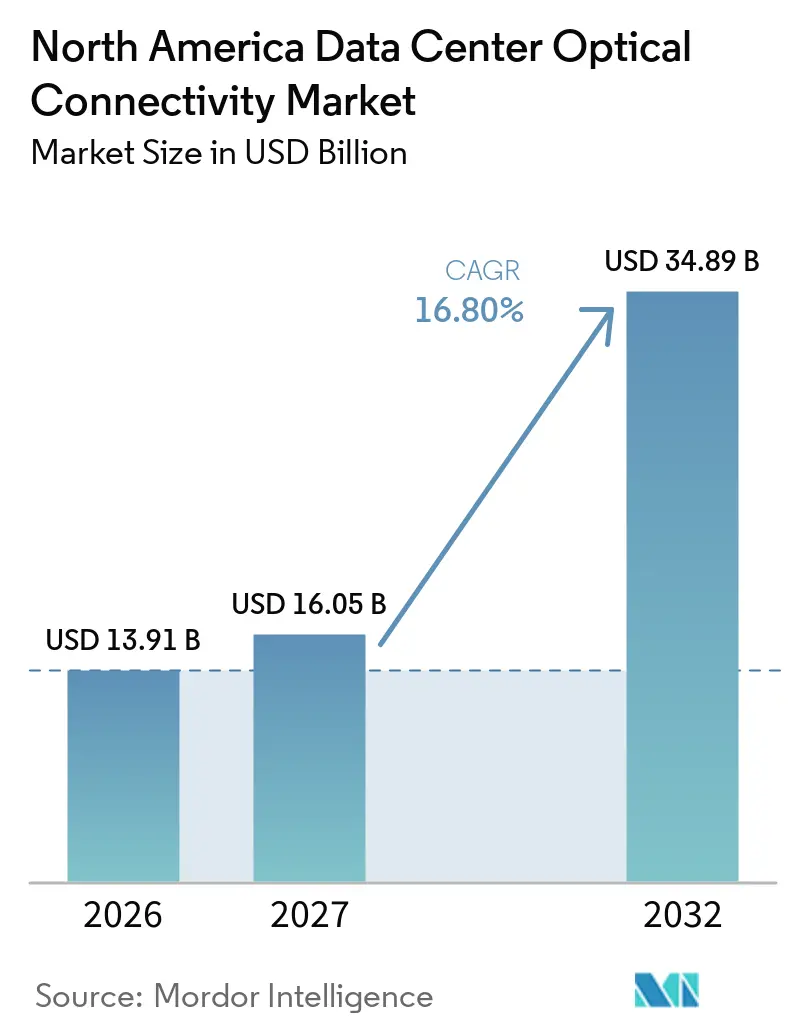
| Base Year Market Size (2026) | USD 13.91 Billion |
| Market Size (2027) | USD 16.05 Billion |
| Market Size (2032) | USD 34.89 Billion |
| Growth Rate (2027 - 2032) | 16.80 % |
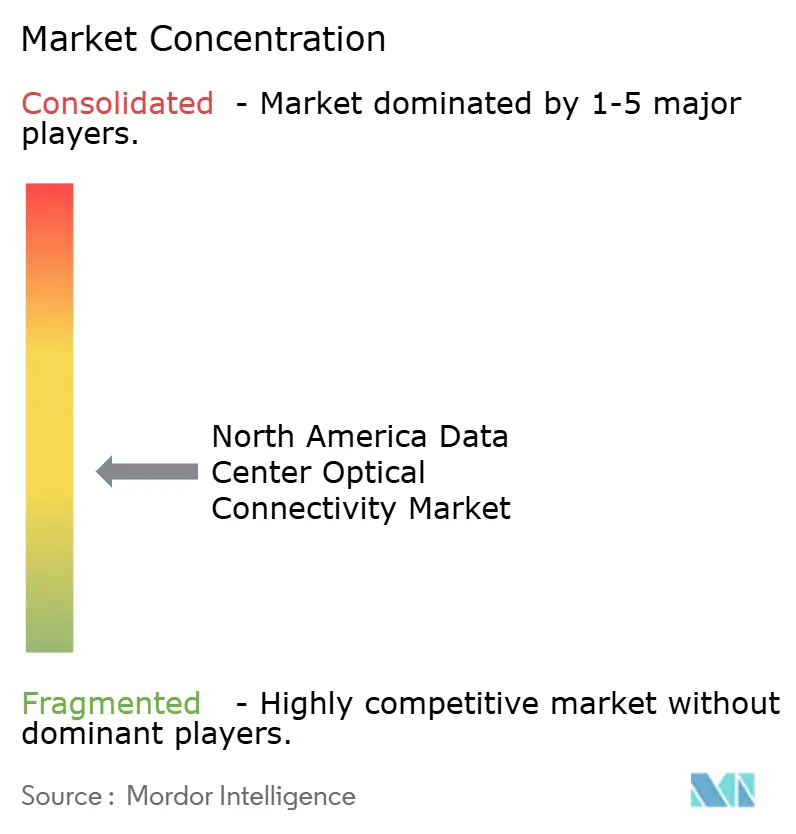
| Market Concentration | Medium |
Major Players *Disclaimer: Major Players sorted in no particular order Image © Mordor Intelligence. Reuse requires attribution under CC BY 4.0. | |
North America Data Center Optical Connectivity Market Analysis by Mordor Intelligence
The North America Data Center Optical Connectivity Market size is projected to expand from USD 13.91 billion in 2026 and USD 16.05 billion in 2027 to USD 34.89 billion by 2032, registering a CAGR of 16.80% between 2027 and 2032.
The North America data center optical connectivity market is being reshaped by GPU-dense AI clusters, which need far more high-speed links than conventional cloud workloads. Rising data center power use makes link power efficiency a design priority alongside bandwidth and latency. The International Energy Agency expects global data center electricity use to reach 945 TWh by 2030, compared with 415 TWh in 2024, while AI-accelerated servers drive much of the increase. This increases the value of optical designs that reduce the power consumed per transmitted bit. Suppliers are responding through higher-speed pluggables, co-packaged optics, domestic photonics capacity, and optical circuit switching. The North America data center optical connectivity market also faces supply-chain pressure because advanced lasers rely on a concentrated materials and manufacturing base.
Key Report Takeaways
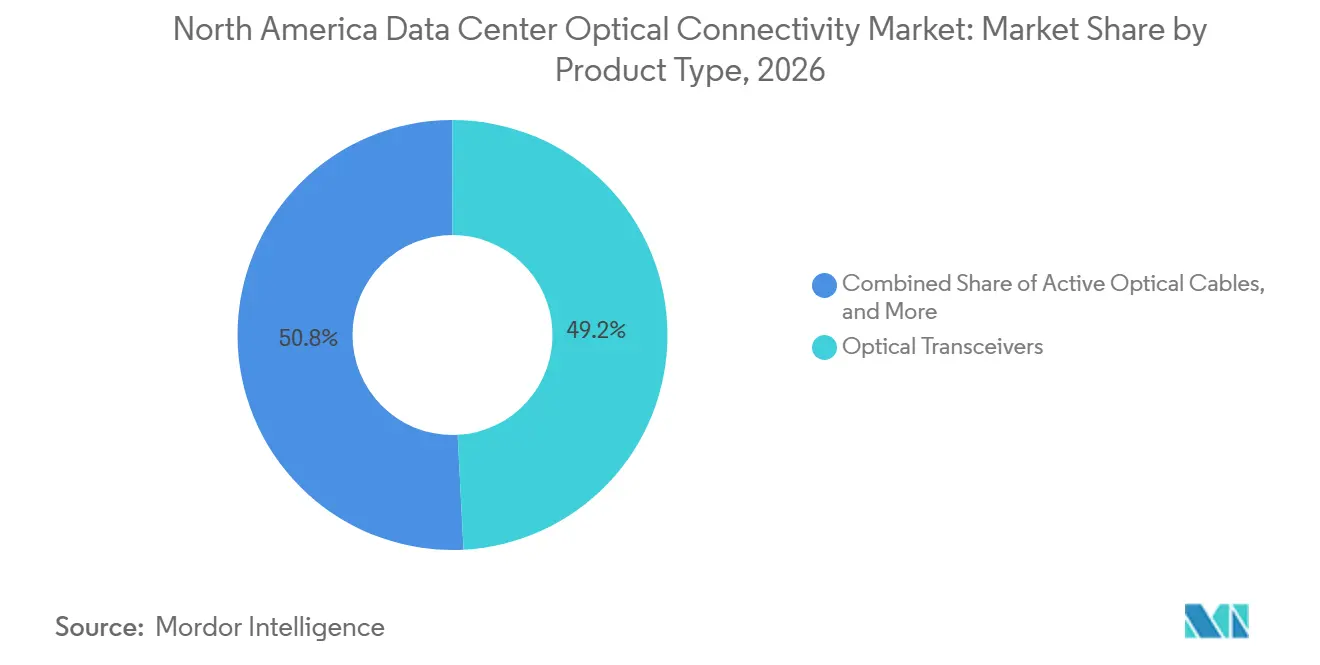
- By product type, optical transceivers held 49.18% of the North America data center optical connectivity market share in 2026, while optical circuit switches are projected to expand at a 29.21% CAGR through 2032.
- By connectivity architecture, conventional pluggable optics held 78.32% share in 2026, while co-packaged optics is projected to expand at a 30.41% CAGR through 2032.
- By data rate, 800 Gbps held 35.62% share in 2026, while the above-1.6 Tbps segment is projected to expand at a 32.43% CAGR through 2032.
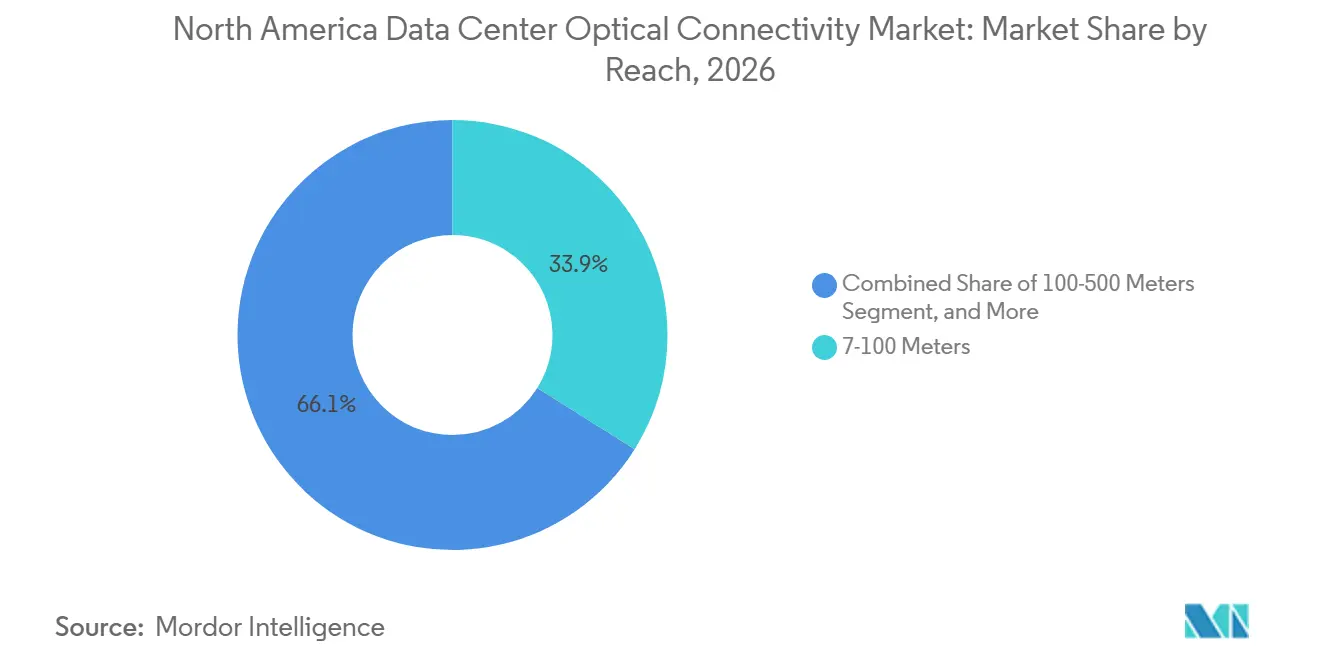
- By reach, the 7-100-meter segment held 33.91% share in 2026, while the 100-500-meter segment is projected to expand at a 19.41% CAGR through 2032.
- By application, GPU-to-Switch connectivity held 30.72% share in 2026, while GPU-to-GPU connectivity is projected to expand at a 31.17% CAGR through 2032.
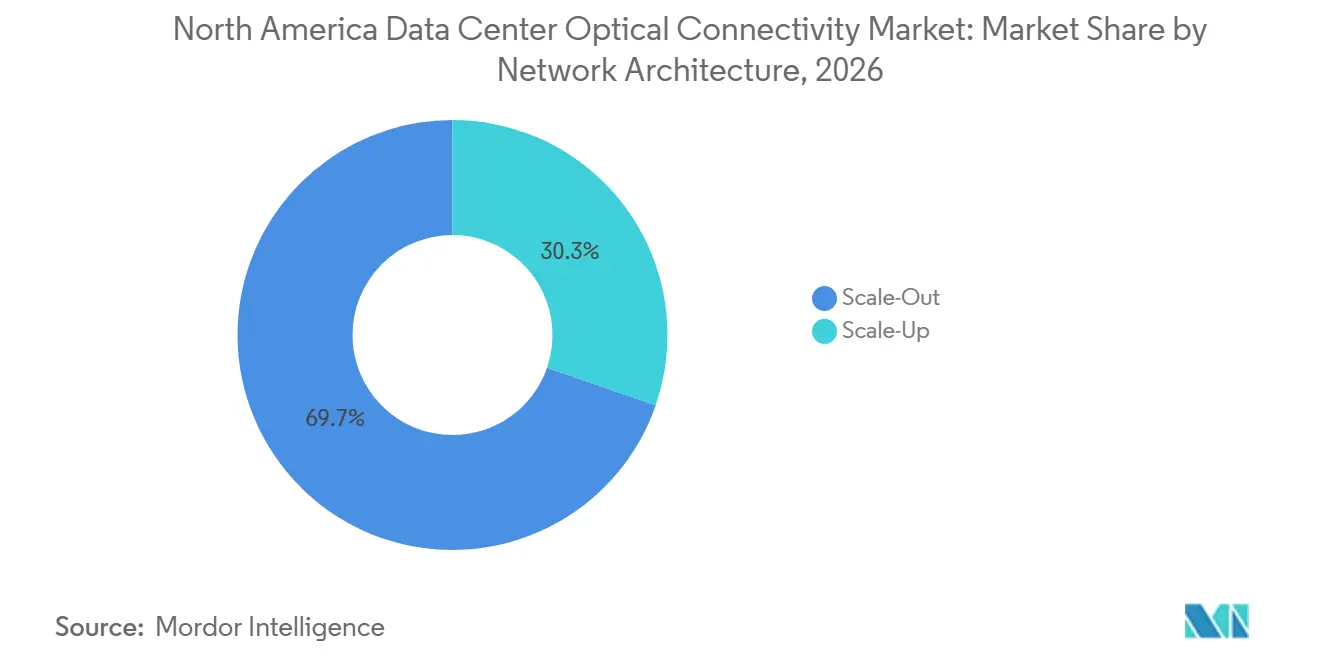
- By network architecture, scale-out front-end networks held 69.71% share in 2026, while scale-up back-end AI networks are projected to expand at a 32.11% CAGR through 2032.
- By data center type, hyperscale facilities held 61.21% share in 2026 and are projected to expand at a 27.30% CAGR through 2032.
- By country, the United States held 84.27% share in 2026, while Mexico is projected to expand at a 20.71% CAGR through 2032.
Note: Market numbers in this report are based on Mordor Intelligence's proprietary estimation framework, which combines nine months of actuals with Q4 projections for base year 2026.
North America Data Center Optical Connectivity Market Trends and Insights
Drivers Impact Analysis*
| Driver | (~) % Impact on CAGR Forecast | Geographic Relevance | Impact Timeline |
|---|---|---|---|
| AI and Generative AI Cluster Expansion | +6.5% | Global, concentrated in the United States, including Northern Virginia, Texas, and Arizona | Short term (≤ 2 years) |
| Hyperscale Migration From 400G to 800G and 1.6T | +4.8% | United States, with spillover to Canada and Mexico | Short term (≤ 2 years) |
| Power-Per-Bit and Thermal-Efficiency Requirements | +2.2% | Global, with highest intensity at United States hyperscale campuses | Medium term (2-4 years) |
| Expansion of Data Center Interconnect and Distributed AI Fabrics | +2.1% | United States, with secondary expansion in Canada and Mexico | Medium term (2-4 years) |
| Regional Supply-Chain Localization and Photonics Manufacturing Incentives | +1.1% | United States, especially North Carolina and Texas, with Canada emerging | Long term (≥ 4 years) |
| High-Fiber-Count and Multicore-Fiber Deployment for Constrained Corridors | +0.8% | United States dense metro campus corridors and Canada urban cores | Medium term (2-4 years) |
| Source: Mordor Intelligence | |||
AI and Generative AI Cluster Expansion
Large language model training clusters commonly require 50,000 to more than 100,000 GPUs. This makes AI cluster construction the strongest demand driver for the North America data center optical connectivity market. Optical bandwidth per compute node has been doubling every 12 months, faster than the 18-month compute scaling cycle described in the draft. NVIDIA Spectrum-X Photonics co-packaged optics switches entered production at CoreWeave and Oracle Cloud Infrastructure in May 2026. Credo stated that more than 11 million 1.6T transceivers are forecast to ship in 2026, with more than twice that volume forecast for 2027.[1] Continuous inference workloads create another layer of demand because they require tight latency and sustained bandwidth after training clusters are commissioned.
Hyperscale Migration From 400G to 800G and 1.6T
The transition from 400 Gbps to 800 Gbps and 1.6 Tbps is occurring within a short procurement window. It creates simultaneous demand across several speed generations in the North America data center optical connectivity market. Cisco released 800G LPO modules for selected router families in February 2026. Marvell introduced its COLORZ 1600 1.6T ZR/ZR+ pluggable, powered by its Electra 2 nm coherent DSP, in March 2026. Hyperscalers are bringing forward 800G qualification work, which places price pressure on 400G products even where unit demand remains high. IEEE 802.3 continues to provide the interoperability baseline across speed tiers and influences the timing of formal adoption.
Power-Per-Bit and Thermal-Efficiency Requirements
Power availability limits at new hyperscale sites have made energy consumed per bit a central design issue. A fully populated 32-port 1.6T switch can generate 1,500 W from optical modules at full load. That thermal load can require liquid cooling that many legacy facilities do not have. The North America data center optical connectivity market is therefore benefiting from lower-power designs that can operate at higher lane speeds. Co-packaged optics removes long electrical paths between the switching ASIC and optics, which can reduce link power compared with conventional pluggables. Operators with constrained power capacity are moving CPO pilots forward rather than waiting for all standards and service procedures to mature. This reduces the practical lifespan of some conventional pluggable configurations.
Expansion of Data Center Interconnect and Distributed AI Fabrics
Power and space limits are pushing AI compute into multiple buildings and campuses. This requires data center interconnect links to serve as extensions of the internal fabric. The GPU-to-GPU application is projected to expand at a 31.17% CAGR through 2032 as traffic between buildings and sites increases. Marvell and Lumentum demonstrated multi-layer 1.6T connectivity using COLORZ 800 ZR/ZR+ modules and the Lumentum R300 optical circuit switch at OFC 2026. The Open Compute Project reported that Google Jupiter Evolving deployments replaced electrical packet switch spines with optical circuit switching and achieved up to 41% lower network power and 30% lower capital expenditure. These results give North American operators a practical benchmark for evaluating all-optical designs in the North America data center optical connectivity market.
Restraints Impact Analysis*
| Restraint | (~) % Impact on CAGR Forecast | Geographic Relevance | Impact Timeline |
|---|---|---|---|
| Signal-Integrity and Thermal-Management Limits at 800G and 1.6T | -1.6% | United States hyperscale campuses and global deployments | Short term (≤ 2 years) |
| Interoperability and Host-ASIC Qualification Constraints for LPO and CPO | -1.2% | Global, most acute in the United States where qualification cycles gate deployment volumes | Medium term (2-4 years) |
| Price Erosion in 400G and Rapid Technology Obsolescence | -0.8% | United States, Canada, and global markets | Short term (≤ 2 years) |
| Tariff, Export-Control, and Concentrated Component-Supply Exposure | -0.7% | United States primarily, with Canada secondary | Medium term (2-4 years) |
| Source: Mordor Intelligence | |||
Signal-Integrity and Thermal-Management Limits at 800G and 1.6T
The move from 100G to 200G per lane introduces signal-integrity issues that are not a simple extension of earlier speed generations. At 224 Gbps PAM4, connectors, PCB vias, and crosstalk can degrade the signal margin. This increases design and assembly risk for high-lane-count modules. The same 1,500 W optical load from a fully populated 32-port 1.6T switch also raises cooling requirements.[2] The North America data center optical connectivity market must absorb additional qualification work when operators shift to each higher speed tier. Those testing cycles can delay production deployment even where customer demand is strong. IEC 61753 performance requirements and IEEE 802.3 interoperability standards shape the technical specifications that suppliers must meet.
Interoperability and Host-ASIC Qualification Constraints for LPO and CPO
LPO and CPO shift more signal-integrity responsibility from the module DSP to the host ASIC SerDes and equalization functions. A module approved with one ASIC does not necessarily work with another ASIC at the same nominal speed. This creates close coordination between optical suppliers and switch-silicon teams. The resulting bilateral qualification work raises the burden on smaller suppliers and slows next-generation architecture ramps. Credo proposed an Open Compute Project-aligned telemetry framework covering health scores, forward-error-correction bins, and event logs for 1.6T and later transceivers. Broad adoption of common diagnostics could lower integration friction, but qualification timing remains a key constraint for the North America data center optical connectivity market.
*Our forecasts treat driver/restraint impacts as directional, not additive. The impact forecasts reflect baseline growth, mix effects, and variable interactions.
Segment Analysis
By Product Type: Transceivers Lead While Optical Circuit Switches Accelerate
Optical transceivers held 49.18% of the North America data center optical connectivity market share in 2026. Their position reflects established 800G OSFP production and broad supplier participation. Active optical cables support short-reach, high-density links inside racks. Fiber-optic cable assemblies, connectors, and interconnect assemblies provide the underlying physical network. These products remain necessary regardless of which active optical technology is selected.
Optical circuit switches are projected to expand at a 29.21% CAGR through 2032. The North America data center optical connectivity market size for optical circuit switches is supported by their ability to replace electrical spine functions with optical paths. Open Compute Project findings from Google Jupiter Evolving deployments showed up to 41% lower network power and 30% lower capital expenditure. Their reconfigurable paths are relevant to changing training traffic patterns. The product therefore has a role in scale-up fabrics, not only in long-haul transport. Transceivers should retain their larger revenue base because every architecture continues to require optical endpoints.

By Connectivity Architecture: Pluggables Retain Scale While CPO Changes Design Priorities
Conventional pluggable optics held 78.32% share in 2026. This segment remains important because failed modules can be hot-swapped without taking a switch offline. That serviceability matters to operations teams running live AI clusters. LPO and near-packaged optics sit between standard pluggables and full CPO. They offer lower-power options while allowing operators to manage qualification risk in stages.
CPO is projected to expand at a 30.41% CAGR through 2032. It reduces the electrical path to the switch ASIC and addresses the power and thermal limits at 1.6T. Ayar Labs joined the NVIDIA NVLink Fusion ecosystem with its TeraPHY chiplet in June 2026, according to the supplied material. The system is designed for rack-scale optical connectivity. The North America data center optical connectivity market will likely retain pluggables for maintenance flexibility, even as CPO moves nearer to the compute package. CPO adoption, therefore, depends as much on operational readiness as on its power benefits.
By Data Rate: 800 Gbps Anchors Volume While Above 1.6 Tbps Sets the Pace
The 800 Gbps segment held 35.62% share in 2026. It is the main transport standard for deployed North American AI infrastructure. Its manufacturing base can support substantial revenue even if its share falls over time. InnoLight is shipping 1.6T modules in volume, while Eoptolink has begun smaller-scale 1.6T shipments, based on the supplied material. The 800G tier remains the practical link between earlier 400G infrastructure and new 1.6T deployments.
The above-1.6 Tbps segment is projected to expand at a 32.43% CAGR through 2032. MACOM introduced a 3.2T front-end chipset in September 2026 with 448 Gbps PAM4 drivers and transimpedance amplifiers. This gives module developers a component path toward the next speed generation. The North America data center optical connectivity industry is moving toward 3.2T evaluation while 1.6T ramps continue. That overlap increases engineering demand but can make earlier generations obsolete faster. Volume adoption will still depend on successful customer qualification and thermal management.
By Reach: Mid-Corridor Links Dominate While Campus Links Expand
The 7-100-meter segment held 33.91% share in 2026. These links connect rows, leaf switches, and spines within current AI cluster layouts. OSFP DR8 and DR4 single-mode configurations support many of these connections. Shorter segments, including up to 3 meters, 3-5 meters, and 5-7 meters, serve in-rack and end-of-row links. Active optical cables and multimode modules have roles where distance and density requirements are lower.
The 100-500-meter segment is projected to expand at a 19.41% CAGR through 2032. This reflects the need to extend AI fabrics across buildings as single-campus power and space become constrained. Corning introduced a multicore-fiber solution at OFC 2026 that provides 4x capacity per fiber within standard 125-micron cladding.[3] It can reduce cable mass by up to 70%. Such designs address conduit constraints in dense campuses. The North America data center optical connectivity market can therefore gain from both higher fiber counts and longer reach requirements.
By Application: GPU-to-Switch Leads While GPU-to-GPU Gains Importance
GPU-to-Switch connectivity held 30.72% share in 2026. Leaf-spine designs create a high optical port count because each GPU server requires links to top-of-rack switching. Server-to-Switch and Switch-to-Switch links support the wider fabric. Storage Connectivity supports NVMe-over-fabrics and distributed training checkpoints. Data center interconnect demand is also rising as multi-site AI clusters become more common.
GPU-to-GPU connectivity is projected to expand at a 31.17% CAGR through 2032. Scale-up training requires direct peer communication at very low latency. The supplied material describes NVIDIA's integration of optical circuit switching into the NVL576 architecture to create direct GPU-to-GPU optical paths. This approach avoids routing every exchange through electrical switches. It supports the shift toward tightly coupled accelerator groups. The North America data center optical connectivity market will need more specialized optical designs as scale-up traffic becomes a larger part of AI clusters.
By Network Architecture: Scale-Out Leads While Scale-Up Captures New Demand
Scale-out front-end networks held 69.71% share in 2026. Their installed base includes 400G and 800G Ethernet and InfiniBand fabrics that connect existing GPU server fleets. This makes scale-out the central revenue source for transceiver vendors. It should retain volume leadership through the forecast period. The architecture remains necessary for distributing workloads across large clusters.
Scale-up back-end AI networks are projected to expand at a 32.11% CAGR through 2032. The North America data center optical connectivity market share is shifting at the margin toward systems that connect accelerators more tightly. Arista reported that its rack-scale portfolio developed with AMD, Broadcom, Meta, Microsoft, and Qualcomm reaches 6.5 petabits per rack. The company stated that this is nearly 4x current OSFP-based output. It also reported a potential 50% reduction in data center footprint per unit of AI compute. These designs show why scale-up links are becoming a major incremental opportunity.
By Data Center Type: Hyperscale Facilities Command Volume and Expansion
Hyperscale data centers held 61.21% share in 2026. They are also projected to expand at a 27.30% CAGR through 2032. This combination indicates that new AI cluster construction is concentrated in large cloud platforms. These operators are redesigning network fabrics for workloads that require much more optical bandwidth per compute node. Colocation facilities serve enterprises and smaller cloud customers with standard 400G and 800G configurations.
Meta and Corning announced an agreement valued at up to USD 6 billion in January 2026 for fiber, cable, and connectivity supporting Meta's United States AI buildout. The North Carolina facility is a production location for this program. Enterprise upgrades from 100G to 400G are moving more slowly. Edge and micro data centers are relevant as inference is placed closer to end users. The North America data center optical connectivity market is therefore led by hyperscale construction, while other facility types add varied requirements. Demand differs by operating model and the maturity of AI deployment.
Geography Analysis
The United States held 84.27% of the North America data center optical connectivity market share in 2026. It is supported by hyperscale construction in Northern Virginia, Dallas-Fort Worth, Phoenix, Silicon Valley, Chicago, and Atlanta. The United States also has a distinct policy position in photonics manufacturing. GlobalFoundries signed a letter of intent for up to USD 300 million in CHIPS funding in July 2026 to accelerate silicon photonics work. The Department of Commerce also announced a letter of intent for up to USD 50 million for Coherent to expand InP manufacturing in Sherman, Texas.[4] These projects aim to strengthen local availability of components needed for high-speed AI interconnects.
NVIDIA and Corning announced a partnership in May 2026 to increase United States optical connectivity manufacturing by 10x and expand United States fiber production by more than 50%. The program includes 3 new facilities in North Carolina and Texas. This directly links domestic supply capacity with the AI data center construction cycle. The United States will remain the primary demand and supply center for the North America data center optical connectivity market. Canada has a smaller but differentiated role because hydroelectric power in Quebec and British Columbia supports power-intensive GPU clusters. Canadian deployments generally follow United States speed adoption with a one-to-two-year lag. Longer distances between population centers increase the importance of longer-reach fiber connectivity.
Mexico is projected to expand at a 20.71% CAGR through 2032. Growth is connected to colocation development in Querétaro and Monterrey. These locations support geographic redundancy needs and local enterprise digitalization. The move from 400G to 800G is accelerating as colocation operators align networks with hyperscale tenant requirements. This supports demand for transceivers and fiber assemblies already qualified in the United States. The North America data center optical connectivity market therefore has a regional hierarchy, with the United States as the core, Canada as a power-oriented extension, and Mexico as the fastest-growing location. Suppliers with North American qualification and regional channel coverage are positioned to address these different requirements.
Competitive Landscape
The North America data center optical connectivity market is moderately fragmented in core technology layers but remains fragmented across the wider supplier field. Coherent, Lumentum, Broadcom, and Marvell operate across lasers, transceivers, switch ASICs, and DSPs. More than 20 vendors compete in 800G optical transceivers, based on the supplied material. This division means that no single supplier controls all layers of a deployed optical network. The competitive focus is increasingly on access to advanced photonics, qualification capacity, and power-efficient system designs.
Marvell completed its acquisition of Celestial AI for USD 3.25 billion in early 2026, according to the supplied material. This reflects a strategy of acquiring photonic IP rather than licensing it. Marvell also launched the COLORZ 1600 and Libra 800G ZR/ZR+ DSP products in March 2026. Broadcom began shipping its Tomahawk 6 Davisson CPO switch in October 2025, based on the supplied material. Lumentum announced a 240,000-square-foot Greensboro, North Carolina facility for InP lasers, with production ramp expected in mid-2028. These actions point to competition based on product integration and local manufacturing capacity.
Optical telemetry is an open area because no supplier has established control over diagnostics across all high-speed modules. Credo's proposed common telemetry approach seeks to standardize health scoring, forward-error-correction information, and event logs. Suppliers that simplify monitoring can create a recurring software and support role within the North America data center optical connectivity market. Domestic InP laser supply is another competitive area as operators place more value on secure sourcing. Lumentum's planned 6-inch InP wafer production could provide a large United States source for CPO-grade lasers. The competitive structure should remain broad because customers require qualified alternatives at several component layers.
North America Data Center Optical Connectivity Industry Leaders
-
Coherent Corp.
-
Lumentum Holdings Inc.
-
Broadcom Inc.
-
Marvell Technology, Inc.
-
Cisco Systems, Inc.
- *Disclaimer: Major Players sorted in no particular order
Recent Industry Developments
- October 2026: MACOM Technology Solutions introduced a 3.2T front-end chipset combining 448 Gbps PAM4 transimpedance amplifiers, photodiodes, and previously released 448 Gbps PAM4 drivers, delivering a single-vendor transmit-receive platform to accelerate next-generation AI infrastructure optical module development.
- September 2026: Marvell Technology showcased 2 nm optical interconnect demonstrations at ECOC 2026 in Málaga, Spain, including 2 nm 1.6T ZR and coherent-lite O-band technologies for 3.2T connectivity.
- July 2026: GlobalFoundries signed a letter of intent with the United States Department of Commerce for up to USD 300 million in CHIPS R&D funding to accelerate next-generation silicon photonics.
- May 2026: NVIDIA Corporation and Corning Incorporated announced a multiyear commercial and technology partnership under which Corning will increase United States optical connectivity manufacturing by 10x and United States fiber production by more than 50%, with 3 new facilities in North Carolina and Texas.
North America Data Center Optical Connectivity Market Report Scope
The North America data center optical connectivity refers to high-speed fiber-optic components, cables, and transceivers engineered to facilitate high-bandwidth, low-latency data transmission within and between data centers across the region.
The North America Data Center Optical Connectivity Market Report is Segmented by Product Type (Optical Transceivers, Active Optical Cables, Fiber-Optic Cable Assemblies, Optical Connectors, Optical Interconnect Assemblies, and Optical Circuit Switches), Connectivity Architecture (Conventional Pluggable Optics, Linear Pluggable Optics (LPO/LRO), Near-Packaged Optics (NPO), and Co-Packaged Optics (CPO)), Data Rate (Up to 400 Gbps, 800 Gbps, 1.6 Tbps, and Above 1.6 Tbps), Reach (Up to 3 Meters, 3-5 Meters, 5-7 Meters, 7-100 Meters, 100-500 Meters, and Above 500 Meters), Application (GPU-to-Switch, GPU-to-GPU, Switch-to-Switch, Server-to-Switch, Storage Connectivity, and Data Center Interconnect), Network Architecture (Scale-Up and Scale-Out), Data Center Type (Hyperscale, Colocation, Enterprise, and Edge and Micro Data Centers), and Country (United States, Canada, and Mexico). The Market Forecasts are Provided in Terms of Value (USD).
| Optical Transceivers |
| Active Optical Cables |
| Fiber-Optic Cable Assemblies |
| Optical Connectors |
| Optical Interconnect Assemblies |
| Optical Circuit Switches |
| Conventional Pluggable Optics |
| Linear Pluggable Optics (LPO/LRO) |
| Near-Packaged Optics (NPO) |
| Co-Packaged Optics (CPO) |
| Up to 400 Gbps |
| 800 Gbps |
| 1.6 Tbps |
| Above 1.6 Tbps |
| Up to 3 Meters |
| 3-5 Meters |
| 5-7 Meters |
| 7-100 Meters |
| 100-500 Meters |
| Above 500 Meters |
| GPU-to-Switch |
| GPU-to-GPU |
| Switch-to-Switch |
| Server-to-Switch |
| Storage Connectivity |
| Data Center Interconnect |
| Scale-Up |
| Scale-Out |
| Hyperscale |
| Colocation |
| Enterprise |
| Edge and Micro Data Centers |
| United States |
| Canada |
| Mexico |
| By Product Type | Optical Transceivers |
| Active Optical Cables | |
| Fiber-Optic Cable Assemblies | |
| Optical Connectors | |
| Optical Interconnect Assemblies | |
| Optical Circuit Switches | |
| By Connectivity Architecture | Conventional Pluggable Optics |
| Linear Pluggable Optics (LPO/LRO) | |
| Near-Packaged Optics (NPO) | |
| Co-Packaged Optics (CPO) | |
| By Data Rate | Up to 400 Gbps |
| 800 Gbps | |
| 1.6 Tbps | |
| Above 1.6 Tbps | |
| By Reach | Up to 3 Meters |
| 3-5 Meters | |
| 5-7 Meters | |
| 7-100 Meters | |
| 100-500 Meters | |
| Above 500 Meters | |
| By Application | GPU-to-Switch |
| GPU-to-GPU | |
| Switch-to-Switch | |
| Server-to-Switch | |
| Storage Connectivity | |
| Data Center Interconnect | |
| By Network Architecture | Scale-Up |
| Scale-Out | |
| By Data Center Type | Hyperscale |
| Colocation | |
| Enterprise | |
| Edge and Micro Data Centers | |
| By Country | United States |
| Canada | |
| Mexico |
Key Questions Answered in the Report
What is the size of the North America data center optical connectivity market?
The North America data center optical connectivity market size is USD 13.91 billion in 2026 and is forecast to reach USD 34.89 billion by 2032 at a 16.80% CAGR.
What is driving demand for optical connectivity in North American data centers?
GPU-dense AI clusters, the shift to 800G and 1.6T links, and power-per-bit constraints are increasing demand for high-speed optical connections.
Which product type leads revenue in this sector?
Optical transceivers lead with 49.18% share in 2026, while optical circuit switches are the fastest-growing product type at a 29.21% CAGR.
Why are co-packaged optics gaining attention?
CPO reduces the electrical path between optics and switching silicon, which can help reduce power use and thermal load at 1.6T speeds.
Which country has the largest demand base in North America?
The United States holds 84.27% share in 2026, supported by hyperscale AI campus construction and domestic photonics manufacturing programs.
What is the fastest-growing application for high-speed optical links?
GPU-to-GPU connectivity is projected to expand at a 31.17% CAGR through 2032 as scale-up AI systems require lower-latency accelerator communication.