
North America Data Center On-Site Power Generation Market Size and Share
Market Overview
| Study Period | 2021 - 2032 |
|---|---|
| Forecast Data Period | 2027 - 2032 |
| Base Year Market Size (2026) | USD 11.83 Billion |
| Market Size (2027) | USD 14.07 Billion |
| Market Size (2032) | USD 24.35 Billion |
| Growth Rate (2027 - 2032) | 11.59 % |
| Market Concentration | Medium |
Major Players *Disclaimer: Major Players sorted in no particular order Image © Mordor Intelligence. Reuse requires attribution under CC BY 4.0. | |
North America Data Center On-Site Power Generation Market Analysis by Mordor Intelligence
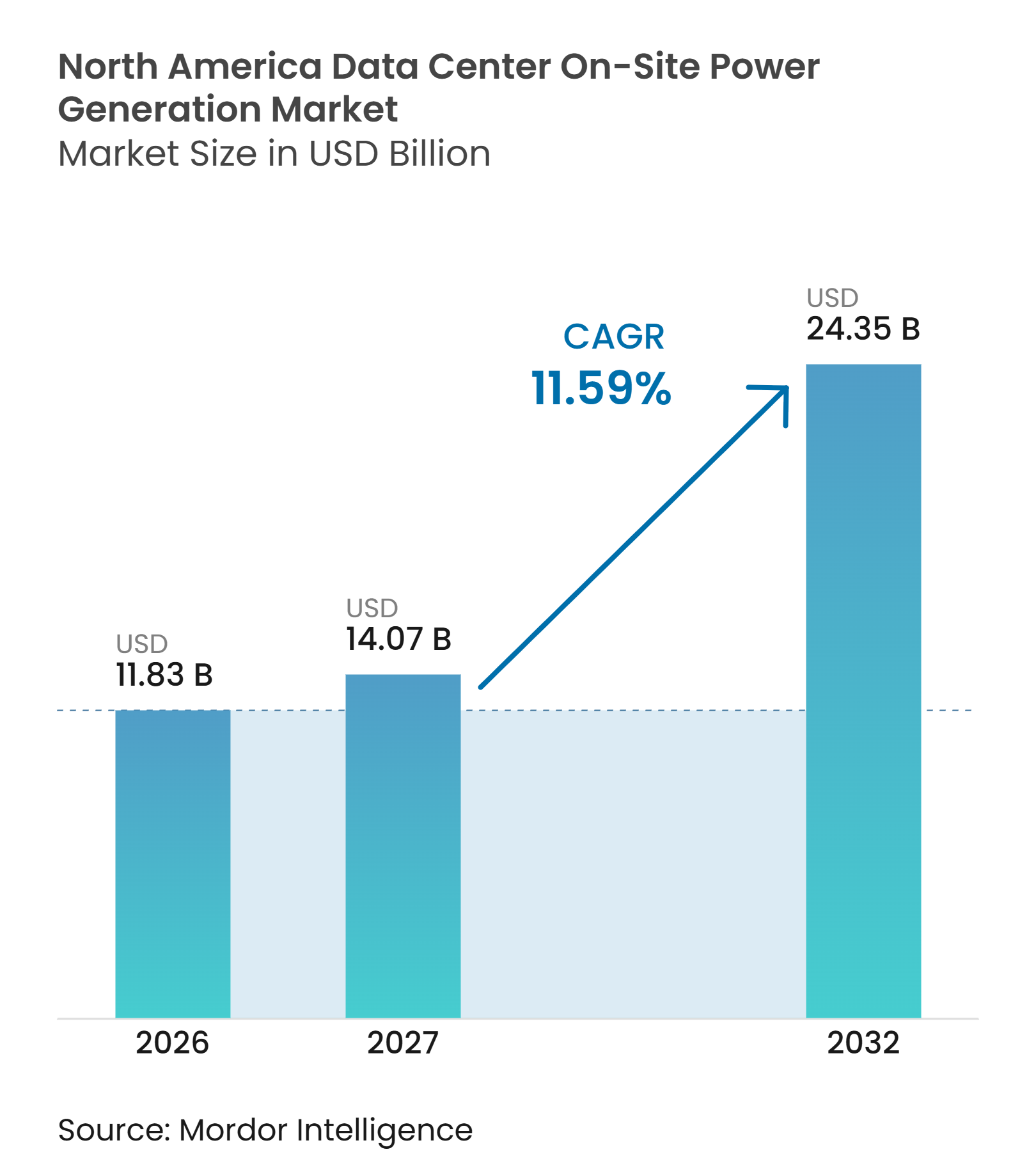
The North America Data Center On-Site Power Generation Market size was valued at USD 11.83 billion in 2026 and is estimated to grow from USD 14.07 billion in 2027 to reach USD 24.35 billion by 2032, at a CAGR of 11.59% during the forecast period (2027-2032). In terms of installed base, the market was valued at 38.51 million megawatt in 2026 and is expected to grow from 42.12 million megawatt in 2027 to 68.11 million megawatt by 2032, at a CAGR of 10.12% during the forecast period (2027-2032), which reflects the need for power that can be commissioned before permanent utility service is available. AI training and inference facilities are increasing power density and shifting site selection toward locations with reliable fuel access, available land, and workable permits. Grid connection delays have changed on-site equipment from an emergency safeguard into a primary part of project delivery, especially for large campuses. Equipment suppliers are responding with modular gas engines, fuel cells, batteries, and managed prime-power services that can be installed in stages. The North America data center on-site power generation market also faces tighter permitting, fuel infrastructure limits, and supply exposure for materials used in fuel-cell systems.
Key Report Takeaways
- By generation technology, diesel generator sets held 52.19% of the North America data center on-site power generation market share in 2026, while fuel cells are projected to expand at a 12.79% CAGR through 2032.
- By installed generation capacity, the 5-20 MW segment accounted for 33.34% of the market in 2026, while the above 20 MW segment is projected to expand at a 12.38% CAGR through 2032.
- By fuel type, diesel held 52.09% of the market in 2026 in the North America data center on-site power generation market, while hydrogen and hydrogen blends are projected to expand at a 12.56% CAGR through 2032.
- By application, emergency backup power accounted for 54.18% of the market in 2026, while temporary and bridge power is projected to expand at a 12.32% CAGR through 2032.
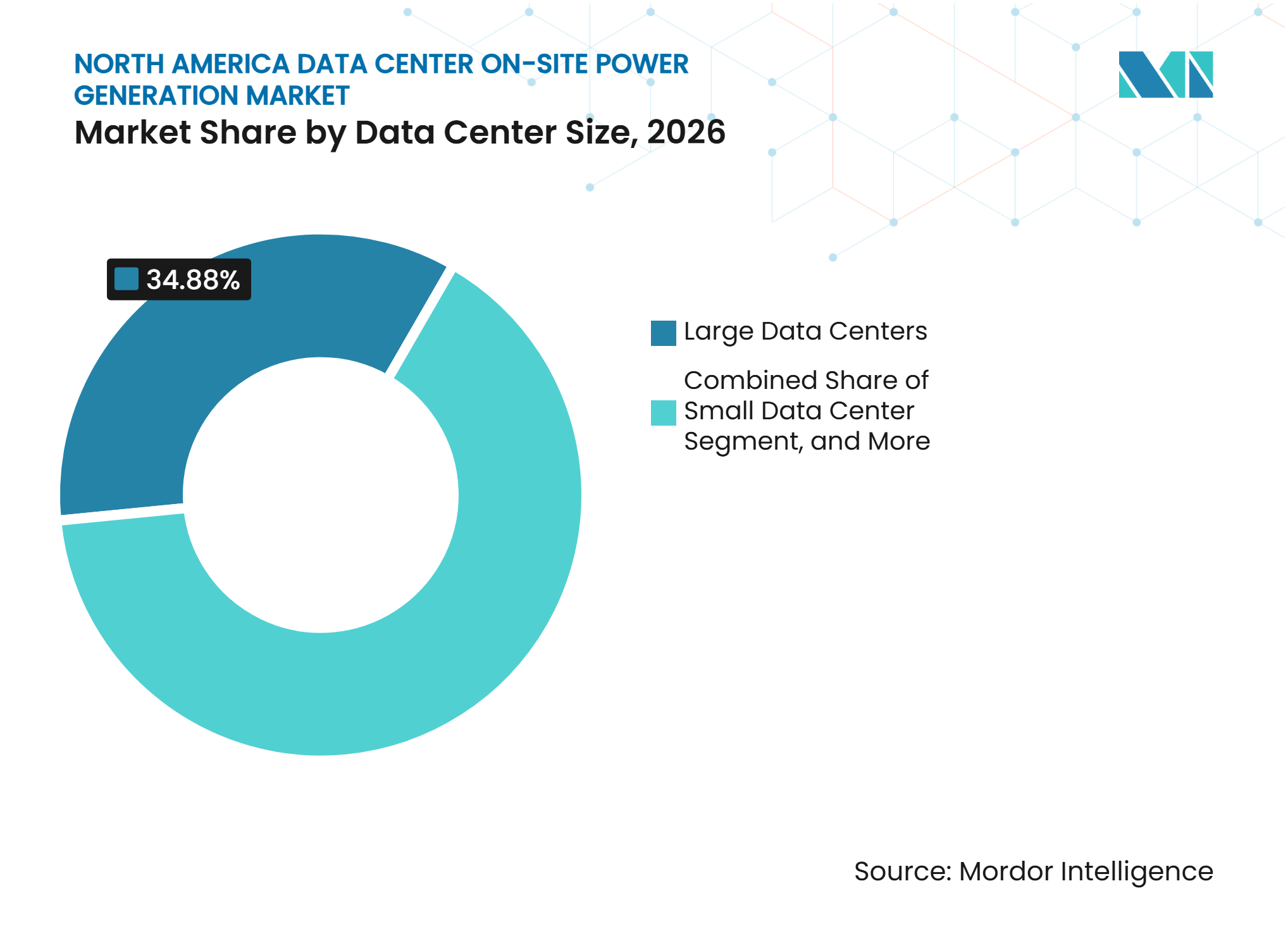
- By data center size, large data centers held 34.88% of the market in 2026, while hyperscale data centers are projected to expand at a 12.29% CAGR through 2032.
- By data center type, colocation operators held 36.17% of the market in 2026, while cloud service providers are projected to expand at a 12.17% CAGR through 2032.
- By geography, the United States held 88.34% of the market in 2026, while Canada is projected to expand at a 12.98% CAGR through 2032.
Note: Market numbers in this report are based on Mordor Intelligence's proprietary estimation framework, which combines nine months of actuals with Q4 projections for base year 2026.
Market Trends and Insights
Drivers Impact Analysis of North America Data Center On-Site Power Generation Market*
| Driver | (~) % Impact on CAGR Forecast | Geographic Relevance | Impact Timeline |
|---|---|---|---|
| AI and Hyperscale Data Center Load Growth | +3.5% | United States, Virginia, Texas, Illinois, and Canada, Alberta and Quebec | Short term (≤ 2 years) |
| Grid Interconnection Delays and Power Availability Constraints | +2.8% | United States, PJM and ERCOT, and Canada, Alberta and Ontario | Medium term (2-4 years) |
| Rising Adoption of Behind-the-Meter Prime Power | +1.5% | United States, Texas and the Southeast, with wider national adoption | Medium term (2-4 years) |
| Demand for High-Availability and Resilient Power Architectures | +1.2% | North America, with greater relevance for AI-density campuses | Medium term (2-4 years) |
| Federal and State Support for Lower-Carbon Distributed Generation | +0.8% | United States, including Virginia, Texas, and Nevada | Medium term (2-4 years) |
| Modular Deployment for Gigawatt-Scale Campus Expansion | +0.6% | United States, West Texas, Utah, the Southeast, and the Midwest | Medium term (2-4 years) |
| Source: Mordor Intelligence | |||
AI and Hyperscale Data Center Load Growth
New hyperscale facilities use racks rated at 150-300 kW, compared with 10-20 kW in conventional enterprise facilities. This operating profile increases the need for firm, high-quality electricity close to the campus. Capacity under construction across the Americas reached 37.7 GW in the second half of 2025, and 91.7% was precommitted before delivery.[1] These commitments raise the risk of delayed revenue when utility power is unavailable on the construction schedule. The North America data center on-site power generation market benefits when developers procure generation during the earliest site-planning stage. Demand favors systems that can add capacity without waiting for a single large utility interconnection.
Grid Interconnection Delays and Power Availability Constraints
Large data center campuses often face utility connection timelines of 3-6 years. A joint assessment by Camus Energy, Encoord, and Princeton University’s ZERO Lab found that flexible on-site generation can allow a 500 MW facility to begin operations 3-5 years sooner than conventional interconnection.[2] The same assessment found grid infrastructure savings of USD 78 million per GW of demand when flexible generation supports large loads. The North America data center on-site power generation market therefore addresses both construction timing and local grid investment constraints. FERC action requiring PJM to establish non-firm transmission pathways for large loads also supports hybrid power configurations. Developers can use those configurations to operate with on-site assets while utility service is developed.
Rising Adoption of Behind-the-Meter Prime Power
The order of power planning has changed for many new campuses. Developers increasingly secure prime power before they finalize a permanent grid connection. This approach reduces the risk that completed server halls remain unused because the utility supply is late. xAI energized its Memphis data center with modular reciprocating units within 122 days, showing why rapid deployment has become commercially important. Wärtsilä’s 790 MW Texas data center order in April 2026 also showed that reciprocating engines can serve large campuses when gas turbines are not available.[3] The North America data center on-site power generation market is gaining from this shift toward equipment that supports both early operation and later grid optionality.
Demand for High-Availability and Resilient Power Architectures
A voltage anomaly in Northern Virginia during July 2024 caused 60 data centers to disconnect simultaneously and removed 1,500 MW from the grid. The event showed the limits of relying on many separate emergency systems during a regional disturbance. AI workloads require stable voltage and power quality because dense GPU systems have limited tolerance for interruptions. Caterpillar and Joule Capital Partners planned a Utah campus with G3520K generator sets and 1.1 GWh of grid-forming battery storage. That design can operate as a quasi-microgrid rather than as a collection of isolated backup units. The North America data center on-site power generation market is consequently moving toward integrated controls, storage, generation, and switchgear.
Restraints Impact Analysis of North America Data Center On-Site Power Generation Market*
| Restraint | (~) % Impact on CAGR Forecast | Geographic Relevance | Impact Timeline |
|---|---|---|---|
| Emissions, Air-Quality, and Permitting Requirements | -1.8% | United States, with high relevance in Virginia, California, and Ohio | Long term (≥ 4 years) |
| Fuel Price and Fuel Supply Volatility | -1.2% | United States pipeline-constrained regions and Mexico | Medium term (2-4 years) |
| Scandium and Stack Supply Exposure in Solid Oxide Fuel Cells | -0.7% | United States, especially solid oxide fuel cell deployments | Long term (≥ 4 years) |
| Community Opposition Linked to Local Air, Noise, Water, and Land Impacts | -0.4% | United States, including Northern Virginia, suburban Texas, and New Mexico | Medium term (2-4 years) |
| Source: Mordor Intelligence | |||
Emissions, Air-Quality, and Permitting Requirements
The Clean Air Act requires preconstruction air permits for on-site plants that exceed major-source thresholds. Permit requirements vary by state, which creates different project timelines for similar facilities. Virginia’s DEQ managed 184 existing New Source Review permits and 21 active data center applications in November 2025. Most of those permits covered diesel standby engines rather than generation designed for long operating hours. EPA revised its standards in 2025 to create a temporary combustion-turbine category for units deployed for up to 24 months at one location. The relief is limited because permanent behind-the-meter plants still require full New Source Review, which can extend project timelines by 12-36 months.
Fuel Price and Fuel Supply Volatility
Natural gas can provide on-site prime power at a lower per-MWh cost than diesel. However, a 500 MW campus can create a gas load similar to that of a power plant. New pipeline laterals and compression may then be needed before the campus can operate at full output. This requirement reduces some of the speed advantage associated with self-supplied gas generation. Mexico faces added exposure because 2-thirds of its natural gas supply is imported from the United States. The North America data center on-site power generation market must therefore balance rapid gas-engine deployment against fuel delivery risk and price volatility.
*Our forecasts treat driver/restraint impacts as directional, not additive. The impact forecasts reflect baseline growth, mix effects, and variable interactions.
North America Data Center On-Site Power Generation Market Segment Analysis
By Generation Technology:
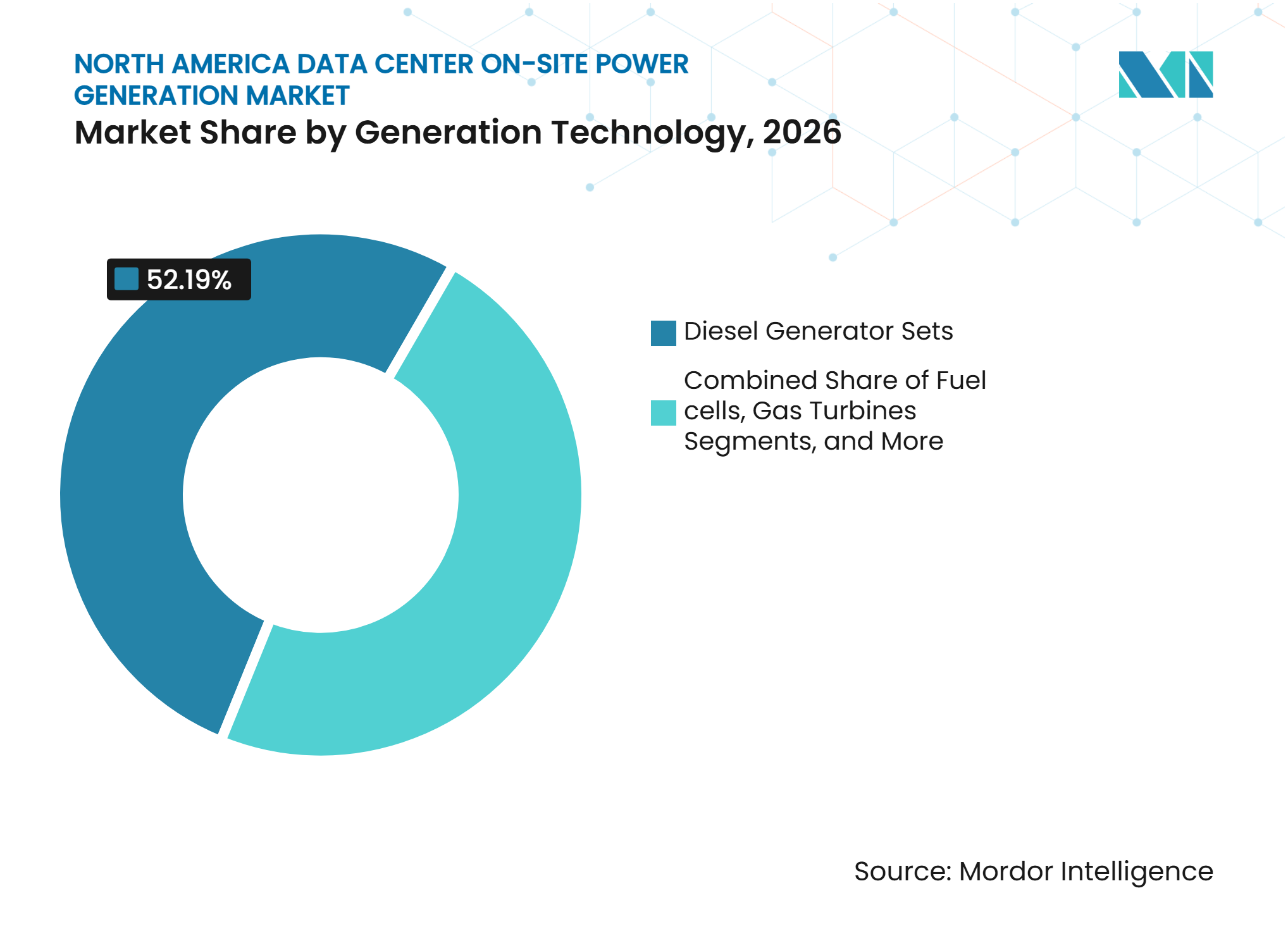
Diesel Incumbency Yields Ground to Fuel CellsDiesel generator sets commanded 52.19% of the North America data center on-site power generation market share in 2026. Their position reflects a large installed base of emergency fleets built across 3 decades. These units remain familiar to operators and are widely used for standby duty. Natural gas generator sets and reciprocating gas engines now receive a greater share of prime-power orders. Cummins expanded its natural gas portfolio with a 3.3 MW generator for large data center requirements. Gas turbines can supply gigawatt-scale baseload capacity. Their long delivery queues have created a practical opening for modular engine systems. The North America data center on-site power generation industry is therefore shifting from a backup-led equipment base toward a broader primary-power mix.
Fuel cells are projected to expand at a 12.79% CAGR through 2032. Their modular format is suited to phased campus development. A peer-reviewed 2026 assessment found that solid oxide fuel cells can achieve 50-60% net electrical efficiency. The study also noted deployment scales from 325 kW to 2.45 GW for planned installations. These characteristics support their use in continuous and primary-load applications. Fuel cells can operate on natural gas before hydrogen supply systems are fully available. Their adoption still depends on stack availability, material sourcing, and local air-permit conditions. The North America data center on-site power generation market gives fuel cells a growing role where lower local emissions and modular deployment matter.



By Installed Generation Capacity:
Gigawatt-Scale Builds Reshape the Upper BracketThe 5-20 MW range held 33.34% of the North America data center on-site power generation market in 2026. This range reflects conventional sizing for established enterprise and colocation facilities. It allows operators to install redundant generator sets across several data halls. The 1-5 MW range serves standardized colocation deployments with Tier III and Tier IV redundancy requirements. Capacities below 1 MW are more relevant for edge nodes and smaller distributed sites. These smaller systems rise with general information technology deployment. Their economics can be constrained because permitting and engineering costs do not fall in direct proportion to capacity. The market remains anchored in these established capacity bands even as larger campuses reshape procurement.
The above 20 MW range is projected to expand at a 12.38% CAGR through 2032. This reflects a move from facility-level backup toward campus-level prime power. VoltaGrid’s Qpac platform combines 20 MW reciprocating nodes into configurations of up to 200 MW. The platform is designed for delivery under a single minor-source air permit. That structure can simplify compliance for developers that need rapid, staged power. Caterpillar and Joule Capital Partners planned more than 4 GW of on-site generation for a Utah campus. This project illustrates how single-site requirements now exceed earlier commercial data center sizing. The North America data center on-site power generation market size for large capacity systems is supported by projects that require repeatable blocks rather than one large plant.
By Fuel Type:
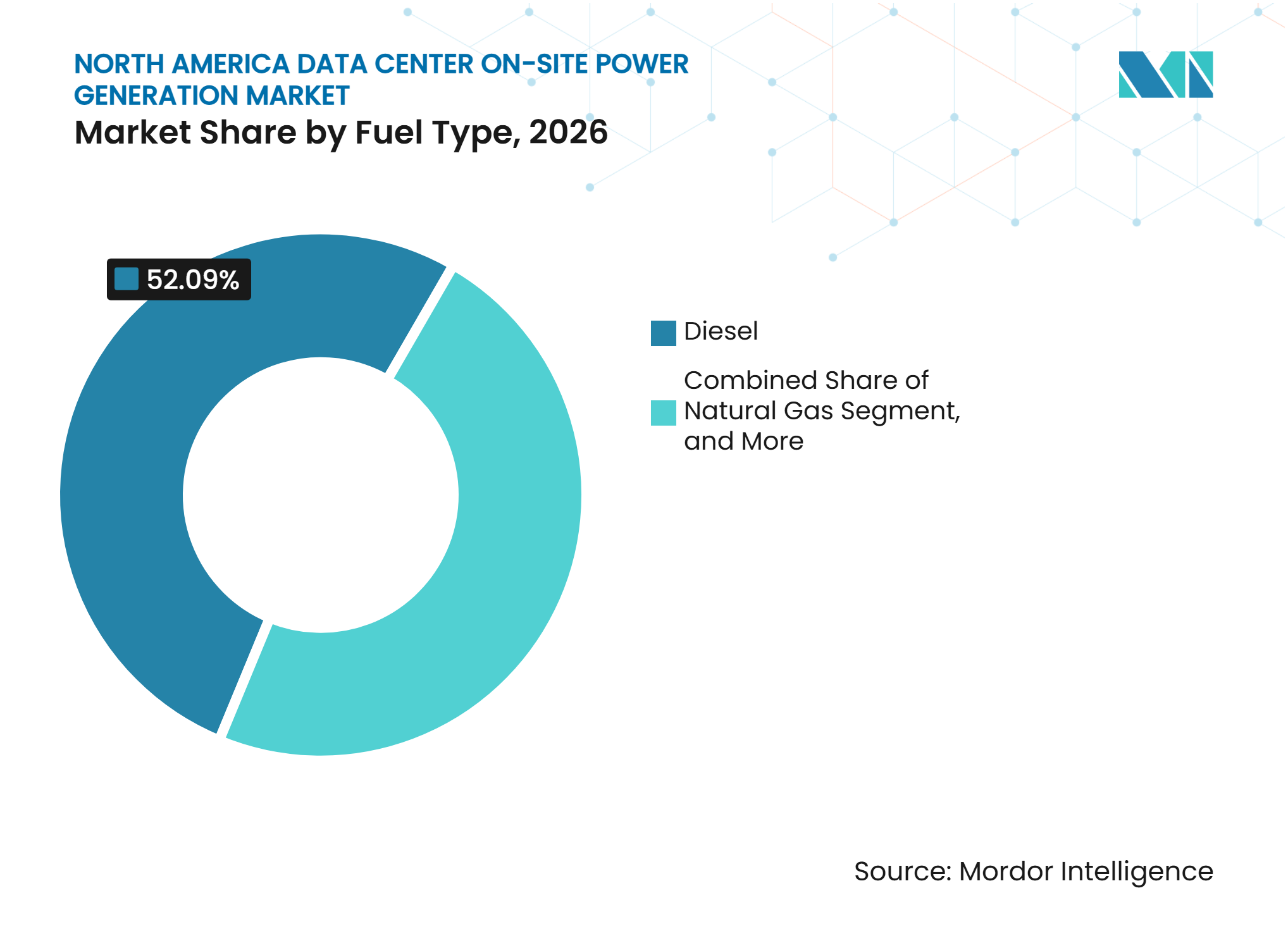
Hydrogen Blends Emerge as the Transition-Era HedgeDiesel accounted for 52.09% of the market in 2026. That share reflects operating backup fleets more than recent choices for new primary supply. Diesel remains valuable where fuel can be stored onsite and used during an outage. Natural gas is the common choice for new prime and bridge-power systems in Texas, Virginia, and the Midwest. It benefits from established pipeline networks and suitable reciprocating-engine technology. Renewable fuels and biogas offer alternatives where supply contracts and local emissions priorities align. Their use depends on reliable fuel availability at the individual site. The North America data center on-site power generation market retains diesel as the incumbent fuel while new investment moves toward gas-based systems.
Hydrogen and hydrogen blends are projected to expand at a 12.56% CAGR through 2032. They provide a transition path for fuel-cell systems installed initially on natural gas. Oracle chose to replace turbines and diesel generators with Bloom Energy fuel cells at Project Jupiter. The revised plan projected 92% lower nitrogen oxide emissions, and the New Mexico Environment Department accepted the application for public review in June 2026. A 72.9 MW solid oxide fuel-cell facility at Amazon’s Hilliard campus received state approval in September 2025. The City of Hilliard identifies the project as a fuel-cell development intended to support the campus. These projects indicate that fuel flexibility is becoming part of long-term power planning.

By Application:
Bridge Power Outpaces Backup as Grid Delays Restructure Use CasesEmergency backup power held 54.18% of the market in 2026. The segment remains large because existing data centers require standby capacity to meet availability commitments. Its share of new spending is declining as operators seek systems that run for longer periods. Prime power applications supply a substantial portion of a site’s regular electricity needs. Continuous power applications supply the full campus load from on-site assets. These applications require more durable equipment, fuel delivery planning, and air-permit preparation. The North America data center on-site power generation market is moving beyond equipment designed only for infrequent emergency use. This transition increases demand for service agreements and control systems that support regular operation.
Temporary and bridge power is projected to expand at a 12.32% CAGR through 2032. Developers use these systems for 2-4 years while permanent connections are built. Conduit Power and Prometheus Hyperscale agreed in September 2025 to deploy up to 300 MW of gas generators and batteries for 2 Texas data centers. The plan allows later grid interconnection without stranding the temporary assets. ECL’s MV-1 facility in Mountain View has operated on hydrogen fuel cells as its primary supply for more than 2 years. Bloom Energy also supplied more than 5 GWh during 2026 East Coast heat-wave grid stress events. The North America data center on-site power generation market thus supports temporary systems that can become part of a long-lived hybrid power architecture.
By Data Center Size:
Hyperscale Demand Anchors the Fastest-Growing CohortLarge facilities held 34.88% of the market in 2026. They represent an established middle tier that includes major colocation and enterprise campuses. These sites have enough scale to justify dedicated generation and redundancy designs. Small and medium facilities expand with enterprise information technology demand. Their smaller load can make the fixed cost of air permits less attractive. Hyperscale projects have different economics because a single campus can require hundreds of MW. Their developers can procure generation, storage, fuel service, and controls as an integrated package. The North America data center on-site power generation market serves each size band, but the largest projects shape equipment capacity and supply-chain choices.
Hyperscale facilities are projected to expand at a 12.29% CAGR through 2032. New sites are being developed in West Texas, Utah, Wyoming, and the Mountain West. These locations offer land, gas access, and distance from congested transmission corridors. A 2025 Data Center Frontier survey found that 61% of respondents selected sites primarily for power availability. This marks a departure from earlier priorities focused on fiber access and land cost. Primary-market net absorption reached 2,497.6 MW in 2025, and Northern Virginia accounted for 1,102 MW. The North America data center on-site power generation market benefits when hyperscale operators treat generation capability as a condition of site viability.
By Data Center Type:
Colocation Operators Lead, Cloud Service Providers Grow FastestColocation operators accounted for 36.17% of the market in 2026. Their contracts require reliable capacity for multiple tenants with different computing loads. On-site generation provides a direct way to support those availability obligations. Operators can also use generation plans to distinguish new projects in supply-constrained locations. Enterprise and edge deployments form a varied group of users. Financial institutions need strict power quality, while edge nodes prioritize local availability and low latency. This group uses a mix of standardized backup equipment and smaller distributed systems. The North America data center on-site power generation market is important to colocation providers because a delayed or unreliable power supply can limit tenant delivery.
Cloud service providers are projected to expand at a 12.17% CAGR through 2032. AWS, Microsoft Azure, and Google Cloud continue to develop large North American campus programs. Their procurement criteria extend beyond uptime because they also manage public emissions commitments. Fuel-cell systems and natural gas arrangements with carbon-management pathways can be more suitable than diesel-only systems for those commitments. The need for fast energization gives cloud providers a reason to use bridge power before utility capacity is available. Their scale also enables multiyear equipment and fuel agreements. The North America data center on-site power generation market will continue to compete on deployment speed, emissions performance, and the ability to support future grid connection. These criteria favor suppliers with integrated equipment, controls, and long-term service capacity.
Geography Analysis
The United States held 88.34% of the regional market in 2026. It has the region’s largest concentration of existing and planned data center capacity. Northern Virginia, Dallas, Silicon Valley, and Chicago remain important demand centers. Texas is attracting gigawatt-scale behind-the-meter projects because of its gas supply and deregulated power structure. State rules that allow curtailment of large grid loads during emergencies also support autonomous power options. Northern Virginia presents a contrasting case because its dense load base meets demanding air-permit requirements. Virginia’s active permit workload has redirected some prime-power interest toward Texas, the Midwest, and the Mountain West.
Canada is projected to expand at a 12.98% CAGR through 2032. Federal digital infrastructure commitments total CAD 4.4 billion (USD 3.17 billion) and support further data center investment. Alberta has exhausted capacity for large-load projects in some areas. Ontario transmission availability is also becoming more limited. Quebec’s hydropower-based system is facing rising demand from data center development. Microsoft has 0.41 GW under construction, while AWS has 0.16 GW of operational capacity. The North America data center on-site power generation market offers Canadian projects a bridge power option while interconnection queues are resolved.
Mexico held the smallest regional share in 2026. MEXDC reported 279 MW of installed capacity and 205 MW under construction during the year. The association expects national capacity to reach 1.73 GW by 2031 under its coordination agreement with Comisión Federal de Electricidad. Querétaro holds 75% of Mexico’s installed data center base. Banamex expects its information technology power capacity to rise from 200 MW to more than 1,300 MW. The added load equals 72% of the state’s 2025 peak demand. Mexico’s dependence on imported U.S. gas and its grid infrastructure gap make on-site systems important for large campuses. The North America data center on-site power generation market is therefore relevant to Mexico as a means of managing delayed grid access and fuel-delivery risk.
Competitive Landscape
Market Concentration
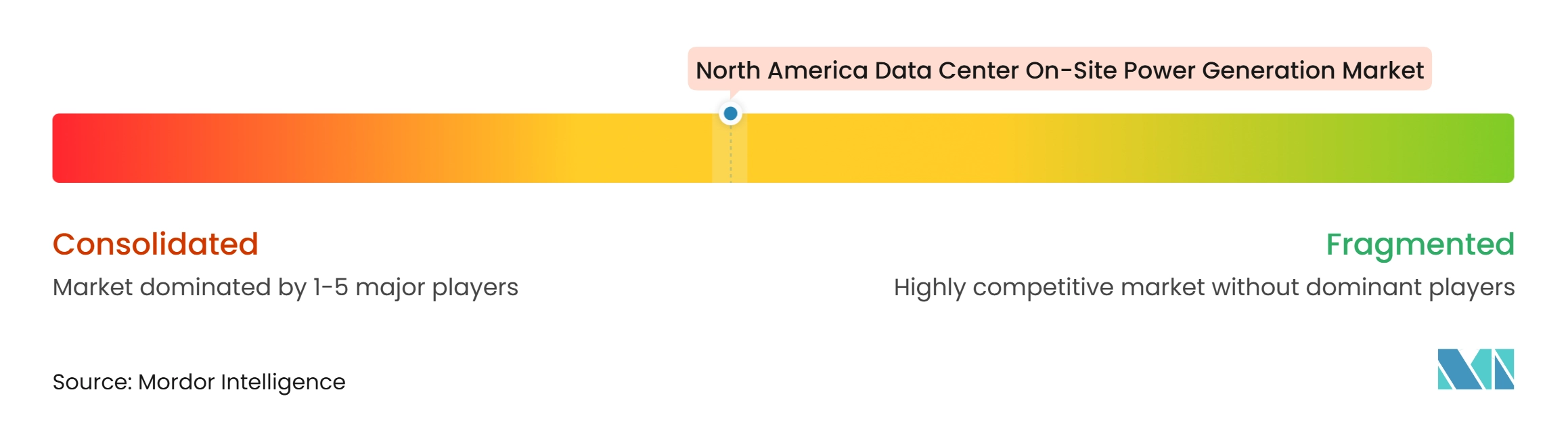
The North America data center on-site power generation market is moderately concentrated among equipment suppliers. Project development remains more fragmented because power solutions are designed around individual sites, fuel access, and permits. Caterpillar generated USD 3.2 billion in power generation revenue in the fourth quarter of its most recent fiscal year. Cummins sold USD 2.6 billion in power generation equipment to data centers in 2025. The company expected data center power-generation sales to expand by 30-35% in 2026. GE Vernova reported USD 2.4 billion in data center electrification orders during the first quarter of 2026. Rolls-Royce Power Systems reported 46% year-over-year data center revenue expansion in 2026.
Large suppliers are adapting their offerings from equipment transactions to managed power services. VoltaGrid structured its 2.3 GW Oracle agreement as a full-service modular power solution using INNIO Jenbacher technology. The approach gives the customer access to capacity without requiring management of every equipment interface. GE Vernova, Chevron, and Engine No. 1 formed a 2025 joint venture targeting up to 4 GW of co-located gas-fired generation for U.S. data centers. The move brings equipment, fuel, and power development capabilities into a single project structure. Oracle’s expansion of its Bloom Energy agreement to up to 2.8 GW in April 2026 shows the scale of committed fuel-cell procurement. Such agreements support suppliers with manufacturing capacity and established service organizations.
Fuel-cell suppliers compete on emissions performance, modularity, and domestic supply-chain positioning. Section 48E retains a 40% Investment Tax Credit for fuel cells, including a 10% domestic-content bonus identified by FuelCell Energy. The policy can improve the economics of lower-carbon distributed generation projects. Bloom Energy has a strong position in primary-load contracts for solid oxide fuel cells. Its reliance on scandium at larger production levels can create supply risk when material availability is limited. Caterpillar, Cummins, Wärtsilä, and INNIO compete more directly in gas- and diesel-engine deployments. The North America data center on-site power generation market remains competitive because operators can choose among engine, turbine, fuel cell, and hybrid designs.
North America Data Center On-Site Power Generation Industry Leaders
-
Caterpillar Inc.
-
Cummins Inc.
-
Generac Power Systems, Inc.
-
Bloom Energy Corporation
-
GE Vernova Inc.
- *Disclaimer: Major Players sorted in no particular order
North America Data Center On-Site Power Generation Market Companies Covered in this Report
- Caterpillar Inc.
- Cummins Inc.
- Generac Power Systems, Inc.
- Bloom Energy Corporation
- GE Vernova Inc.
- Rolls-Royce Holdings plc
- Mitsubishi Heavy Industries, Ltd.
- Wärtsilä Corporation
- Siemens Energy AG
- Schneider Electric SE
- Eaton Corporation plc
- Vertiv Holdings Co
- Rehlko, LLC
- MTU Onsite Energy GmbH
- Atlas Copco AB
- Ameresco, Inc.
- Hunt Energy Company, L.P.
- PowerSecure, Inc.
- Aggreko plc
- FuelCell Energy, Inc.
Recent Industry Developments in North America Data Center On-Site Power Generation Market
- June 2026: Bloom Energy and Brookfield Infrastructure expanded their fuel cell supply agreement from USD 5 billion to USD 25 billion, one of the largest distributed-energy contracts on record, anchoring Bloom's production ramp with long-term committed offtake and signaling institutional confidence in fuel cells as primary data center power infrastructure.
- June 2026: Oracle submitted an updated air quality permit application to the New Mexico Environment Department for Project Jupiter in Doña Ana County, replacing its prior gas turbine and diesel generator design with a Bloom Energy fuel cell microgrid, the updated plan projected 92% lower NOx emissions, and New Mexico deemed the application complete for public review.
- April 2026: Oracle expanded its Bloom Energy agreement to up to 2.8 GW of fuel cells over 4 years, with 1.2 GW already contracted and deploying, Bloom delivered the initial system 35 days ahead of schedule.
- April 2026: Wärtsilä secured a 790 MW natural gas engine order for a Texas data center, its largest single data center contract to date, using 42 Wärtsilä 50SG engines, pushing cumulative U.S. data center order volume above 2.4 GW.
North America Data Center On-Site Power Generation Market Report Scope
The North America Data Center On-Site Power Generation Market Report comprises solutions that enable data centers to generate electricity within or adjacent to their facilities to ensure reliable, resilient, and uninterrupted power supply. These systems support operational continuity by reducing dependence on external grids, mitigating power outage risks, and addressing growing energy demands from digital infrastructure. The market includes technologies designed for backup, primary, and continuous power generation, helping operators enhance energy security, optimize operational efficiency, support sustainability objectives, and meet the increasing power requirements of modern, high-density computing environments.
The North America Data Center On-Site Power Generation Market is Segmented by Generation Technology (Diesel Generator Sets, Natural Gas Generator Sets, Gas Turbines, Reciprocating Gas Engines, Fuel Cells, and Other Generation Technologies), Installed Generation Capacity (Below 1 MW, 1–5 MW, 5–20 MW, and Above 20 MW), Fuel Type (Diesel, Natural Gas, Renewable Fuels and Biogas, Hydrogen and Hydrogen Blends, and Other Fuel Types), Application (Emergency Backup Power, Prime Power, Continuous Power, and Temporary and Bridge Power), Data Center Size (Small, Medium, Large, and Hyperscale), Data Center Type (Colocation, Cloud Service Providers, and Enterprise and Edge), and Geography (United States, Canada, and Mexico). The Market Forecasts are Provided in Terms of Value (USD) and Volume (MW).
Segmentation Overview
| Diesel Generator Sets |
| Natural Gas Generator Sets |
| Gas Turbines |
| Reciprocating Gas Engines |
| Fuel Cells |
| Other Generation Technologies |
| Below 1 MW |
| 1-5 MW |
| Above 5-20 MW |
| Above 20 MW |
| Diesel |
| Natural Gas |
| Renewable Fuels and Biogas |
| Hydrogen and Hydrogen Blends |
| Other Fuels |
| Emergency Backup Power |
| Prime Power |
| Continuous Power |
| Temporary and Bridge Power |
| Small |
| Medium |
| Large |
| Hyperscale |
| Colocation |
| Cloud Service Providers (CSPs) |
| Enterprise and Edge |
| United States |
| Canada |
| Mexico |
| By Generation Technology | Diesel Generator Sets |
| Natural Gas Generator Sets | |
| Gas Turbines | |
| Reciprocating Gas Engines | |
| Fuel Cells | |
| Other Generation Technologies | |
| By Installed Generation Capacity | Below 1 MW |
| 1-5 MW | |
| Above 5-20 MW | |
| Above 20 MW | |
| By Fuel Type | Diesel |
| Natural Gas | |
| Renewable Fuels and Biogas | |
| Hydrogen and Hydrogen Blends | |
| Other Fuels | |
| By Application | Emergency Backup Power |
| Prime Power | |
| Continuous Power | |
| Temporary and Bridge Power | |
| By Data Center Size | Small |
| Medium | |
| Large | |
| Hyperscale | |
| By Data Center Type | Colocation |
| Cloud Service Providers (CSPs) | |
| Enterprise and Edge | |
| By Geography | United States |
| Canada | |
| Mexico |
Key Questions Answered in the Report
What is the size of the North America data center on-site power generation market?
The market is valued at USD 11.83 billion in 2026 and is expected to reach USD 24.35 billion by 2032 at an 11.59% CAGR. The forecast reflects higher demand for behind-the-meter capacity across backup, prime-power, bridge-power, and continuous-power deployments across regional markets throughout the forecast period.
What is driving on-site power demand at North American data centers?
AI workloads, delayed grid connections, and the need for reliable power are increasing demand for prime, bridge, and resilient on-site systems.
Which generation technology is expanding fastest?
Fuel cells are projected to expand at a 12.79% CAGR through 2032, supported by modular deployment and lower local emissions.
Why are data center operators using bridge power?
Bridge-power systems can allow a campus to operate while permanent utility interconnection is being completed, often over a 2-4 year period.
Which country leads regional demand?
The United States held 88.34% of regional demand in 2026, supported by its large installed data center base and growing hyperscale development.
Which fuel type has the strongest projected expansion?
Hydrogen and hydrogen blends are projected to expand at a 12.56% CAGR through 2032 as fuel-cell projects build flexibility for future supply changes.