
North America Data Center Insurance Market Size and Share
Market Overview
| Study Period | 2021 - 2032 |
|---|---|
| Forecast Data Period | 2027 - 2032 |
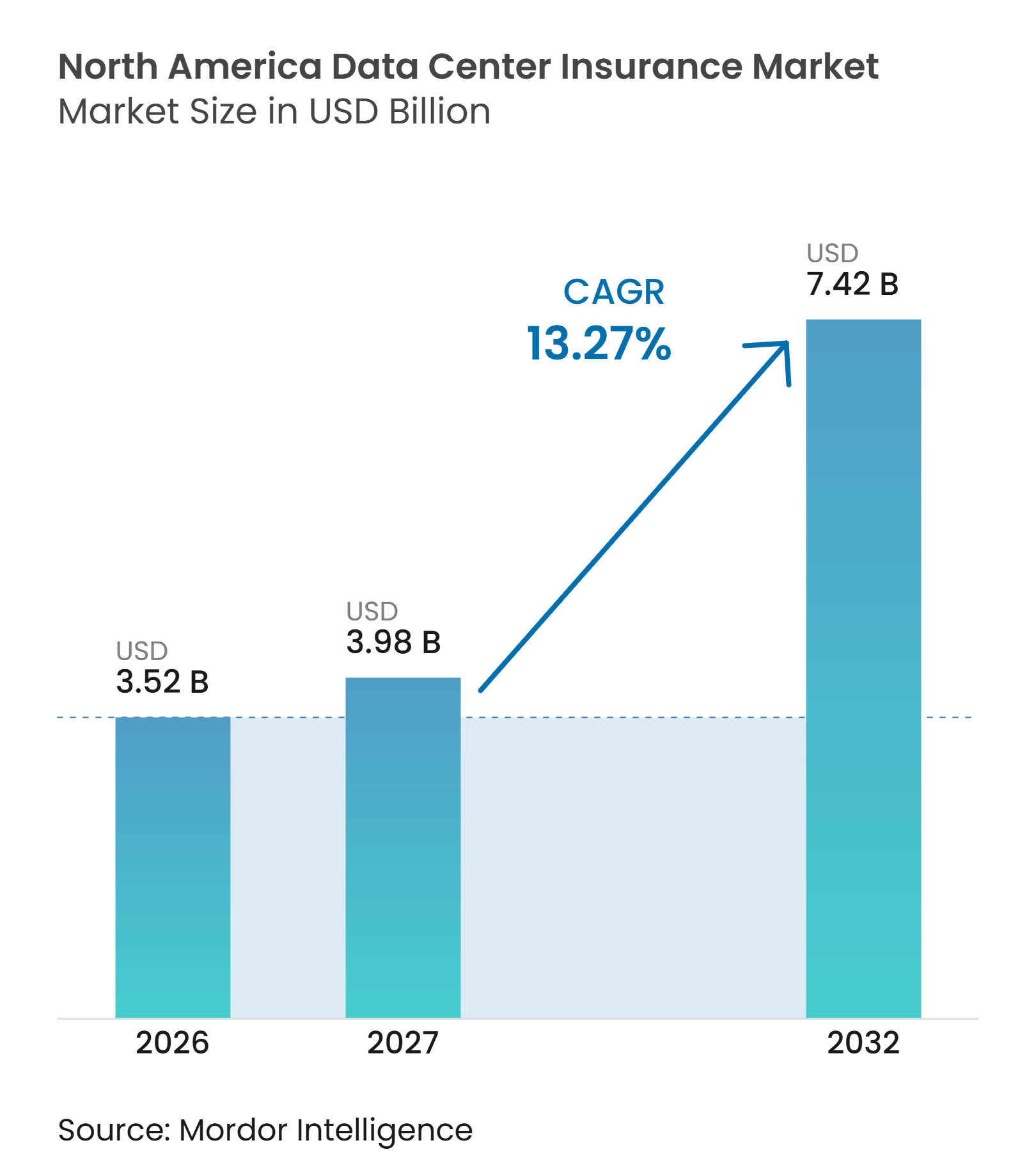
| Base Year Market Size (2026) | USD 3.52 Billion |
| Market Size (2027) | USD 3.98 Billion |
| Market Size (2032) | USD 7.42 Billion |
| Growth Rate (2027 - 2032) | 13.27 % |
| Market Concentration | Medium |
Major Players *Disclaimer: Major Players sorted in no particular order Image © Mordor Intelligence. Reuse requires attribution under CC BY 4.0. | |
North America Data Center Insurance Market Analysis by Mordor Intelligence
The North America data center insurance market size is valued at USD 3.52 billion in 2026 and is forecast to reach USD 7.42 billion by 2032, growing at a CAGR of 13.27% from 2027 to 2032. Larger AI and cloud facilities are moving data centers into the category of critical infrastructure, which is changing how lenders, owners, and insurers assess project risk. Construction values, equipment density, and reliance on continuous power are raising the amount of protection required during both construction and operations. The North America data center insurance market is also shifting toward coordinated programs that cover property damage, business interruption, cyber events, and construction delays. Limited high-limit capacity remains a practical constraint, particularly when a single campus requires coverage that exceeds the limits of any one insurer. These conditions create an opening for broker-led placements, captive structures, reinsurance, and parametric products.
Key Report Takeaways
- By insurance type, property damage insurance held 33.42% of the North America data center insurance market share in 2026, while cyber insurance is projected to expand at a 14.63% CAGR through 2032.
- By coverage structure, combined property and business interruption policies held 40.86% of the North America data center insurance market share in 2026, while parametric insurance is expected to grow at a 14.27% CAGR through 2032.
- By risk exposure, electrical and mechanical equipment failure accounted for 24.63% of the North America data center insurance market size in 2026, while cyber-related operational disruption is projected to advance at a 14.36% CAGR through 2032.
- By policyholder, data center owners and operators held 35.81% share in 2026, while cloud service providers are projected to expand at a 14.82% CAGR through 2032.
- By insurance distribution channel, insurance brokers and consultants held 56.48% share in 2026, while managing general agents and specialist underwriting agencies are expected to grow at a 14.61% CAGR through 2032.
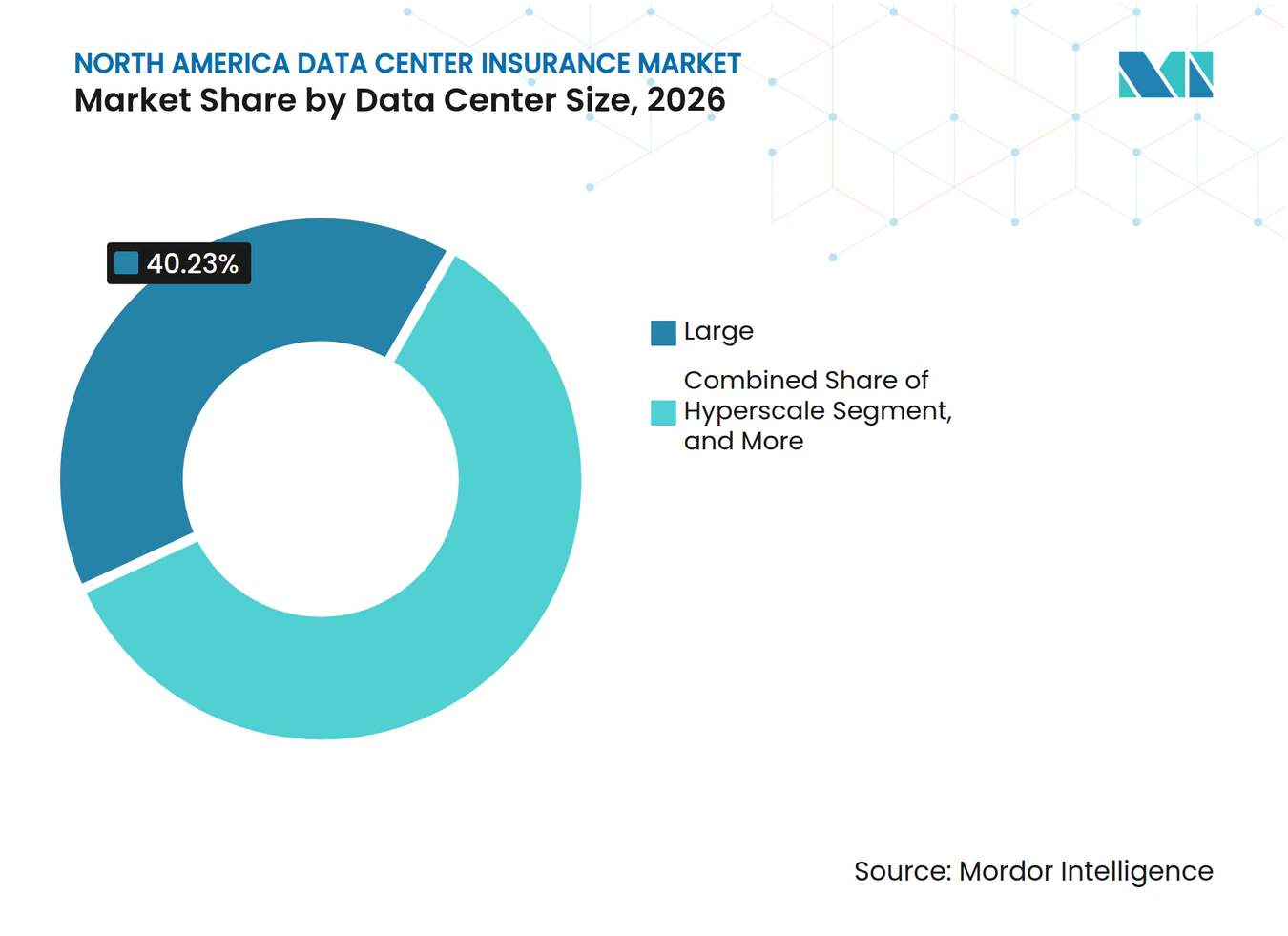
- By data center size, large data centers held 40.23% share in 2026, while hyperscale data centers are projected to expand at a 14.73% CAGR through 2032.
- By data center type, colocation data centers held 42.67% share in 2026, while cloud service provider facilities are expected to grow at a 14.52% CAGR through 2032.
- By geography, the United States held 87.46% share in 2026, while Mexico is projected to advance at a 14.49% CAGR through 2032.
Note: Market numbers in this report are based on Mordor Intelligence's proprietary estimation framework, which combines nine months of actuals with Q4 projections for base year 2026.
Market Trends and Insights
Drivers Impact Analysis of North America Data Center Insurance Market*
| Driver | (~) % Impact on CAGR Forecast | Geographic Relevance | Impact Timeline |
|---|---|---|---|
| AI and Cloud Computing Capacity Expansion | +4.2% | Global, concentrated in United States hyperscale corridors | Short term (≤ 2 years) |
| Hyperscale and Colocation Buildout | +3.3% | United States primary, Canada and Mexico emerging | Short term (≤ 2 years) |
| Rising Cyber and Data Privacy Exposure | +2.8% | United States and Canada, with spill-over to Mexico | Medium term (2-4 years) |
| Increasing Regulatory and Contractual Continuity Requirements | +1.5% | United States and Canada, Mexico financial sector | Medium term (2-4 years) |
| Grid Constraints and Behind-the-Meter Power Deployment | +1.1% | United States primary, expanding nationally | Long term (≥ 4 years) |
| Phased Handover and High-Density Cooling Complexity | +0.7% | United States hyperscale campuses and Canadian builds | Medium term (2-4 years) |
| Source: Mordor Intelligence | |||
AI and Cloud Computing Capacity Expansion
Cloud and AI investments are increasing the value of facilities that need to be insured. The five largest cloud providers are projected to spend more than USD 600 billion in 2026, with USD 450 billion directed to physical AI infrastructure in large data centers. Each new campus creates demand for construction, property, business interruption, and cyber coverage. Insurance capacity has become a financing requirement rather than a routine contractual item for many large projects. This moves insurers and brokers into project planning earlier, when technical information can still shape the risk profile. The North America data center insurance market benefits as new spending creates assets that were not previously insured.
Hyperscale and Colocation Buildout
Hyperscale and colocation construction is increasing both premium opportunities and the complexity of individual placements. Large campuses integrate power systems, cooling equipment, construction, and tenant obligations in a single location. A loss to a shared system can create property, liability, business interruption, and cyber claims simultaneously. Swiss Re highlights that the concentration of data center values makes accumulation a central underwriting issue. The North America data center insurance market, therefore, needs more layered programs and stronger engineering review. This also supports a larger role for reinsurance and specialist brokers.
Rising Cyber and Data Privacy Exposure
Cyber exposure is increasingly tied to the physical operations of data centers. The NAIC reported USD 9.46 billion in United States cyber direct written premiums during 2025, along with 56,323 reported claims, an increase of 20% from the prior year.[1] Power management, cooling, fire suppression, and access systems are increasingly connected to digital networks. An attack on those systems can disrupt physical operations as well as data services. NFPA notes that high-density AI facilities are creating safety questions that existing standards must address. This supports the demand for policies that address both cyber incidents and their operational effects.
Increasing Regulatory and Contractual Continuity Requirements
Project lenders increasingly require comprehensive insurance before funding a major data center. Cloud and colocation contracts also include service-level obligations that can create high costs after an outage. Standard policies may not respond quickly enough to a loss that does not involve physical damage. Tier ratings and infrastructure standards give insurers practical evidence of a site’s design and operating controls. This allows underwriters to distinguish between facilities with different resilience features. The North America data center insurance market is consequently moving toward coordinated coverage that follows the facility from construction through operations.
Restraints Impact Analysis of North America Data Center Insurance Market*
| Restraint | (~) % Impact on CAGR Forecast | Geographic Relevance | Impact Timeline |
|---|---|---|---|
| Limited High-Limit Insurance and Reinsurance Capacity | -1.2% | Global, most acute for United States hyperscale campuses | Short term (≤ 2 years) |
| Coverage Exclusions and Protection Gaps for Power and Cyber Losses | -0.9% | United States and Canada primary | Medium term (2-4 years) |
| Systemic Cloud Outage and Aggregation Risk | -0.6% | United States, with spill-over to Canada and Mexico | Long term (≥ 4 years) |
| Community, Environmental, and Permitting Litigation | -0.4% | United States and Mexico, Querétaro and Mexico City | Medium term (2-4 years) |
| Source: Mordor Intelligence | |||
Limited High-Limit Insurance and Reinsurance Capacity
Available insurance and reinsurance limits do not always match the value of the largest campuses. This issue is most severe when a project requires multiple insurers to support a single tower of coverage. Swiss Re identifies data center value accumulation as a growing issue for the insurance sector. Carriers can respond by tightening terms, increasing retentions, or limiting their exposure in a concentrated region. These actions may leave owners retaining a larger portion of the risk. The result is slower placement for the largest facilities, even where buyers are willing to pay for coverage.
Coverage Exclusions and Protection Gaps for Power and Cyber Losses
Traditional property and cyber policies were not designed around data centers with on-site power generation and dense AI hardware. Swiss Re notes that power and natural hazard exposures are becoming more material as facilities scale. A physical power failure may fall outside a cyber policy, whereas a property policy may include waiting periods before business interruption protection applies. Battery storage and liquid cooling add separate fire, water, and equipment risks. NFPA has also identified the need to manage safety risks in the development of AI data centers. These gaps can increase retained losses and complicate policy design.
*Our forecasts treat driver/restraint impacts as directional, not additive. The impact forecasts reflect baseline growth, mix effects, and variable interactions.
North America Data Center Insurance Market Segment Analysis
By Insurance Type:
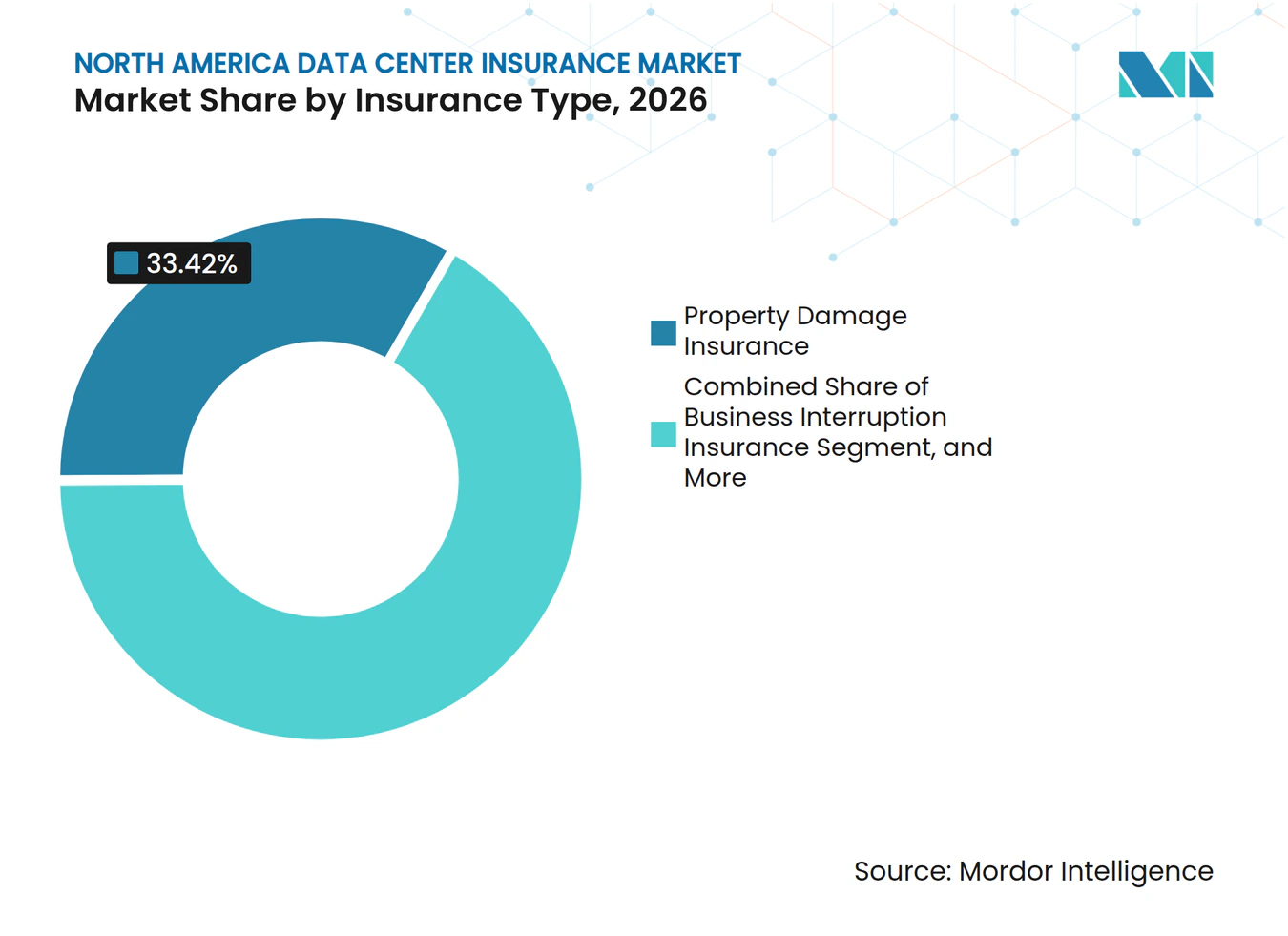
Property Damage Supports Current Premiums While Cyber Insurance GrowsProperty damage insurance held 33.42% of the North America data center insurance market share in 2026. It reflects the high replacement value of buildings, electrical infrastructure, cooling systems, and servers. Major facilities require coverage that addresses both loss of physical assets and the cost of restoring operations. Business interruption coverage remains closely linked because an outage can create substantial service and revenue consequences. Equipment breakdown coverage is also important as specialized computing equipment raises replacement costs and can lengthen repair periods. These conditions keep property damage at the center of current insurance spending.
Cyber insurance is projected to grow at a 14.63% CAGR through 2032. The segment is supported by the closer connection between information systems and operational technology. Cyber events can affect cooling, access control, power management, and fire protection controls. The NAIC found that cyber claims and direct written premiums remained substantial in the United States during 2025. Natural catastrophe, construction all-risk, liability, surety, and professional liability policies also remain necessary as part of a broader program. The mix of coverages reflects the range of risks that arise during construction and operations.



By Coverage Structure:
Combined Policies Lead While Parametric Products Gain UseCombined property and business interruption policies held 40.86% of the North America data center insurance market share in 2026. Lenders often require a coordinated response to physical damage and the income loss that follows the same event. The structure can reduce uncertainty between separate policies when a claim affects both equipment and operations. Standalone policies continue to serve facilities with simpler requirements. Package policies can provide a practical option for mid-sized operators who need multiple lines in a single arrangement. Captive and self-insurance programs remain relevant where commercial limits do not cover the full value of a campus.
Parametric insurance is expected to grow at a 14.27% CAGR through 2032. These policies can provide a defined payment upon an agreed-upon trigger, rather than relying on a conventional physical damage assessment. Descartes Underwriting introduced a suite for data center investors and operators in January 2026, with up to USD 140 million per policy for specified earthquake and hurricane risks in the United States. Zurich also introduced a builders' risk solution that includes parametric weather cover for eligible United States projects.[2] The approach can provide quicker liquidity when a weather event or delay disrupts a project. It is becoming a complement to traditional indemnity coverage rather than a replacement for it.
By Risk Exposure:
Equipment Failure Leads Today While Cyber Disruption AdvancesElectrical and mechanical equipment failure accounted for 24.63% of the North America data center insurance market size in 2026. Power systems, cooling units, uninterruptible power supplies, and related controls are critical to continuous operations. Their failure can stop services even when the broader facility has not sustained extensive damage. High-density computing increases the consequences of a cooling or power disruption. Fire, explosion, and water damage remain separate concerns because they can damage equipment and delay recovery. The risk profile requires insurers to review site design, maintenance practices, and emergency redundancy.
Cyber-related operational disruption is projected to advance at a 14.36% CAGR through 2032. This category includes events that begin digitally but cause a physical operating problem. A compromised building management system can affect cooling, fire suppression, or access functions. NFPA has stated that AI data center expansion is creating new safety management challenges. Supply chain interruptions are also relevant when specialized power and cooling components take longer to replace. These exposures encourage broader risk engineering and clearer coordination between cyber and property policies.
By Policyholder:
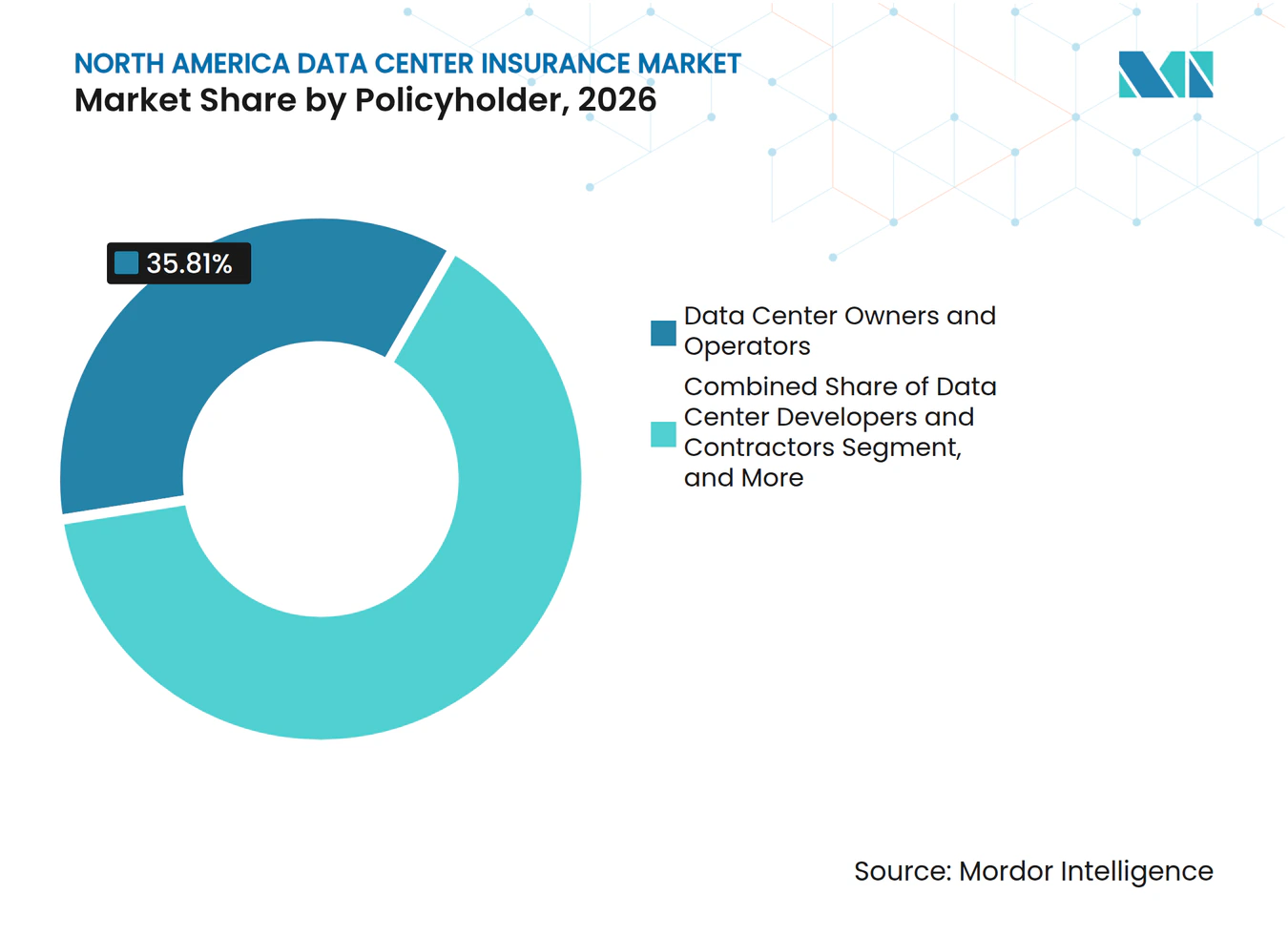
Owners and Operators Lead While Cloud Providers ExpandData center owners and operators held 35.81% of the North America data center insurance market share in 2026. They purchase coverage at the entity that owns the facility and carries the primary financing obligations. Their programs commonly include property protection, business interruption, liability, and construction coverage. Colocation operators require additional attention because a single facility may support many customers with varying service commitments. Developers and contractors need builders' risk and construction all-risk protection while a project is being delivered. These requirements sustain demand across the full development cycle.
Cloud service providers are projected to expand at a 14.82% CAGR through 2032. Their exposure grows when they own and operate campuses rather than relying only on third-party colocation capacity. Larger projects can exceed the level of loss that a firm would prefer to retain internally. Financing arrangements also increase the use of third-party insurance for some projects. The change supports lifecycle programs that can continue from site development through operations. Equipment and service providers also need specialized protection for the transport, storage, and installation of high-value computing equipment.

By Insurance Distribution Channel:
Brokers Lead While Specialist Agencies GrowInsurance brokers and consultants held 56.48% of the North America data center insurance market share in 2026. Large placements need coordination among carriers, reinsurers, engineers, lenders, and the insured. Brokers can organize the underwriting information needed for construction, property, cyber, and business interruption policies. Their role is particularly important when limits are layered across several carriers. Direct insurance remains more common for smaller facilities with standard property profiles. Reinsurance-supported programs help insurers provide capacity for larger and more complex risks.
Managing general agents and specialist underwriting agencies are expected to grow at a 14.61% CAGR through 2032. These firms can focus their underwriting knowledge on data center construction, power systems, and operational risks. Specialist capacity can also help the market respond to areas where broad-market carriers have limited appetite. Technical knowledge of fire protection, cooling, and regulatory obligations can improve the quality of a placement. The segment’s growth reflects demand for faster policy design and more focused risk selection. It also broadens the number of channels that can support the North America data center insurance market.
By Data Center Size:
Large Facilities Lead While Hyperscale Projects Redefine UnderwritingLarge data centers held 40.23% of the North America data center insurance market share in 2026. Their lead reflects the concentration of asset value in facilities with large power, cooling, and computing systems. Medium-sized sites serve regional enterprises, cloud workloads, and public-sector requirements with more standardized insurance needs. Small sites, including enterprise facilities and edge nodes, command lower premiums but may entail location-specific service risks. Equipment refresh cycles also create a valuation challenge across all facility sizes. AI hardware may become outdated more quickly than the building and utility systems that support it.
Hyperscale data centers are projected to grow at a 14.73% CAGR through 2032. Their construction periods can extend as projects become more complex and their power requirements rise. FM Global increased its data center capacity to USD 5 billion through FM Intellium in January 2026. The additional capacity underscores the need for insurers capable of supporting large facilities and their associated power systems. Behind-the-meter generation also adds concerns involving turbines, battery storage, fuel supply, and permitting. These projects require an underwriting approach that considers both energy infrastructure and information technology.
By Data Center Type:
Colocation Holds the Lead While Cloud Facilities Grow FastestColocation data centers held 42.67% of the North America data center insurance market share in 2026. The model places many customers and service commitments behind shared power, cooling, and security systems. A disruption at one shared system can affect multiple customers at once. This creates a combined exposure across property, business interruption, liability, and cyber coverages. Integrated programs can be useful because several insurance lines may respond to the same incident. Enterprise and edge facilities have lower absolute values but may be more sensitive to localized disruptions.
Cloud service provider facilities are projected to expand at a 14.52% CAGR through 2032. Owner-operated AI campuses increase the provider’s direct exposure to buildings, specialized power equipment, and computing assets. A provider operating adjacent buildings can also face concentration risk when sites share infrastructure. Swiss Re describes the accumulation risk created by concentrated data center values. The North America data center insurance market must therefore consider connections between sites, not only the design of a single building. Lifecycle coverage is increasingly relevant as these facilities move through development, commissioning, and operation.
Geography Analysis
The United States held 87.46% of the North America data center insurance market share in 2026. Its position reflects the concentration of hyperscale and colocation investment in major development corridors. Swiss Re identifies significant exposure to hail and tornado conditions across parts of the United States data center capacity.[3] Power and cooling failures remain important because they can lead to long business interruption losses. NFPA 75 and NFPA 855 influence property risk assessment for information technology equipment and battery energy storage systems. Insurers are moving toward programs that cover construction, commissioning, and operations because transition periods can create coverage gaps.
Mexico is projected to grow at a 14.49% CAGR from 2027 to 2032. New cloud and hyperscale projects are increasing the need for locally structured insurance programs. Data privacy and financial-sector cyber obligations increase attention to protecting facilities serving regulated workloads. The LFPDPPP framework and requirements affecting financial institutions are relevant compliance factors for buyers with sensitive data. Grid and water availability remain important site considerations as data center development accelerates. These conditions create demand for insurance structures that reflect local licensing, operational, and infrastructure requirements.
Canada is seeing larger proposed facilities, which is increasing the need for layered placements and reinsurance. Data sovereignty supports investment in domestic facilities for workloads that must remain in the country. Bell Canada announced a CAD 1.7 billion (USD 1.24 billion), in a 300-megawatt AI data center in Saskatchewan during 2026. The shift toward larger facilities creates a stronger need for property, business interruption, cyber, and construction protection. North America data center insurance market practices developed in the United States, including lifecycle programs and parametric products, are becoming relevant in Canada and Mexico. This provides a common direction for regional underwriting while local rules and infrastructure conditions continue to differ.
Competitive Landscape
Market Concentration
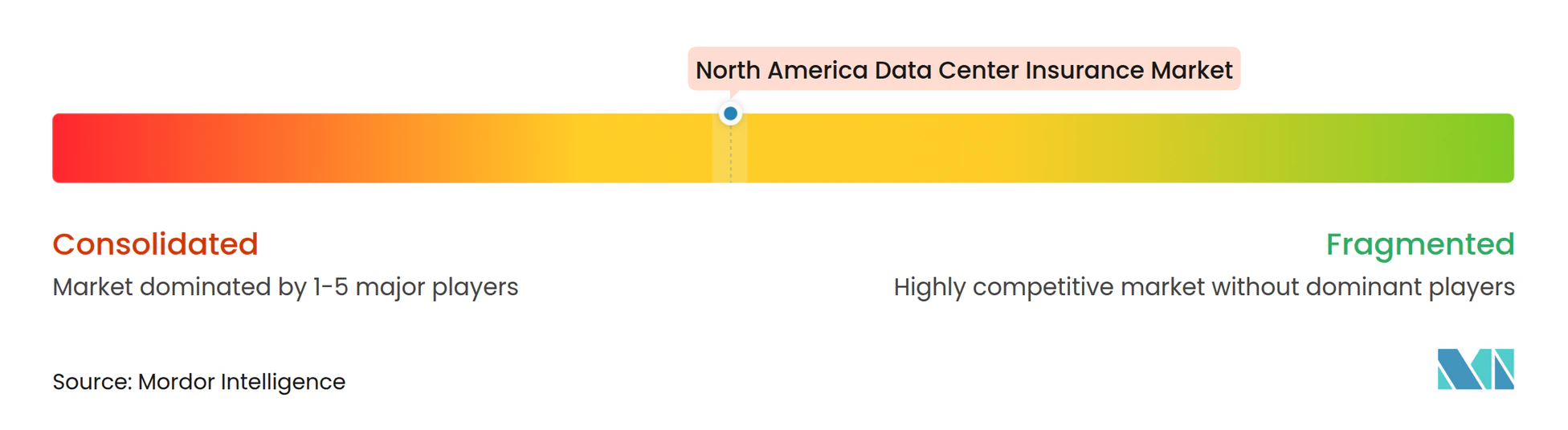
The North America data center insurance market has a limited group of global carriers and specialist providers, but major placements remain syndicated because no single insurer can cover every exposure at the largest campuses. FM Global differentiates its offering through risk engineering and the capacity available through FM Intellium. The company launched FM Intellium in 2025 for data center and power generation clients. Aon has built a lifecycle program that follows clients from construction to operations.[4] Its April 2026 expansion increased the program's total capacity to USD 3.5 billion.
Product design is becoming an important point of competition. Zurich North America has incorporated builders' risk and parametric weather protection into its Data Center Project Guard solution for eligible new projects. Descartes Underwriting has introduced parametric cover for defined natural-peril losses affecting data center investors and operators. These offerings focus on delays and other financial effects that traditional policies may not address quickly. Brokers remain important because complex campuses need several coverage lines, multiple insurers, and detailed engineering information. Competition is therefore based on capacity, technical knowledge, claims support, and the ability to maintain coverage through each project stage.
Capacity constraints leave room for captives, reinsurance, and parametric structures where commercial limits are insufficient. The need to manage connected campus risks also makes engineering-led selection more important than volume growth. Carriers are likely to remain selective where projects share substations, cooling systems, or local hazard exposure. Buyers benefit from early engagement with brokers and insurers because coverage can affect financing and construction schedules. The available evidence points to a competitive environment where capacity, engineering expertise, and placement structures matter more than price alone. Insurers and brokers can differentiate by helping clients close protection gaps before a large facility reaches operations.
North America Data Center Insurance Industry Leaders
-
Aon plc
-
American International Group, Inc.
-
Allianz SE
-
AXA S.A.
-
Berkshire Hathaway Inc.
- *Disclaimer: Major Players sorted in no particular order
North America Data Center Insurance Market Companies Covered in this Report
- Aon plc
- American International Group, Inc.
- Allianz SE
- AXA S.A.
- Berkshire Hathaway Inc.
- Chubb Limited
- FM Global
- Zurich Insurance Group Ltd
- The Travelers Companies, Inc.
- Liberty Mutual Holding Company Inc.
- CNA Financial Corporation
- QBE Insurance Group Limited
- Intact Financial Corporation
- Sompo Holdings, Inc.
- Tokio Marine Holdings, Inc.
- The Hartford Financial Services Group, Inc.
- W. R. Berkley Corporation
- Ryan Specialty Holdings, Inc.
- CRC Insurance Services, Inc.
- Lockton Companies, LLC
Recent Industry Developments in North America Data Center Insurance Market
- August 2026: Allianz Commercial published a claims analysis based on 221 data center insurance claims with total analyzed loss value of EUR 677 million (USD 771 million), finding that fire accounted for more than 50% of loss severity, water damage was the most frequent cause by claim volume, and business interruption was the primary driver of severity by insurance line. Real losses of USD 50 million to USD 100 million were confirmed at hyperscale facilities from cooling system damage, hot-works fires, and power disturbances.
- April 2026: Aon expanded its Data Center Lifecycle Insurance Program by an additional USD 1 billion, raising total capacity to USD 3.5 billion and extending coverage to existing data centers completing their first year of operations, the first lifecycle program in the market to provide coordinated coverage continuity into the long-term operational phase beyond construction and commissioning.
- January 2026: FM Global raised its data center coverage capacity to USD 5 billion through FM Intellium, the insurer's dedicated data center and power generation business unit, describing this as the largest single-carrier capacity then available in the data center insurance market.
- January 2026: Descartes Underwriting launched a parametric insurance suite for data center lenders, investors, and operators, covering property damage and non-damage financial losses from up to 20 natural perils. Capacity of up to USD 140 million per policy is available for earthquake and hurricane risks in the United States, providing delay-in-start-up liquidity without a physical damage trigger requirement.
North America Data Center Insurance Market Report Scope
The North America Data Center Insurance Market is a specialized sub-market of the broader commercial property and casualty (P&C) and cyber insurance sectors. It is classified as a financial service market focused on risk transfer and mitigation for critical digital infrastructure.
The North America Data Center Insurance Market Report is Segmented by Insurance Type (Property Damage Insurance, Business Interruption Insurance, Equipment Breakdown Insurance, Cyber Insurance, Natural Catastrophe Insurance, General and Third-Party Liability Insurance, Construction and Erection All-Risk Insurance, and Other Insurance Types), Coverage Structure (Standalone Policies, Combined Property and Business Interruption Policies, Package Policies, Parametric Insurance, and Captive and Self-Insurance Arrangements), Risk Exposure (Fire and Explosion, Electrical and Mechanical Equipment Failure, Power Supply Disruption, Flooding and Water Damage, Windstorms and Severe Weather, Earthquakes and Other Geophysical Hazards, Cyber-Related Operational Disruption, and Third-Party and Supply Chain Disruption), Policyholder (Data Center Owners and Operators, Colocation Providers, Cloud Service Providers, Data Center Developers and Contractors, and Data Center Equipment and Service Providers), Insurance Distribution Channel (Direct Insurance, Insurance Brokers and Consultants, Managing General Agents and Specialist Underwriting Agencies, and Reinsurance-Supported Insurance Programs), Data Center Size (Small, Medium, Large, and Hyperscale), Data Center Type (Colocation, Cloud Service Providers (CSPs), and Enterprise and Edge), and Geography (United States, Canada, and Mexico). The Market Forecasts are Provided in Terms of Value (USD).
Segmentation Overview
| Property Damage Insurance |
| Business Interruption Insurance |
| Equipment Breakdown Insurance |
| Cyber Insurance |
| Natural Catastrophe Insurance |
| General and Third-Party Liability Insurance |
| Construction and Erection All-Risk Insurance |
| Other Insurance Types |
| Standalone Policies |
| Combined Property and Business Interruption Policies |
| Package Policies |
| Parametric Insurance |
| Captive and Self-Insurance Arrangements |
| Fire and Explosion |
| Electrical and Mechanical Equipment Failure |
| Power Supply Disruption |
| Flooding and Water Damage |
| Windstorms and Severe Weather |
| Earthquakes and Other Geophysical Hazards |
| Cyber-Related Operational Disruption |
| Third-Party and Supply Chain Disruption |
| Data Center Owners and Operators |
| Colocation Providers |
| Cloud Service Providers |
| Data Center Developers and Contractors |
| Data Center Equipment and Service Providers |
| Direct Insurance |
| Insurance Brokers and Consultants |
| Managing General Agents and Specialist Underwriting Agencies |
| Reinsurance-Supported Insurance Programs |
| Small |
| Medium |
| Large |
| Hyperscale |
| Colocation |
| Cloud Service Providers (CSPs) |
| Enterprise and Edge |
| United States |
| Canada |
| Mexico |
| By Insurance Type | Property Damage Insurance |
| Business Interruption Insurance | |
| Equipment Breakdown Insurance | |
| Cyber Insurance | |
| Natural Catastrophe Insurance | |
| General and Third-Party Liability Insurance | |
| Construction and Erection All-Risk Insurance | |
| Other Insurance Types | |
| By Coverage Structure | Standalone Policies |
| Combined Property and Business Interruption Policies | |
| Package Policies | |
| Parametric Insurance | |
| Captive and Self-Insurance Arrangements | |
| By Risk Exposure | Fire and Explosion |
| Electrical and Mechanical Equipment Failure | |
| Power Supply Disruption | |
| Flooding and Water Damage | |
| Windstorms and Severe Weather | |
| Earthquakes and Other Geophysical Hazards | |
| Cyber-Related Operational Disruption | |
| Third-Party and Supply Chain Disruption | |
| By Policyholder | Data Center Owners and Operators |
| Colocation Providers | |
| Cloud Service Providers | |
| Data Center Developers and Contractors | |
| Data Center Equipment and Service Providers | |
| By Insurance Distribution Channel | Direct Insurance |
| Insurance Brokers and Consultants | |
| Managing General Agents and Specialist Underwriting Agencies | |
| Reinsurance-Supported Insurance Programs | |
| By Data Center Size | Small |
| Medium | |
| Large | |
| Hyperscale | |
| By Data Center Type | Colocation |
| Cloud Service Providers (CSPs) | |
| Enterprise and Edge | |
| By Geography | United States |
| Canada | |
| Mexico |
Key Questions Answered in the Report
What is the North America data center insurance market size?
The North America data center insurance market is valued at USD 3.52 billion in 2026 and is forecast to reach USD 7.42 billion by 2032 at a 13.27% CAGR.
What is driving demand for data center insurance in North America?
AI and cloud capacity expansion, larger campuses, cyber exposure, and lender requirements are expanding the need for property, business interruption, construction, and cyber protection.
Which insurance type has the largest share in North America?
Property damage insurance leads with 33.42% share in 2026 because physical buildings, power systems, cooling equipment, and servers carry significant replacement values.
Which coverage structure is growing fastest?
Parametric insurance is expected to grow at a 14.27% CAGR through 2032 because it can provide defined payments after a covered trigger.
Which country leads data center insurance demand in North America?
The United States leads with 87.46% share in 2026, supported by its concentration of hyperscale and colocation facilities.
Why do hyperscale data centers need specialized insurance programs?
Their concentrated values, shared infrastructure, high-density equipment, and long construction periods often require layered coverage, specialist engineering review, and reinsurance support.